Within Work Prep
Can Your Workspace Remember Tomorrow's Task?
Files, notes and strategically placed objects can carry intentions into tomorrow instead of leaving prospective memory to do all the work.
On this page
- Why future intentions are easy to forget
- Turning files, notes and objects into reminders
- Choosing cues that remain obvious when work resumes
Page outline Jump by section
Introduction
A workspace can do part of tomorrow’s remembering for you. Instead of ending the day with an unfinished task held mainly as a mental intention — “carry on with the analysis”, “send that document”, “check those figures” — you can encode the intention into something you are likely to encounter when work resumes: the open file, a note beside the relevant passage, an object placed somewhere unusual, or a deliberately positioned digital document.
Researchers call the broader strategy intention offloading: creating an external cue so that remembering a future action does not depend entirely on prospective memory. Reviews find that external reminders can substantially improve fulfilment of delayed intentions, particularly when memory load or distraction makes unaided remembering less dependable.[PubMed]pubmed.ncbi.nlm.nih.govPub Med Cognitive OffloadingCognitive Offloading - PubMedAugust 16, 2016…
The practical point is not that every unfinished task needs a reminder. It is that a well-designed workspace can preserve the thread of work across an overnight interruption. The best cue is noticeable when work resumes, connected to the task it represents, and specific enough to recover the intended next action without another round of reconstruction.
Why future intentions are easy to lose
Remembering something you have already learnt and remembering that you need to do something later are different problems. The latter is prospective memory: remembering to execute an intention when the appropriate time or situation arrives. Unlike an ordinary memory question, there may be nobody prompting you to retrieve the information. You have to notice that the moment for action has arrived and recover what you intended to do.[PubMed]pubmed.ncbi.nlm.nih.govFocal/nonfocal cue effects in prospective memory: monitoring difficulty or different retrieval processes? - PubMed…
That distinction matters when work crosses a boundary such as an evening, weekend or meeting. At 17:30, the significance of a spreadsheet, half-written paragraph or unresolved question may be completely obvious because its context is active in your mind. Tomorrow morning, you may remember the project while failing to retrieve the precise state in which you left it: which discrepancy mattered, what you had ruled out, or what you intended to try next.
Prospective-memory experiments also show why simply deciding to remember is an imperfect strategy. Remembering future intentions competes with whatever else occupies attention. In Sam Gilbert’s experiments on intention offloading, participants became more likely to create reminders when they had more intentions to hold in memory and when interruptions were introduced. Crucially, those were also circumstances in which unaided memory performed worse. Across four experiments involving 1,196 participants, setting external reminders improved performance.[PubMed]pubmed.ncbi.nlm.nih.govPub Med Strategic offloading of delayed intentions into the external environmentStrategic offloading of delayed intentions into the external environment - PubMedNovember 18, 2014…
More recent work reaches a similar conclusion for time-based intentions. In experiments where people had to remember an action while simultaneously performing a working-memory task, reminders increased accuracy and became more attractive as the delay grew longer.[Springer]link.springer.comStrategic reminder setting for time-based intentions: Influence of metacognition, delay length, and cue visibility | Memory & Cog…
This suggests a useful interpretation of end-of-day preparation. Leaving a cue is not merely organising the desk. It changes the memory problem. Rather than requiring tomorrow’s self to spontaneously retrieve an intention, the environment presents information capable of prompting retrieval.
Turning files, notes and objects into reminders
An external reminder works because some part of the intention is moved into the environment. The principle is broader than conventional alerts. Research on cognitive and intention offloading explicitly includes diaries, lists, sticky notes, digital alerts and strategically positioned physical objects.[Springer]link.springer.comOutsourcing Memory to External Tools: A Review of ‘Intention Offloading’ | Psychonomic Bulletin & Review | Springer Nature LinkJu…
A workspace therefore offers several natural places to store an unfinished intention.
Put the instruction where the work will happen. If a report is unfinished, a note inside the report saying “Next: reconcile Table 2 with the June spreadsheet” carries more useful information into tomorrow than a separate task saying “continue report”. For code, the equivalent might be a comment beside the failing function. For research, it could be a note attached to the source that still needs checking.
Use position as information. A document deliberately placed at the top of a working folder, a paper left on the keyboard or an item placed beside the bag that must leave with you can function as a cue because its location makes it difficult to encounter the workspace without encountering the reminder. Gilbert’s experimental intention-offloading paradigm deliberately models this idea: participants could reposition items in their environment so that their later location prompted the required action. The researchers compare the mechanism with placing an object by the front door so that it reminds you to take it when leaving.[PubMed Central (PMC)]pmc.ncbi.nlm.nih.govPubMed Central (PMC)Strategic offloading of delayed intentions into the external environment - PMC…
Preserve state as well as task identity. There is an important difference between remembering that a project is unfinished and recovering where to restart it. A workspace cue is especially useful when it captures the latter. “Budget” identifies a project; “Next: find why contractor costs differ by £4,800 between these two sheets” restores a working problem. That distinction follows from prospective-memory research separating the need to notice that an action is required from the need to remember what that action is.[PubMed Central (PMC)]pmc.ncbi.nlm.nih.govPubMed Central (PMC)Strategic offloading of delayed intentions into the external environment - PMC…
A useful cue can therefore contain both components: the trigger and the action. “When I reopen this file, check the July total against invoice 184” does more than record information. It links the situation tomorrow will present with the behaviour you want that situation to elicit.
That resembles an implementation intention, an if-then plan linking a specified future cue with an intended response. Research has repeatedly found that such encoding can improve prospective remembering, apparently in part by strengthening the association between cue and response.[PubMed]pubmed.ncbi.nlm.nih.govImplementation intentions facilitate prospective memory under high attention demands - PubMedJune 1, 2008… The effect should not be overstated as perfectly automatic: experiments have also found that implementation intentions do not eliminate performance losses under heavy cognitive demands.[DOI]doi.orgOpen source on doi.org. The safer conclusion is that a strong cue-action link helps retrieval; it does not make attention irrelevant.

What makes a workspace cue hard to miss?
The temptation is to equate an effective reminder with a conspicuous reminder. Prospective-memory research suggests a more useful distinction: what matters is not merely whether a cue is visually striking, but whether normal activity directs attention towards the feature that carries the intention.
Research comparing focal and non-focal prospective-memory cues illustrates this. A focal cue is processed naturally as part of what someone is already doing; a non-focal cue requires attention to a feature that the ongoing activity would not otherwise emphasise. Experiments have found that focal cues can support relatively strong prospective remembering without the same degree of continual monitoring demanded by non-focal cues.[PubMed]pubmed.ncbi.nlm.nih.govFocal/nonfocal cue effects in prospective memory: monitoring difficulty or different retrieval processes? - PubMed… Other work indicates that simply increasing visual salience is not equivalent to making a cue focal to the activity.[ScienceDirect]sciencedirect.comOpen source on sciencedirect.com.
For workspace design, that points towards encounter probability, not decoration, as the central criterion. A reminder is strong when resuming work naturally brings you into contact with it.
A sticky note buried among twelve other sticky notes may be colourful yet weak. A sentence at the exact point where you will resume writing may be visually modest yet extremely well placed. Likewise, an open browser tab can be a poor reminder if you routinely return to dozens of tabs, whereas putting the required document in the project’s obvious starting location may make encountering it almost unavoidable.
Three questions are particularly useful when leaving a cue:
- Will I encounter it naturally? Put the cue on tomorrow’s path into the task rather than somewhere you must remember to check.
- Will I understand it without reconstructing today’s context? “Check this” is fragile; “Check whether the 12 July invoice explains the £4,800 difference” carries its own context.
- Does it point to an action? A cue should ideally make the first behaviour apparent, rather than merely announce that unfinished work exists.
This also explains why deliberately unusual object placement can work. A notebook sitting in its normal storage place contains little new information. The same notebook positioned across the keyboard can acquire signalling value because its location violates expectation. But that advantage depends on preserving the signal. If the desk is routinely covered with displaced objects, unusual placement ceases to be unusual.
Do not turn the workspace into a reminder wall
Intention offloading is effective, but more offloading is not automatically better. Creating and maintaining reminders has costs, and research finds that people make trade-offs between the effort or cost of setting reminders and the expected memory benefit.[Springer]link.springer.comOutsourcing Memory to External Tools: A Review of ‘Intention Offloading’ | Psychonomic Bulletin & Review | Springer Nature LinkJu… A workspace covered in cues also creates a practical problem: every item competes to be treated as significant.
The aim is therefore not to externalise every future intention. Workspace cues are most valuable for intentions that are both easy to lose and useful to recover immediately: the unresolved question in a document, the file required for the first task, the physical item that must leave the office, or the exact next operation in a complicated piece of work.
There is another reason to be selective. Research suggests that reminder setting is partly metacognitive: people decide whether to offload according not only to their actual memory performance but also to their beliefs and confidence about how well they will remember. Those judgements can be imperfect.[Springer]link.springer.comOutsourcing Memory to External Tools: A Review of ‘Intention Offloading’ | Psychonomic Bulletin & Review | Springer Nature LinkJu… A 2024 study extending this work to real-world intentions likewise found evidence that metacognition helps guide whether people create reminders for their plans.[PubMed]pubmed.ncbi.nlm.nih.govOpen source on nih.gov.
A sensible rule is therefore to use cues where tomorrow would otherwise require significant retrieval or reconstruction, not simply wherever a reminder can be added. The scarce resource is not sticky notes or digital annotations; it is the ability of a cue to stand out as meaningful when it matters.
Preserve the thread, not the whole plan
There is a subtle benefit to recording the next action before stopping. Unfinished goals can remain mentally active after work has ceased. In experiments by E. J. Masicampo and Roy Baumeister, unfulfilled goals produced intrusive thoughts and interference with unrelated activities. Allowing participants to make specific plans for those goals reduced these effects.[PubMed]pubmed.ncbi.nlm.nih.govOpen source on nih.gov.
That finding should not be stretched into a claim that leaving a sticky note will reliably stop work-related rumination; the experiments studied plan making rather than workspace arrangement itself. But it supports the underlying logic of making an unfinished intention concrete before disengaging. You do not need to keep rehearsing “remember where I was” if the information needed for resumption has been captured somewhere dependable.
This is where workspace cues fit particularly well within preparation for tomorrow. The objective is not a comprehensive evening planning system. It is a small transfer of responsibility from memory to environment.
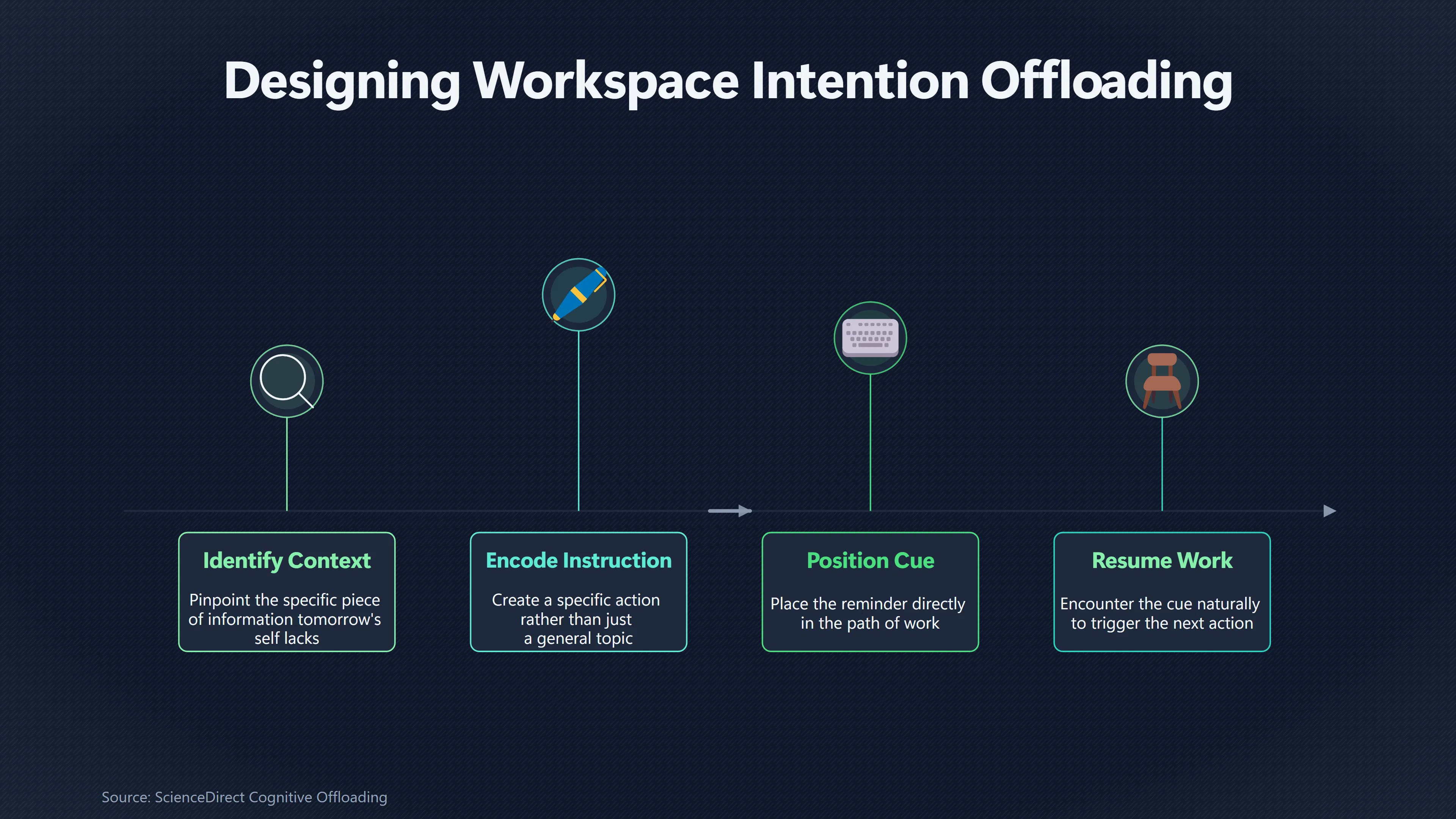
Before stopping, identify the piece of context that tomorrow’s self is most likely to lack. Put that information at the point where tomorrow’s work will resume. If necessary, reposition the relevant file or object so encountering it becomes part of starting work. Then make the cue specific enough to recover an action rather than merely a topic.
The resulting workspace acts less like storage and more like a handover. Today’s working memory leaves tomorrow a visible instruction: this is where you were, and this is what happens next.
Amazon book picks
Further Reading
Books and field guides related to Can Your Workspace Remember Tomorrow's Task?. Use these as the next step if you want deeper reading beyond the article.
Getting Things Done
The personal productivity guru (Fast Company) delivers powerful methods that vastly increase your efficiency and creative results-at work...
Atomic Habits
Rating: 3.5/5 from 7 Google Books ratings
The #1 New York Times bestseller. Over 25 million copies sold! Translated into 60+ languages! Tiny Changes, Remarkable Results No matter...
The Organized Mind
'Thought-provoking and practical ... Good advice based on sound neuroscientific principles' Sunday Times In The Organized Mind, New York...
The Checklist Manifesto
THE GAME-CHANGING BOOK FROM THE BESTSELLING AUTHOR OF BEING MORTAL Today we find ourselves in possession of stupendous know-how, which we...
eBay marketplace picks
Marketplace Samples
Live-tested eBay searches with available results related to this page.
Selected fromoffice desk accessories oneBay.co.uk.
Endnotes
1.
Source: link.springer.com
Link:https://link.springer.com/article/10.3758/s13421-025-01708-x
Source snippet
Strategic reminder setting for time-based intentions: Influence of metacognition, delay length, and cue visibility | Memory & Cog...
2.
Source: link.springer.com
Link:https://link.springer.com/article/10.3758/s13423-022-02139-4
Source snippet
Outsourcing Memory to External Tools: A Review of ‘Intention Offloading’ | Psychonomic Bulletin & Review | Springer Nature LinkJu...
3.
Source: doi.org
Link:https://doi.org/10.3758/MC.38.2.221
4.
Source: sciencedirect.com
Link:https://www.sciencedirect.com/science/article/abs/pii/S0001691817301580
5.
Source: sciencedirect.com
Title: ScienceDirect Cognitive Offloading
Link:https://www.sciencedirect.com/science/article/abs/pii/S1364661316300985
6.
Source: sciencedirect.com
Link:https://www.sciencedirect.com/science/article/pii/S030105112600147X
7.
Source: link.springer.com
Link:https://link.springer.com/article/10.1007/s10339-024-01190-4
8.
Source: link.springer.com
Link:https://link.springer.com/article/10.3758/s13421-024-01529-4
9.
Source: link.springer.com
Link:https://link.springer.com/article/10.1007/s00426-023-01834-8
10.
Source: doi.org
Link:https://doi.org/10.3758/s13423-022-02139-4
11.
Source: sciencedirect.com
Link:https://www.sciencedirect.com/science/article/pii/S0885201417302241
12.
Source: doi.org
Title: Cognitive Offloading: Trends in Cognitive Sciences
Link:https://doi.org/10.1016/j.tics.2016.07.002
13.
Source: sciencedirect.com
Link:https://www.sciencedirect.com/science/article/pii/S0165178115000360
14.
Source: sciencedirect.com
Link:https://www.sciencedirect.com/science/article/abs/pii/S0165178115000360
15.
Source: sciencedirect.com
Title: Unfulfilled goals interfere with tasks that require executive functions
Link:https://www.sciencedirect.com/science/article/pii/S0022103110002283
16.
Source: sciencedirect.com
Title: Unfulfilled goals interfere with tasks that require executive functions
Link:https://www.sciencedirect.com/science/article/abs/pii/S0022103110002283
17.
Source: sciencedirect.com
Link:https://www.sciencedirect.com/science/article/abs/pii/S0065260106380021
18.
Source: sciencedirect.com
Link:https://www.sciencedirect.com/science/chapter/bookseries/abs/pii/S0065260106380021
19.
Source: sciencedirect.com
Title: The age-prospective memory-paradox: an exploration of possible mechanisms
Link:https://www.sciencedirect.com/science/article/pii/S1041610224029089
20.
Source: sciencedirect.com
Link:https://www.sciencedirect.com/science/article/abs/pii/S002210310600028X
21.
Source: sciencedirect.com
Title: Interfered by unaccomplished academic tasks: The role of success expectations
Link:https://www.sciencedirect.com/science/article/abs/pii/S0023969021000576
22.
Source: sciencedirect.com
Link:https://www.sciencedirect.com/science/article/pii/S0022096525000499
23.
Source: sciencedirect.com
Link:https://www.sciencedirect.com/science/article/abs/pii/S1053810020300179
24.
Source: sciencedirect.com
Link:https://www.sciencedirect.com/science/article/pii/S0028393217300544
25.
Source: youtube.com
Title: What Is Prospective Memory and Why Does It Matter for Patient Care?
Link:https://www.youtube.com/watch?v=FF95zqTS8lU
Source snippet
Prospective memory...
26.
Source: youtube.com
Title: Prospective memory
Link:https://www.youtube.com/watch?v=7a8ZsNaq-V0
Source snippet
For practical strategies on reducing memory load, Remembering to remember: prospective memory examines how outsourcing intentions to phys...
27.
Source: pubmed.ncbi.nlm.nih.gov
Title: Pub Med Cognitive Offloading
Link:https://pubmed.ncbi.nlm.nih.gov/27542527/
Source snippet
Cognitive Offloading - PubMedAugust 16, 2016...
Published: August 16, 2016
28.
Source: pmc.ncbi.nlm.nih.gov
Link:https://pmc.ncbi.nlm.nih.gov/articles/PMC9971128/
Source snippet
PubMed Central (PMC)Outsourcing Memory to External Tools: A Review of ‘Intention Offloading’ - PMC...
29.
Source: pubmed.ncbi.nlm.nih.gov
Link:https://pubmed.ncbi.nlm.nih.gov/20438269/
Source snippet
Focal/nonfocal cue effects in prospective memory: monitoring difficulty or different retrieval processes? - PubMed...
30.
Source: pmc.ncbi.nlm.nih.gov
Link:https://pmc.ncbi.nlm.nih.gov/articles/PMC4448673/
Source snippet
PubMed Central (PMC)Strategic offloading of delayed intentions into the external environment - PMC...
31.
Source: pubmed.ncbi.nlm.nih.gov
Title: Pub Med Strategic offloading of delayed intentions into the external environment
Link:https://pubmed.ncbi.nlm.nih.gov/25404057/
Source snippet
Strategic offloading of delayed intentions into the external environment - PubMedNovember 18, 2014...
Published: November 18, 2014
32.
Source: pubmed.ncbi.nlm.nih.gov
Link:https://pubmed.ncbi.nlm.nih.gov/18604955/
Source snippet
Implementation intentions facilitate prospective memory under high attention demands - PubMedJune 1, 2008...
Published: June 1, 2008
33.
Source: pubmed.ncbi.nlm.nih.gov
Link:https://pubmed.ncbi.nlm.nih.gov/20173194/
34.
Source: pmc.ncbi.nlm.nih.gov
Link:https://pmc.ncbi.nlm.nih.gov/articles/PMC2864946/
35.
Source: pmc.ncbi.nlm.nih.gov
Link:https://pmc.ncbi.nlm.nih.gov/articles/PMC11103908/
36.
Source: pubmed.ncbi.nlm.nih.gov
Link:https://pubmed.ncbi.nlm.nih.gov/39023988/
37.
Source: pubmed.ncbi.nlm.nih.gov
Link:https://pubmed.ncbi.nlm.nih.gov/21688924/
38.
Source: pmc.ncbi.nlm.nih.gov
Link:https://pmc.ncbi.nlm.nih.gov/articles/11781985/
39.
Source: pubmed.ncbi.nlm.nih.gov
Link:https://pubmed.ncbi.nlm.nih.gov/37289516/
40.
Source: pmc.ncbi.nlm.nih.gov
Link:https://pmc.ncbi.nlm.nih.gov/articles/PMC10497694/
41.
Source: pubmed.ncbi.nlm.nih.gov
Link:https://pubmed.ncbi.nlm.nih.gov/36945870/
42.
Source: pubmed.ncbi.nlm.nih.gov
Link:https://pubmed.ncbi.nlm.nih.gov/36201804/
43.
Source: pubmed.ncbi.nlm.nih.gov
Link:https://pubmed.ncbi.nlm.nih.gov/35311306/
44.
Source: pubmed.ncbi.nlm.nih.gov
Link:https://pubmed.ncbi.nlm.nih.gov/34958456/
45.
Source: pubmed.ncbi.nlm.nih.gov
Link:https://pubmed.ncbi.nlm.nih.gov/34753411/
46.
Source: pubmed.ncbi.nlm.nih.gov
Link:https://pubmed.ncbi.nlm.nih.gov/32400318/
47.
Source: pubmed.ncbi.nlm.nih.gov
Link:https://pubmed.ncbi.nlm.nih.gov/31448938/
48.
Source: pubmed.ncbi.nlm.nih.gov
Link:https://pubmed.ncbi.nlm.nih.gov/30957661/
49.
Source: pubmed.ncbi.nlm.nih.gov
Link:https://pubmed.ncbi.nlm.nih.gov/30966873/
50.
Source: pubmed.ncbi.nlm.nih.gov
Link:https://pubmed.ncbi.nlm.nih.gov/29364055/
51.
Source: pmc.ncbi.nlm.nih.gov
Link:https://pmc.ncbi.nlm.nih.gov/articles/PMC6070398/
52.
Source: pmc.ncbi.nlm.nih.gov
Link:https://pmc.ncbi.nlm.nih.gov/articles/PMC5546307/
53.
Source: pubmed.ncbi.nlm.nih.gov
Link:https://pubmed.ncbi.nlm.nih.gov/28189493/
54.
Source: pmc.ncbi.nlm.nih.gov
Link:https://pmc.ncbi.nlm.nih.gov/articles/PMC5510470/
55.
Source: pmc.ncbi.nlm.nih.gov
Link:https://pmc.ncbi.nlm.nih.gov/articles/PMC4868976/
56.
Source: pubmed.ncbi.nlm.nih.gov
Link:https://pubmed.ncbi.nlm.nih.gov/26092219/
57.
Source: pmc.ncbi.nlm.nih.gov
Link:https://pmc.ncbi.nlm.nih.gov/articles/PMC3874241/
58.
Source: pmc.ncbi.nlm.nih.gov
Link:https://pmc.ncbi.nlm.nih.gov/articles/PMC4428576/
59.
Source: pmc.ncbi.nlm.nih.gov
Link:https://pmc.ncbi.nlm.nih.gov/articles/PMC3066451/
60.
Source: pubmed.ncbi.nlm.nih.gov
Link:https://pubmed.ncbi.nlm.nih.gov/19130080/
61.
Source: pubmed.ncbi.nlm.nih.gov
Link:https://pubmed.ncbi.nlm.nih.gov/35789477/
62.
Source: pubmed.ncbi.nlm.nih.gov
Link:https://pubmed.ncbi.nlm.nih.gov/15250185/
63.
Source: pubmed.ncbi.nlm.nih.gov
Link:https://pubmed.ncbi.nlm.nih.gov/7796305/
64.
Source: pubmed.ncbi.nlm.nih.gov
Link:https://pubmed.ncbi.nlm.nih.gov/21443381/
65.
Source: pubmed.ncbi.nlm.nih.gov
Link:https://pubmed.ncbi.nlm.nih.gov/33393806/
66.
Source: cancercontrol.cancer.gov
Title: implementation intentions
Link:https://cancercontrol.cancer.gov/brp/research/constructs/implementation-intentions
Additional References
67.
Source: tandfonline.com
Link:https://www.tandfonline.com/doi/full/10.1080/20445911.2014.975816
Source snippet
Taylor & Francis OnlineImplementation intentions forge a strong cue–response link and boost prospective memory performance: Journal of Co...
68.
Source: youtube.com
Title: Why Your Ancestors’ Brains Weren’t Built for To-Do Lists
Link:https://www.youtube.com/watch?v=VIVGHXTy4XM
Source snippet
What Is Prospective Memory and Why Does It Matter for Patient Care?...
69.
Source: psychologicalscience.org
Title: Implementation Intentions and Facilitation of Prospective Memory
Link:https://www.psychologicalscience.org/journals/psychological-science/1467-9280.00385/
70.
Source: researchgate.net
Link:https://www.researchgate.net/publication/37367696_Implementation_Intentions_and_Goal_Achievement_A_Meta-Analysis_of_Effects_and_Processes
71.
Source: researchgate.net
Link:https://www.researchgate.net/publication/51234294_Consider_It_Done_Plan_Making_Can_Eliminate_the_Cognitive_Effects_of_Unfulfilled_Goals
72.
Source: agpedia.org
Link:https://www.agpedia.org/cite/risko-gilbert-2016-cognitive-offloading
73.
Source: guilfordjournals.com
Link:https://guilfordjournals.com/doi/10.1521/soco.2012.30.1.37
74.
Source: tandfonline.com
Link:https://www.tandfonline.com/doi/full/10.1080/20445911.2012.727389
75.
Source: tandfonline.com
Link:https://www.tandfonline.com/doi/full/10.1080/09602011.2025.2597773
76.
Source: digital.library.adelaide.edu.au
Link:https://digital.library.adelaide.edu.au/items/bd83ce59-2e9e-4d1c-ba59-f7f98cb50253