Within Temptation Bundling
Can the Temptation Teach the Strategy Itself?
In a commercial-gym study, simply receiving an audiobook appeared to prompt some people to pair listening with exercise even without explicit instructions.
On this page
- Why audiobook only participants also changed their behaviour
- What researchers meant by information leakage
- Using context to make a useful pairing feel obvious
Page outline Jump by section
Introduction
Yes — sometimes the reward appears capable of teaching the temptation-bundling strategy by itself. The clearest evidence comes from a large commercial-gym experiment in which members joined an exercise programme and received a free audiobook. Some were explicitly taught to pair enjoyable media with workouts; others simply received the audiobook. Surprisingly, the audiobook-only group also changed its exercise behaviour. The researchers’ explanation was information leakage: in the setting of a programme designed to increase exercise, an audiobook was not interpreted as a random present. Many people inferred that it was there to be enjoyed while working out.[ScienceDirect]sciencedirect.comScienceDirect Teaching temptation bundling to boost exercise: A field experimentTeaching temptation bundling to boost exercise: A field experiment - ScienceDirect…
That makes this study unusually useful for practical self-improvement. It suggests that an environment can sometimes communicate a behavioural strategy without spelling it out. But the finding is more limited than saying that rewards automatically create habits. The reward had to make sense alongside the target activity, the evidence for the mechanism is partly indirect, and explicit teaching still seems to have added something — particularly over longer periods.[Wharton Faculty Platform]faculty.wharton.upenn.eduOpen source on upenn.edu.
Why audiobook-only participants also changed their behaviour
The 2020 study by Erika Kirgios and colleagues grew out of earlier temptation-bundling research in which tempting audio novels were deliberately paired with gym visits. The original experiment made that relationship unmistakable: some participants could access their chosen audiobooks only at the gym, while another group was encouraged to reserve them for workouts. Gym attendance initially increased substantially, although the effects weakened over time.[PubMed Central (PMC)]pmc.ncbi.nlm.nih.govPubMed Central (PMC)Holding the Hunger Games Hostage at the Gym: An Evaluation of Temptation Bundling - PMCFebruary 1, 2014…
The later StepUp study asked a subtler question: does someone actually need to be taught the strategy? It was conducted with members of 24 Hour Fitness. In the main randomised comparison, 2,334 eligible participants were assigned either to receive a free audiobook plus an explanation and encouragement to temptation bundle, or simply to receive the free audiobook without that explanation. The programme itself was explicitly about exercising more regularly.[Wharton Faculty Platform]faculty.wharton.upenn.eduOpen source on upenn.edu.
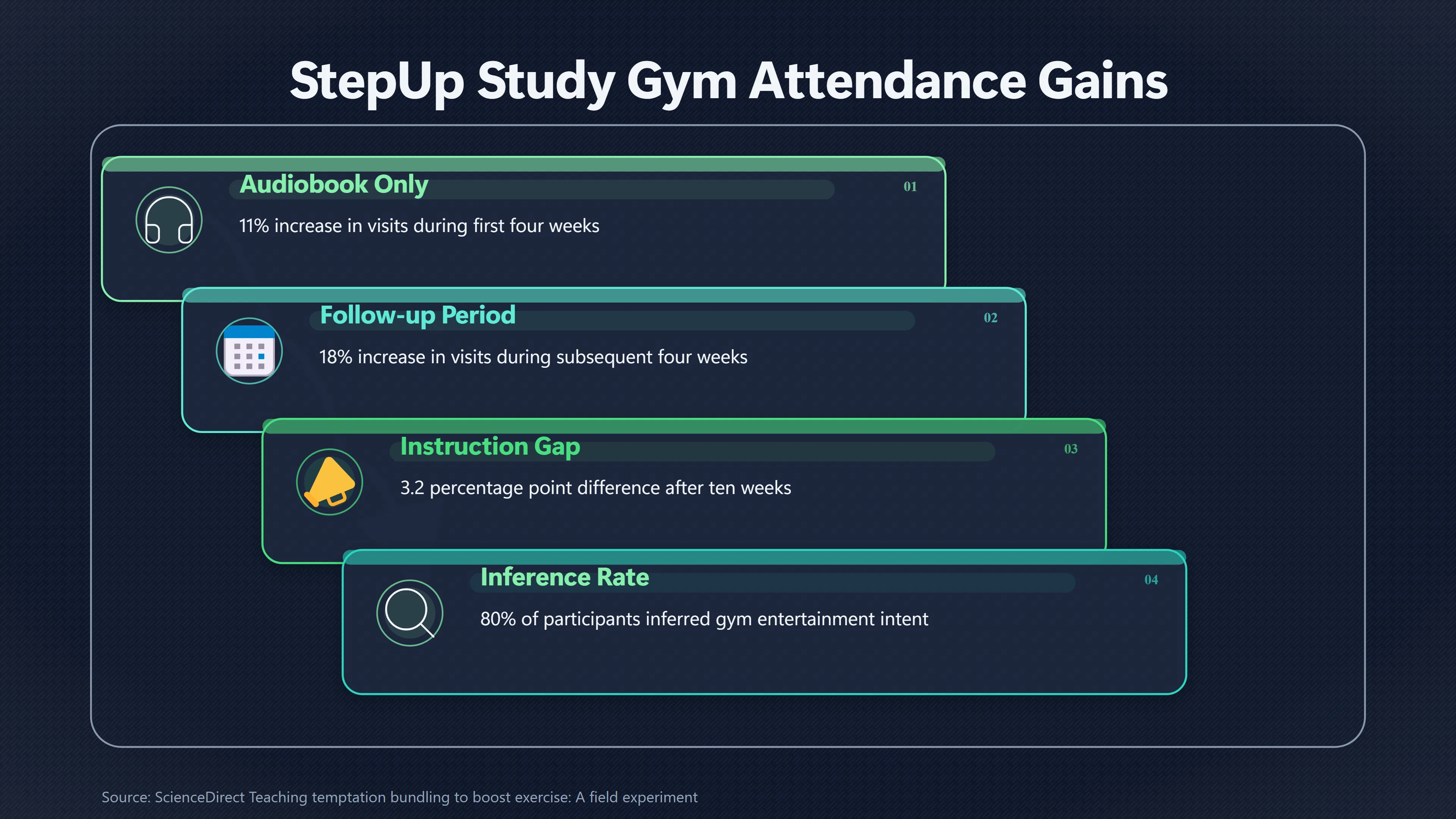
Explicit instruction produced only a modest advantage over the audiobook alone. During the four-week intervention, teaching bundling increased the probability of making at least one weekly gym visit by about 2.2 percentage points relative to simply providing the audiobook, a marginally significant difference; ten weeks afterwards the difference was 3.2 percentage points and statistically significant. The researchers found much less evidence that the extra instruction increased the number of weekly visits.[Wharton Faculty Platform]faculty.wharton.upenn.eduOpen source on upenn.edu.
That relatively small difference became interesting because the supposedly minimal treatment was not necessarily psychologically minimal. Giving someone an audiobook while enrolling them in an exercise programme creates a fairly obvious possible relationship between the two things: perhaps I am meant to listen to this while exercising. In other words, the audiobook may have functioned simultaneously as a reward and as a clue about how to use the reward.
The broader comparison strengthened that interpretation. The researchers incorporated another StepUp condition whose participants received the programme’s other features but no audiobook. Across the full analysis of 6,792 participants, simply receiving the audiobook was associated with more gym attendance: the authors summarised the estimated increase in gym visits as 11% during the four-week programme and 18% during the following four weeks.[Wharton Faculty Platform]faculty.wharton.upenn.eduOpen source on upenn.edu.
This does not prove that every extra workout resulted from audiobook listening. Only 13% of the audiobook-only participants actually downloaded the free audiobook through the programme, for example, and the field experiment did not track whether people listened during their workouts.[Wharton Faculty Platform]faculty.wharton.upenn.eduOpen source on upenn.edu. That limitation matters. The behavioural result is evidence that the apparently simple gift did something useful; identifying why required additional experiments.
What researchers meant by information leakage
“Information leakage” here has nothing to do with privacy or confidential data. It describes information that people infer from the way a choice, message or object is presented, even though nobody states that information explicitly.
Earlier decision research showed why such inferences can be reasonable. A speaker’s choice between apparently equivalent descriptions can reveal something about the speaker’s reference point or evaluation. Sher and McKenzie described how wording can therefore carry an “implicit recommendation”: the literal information may be equivalent while the choice of presentation communicates additional clues.[PubMed]pubmed.ncbi.nlm.nih.govPub Med Information leakage from logically equivalent framesInformation leakage from logically equivalent frames - PubMedDecember 20, 2005…
Kirgios and colleagues applied the same idea to behaviour-change design. Consider the difference between receiving an audiobook in three settings:
- a general birthday present;
- a reading programme;
- a programme specifically intended to get you exercising.
The physical reward can be identical, but its apparent purpose changes with its source. In the third case, the gym context supplies a missing instruction: use this with exercise. That inference can lead someone towards temptation bundling without anyone having to explain the term.[Wharton Faculty Platform]faculty.wharton.upenn.eduOpen source on upenn.edu.
The researchers first checked whether real gym-goers actually made that inference. A preregistered follow-up survey showed 75 gym-goers the materials seen by StepUp participants who had received an audiobook but no bundling instructions. In open-ended responses, 60 of the 75 — 80% — spontaneously said that the audiobook was intended for entertainment at the gym. The same proportion subsequently selected gym entertainment when given explicit response options.[Wharton Faculty Platform]faculty.wharton.upenn.eduOpen source on upenn.edu.
That is an important detail. Participants were not merely agreeing with a temptation-bundling suggestion after researchers put it in front of them. Four out of five produced the gym connection in their unrestricted answers.
The context mattered more than the audiobook
A stronger test came from a preregistered experiment with 602 participants. Everyone was asked to imagine receiving the same kind of gift — a free audiobook — but its context varied. One group imagined joining a 28-day programme designed to build exercise habits; the other imagined joining a 28-day virtual book club designed to build reading habits.[Wharton Faculty Platform]faculty.wharton.upenn.eduOpen source on upenn.edu.
The difference was striking. In the exercise-programme condition, 66.2% believed the programme designers most wanted them to listen to the audiobook while exercising. In the reading-programme condition, only 2.64% thought so. Participants in the exercise condition also reported being significantly more likely to use the audiobook while exercising.[Wharton Faculty Platform]faculty.wharton.upenn.eduOpen source on upenn.edu.
Statistical analysis was consistent with the proposed mechanism: the exercise-programme context changed what participants believed the designers intended, and those inferred intentions in turn predicted whether they expected to use the audiobook during exercise. Once the researchers statistically accounted for the inference about intended use, the direct relationship between programme context and expected exercise listening essentially disappeared.[Wharton Faculty Platform]faculty.wharton.upenn.eduOpen source on upenn.edu.
A separate follow-up experiment with 304 university gym members also helps distinguish this explanation from simpler alternatives. Participants exposed to the audiobook-only version of StepUp were more likely than control participants to expect that gym-goers would exercise because they wanted to listen to the audiobook during workouts, and because the audiobook reminded them of the gym. The researchers did not find corresponding evidence that merely feeling grateful to, or more positive about, the gym explained the predicted increase.[Wharton Faculty Platform]faculty.wharton.upenn.eduOpen source on upenn.edu.
Together, those experiments make the interpretation more convincing than the field result alone: it was not simply that “free stuff motivates people”. The combination of a particular reward and a particular setting communicated something about how the reward could be used.
Using context to make a useful pairing feel obvious
The practical lesson is not that explanations are unnecessary. It is that the design of a reward can carry part of the explanation.
A bundle-ready temptation has three useful properties. It is genuinely appealing, it can be consumed alongside the beneficial activity without making that activity impractical, and its placement makes the pairing easy to infer. An absorbing podcast already queued on a walking playlist communicates “listen while walking” more naturally than an unrelated voucher handed out after a walk. Entertainment downloaded to a device used on an exercise bike makes the connection more salient than the same entertainment sitting among dozens of unrelated options.
The StepUp experiment is particularly revealing because the reward remained unrestricted. Unlike the original study, nobody physically locked the audiobook at the gym. Participants therefore had to infer a rule and, if they chose, impose it on themselves. The researchers interpreted the results as evidence that at least some people can extract useful self-control strategies from environmental clues rather than requiring an externally enforced commitment device.[Wharton Faculty Platform]faculty.wharton.upenn.eduOpen source on upenn.edu.
There is also a design lesson for organisations. A gym, workplace wellbeing programme or exercise app need not treat incentives purely as payment for compliance. Providing something that is naturally usable during the desired behaviour can potentially serve two purposes: making the behaviour more enjoyable and signalling how that immediate enjoyment can be incorporated into it. A review of behavioural interventions for home-based workers, for example, identifies streaming entertainment or audiobooks as inexpensive activities that can be combined with physical activity.[PubMed Central (PMC)]pmc.ncbi.nlm.nih.govPubMed Central (PMC)Behavioral Interventions to Improve Home-Based Office-Workers’ Health - PMCJanuary 13, 2022…
The important qualification is that this is an inference from one particularly intuitive pairing. Audiobooks work unusually well because listening and many forms of exercise can occur simultaneously. It would be unsafe to assume that any pleasant gift supplied in any self-improvement context will spontaneously teach temptation bundling. The evidence directly establishes the phenomenon for an audiobook placed inside an exercise-promoting context; broader generalisation remains a hypothesis rather than a demonstrated rule.[Wharton Faculty Platform]faculty.wharton.upenn.eduOpen source on upenn.edu.
Why explicit teaching still has an advantage
If the audiobook could communicate the basic idea, why bother teaching temptation bundling at all? The study suggests an important distinction between inferring one pairing and learning a reusable strategy.
Someone who receives an audiobook from a gym might learn a narrow rule: this audiobook goes with my workouts. Someone explicitly taught temptation bundling can potentially learn the higher-level rule: I can attach something I immediately enjoy to an activity whose benefits arrive later. That rule can survive the end of a particular audiobook because the person can substitute a podcast, television programme or other compatible entertainment.
The authors themselves offered this as a possible explanation for the longer-run advantage of explicit instruction. Participants who were taught the strategy were encouraged to choose whatever media they preferred, potentially creating a broader and more adaptable personal rule. Audiobook-only participants may instead have associated exercise specifically with the one gift they had received and failed to replace it when it was finished.[Wharton Faculty Platform]faculty.wharton.upenn.eduOpen source on upenn.edu.
That interpretation remains plausible rather than proven. The researchers could not observe exactly what media participants consumed during each workout, and they explicitly called for further work to confirm the information-leakage mechanism in the field. They also acknowledged possibilities such as the audiobook keeping the gym top-of-mind, while noting that their follow-up experiments made explanations based simply on gratitude or positive feelings less persuasive.[Wharton Faculty Platform]faculty.wharton.upenn.eduOpen source on upenn.edu.
So the most defensible conclusion is narrower — and more interesting — than “rewards teach habits”. A well-chosen temptation, presented in a setting where its relationship to a difficult beneficial activity is conspicuous, can sometimes make the temptation-bundling strategy discoverable. The StepUp findings suggest that people do not always need a behavioural technique delivered as a lesson: they can infer the pairing from what their environment puts in front of them. Explicit teaching may still be worthwhile because it can turn that one obvious pairing into a strategy that can be adapted and reused.[sciencedirect.com]sciencedirect.comScienceDirect Teaching temptation bundling to boost exercise: A field experimentTeaching temptation bundling to boost exercise: A field experiment - ScienceDirect…
Amazon book picks
Further Reading
Books and field guides related to Can the Temptation Teach the Strategy Itself?. Use these as the next step if you want deeper reading beyond the article.
Atomic Habits
Rating: 3.5/5 from 7 Google Books ratings
The #1 New York Times bestseller. Over 25 million copies sold! Translated into 60+ languages! Tiny Changes, Remarkable Results No matter...
How to Change
Wall Street Journal bestseller “A welcome revelation.” --The Financial Times Award-winning Wharton Professor and Choiceology podcast host...
The Power of Habit
Rating: 4.0/5 from 145 Google Books ratings
Duhigg takes us to the edge of scientific discoveries that explain why habits exist and how they can be changed. Distilling information i...
Good Habits, Bad Habits
'The world's leading expert on habits' - Matthew Syed, bestselling author of Black Box Thinking and Rebel IdeasWhat if you could harness...
eBay marketplace picks
Marketplace Samples
Live-tested eBay searches with available results related to this page.
Selected fromfitness motivation poster oneBay.co.uk.

Current eBay listing
Gym Fitness Motivation Framed Wall Art Poster Canvas Print Picture
Current eBay listing
Fitness Motivation Framed Wall Art Poster Canvas Print Picture

Endnotes
1.
Source: sciencedirect.com
Title: ScienceDirect Teaching temptation bundling to boost exercise: A field experiment
Link:https://www.sciencedirect.com/science/article/pii/S074959782030385X
Source snippet
Teaching temptation bundling to boost exercise: A field experiment - ScienceDirect...
2.
Source: sciencedirect.com
Title: ScienceDirect Information leakage from logically equivalent frames
Link:https://www.sciencedirect.com/science/article/pii/S001002770500212X
Source snippet
Information leakage from logically equivalent frames - ScienceDirect...
3.
Source: sciencedirect.com
Link:https://www.sciencedirect.com/journal/cognition/vol/101/issue/3
4.
Source: sciencedirect.com
Link:https://www.sciencedirect.com/author/20433982500/katherine-l-milkman
5.
Source: sciencedirect.com
Link:https://www.sciencedirect.com/author/11138779200/angela-lee-duckworth
6.
Source: sciencedirect.com
Link:https://www.sciencedirect.com/science/article/abs/pii/S001002770500212X
7.
Source: faculty.wharton.upenn.edu
Link:https://faculty.wharton.upenn.edu/wp-content/uploads/2017/07/TemptationBundling.pdf
8.
Source: pmc.ncbi.nlm.nih.gov
Link:https://pmc.ncbi.nlm.nih.gov/articles/PMC4381662/
Source snippet
PubMed Central (PMC)Holding the Hunger Games Hostage at the Gym: An Evaluation of Temptation Bundling - PMCFebruary 1, 2014...
Published: February 1, 2014
9.
Source: pubmed.ncbi.nlm.nih.gov
Title: Pub Med Information leakage from logically equivalent frames
Link:https://pubmed.ncbi.nlm.nih.gov/16364278/
Source snippet
Information leakage from logically equivalent frames - PubMedDecember 20, 2005...
Published: December 20, 2005
10.
Source: pmc.ncbi.nlm.nih.gov
Link:https://pmc.ncbi.nlm.nih.gov/articles/PMC8754544/
Source snippet
PubMed Central (PMC)Behavioral Interventions to Improve Home-Based Office-Workers’ Health - PMCJanuary 13, 2022...
Published: January 13, 2022
11.
Source: pmc.ncbi.nlm.nih.gov
Link:https://pmc.ncbi.nlm.nih.gov/articles/PMC8833156/
12.
Source: pmc.ncbi.nlm.nih.gov
Link:https://pmc.ncbi.nlm.nih.gov/articles/PMC8822539/
13.
Source: pmc.ncbi.nlm.nih.gov
Link:https://pmc.ncbi.nlm.nih.gov/articles/PMC7970405/
14.
Source: knowledge.wharton.upenn.edu
Title: researchers used hunger games encourage healthier choices
Link:https://knowledge.wharton.upenn.edu/article/researchers-used-hunger-games-encourage-healthier-choices/
15.
Source: pubmed.ncbi.nlm.nih.gov
Link:https://pubmed.ncbi.nlm.nih.gov/25843979/
Additional References
16.
Source: harvard-edge.github.io
Link:https://harvard-edge.github.io/cs249r_book_dev/vol2/fault_tolerance/fault_tolerance.html
Source snippet
Machine Learning Systems at ScaleJuly 27, 2026 — Feature completeness | Input richness | Use content features when user history or real-t...
Published: July 27, 2026
17.
Source: feedland.org
Title: No matter how attractive the opportunity seems—no
Link:https://feedland.org/?river=true&screenname=fl0rinb
Source snippet
July 31, 2026 — I’m a purist when it comes to not working while on sabbatical, particularly when it comes in the form of consulti...
Published: July 31, 2026
18.
Source: youtube.com
Title: Changing Behavior With ‘Temptation Bundling’
Link:https://www.youtube.com/watch?v=GKIUMOKkXPg
Source snippet
"Behavior Change for Good" Katy Milkman exercise How to Change—for Good | Katy Milkman (Harvard PhD & Choiceology Host) | Colloquy Podcast...
19.
Source: youtube.com
Title: Katy Milkman
Link:https://www.youtube.com/watch?v=-KZSLC9zXVA
Source snippet
Professor Katherine Milkman on Temptation Bundling...
20.
Source: youtube.com
Title: Angela Duckworth and Katherine Milkman Unlock the Science of Change
Link:https://www.youtube.com/watch?v=PmcUVs2rF3g
Source snippet
A Mega-Study Approach to Applied Behavioral Science (Katy Milkman on NoBeC Talks)...
21.
Source: youtube.com
Link:https://www.youtube.com/watch?v=qB6PApSa6tk
Source snippet
Changing Behavior With 'Temptation Bundling'...
22.
Source: youtube.com
Title: Professor Katherine Milkman on Temptation Bundling
Link:https://www.youtube.com/watch?v=snHnUc9Yudk
Source snippet
Angela Duckworth and Katherine Milkman Unlock the Science of Change...
23.
Source: researchgate.net
Link:https://www.researchgate.net/publication/256040779_Holding_the_Hunger_Games_Hostage_at_the_Gym_An_Evaluation_of_Temptation_Bundling
24.
Source: researchgate.net
Link:https://www.researchgate.net/publication/368895405_Individual_Agency_in_Behavioral_Public_Policy_New_Knowledge_Problems
25.
Source: podtail.nl
Link:https://podtail.nl/podcast/hardcore-software-by-steven-sinofsky-audio-edition/081-first-[feedback