Within Useful Cues
Do Specific Reminders Work Better Than General Ones?
Specific prompts can outperform vague encouragement when they appear exactly where a person can choose and begin the intended action.
On this page
- What makes a prompt specific enough to act on
- What stair use studies found about message wording
- Turning vague reminders into clear environmental instructions
Page outline Jump by section
Introduction
A reminder is most useful when it does more than say that a goal matters. At a decision point, a specific prompt can identify the action to take, make its benefit concrete and appear while the action is still possible. Research on stair use provides an unusually clear test of this distinction. In one university building, a specific message about the calories burned by taking the stairs increased stair use, while a general encouragement to “burn calories” and “get healthy” did not.[PubMed]pubmed.ncbi.nlm.nih.govPoint-of-Decision Signs and Stair Use in a University Worksite Setting: General Versus Specific Messages - PubMedMarch 26, 2014…
But specificity is not simply a licence to add more words. Other field research shows that a detailed message can lose its advantage when people are moving quickly and have little time to read.[ResearchGate]researchgate.netPrompts to Increase Stair Climbing in Stations: The Effect of Message Complexity | Request PDFSeptember 1, 2012… The practical lesson for self-improvement is therefore narrower and more useful: put a brief, concrete instruction where the relevant choice occurs, and make the next action immediately obvious.
What makes a prompt specific enough to act on?
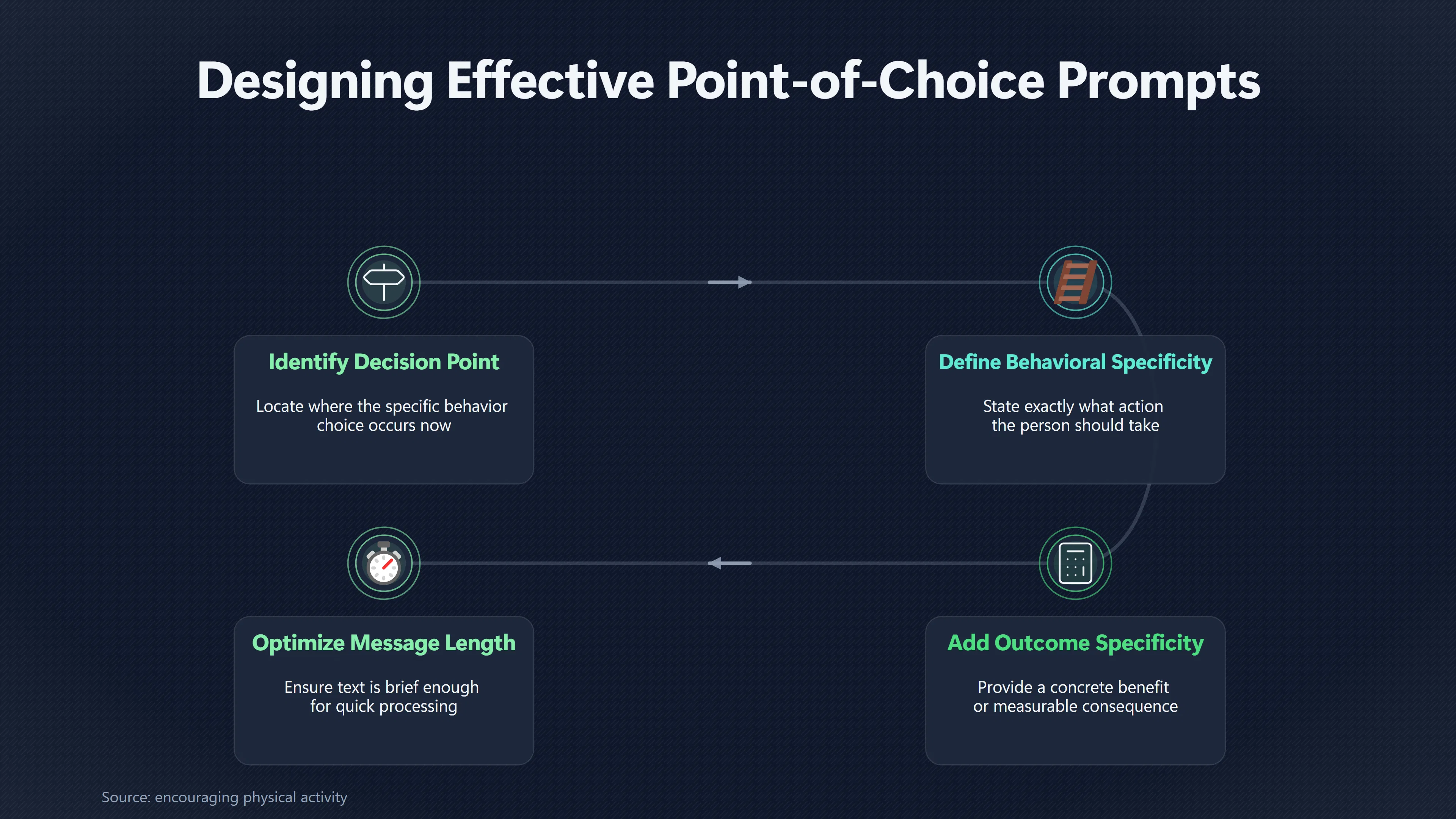
A general reminder keeps a broad goal mentally available: “be healthier”, “exercise more” or “remember to study”. A specific environmental prompt reduces the distance between that goal and an available behaviour: “take the stairs”, “open the practice questions” or “put your phone here before bed”.
The distinction matters because a decision point is a short window. When someone reaches a lift and staircase, for example, they do not need a general explanation that physical activity is desirable. They need information capable of influencing the choice available now. This is the logic of a point-of-decision, or point-of-choice, prompt: place the cue near the competing options rather than somewhere the person cannot immediately act on it. The Community Preventive Services Task Force’s review of 16 qualifying studies concluded that there was strong evidence that such prompts increase stair use, although the absolute changes were generally modest.[PubMed]pubmed.ncbi.nlm.nih.govPoint-of-decision prompts to increase stair use. A systematic review update - PubMed…
Placement can be as important as persuasive content. In a study across four university buildings, researchers recorded 14,138 choices between stairs and lifts. Putting a motivational intervention inside the lifts produced no significant increase in stair climbing. When a point-of-choice prompt was added where people selected their method of ascent, stair use increased significantly, with an odds ratio of 1.23. The researchers concluded that visibility when the behavioural choice is actually being made appeared necessary for changing behaviour in this setting.[BPS PsycHub]bpspsychub.onlinelibrary.wiley.comBPS PsycHubPrompt before the choice is made: Effects of a stair‐climbing intervention in university buildings - Lewis - 2012 - British Jo…
This gives “specific” two related meanings. Behavioural specificity tells people what they can do: take the stairs rather than the lift. Outcome specificity makes the reason concrete: how much activity, energy expenditure or another relevant benefit is associated with that choice. Research supports both ideas, but also shows that more detailed information is not automatically more effective.
What stair-use studies found about message wording
The most direct comparison comes from a university worksite study by Mary Eckhardt, Jacqueline Kerr and Wendell Taylor. Researchers observed 2,997 stair-or-lift choices in an eight-storey building across a two-week baseline period, two weeks with a general message and two weeks with a specific message.[PubMed]pubmed.ncbi.nlm.nih.govPoint-of-Decision Signs and Stair Use in a University Worksite Setting: General Versus Specific Messages - PubMedMarch 26, 2014…
The contrast was unusually clean. The general prompt said “Burn calories. Get healthy”. The specific version told passers-by that walking upstairs burns almost five times as many calories as riding a lift. Compared with baseline, the general message did not produce a statistically significant change: its odds ratio was 1.13, with a 95% confidence interval from 0.84 to 1.52. The specific message produced significantly greater odds of stair use than baseline, at 2.04, and also outperformed the general message directly, at 1.57.[PubMed Central (PMC)]pmc.ncbi.nlm.nih.govOpen source on nih.gov.
That result fits earlier work by Oliver Webb and Frank Eves. In structured interviews with 1,200 people, they compared relatively general descriptions of stair climbing with messages describing specific consequences. Participants found consequence-focused messages more persuasive. The researchers also found evidence that validating the information presented could increase its persuasive appeal.[PubMed]pubmed.ncbi.nlm.nih.govPub Med Promoting stair climbing: effects of message specificity and validationPromoting stair climbing: effects of message specificity and validation - PubMedFebruary 1, 2007…
There is an important qualification, however. “More specific” can also mean “longer and harder to process”. Amanda Lewis and Eves tested this in a UK railway station with 48,697 observed stair-or-escalator choices. One message stated that regular stair climbing protects the heart; the more specific version added a target of seven minutes per day. Both increased stair climbing after pedestrian traffic was taken into account: the estimated odds ratios were 1.07 for the simpler message and 1.10 for the more complex one. There was no straightforward victory for added detail. Crucially, the complex message became less effective during busier periods, whereas the simple message was not similarly impaired by traffic volume.[ResearchGate]researchgate.netPrompts to Increase Stair Climbing in Stations: The Effect of Message Complexity | Request PDFSeptember 1, 2012…
So the evidence does not support a rule that every prompt should contain a number, explanation or detailed benefit. It supports a more discriminating principle: specificity helps when it makes the relevant action or consequence clearer without demanding more attention than the situation allows.
Specificity works best when it reduces the decision
Environmental prompts have limited time to do their job. In a quiet workplace, someone may have enough attention to process a sentence about the consequences of taking the stairs. A commuter leaving a crowded train may have only seconds. The railway-station findings are therefore especially useful because they expose a trade-off that is easy to miss: informational precision and cognitive simplicity are not always the same thing.[ResearchGate]researchgate.netPrompts to Increase Stair Climbing in Stations: The Effect of Message Complexity | Request PDFSeptember 1, 2012…
That trade-off also explains why directional information can be valuable. A person may already be willing to take the stairs but not know where they are. A prompt saying where the stairs are removes an immediate practical uncertainty instead of attempting to increase motivation. A systematic review of stair-use interventions reported that combining motivational and directional signs in worksites increased stair climbing in 83% of the studies examining that approach, although the review also cautioned that evidence for worksite interventions overall was more limited than evidence from public settings and that external validity was often poorly reported.[PubMed]pubmed.ncbi.nlm.nih.govPub Med Stair-use interventions in worksites and public settingsPub Med Stair-use interventions in worksites and public settings
Public-health practice reflects the same concern with actionability. The US Centers for Disease Control and Prevention describes placing prompts strategically at decision points and gives the example “No waiting one door over”, which simultaneously suggests an advantage and indicates that the alternative is nearby. The CDC also recommends testing messages with the intended audience rather than assuming that the same factual, inspirational or humorous wording will motivate everyone.[CDC]cdc.govOpen source on cdc.gov.
The useful distinction, then, is not “detailed versus short”. It is decision-relevant versus vague. A short directional instruction can be highly specific. A long paragraph about the importance of health can remain behaviourally vague.
Turning vague reminders into clear environmental instructions
For personal self-improvement, the stair studies suggest a simple design test: when the cue appears, can the person tell what to do next without having to translate a broad goal into an action? The closer the prompt comes to answering that question, the more closely it resembles the interventions that work at real decision points.
Consider how common reminders change when rewritten around the choice that actually occurs:
- “Exercise more” → “Take the stairs to the third floor.” The second version names an available behaviour and a stopping point.
- “Drink more water” → “Fill this bottle before you make coffee.” The cue identifies an action attached to a recurring moment.
- “Read every day” → “Read five pages before opening social media.” The intended behaviour appears alongside the competing choice.
- “Practise guitar” → “Play the first exercise when you sit at this desk.” The instruction specifies both the response and its context.
- “Use your phone less” → “Leave your phone on this shelf during dinner.” Instead of condemning an unwanted habit, the prompt supplies an alternative action.
- “Be productive” → “Open the draft and write the next paragraph.” The reminder removes an additional planning decision.
These examples are applications of the evidence rather than interventions individually tested in the stair studies. The important transferable feature is the structure: a concrete response, presented at a location or moment where that response is feasible.
Specific benefits can strengthen the message when they genuinely help someone choose. But the railway-station evidence cautions against turning every cue into a miniature educational poster.[ResearchGate]researchgate.netPrompts to Increase Stair Climbing in Stations: The Effect of Message Complexity | Request PDFSeptember 1, 2012… A prompt beside a home staircase does not need to explain the physiology of physical activity; a study prompt on a laptop does not need to rehearse the long-term economic benefits of qualifications. If the person already endorses the goal, explanation may simply compete with the instruction for attention.
The useful rule is “specific, timely and brief”
Stair-use research is valuable for self-improvement precisely because it observes actual choices rather than merely asking whether people approve of healthier behaviour. Across the wider literature, point-of-choice prompting has repeatedly produced behavioural effects: a systematic review of choice-architecture interventions found that 37 of 50 studies examining physical-activity prompting while the intervention was present reported a significant effect, although other studies produced mixed or null findings.[PubMed Central (PMC)]pmc.ncbi.nlm.nih.govOpen source on nih.gov. A separate systematic review concluded that point-of-decision stair prompts had strong evidence of effectiveness.[PubMed]pubmed.ncbi.nlm.nih.govPoint-of-decision prompts to increase stair use. A systematic review update - PubMed…
Within that broader finding, the wording studies sharpen the lesson. A university experiment found a specific consequence message effective where a general health message was not.[PubMed]pubmed.ncbi.nlm.nih.govPoint-of-Decision Signs and Stair Use in a University Worksite Setting: General Versus Specific Messages - PubMedMarch 26, 2014… Interview research likewise favoured messages about specific consequences.[PubMed]pubmed.ncbi.nlm.nih.govPub Med Promoting stair climbing: effects of message specificity and validationPromoting stair climbing: effects of message specificity and validation - PubMedFebruary 1, 2007… Yet the large railway-station study showed why specificity has limits: adding useful detail can also add reading effort, and the more complex message suffered when pedestrian traffic was heavy.[ResearchGate]researchgate.netPrompts to Increase Stair Climbing in Stations: The Effect of Message Complexity | Request PDFSeptember 1, 2012…
For environmental cues, therefore, the target is not maximum information. It is minimum ambiguity at the moment of choice. A good prompt tells you what feasible action to take while there is still time to take it. General encouragement can remind you of the person you hope to become; a well-designed decision-point prompt tells you what to do in the next few seconds.
Amazon book picks
Further Reading
Books and field guides related to Do Specific Reminders Work Better Than General Ones?. Use these as the next step if you want deeper reading beyond the article.
Tiny Habits
Improving your life is much easier than you think. Whether it’s losing weight, sleeping more, or restoring your work/life balance – the s...
Atomic Habits
Rating: 3.5/5 from 7 Google Books ratings
The #1 New York Times bestseller. Over 25 million copies sold! Translated into 60+ languages! Tiny Changes, Remarkable Results No matter...
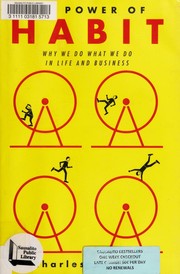
The Power of Habit
Rating: 4.0/5 from 145 Google Books ratings
Duhigg takes us to the edge of scientific discoveries that explain why habits exist and how they can be changed. Distilling information i...
Nudge
Rating: 3.5/5 from 29 Google Books ratings
Thaler and Sunstein offer a groundbreaking discussion of how to apply the science of choice to nudge people toward decisions that can imp...
eBay marketplace picks
Marketplace Samples
Live-tested eBay searches with available results related to this page.
Selected frommotivational desk sign oneBay.co.uk.

Endnotes
1.
Source: researchgate.net
Link:https://www.researchgate.net/publication/230841446_Prompts_to_Increase_Stair_Climbing_in_Stations_The_Effect_of_Message_Complexity
Source snippet
Prompts to Increase Stair Climbing in Stations: The Effect of Message Complexity | Request PDFSeptember 1, 2012...
Published: September 1, 2012
2.
Source: cdc.gov
Link:https://www.cdc.gov/physical-activity/php/stairwell-prompts/signs.html
3.
Source: cdc.gov
Title: encouraging physical activity
Link:https://www.cdc.gov/physical-activity/php/strategies/encouraging-physical-activity.html
4.
Source: researchgate.net
Link:https://www.researchgate.net/publication/351084590_Network_Meta-Analysis_Comparing_the_Outcomes_of_Treatments_for_Intermittent_Claudication_Tested_in_Randomized_Controlled_Trials
5.
Source: researchgate.net
Link:https://www.researchgate.net/publication/340496596_Choice_architecture_interventions_to_change_physical_activity_and_sedentary_behavior_A_systematic_review_of_effects_on_intention_behavior_and_health_outcomes_during_and_after_intervention
6.
Source: researchgate.net
Link:https://www.researchgate.net/publication/261137534_Point-of-Decision_Signs_and_Stair_Use_in_a_University_Worksite_Setting_General_Versus_Specific_Messages
7.
Source: researchgate.net
Link:https://www.researchgate.net/publication/294444098_Point_of_decision_signs_and_stair_use_in_a_university_worksite_setting_General_versus_specific_messages
8.
Source: researchgate.net
Link:https://www.researchgate.net/publication/51170427_Specific_Effects_of_a_Calorie-Based_Intervention_on_Stair_Climbing_in_Overweight_Commuters
9.
Source: researchgate.net
Title: (PDF) Psychology & Health
Link:https://www.researchgate.net/publication/259591964_Psychology_Health
10.
Source: researchgate.net
Title: (PDF) Promoting stair climbing: Effects of message specificity and validation
Link:https://www.researchgate.net/publication/7020382_Promoting_stair_climbing_Effects_of_message_specificity_and_validation
11.
Source: researchgate.net
Title: 7105902 Worksite interventions to increase stair climbing Reasons for caution
Link:https://www.researchgate.net/publication/7105902_Worksite_interventions_to_increase_stair_climbing_Reasons_for_caution
12.
Source: odphp.health.gov
Title: physical activity point decision prompts encourage use stairs
Link:https://odphp.health.gov/healthypeople/tools-action/browse-evidence-based-resources/physical-activity-point-decision-prompts-encourage-use-stairs
13.
Source: researchgate.net
Title: (PDF) Peak Performance Through Nutrition and Exercise
Link:https://www.researchgate.net/publication/235035957_Peak_Performance_Through_Nutrition_and_Exercise
14.
Source: researchgate.net
Link:https://www.researchgate.net/publication/320969370_Nudge_Concept_Effectiveness_and_Ethics
15.
Source: researchgate.net
Link:https://www.researchgate.net/publication/274013600_Less_Sitting_and_More_Moving_in_the_Office_Using_Descriptive_Norm_Messages_to_Decrease_Sedentary_Behavior_and_Increase_Light_Physical_Activity_at_Work
16.
Source: researchgate.net
Link:https://www.researchgate.net/publication/257591930_Testing_the_theory_underlying_the_success_of_point-of-choice_prompts_A_multi-component_stair_climbing_intervention
17.
Source: pubmed.ncbi.nlm.nih.gov
Link:https://pubmed.ncbi.nlm.nih.gov/24670074/
Source snippet
Point-of-Decision Signs and Stair Use in a University Worksite Setting: General Versus Specific Messages - PubMedMarch 26, 2014...
Published: March 26, 2014
18.
Source: pmc.ncbi.nlm.nih.gov
Link:https://pmc.ncbi.nlm.nih.gov/articles/PMC7140383/
19.
Source: pubmed.ncbi.nlm.nih.gov
Link:https://pubmed.ncbi.nlm.nih.gov/20117614/
Source snippet
Point-of-decision prompts to increase stair use. A systematic review update - PubMed...
20.
Source: bpspsychub.onlinelibrary.wiley.com
Link:https://bpspsychub.onlinelibrary.wiley.com/doi/10.1111/j.2044-8287.2011.02060.x
Source snippet
BPS PsycHubPrompt before the choice is made: Effects of a stair‐climbing intervention in university buildings - Lewis - 2012 - British Jo...
21.
Source: pubmed.ncbi.nlm.nih.gov
Link:https://pubmed.ncbi.nlm.nih.gov/22248016/
Source snippet
Prompt before the choice is made: effects of a stair-climbing intervention in university buildings - PubMed...
22.
Source: pubmed.ncbi.nlm.nih.gov
Title: Pub Med Promoting stair climbing: effects of message specificity and validation
Link:https://pubmed.ncbi.nlm.nih.gov/16763074/
Source snippet
Promoting stair climbing: effects of message specificity and validation - PubMedFebruary 1, 2007...
Published: February 1, 2007
23.
Source: doi.org
Link:https://doi.org/10.1093/her%2Fcyl045
24.
Source: pubmed.ncbi.nlm.nih.gov
Title: Pub Med Stair-use interventions in worksites and public settings
Link:https://pubmed.ncbi.nlm.nih.gov/25449692/
25.
Source: pmc.ncbi.nlm.nih.gov
Link:https://pmc.ncbi.nlm.nih.gov/articles/PMC13263016/
26.
Source: pmc.ncbi.nlm.nih.gov
Link:https://pmc.ncbi.nlm.nih.gov/articles/PMC12488497/
27.
Source: pmc.ncbi.nlm.nih.gov
Link:https://pmc.ncbi.nlm.nih.gov/articles/PMC11321217/
28.
Source: pmc.ncbi.nlm.nih.gov
Link:https://pmc.ncbi.nlm.nih.gov/articles/PMC11565501/
29.
Source: pmc.ncbi.nlm.nih.gov
Link:https://pmc.ncbi.nlm.nih.gov/articles/PMC10309613/
30.
Source: pmc.ncbi.nlm.nih.gov
Link:https://pmc.ncbi.nlm.nih.gov/articles/PMC10230356/
31.
Source: pmc.ncbi.nlm.nih.gov
Link:https://pmc.ncbi.nlm.nih.gov/articles/PMC10151484/
32.
Source: pmc.ncbi.nlm.nih.gov
Link:https://pmc.ncbi.nlm.nih.gov/articles/PMC9620615/
33.
Source: pmc.ncbi.nlm.nih.gov
Link:https://pmc.ncbi.nlm.nih.gov/articles/PMC8633462/
34.
Source: pmc.ncbi.nlm.nih.gov
Link:https://pmc.ncbi.nlm.nih.gov/articles/PMC7875376/
35.
Source: pmc.ncbi.nlm.nih.gov
Link:https://pmc.ncbi.nlm.nih.gov/articles/PMC6675111/
36.
Source: ncbi.nlm.nih.gov
Link:https://www.ncbi.nlm.nih.gov/books/NBK540702/
37.
Source: pmc.ncbi.nlm.nih.gov
Link:https://pmc.ncbi.nlm.nih.gov/articles/PMC6349558/
38.
Source: pmc.ncbi.nlm.nih.gov
Link:https://pmc.ncbi.nlm.nih.gov/articles/PMC5719260/
39.
Source: pmc.ncbi.nlm.nih.gov
Link:https://pmc.ncbi.nlm.nih.gov/articles/PMC5001632/
40.
Source: pmc.ncbi.nlm.nih.gov
Link:https://pmc.ncbi.nlm.nih.gov/articles/PMC6125035/
41.
Source: pmc.ncbi.nlm.nih.gov
Link:https://pmc.ncbi.nlm.nih.gov/articles/PMC4769667/
42.
Source: pmc.ncbi.nlm.nih.gov
Link:https://pmc.ncbi.nlm.nih.gov/articles/PMC4631103/
43.
Source: pmc.ncbi.nlm.nih.gov
Link:https://pmc.ncbi.nlm.nih.gov/articles/PMC4033716/
44.
Source: pmc.ncbi.nlm.nih.gov
Link:https://pmc.ncbi.nlm.nih.gov/articles/PMC5512715/
45.
Source: pmc.ncbi.nlm.nih.gov
Link:https://pmc.ncbi.nlm.nih.gov/articles/PMC3490976/
46.
Source: pmc.ncbi.nlm.nih.gov
Link:https://pmc.ncbi.nlm.nih.gov/articles/PMC4636338/
47.
Source: doi.org
Link:https://doi.org/10.1111/j.2044-8287.2011.02060.x
48.
Source: bpspsychub.onlinelibrary.wiley.com
Title: j.2044 8287.2011.02060.x
Link:https://bpspsychub.onlinelibrary.wiley.com/doi/abs/10.1111/j.2044-8287.2011.02060.x
49.
Source: onlinelibrary.wiley.com
Link:https://onlinelibrary.wiley.com/doi/full/10.1038/oby.2006.259
50.
Source: pubmed.ncbi.nlm.nih.gov
Link:https://pubmed.ncbi.nlm.nih.gov/18019888/
51.
Source: pubmed.ncbi.nlm.nih.gov
Link:https://pubmed.ncbi.nlm.nih.gov/21618070/
Additional References
52.
Source: journals.sagepub.com
Link:https://journals.sagepub.com/doi/10.4278/ajhp.120816-ARB-398
Source snippet
Sage JournalsPoint-of-Decision Signs and Stair Use in a University Worksite Setting: General versus Specific Messages - Mary R. Eckhardt...
53.
Source: sciencedirect.com
Link:https://www.sciencedirect.com/science/article/abs/pii/S0749379709007508
Source snippet
Point-of-Decision Prompts to Increase Stair Use: A Systematic Review Update - ScienceDirect...
54.
Source: youtube.com
Title: Understanding Nudge Theory & Libertarian Paternalism
Link:https://www.youtube.com/watch?v=q0Jn5K8QngQ
Source snippet
To see how placing concrete cues and choice architecture directly at decision points outperforms vague reminders, explore Choiceology's G...
55.
Source: youtube.com
Title: What Is Implementation Intention For Building Habits?
Link:https://www.youtube.com/watch?v=tKVv5YlUcMI
Source snippet
Understanding Nudge Theory & Libertarian Paternalism...
56.
Source: sciencedirect.com
Link:https://www.sciencedirect.com/science/article/pii/S009174351300460X
57.
Source: scribd.com
Link:https://www.scribd.com/document/558833456/How-to-Completely-Reverse-Diabetes-in-as-Little-as-14-Days-7-Bonuses-PDFDrive
58.
Source: ovid.com
Link:https://www.ovid.com/journals/ajhpr/pdf/10.4278/ajhp.120816-arb-398~point-of-decision-signs-and-stair-use-in-a-university
59.
Source: healthpartners.com
Link:https://www.healthpartners.com/knowledgeexchange/display/document-rn19343
60.
Source: paperity.org
Link:https://paperity.org/p/87583569/promoting-stair-climbing-effects-of-message-specificity-and-validation
61.
Source: eurekamag.com
Link:https://eurekamag.com/research/050/044/050044390.php