Within Reduce Friction
Stop Re Deciding Habits You Already Planned
Preselecting known answers can remove the miniature planning sessions that make familiar routines harder to begin.
On this page
- How repeated decisions add friction
- Preselecting workouts, meals and study tasks
- When keeping a choice is worth the effort
Page outline Jump by section
Introduction
A routine is harder to start when it quietly contains a planning meeting. “Exercise” can still require deciding which workout, for how long and where. “Study” can mean choosing a subject, chapter and first task. Dinner can begin with deciding what to cook. One useful form of friction reduction is therefore simple: make recurring decisions before the moment when the habit is supposed to begin.
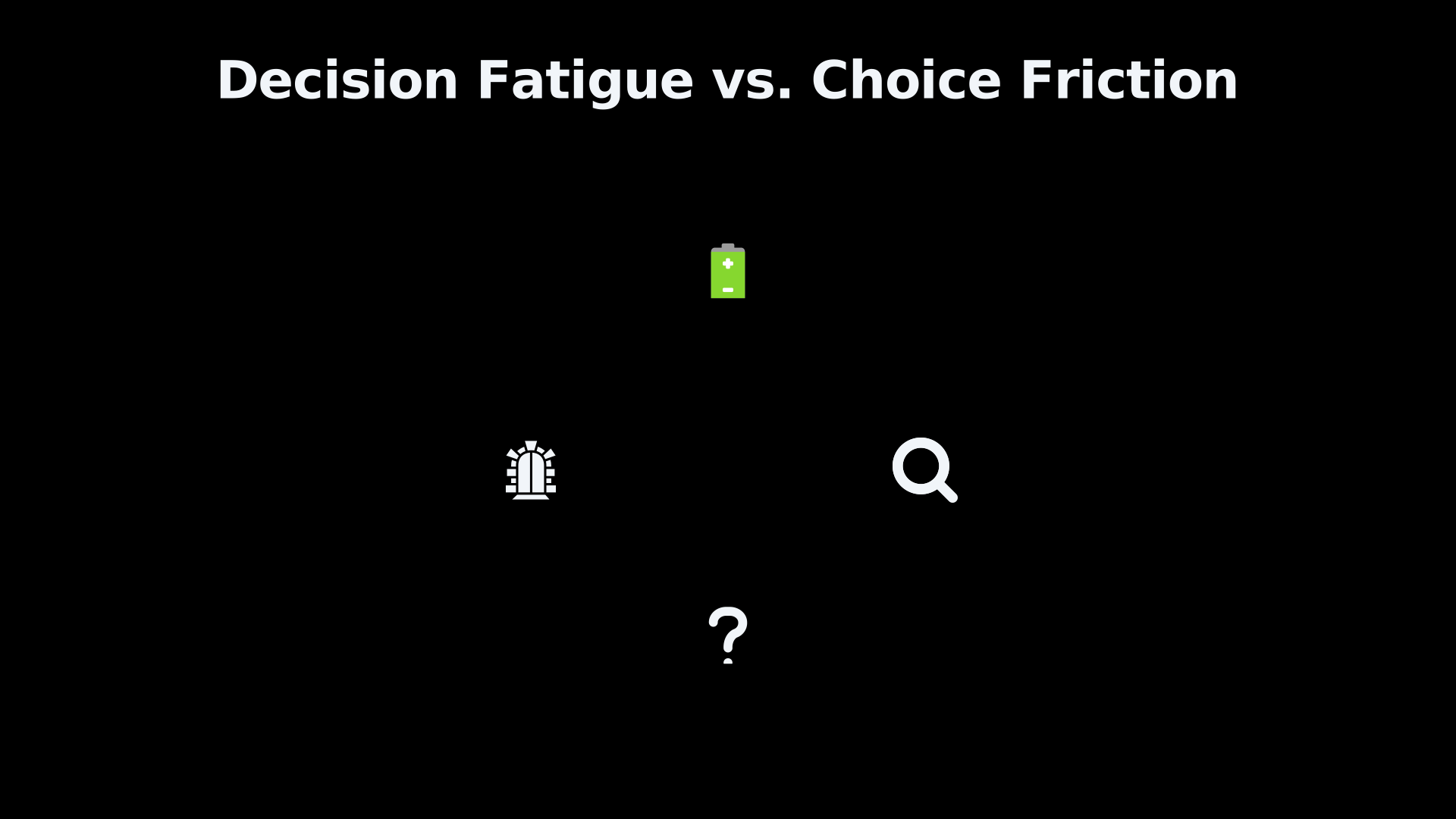
The strongest evidence does not support the popular idea that every trivial choice drains a fixed reservoir of “decision-making energy”. Research on decision fatigue and choice overload is more mixed than that slogan suggests. The better-supported mechanism is narrower: decisions become troublesome when options are difficult to compare, preferences are uncertain, or deciding competes with simply getting started. Preselecting a sensible default removes that deliberative step. Implementation-intention research also shows that specifying what response will follow a particular cue can improve goal attainment, while stable contexts help repeated behaviours become more automatic.[doi.org]doi.orgThe when and how of planning: Meta-analysis of the scope and components of implementation intentions in 642 tests: European Review of…
How repeated decisions add friction
The crucial distinction is between deciding what you want to achieve and repeatedly deciding how to enact a decision you have already made. The first can be valuable. The second can become avoidable friction.
Suppose someone has already decided to exercise three mornings a week. If Tuesday morning still presents a menu — run or lift weights, home or gym, 20 or 40 minutes, legs or upper body — the person has not yet reached the exercise itself. They have reached another decision. On a good morning that may barely matter. On a rushed morning it creates another point at which the routine can stall.
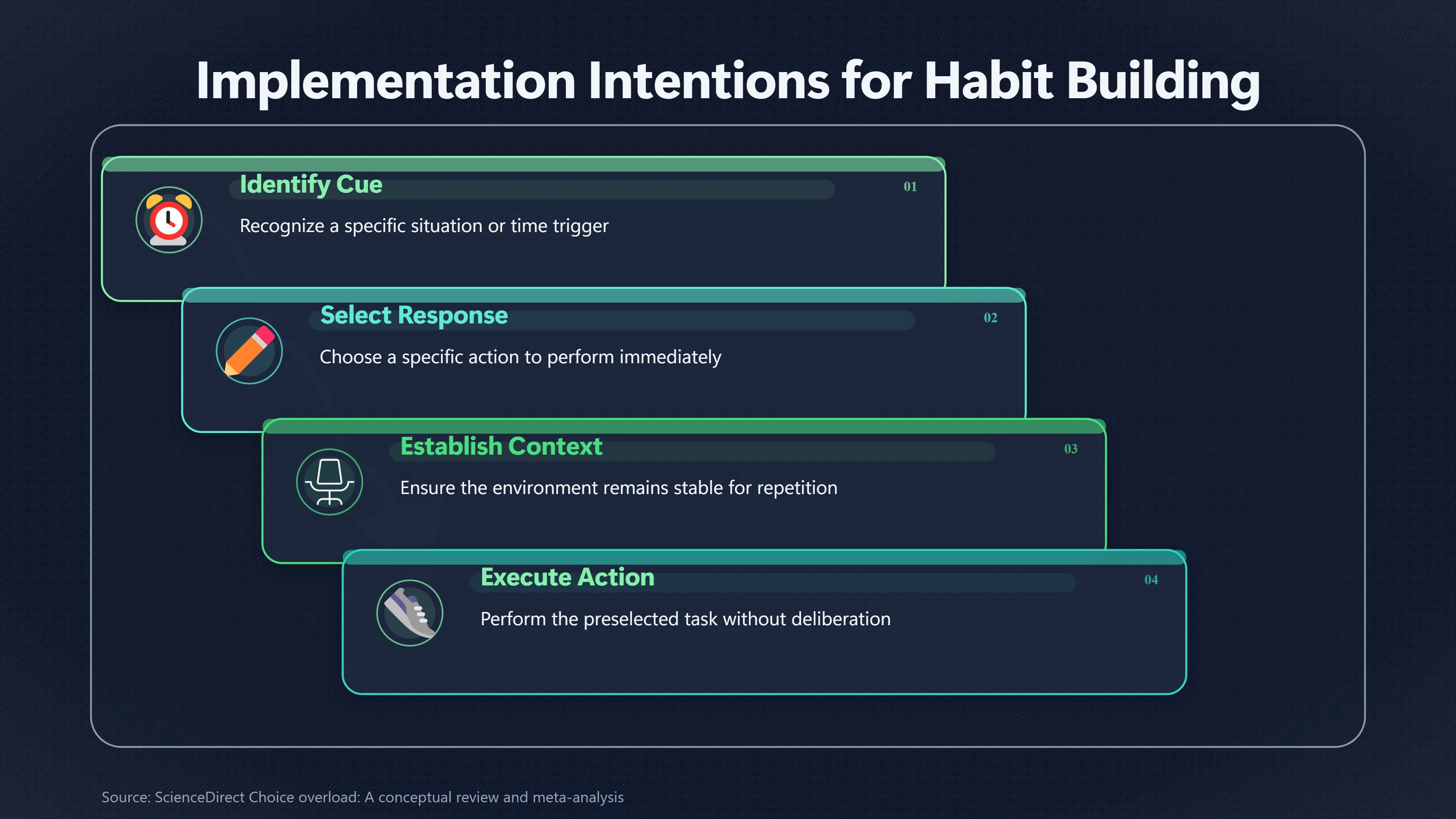
Implementation intentions offer particularly relevant evidence. These plans connect a specified situation with a specified response: in effect, deciding in advance what happens when a cue occurs. A 2006 meta-analysis covering 94 independent tests reported a medium-to-large overall effect on goal attainment, and proposed that specifying the response in advance makes the relevant opportunity more accessible while making initiation more automatic.[ScienceDirect]sciencedirect.comImplementation Intentions and Goal Achievement: A Meta‐analysis of Effects and Processes - ScienceDirect… A much larger 2024 meta-analysis, covering 642 independent tests, found beneficial effects across cognitive, emotional and behavioural outcomes, with effect sizes ranging from d = 0.27 to 0.66. Effects were stronger when plans took a contingent if–then form, when people were motivated to pursue the goal and when plans were rehearsed.[DOI]doi.orgThe when and how of planning: Meta-analysis of the scope and components of implementation intentions in 642 tests: European Review of…
This does not mean every routine needs to be written as a formal if–then statement. The practical principle is to turn an open question into a prepared response. Instead of reaching 7am and asking, “Should I exercise, and what should I do?”, the relevant answer might already be: “On Tuesday after breakfast, I do workout A.”
That distinction matters because the evidence on choice itself is nuanced. A 2010 meta-analysis of 50 experiments found that simply increasing the number of options had an average choice-overload effect close to zero, with substantial variation between studies.[OUP Academic]academic.oup.comOUP AcademicCan There Ever Be Too Many Options? A Meta-Analytic Review of Choice Overload | Journal of Consumer Research | Oxford Academic… A later meta-analysis found that overload was more likely when the decision was difficult, the options were complex, the chooser was uncertain about their preferences, or the aim was to minimise decision effort.[ScienceDirect]sciencedirect.comScienceDirect Choice overload: A conceptual review and meta-analysisChoice overload: A conceptual review and meta-analysis - ScienceDirectApril 1, 2015… So “choices are exhausting” is too crude. A more defensible rule is: remove recurring choices when they add complexity without adding useful adaptation.
There is another reason preselection fits habit building particularly well. Habit research describes habits as responses that become increasingly cued by recurring contexts rather than requiring fresh deliberation.[PubMed Central (PMC)]pmc.ncbi.nlm.nih.govPubMed Central (PMC)A review and analysis of the use of ‘habit’ in understanding, predicting and influencing health-related behaviour - P… In a six-week study of university students, greater stability in the context of study-habit repetitions predicted stronger automaticity and better attainment of repetition goals; a second dataset from users of a habit-building app showed the same pattern.[PubMed Central (PMC)]pmc.ncbi.nlm.nih.govPubMed Central (PMC)Context Stability in Habit Building Increases Automaticity and Goal Attainment - PMC… A default response therefore does two jobs: it removes an immediate decision and helps preserve the consistency from which automaticity can develop.
Preselect workouts, meals and study tasks
The most useful defaults are concrete enough to start immediately but not so rigid that they survive after circumstances change. Three familiar routines show what that looks like.
Workouts: decide the session, not merely that you will exercise. A calendar entry saying “exercise” leaves much of the behavioural work unresolved. “Monday: workout A; Wednesday: workout B; Saturday: 30-minute run” converts several recurring choices into previously selected answers. The person can still deviate when necessary, but deviation becomes the exception rather than the starting procedure.
Evidence from physical-activity interventions supports advance planning, although it should not be oversold as a universal solution. A 2022 systematic review and meta-analysis covering 41 randomised trials, with 35 included in the quantitative synthesis, found that planning interventions produced a small-to-moderate improvement in physical activity (SMD = 0.35, 95% CI 0.25–0.44). Results varied considerably between studies, and interventions using reinforcement during follow-up tended to work better.[PubMed]pubmed.ncbi.nlm.nih.govThe Effectiveness of Planning Interventions for Improving Physical Activity in the General Population: A Systematic Review and Meta… An earlier review likewise found that reinforced implementation-intention interventions improved physical activity, while another systematic review emphasised that results depend partly on factors such as existing motivation and self-efficacy.[PubMed Central (PMC)]pmc.ncbi.nlm.nih.govPubMed Central (PMC)Impact of implementation intentions on physical activity practice in adults: A systematic review and meta-analysis of…
The practical target is consequently not maximal scheduling. It is eliminating the predictable question that appears at the start of every session. A beginner might use a small rotation of established workouts; an experienced athlete whose training genuinely needs day-to-day adjustment has more reason to retain choice.
Meals: decide from a small repertoire before hunger becomes the planning system. Meal planning is a particularly intuitive application because eating requires repeated decisions every day. A weekly plan can preselect several breakfasts, lunches and evening meals while still leaving room for social occasions, leftovers or changed appetites.
The evidence here is useful but less causal. In the French NutriNet-Santé study, researchers examined meal planning among 40,554 adults. Fifty-seven per cent reported planning meals at least occasionally. Meal planning was associated with greater adherence to nutritional guidelines and greater food variety; planners also had lower odds of obesity, although the study’s cross-sectional design means it cannot establish that planning caused those outcomes.[PubMed]pubmed.ncbi.nlm.nih.govOpen source on nih.gov. The authors specifically suggested that planning might help address perceived time scarcity around preparing food.[DOI]doi.orgOpen source on doi.org.
For habit design, the more cautious lesson is valuable enough: a meal plan can move the question “What shall I make?” away from the moment when cooking needs to start. There is no need to infer that repeating the same lunch is intrinsically healthier or that everyone needs a seven-day menu.
Study: choose the first executable task in advance. “Study chemistry tonight” is more specific than “study”, but it still permits a miniature negotiation: which topic, textbook or problem set? A better preselection might be “At 7pm, open the problem set and begin questions 11–15.” The point is not that five questions are an ideal study method. It is that the first action has already been selected.
This is where implementation intentions and context-stability findings combine especially neatly. The 2024 implementation-intention meta-analysis found that plans can use cues including a particular time and place or a particular point in a task sequence.[DOI]doi.orgThe when and how of planning: Meta-analysis of the scope and components of implementation intentions in 642 tests: European Review of… Meanwhile, the study of intentional habit building found that stable contexts supported both automaticity and repetition-goal attainment in students building study habits.[PubMed Central (PMC)]pmc.ncbi.nlm.nih.govPubMed Central (PMC)Context Stability in Habit Building Increases Automaticity and Goal Attainment - PMC… Preselecting both the cue and the opening task reduces the distance between “it is study time” and actually doing academic work.
Across all three cases, the pattern is the same:
- Open workout choice: “What exercise should I do today?” → Default: follow the next session in the preselected programme.
- Open meal choice: “What should I cook tonight?” → Default: make the meal already assigned to tonight, unless circumstances give a reason to change it.
- Open study choice: “What should I work on?” → Default: begin the specific chapter, problem set or review block selected earlier.
The default should normally be good enough rather than endlessly optimised. If choosing between several reasonable workouts consumes more effort than the difference between them warrants, the search for the perfect choice has become part of the friction.
When keeping a choice is worth the effort
Reducing repeated decisions is not the same as eliminating choice. Deliberation earns its place when circumstances have changed, feedback matters, preferences are still being discovered or the consequences of selecting the wrong option are substantial.
That qualification is important because choice overload is conditional. The research does not show that fewer options are universally better. The 2010 meta-analysis found no reliable overall disadvantage from larger choice sets, while subsequent work suggests that problems are more likely when choices are complex, difficult and made without clear preferences.[OUP Academic]academic.oup.comOUP AcademicCan There Ever Be Too Many Options? A Meta-Analytic Review of Choice Overload | Journal of Consumer Research | Oxford Academic… Someone who knows exactly which of ten breakfasts they want may experience almost no meaningful decision friction. Someone comparing ten unfamiliar training programmes with numerous attributes faces a different task.
Defaults can also become liabilities when they stop matching the goal. Recent habit research stresses this trade-off: automatic behaviours can support long-term goals by reducing deliberation and interference, but established responses can become obstructive when goals change.[PubMed]pubmed.ncbi.nlm.nih.govOpen source on nih.gov. Preselection should therefore simplify execution without suspending judgement.
A useful test is to ask whether today’s information could reasonably change the answer. If not, re-deciding probably has little value. The same breakfast on ordinary working mornings, a fixed sequence of strength sessions, or a predefined first study task are plausible candidates for defaults. By contrast, choosing exercise while injured, adjusting revision priorities after a poor practice test, or planning dinner for guests may contain information worth considering.
This suggests a simple operating rule: decide once at the level where the answer is stable; reconsider at the level where new information matters. A workout programme can be selected for several weeks while loads are adjusted session by session. A repertoire of weekday meals can remain stable while portions or ingredients vary. A study timetable can determine which subject comes next while performance on practice questions determines what needs further review.
Make the default easy to follow and easy to revise
The aim is not to construct a perfectly predetermined life. It is to prevent settled intentions from repeatedly returning to the planning stage.
Start with a routine that reliably produces the same question just before action: What workout? What meal? What should I study first? Choose a satisfactory answer while there is time to think, attach it to a recognisable situation, and make that answer the default until there is a concrete reason to reconsider it. Where appropriate, phrase the plan contingently — “when this situation occurs, I do this” — because implementation-intention evidence indicates that contingent plans outperform vaguer forms of planning.[DOI]doi.orgThe when and how of planning: Meta-analysis of the scope and components of implementation intentions in 642 tests: European Review of…
Then separate execution time from review time. During execution, follow the default unless something relevant has changed. At review time — perhaps when the training block ends, the weekly meal plan is written or the next set of study priorities is chosen — deliberation becomes useful again. This preserves flexibility without requiring flexibility to be exercised at every repetition.
The deeper advantage is not a magical conservation of a finite stock of willpower. It is architectural. Preselection removes an unnecessary branch from the path between cue and action. Repeating a consistent response in a stable context can then strengthen the automaticity that defines a mature habit.[PubMed Central (PMC)]pmc.ncbi.nlm.nih.govOpen source on nih.gov. Good self-improvement still requires judgement, but familiar routines do not need to demand the same judgement afresh every day.

Amazon book picks
Further Reading
Books and field guides related to Stop Re Deciding Habits You Already Planned. Use these as the next step if you want deeper reading beyond the article.
The ONE Thing: The Surprisingly Simple Truth Behind Extraordi...
YOU WANT LESS. You want fewer distractions and less on your plate. The daily barrage of e-mails, texts, tweets, messages, and meetings di...
Essentialism: The Disciplined Pursuit of Less
Have you ever found yourself struggling with information overload? Have you ever felt both overworked and underutilised? Do you ever feel...
Nudge
Rating: 3.5/5 from 29 Google Books ratings
Thaler and Sunstein offer a groundbreaking discussion of how to apply the science of choice to nudge people toward decisions that can imp...
The Paradox of Choice: Why More Is Less
Rating: 3.5/5 from 13 Google Books ratings
Whether we’re buying a pair of jeans, ordering a cup of coffee, purchasing shampoo from the drug store, selecting a long-distance carrier...
eBay marketplace picks
Marketplace Samples
Live-tested eBay searches with available results related to this page.
Selected fromworkout card deck oneBay.co.uk.

Endnotes
1.
Source: doi.org
Link:https://doi.org/10.1080/10463283.2024.2334563
Source snippet
The when and how of planning: Meta-analysis of the scope and components of implementation intentions in 642 tests: European Review of...
2.
Source: academic.oup.com
Link:https://academic.oup.com/jcr/article-abstract/37/3/409/1827647
Source snippet
OUP AcademicCan There Ever Be Too Many Options? A Meta-Analytic Review of Choice Overload | Journal of Consumer Research | Oxford Academic...
3.
Source: sciencedirect.com
Link:https://www.sciencedirect.com/science/article/abs/pii/S0065260106380021
Source snippet
Implementation Intentions and Goal Achievement: A Meta‐analysis of Effects and Processes - ScienceDirect...
4.
Source: sciencedirect.com
Title: ScienceDirect Choice overload: A conceptual review and meta-analysis
Link:https://www.sciencedirect.com/science/article/pii/S1057740814000916
Source snippet
Choice overload: A conceptual review and meta-analysis - ScienceDirectApril 1, 2015...
Published: April 1, 2015
5.
Source: doi.org
Link:https://doi.org/10.1186/s12966
6.
Source: doi.org
Link:https://doi.org/10.1080/09645292.2026.2680605
7.
Source: sciencedirect.com
Link:https://www.sciencedirect.com/science/article/pii/S0306919226000813
8.
Source: sciencedirect.com
Link:https://www.sciencedirect.com/science/article/pii/S0361476X25000876
9.
Source: sciencedirect.com
Link:https://www.sciencedirect.com/science/article/pii/S0361476X25000876?dgcid=rss_sd_all
10.
Source: doi.org
Link:https://doi.org/10.1146/annurev-nutr-111124-101104
11.
Source: sciencedirect.com
Link:https://www.sciencedirect.com/science/article/pii/S0195666324006019
12.
Source: sciencedirect.com
Link:https://www.sciencedirect.com/science/article/abs/pii/S0191886924000771
13.
Source: sciencedirect.com
Link:https://www.sciencedirect.com/science/article/pii/S0195666322000885
14.
Source: academic.oup.com
Link:https://academic.oup.com/jrssig/article/15/6/38/7037731
15.
Source: sciencedirect.com
Link:https://www.sciencedirect.com/science/article/pii/S0195666316304640
16.
Source: doi.org
Title: Choice overload: A conceptual review and meta‐analysis
Link:https://doi.org/10.1016/j.jcps.2014.08.002
17.
Source: academic.oup.com
Link:https://academic.oup.com/abm/article/46/1/114/4563248
18.
Source: academic.oup.com
Link:https://academic.oup.com/jcr/article-abstract/37/3/409/1827647?login=false
19.
Source: sciencedirect.com
Link:https://www.sciencedirect.com/science/article/pii/S0191886906003485
20.
Source: doi.org
Link:https://doi.org/10.1002/1099-0992%28200011/12%2930%3A6%3C873%3A%3AAID-EJSP22%3E3.0.CO%3B2-U
21.
Source: sciencedirect.com
Link:https://www.sciencedirect.com/science/chapter/bookseries/abs/pii/S0065260106380021
22.
Source: sciencedirect.com
Link:https://www.sciencedirect.com/science/article/pii/S0002916522007778
23.
Source: sciencedirect.com
Link:https://www.sciencedirect.com/science/article/abs/pii/S0022103117301968
24.
Source: sciencedirect.com
Link:https://www.sciencedirect.com/science/article/pii/S0167487026000139
25.
Source: sciencedirect.com
Title: Dodging dietary defaults: Choosing away from healthy nudges
Link:https://www.sciencedirect.com/science/article/pii/S0749597820303873
26.
Source: sciencedirect.com
Title: Decision fatigue and heuristic analyst forecasts
Link:https://www.sciencedirect.com/science/article/pii/S0304405X19300054
27.
Source: sciencedirect.com
Link:https://www.sciencedirect.com/science/article/pii/S0959475214000681
28.
Source: sciencedirect.com
Link:https://www.sciencedirect.com/science/article/abs/pii/S0022103109001401
29.
Source: pmc.ncbi.nlm.nih.gov
Link:https://pmc.ncbi.nlm.nih.gov/articles/PMC9226889/
Source snippet
PubMed Central (PMC)Context Stability in Habit Building Increases Automaticity and Goal Attainment - PMC...
30.
Source: pmc.ncbi.nlm.nih.gov
Link:https://pmc.ncbi.nlm.nih.gov/articles/PMC4566897/
Source snippet
PubMed Central (PMC)A review and analysis of the use of ‘habit’ in understanding, predicting and influencing health-related behaviour - P...
31.
Source: pubmed.ncbi.nlm.nih.gov
Title: Pub Med Psychology of Habit
Link:https://pubmed.ncbi.nlm.nih.gov/26361052/
Source snippet
Psychology of Habit - PubMed...
32.
Source: pubmed.ncbi.nlm.nih.gov
Link:https://pubmed.ncbi.nlm.nih.gov/35742582/
Source snippet
The Effectiveness of Planning Interventions for Improving Physical Activity in the General Population: A Systematic Review and Meta...
33.
Source: pmc.ncbi.nlm.nih.gov
Link:https://pmc.ncbi.nlm.nih.gov/articles/PMC9223740/
Source snippet
PubMed Central (PMC)The Effectiveness of Planning Interventions for Improving Physical Activity in the General Population: A Systematic R...
34.
Source: pmc.ncbi.nlm.nih.gov
Link:https://pmc.ncbi.nlm.nih.gov/articles/PMC6235272/
Source snippet
PubMed Central (PMC)Impact of implementation intentions on physical activity practice in adults: A systematic review and meta-analysis of...
35.
Source: pubmed.ncbi.nlm.nih.gov
Link:https://pubmed.ncbi.nlm.nih.gov/31923898/
36.
Source: pubmed.ncbi.nlm.nih.gov
Link:https://pubmed.ncbi.nlm.nih.gov/28153017/
37.
Source: pmc.ncbi.nlm.nih.gov
Link:https://pmc.ncbi.nlm.nih.gov/articles/PMC5288891/
38.
Source: pubmed.ncbi.nlm.nih.gov
Link:https://pubmed.ncbi.nlm.nih.gov/39321606/
39.
Source: pmc.ncbi.nlm.nih.gov
Link:https://pmc.ncbi.nlm.nih.gov/articles/PMC11641623/
40.
Source: pmc.ncbi.nlm.nih.gov
Link:https://pmc.ncbi.nlm.nih.gov/articles/PMC13334064/
41.
Source: GOV.UK
Link:https://www.gov.uk/research-for-development-outputs/when-choice-matters-the-asymmetric-effects-of-[precommitment
42.
Source: pmc.ncbi.nlm.nih.gov
Link:https://pmc.ncbi.nlm.nih.gov/articles/PMC13083051/
43.
Source: pubmed.ncbi.nlm.nih.gov
Link:https://pubmed.ncbi.nlm.nih.gov/41784001/
44.
Source: pmc.ncbi.nlm.nih.gov
Link:https://pmc.ncbi.nlm.nih.gov/articles/PMC13281206/
45.
Source: pmc.ncbi.nlm.nih.gov
Link:https://pmc.ncbi.nlm.nih.gov/articles/PMC12736114/
46.
Source: pubmed.ncbi.nlm.nih.gov
Link:https://pubmed.ncbi.nlm.nih.gov/41470846/
47.
Source: pmc.ncbi.nlm.nih.gov
Link:https://pmc.ncbi.nlm.nih.gov/articles/PMC12671926/
48.
Source: pubmed.ncbi.nlm.nih.gov
Link:https://pubmed.ncbi.nlm.nih.gov/40591577/
49.
Source: pubmed.ncbi.nlm.nih.gov
Link:https://pubmed.ncbi.nlm.nih.gov/40553762/
50.
Source: pmc.ncbi.nlm.nih.gov
Link:https://pmc.ncbi.nlm.nih.gov/articles/PMC11808891/
52.
Source: pmc.ncbi.nlm.nih.gov
Link:https://pmc.ncbi.nlm.nih.gov/articles/PMC11111947/
53.
Source: pubmed.ncbi.nlm.nih.gov
Link:https://pubmed.ncbi.nlm.nih.gov/38784631/
54.
Source: pmc.ncbi.nlm.nih.gov
Link:https://pmc.ncbi.nlm.nih.gov/articles/PMC10956610/
55.
Source: pubmed.ncbi.nlm.nih.gov
Link:https://pubmed.ncbi.nlm.nih.gov/37724051/
56.
Source: pubmed.ncbi.nlm.nih.gov
Link:https://pubmed.ncbi.nlm.nih.gov/37460164/
57.
Source: pmc.ncbi.nlm.nih.gov
Link:https://pmc.ncbi.nlm.nih.gov/articles/PMC10327592/
58.
Source: pmc.ncbi.nlm.nih.gov
Link:https://pmc.ncbi.nlm.nih.gov/articles/PMC10151500/
59.
Source: pubmed.ncbi.nlm.nih.gov
Link:https://pubmed.ncbi.nlm.nih.gov/36476147/
60.
Source: pmc.ncbi.nlm.nih.gov
Link:https://pmc.ncbi.nlm.nih.gov/articles/PMC10585941/
61.
Source: pubmed.ncbi.nlm.nih.gov
Link:https://pubmed.ncbi.nlm.nih.gov/36395010/
62.
Source: pmc.ncbi.nlm.nih.gov
Link:https://pmc.ncbi.nlm.nih.gov/articles/PMC12318445/
63.
Source: pmc.ncbi.nlm.nih.gov
Link:https://pmc.ncbi.nlm.nih.gov/articles/PMC8149892/
64.
Source: pubmed.ncbi.nlm.nih.gov
Link:https://pubmed.ncbi.nlm.nih.gov/34054628/
65.
Source: pmc.ncbi.nlm.nih.gov
Link:https://pmc.ncbi.nlm.nih.gov/articles/PMC9207816/
66.
Source: pubmed.ncbi.nlm.nih.gov
Link:https://pubmed.ncbi.nlm.nih.gov/32853224/
67.
Source: pmc.ncbi.nlm.nih.gov
Link:https://pmc.ncbi.nlm.nih.gov/articles/PMC7384807/
68.
Source: pubmed.ncbi.nlm.nih.gov
Link:https://pubmed.ncbi.nlm.nih.gov/31725157/
69.
Source: pmc.ncbi.nlm.nih.gov
Link:https://pmc.ncbi.nlm.nih.gov/articles/PMC7244903/
70.
Source: pmc.ncbi.nlm.nih.gov
Link:https://pmc.ncbi.nlm.nih.gov/articles/PMC6895142/
71.
Source: pmc.ncbi.nlm.nih.gov
Link:https://pmc.ncbi.nlm.nih.gov/articles/PMC7183880/
72.
Source: pmc.ncbi.nlm.nih.gov
Link:https://pmc.ncbi.nlm.nih.gov/articles/PMC6112163/
73.
Source: pmc.ncbi.nlm.nih.gov
Link:https://pmc.ncbi.nlm.nih.gov/articles/PMC6335452/
74.
Source: pubmed.ncbi.nlm.nih.gov
Link:https://pubmed.ncbi.nlm.nih.gov/30966912/
75.
Source: pubmed.ncbi.nlm.nih.gov
Link:https://pubmed.ncbi.nlm.nih.gov/30537679/
76.
Source: pubmed.ncbi.nlm.nih.gov
Link:https://pubmed.ncbi.nlm.nih.gov/30427874/
77.
Source: pmc.ncbi.nlm.nih.gov
Link:https://pmc.ncbi.nlm.nih.gov/articles/PMC6119549/
78.
Source: pmc.ncbi.nlm.nih.gov
Link:https://pmc.ncbi.nlm.nih.gov/articles/PMC5625007/
79.
Source: pubmed.ncbi.nlm.nih.gov
Link:https://pubmed.ncbi.nlm.nih.gov/27561889/
80.
Source: pmc.ncbi.nlm.nih.gov
Link:https://pmc.ncbi.nlm.nih.gov/articles/PMC4963889/
81.
Source: pubmed.ncbi.nlm.nih.gov
Link:https://pubmed.ncbi.nlm.nih.gov/27399764/
82.
Source: pmc.ncbi.nlm.nih.gov
Link:https://pmc.ncbi.nlm.nih.gov/articles/PMC4856169/
83.
Source: pubmed.ncbi.nlm.nih.gov
Link:https://pubmed.ncbi.nlm.nih.gov/26361052/?dopt=Abstract
84.
Source: pubmed.ncbi.nlm.nih.gov
Link:https://pubmed.ncbi.nlm.nih.gov/25965276/
85.
Source: pubmed.ncbi.nlm.nih.gov
Link:https://pubmed.ncbi.nlm.nih.gov/25441239/
86.
Source: pubmed.ncbi.nlm.nih.gov
Link:https://pubmed.ncbi.nlm.nih.gov/24390824/
87.
Source: pubmed.ncbi.nlm.nih.gov
Link:https://pubmed.ncbi.nlm.nih.gov/21749245/
88.
Source: pmc.ncbi.nlm.nih.gov
Link:https://pmc.ncbi.nlm.nih.gov/articles/PMC2862890/
89.
Source: pubmed.ncbi.nlm.nih.gov
Link:https://pubmed.ncbi.nlm.nih.gov/20207189/
90.
Source: pubmed.ncbi.nlm.nih.gov
Link:https://pubmed.ncbi.nlm.nih.gov/18851764/
91.
Source: pubmed.ncbi.nlm.nih.gov
Link:https://pubmed.ncbi.nlm.nih.gov/12088128/
92.
Source: pubmed.ncbi.nlm.nih.gov
Link:https://pubmed.ncbi.nlm.nih.gov/12009041/
93.
Source: pubmed.ncbi.nlm.nih.gov
Link:https://pubmed.ncbi.nlm.nih.gov/9554090/
94.
Source: pubmed.ncbi.nlm.nih.gov
Link:https://pubmed.ncbi.nlm.nih.gov/18444745/
95.
Source: pmc.ncbi.nlm.nih.gov
Link:https://pmc.ncbi.nlm.nih.gov/articles/PMC3505409/
96.
Source: pubmed.ncbi.nlm.nih.gov
Link:https://pubmed.ncbi.nlm.nih.gov/20658824/
97.
Source: pubmed.ncbi.nlm.nih.gov
Link:https://pubmed.ncbi.nlm.nih.gov/23456214/
98.
Source: pubmed.ncbi.nlm.nih.gov
Link:https://pubmed.ncbi.nlm.nih.gov/33444109/
Additional References
99.
Source: youtube.com
Link:https://www.youtube.com/watch?v=N7SDVVbxgNU
Source snippet
A Sticky Situation: With Guests Richard Thaler, Wendy Wood & Susan Budowski...
100.
Source: youtube.com
Title: What Behavioral Science Says About Changing Habits Around the New Year
Link:https://www.youtube.com/watch?v=GmkzPcbFh8k
Source snippet
How to reduce decision fatigue habits Fight Decision Fatigue: Limit Your Options...
101.
Source: youtube.com
Title: A Sticky Situation: With Guests Richard Thaler, Wendy Wood & Susan Budowski
Link:https://www.youtube.com/watch?v=2RRs0XDtLII
Source snippet
What Behavioral Science Says About Changing Habits Around the New Year...
102.
Source: youtube.com
Title: How to change your behavior for the better | Dan Ariely
Link:https://www.youtube.com/watch?v=tPBFVIxnbDw
Source snippet
Implementation Intention Explained: How to DOUBLE YOUR SUCCESS with a Goal or Habit...
103.
Source: psychologicalscience.org
Title: Procrastination, Deadlines, and Performance: [Self-Control]({{ ‘self-control/’ | relative_url }}) by Precommitment
Link:https://www.psychologicalscience.org/journals/psychological-science/1467-9280.00441/
104.
Source: researchgate.net
Link:https://www.researchgate.net/publication/37367696_Implementation_Intentions_and_Goal_Achievement_A_Meta-Analysis_of_Effects_and_Processes
105.
Source: researchgate.net
Link:https://www.researchgate.net/publication/378870694_The_When_and_How_of_Planning_Meta-Analysis_of_the_Scope_and_Components_of_Implementation_Intentions_in_642_Tests
106.
Source: tandfonline.com
Link:https://www.tandfonline.com/doi/full/10.1080/17437199.2011.560095
107.
Source: tandfonline.com
Link:https://www.tandfonline.com/doi/abs/10.1080/17437199.2011.560095
108.
Source: stir.ac.uk
Link:https://www.stir.ac.uk/research/hub/publication/1935889