Within Spending Systems
When Does Waiting Actually Stop an Impulse Buy?
A next-day review can weaken a purchase urge more effectively when you leave the shopping environment instead of continuing to browse.
On this page
- What longer purchase delays appear to change
- Why leaving the shopping environment matters
- How to build a next day review rule
Page outline Jump by section
Introduction
Waiting can reduce an impulse purchase, but the evidence does not support a magical universal rule such as “always wait 24 hours”. What seems to matter is whether the delay actually separates the shopper from the state that produced the urge. In University of Michigan experiments, an approximately 25-hour postponement reduced both the felt urge to buy impulsively and purchase intention, whereas a ten-minute delay imposed while participants remained on Amazon did not significantly reduce impulse purchases or impulsive spending. Every participant in that short-delay condition continued shopping while waiting.[Deep Blue]deepblue.lib.umich.eduDeep Blue Impulse Buying: Designing for Self-Control with E-commerceDeep Blue Impulse Buying: Designing for Self-Control with E-commerce
That distinction makes a next-day rule more useful than a checkout countdown. For a non-essential purchase, the practical intervention is: save the item, leave the shop or close the shopping app, do something unrelated, and make a fresh decision the next day. The waiting period works best as a change of context, not merely as elapsed time.
What longer purchase delays appear to change
The most directly relevant experimental evidence comes from Carol Moser’s University of Michigan research on designing e-commerce systems that support self-control. The work tested postponement alongside reflection and distraction rather than assuming that delay itself would necessarily work. In one online experiment, participants reconsidered purchases after roughly 25 hours. Both their reported impulse-buying urge and their intention to purchase declined.[Deep Blue]deepblue.lib.umich.eduDeep Blue Impulse Buying: Designing for Self-Control with E-commerceDeep Blue Impulse Buying: Designing for Self-Control with E-commerce
That result is important because an impulse-buying urge is not identical to a completed purchase. Researchers commonly distinguish the sudden desire to buy from the subsequent behaviour: a person can feel a strong urge without acting on it. Earlier mall research likewise found that browsing, affect, available time and individual impulse-buying tendencies feed into the urge and ultimately into whether an impulse purchase occurs.[ScienceDirect]sciencedirect.comScienceDirect Impulse buying: Modeling its precursorsImpulse buying: Modeling its precursors - ScienceDirect… A useful waiting rule therefore does not have to make an attractive product unattractive. It only has to weaken the urgency enough for an ordinary purchasing decision to replace the immediate one.
Moser’s findings also provide an unusually useful comparison with a much shorter intervention. In a laboratory study involving Amazon shopping, a ten-minute delay did not produce a statistically significant reduction in the number of impulse products purchased or the amount spent impulsively. Participants did not actually disengage: all continued shopping during those ten minutes.[Deep Blue]deepblue.lib.umich.eduDeep BlueData Set | Impulse Buying: Designing for Self-Control with E-commerce | ID: m039k5047 | Deep Blue Data…
The sensible interpretation is not that precisely 25 hours is an evidence-established optimum. The experiments compared different settings and designs, rather than running a clean contest between ten minutes, one hour, 12 hours, 24 hours and several days. The evidence is therefore too thin to declare a scientifically optimal waiting period. What it does support is the more useful distinction between a delay long enough for everyday life to intervene and a nominal delay during which the person remains immersed in shopping. Moser’s conclusion was correspondingly conditional: postponement can help when it lasts long enough for natural distractions to cool the impulse, or when a shorter interval is deliberately occupied by reflection or distraction rather than further browsing.[Deep Blue]deepblue.lib.umich.eduDeep BlueData Set | Impulse Buying: Designing for Self-Control with E-commerce | ID: m039k5047 | Deep Blue Data…
This also explains why “sleep on it” is a reasonable personal policy without needing to claim that 24 hours is a special psychological threshold. A next-day decision is simply an easy way to create substantial temporal and contextual separation.
Why leaving the shopping environment matters
An impulse-buying urge is partly a response to what is happening now. Retail environments contain cues designed, intentionally or otherwise, to keep attention on products and make purchasing appealing: promotions, displays, attractive presentation, easy navigation and enjoyable browsing. A major meta-analysis found that impulse buying reflects both internal characteristics and external marketing stimuli, with communication and price stimuli among the important retail influences.[Springer Link]link.springer.comSpringer LinkImpulse buying: a meta-analytic review | Journal of the Academy of Marketing Science | Springer Nature LinkJuly 9, 2019… A systematic review similarly found that discounts and other immediate rewards can accelerate decisions, while online visual appeal and other website cues can stimulate pleasure, arousal and impulsive purchasing.[DOI]doi.orgImpulse buying: A systematic literature review and future research directionsImpulse buying: A systematic literature review and future research directions - Redine - 2023 - International Journal of Consumer Stud…
Online shopping does not remove the environment; it relocates it to the screen. Research on electronic stores has linked design and ease of navigation with shopping enjoyment, browsing and impulse-buying behaviour.[ScienceDirect]sciencedirect.comScienceDirect The role of atmospheric cues in online impulse-buying behaviorThe role of atmospheric cues in online impulse-buying behavior - ScienceDirect… Consequently, “wait ten minutes” and “stop shopping for ten minutes” are behaviourally different instructions.
Imagine seeing trainers reduced from £120 to £75. One version of a waiting rule says that checkout is blocked for ten minutes, but during those minutes you can inspect photographs, read reviews, compare colourways, notice “customers also bought” recommendations and search for similar trainers. The other says to save the link and close the site until tomorrow. Only the second reliably removes the continuing stream of shopping cues.
That distinction is consistent with the wider evidence on browsing. The classic Beatty and Ferrell model connected browsing activity with felt impulse-buying urges and eventual purchases, while later research has repeatedly treated browsing and shopping enjoyment as important parts of the impulse-buying process.[ScienceDirect]sciencedirect.comScienceDirect Impulse buying: Modeling its precursorsImpulse buying: Modeling its precursors - ScienceDirect… The University of Michigan short-delay experiment makes the point unusually concrete: keeping people inside the shopping process may preserve precisely the state that the waiting period is supposed to interrupt.[Deep Blue]deepblue.lib.umich.eduDeep Blue Impulse Buying: Designing for Self-Control with E-commerceDeep Blue Impulse Buying: Designing for Self-Control with E-commerce
Leaving also creates room for competing thoughts that are unlikely to appear while attention is fixed on the product. During Moser’s delay research, participants who changed their minds described considerations such as finding a cheaper or more useful alternative and recognising, after waiting, that they did not need or strongly want an item.[Deep Blue]deepblue.lib.umich.eduDeep Blue Impulse Buying: Designing for Self-ControlDeep Blue Impulse Buying: Designing for Self-Control This is the practical value of cooling an impulse: the original desire gets another chance to compete with price, usefulness, existing possessions and other priorities.
There is a useful parallel in research on formal consumer cooling-off periods. A qualitative study of people rescinding timeshare purchases found that reconsideration could involve reassessing value and financial capacity, recognising mismatches between the product and personal circumstances, reflecting on the sales presentation and hearing cautionary views from other people.[ScienceDirect]sciencedirect.comOpen source on sciencedirect.com. That research concerns post-contract cancellation rather than everyday discretionary shopping, so it should not be treated as direct proof for a next-day rule. It nevertheless illustrates what extra time can make possible: information and priorities that were weak during the original sales encounter can become more influential later.
How to build a next-day review rule
A useful waiting rule should be precise enough that it operates automatically when temptation appears. “I will try to think harder before buying things” still asks for self-control at the moment when the urge is strongest. A rule such as “unplanned non-essential purchases wait until tomorrow, outside the shopping environment” decides the procedure in advance.
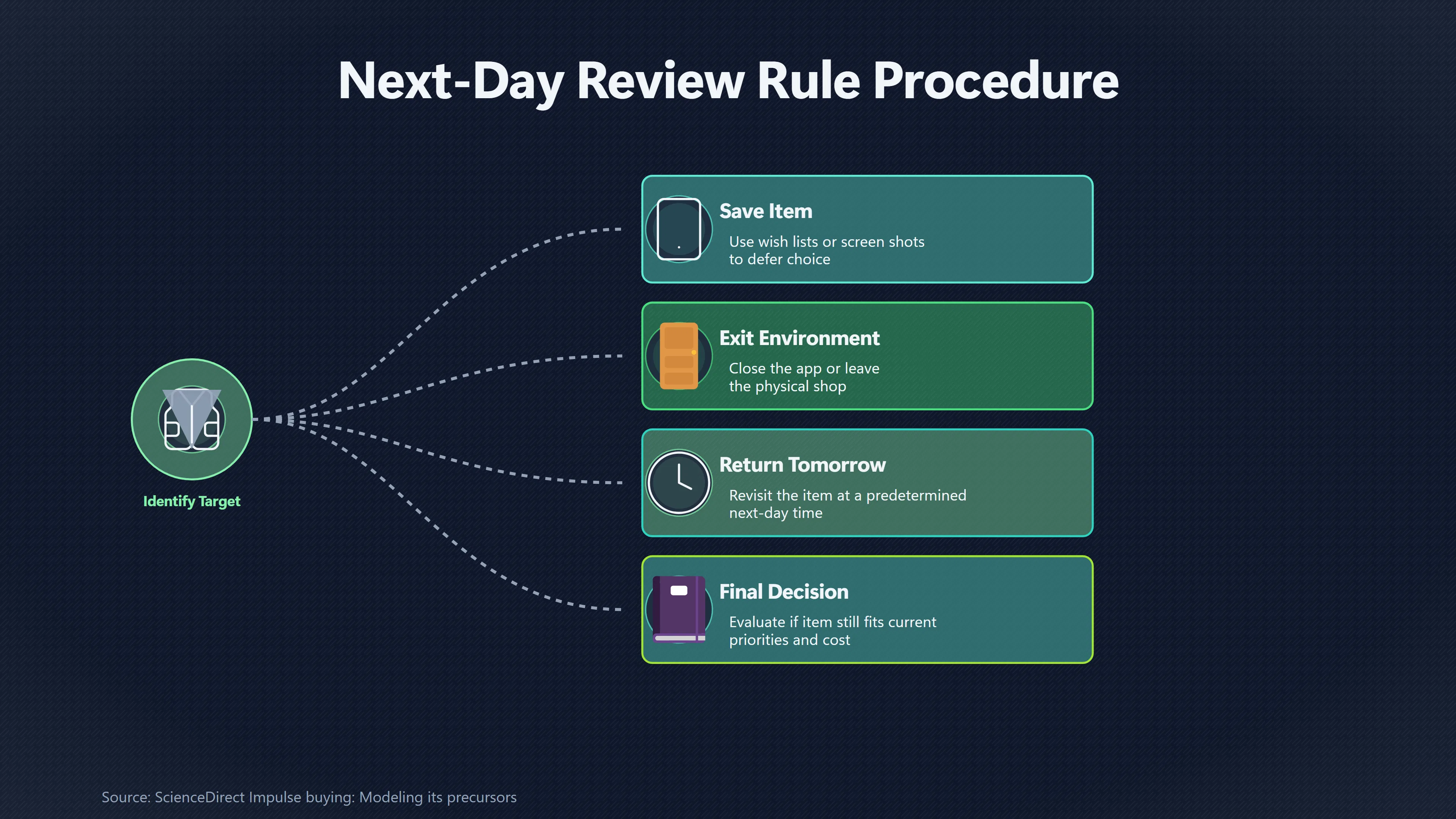
The intervention can be kept deliberately simple:
- Define what must wait. Apply the rule to discretionary, unplanned purchases rather than routine essentials. A supermarket staple that has run out does not need a 24-hour deliberation; an unexpected £80 jacket probably does.
-
Save the item without buying it. Use a wish list, note, screenshot or saved-for-later list. Online commerce makes this form of deferred choice particularly easy: researchers describe wish lists, baskets and similar holding areas as “intermediate choice lists” that let shoppers postpone a final purchase decision. ScienceDirect
- Exit the shopping environment. Close the retailer’s site or app, leave the physical shop, and avoid replacing the original product search with an evening of comparison shopping. This is the element most easily lost when a waiting rule is treated as nothing more than a timer.
- Return at a predetermined time. “Tomorrow” is easier to enforce than “later”. The point is to create a new decision occasion rather than repeatedly reopening the item whenever the urge returns.
- Ask whether you still choose it. The next-day question is not “Can I prove that I don’t need this?” It is simply whether, after the cooling period, the item is still worth its full cost and fits the purpose you would give it.
The saved item matters because postponement need not mean prohibition. Online shoppers already use baskets and saved lists to defer decisions, and research on online shopping hesitation shows that consumers naturally create additional processing time at several stages before final payment. PubMed A personal waiting rule formalises that behaviour: not now remains genuinely different from never.
This distinction can make the system easier to follow. A rigid ban creates an immediate conflict between desire and self-denial. A waiting period asks for a smaller action: preserve the option, but postpone payment. If tomorrow’s answer is still yes, the rule has done its job even if the purchase goes ahead. Its purpose is to filter purchases whose appeal depends heavily on immediacy, not to eliminate discretionary spending.
When a shorter pause can still help
The failure of a ten-minute shopping delay should not be interpreted as evidence that every pause shorter than a day is useless. Moser’s other experiment found that even a brief intervention could reduce felt impulse-buying urge and purchase intention when participants were directed either to reflect on reasons for and against the purchase or to perform an unrelated distracting task. Deep Blue
This suggests a practical hierarchy. If the purchase can comfortably wait until tomorrow, postponement plus leaving the shopping environment is the cleaner rule. If a next-day decision is genuinely impractical, the pause should contain an activity that breaks continued product stimulation: step away, do something unrelated, or deliberately list reasons for and against buying. What appears least promising is passive waiting while continuing to browse.
There is an important limitation here. Much of the direct intervention evidence comes from a small research programme, while the wider impulse-buying literature contains many surveys and correlational studies rather than trials of specific waiting periods. Reviews of the field have explicitly noted the prevalence of correlational evidence and the need for more experimental and longitudinal work. Springer Link So claims such as “a 48-hour rule is twice as effective as a 24-hour rule” or “expensive purchases need seven days” go beyond what the evidence currently establishes.
The defensible lesson is simpler and more useful: make the delay long enough, or different enough, to stop rehearsing the purchase.
A waiting period should cool the urge, not preserve it
The best-supported version of a waiting rule is therefore not a stopwatch attached to checkout. It is a deliberate break between encountering an attractive non-essential item and deciding to pay for it.
For everyday use, a next-day rule has three advantages at once: it is easy to remember, it provides substantially more separation than a token checkout delay, and it naturally creates an opportunity to leave the shopping environment. The University of Michigan experiments give that design more direct support than the popular but poorly substantiated claim that “24 hours” itself is a magic number. Deep Blue
The crucial implementation detail is what happens after the item is saved. Continuing to scroll, compare, watch reviews and inspect alternatives can keep the buying episode alive. Closing the shop and returning to ordinary life gives the original urge an opportunity to weaken. The next day, the product can be judged as a purchase rather than experienced as an impulse.
Amazon book picks
Further Reading
Books and field guides related to When Does Waiting Actually Stop an Impulse Buy?. Use these as the next step if you want deeper reading beyond the article.
The Year of Less
The Year of Less In her late twenties, Cait Flanders found herself stuck in the consumerism cycle that grips so many of us: earn more, bu...
Dopamine Nation
'Her stories have the power to transform your life' Lori Gottlieb, bestselling author of Maybe You Should Talk to Someone 'Radically chan...
Atomic Habits
Rating: 3.5/5 from 7 Google Books ratings
The #1 New York Times bestseller. Over 25 million copies sold! Translated into 60+ languages! Tiny Changes, Remarkable Results No matter...
The Psychology of Money
Doing well with money isn't necessarily about what you know. It's about how you behave. And behavior is hard to teach, even to really sma...
eBay marketplace picks
Marketplace Samples
Live-tested eBay searches with available results related to this page.
Selected fromself improvement wall art oneBay.co.uk.

Current eBay listing
Self improvement Framed Wall Art Poster Canvas Print Picture

Current eBay listing
Self Improvement Quote Framed Wall Art Poster Canvas Print Picture
Endnotes
1.
Source: sciencedirect.com
Title: ScienceDirect Impulse buying: Modeling its precursors
Link:https://www.sciencedirect.com/science/article/pii/S002243599980092X
Source snippet
Impulse buying: Modeling its precursors - ScienceDirect...
2.
Source: sciencedirect.com
Link:https://www.sciencedirect.com/science/article/abs/pii/S0969698914001428
Source snippet
Does urge to buy impulsively differ from impulsive buying behaviour? Assessing the impact of situational factors - ScienceDi...
3.
Source: link.springer.com
Link:https://link.springer.com/article/10.1007/s11747-019-00670-w
Source snippet
Springer LinkImpulse buying: a meta-analytic review | Journal of the Academy of Marketing Science | Springer Nature LinkJuly 9, 2019...
Published: July 9, 2019
4.
Source: doi.org
Title: Impulse buying: A systematic literature review and future research directions
Link:https://doi.org/10.1111/ijcs.12862
Source snippet
Impulse buying: A systematic literature review and future research directions - Redine - 2023 - International Journal of Consumer Stud...
5.
Source: sciencedirect.com
Title: ScienceDirect The role of atmospheric cues in online impulse-buying behavior
Link:https://www.sciencedirect.com/science/article/pii/S1567422313000410
Source snippet
The role of atmospheric cues in online impulse-buying behavior - ScienceDirect...
6.
Source: sciencedirect.com
Title: ScienceDirect Impulse buying: Modeling its precursors
Link:https://www.sciencedirect.com/science/article/abs/pii/S002243599980092X
Source snippet
Impulse buying: Modeling its precursors - ScienceDirect...
7.
Source: sciencedirect.com
Link:https://www.sciencedirect.com/science/article/pii/S0148296312001816
9.
Source: music.amazon.com
Title: parent guide for helping your teen overcome pornography addiction
Link:https://music.amazon.com/podcasts/9f2e4274-fd5d-40c3-b4c8-a05402975dbf/parent-guide-for-helping-your-teen-overcome-pornography-addiction?tag=searcht-20
10.
Source: doi.org
Link:https://doi.org/10.62885/ekuisci.v3i5.1205
11.
Source: sciencedirect.com
Link:https://www.sciencedirect.com/science/article/pii/S0969698926001013
12.
Source: sciencedirect.com
Link:https://www.sciencedirect.com/science/article/abs/pii/S0969698926001013
13.
Source: sciencedirect.com
Link:https://www.sciencedirect.com/science/article/pii/S0969698925003340?dgcid=rss_sd_all
14.
Source: sciencedirect.com
Link:https://www.sciencedirect.com/org/science/article/abs/pii/S0007070X25002496
15.
Source: sciencedirect.com
Link:https://www.sciencedirect.com/science/article/abs/pii/S1071581925002526
16.
Source: sciencedirect.com
Link:https://www.sciencedirect.com/org/science/article/abs/pii/S0736376125000217
17.
Source: sciencedirect.com
Link:https://www.sciencedirect.com/science/article/pii/S0969698925000311
18.
Source: link.springer.com
Link:https://link.springer.com/article/10.1007/s11747-025-01091-8
19.
Source: sciencedirect.com
Title: The effects of buy now, pay later (BNPL) on customers’ online purchase behavior
Link:https://www.sciencedirect.com/science/article/pii/S0022435924000654
20.
Source: doi.org
Title: The Effect of Payment Delay on Consumer Purchase Intention
Link:https://doi.org/10.3390/admsci14090226
21.
Source: sciencedirect.com
Link:https://www.sciencedirect.com/science/article/abs/pii/S0969698924000262
22.
Source: doi.org
Link:https://doi.org/10.7717/peerj-cs.1777
23.
Source: sciencedirect.com
Link:https://www.sciencedirect.com/science/article/pii/S0377221721006226
24.
Source: sciencedirect.com
Link:https://www.sciencedirect.com/science/article/abs/pii/S0377221721006226
25.
Source: sciencedirect.com
Title: Using mobile while shopping in-store: a new model of impulse-buying behaviour
Link:https://www.sciencedirect.com/org/science/article/pii/S0736376122000453
26.
Source: doi.org
Link:https://doi.org/10.1108/JRIM
27.
Source: sciencedirect.com
Title: Active and upcoming deals: effect on purchase intention
Link:https://www.sciencedirect.com/org/science/article/abs/pii/S0263450319000135
28.
Source: doi.org
Link:https://doi.org/10.1111/jbl.12210
29.
Source: sciencedirect.com
Title: Now or later: Delay’s effects on post-consumption emotions and consumer loyalty
Link:https://www.sciencedirect.com/science/article/abs/pii/S0148296313003147
30.
Source: sciencedirect.com
Link:https://www.sciencedirect.com/science/article/abs/pii/S0167923613000900
31.
Source: sciencedirect.com
Link:https://www.sciencedirect.com/science/article/pii/S0969698912000781
32.
Source: sciencedirect.com
Link:https://www.sciencedirect.com/science/article/abs/pii/S0969698912000781
33.
Source: doi.org
Title: Advance Selling When Consumers Regret | Management Science
Link:https://doi.org/10.1287/MNSC.1110.1473
34.
Source: sciencedirect.com
Title: Exploring night-time grocery shopping behaviour
Link:https://www.sciencedirect.com/science/article/abs/pii/S0969698906000191
35.
Source: sciencedirect.com
Title: The effect of time delay on multi-attribute choice
Link:https://www.sciencedirect.com/science/article/pii/S0167487003001089
36.
Source: sciencedirect.com
Title: Model-based evaluation of cooling-off policies
Link:https://www.sciencedirect.com/science/article/pii/S0899825621000695
37.
Source: sciencedirect.com
Title: Model-based evaluation of cooling-off policies
Link:https://www.sciencedirect.com/science/article/abs/pii/S0899825621000695
38.
Source: sciencedirect.com
Title: Socio-economic status, delay of gratification, and impulse buying
Link:https://www.sciencedirect.com/science/article/abs/pii/S0167487098000099
39.
Source: sciencedirect.com
Link:https://www.sciencedirect.com/science/article/pii/S0969698925003340
40.
Source: sciencedirect.com
Title: Now or later: Delay’s effects on post-consumption emotions and consumer loyalty
Link:https://www.sciencedirect.com/science/article/pii/S0148296313003147
41.
Source: sciencedirect.com
Link:https://www.sciencedirect.com/science/article/pii/S1071581925002526
42.
Source: sciencedirect.com
Link:https://www.sciencedirect.com/science/article/pii/S0969698924000262
43.
Source: sciencedirect.com
Link:https://www.sciencedirect.com/science/article/pii/S0148296320307402
44.
Source: sciencedirect.com
Link:https://www.sciencedirect.com/science/article/pii/S0148296317302424
45.
Source: sciencedirect.com
Title: Decision-makers are more impulsive on smartphones than on computers
Link:https://www.sciencedirect.com/science/article/pii/S2214804322000891
46.
Source: sciencedirect.com
Link:https://www.sciencedirect.com/science/article/pii/S0969698925000475
47.
Source: sciencedirect.com
Title: Demand Postponement with Strategic Service Customers
Link:https://www.sciencedirect.com/science/article/pii/S0305048321001493
48.
Source: doi.org
Title: Consumer wayfinding tasks, strategies, and errors: An exploratory field study
Link:https://doi.org/10.1002/%28SICI%291520-6793%28199605%2913%3A3%3C265%3A%3AAID-MAR2%3E3.0.CO%3B2-A
49.
Source: doi.org
Link:https://doi.org/10.1016/j.ijhcs.2025.103697
50.
Source: doi.org
Link:https://doi.org/10.1016/j.jretconser.2022.103000
51.
Source: deepblue.lib.umich.edu
Title: Deep Blue Impulse Buying: Designing for Self-Control with E-commerce
Link:https://deepblue.lib.umich.edu/items/b4da4889-a5bd-4fd5-a8c6-5b940df3b972
52.
Source: si.umich.edu
Title: School of Information Virtual dissertation defense: Carol Moser | umsi
Link:https://www.si.umich.edu/about-umsi/events/virtual-dissertation-defense-carol-moser
53.
Source: deepblue.lib.umich.edu
Link:https://deepblue.lib.umich.edu/data/concern/data_sets/m039k5047?locale=en
Source snippet
Deep BlueData Set | Impulse Buying: Designing for Self-Control with E-commerce | ID: m039k5047 | Deep Blue Data...
54.
Source: deepblue.lib.umich.edu
Title: Deep Blue Impulse Buying: Designing for Self-Control
Link:https://deepblue.lib.umich.edu/bitstream/handle/2027.42/155212/moserc_1.pdf
56.
Source: pmc.ncbi.nlm.nih.gov
Link:https://pmc.ncbi.nlm.nih.gov/articles/PMC11848323/
57.
Source: pmc.ncbi.nlm.nih.gov
Link:https://pmc.ncbi.nlm.nih.gov/articles/PMC11694021/
58.
Source: pmc.ncbi.nlm.nih.gov
Link:https://pmc.ncbi.nlm.nih.gov/articles/PMC11481336/
59.
Source: pmc.ncbi.nlm.nih.gov
Link:https://pmc.ncbi.nlm.nih.gov/articles/PMC10803011/
60.
Source: pmc.ncbi.nlm.nih.gov
Link:https://pmc.ncbi.nlm.nih.gov/articles/PMC9763727/
61.
Source: onlinelibrary.wiley.com
Link:https://onlinelibrary.wiley.com/doi/full/10.1111/ijcs.12862
62.
Source: onlinelibrary.wiley.com
Link:https://onlinelibrary.wiley.com/doi/abs/10.1111/ijcs.12862
63.
Source: pmc.ncbi.nlm.nih.gov
Link:https://pmc.ncbi.nlm.nih.gov/articles/PMC9275553/
64.
Source: pmc.ncbi.nlm.nih.gov
Link:https://pmc.ncbi.nlm.nih.gov/articles/PMC8811303/
65.
Source: ofgem.gov.uk
Link:https://www.ofgem.gov.uk/publications/domestic-consumer-expectations-and-preferences-switching-energy-supplier-and-cooling-period
66.
Source: researchportal.hkust.edu.hk
Title: hkust.edu.hk Advance selling when consumers regret
Link:https://researchportal.hkust.edu.hk/en/publications/advance-selling-when-consumers-regret/
67.
Source: GOV.UK
Title: www.gov.uk How to be savvy when doing your Christmas shopping
Link:https://www.gov.uk/government/news/how-to-be-savvy-when-doing-your-christmas-shopping
68.
Source: deepblue.lib.umich.edu
Link:https://deepblue.lib.umich.edu/data/catalog?depositor=%22bdcase%40umich.edu%22&f%5Bcreator_sim%5D%5B%5D=Moser%2C+Carol&f%5Bsubject_discipline_sim%5D%5B%5D=Social+Sciences&locale=en&per_page=50&search_field=advanced&sort=system_modified_dtsi+asc
69.
Source: deepblue.lib.umich.edu
Link:https://deepblue.lib.umich.edu/data/catalog.html?depositor=%22cjsifuen%40umich.edu%22&locale=en&page=9&per_page=100&search_field=advanced&sort=title_sort_ssi+desc
70.
Source: deepblue.lib.umich.edu
Link:https://deepblue.lib.umich.edu/data/catalog?depositor=%22weiyuli%40umich.edu%22&f%5Bhuman_readable_type_sim%5D%5B%5D=Work&f%5Blanguage_sim%5D%5B%5D=English&f%5Bresource_type_sim%5D%5B%5D=Dataset&locale=en&page=10&per_page=20&search_field=advanced&sort=system_create_dtsi+asc
71.
Source: dictionary.cambridge.org
Title: impulse purchase
Link:https://dictionary.cambridge.org/dictionary/english/impulse-purchase
72.
Source: dictionary.cambridge.org
Title: impulse purchase
Link:https://dictionary.cambridge.org/no/ordbok/engelsk/impulse-purchase
73.
Source: repository.hkust.edu.hk
Title: hkust.edu.hk The effect of time delay on multi-attribute choice
Link:https://repository.hkust.edu.hk/ir/Record/1783.1-9847
74.
Source: theapef.org
Link:https://www.theapef.org/financial-literacy/make-it-make-cents/impulse-buying
Additional References
75.
Source: youtube.com
Title: Why You Keep Buying Things You Don’t End Up Using
Link:https://www.youtube.com/watch?v=HENG9mXYGxs
Source snippet
For a deeper look into the behavioral mechanics of delaying gratification and interrupting spending momentum, check out The 24-Hour Rule...
76.
Source: nature.com
Link:https://www.nature.com/articles/s41599-023-02204-w
77.
Source: youtube.com
Title: Your Brain’s Hijacked: 7 Ways to Stop Impulse Spending NOW
Link:https://www.youtube.com/watch?v=OS1L8F6L77E
Source snippet
The Real Reason You Can't Stop Impulse Buying...
78.
Source: researchgate.net
Link:https://www.researchgate.net/publication/360474910_Dark_patterns_in_online_shopping_do_they_work_and_can_nudges_help_mitigate_impulse_buying
79.
Source: researchgate.net
Link:https://www.researchgate.net/publication/371145538_Exploring_the_Factors_Affecting_the_Online_and_Offline_Impulse_Buying_Behaviour_of_the_Millennium_Generation
80.
Source: researchgate.net
Link:https://www.researchgate.net/publication/256022122_In_Praise_of_Putting_Things_Off_Postponing_Consumption_Pleasures_Facilitates_Self-Control
81.
Source: researchgate.net
Link:https://www.researchgate.net/publication/247837214_Remedying_Hyperopia_The_Effects_of_Self-Control_Regret_on_Consumer_Behavior
82.
Source: researchgate.net
Link:https://www.researchgate.net/publication/381158307_System-2_Recommenders_Disentangling_Utility_and_Engagement_in_Recommendation_Systems_via_Temporal_Point-Processes
83.
Source: researchgate.net
Link:https://www.researchgate.net/publication/372088425_The_role_of_dark_pattern_stimuli_and_personality_in_online_impulse_shopping_An_application_of_S-O-R_theory
84.
Source: researchgate.net
Link:https://www.researchgate.net/publication/378809800_The_urge_to_splurge_Differentiating_unplanned_and_impulse_purchases