Within Precommitment
Does Making Savings Harder to Reach Work?
Commitment savings can raise balances by making money harder to withdraw before short-term spending competes with a longer-term goal.
On this page
- How restricted access changes the spending decision
- What the Philippines commitment account trial found
- When mild separation may be better than a hard lock
Page outline Jump by section
Introduction
Commitment savings can work because they change when the spending decision is made. Instead of leaving saved money continuously available and relying on restraint whenever an impulse purchase appears, the saver chooses in advance to make some money difficult or impossible to withdraw until a date or target is reached. The strongest field evidence comes from a randomised trial in the Philippines: clients offered such an account accumulated substantially higher bank savings after a year, even though the account paid the same interest rate as ordinary savings.[isps.yale.edu]isps.yale.eduJanuary 20, 2006…
That is good evidence that restricted access can help some people save. It is not evidence that everyone should lock up their money. Hard commitments sacrifice liquidity, uptake can be limited, and other studies show that people facing financial shocks or existing debt can respond in ways that offset the apparent benefit. The practical question is therefore not simply whether making savings harder to reach works, but when the protection from impulsive withdrawal is worth the loss of flexibility.[GOV.UK]GOV.UKThe limits of commitment: who benefits from illiquid savings products13, 2021…
How restricted access changes the spending decision
An ordinary savings account leaves two decisions open. First, you decide whether to put money into savings. Later, whenever another use for the money appears, you decide whether to take it back out. The second decision can quietly undo the first.
A commitment account removes or weakens that second decision. Once money crosses the boundary, the saver cannot simply reverse course because a purchase suddenly feels attractive. This is a particularly literal form of precommitment: rather than hoping to prefer the long-term goal tomorrow, the saver deliberately gives tomorrow’s self fewer options.
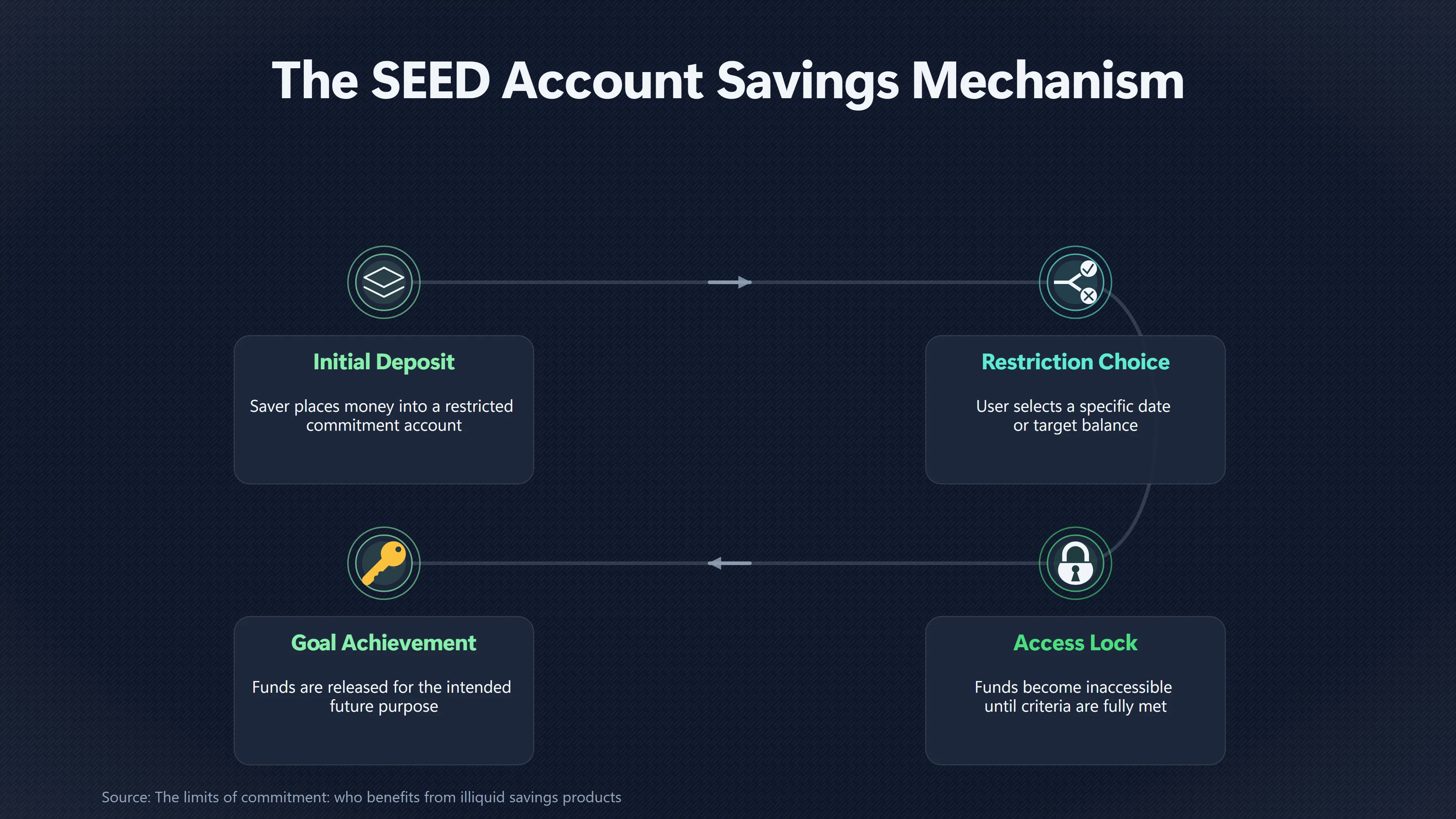
The Philippine experiment makes the mechanism unusually clear. Researchers Nava Ashraf, Dean Karlan and Wesley Yin worked with the Green Bank of Caraga in Mindanao to create the SEED account. Clients could choose one of two withdrawal restrictions. They could specify a future date, such as a time when school fees or Christmas expenses were expected, or specify a target balance, such as the amount needed for a home improvement. Once chosen, the restriction could not simply be changed and the funds normally remained inaccessible until the target was met.[ResearchGate]researchgate.netResearchGate(PDF) Tying Odysseus to the Mast: Evidence From a Commitment Savings Product in the PhilippinesJuly 1, 2005…
That design matters because it separates commitment from financial reward. SEED paid the same 4 per cent annual interest as the bank’s ordinary savings account. The special feature was therefore not a higher return for tolerating inconvenience; it was the inability to casually undo the saving decision.[J-PAL]povertyactionlab.orgOpen source on povertyactionlab.org.
Among the 202 people who opened SEED accounts, 140 chose a date-based target and 62 an amount-based target. The researchers regarded the amount target as potentially stronger: if access requires reaching a particular balance, stopping deposits early also postpones access to the money already saved. A date lock, by contrast, eventually expires whether or not the saver continues contributing.[ResearchGate]researchgate.netResearchGate(PDF) Tying Odysseus to the Mast: Evidence From a Commitment Savings Product in the PhilippinesJuly 1, 2005…
The product also linked the restriction to concrete purposes. Forty-eight per cent of account holders named celebrations such as Christmas, birthdays or fiestas as their goal; 21 per cent named education, while another 20 per cent named business or home investment. That illustrates an important feature of commitment saving: the lock was not merely making money inconvenient to obtain. It was protecting money already assigned to a future use from competing demands in the meantime.[ResearchGate]researchgate.netResearchGate(PDF) Tying Odysseus to the Mast: Evidence From a Commitment Savings Product in the PhilippinesJuly 1, 2005…
What the Philippines trial found
The experiment began with 1,777 existing or former bank clients. Of 710 clients randomly offered the commitment product, 202 — 28.4 per cent — opened an account. After twelve months, the average savings balance of clients assigned to the commitment-treatment group was 81 percentage points higher than that of the control group. Because assignment to the offer was random, the comparison is considerably more informative than simply observing that people who voluntarily choose locked accounts tend to save more.[isps.yale.edu]isps.yale.eduJanuary 20, 2006…
The distinction between being offered the account and opening one is crucial. Only about 28 per cent of those offered SEED accepted it, yet the headline effect compares the whole treatment group with the control group. The experiment therefore provides evidence that making a commitment account available and actively offering it caused higher savings, rather than merely showing that unusually motivated savers accumulated money after choosing one.[isps.yale.edu]isps.yale.eduJanuary 20, 2006…
There was also evidence that the people attracted to commitment were not random. In baseline questions designed to detect changing preferences between immediate and delayed rewards, women showing the pattern the researchers associated with time inconsistency were significantly more likely to take up SEED. This is consistent with the intended mechanism: at least some customers appeared to recognise value in restricting their own future access. It should not, however, be read as proof that present bias explains every account opened. Restricted personal control over money within a household was another plausible benefit of an individually controlled account.[isps.yale.edu]isps.yale.eduJanuary 20, 2006…
The result is especially striking because the intervention did not require people to make continuing deposits. SEED restricted withdrawals but did not contractually force subsequent saving. In that sense, the intervention protected accumulated money rather than replacing the act of saving itself.[ResearchGate]researchgate.netResearchGate(PDF) Tying Odysseus to the Mast: Evidence From a Commitment Savings Product in the PhilippinesJuly 1, 2005…
Later research also found effects beyond the account balance. Among married women who initially had relatively little household decision-making power, being offered the individually controlled commitment account affected measures of financial decision-making and shifted spending towards some female-oriented durable goods. Those findings underline that making savings inaccessible to other immediate claims can matter for reasons besides one’s own impulse spending. They also caution against interpreting every effect of SEED as pure self-control.[ScienceDirect]sciencedirect.comFemale Empowerment: Impact of a Commitment Savings Product in the Philippines - ScienceDirect…

A harder lock is not automatically a better lock
If restricting withdrawals protects savings, it is tempting to conclude that stronger restrictions should always work better. The wider experimental literature gives a more complicated answer.
In one experiment examining different withdrawal rules, participants allocated money between liquid savings and commitment accounts. When interest rates were equal, the account permitting no early withdrawal attracted more money than versions offering either emergency access or withdrawal with a 10 per cent penalty. The strict account received 53.7 per cent of participants’ allocated funds, compared with roughly 45 per cent for the less restrictive alternatives. When both a no-withdrawal account and a 10 per cent penalty account were simultaneously available, participants still put substantially more into the completely locked version.[National Bureau of Economic Research]nber.orgOpen source on nber.org.
That finding is useful because it rules out a simple assumption that consumers invariably dislike strong commitment. Some people appear willing to sacrifice liquidity precisely because a weak barrier can be overridden when temptation arrives.
But there is a selection problem built into that strength. A hard lock can only protect money that someone is willing to put behind it. Research comparing hard and soft commitment savings found that hard commitments can suffer from lower initial uptake. In a six-month randomised experiment, a softer intervention — asking participants to identify savings goals and pledge to pursue them without actually preventing withdrawals — generated more initial saving than either an unrestricted account or a hard commitment account. Yet among participants using the products, the hard commitment ultimately produced the largest savings balances at six months.[Wiley Online Library]onlinelibrary.wiley.comOnline Library Soft versus Hard Commitments: A Test on Savings BehaviorsWiley Online LibrarySoft versus Hard Commitments: A Test on Savings Behaviors - Burke - 2018 - Journal of Consumer Affairs - Wiley Online…
The apparent tension is informative rather than contradictory. A strong lock may be more effective once adopted, while a milder barrier may be acceptable to more people. The best intervention therefore depends not only on how effectively it prevents withdrawals, but also on whether people will use it in the first place.
When mild separation may be better than a hard lock
Liquidity has real value. Money withdrawn for an impulsive purchase and money withdrawn for an emergency look identical in an account ledger, but they are not equivalent for the saver. A commitment mechanism designed to stop the first can create problems if it also prevents the second.
Evidence from Kenya illustrates the trade-off. A field experiment compared a softer “safe box”, whose key remained with the saver, with a more restrictive locked box for health savings. The softer version had somewhat higher take-up and significantly increased spending on the intended preventative-health investments; the harder lock produced a much smaller, statistically insignificant effect on that target outcome. Researchers reviewing the experiment emphasised the central design problem: stronger commitment can improve self-control, but reduced flexibility makes it harder to respond to genuine shocks and increases the cost of choosing the wrong commitment in advance.[PubMed Central (PMC)]pmc.ncbi.nlm.nih.govPub Med Central (PMC)SAVINGS BY AND FOR THE POOR: A RESEARCH REVIEW AND AGENDAPub Med Central (PMC)SAVINGS BY AND FOR THE POOR: A RESEARCH REVIEW AND AGENDA
Research in Ghana provides an even sharper warning against judging commitment products solely by the balance visible in the locked account. An illiquid savings intervention increased savings held at the participating bank overall. But customers with above-median histories of overdrafting did not generate additional net savings once their finances elsewhere were considered. Instead, they reduced other savings and took on new debt, offsetting the committed funds. Customers with lower previous overdraft use, by contrast, increased savings during and after the commitment period.[GOV.UK]GOV.UKThe limits of commitment: who benefits from illiquid savings products13, 2021…
This changes the interpretation of “successful” locking. If £500 appears in an inaccessible account while the saver simultaneously borrows £500 at high cost to meet ordinary expenses, the commitment has not produced the same improvement as £500 of genuinely additional saving. For someone with volatile income, little emergency liquidity or expensive debt, preserving access to cash can be more valuable than preventing every discretionary withdrawal.
There is therefore a useful spectrum rather than a simple locked-versus-unlocked choice. At one end sits a binding account such as SEED, where a predetermined rule removes the later withdrawal decision. Further along are penalties or emergency exceptions that make withdrawals possible but costly. Softer still are separate accounts, earmarking and physical separation: money remains technically accessible, but taking it requires crossing an extra boundary. Reviews of the evidence find support for both externally enforced restrictions and softer psychological commitment, while also warning that restrictions and penalties can impose costs without necessarily creating equivalent gains in overall savings.[Evidence Hub]evidence-hub.maps.org.ukOpen source on maps.org.uk.
For self-improvement, the design principle is therefore narrower than “lock your money away”. A hard commitment makes the most sense when the future expense is reasonably predictable, the protected money is genuinely surplus to near-term needs, adequate emergency liquidity exists elsewhere, and repeated discretionary withdrawals are the problem being solved. Mild separation is more attractive when the saver wants friction rather than prohibition — enough distance to interrupt an impulsive purchase, but not so much that an unexpected bill turns a behavioural tool into a financial constraint.

Does making savings harder to reach work?
Yes, for some savers and some goals. The Philippine SEED experiment provides unusually clean evidence that voluntarily restricting future withdrawals can materially increase savings, and subsequent experiments confirm that people sometimes actively prefer strong illiquidity when it protects them from future spending.[isps.yale.edu]isps.yale.eduJanuary 20, 2006…
But the mechanism works by exchanging flexibility for protection. That exchange is valuable when easy access repeatedly defeats a stable long-term intention. It becomes less attractive when the future is genuinely uncertain, liquidity is already scarce or locking one pot merely pushes spending into debt or withdrawals from another.
The broader lesson for precommitment is consequently precise: the benefit does not come from making life arbitrarily difficult. It comes from identifying a predictable decision that tends to go wrong — “shall I raid these savings?” — and, where the consequences of doing so are acceptable, making that decision earlier. Commitment savings works when today’s deliberate restriction is a better guide to the saver’s long-term interests than tomorrow’s easy withdrawal.
Amazon book picks
Further Reading
Books and field guides related to Does Making Savings Harder to Reach Work?. Use these as the next step if you want deeper reading beyond the article.
Your Money or Your Life
A fully revised edition of one of the most influential books ever written on personal finance with more than a million copies sold “The b...
Nudge
Rating: 3.5/5 from 29 Google Books ratings
Thaler and Sunstein offer a groundbreaking discussion of how to apply the science of choice to nudge people toward decisions that can imp...
The Psychology of Money: Timeless Lessons on Wealth, Greed, a...
Doing well with money isn’t necessarily about what you know. It’s about how you behave. And behavior is hard to teach, even to really sma...
Nudge: Improving Decisions About Health, Wealth, and Happiness
Rating: 3.5/5 from 29 Google Books ratings
Thaler and Sunstein offer a groundbreaking discussion of how to apply the science of choice to nudge people toward decisions that can imp...
eBay marketplace picks
Marketplace Samples
Live-tested eBay searches with available results related to this page.
Selected frommotivational poster oneBay.co.uk.

Current eBay listing
Motivational Quotes Framed Wall Art Poster Canvas Print Picture



Current eBay listing
Gym Motivational Posters Work Out Insperational Quotes Wall Art
Endnotes
1.
Source: isps.yale.edu
Link:https://isps.yale.edu/resource/tying-odysseus-to-the-mast-evidence-from-a-commitment-savings-product-in-the-philippines
Source snippet
January 20, 2006...
Published: January 20, 2006
2.
Source: povertyactionlab.org
Link:https://www.povertyactionlab.org/evaluation/commitment-savings-products-philippines
3.
Source: GOV.UK
Title: The limits of commitment: who benefits from illiquid savings products
Link:https://www.gov.uk/research-for-development-outputs/the-limits-of-commitment-who-benefits-from-illiquid-savings-products
Source snippet
13, 2021...
4.
Source: onlinelibrary.wiley.com
Title: Online Library Soft versus Hard Commitments: A Test on Savings Behaviors
Link:https://onlinelibrary.wiley.com/doi/10.1111/joca.12170
Source snippet
Wiley Online LibrarySoft versus Hard Commitments: A Test on Savings Behaviors - Burke - 2018 - Journal of Consumer Affairs - Wiley Online...
5.
Source: researchgate.net
Link:https://www.researchgate.net/publication/5012112_Tying_Odysseus_to_the_Mast_Evidence_From_a_Commitment_Savings_Product_in_the_Philippines
Source snippet
ResearchGate(PDF) Tying Odysseus to the Mast: Evidence From a Commitment Savings Product in the PhilippinesJuly 1, 2005...
Published: July 1, 2005
6.
Source: povertyactionlab.org
Link:https://www.povertyactionlab.org/evaluation/commitment-savings-products-philippines?lang=en
7.
Source: sciencedirect.com
Link:https://www.sciencedirect.com/science/article/pii/S0305750X09001910
Source snippet
Female Empowerment: Impact of a Commitment Savings Product in the Philippines - ScienceDirect...
8.
Source: sciencedirect.com
Link:https://www.sciencedirect.com/science/article/abs/pii/S0305750X09001910
Source snippet
Female Empowerment: Impact of a Commitment Savings Product in the Philippines - ScienceDirect...
9.
Source: onlinelibrary.wiley.com
Title: Online Library Savings by and for the Poor: A Research Review and Agenda
Link:https://onlinelibrary.wiley.com/doi/full/10.1111/roiw.12101
10.
Source: researchgate.net
Title: (PDF) Semiparametric Efficiency in Policy Learning with General Treatments
Link:https://www.researchgate.net/publication/398980213_Semiparametric_Efficiency_in_Policy_Learning_with_General_Treatments
11.
Source: sciencedirect.com
Link:https://www.sciencedirect.com/science/article/pii/S0264999323003486
12.
Source: myscp.onlinelibrary.wiley.com
Link:https://myscp.onlinelibrary.wiley.com/doi/10.1002/jcpy.1354
13.
Source: sciencedirect.com
Link:https://www.sciencedirect.com/science/article/pii/S0167268121004984
14.
Source: sciencedirect.com
Link:https://www.sciencedirect.com/science/article/pii/S0047272720300086
15.
Source: sciencedirect.com
Link:https://www.sciencedirect.com/science/article/abs/pii/S0047272720300086
16.
Source: researchgate.net
Link:https://www.researchgate.net/publication/323503881_The_Role_of_Mental_Accounting_in_Household_Spending_and_Investing_Decisions
17.
Source: researchgate.net
Title: Soft versus Hard Commitments: A Test on Savings Behaviors
Link:https://www.researchgate.net/publication/321076741_Soft_versus_Hard_Commitments_A_Test_on_Savings_Behaviors
18.
Source: researchgate.net
Title: 397486284 Intertemporal Choice
Link:https://www.researchgate.net/publication/397486284_Intertemporal_Choice
19.
Source: onlinelibrary.wiley.com
Link:https://onlinelibrary.wiley.com/doi/full/10.1002/CL2.157
20.
Source: researchgate.net
Title: (PDF) Savings By and For the Poor: A Research Review and Agenda
Link:https://www.researchgate.net/publication/260307479_Savings_By_and_For_the_Poor_A_Research_Review_and_Agenda
21.
Source: onlinelibrary.wiley.com
Link:https://onlinelibrary.wiley.com/doi/abs/10.1111/roiw.12101
22.
Source: sciencedirect.com
Link:https://www.sciencedirect.com/science/article/pii/S0167487004001047
23.
Source: researchgate.net
Title: (PDF) A Review of Commitment Savings Products in Developing Countries
Link:https://www.researchgate.net/publication/237534234_A_Review_of_Commitment_Savings_Products_in_Developing_Countries
24.
Source: sciencedirect.com
Title: Are assets fungible?: Testing the behavioral theory of life-cycle savings
Link:https://www.sciencedirect.com/science/article/pii/S0167268198000705
25.
Source: sciencedirect.com
Title: Loose knots: Strong versus weak commitments to save for education in Uganda
Link:https://www.sciencedirect.com/science/article/pii/S0304387824001937
26.
Source: serp-p.pids.gov.ph
Link:https://serp-p.pids.gov.ph/publication/public/view?slug=tying-odysseus-to-the-mast-evidence-from-a-commitment-savings-product-in-the-philippines
27.
Source: researchgate.net
Link:https://www.researchgate.net/scientific-contributions/Tricia-Koroknay-Palicz-2279496971
28.
Source: researchgate.net
Link:https://www.researchgate.net/publication/347764658_The_Limits_of_Commitment_Who_Benefits_From_Illiquid_Savings_Products
29.
Source: neuaxis.mod.gov.my
Link:https://neuaxis.mod.gov.my/neuaxis/Record/okr-10986-30654
30.
Source: nber.org
Link:https://www.nber.org/papers/w21474
31.
Source: pmc.ncbi.nlm.nih.gov
Link:https://pmc.ncbi.nlm.nih.gov/articles/PMC7079766/
32.
Source: pmc.ncbi.nlm.nih.gov
Title: Pub Med Central (PMC)SAVINGS BY AND FOR THE POOR: A RESEARCH REVIEW AND AGENDA
Link:https://pmc.ncbi.nlm.nih.gov/articles/PMC4358152/
33.
Source: evidence-hub.maps.org.uk
Link:https://evidence-hub.maps.org.uk/en/research-library/review/evidence-based-strategies-to-build-emergency-savings
34.
Source: pmc.ncbi.nlm.nih.gov
Link:https://pmc.ncbi.nlm.nih.gov/articles/PMC12272607/
35.
Source: pmc.ncbi.nlm.nih.gov
Link:https://pmc.ncbi.nlm.nih.gov/articles/PMC11894509/
36.
Source: povertyactionlab.org
Link:https://www.povertyactionlab.org/blog/5-26-21/leveraging-behavioral-insights-increase-savings-low-and-middle-income-countries
37.
Source: doi.org
Title: AE A RCT Registry
Link:https://doi.org/10.1257/rct.3682-3.2
38.
Source: pmc.ncbi.nlm.nih.gov
Link:https://pmc.ncbi.nlm.nih.gov/articles/PMC6092028/
39.
Source: povertyactionlab.org
Link:https://www.povertyactionlab.org/media/file-research-paper/tying-odysseus-mast-evidence-commitment-savings-product-philippines
40.
Source: povertyactionlab.org
Link:https://www.povertyactionlab.org/evaluation/deposit-collectors-philippines
41.
Source: povertyactionlab.org
Link:https://www.povertyactionlab.org/es/evaluation/productos-de-ahorro-con-compromiso-en-filipinas?lang=es
42.
Source: povertyactionlab.org
Link:https://www.povertyactionlab.org/evaluation/commitment-savings-accounts-farmers-rwanda
43.
Source: pubmed.ncbi.nlm.nih.gov
Link:https://pubmed.ncbi.nlm.nih.gov/40313910/
Additional References
44.
Source: youtube.com
Title: Can Commitment Savings Help Americans Be Better Prepared for Retirement?
Link:http://www.youtube.com/watch?v=8FzffFjklQ0
Source snippet
Commitment devices savings behavioral economics Commitment Devices in Behavioral Economics...
45.
Source: youtube.com
Link:http://www.youtube.com/watch?v=shTPlnMXvYQ
Source snippet
FAI's Timothy Ogden in Conversation with Harvard's Nava Ashraf (Part 1)...
46.
Source: youtube.com
Title: FAI’s Timothy Ogden in Conversation with Harvard’s Nava Ashraf (Part 1)
Link:http://www.youtube.com/watch?v=0iRMAGu-G94
Source snippet
Can Commitment Savings Help Americans Be Better Prepared for Retirement?...
47.
Source: youtube.com
Link:http://www.youtube.com/watch?v=j6noKx4liOo
Source snippet
Small Change Big Change, The Limbo Game of Savings: Dean Karlan at TEDxMiddlebury...
48.
Source: studylib.net
Link:https://studylib.net/doc/10606087/tying-odysseus-to-the-mast–evidence-from-a-n-a
49.
Source: cenfri.org
Link:https://cenfri.org/research-paper/household-decision-making-and-savings-impacts-further-evidence-from-a-commitment-savings-product-in-the-philippines/
50.
Source: poverty-action.org
Link:https://poverty-action.org/publication/limits-commitment-who-benefits-illiquid-savings-products
51.
Source: poverty-action.org
Link:https://poverty-action.org/publication/tying-odysseus-mast-evidence-commitment-savings-product-philippines
52.
Source: scribd.com
Link:https://www.scribd.com/document/1017146994/Poor-Economics-Book-Report
53.
Source: eurekamag.com
Link:https://eurekamag.com/research/087/633/087633697.php