Within Design Around Temptation
How Preselected Options Quietly Change What You Buy
Preselected options can steer shoppers toward costlier choices even when they never actively decide that the upgrade is better.
On this page
- What the UK online shopping experiment found
- Why preselection changes consumer decisions
- How to review defaults before completing a purchase
Page outline Jump by section
Introduction
A preselected shopping option can change what people buy even when they never consciously decide that the preselected choice is better. In a large UK government-commissioned experiment, shoppers shown a more expensive option already selected were about 60% more likely to choose the costlier protection plan and 70% more likely to choose the costlier shipping option than shoppers required to make an active choice. The same experiment found that people moved through the shopping journey faster when an option was preselected.[GOV.UK Assets]service.gov.ukUK Assets Research into potentially harmful online choice architectureAssetsResearch into potentially harmful online choice architecture
That makes shopping defaults a useful example of environment design in self-improvement. The practical lesson is not that online shops are universally manipulating customers: most defaults observed in the accompanying UK survey actually pointed towards cheaper or similarly priced choices. Rather, the starting state of a decision deserves scrutiny because accepting it can feel like doing nothing, while rejecting it requires an active decision.[GOV.UK]GOV.UKThe prevalence and potential harm of defaults in online shoppingThe prevalence and potential harm of defaults in online shopping
What the UK online-shopping experiment found
The Department for Business and Trade commissioned Alma Economics to examine defaults in UK e-commerce. The research, conducted in 2024, had two linked stages. First, researchers manually followed consumer journeys through 558 popular UK shopping websites and apps. They recorded 412 instances of defaults, spread across 49% of the sampled services. Defaults were particularly common in retail: 69% of the retail websites and apps examined contained at least one. Shipping and delivery were the most common defaults within the customer-service category.[GOV.UK]GOV.UKThe prevalence and potential harm of defaults in online shoppingThe prevalence and potential harm of defaults in online shopping
Importantly, this observational exercise did not show that online defaults were generally designed to make shoppers spend more. About 64% directed people towards a cheaper or similarly priced option. The researchers therefore described the real-world picture as more nuanced than a simple story about harmful design. Defaults can save effort when they select an option that suits the shopper; the problem arises when the default and the shopper’s interests diverge.[GOV.UK Assets]service.gov.ukUK Assets Research into potentially harmful online choice architectureAssetsResearch into potentially harmful online choice architecture
The second stage isolated that possibility experimentally. A randomised controlled trial involved 5,889 participants using a simulated shopping platform designed to resemble a familiar e-commerce site. Participants encountered decisions involving either a protection plan or shipping. In the control condition they had to choose actively; in treatment conditions, the more expensive choice was either genuinely preselected or merely made to look visually prominent in a way that mimicked a default.[GOV.UK Assets]service.gov.ukUK Assets Research into potentially harmful online choice architectureAssetsResearch into potentially harmful online choice architecture
The distinction produced the study’s most striking result. Actual preselection strongly increased selection of the expensive option: roughly 60% for the protection plan and 70% for shipping relative to the control condition. By contrast, merely making an option look like a default had much weaker effects. For protection plans, the effect of the mimicking treatment was statistically indistinguishable from zero; for shipping, participants were only about 5% more likely to choose the visually prominent expensive option.[GOV.UK Assets]service.gov.ukUK Assets Research into potentially harmful online choice architectureAssetsResearch into potentially harmful online choice architecture
That comparison matters. It suggests that the result was not simply “people buy whatever catches their eye”. There was something consequential about having the decision already made on the shopper’s behalf. The preselected choice became the option that had to be actively rejected.
There was another revealing difference: preselection reduced the overall time participants spent on the shopping journey by about 12%. The researchers interpreted the time results as consistent with shoppers spending less time deliberating when a default was available, whereas the control condition forced them to select an option themselves.[GOV.UK Assets]service.gov.ukUK Assets Research into potentially harmful online choice architectureAssetsResearch into potentially harmful online choice architecture
Yet the study did not find statistically significant effects of preselection on its self-reported measure of willingness to pay or on its estimated consumer-surplus measure. Nor did most participants report feeling badly about their decisions afterwards. The evidence is therefore strongest for a change in observed choice, not for a claim that everyone influenced by a default later regrets the purchase or suffers measurable financial harm. Participants exposed to preselection were, however, less likely to say they would choose the same option again.[GOV.UK Assets]service.gov.ukUK Assets Research into potentially harmful online choice architectureAssetsResearch into potentially harmful online choice architecture
Why preselection changes consumer decisions
Defaults work partly because they change the task. Compare two checkout screens. On the first, neither standard nor premium delivery is selected, so the shopper must answer, “Which delivery option do I want?” On the second, premium delivery is already selected. Now the immediate task can become, “Is there enough reason to change this?” Those are not psychologically identical decisions even though exactly the same alternatives remain available.
A broader meta-analysis of 58 default studies, covering 73,675 participants, found a substantial average default effect but also considerable variation between settings. Its analysis highlighted several possible channels. A default may be treated as an implicit endorsement — a signal that the choice architect considers the option appropriate — or as an existing status quo that the person becomes reluctant to give up. Staying with a default can also be easier than changing it, particularly when the shopper is moving quickly through several decisions.[Cambridge University Press]cambridge.orgCambridge University PressWhen and why defaults influence decisions: a meta-analysis of default effects | Behavioural Public Policy | Cam…
The UK experiment offers unusually useful evidence about attention. For shipping, people who noticed the default were 31 percentage points less likely to select the expensive default than those who did not notice it. The researchers therefore concluded that making defaults more noticeable could reduce their influence. This does not prove that awareness completely neutralises defaults, but it supports a simple practical point: recognising that a choice has been made for you changes the decision environment.[GOV.UK Assets]service.gov.ukUK Assets Research into potentially harmful online choice architectureAssetsResearch into potentially harmful online choice architecture
Age also mattered. The experiment found that older participants had a greater probability of selecting the expensive option when it was preselected. The detailed analysis found an interaction between age category and the preselection treatment in both the protection-plan and shipping experiments. The authors consequently highlighted older consumers as a group that may warrant particular attention when retailers or regulators assess default design.[GOV.UK Assets]service.gov.ukUK Assets Research into potentially harmful online choice architectureAssetsResearch into potentially harmful online choice architecture
These findings should not be turned into the stronger claim that consumers are powerless against defaults. Defaults vary greatly in effectiveness, and people can reject them. Indeed, the wider meta-analysis found studies with weak, insignificant and even negative effects alongside studies showing large ones. What preselection does is alter the probability of a choice — sometimes substantially — without eliminating the alternative.[Cambridge University Press]cambridge.orgCambridge University PressWhen and why defaults influence decisions: a meta-analysis of default effects | Behavioural Public Policy | Cam…

How to review defaults before completing a purchase
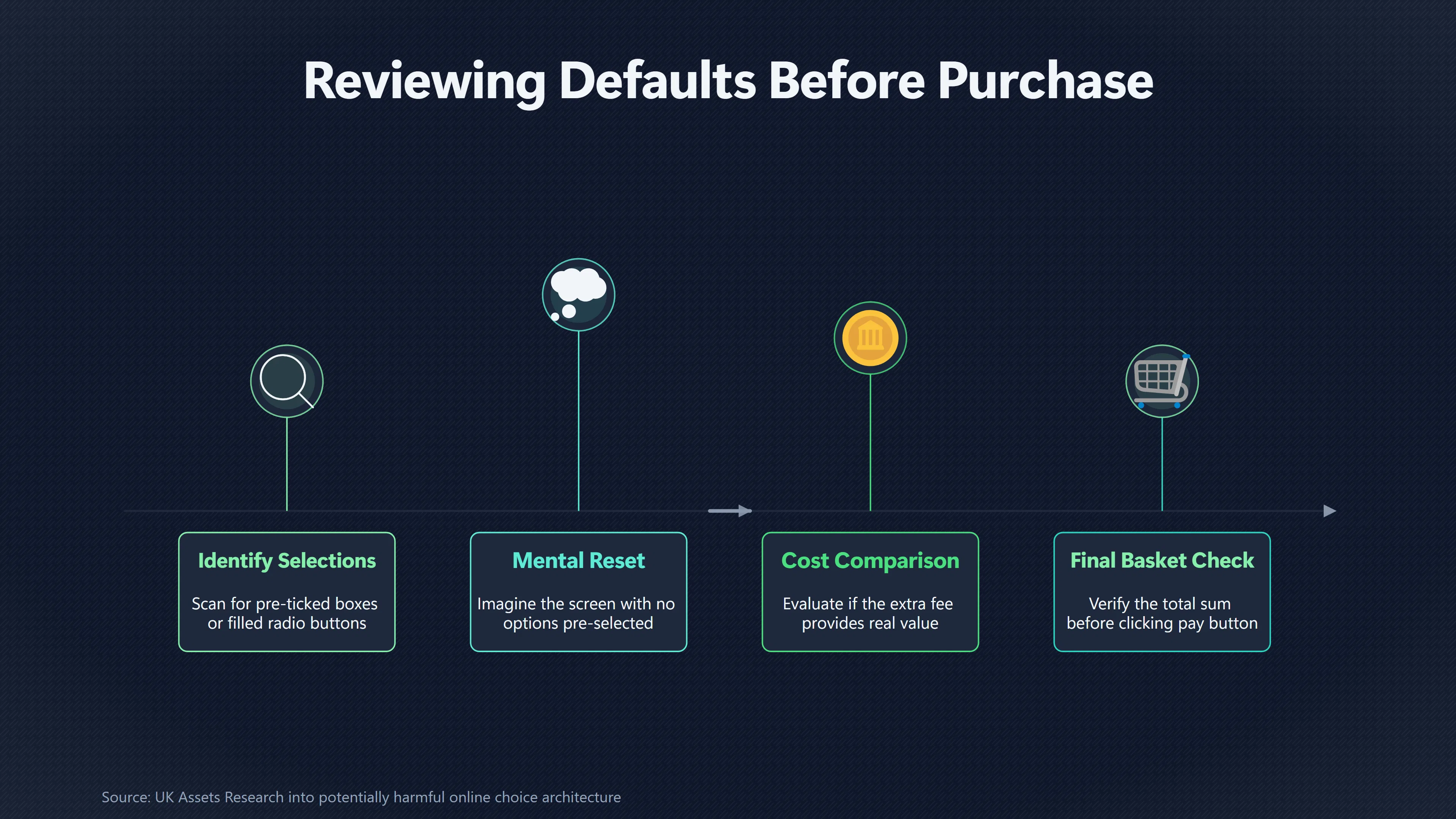
The self-improvement application is straightforward: do not rely on remembering to resist every expensive suggestion. Instead, create a small checkout routine that makes the default visible before money changes hands. This uses the same environment-design principle in reverse: turn passive continuation back into an active decision.
A useful review can be kept short:
- Identify anything already selected. Before paying, scan delivery, warranties or protection plans, subscriptions, quantities and other configurable options. Treat a filled radio button, ticked box or already-added item as a decision that still needs your approval.
- Ask what you would choose from a blank screen. Mentally remove the preselection: “If neither option were selected, would I pay extra for this?” That question helps separate your preference from the website’s starting point.
- Compare the incremental cost with the incremental benefit. “Premium delivery is only £3 more” is less informative than “Am I paying £3 because receiving this sooner is actually worth £3 to me?” The same logic applies to protection plans and upgrades.
- Give unfamiliar defaults extra attention. The UK experiment’s finding that noticing a shipping default sharply reduced selection of the expensive option suggests that simply detecting the preselection is behaviourally meaningful. GOV.UK Assets
Amazon book picks
Further Reading
Books and field guides related to How Preselected Options Quietly Change What You Buy. Use these as the next step if you want deeper reading beyond the article.
Nudge
Rating: 3.5/5 from 29 Google Books ratings
Thaler and Sunstein offer a groundbreaking discussion of how to apply the science of choice to nudge people toward decisions that can imp...
Predictably Irrational
Intelligent, lively, humorous, and thoroughly engaging, "The Predictably Irrational" explains why people often make bad decisions and wha...
The Paradox of Choice
Rating: 3.5/5 from 13 Google Books ratings
Whether we’re buying a pair of jeans, ordering a cup of coffee, purchasing shampoo from the drug store, selecting a long-distance carrier...
Thinking, Fast and Slow
Why is there more chance we'll believe something if it's in a bold type face? Why are judges more likely to deny parole before lunch? Why...
eBay marketplace picks
Marketplace Samples
Live-tested eBay searches with available results related to this page.
Selected fromsaving money poster oneBay.co.uk.
Endnotes
2.
Source: GOV.UK
Title: The prevalence and potential harm of defaults in online shopping
Link:https://www.gov.uk/government/publications/the-prevalence-and-potential-harm-of-defaults-in-online-shopping
3.
Source: cambridge.org
Link:https://www.cambridge.org/core/journals/behavioural-public-policy/article/when-and-why-defaults-influence-decisions-a-metaanalysis-of-default-effects/67AF6972CFB52698A60B6BD94B70C2C0
Source snippet
Cambridge University PressWhen and why defaults influence decisions: a meta-analysis of default effects | Behavioural Public Policy | Cam...
4.
Source: GOV.UK
Title: Getting consent for additional charges when selling online
Link:https://www.gov.uk/government/publications/getting-consent-for-additional-charges-when-selling-online/getting-consent-for-additional-charges-when-selling-online
Source snippet
18, 2025...
5.
Source: GOV.UK
Title: www.gov.uk Providing clear and accurate information about prices
Link:https://www.gov.uk/government/publications/price-transparency-cma209/providing-clear-and-accurate-information-about-prices-summary
6.
Source: GOV.UK
Title: www.gov.uk Unfair commercial practices
Link:https://www.gov.uk/government/publications/unfair-commercial-practices-cma207/unfair-commercial-practices?deliveryName=DM178353
7.
Source: findajob.dwp.gov.uk
Title: dwp.gov.uk Head of Analysis | Job details | Find a job
Link:https://findajob.dwp.gov.uk/details/16101510
8.
Source: GOV.UK
Link:https://www.gov.uk/government/news/new-laws-set-to-ban-mandatory-hidden-fees-from-online-shopping-saving-money-for-consumers
9.
Source: GOV.UK
Link:https://www.gov.uk/government/consultations/smarter-regulation-improving-price-transparency-and-product-information-for-consumers/outcome/government-response-to-consultation-on-smarter-regulation-improving-consumer-price-transparency-and-product-information-for-consumers
10.
Source: GOV.UK
Title: www.gov.uk Online choice architecture
Link:https://www.gov.uk/government/collections/online-choice-architecture
11.
Source: GOV.UK
Link:https://www.gov.uk/government/publications/online-choice-architecture-how-digital-design-can-harm-competition-and-consumers/evidence-review-of-online-choice-architecture-and-consumer-and-competition-harm
12.
Source: cambridge.org
Title: Behavioural Public Policy: Volume 3
Link:https://www.cambridge.org/core/journals/behavioural-public-policy/volume/1E6135ADFCBBC9AC9170DAEB3BBDA9DA
13.
Source: cambridge.org
Title: Behavioural Public Policy: Volume 3
Link:https://www.cambridge.org/core/journals/behavioural-public-policy/issue/A79371F48A293EFEF457CE2735A6E273
14.
Source: ouci.dntb.gov.ua
Link:https://ouci.dntb.gov.ua/en/works/loNNRVpe/
15.
Source: ouci.dntb.gov.ua
Link:https://ouci.dntb.gov.ua/en/works/7q0DPJA9/
Additional References
16.
Source: business.columbia.edu
Link:https://business.columbia.edu/faculty/research/when-and-why-defaults-influence-decisions-meta-analysis-default-effects
Source snippet
Columbia Business SchoolWhen and why defaults influence decisions: a meta-analysis of default effects | Columbia Business School...
17.
Source: almaeconomics.com
Link:https://almaeconomics.com/research-post-economies-and-market/harmful-online-choice-architecture-department-for-business-and-trade/
Source snippet
Alma EconomicsHarmful Online Choice Architecture – Department for Business and Trade - Alma Economics...
18.
Source: aplaceformom.com
Title: SENIOR LIVING COSTS IN OREGON VS. NATIONAL COSTS Cost
Link:https://www.aplaceformom.com/nursing-homes/oregon/tulsa
Source snippet
9 Best Nursing Homes in Tulsa, ORJuly 21, 2026 — COST OF NURSING HOMES IN TULSA, OR The average cost of senior living in Oregon is $5,889...
Published: July 21, 2026
19.
Source: youtube.com
Title: Choice Architecture: Some Illustrative Examples
Link:https://www.youtube.com/watch?v=w97kkn6FLQk
Source snippet
Dark patterns defaults online shopping behavioral economics Dark Patterns: How Websites Engineer You to Overspend...
20.
Source: youtube.com
Title: Prof. Eric J. Johnson: Choice Architecture and Financial Decisions
Link:https://www.youtube.com/watch?v=pFc-s93S6Ls
Source snippet
Are we in control of our decisions? | Dan Ariely...
21.
Source: youtube.com
Title: Are we in control of our decisions? | Dan Ariely
Link:https://www.youtube.com/watch?v=9X68dm92HVI
Source snippet
Status Quo Bias: Why You Always Choose the Default Option...
22.
Source: researchgate.net
Link:https://www.researchgate.net/publication/374452819_Buy_solar_get_cashback_do_consumer_subsidies_described_as_promotions_influence_electricity_choices
23.
Source: researchgate.net
Link:https://www.researchgate.net/publication/352503211_Motivated_by_default-How_nudges_facilitate_people_to_act_in_line_with_their_motivation
24.
Source: researchgate.net
Link:https://www.researchgate.net/publication/342947893_Organic_defaults_in_online-shopping_Immediate_effects_but_no_spillover_to_similar_choices
25.
Source: researchgate.net
Link:https://www.researchgate.net/publication/360496739_School_Gardens_Education_Plan_through_the_Awareness_of_Elementary_and_Middle_School_Parents