Within Better Habits
Can Your Environment Remind You to Act?
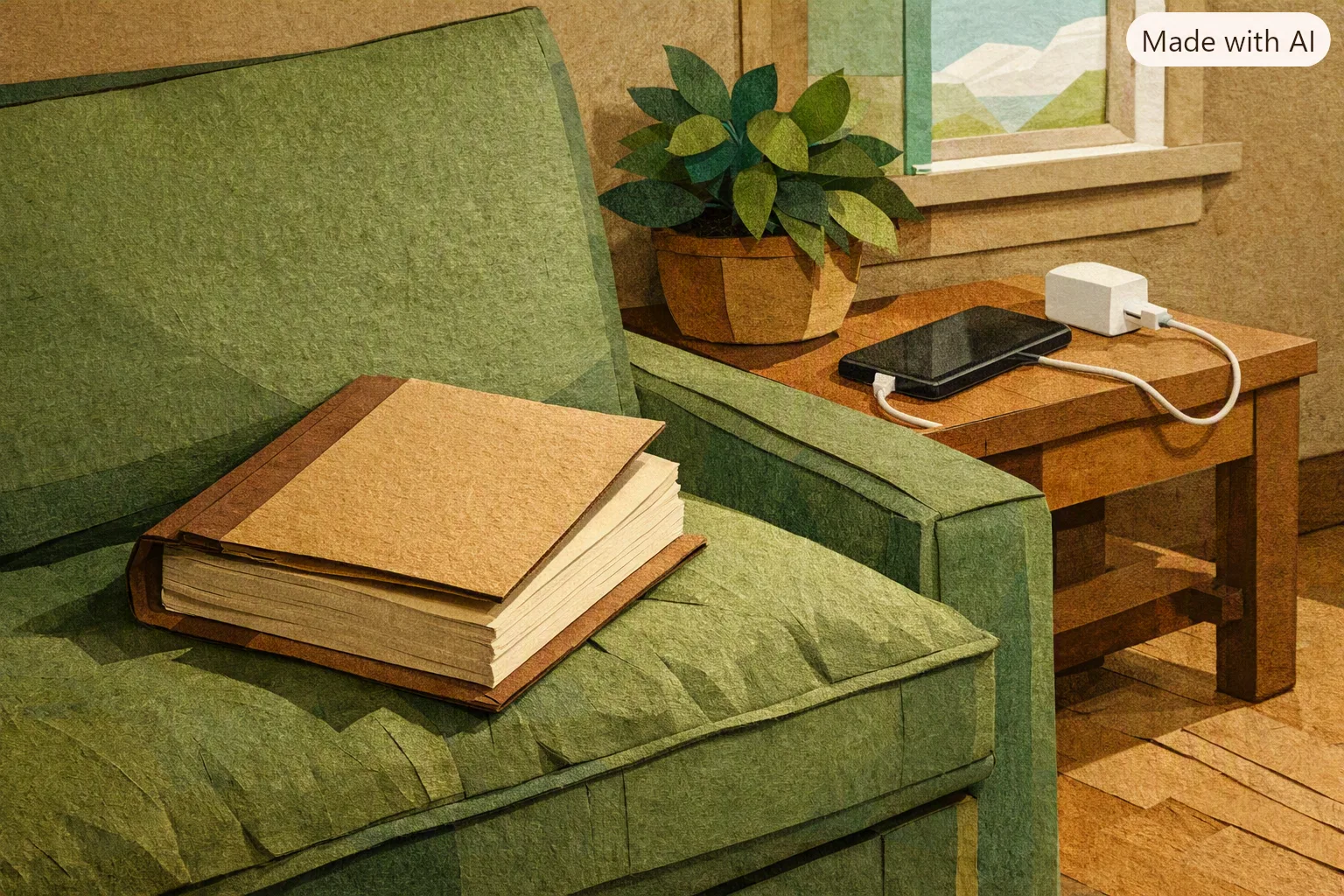
Visible and well-placed cues can make a planned action easier to remember and more likely to begin automatically.
On this page
- What makes a cue noticeable
- Placing cues where action starts
- Avoiding clutter and cue fatigue
Page outline Jump by section
Introduction
Environmental cues can make a desired behaviour easier to start because they move part of the job from memory and motivation into the situation itself. A book left on the pillow can prompt reading; a water bottle placed beside a laptop can prompt drinking; running shoes beside the front door can make an intended walk harder to overlook. The cue does not perform the behaviour for you. Its value is that, when encountered repeatedly at the right moment, it can become associated with a particular response.
That mechanism is central to habit research. Repetition in a stable context strengthens links between recurring cues and actions, so the behaviour can become increasingly automatic rather than requiring a fresh decision each time. Studies of everyday habit formation, laboratory learning and context stability all point in this direction.[wiley.com]onlinelibrary.wiley.comWiley Online LibraryHow are habits formed: Modelling habit formation in the real world - Lally - 2010 - European Journal of Social Psycho…
The practical implication is more precise than “put reminders everywhere”. Effective cues tend to be noticeable, specific and encountered where action can actually begin. Too many prompts, by contrast, can become background noise.
What makes a cue noticeable?
A useful cue must first win enough attention to trigger the intended response. That sounds obvious, but visibility is not simply a matter of making something large or brightly coloured. A cue works best when it is distinctive relative to its surroundings and closely connected to a behaviour the person has already decided to perform.
Research on point-of-decision prompts provides a clear real-world example. Signs placed by lifts or escalators, precisely where people choose between them and the stairs, have repeatedly increased stair use. A systematic review commissioned for the US Community Guide found strong evidence that such prompts increased stair climbing, while a later review of choice-architecture studies found significant physical-activity effects in most studies using prompts such as signs, floor markings and stair-riser messages.[PubMed]pubmed.ncbi.nlm.nih.govPoint-of-decision prompts to increase stair use. A systematic review update - PubMed…
Specificity can matter too. In one university worksite study involving nearly 3,000 observations, a specific stair-use message significantly increased the odds of taking the stairs, whereas the more general message did not; the specific message also outperformed the general one directly.[PubMed]pubmed.ncbi.nlm.nih.govPoint-of-Decision Signs and Stair Use in a University Worksite Setting: General Versus Specific Messages - PubMedMarch 26, 2014… This is a useful clue for personal environments: “exercise more” is a weak environmental instruction, while seeing your resistance band attached to the chair where you intend to use it points much more clearly towards a particular action.
Visual cues can influence behaviour beyond exercise. A 2024 systematic review and meta-analysis covering 66 studies found that visual cues and primes could shift food and drink choices or consumption in the expected direction, although their effectiveness varied by the type of cue, participant and outcome.[PubMed]pubmed.ncbi.nlm.nih.govA systematic review and meta-analysis of visual cues and primes for nudging consumption-related behaviours - PubMedDecember 5, 2024… That variation is important. A cue is not a behavioural command; it changes the probability of noticing, considering or initiating a response.
For self-improvement, the strongest cues therefore tend to have three qualities:
- They are easy to perceive. The notebook is open on the desk rather than buried in a drawer.
- They imply one clear action. A prepared gym bag means “take this with you”, not merely “remember fitness”.
- They appear when the behaviour is feasible. A cue to stretch beside the kettle is more actionable than the same reminder on a noticeboard you see while rushing out of the house.
The last quality is particularly important because cues acquire their power through association. Habit research suggests that repeated behaviour becomes linked to the contexts in which it occurs. In daily-life studies, strongly habitual actions have been triggered by recurring performance contexts, such as locations, even when people’s immediate goals were less influential.[ScienceDirect]sciencedirect.comOpen source on sciencedirect.com.
Put the cue where action starts
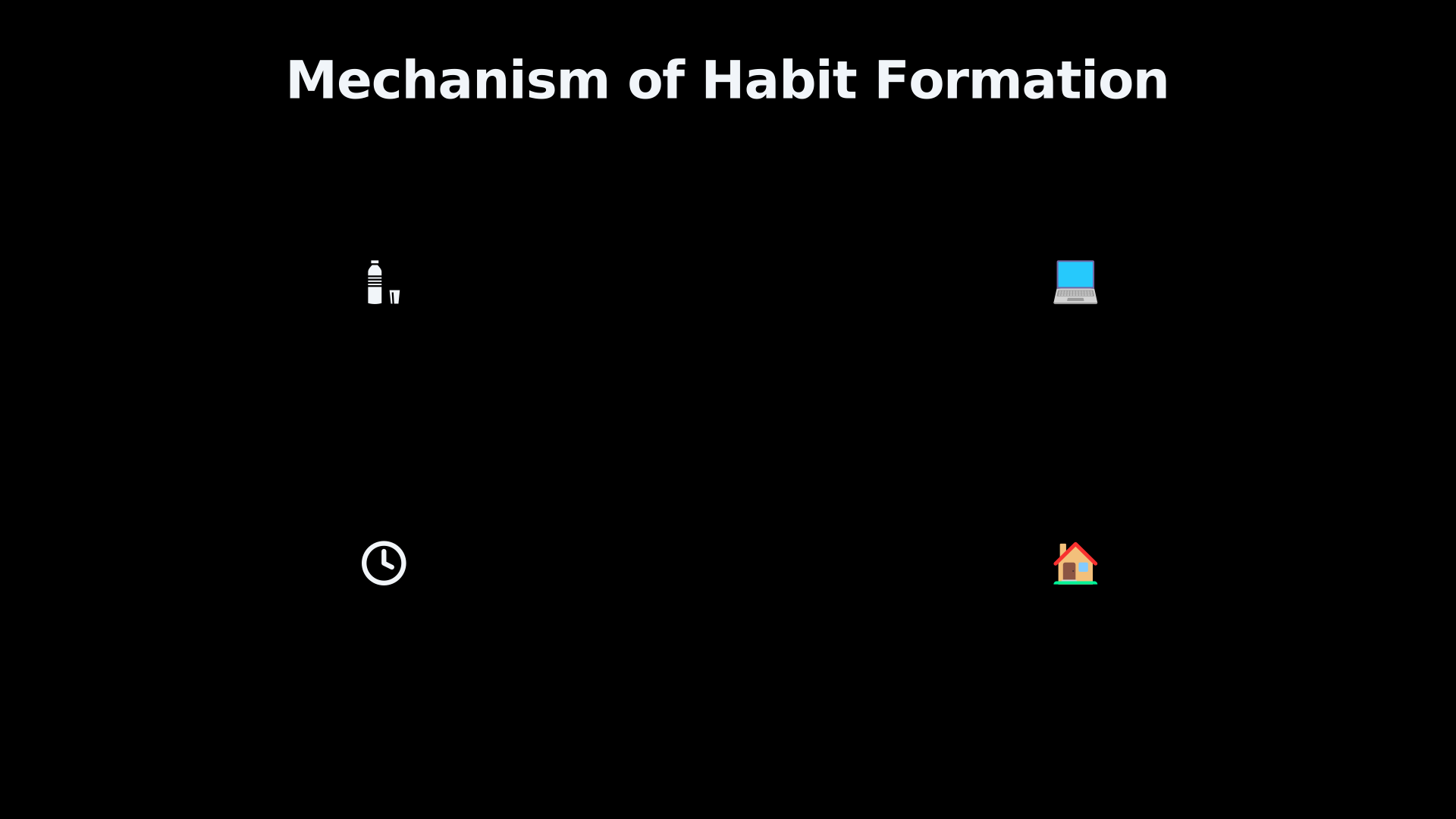
The most useful place for a cue is usually not where you plan the behaviour but where you can begin it.
That is why point-of-decision prompts are such a revealing model. A poster encouraging stair use would be much less useful if placed outside the building; beside the lift, it appears at the decision point. The same principle can be applied at home or work. If you want to take medication after breakfast, placing it somewhere appropriate and safe within the breakfast routine is more closely linked to action than keeping a reminder in another room. If you want to practise guitar after dinner, leaving the instrument ready where you normally sit removes a memory step between the cue and the response.
The behavioural mechanism is repetition in a recurring context. In a classic 12-week field study, participants chose an eating, drinking or activity behaviour and repeated it in the same context each day. Automaticity generally increased with repetition, although the time required varied enormously between people. Importantly, one missed opportunity did not materially derail the habit-building process.[Wiley Online Library]onlinelibrary.wiley.comWiley Online LibraryHow are habits formed: Modelling habit formation in the real world - Lally - 2010 - European Journal of Social Psycho…
More recent research strengthens the case for contextual consistency. In one study of students building study habits, and another using data from a habit-building app, greater stability of place and time predicted both stronger automaticity and better attainment of repetition goals.[PubMed Central (PMC)]pmc.ncbi.nlm.nih.govPubMed Central (PMC)Context Stability in Habit Building Increases Automaticity and Goal Attainment - PMC… Experimental work has likewise found that practice strengthens measurable context–response associations, and that those associations subsequently help guide performance even when deliberate thinking is made harder by cognitive load.[PubMed]pubmed.ncbi.nlm.nih.govPub Med Measuring context-response associations that drive habitsMeasuring context-response associations that drive habits - PubMed…
A cue need not be an object. It can be a recurring event: finishing breakfast, arriving home, turning on a computer or brushing your teeth. In a randomised trial of 192 adults building a nutrition habit, participants linked their behaviour either to an existing daily routine or to a particular time. Both strategies produced increases in automaticity, with no significant advantage for one cue type over the other; repeated enactment was the key predictor of habit development. Among participants who successfully formed habits, median time to peak automaticity was 59 days.[BPS PsycHub]bpspsychub.onlinelibrary.wiley.comOpen source on wiley.com.
This means there is little reason to search for a universally “best” cue. The better question is whether the cue is dependable enough to recur and close enough to the behaviour to be useful.
For example:
To read before bed: put the book on the pillow or bedside table before the evening begins. The bedroom and bedtime routine then repeatedly present the same behavioural opportunity.
To practise a skill after work: leave the required materials set up before finishing the previous session. Opening the laptop or sitting at the desk can then expose the next action immediately.
To take a lunchtime walk: place walking shoes, headphones or a jacket beside whatever you normally encounter when lunch begins.
To prepare tomorrow’s priorities: leave a notebook and pen on top of the keyboard before ending the workday, making planning the first visible step on return.
The common feature is not decorative organisation. It is reducing the distance between seeing the cue and starting the response.
Recurring situations can become cues themselves
Physical reminders are particularly useful when a behaviour is new, but successful repetition can gradually make the broader context carry the cueing role.
Habit researchers describe this in terms of cue–response associations. When a behaviour is repeatedly performed after the same event or in the same setting, perceiving that context can begin to activate the response with decreasing dependence on conscious deliberation. Research into cue-contingent automaticity has found that habitual responses can be elicited by associated situations even when the behaviour is no longer aligned with a person’s current intention.[PubMed]pubmed.ncbi.nlm.nih.govOpen source on nih.gov. That finding helps explain both why established bad habits can be stubborn and why deliberately repeated good behaviours can eventually become easier to initiate.
This is also why environmental cues work best as part of a repeated pattern rather than as isolated motivational decorations. Seeing a pair of trainers once may remind you to exercise. Seeing them beside the door every Monday, Wednesday and Friday just before a planned walk gives the brain repeated opportunities to learn a more reliable relationship between situation and response.
Context stability does not mean life must become rigid. Rather, it means preserving enough recurring structure for a recognisable trigger to develop. The research comparing routine-based and clock-time cues suggests that either can work.[BPS PsycHub]bpspsychub.onlinelibrary.wiley.comOpen source on wiley.com. A person with unpredictable working hours might therefore choose “after I make my first coffee at home” rather than “at 6.30 pm”. Someone whose schedule is highly regular may find the clock itself sufficiently dependable.
The important distinction is between a cue that reliably occurs and a cue you repeatedly miss. A reminder placed somewhere you rarely look has little opportunity to acquire a behavioural association, however clever its wording.

Why more reminders can become less effective
Once people recognise that cues can help, an obvious temptation is to add more of them: sticky notes on the desk, phone notifications, calendar alerts, posters, widgets and alarms. That can defeat the purpose.
Human attention adapts to repeated, low-value signals. One particularly well-documented example comes from healthcare, where clinicians may face large numbers of computerised warnings and reminders. Reviews describe “alert fatigue”: excessive or poorly targeted prompts increase cognitive load and are increasingly ignored or overridden.[PubMed Central (PMC)]pmc.ncbi.nlm.nih.govOpen source on nih.gov. The setting is specialised, but the attentional principle is relevant to ordinary self-management. A cue that competes with fifteen other cues can stop functioning as a distinctive signal.
Research on health-promotion reminders is consistent with a more cautious interpretation of prompting. A systematic review of 19 studies involving more than 15,000 participants found promising effects from periodic prompts in several interventions, but the authors also noted substantial uncertainty about optimal frequency, prompt characteristics and long-term effects.[PubMed Central (PMC)]pmc.ncbi.nlm.nih.govOpen source on nih.gov. Prompts can help, but there is no evidence-based rule that simply increasing their number produces better behaviour.
Clutter also weakens one of the main advantages of an environmental cue: its ability to make a desired response stand out. If a desk contains five reminder cards, unopened post, supplements, exercise equipment, cables and several abandoned task lists, adding another visual cue may contribute more noise than information.
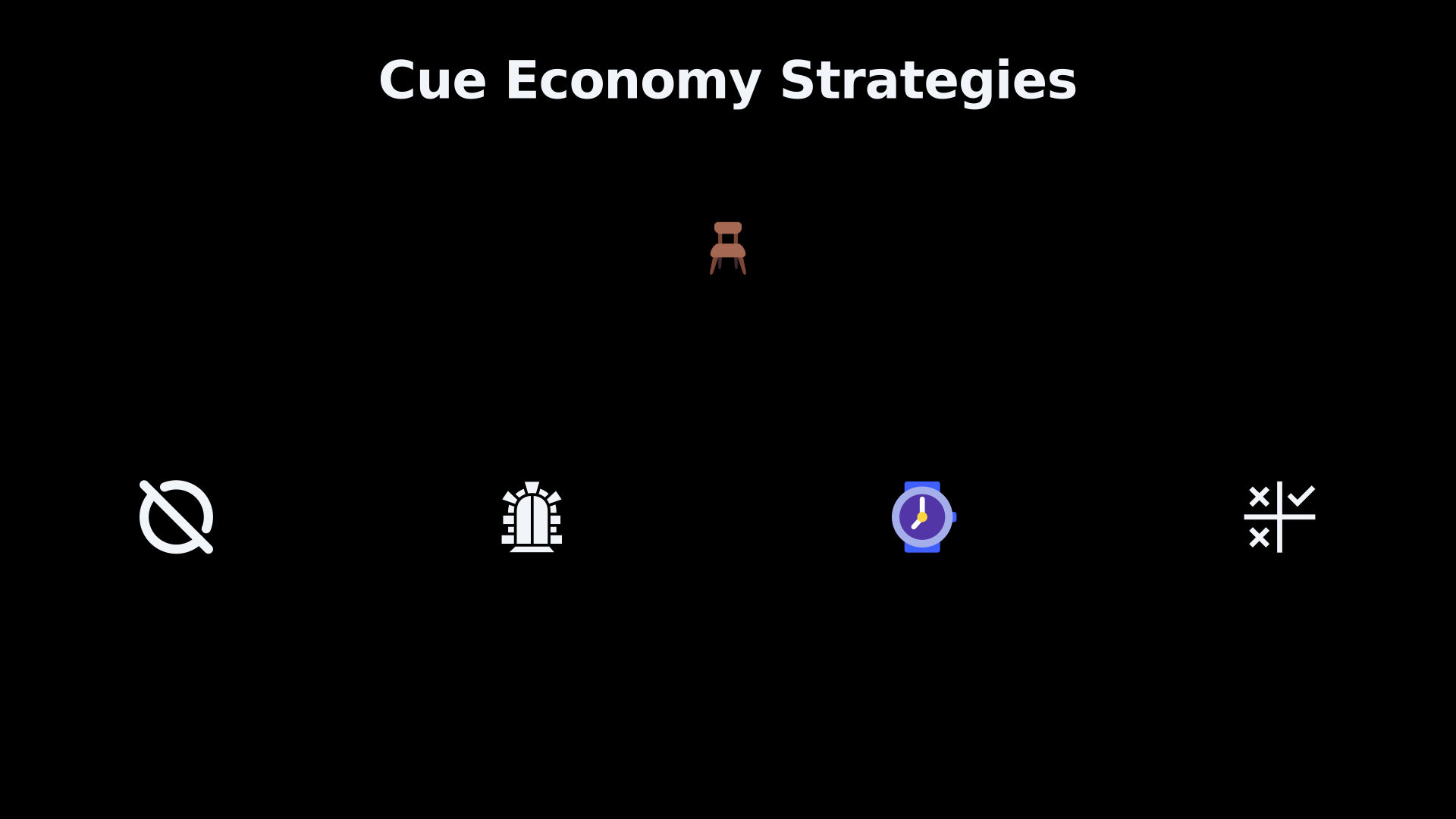
A better approach is cue economy:
- Give an important behaviour one conspicuous cue rather than several competing ones.
- Remove or relocate obsolete reminders once they no longer serve a purpose.
- Avoid using the same signal for several unrelated behaviours.
- Place prompts at decision points instead of distributing them throughout the environment.
- If you repeatedly see a cue without acting on it, change either its location, the action it specifies or the timing rather than simply making it louder.
That final point matters because repeated non-response may teach the wrong association: the cue becomes something to overlook.
Useful cues are prompts, not substitutes for action
Environmental cues are most defensible as a way of improving behavioural initiation, not as a stand-alone theory of self-improvement. Reviews of environmental interventions find that prompting and physical restructuring can affect behaviour, but effects vary considerably by setting and intervention design.[PubMed Central (PMC)]pmc.ncbi.nlm.nih.govOpen source on nih.gov. Likewise, a meta-analysis of physical-activity habit interventions did not find that merely including “prompts/cues” or “restructuring the physical environment” reliably explained stronger habit outcomes across studies.[PubMed Central (PMC)]pmc.ncbi.nlm.nih.govOpen source on nih.gov.
That is an important limit. Putting a yoga mat in the living room cannot compensate for choosing a routine you dislike, making the session impractically long or never actually repeating it. A cue helps most when a person already has a clear intended behaviour and the environment is being arranged to make its initiation more reliable.
The practical test is therefore simple: when this cue appears, is there one obvious action I can begin immediately?
If the answer is yes, repeated exposure in a stable situation can gradually make that cue more useful and the response less dependent on remembering at exactly the right moment. If the answer is no, the object is probably decoration rather than behavioural design.
Amazon book picks
Further Reading
Books and field guides related to Can Your Environment Remind You to Act?. Use these as the next step if you want deeper reading beyond the article.
Atomic Habits
Rating: 3.5/5 from 7 Google Books ratings
The #1 New York Times bestseller. Over 25 million copies sold! Translated into 60+ languages! Tiny Changes, Remarkable Results No matter...
Tiny Habits
Improving your life is much easier than you think. Whether it’s losing weight, sleeping more, or restoring your work/life balance – the s...
The Power of Habit
Rating: 4.0/5 from 145 Google Books ratings
Duhigg takes us to the edge of scientific discoveries that explain why habits exist and how they can be changed. Distilling information i...
Good Habits, Bad Habits
'The world's leading expert on habits' - Matthew Syed, bestselling author of Black Box Thinking and Rebel IdeasWhat if you could harness...
eBay marketplace picks
Marketplace Samples
Live-tested eBay searches with available results related to this page.
Selected frommotivational poster oneBay.co.uk.
Current eBay listing
Motivational Quotes Framed Wall Art Poster Canvas Print Picture
Current eBay listing
Gym Motivational Posters Work Out Insperational Quotes Wall Art
Endnotes
1.
Source: onlinelibrary.wiley.com
Link:https://onlinelibrary.wiley.com/doi/10.1002/ejsp.674
Source snippet
Wiley Online LibraryHow are habits formed: Modelling habit formation in the real world - Lally - 2010 - European Journal of Social Psycho...
2.
Source: sciencedirect.com
Link:https://www.sciencedirect.com/science/article/pii/S002210311100254X
3.
Source: bpspsychub.onlinelibrary.wiley.com
Link:https://bpspsychub.onlinelibrary.wiley.com/doi/abs/10.1111/bjhp.12504
4.
Source: sciencedirect.com
Link:https://www.sciencedirect.com/org/science/article/pii/S1438887124002619
5.
Source: sciencedirect.com
Title: Habit and climate change
Link:https://www.sciencedirect.com/science/article/pii/S2352154621000425
6.
Source: sciencedirect.com
Title: Habit and climate change
Link:https://www.sciencedirect.com/science/article/abs/pii/S2352154621000425
7.
Source: sciencedirect.com
Link:https://www.sciencedirect.com/science/article/pii/S0956053X16305414
8.
Source: sciencedirect.com
Link:https://www.sciencedirect.com/science/article/abs/pii/S0969698914000642
9.
Source: sciencedirect.com
Title: Please turn off the lights: The effectiveness of visual prompts
Link:https://www.sciencedirect.com/science/article/pii/S0003687011001499
10.
Source: onlinelibrary.wiley.com
Link:https://onlinelibrary.wiley.com/doi/abs/10.1002/ejsp.674
11.
Source: onlinelibrary.wiley.com
Link:https://onlinelibrary.wiley.com/doi/10.1002/ejsp.674?947f74f7_page=5&b158b201_page=5
12.
Source: onlinelibrary.wiley.com
Link:https://onlinelibrary.wiley.com/doi/abs/10.1002/ejsp.674?MixPanelId=15e3fe314440-0468d8411-64220f54-100000-15e3fe314460
13.
Source: onlinelibrary.wiley.com
Link:https://onlinelibrary.wiley.com/doi/abs/10.1002/ejsp.674?source=content_type%3Areact%7Cfirst_level_url%3Aarticle%7Csection%3Amain_content%7Cbutton%3Abody_link
14.
Source: onlinelibrary.wiley.com
Link:https://onlinelibrary.wiley.com/doi/10.1002/ejsp.674?2d235898_page=2&538fcd4b_page=6&d2101103_page=8&d73ad837_page=2
15.
Source: sciencedirect.com
Title: Behavioral compliance with warnings: effects of voice, context, and location
Link:https://www.sciencedirect.com/science/article/pii/092575359390028C
16.
Source: sciencedirect.com
Link:https://www.sciencedirect.com/science/article/pii/S0272494418307527
17.
Source: sciencedirect.com
Title: Small change, big change – Increasing attention with product package variations
Link:https://www.sciencedirect.com/science/article/pii/S0950329320302767
18.
Source: sciencedirect.com
Title: Are the warning icons more attentional?
Link:https://www.sciencedirect.com/science/article/abs/pii/S0003687017301230
19.
Source: pmc.ncbi.nlm.nih.gov
Link:https://pmc.ncbi.nlm.nih.gov/articles/PMC9226889/
Source snippet
PubMed Central (PMC)Context Stability in Habit Building Increases Automaticity and Goal Attainment - PMC...
20.
Source: pubmed.ncbi.nlm.nih.gov
Title: Pub Med Measuring context-response associations that drive habits
Link:https://pubmed.ncbi.nlm.nih.gov/38047612/
Source snippet
Measuring context-response associations that drive habits - PubMed...
21.
Source: pubmed.ncbi.nlm.nih.gov
Link:https://pubmed.ncbi.nlm.nih.gov/20117614/
Source snippet
Point-of-decision prompts to increase stair use. A systematic review update - PubMed...
22.
Source: pmc.ncbi.nlm.nih.gov
Link:https://pmc.ncbi.nlm.nih.gov/articles/PMC7140383/
23.
Source: pubmed.ncbi.nlm.nih.gov
Link:https://pubmed.ncbi.nlm.nih.gov/24670074/
Source snippet
Point-of-Decision Signs and Stair Use in a University Worksite Setting: General Versus Specific Messages - PubMedMarch 26, 2014...
Published: March 26, 2014
24.
Source: pubmed.ncbi.nlm.nih.gov
Link:https://pubmed.ncbi.nlm.nih.gov/39643083/
Source snippet
A systematic review and meta-analysis of visual cues and primes for nudging consumption-related behaviours - PubMedDecember 5, 2024...
Published: December 5, 2024
25.
Source: pubmed.ncbi.nlm.nih.gov
Link:https://pubmed.ncbi.nlm.nih.gov/35756236/
26.
Source: pubmed.ncbi.nlm.nih.gov
Link:https://pubmed.ncbi.nlm.nih.gov/20658824/
27.
Source: pmc.ncbi.nlm.nih.gov
Link:https://pmc.ncbi.nlm.nih.gov/articles/PMC10983371/
28.
Source: pmc.ncbi.nlm.nih.gov
Link:https://pmc.ncbi.nlm.nih.gov/articles/PMC11845892/
29.
Source: pmc.ncbi.nlm.nih.gov
Link:https://pmc.ncbi.nlm.nih.gov/articles/PMC2762806/
30.
Source: pmc.ncbi.nlm.nih.gov
Link:https://pmc.ncbi.nlm.nih.gov/articles/PMC10260803/
31.
Source: pmc.ncbi.nlm.nih.gov
Link:https://pmc.ncbi.nlm.nih.gov/articles/PMC10498635/
32.
Source: pubmed.ncbi.nlm.nih.gov
Link:https://pubmed.ncbi.nlm.nih.gov/42148822/
33.
Source: pmc.ncbi.nlm.nih.gov
Link:https://pmc.ncbi.nlm.nih.gov/articles/PMC12836306/
34.
Source: pmc.ncbi.nlm.nih.gov
Link:https://pmc.ncbi.nlm.nih.gov/articles/PMC12649445/
35.
Source: pubmed.ncbi.nlm.nih.gov
Link:https://pubmed.ncbi.nlm.nih.gov/40383155/
36.
Source: pmc.ncbi.nlm.nih.gov
Link:https://pmc.ncbi.nlm.nih.gov/articles/PMC11920387/
37.
Source: pmc.ncbi.nlm.nih.gov
Link:https://pmc.ncbi.nlm.nih.gov/articles/PMC11876489/
38.
Source: pubmed.ncbi.nlm.nih.gov
Link:https://pubmed.ncbi.nlm.nih.gov/39918864/
39.
Source: pmc.ncbi.nlm.nih.gov
Link:https://pmc.ncbi.nlm.nih.gov/articles/PMC11641623/
40.
Source: pmc.ncbi.nlm.nih.gov
Link:https://pmc.ncbi.nlm.nih.gov/articles/PMC11574773/
41.
Source: pmc.ncbi.nlm.nih.gov
Link:https://pmc.ncbi.nlm.nih.gov/articles/PMC11635918/
42.
Source: pubmed.ncbi.nlm.nih.gov
Link:https://pubmed.ncbi.nlm.nih.gov/38787601/
43.
Source: pmc.ncbi.nlm.nih.gov
Link:https://pmc.ncbi.nlm.nih.gov/articles/PMC11201238/
44.
Source: pubmed.ncbi.nlm.nih.gov
Link:https://pubmed.ncbi.nlm.nih.gov/37593567/
45.
Source: pmc.ncbi.nlm.nih.gov
Link:https://pmc.ncbi.nlm.nih.gov/articles/PMC11046690/
46.
Source: pubmed.ncbi.nlm.nih.gov
Link:https://pubmed.ncbi.nlm.nih.gov/37948981/
47.
Source: pmc.ncbi.nlm.nih.gov
Link:https://pmc.ncbi.nlm.nih.gov/articles/PMC10545861/
48.
Source: pubmed.ncbi.nlm.nih.gov
Link:https://pubmed.ncbi.nlm.nih.gov/37794916/
49.
Source: pmc.ncbi.nlm.nih.gov
Link:https://pmc.ncbi.nlm.nih.gov/articles/PMC10152515/
50.
Source: pmc.ncbi.nlm.nih.gov
Link:https://pmc.ncbi.nlm.nih.gov/articles/PMC10337295/
51.
Source: pmc.ncbi.nlm.nih.gov
Link:https://pmc.ncbi.nlm.nih.gov/articles/PMC10182474/
52.
Source: pmc.ncbi.nlm.nih.gov
Link:https://pmc.ncbi.nlm.nih.gov/articles/PMC10305802/
53.
Source: pmc.ncbi.nlm.nih.gov
Link:https://pmc.ncbi.nlm.nih.gov/articles/PMC9372943/
54.
Source: pmc.ncbi.nlm.nih.gov
Link:https://pmc.ncbi.nlm.nih.gov/articles/PMC9246170/
55.
Source: pmc.ncbi.nlm.nih.gov
Link:https://pmc.ncbi.nlm.nih.gov/articles/PMC9231655/
56.
Source: pmc.ncbi.nlm.nih.gov
Link:https://pmc.ncbi.nlm.nih.gov/articles/PMC12318445/
57.
Source: pmc.ncbi.nlm.nih.gov
Link:https://pmc.ncbi.nlm.nih.gov/articles/PMC8381742/
58.
Source: pmc.ncbi.nlm.nih.gov
Link:https://pmc.ncbi.nlm.nih.gov/articles/PMC8628490/
59.
Source: pmc.ncbi.nlm.nih.gov
Link:https://pmc.ncbi.nlm.nih.gov/articles/PMC8614132/
60.
Source: pubmed.ncbi.nlm.nih.gov
Link:https://pubmed.ncbi.nlm.nih.gov/34713424/
61.
Source: pmc.ncbi.nlm.nih.gov
Link:https://pmc.ncbi.nlm.nih.gov/articles/PMC8800991/
62.
Source: pmc.ncbi.nlm.nih.gov
Link:https://pmc.ncbi.nlm.nih.gov/articles/PMC8734590/
63.
Source: pmc.ncbi.nlm.nih.gov
Link:https://pmc.ncbi.nlm.nih.gov/articles/PMC9207816/
64.
Source: pubmed.ncbi.nlm.nih.gov
Link:https://pubmed.ncbi.nlm.nih.gov/33502088/
65.
Source: pubmed.ncbi.nlm.nih.gov
Link:https://pubmed.ncbi.nlm.nih.gov/33405284/
66.
Source: pmc.ncbi.nlm.nih.gov
Link:https://pmc.ncbi.nlm.nih.gov/articles/PMC7495879/
67.
Source: pubmed.ncbi.nlm.nih.gov
Link:https://pubmed.ncbi.nlm.nih.gov/32819410/
68.
Source: pmc.ncbi.nlm.nih.gov
Link:https://pmc.ncbi.nlm.nih.gov/articles/PMC7293059/
69.
Source: pubmed.ncbi.nlm.nih.gov
Link:https://pubmed.ncbi.nlm.nih.gov/32264899/
70.
Source: pmc.ncbi.nlm.nih.gov
Link:https://pmc.ncbi.nlm.nih.gov/articles/PMC7106637/
71.
Source: pubmed.ncbi.nlm.nih.gov
Link:https://pubmed.ncbi.nlm.nih.gov/32228721/
72.
Source: pmc.ncbi.nlm.nih.gov
Link:https://pmc.ncbi.nlm.nih.gov/articles/PMC7015073/
73.
Source: pmc.ncbi.nlm.nih.gov
Link:https://pmc.ncbi.nlm.nih.gov/articles/PMC6724306/
74.
Source: pmc.ncbi.nlm.nih.gov
Link:https://pmc.ncbi.nlm.nih.gov/articles/PMC11002995/
75.
Source: pmc.ncbi.nlm.nih.gov
Link:https://pmc.ncbi.nlm.nih.gov/articles/PMC6524686/
76.
Source: pubmed.ncbi.nlm.nih.gov
Link:https://pubmed.ncbi.nlm.nih.gov/31134173/
77.
Source: pmc.ncbi.nlm.nih.gov
Link:https://pmc.ncbi.nlm.nih.gov/articles/PMC6777541/
78.
Source: pmc.ncbi.nlm.nih.gov
Link:https://pmc.ncbi.nlm.nih.gov/articles/PMC6329430/
79.
Source: pmc.ncbi.nlm.nih.gov
Link:https://pmc.ncbi.nlm.nih.gov/articles/PMC6378489/
80.
Source: pubmed.ncbi.nlm.nih.gov
Link:https://pubmed.ncbi.nlm.nih.gov/30572936/
81.
Source: pmc.ncbi.nlm.nih.gov
Link:https://pmc.ncbi.nlm.nih.gov/articles/PMC5682193/
82.
Source: pmc.ncbi.nlm.nih.gov
Link:https://pmc.ncbi.nlm.nih.gov/articles/PMC6629843/
83.
Source: pmc.ncbi.nlm.nih.gov
Link:https://pmc.ncbi.nlm.nih.gov/articles/PMC5855236/
84.
Source: pmc.ncbi.nlm.nih.gov
Link:https://pmc.ncbi.nlm.nih.gov/articles/PMC5729261/
85.
Source: pmc.ncbi.nlm.nih.gov
Link:https://pmc.ncbi.nlm.nih.gov/articles/PMC5673884/
86.
Source: pubmed.ncbi.nlm.nih.gov
Link:https://pubmed.ncbi.nlm.nih.gov/28950159/
87.
Source: pubmed.ncbi.nlm.nih.gov
Link:https://pubmed.ncbi.nlm.nih.gov/28550001/
88.
Source: pmc.ncbi.nlm.nih.gov
Link:https://pmc.ncbi.nlm.nih.gov/articles/PMC5526809/
89.
Source: pubmed.ncbi.nlm.nih.gov
Link:https://pubmed.ncbi.nlm.nih.gov/27207873/
90.
Source: pmc.ncbi.nlm.nih.gov
Link:https://pmc.ncbi.nlm.nih.gov/articles/PMC5510470/
91.
Source: pmc.ncbi.nlm.nih.gov
Link:https://pmc.ncbi.nlm.nih.gov/articles/PMC4847906/
92.
Source: pubmed.ncbi.nlm.nih.gov
Link:https://pubmed.ncbi.nlm.nih.gov/26747176/
93.
Source: pmc.ncbi.nlm.nih.gov
Link:https://pmc.ncbi.nlm.nih.gov/articles/PMC4723726/
94.
Source: pmc.ncbi.nlm.nih.gov
Link:https://pmc.ncbi.nlm.nih.gov/articles/PMC4500900/
95.
Source: pubmed.ncbi.nlm.nih.gov
Link:https://pubmed.ncbi.nlm.nih.gov/25900104/
96.
Source: pmc.ncbi.nlm.nih.gov
Link:https://pmc.ncbi.nlm.nih.gov/articles/PMC3978550/
97.
Source: pubmed.ncbi.nlm.nih.gov
Link:https://pubmed.ncbi.nlm.nih.gov/24667840/
98.
Source: pmc.ncbi.nlm.nih.gov
Link:https://pmc.ncbi.nlm.nih.gov/articles/PMC4566897/
99.
Source: pubmed.ncbi.nlm.nih.gov
Link:https://pubmed.ncbi.nlm.nih.gov/24188333/
100.
Source: pubmed.ncbi.nlm.nih.gov
Link:https://pubmed.ncbi.nlm.nih.gov/23506465/
101.
Source: pubmed.ncbi.nlm.nih.gov
Link:https://pubmed.ncbi.nlm.nih.gov/22340523/
102.
Source: pubmed.ncbi.nlm.nih.gov
Link:https://pubmed.ncbi.nlm.nih.gov/21749245/
103.
Source: pubmed.ncbi.nlm.nih.gov
Link:https://pubmed.ncbi.nlm.nih.gov/21678185/
104.
Source: pubmed.ncbi.nlm.nih.gov
Link:https://pubmed.ncbi.nlm.nih.gov/21215528/
105.
Source: pubmed.ncbi.nlm.nih.gov
Link:https://pubmed.ncbi.nlm.nih.gov/19632970/
106.
Source: pubmed.ncbi.nlm.nih.gov
Link:https://pubmed.ncbi.nlm.nih.gov/19653478/
107.
Source: pmc.ncbi.nlm.nih.gov
Link:https://pmc.ncbi.nlm.nih.gov/articles/PMC3505409/
108.
Source: pubmed.ncbi.nlm.nih.gov
Link:https://pubmed.ncbi.nlm.nih.gov/15982113/
109.
Source: pmc.ncbi.nlm.nih.gov
Link:https://pmc.ncbi.nlm.nih.gov/articles/PMC1560639/
110.
Source: pubmed.ncbi.nlm.nih.gov
Link:https://pubmed.ncbi.nlm.nih.gov/23072564/
111.
Source: pmc.ncbi.nlm.nih.gov
Link:https://pmc.ncbi.nlm.nih.gov/articles/PMC4826769/
112.
Source: pubmed.ncbi.nlm.nih.gov
Link:https://pubmed.ncbi.nlm.nih.gov/25449692/
113.
Source: pubmed.ncbi.nlm.nih.gov
Link:https://pubmed.ncbi.nlm.nih.gov/18624603/
114.
Source: pubmed.ncbi.nlm.nih.gov
Link:https://pubmed.ncbi.nlm.nih.gov/23512568/
115.
Source: pubmed.ncbi.nlm.nih.gov
Link:https://pubmed.ncbi.nlm.nih.gov/29952735/
116.
Source: pubmed.ncbi.nlm.nih.gov
Link:https://pubmed.ncbi.nlm.nih.gov/11011871/
117.
Source: pubmed.ncbi.nlm.nih.gov
Link:https://pubmed.ncbi.nlm.nih.gov/26616119/
118.
Source: pubmed.ncbi.nlm.nih.gov
Link:https://pubmed.ncbi.nlm.nih.gov/26616119/?dopt=Abstract
119.
Source: pubmed.ncbi.nlm.nih.gov
Link:https://pubmed.ncbi.nlm.nih.gov/24815766/
120.
Source: pmc.ncbi.nlm.nih.gov
Link:https://pmc.ncbi.nlm.nih.gov/articles/PMC7872013/
Additional References
121.
Source: youtube.com
Title: Atomic Habits: How to Get 1% Better Every Day
Link:https://www.youtube.com/watch?v=U_nzqnXWvSo
Source snippet
Environmental cues habit formation point of decision prompts The Science of How Your Brain Forms Habits (and How to Take Control)...
122.
Source: youtube.com
Title: The Science of How Your Brain Forms Habits (and How to Take Control)
Link:https://www.youtube.com/watch?v=idhDz9miZ3w
Source snippet
Richard H. Thaler on nudges and choice architecture...
123.
Source: youtube.com
Title: Richard H. Thaler on nudges and choice architecture
Link:https://www.youtube.com/watch?v=AZExnUKfik0
Source snippet
Atomic Habits: How to Get 1% Better Every Day - James Clear...
124.
Source: youtube.com
Title: Wendy Wood: How Habits Guide Behavior
Link:https://www.youtube.com/watch?v=OWiDYOjgEFI
Source snippet
The Science of How Your Brain Forms Habits (and How to Take Control)...
125.
Source: youtube.com
Title: How Your Environment Quietly Controls Your Habits | James Clear
Link:https://www.youtube.com/watch?v=uGWELW82Eoc
Source snippet
Wendy Wood: How Habits Guide Behavior...