Within Written Records
Can Tracking a Habit Change the Habit Itself?
Monitoring can sometimes change behaviour itself by making the action more noticeable and highlighting gaps between plans and performance.
On this page
- What measurement reactivity means
- Why awareness may alter behaviour
- When tracking stops being passive observation
Page outline Jump by section
Introduction
A habit log does not always sit outside the behaviour it records. Writing down a workout, checking a step count or answering a daily question about drinking can make that behaviour more noticeable and can sometimes change what happens next. Researchers call this measurement reactivity: the act of measuring a behaviour alters the behaviour, thoughts or feelings being measured.[PubMed Central (PMC)]pmc.ncbi.nlm.nih.govPubMed Central (PMC)Measurement Reactivity in a Randomized Clinical Trial Using Self-Reported Data - PMCNovember 16, 2016…
For self-improvement, that creates an important twist. A written record may make progress harder to misremember, but the record is not necessarily a neutral historical document. It can also function as a small intervention. Seeing “0 sessions this week” makes a gap between intention and performance unusually concrete; recording a successful day can reinforce attention to the goal. Experimental evidence supports a real effect of monitoring on goal attainment, although research specifically isolating mere measurement generally finds smaller and less consistent effects.[White Rose Research Online]eprints.whiterose.ac.ukWhite Rose Research OnlineDoes Monitoring Goal Progress Promote Goal Attainment? A Meta-Analysis of the Experimental Evidence. - White Ro…
The useful conclusion is therefore not that every habit tracker automatically improves behaviour. It is that once tracking repeatedly directs attention towards a habit and its relationship to a goal, it may stop being passive observation.
What measurement reactivity means
Measurement reactivity occurs when measuring something contributes to changing it. In behavioural research this creates a methodological problem: researchers may want to discover what people normally do, yet questionnaires, diaries, wearable devices or repeated prompts can make participants think about precisely the behaviour the researchers hoped merely to observe.[PubMed Central (PMC)]pmc.ncbi.nlm.nih.govPubMed Central (PMC)Measurement Reactivity in a Randomized Clinical Trial Using Self-Reported Data - PMCNovember 16, 2016…
The effect can arise with surprisingly little intervention. The closely related question–behaviour effect asks whether simply questioning people about a behaviour changes their subsequent behaviour. An updated systematic review covering 43 measurement-versus-no-measurement studies and 104,388 participants found a statistically significant but small overall effect, with a standardised mean difference of 0.06. There was substantial variation between studies and evidence of publication bias, so the result is better understood as evidence that measurement can influence behaviour than as a promise that asking questions reliably changes habits.[PubMed Central (PMC)]pmc.ncbi.nlm.nih.govPubMed Central (PMC)Asking questions changes health-related behavior: an updated systematic review and meta-analysis - PMC…
Repeated digital monitoring provides another test. A 2022 systematic review of digital, in-the-moment measurement found small but meaningful pooled reactivity effects in the studies suitable for meta-analysis, with Cohen’s d values around 0.27–0.30. However, 81% of the included studies concerned physical-activity indicators, while evidence for other behaviours was sparse and mixed. The authors concluded that digital momentary measurement can itself be reactive rather than offering a completely unobtrusive window onto everyday behaviour.[PubMed]pubmed.ncbi.nlm.nih.govA systematic review and meta-analysis of studies of reactivity to digital in-the-moment measurement of health behaviour - PubMed…
That distinction matters when interpreting a personal record. If someone starts logging daily walks and subsequently walks more, the log may accurately document the improvement while simultaneously helping to cause it. Those two functions are compatible: the record can be both evidence and intervention.
Why awareness may alter behaviour
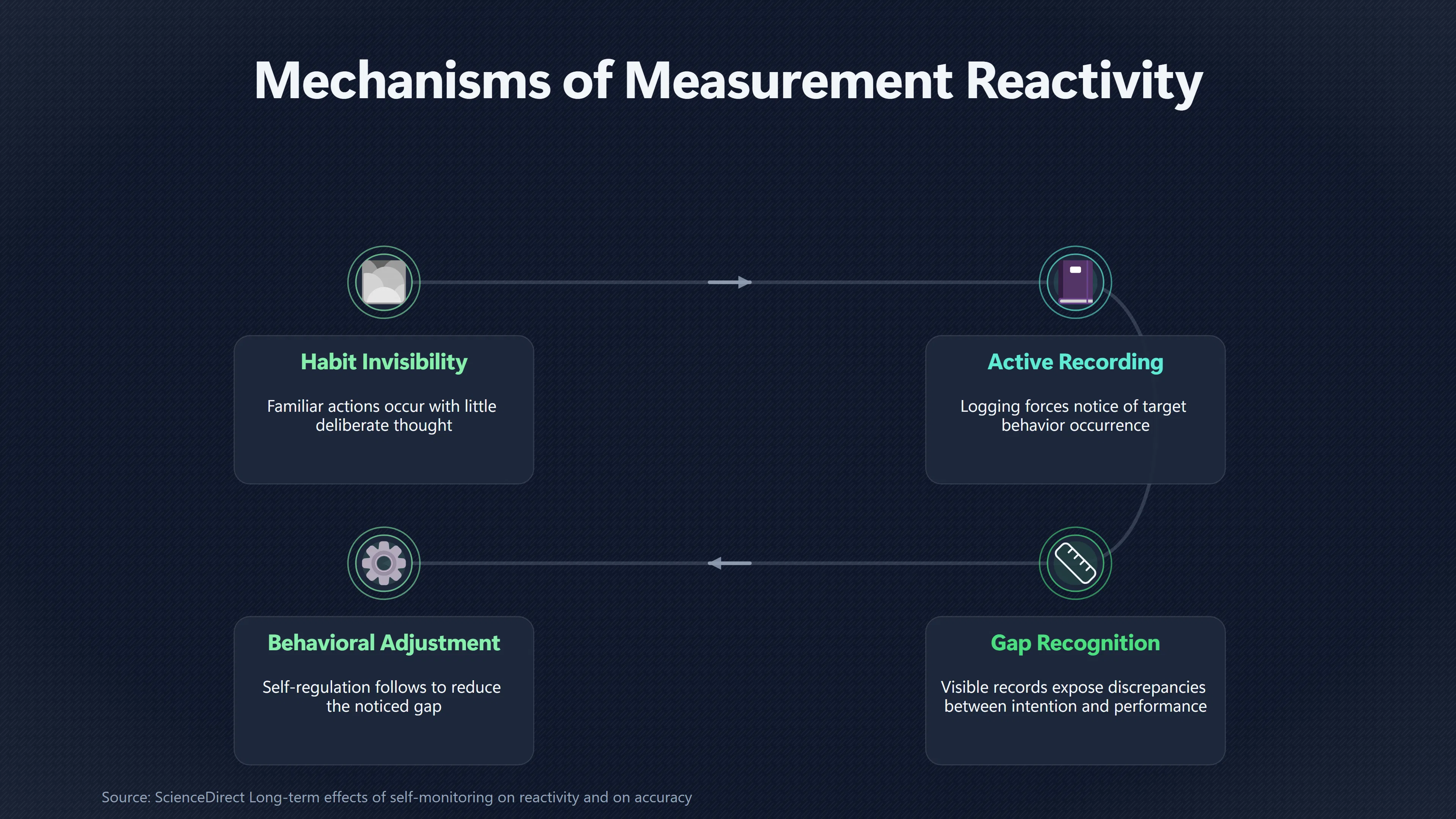
The most plausible pathway begins with attention. Habits are useful partly because familiar actions can occur with relatively little deliberate thought. Recording them reverses some of that invisibility. The person has to notice whether the target behaviour happened, classify it and often confront a number or mark representing the result.
Research on measurement reactivity proposes several overlapping mechanisms rather than one settled explanation. Measurement can increase awareness of one’s behaviour, make a health or behavioural goal more salient, trigger social-desirability concerns, or expose a discrepancy between current and desired performance. Once that discrepancy is noticed, ordinary self-regulation can follow: the person changes behaviour to reduce the gap.[PubMed Central (PMC)]pmc.ncbi.nlm.nih.govPubMed Central (PMC)Asking questions changes health-related behavior: an updated systematic review and meta-analysis - PMC…
This is closely related to why deliberate progress monitoring can work as a behaviour-change technique. Harkin and colleagues’ meta-analysis examined 138 randomised studies involving 19,951 participants. Interventions intended to increase progress monitoring substantially increased monitoring itself and produced a moderate overall improvement in goal attainment (d = 0.40). Changes in monitoring frequency statistically mediated the improvement, and effects were larger when monitoring information was physically recorded.[White Rose Research Online]eprints.whiterose.ac.ukWhite Rose Research OnlineDoes Monitoring Goal Progress Promote Goal Attainment? A Meta-Analysis of the Experimental Evidence. - White Ro…
Those findings should not be mistaken for a pure estimate of measurement reactivity: these were interventions designed to promote progress monitoring, not experiments in which every other possible influence of measurement was removed. But they demonstrate the practical overlap. The same act that produces a record — checking progress against a target and writing the result down — is also an established form of self-regulation.[ResearchGate]researchgate.netResearchGate(PDF) Does Monitoring Goal Progress Promote Goal Attainment? A Meta-Analysis of the Experimental EvidenceOctober 19, 2015…
A simple example shows why. Suppose the plan is to read for 30 minutes every evening. Without tracking, missing Tuesday may have little psychological presence by Friday. With a visible log, entering the first miss makes it explicit; entering a second produces a pattern. The tracker has not supplied motivation from nowhere. It has changed the information environment in which the next decision is made.
When a tracker becomes part of the habit
Physical-activity research provides unusually clear demonstrations because behaviour can be measured while varying how much feedback the participant receives. In one study, 63 adults first wore a sealed pedometer while believing that it was a body-posture monitor. They subsequently experienced sealed, visible and visible-plus-diary conditions. Average activity was about 8,362 steps per day during covert monitoring but 9,635 during the condition in which participants could see the device and logged their steps. The diary condition produced significantly more steps than covert or sealed monitoring.[PubMed]pubmed.ncbi.nlm.nih.govPub Med Increasing our understanding of reactivity to pedometers in adultsIncreasing our understanding of reactivity to pedometers in adults - PubMed…
A related study of 50 adults reported roughly 9,541 daily steps while the pedometer was sealed and its real purpose concealed, compared with 11,385 when participants could see the count and recorded it in an activity log. The design cannot identify which element — knowing the device’s purpose, seeing the feedback or completing the log — caused how much of the increase, but that is precisely the practical point: making measurement visible and actionable can change the thing being measured.[PubMed]pubmed.ncbi.nlm.nih.govPub Med Reactivity: an issue for short-term pedometer studies?Reactivity: an issue for short-term pedometer studies? - PubMed…
Reactivity is not necessarily permanent. Studies using repeated momentary assessment often look for an initial behavioural shift that fades as participants become accustomed to being monitored. A 2024 analysis of ecological momentary assessment data found patterns consistent with this: older adults showed less sedentary behaviour and more upright time during the first few days than later in the monitoring period, while women in midlife showed higher light physical activity during the earliest prompts.[PubMed]pubmed.ncbi.nlm.nih.govOpen source on nih.gov.
Yet fading cannot simply be assumed. An older experiment in which students recorded face-touching found a striking reduction during self-monitoring in both short- and longer-duration conditions. Face-touching rose again when recording stopped, suggesting that the reactive effect could persist while self-monitoring remained in place rather than disappearing merely through familiarity.[ScienceDirect]sciencedirect.comScienceDirect Long-term effects of self-monitoring on reactivity and on accuracyScienceDirect Long-term effects of self-monitoring on reactivity and on accuracy
The direction of change is not guaranteed either. In accelerometer research, participants have sometimes become less active over the monitoring period. One study of 171 adults found sedentary time increasing by about 2.4 minutes per day and light physical activity declining by about 2.4 minutes per day across seven days, while moderate-to-vigorous activity did not significantly change. That pattern was interpreted as evidence of small measurement-reactivity effects, but it also illustrates why reactivity should not be reduced to “tracking motivates improvement”.[PubMed]pubmed.ncbi.nlm.nih.govPitfalls in accelerometer-based measurement of physical activity: The presence of reactivity in an adult population - PubMed…
More measurement is not automatically better
If recording creates awareness, it is tempting to assume that increasingly intensive tracking should produce increasingly strong behaviour change. The evidence does not justify that simple rule.
The earlier systematic review of question–behaviour effects found no clear dose–response relationship when studies compared more intensive with less intensive measurement.[PubMed]pubmed.ncbi.nlm.nih.govOpen source on nih.gov. More recent work reinforces the reason for caution. A 2026 randomised smartphone study assigned 136 participants to answer questions about unhealthy snacking three, six or nine times per day for three weeks. Craving and snacking declined over time, consistent with a reactive self-monitoring effect, but increasing assessment frequency did not produce correspondingly greater reductions.[ScienceDirect]sciencedirect.comOpen source on sciencedirect.com.
Tracking can also have complicated effects within the same behaviour. A randomised daily-diary study of substance use found evidence that intensive monitoring could affect alcohol use during the first week, but the pattern was not simply beneficial: monitoring was associated with indications of both a greater desire to start drinking and reduced quantity once drinking began. The effects appeared to diminish by the second week, while marijuana use showed no comparable reactivity.[PubMed Central (PMC)]pmc.ncbi.nlm.nih.govOpen source on nih.gov.
These findings put a useful limit on the self-improvement claim. A tracker does not operate like a medicine whose effect necessarily rises with the dose. Repeated measurement adds attention, but it can also add burden, self-consciousness and repeated exposure to the behaviour being tracked. Whether that helps depends on the behaviour, what the measurement makes salient and how the person responds to the information.
The record is both evidence and intervention
Written records remain valuable because they replace vague retrospective impressions with something inspectable. Measurement reactivity does not cancel that advantage. It changes what the record means.
If a person records exercise for eight weeks and becomes more active, the resulting log answers one question well: what happened while I was tracking? It does not necessarily answer a different question: what would my behaviour have been if I had not tracked it? The second is a counterfactual, and the act of measurement may have helped produce the first result.
This is why measurement reactivity is a risk in research but can be useful in self-improvement. Researchers trying to estimate undisturbed behaviour may need concealed displays, less obtrusive measurement or control groups because reactivity contaminates observation. A person deliberately trying to change a habit has a different objective. If a simple record increases useful awareness without becoming burdensome, its lack of neutrality may be a feature rather than a defect.[PubMed]pubmed.ncbi.nlm.nih.govPub Med Presence and duration of reactivity to pedometers in adultsPub Med Presence and duration of reactivity to pedometers in adults
The evidence still argues against treating tracking as a guaranteed behavioural lever. The best controlled research on mere questioning finds small average effects and substantial heterogeneity, while reviews of broader self-regulation interventions find that self-monitoring works in some behavioural settings more reliably than others.[PubMed Central (PMC)]pmc.ncbi.nlm.nih.govPubMed Central (PMC)Asking questions changes health-related behavior: an updated systematic review and meta-analysis - PMC…
The more defensible principle is narrower: recording a habit changes the information available at the moment of the next choice. It can make an unnoticed pattern visible, turn an intention–behaviour gap into concrete feedback and repeatedly bring a goal back into attention. When that happens, the written record is no longer merely preserving the past accurately. It has become one of the conditions shaping what happens next.
Amazon book picks
Further Reading
Books and field guides related to Can Tracking a Habit Change the Habit Itself?. Use these as the next step if you want deeper reading beyond the article.
Atomic Habits
Rating: 3.5/5 from 7 Google Books ratings
The #1 New York Times bestseller. Over 25 million copies sold! Translated into 60+ languages! Tiny Changes, Remarkable Results No matter...
Tiny Habits
The world's leading expert on habit formation shows how you can have a happier, healthier life: by starting small. Myth: Change is hard....

The Power of Habit
Rating: 4.0/5 from 145 Google Books ratings
Duhigg takes us to the edge of scientific discoveries that explain why habits exist and how they can be changed. Distilling information i...
eBay marketplace picks
Marketplace Samples
Live-tested eBay searches with available results related to this page.
Selected fromproductivity poster oneBay.co.uk.




Endnotes
1.
Source: researchgate.net
Link:https://www.researchgate.net/publication/291335719_Does_Monitoring_Goal_Progress_Promote_Goal_Attainment_A_Meta-Analysis_of_the_Experimental_Evidence
Source snippet
ResearchGate(PDF) Does Monitoring Goal Progress Promote Goal Attainment? A Meta-Analysis of the Experimental EvidenceOctober 19, 2015...
Published: October 19, 2015
2.
Source: sciencedirect.com
Title: ScienceDirect Long-term effects of self-monitoring on reactivity and on accuracy
Link:https://www.sciencedirect.com/science/article/pii/000579678290095X
3.
Source: sciencedirect.com
Link:https://www.sciencedirect.com/science/article/pii/S1471015326000486
4.
Source: researchgate.net
Title: (PDF) Ecological Momentary Assessment in clinical research: A systematic review
Link:https://www.researchgate.net/publication/383677144_Ecological_Momentary_Assessment_in_clinical_research_A_systematic_review
5.
Source: sciencedirect.com
Link:https://www.sciencedirect.com/science/article/pii/S0277953624005288
6.
Source: sciencedirect.com
Link:https://www.sciencedirect.com/science/article/pii/S0163638323000747
7.
Source: sciencedirect.com
Link:https://www.sciencedirect.com/science/article/pii/S030646031930944X
8.
Source: sciencedirect.com
Link:https://www.sciencedirect.com/science/article/pii/S0002916522027861
9.
Source: sciencedirect.com
Link:https://www.sciencedirect.com/science/article/abs/pii/S0306460316304154
10.
Source: researchgate.net
Link:https://www.researchgate.net/publication/264865782_The_Question-Behavior_Effect_Genuine_Effect_or_Spurious_Phenomenon_A_Systematic_Review_of_Randomized_Controlled_Trials_With_Meta-Analyses
11.
Source: researchgate.net
Title: (PDF) Theoretical Explanations for Reactivity in Self-Monitoring
Link:https://www.researchgate.net/publication/247719763_Theoretical_Explanations_for_Reactivity_in_Self-Monitoring
12.
Source: sciencedirect.com
Title: A meta-analytic synthesis of the question–behavior effect
Link:https://www.sciencedirect.com/science/article/abs/pii/S1057740815001102
13.
Source: sciencedirect.com
Link:https://www.sciencedirect.com/science/article/pii/S0895435619311461
14.
Source: sciencedirect.com
Title: Long-term effects of self-monitoring on reactivity and on accuracy
Link:https://www.sciencedirect.com/science/article/abs/pii/000579678290095X
15.
Source: sciencedirect.com
Link:https://www.sciencedirect.com/science/article/pii/S1057740804701333
16.
Source: sciencedirect.com
Link:https://www.sciencedirect.com/science/article/pii/S0895435625000010
17.
Source: sciencedirect.com
Title: The reactivity of addictive behaviors to self-monitoring: A functional analysis
Link:https://www.sciencedirect.com/science/article/pii/0306460380900416
18.
Source: sciencedirect.com
Title: The relative reactivity of external observations and self-monitoring
Link:https://www.sciencedirect.com/science/article/pii/S0005789476800573
19.
Source: sciencedirect.com
Title: Multiple tracking and the reactivity of self-monitoring: I. Negative behaviors
Link:https://www.sciencedirect.com/science/article/abs/pii/S0005789477801536
20.
Source: sciencedirect.com
Title: Monitoring Children’s Physical Activity With Pedometers: Reactivity Revisited
Link:https://www.sciencedirect.com/science/article/pii/S1728869X12600021
21.
Source: sciencedirect.com
Link:https://www.sciencedirect.com/science/article/abs/pii/S0277953624005288
22.
Source: researchgate.net
Title: 239032421 Lack of Reactivity During Pedometer Self Monitoring in Adults
Link:https://www.researchgate.net/publication/239032421_Lack_of_Reactivity_During_Pedometer_Self-Monitoring_in_Adults?_tp=eyJjb250ZXh0Ijp7InBhZ2UiOiJzY2llbnRpZmljQ29udHJpYnV0aW9ucyIsInByZXZpb3VzUGFnZSI6bnVsbCwic3ViUGFnZSI6bnVsbH19
23.
Source: researchgate.net
Link:https://www.researchgate.net/publication/5671025_Reactivity_An_issue_for_short-term_pedometer_studies
24.
Source: pmc.ncbi.nlm.nih.gov
Link:https://pmc.ncbi.nlm.nih.gov/articles/PMC5241226/
Source snippet
PubMed Central (PMC)Measurement Reactivity in a Randomized Clinical Trial Using Self-Reported Data - PMCNovember 16, 2016...
Published: November 16, 2016
25.
Source: pubmed.ncbi.nlm.nih.gov
Link:https://pubmed.ncbi.nlm.nih.gov/35264084/
Source snippet
A systematic review and meta-analysis of studies of reactivity to digital in-the-moment measurement of health behaviour - PubMed...
26.
Source: eprints.whiterose.ac.uk
Link:https://eprints.whiterose.ac.uk/id/eprint/87431/
Source snippet
White Rose Research OnlineDoes Monitoring Goal Progress Promote Goal Attainment? A Meta-Analysis of the Experimental Evidence. - White Ro...
27.
Source: pmc.ncbi.nlm.nih.gov
Link:https://pmc.ncbi.nlm.nih.gov/articles/PMC7308800/
Source snippet
PubMed Central (PMC)Asking questions changes health-related behavior: an updated systematic review and meta-analysis - PMC...
28.
Source: pubmed.ncbi.nlm.nih.gov
Link:https://pubmed.ncbi.nlm.nih.gov/28921747/
Source snippet
Pitfalls in accelerometer-based measurement of physical activity: The presence of reactivity in an adult population - PubMed...
29.
Source: pubmed.ncbi.nlm.nih.gov
Link:https://pubmed.ncbi.nlm.nih.gov/32229251/
Source snippet
Asking questions changes health-related behavior: an updated systematic review and meta-analysis - PubMed...
30.
Source: pmc.ncbi.nlm.nih.gov
Link:https://pmc.ncbi.nlm.nih.gov/articles/PMC7571594/
Source snippet
PubMed Central (PMC)Self-Regulation Mechanisms in Health Behaviour Change: A Systematic Meta-Review of Meta-Analyses, 2006–2017 - PMC...
31.
Source: pubmed.ncbi.nlm.nih.gov
Title: Pub Med Increasing our understanding of reactivity to pedometers in adults
Link:https://pubmed.ncbi.nlm.nih.gov/19204581/
Source snippet
Increasing our understanding of reactivity to pedometers in adults - PubMed...
32.
Source: pubmed.ncbi.nlm.nih.gov
Title: Pub Med Reactivity: an issue for short-term pedometer studies?
Link:https://pubmed.ncbi.nlm.nih.gov/18178685/
Source snippet
Reactivity: an issue for short-term pedometer studies? - PubMed...
33.
Source: pubmed.ncbi.nlm.nih.gov
Link:https://pubmed.ncbi.nlm.nih.gov/41726043/
34.
Source: pmc.ncbi.nlm.nih.gov
Link:https://pmc.ncbi.nlm.nih.gov/articles/PMC12922600/
35.
Source: pubmed.ncbi.nlm.nih.gov
Link:https://pubmed.ncbi.nlm.nih.gov/25133835/
36.
Source: pmc.ncbi.nlm.nih.gov
Link:https://pmc.ncbi.nlm.nih.gov/articles/PMC6934919/
37.
Source: pubmed.ncbi.nlm.nih.gov
Title: Pub Med Presence and duration of reactivity to pedometers in adults
Link:https://pubmed.ncbi.nlm.nih.gov/22595985/
38.
Source: pmc.ncbi.nlm.nih.gov
Link:https://pmc.ncbi.nlm.nih.gov/articles/PMC12963814/
39.
Source: pmc.ncbi.nlm.nih.gov
Link:https://pmc.ncbi.nlm.nih.gov/articles/PMC12853084/
40.
Source: pmc.ncbi.nlm.nih.gov
Link:https://pmc.ncbi.nlm.nih.gov/articles/PMC12750485/
41.
Source: pmc.ncbi.nlm.nih.gov
Link:https://pmc.ncbi.nlm.nih.gov/articles/PMC12064450/
42.
Source: pmc.ncbi.nlm.nih.gov
Link:https://pmc.ncbi.nlm.nih.gov/articles/PMC11659718/
43.
Source: pubmed.ncbi.nlm.nih.gov
Link:https://pubmed.ncbi.nlm.nih.gov/38959816/
44.
Source: pmc.ncbi.nlm.nih.gov
Link:https://pmc.ncbi.nlm.nih.gov/articles/PMC11629396/
45.
Source: pmc.ncbi.nlm.nih.gov
Link:https://pmc.ncbi.nlm.nih.gov/articles/PMC10765525/
46.
Source: pmc.ncbi.nlm.nih.gov
Link:https://pmc.ncbi.nlm.nih.gov/articles/PMC10442809/
47.
Source: pubmed.ncbi.nlm.nih.gov
Link:https://pubmed.ncbi.nlm.nih.gov/36174163/
48.
Source: pmc.ncbi.nlm.nih.gov
Link:https://pmc.ncbi.nlm.nih.gov/articles/PMC9163273/
49.
Source: pubmed.ncbi.nlm.nih.gov
Link:https://pubmed.ncbi.nlm.nih.gov/35719870/
50.
Source: pubmed.ncbi.nlm.nih.gov
Link:https://pubmed.ncbi.nlm.nih.gov/35410547/
51.
Source: pmc.ncbi.nlm.nih.gov
Link:https://pmc.ncbi.nlm.nih.gov/articles/PMC9999286/
52.
Source: pubmed.ncbi.nlm.nih.gov
Link:https://pubmed.ncbi.nlm.nih.gov/37287532/
53.
Source: pubmed.ncbi.nlm.nih.gov
Link:https://pubmed.ncbi.nlm.nih.gov/33440344/
54.
Source: pmc.ncbi.nlm.nih.gov
Link:https://pmc.ncbi.nlm.nih.gov/articles/PMC7430559/
55.
Source: pmc.ncbi.nlm.nih.gov
Link:https://pmc.ncbi.nlm.nih.gov/articles/PMC7429262/
56.
Source: pubmed.ncbi.nlm.nih.gov
Link:https://pubmed.ncbi.nlm.nih.gov/31775064/
57.
Source: pmc.ncbi.nlm.nih.gov
Link:https://pmc.ncbi.nlm.nih.gov/articles/PMC6693254/
58.
Source: pmc.ncbi.nlm.nih.gov
Link:https://pmc.ncbi.nlm.nih.gov/articles/PMC4565778/
59.
Source: pmc.ncbi.nlm.nih.gov
Link:https://pmc.ncbi.nlm.nih.gov/articles/PMC4931712/
60.
Source: pubmed.ncbi.nlm.nih.gov
Link:https://pubmed.ncbi.nlm.nih.gov/26162771/
61.
Source: pmc.ncbi.nlm.nih.gov
Link:https://pmc.ncbi.nlm.nih.gov/articles/PMC3972382/
62.
Source: pmc.ncbi.nlm.nih.gov
Link:https://pmc.ncbi.nlm.nih.gov/articles/PMC4059597/
63.
Source: pubmed.ncbi.nlm.nih.gov
Link:https://pubmed.ncbi.nlm.nih.gov/24015965/
64.
Source: pmc.ncbi.nlm.nih.gov
Link:https://pmc.ncbi.nlm.nih.gov/articles/PMC4882469/
65.
Source: pmc.ncbi.nlm.nih.gov
Link:https://pmc.ncbi.nlm.nih.gov/articles/PMC3529752/
66.
Source: pmc.ncbi.nlm.nih.gov
Link:https://pmc.ncbi.nlm.nih.gov/articles/PMC3187747/
67.
Source: pubmed.ncbi.nlm.nih.gov
Link:https://pubmed.ncbi.nlm.nih.gov/20205982/
68.
Source: pubmed.ncbi.nlm.nih.gov
Link:https://pubmed.ncbi.nlm.nih.gov/16507060/
69.
Source: ncbi.nlm.nih.gov
Link:https://www.ncbi.nlm.nih.gov/books/NBK574081/
70.
Source: pubmed.ncbi.nlm.nih.gov
Link:https://pubmed.ncbi.nlm.nih.gov/20939639/
71.
Source: pubmed.ncbi.nlm.nih.gov
Link:https://pubmed.ncbi.nlm.nih.gov/7126117/
72.
Source: pubmed.ncbi.nlm.nih.gov
Link:https://pubmed.ncbi.nlm.nih.gov/39800011/
73.
Source: pmc.ncbi.nlm.nih.gov
Link:https://pmc.ncbi.nlm.nih.gov/articles/PMC5798432/
74.
Source: pubmed.ncbi.nlm.nih.gov
Link:https://pubmed.ncbi.nlm.nih.gov/27992833/
75.
Source: pubmed.ncbi.nlm.nih.gov
Link:https://pubmed.ncbi.nlm.nih.gov/20887573/
76.
Source: pubmed.ncbi.nlm.nih.gov
Link:https://pubmed.ncbi.nlm.nih.gov/17696685/
77.
Source: pubmed.ncbi.nlm.nih.gov
Link:https://pubmed.ncbi.nlm.nih.gov/41787779/
78.
Source: eprints.whiterose.ac.uk
Link:https://eprints.whiterose.ac.uk/id/eprint/133810/
Additional References
79.
Source: youtube.com
Title: Ask, Don’t Tell
Link:https://www.youtube.com/watch?v=BeKwpE4cXtM
Source snippet
For a direct breakdown of how logging and measuring actions alters psychological decision-making and habit [consistency]({{ 'consistency/' | relative_url }}), explore Why an Em...
80.
Source: youtube.com
Title: Why an Empty Cell Made Her Run: Psychology of Self-Monitoring
Link:https://www.youtube.com/watch?v=qNRdQqmC58Y
Source snippet
The benefit of self-monitoring (the hawthorne effect)...
81.
Source: youtube.com
Title: The benefit of self-monitoring (the hawthorne effect)
Link:https://www.youtube.com/watch?v=Smt06gqsd8s
Source snippet
Part 13: Organizing support: Use self-monitoring of behavior...
82.
Source: youtube.com
Title: The Hawthorne Effect
Link:https://www.youtube.com/watch?v=kgh1vTaZjX0
Source snippet
Ask, Don't Tell - The Question/Behavior Effect | The Diary of a CEO | Law 6...
83.
Source: youtube.com
Title: Part 13: Organizing support: Use self-monitoring of behavior
Link:https://www.youtube.com/watch?v=DbbE_METIGA
Source snippet
The Hawthorne Effect - Explained 5 Minutes...
84.
Source: escholarship.org
Link:https://escholarship.org/uc/item/4r7461w6
85.
Source: tandfonline.com
Link:https://www.tandfonline.com/doi/abs/10.1080/17437199.2022.2047096
86.
Source: tandfonline.com
Link:https://www.tandfonline.com/doi/abs/10.1207/s15327841mpee1001_1
87.
Source: doi.org
Link:https://doi.org/10.1093/ajcn/nqx048
88.
Source: studies.mrc-epid.cam.ac.uk
Link:https://studies.mrc-epid.cam.ac.uk/fenland-measurement-reactivity