Within Fewer Decisions
Does Decision Fatigue Really Explain Why Planning Helps?
Pre-deciding useful actions can reduce friction without assuming that every earlier choice drains a fixed reserve of willpower.
On this page
- What classic ego depletion theory claimed
- What large replication studies found
- Stronger reasons to reduce decisions at action time
Page outline Jump by section
Introduction
Reducing daily choices can be useful, but the familiar explanation — that every decision drains a fixed reservoir of willpower — is much less secure than popular “decision fatigue” advice often suggests. Classic ego-depletion experiments proposed that acts of choice and self-control consume a common limited resource. Early studies and a 2010 meta-analysis appeared to support that account, but later bias analyses and two large preregistered multi-laboratory projects found effects close to zero.[PubMed]pubmed.ncbi.nlm.nih.govPub Med Ego depletion: is the active self a limited resource?Ego depletion: is the active self a limited resource? - PubMed…

That does not make pre-deciding actions pointless. It changes the reason for doing it. A stronger evidence-based case is that a good plan removes ambiguity at the moment of action, makes the relevant cue easier to recognise and links that cue to a response already chosen. In practical self-improvement, “decide beforehand” remains sensible advice without requiring the metaphor of a willpower battery.[ScienceDirect]sciencedirect.comImplementation Intentions and Goal Achievement: A Meta‐analysis of Effects and Processes - ScienceDirect…
What classic ego-depletion theory actually claimed
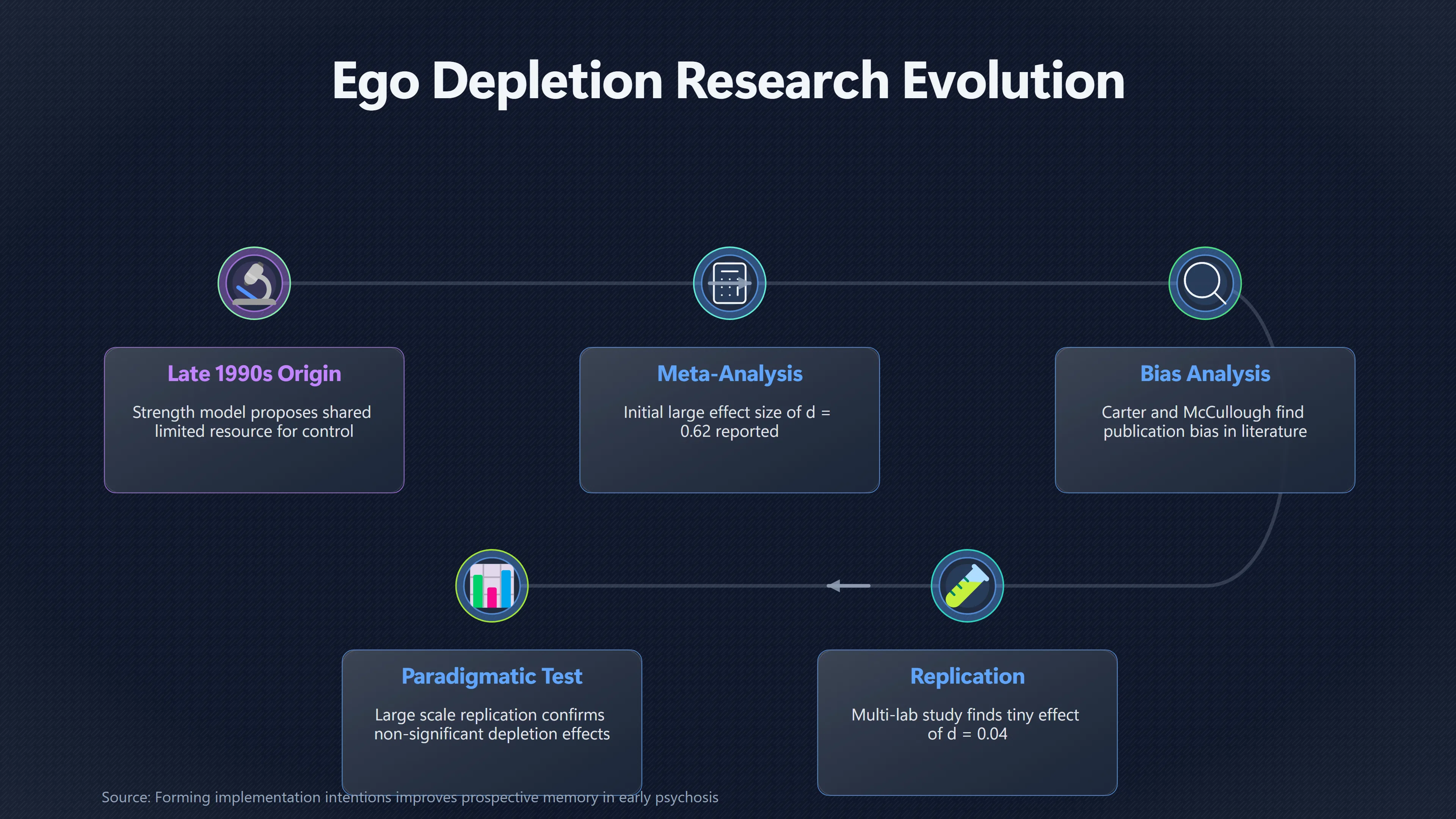
The influential version of ego-depletion theory emerged from experiments in the late 1990s. Its central claim was unusually broad: different acts of deliberate control could depend on a shared, limited resource, so exerting control in one activity would temporarily impair performance on another. One early experiment, for example, had participants resist tempting chocolates and eat radishes instead; those participants subsequently gave up sooner on unsolvable puzzles. Other experiments connected emotion suppression, thought suppression and deliberate choice with poorer performance or persistence on a later task.[PubMed]pubmed.ncbi.nlm.nih.govPub Med Self-control as limited resource: regulatory depletion patternsSelf-control as limited resource: regulatory depletion patterns - PubMed…
This became the “strength model” of self-control. A 2000 review compared self-regulation to muscular exertion: using self-control was proposed to consume some limited capacity, leaving less available for the next demand.[PubMed]pubmed.ncbi.nlm.nih.govSelf-regulation and depletion of limited resources: does self-control resemble a muscle? - PubMed… That framework supplied an intuitive explanation for an everyday experience — after a demanding day, resisting temptation or making another difficult decision can certainly feel harder.
The theory became directly relevant to decision reduction through experiments by Kathleen Vohs and colleagues. Their 2008 paper reported that participants who made repeated choices about consumer products or university courses subsequently showed poorer performance on measures including physical stamina, persistence, procrastination and arithmetic. A field component also found that shoppers reporting more previous active decision-making showed less self-control afterwards. The authors interpreted the findings as evidence that choosing and self-control draw on the same limited resource.[PubMed]pubmed.ncbi.nlm.nih.govMaking choices impairs subsequent self-control: a limited-resource account of decision making, self-regulation, and active initiati…
The resulting practical story was compelling: every choice costs a little willpower, so eliminating minor decisions should preserve that resource for important ones. But that story makes a stronger scientific claim than the practical advice actually needs. It assumes not merely that repeated difficult decisions can be tiring, but that choosing causes subsequent self-control impairment because a general-purpose resource has been depleted.
Initially, the quantitative literature appeared to support that interpretation. A prominent 2010 meta-analysis concluded that ego depletion produced a medium-to-large effect, conventionally reported as d = 0.62.[PubMed]pubmed.ncbi.nlm.nih.govPub Med Ego depletion and the strength model of self-control: a meta-analysisEgo depletion and the strength model of self-control: a meta-analysis - PubMed… For several years, that estimate helped make the limited-resource model look like a well-established foundation for advice about conserving willpower.
Large replications changed the picture
The first major warning concerned the published evidence itself. Carter and McCullough reanalysed the earlier literature using techniques intended to detect small-study and publication effects. They found strong indications of publication bias and estimated that, after correction, the depletion effect could be indistinguishable from zero.[PubMed]pubmed.ncbi.nlm.nih.govOpen source on nih.gov.
A subsequent series of meta-analytic tests by Carter, Kofler, Forster and McCullough reached a similarly sceptical conclusion. Using more restrictive criteria and methods intended to address limitations of the earlier evidence base, the researchers found very little support for a depletion effect as conventionally measured in laboratory experiments. They argued that the results strongly challenged the claim that self-control behaves as though it relies on a limited psychological or physical resource.[PubMed]pubmed.ncbi.nlm.nih.govOpen source on nih.gov.
The dispute then moved from reanalysing old studies to conducting much larger, preregistered tests.
In 2016, Martin Hagger and colleagues coordinated 23 laboratories using a standardised ego-depletion procedure, producing a combined sample of 2,141 participants. The estimated effect was d = 0.04, with a 95% confidence interval from −0.07 to 0.15. In other words, the estimate was tiny and statistically compatible with no depletion effect.[PubMed]pubmed.ncbi.nlm.nih.govPub Med A Multilab Preregistered Replication of the Ego-Depletion EffectA Multilab Preregistered Replication of the Ego-Depletion Effect - PubMed…
That replication did not settle every methodological dispute. Critics argued, among other things, that its initial depletion manipulation might not have been sufficiently demanding, illustrating a recurring difficulty in this literature: a null result is harder to interpret when researchers disagree about whether the experimental procedure successfully induced the proposed state in the first place. Reviews of the controversy note that many earlier studies had not included strong manipulation checks either.[BPS Psych Hub]bpspsychub.onlinelibrary.wiley.comOpen source on wiley.com.
A second major preregistered effort therefore matters. Published in 2021, it involved 36 laboratories and 3,531 participants and deliberately used a “paradigmatic replication” approach rather than simply repeating the earlier standardised procedure. Its confirmatory estimate was again very small, d = 0.06, and non-significant. Bayesian analysis found the observed data four times more likely under the null hypothesis than under the researchers’ specified depletion hypothesis. An exploratory analysis using the full sample produced a statistically significant d = 0.08, but that is still far smaller than the effect suggested by the influential earlier literature.[PubMed]pubmed.ncbi.nlm.nih.govPub Med A Multisite Preregistered Paradigmatic Test of the Ego-Depletion EffectA Multisite Preregistered Paradigmatic Test of the Ego-Depletion Effect - PubMed…
These results do not prove that previous mental effort can never affect later behaviour. Indeed, proponents of ego-depletion theory continue to argue that the original model should be refined rather than abandoned, with greater attention to the strength and duration of the initial exertion, fatigue and conservation of effort. A 2024 review by Baumeister and colleagues makes precisely that case.[ScienceDirect]sciencedirect.comOpen source on sciencedirect.com. The narrower conclusion is more defensible: large preregistered studies do not support treating a sizeable, automatic depletion of a general willpower resource as an established fact.
“Decision fatigue” is broader than a willpower battery
There is another reason to be careful with the terminology. “Decision fatigue” is now used for several related observations — becoming tired while deciding, shifting towards easier or default options, avoiding decisions, or showing changes in judgement over time. Those observations do not automatically demonstrate classic ego depletion, much less identify a finite resource as their cause.
Recent research illustrates the distinction. A 2025 preregistered systematic review examined decision fatigue among healthcare professionals, where repeated high-stakes decisions provide a plausible real-world test case. It screened 14,740 records and included 82 studies or discussions, including 72 quantitative studies. Among cases that quantitatively assessed a decision-fatigue hypothesis, 45% produced evidence of significant effects. Yet the reviewers also found inconsistent definitions, inadequate operationalisation and underdeveloped theoretical explanations.[PubMed]pubmed.ncbi.nlm.nih.govOpen source on nih.gov.
That mixed result is instructive. Behaviour can change across a long sequence of decisions without demonstrating that each preceding choice has subtracted a fixed quantity from an internal store. Time on task, sleepiness, workload, stress, attention, motivation, changing incentives and a growing preference for easier responses can potentially produce superficially similar patterns. The healthcare reviewers therefore define decision fatigue more cautiously as a tendency towards less effortful decisions as the cumulative burden of effortful decision-making increases, rather than simply assuming the classic resource mechanism.[Taylor & Francis Online]tandfonline.comOpen source on tandfonline.com.
For everyday self-improvement, this means observations such as “I make worse choices late in a difficult day” should not be dismissed. They simply do not establish the popular causal story that breakfast choices, clothing choices and email decisions have steadily emptied the same tank needed to exercise that evening.

Planning has stronger reasons to work
Fortunately, reducing decisions at action time does not stand or fall with ego depletion. Research on implementation intentions supplies a more direct reason for deciding useful actions beforehand.
An implementation intention connects a recognisable situation with a predetermined response: in simplified form, “If situation Y occurs, I will do X.” A major meta-analysis covering 94 independent tests reported a medium-to-large overall effect on goal attainment, d = 0.65. The plans were intended to bridge the familiar gap between wanting to achieve something and successfully initiating the behaviour when the opportunity arrives.[ScienceDirect]sciencedirect.comImplementation Intentions and Goal Achievement: A Meta‐analysis of Effects and Processes - ScienceDirect…
Crucially, experiments investigating how these plans work point towards mechanisms that do not require a depleted-resource theory. Thomas Webb and Paschal Sheeran tested two proposed components: whether planning makes the specified situational cue more mentally accessible, and whether it strengthens the association between that cue and the intended response. Both processes helped account for improved goal achievement.[ScienceDirect]sciencedirect.comOpen source on sciencedirect.com.
Consider the difference between these two intentions:
“I should exercise tomorrow.”
“After I close my laptop at 5.30, I will put on my trainers and start my 20-minute walk.”
The second version has removed several questions from the later action point: whether to exercise, when to begin and what the first action is. But its advantage need not be that answering those questions tomorrow would consume precious units of willpower. The plan has instead created a clearer trigger and attached a prepared response to it.
Evidence from prospective memory — remembering to carry out an intended future action — reinforces this interpretation. A 2015 meta-analysis of 36 comparisons found an overall medium-sized improvement in prospective-memory performance from implementation intentions. For healthy young adults the estimated effect was d = 0.445, while the estimate for older adults was d = 0.680.[ScienceDirect]sciencedirect.comOpen source on sciencedirect.com. Planning can therefore help with a problem more specific than “running out of willpower”: successfully retrieving an intended action when its moment arrives.
Reduce the decisions that obstruct action
The evidence supports a selective rather than maximalist approach to decision reduction. There is little scientific reason to treat choice itself as something that must be minimised throughout the day because every decision supposedly consumes a fixed reserve. Choice is often useful: it allows adaptation when circumstances change, helps people learn what works and prevents rigid plans from surviving after they have stopped serving their purpose.
The higher-value target is recurrent uncertainty at predictable action points. If the same minor negotiation repeatedly appears between an intention and a behaviour, settling it beforehand can make execution simpler.
That distinction changes what sensible decision reduction looks like:
- Pre-decide the first action. “After breakfast, I open the document and work for ten minutes” removes the question of how to begin.
- Attach action to a clear cue. A recognisable event or situation gives the plan something concrete to trigger it; implementation-intention research specifically supports this cue–response structure.[ScienceDirect]sciencedirect.comOpen source on sciencedirect.com.
- Standardise recurring low-value choices when they genuinely create hesitation. A regular study location, exercise slot or default breakfast can be convenient, but there is no need to eliminate harmless choices merely to “save willpower”.
- Keep important decisions revisable. Pre-deciding is most useful when the desired behaviour is already reasonably settled. It should not convert decisions requiring new information or judgement into automatic routines.
This framing also makes the technique more robust. If future research ultimately identifies reliable ego-depletion effects under particular conditions, reducing unnecessary effort may provide an additional benefit. If the strong limited-resource theory continues to fare poorly, the planning strategy still has independent support through cue recognition, prospective memory and stronger cue–response links.[White Rose Research Online]eprints.whiterose.ac.ukWhite Rose Research OnlineHow do implementation intentions promote goal attainment? A test of component processes - White Rose Research O…
The practical claim worth keeping
“Reduce decisions” is therefore better understood as an execution strategy than an energy-conservation law.
Classic ego-depletion research supplied an appealing explanation for why the strategy might work, and early experiments and meta-analysis appeared to support it. But evidence of publication bias, followed by preregistered multi-lab estimates of d = 0.04 and d = 0.06, makes the simple model of a reliably draining willpower reservoir a poor foundation for confident self-improvement advice.[PubMed]pubmed.ncbi.nlm.nih.govOpen source on nih.gov.
The more durable lesson is narrower: when you already know what you want to do and predictable hesitation keeps preventing it, make the useful decision earlier. Specify the situation, choose the response and make the first step obvious. That reduces opportunities for delay and helps the intended action become available when its cue arrives. The benefit does not require believing that choosing a shirt in the morning has used up some of the willpower you will need at night. It requires only the much better-supported insight that a decision already translated into a concrete cue–response plan can be easier to execute than an intention that still has to be worked out in the moment.[sciencedirect.com]sciencedirect.comImplementation Intentions and Goal Achievement: A Meta‐analysis of Effects and Processes - ScienceDirect…
Amazon book picks
Further Reading
Books and field guides related to Does Decision Fatigue Really Explain Why Planning Helps?. Use these as the next step if you want deeper reading beyond the article.
Thinking, Fast and Slow
Why is there more chance we'll believe something if it's in a bold type face? Why are judges more likely to deny parole before lunch? Why...
Atomic Habits
Rating: 3.5/5 from 7 Google Books ratings
The #1 New York Times bestseller. Over 25 million copies sold! Translated into 60+ languages! Tiny Changes, Remarkable Results No matter...
The Willpower Instinct
Based on Stanford University psychologist Kelly McGonigal's wildly popular course "The Science of Willpower," The Willpower Instinct is t...
Scarcity
A surprising and intriguing examination of how scarcity—and our flawed responses to it—shapes our lives, our society, and our culture
eBay marketplace picks
Marketplace Samples
Live-tested eBay searches with available results related to this page.
Selected fromproductivity poster oneBay.co.uk.




Endnotes
1.
Source: sciencedirect.com
Link:https://www.sciencedirect.com/science/article/abs/pii/S0065260106380021
Source snippet
Implementation Intentions and Goal Achievement: A Meta‐analysis of Effects and Processes - ScienceDirect...
2.
Source: sciencedirect.com
Link:https://www.sciencedirect.com/science/article/pii/S2352250X24000952
3.
Source: sciencedirect.com
Link:https://www.sciencedirect.com/science/article/abs/pii/S002210310600028X
4.
Source: sciencedirect.com
Link:https://www.sciencedirect.com/science/article/pii/S0165178115000360
5.
Source: sciencedirect.com
Link:https://www.sciencedirect.com/science/article/pii/S2352250X24000927
6.
Source: sciencedirect.com
Title: Forming implementation intentions improves prospective memory in early psychosis
Link:https://www.sciencedirect.com/science/article/abs/pii/S0165178115004199
7.
Source: sciencedirect.com
Link:https://www.sciencedirect.com/science/article/abs/pii/S0165178115000360
8.
Source: sciencedirect.com
Title: Free will in consumer behavior: Self-control, ego depletion, and choice
Link:https://www.sciencedirect.com/science/article/pii/S1057740807000034
9.
Source: sciencedirect.com
Link:https://www.sciencedirect.com/science/article/pii/S0191886906003485
10.
Source: sciencedirect.com
Link:https://www.sciencedirect.com/science/chapter/bookseries/abs/pii/S0065260106380021
11.
Source: sciencedirect.com
Link:https://www.sciencedirect.com/science/article/abs/pii/S1041608007000313
12.
Source: sciencedirect.com
Link:https://www.sciencedirect.com/science/article/abs/pii/S2352550925000260
13.
Source: pubmed.ncbi.nlm.nih.gov
Title: Pub Med Ego depletion: is the active self a limited resource?
Link:https://pubmed.ncbi.nlm.nih.gov/9599441/
Source snippet
Ego depletion: is the active self a limited resource? - PubMed...
14.
Source: pubmed.ncbi.nlm.nih.gov
Title: Pub Med Ego depletion and the strength model of self-control: a meta-analysis
Link:https://pubmed.ncbi.nlm.nih.gov/20565167/
Source snippet
Ego depletion and the strength model of self-control: a meta-analysis - PubMed...
15.
Source: pubmed.ncbi.nlm.nih.gov
Title: Pub Med A Multilab Preregistered Replication of the Ego-Depletion Effect
Link:https://pubmed.ncbi.nlm.nih.gov/27474142/
Source snippet
A Multilab Preregistered Replication of the Ego-Depletion Effect - PubMed...
16.
Source: pubmed.ncbi.nlm.nih.gov
Title: Pub Med A Multisite Preregistered Paradigmatic Test of the Ego-Depletion Effect
Link:https://pubmed.ncbi.nlm.nih.gov/34520296/
Source snippet
A Multisite Preregistered Paradigmatic Test of the Ego-Depletion Effect - PubMed...
17.
Source: eprints.whiterose.ac.uk
Link:https://eprints.whiterose.ac.uk/id/eprint/10753/
Source snippet
White Rose Research OnlineHow do implementation intentions promote goal attainment? A test of component processes - White Rose Research O...
18.
Source: pubmed.ncbi.nlm.nih.gov
Title: Pub Med Self-control as limited resource: regulatory depletion patterns
Link:https://pubmed.ncbi.nlm.nih.gov/9523419/
Source snippet
Self-control as limited resource: regulatory depletion patterns - PubMed...
19.
Source: pubmed.ncbi.nlm.nih.gov
Link:https://pubmed.ncbi.nlm.nih.gov/10748642/
Source snippet
Self-regulation and depletion of limited resources: does self-control resemble a muscle? - PubMed...
20.
Source: pubmed.ncbi.nlm.nih.gov
Link:https://pubmed.ncbi.nlm.nih.gov/18444745/
Source snippet
Making choices impairs subsequent self-control: a limited-resource account of decision making, self-regulation, and active initiati...
21.
Source: pmc.ncbi.nlm.nih.gov
Title: Pub Med Central (PMC)An updated meta-analysis of the ego depletion effect
Link:https://pmc.ncbi.nlm.nih.gov/articles/PMC6013521/
Source snippet
PubMed Central (PMC)An updated meta-analysis of the ego depletion effect - PMC...
22.
Source: pubmed.ncbi.nlm.nih.gov
Link:https://pubmed.ncbi.nlm.nih.gov/25126083/
23.
Source: pubmed.ncbi.nlm.nih.gov
Link:https://pubmed.ncbi.nlm.nih.gov/26076043/
24.
Source: bpspsychub.onlinelibrary.wiley.com
Link:https://bpspsychub.onlinelibrary.wiley.com/doi/10.1111/bjso.12594
25.
Source: pmc.ncbi.nlm.nih.gov
Link:https://pmc.ncbi.nlm.nih.gov/articles/PMC6124090/
26.
Source: pubmed.ncbi.nlm.nih.gov
Link:https://pubmed.ncbi.nlm.nih.gov/40591577/
27.
Source: tandfonline.com
Link:https://www.tandfonline.com/doi/full/10.1080/17437199.2025.2513916
28.
Source: pubmed.ncbi.nlm.nih.gov
Link:https://pubmed.ncbi.nlm.nih.gov/25639373/
29.
Source: pubmed.ncbi.nlm.nih.gov
Link:https://pubmed.ncbi.nlm.nih.gov/41784001/
30.
Source: bpspsychub.onlinelibrary.wiley.com
Link:https://bpspsychub.onlinelibrary.wiley.com/doi/10.1111/bjop.70065
31.
Source: onlinelibrary.wiley.com
Link:https://onlinelibrary.wiley.com/doi/10.1002/hsr2.71166
32.
Source: pmc.ncbi.nlm.nih.gov
Link:https://pmc.ncbi.nlm.nih.gov/articles/PMC12206732/
33.
Source: pubmed.ncbi.nlm.nih.gov
Link:https://pubmed.ncbi.nlm.nih.gov/40589880/
34.
Source: pmc.ncbi.nlm.nih.gov
Link:https://pmc.ncbi.nlm.nih.gov/articles/PMC11808891/
36.
Source: pubmed.ncbi.nlm.nih.gov
Link:https://pubmed.ncbi.nlm.nih.gov/39922690/
37.
Source: pubmed.ncbi.nlm.nih.gov
Link:https://pubmed.ncbi.nlm.nih.gov/39526649/
38.
Source: shmpublications.onlinelibrary.wiley.com
Link:https://shmpublications.onlinelibrary.wiley.com/doi/full/10.1002/jhm.13550
39.
Source: pubmed.ncbi.nlm.nih.gov
Link:https://pubmed.ncbi.nlm.nih.gov/39278166/
40.
Source: doi.org
Link:https://doi.org/10.1080/10463283.2024.2334563
41.
Source: tandfonline.com
Link:https://www.tandfonline.com/doi/abs/10.1080/10463283.2024.2334563
42.
Source: pmc.ncbi.nlm.nih.gov
Link:https://pmc.ncbi.nlm.nih.gov/articles/PMC10307977/
43.
Source: onlinelibrary.wiley.com
Link:https://onlinelibrary.wiley.com/doi/full/10.1002/cb.2148
44.
Source: onlinelibrary.wiley.com
Link:https://onlinelibrary.wiley.com/doi/abs/10.1002/cb.2148
45.
Source: onlinelibrary.wiley.com
Link:https://onlinelibrary.wiley.com/doi/10.1002/cb.2148
46.
Source: pmc.ncbi.nlm.nih.gov
Link:https://pmc.ncbi.nlm.nih.gov/articles/PMC12422598/
47.
Source: pmc.ncbi.nlm.nih.gov
Link:https://pmc.ncbi.nlm.nih.gov/articles/PMC8134656/
48.
Source: pmc.ncbi.nlm.nih.gov
Link:https://pmc.ncbi.nlm.nih.gov/articles/PMC8186735/
49.
Source: pubmed.ncbi.nlm.nih.gov
Link:https://pubmed.ncbi.nlm.nih.gov/34113424/
50.
Source: doi.org
Title: The Past, Present, and Future of Ego Depletion | Social Psychology
Link:https://doi.org/10.1027/1864-9335%2Fa000398
51.
Source: pubmed.ncbi.nlm.nih.gov
Link:https://pubmed.ncbi.nlm.nih.gov/30427874/
52.
Source: pmc.ncbi.nlm.nih.gov
Link:https://pmc.ncbi.nlm.nih.gov/articles/PMC6235272/
53.
Source: pmc.ncbi.nlm.nih.gov
Link:https://pmc.ncbi.nlm.nih.gov/articles/PMC6016937/
54.
Source: pubmed.ncbi.nlm.nih.gov
Link:https://pubmed.ncbi.nlm.nih.gov/29940020/
55.
Source: pmc.ncbi.nlm.nih.gov
Link:https://pmc.ncbi.nlm.nih.gov/articles/PMC6119549/
56.
Source: pubmed.ncbi.nlm.nih.gov
Link:https://pubmed.ncbi.nlm.nih.gov/28931013/
57.
Source: pmc.ncbi.nlm.nih.gov
Link:https://pmc.ncbi.nlm.nih.gov/articles/PMC5394171/
58.
Source: pmc.ncbi.nlm.nih.gov
Link:https://pmc.ncbi.nlm.nih.gov/articles/PMC5306285/
59.
Source: pubmed.ncbi.nlm.nih.gov
Link:https://pubmed.ncbi.nlm.nih.gov/27826272/
60.
Source: pmc.ncbi.nlm.nih.gov
Link:https://pmc.ncbi.nlm.nih.gov/articles/PMC5079083/
61.
Source: pmc.ncbi.nlm.nih.gov
Link:https://pmc.ncbi.nlm.nih.gov/articles/PMC4971805/
62.
Source: doi.org
Title: A Multilab Preregistered Replication of the Ego-Depletion Effect
Link:https://doi.org/10.1177%2F1745691616652873
63.
Source: compass.onlinelibrary.wiley.com
Link:https://compass.onlinelibrary.wiley.com/doi/10.1111/spc3.12200
64.
Source: pubmed.ncbi.nlm.nih.gov
Link:https://pubmed.ncbi.nlm.nih.gov/26142837/
65.
Source: pmc.ncbi.nlm.nih.gov
Link:https://pmc.ncbi.nlm.nih.gov/articles/PMC4654698/
66.
Source: pubmed.ncbi.nlm.nih.gov
Link:https://pubmed.ncbi.nlm.nih.gov/25965276/
67.
Source: tandfonline.com
Link:https://www.tandfonline.com/doi/full/10.1080/20445911.2014.975816
68.
Source: pmc.ncbi.nlm.nih.gov
Link:https://pmc.ncbi.nlm.nih.gov/articles/PMC4115664/
69.
Source: pmc.ncbi.nlm.nih.gov
Link:https://pmc.ncbi.nlm.nih.gov/articles/PMC4113409/
70.
Source: tandfonline.com
Link:https://www.tandfonline.com/doi/full/10.1080/17437199.2011.560095
71.
Source: bpspsychub.onlinelibrary.wiley.com
Link:https://bpspsychub.onlinelibrary.wiley.com/doi/full/10.1348/014466607X267010
72.
Source: pubmed.ncbi.nlm.nih.gov
Link:https://pubmed.ncbi.nlm.nih.gov/18096108/
73.
Source: bpspsychub.onlinelibrary.wiley.com
Link:https://bpspsychub.onlinelibrary.wiley.com/doi/10.1348/014466607X267010
74.
Source: doi.org
Title: Free will in consumer behavior: Self‐control, ego depletion, and choice
Link:https://doi.org/10.1016/j.jcps.2007.10.002
75.
Source: myscp.onlinelibrary.wiley.com
Link:https://myscp.onlinelibrary.wiley.com/doi/10.1016/j.jcps.2007.10.002
76.
Source: myscp.onlinelibrary.wiley.com
Link:https://myscp.onlinelibrary.wiley.com/doi/abs/10.1016/j.jcps.2007.10.002
77.
Source: onlinelibrary.wiley.com
Link:https://onlinelibrary.wiley.com/doi/10.1002/9780470713150.ch6
78.
Source: doi.org
Link:https://doi.org/10.1002/EJSP.205
79.
Source: onlinelibrary.wiley.com
Link:https://onlinelibrary.wiley.com/doi/10.1002/ejsp.205
80.
Source: pubmed.ncbi.nlm.nih.gov
Link:https://pubmed.ncbi.nlm.nih.gov/15018677/
81.
Source: pubmed.ncbi.nlm.nih.gov
Link:https://pubmed.ncbi.nlm.nih.gov/18444745/?dopt=Abstract
82.
Source: pubmed.ncbi.nlm.nih.gov
Link:https://pubmed.ncbi.nlm.nih.gov/18704202/
Additional References
83.
Source: youtube.com
Title: Roy Baumeister
Link:https://www.youtube.com/watch?v=KfnUicHDNM8
Source snippet
Ego Depletion: The Famous Theory of Willpower That Failed Replication...
84.
Source: youtube.com
Title: Episode 26: Willpower and Ego Depletion with Roy Baumeister
Link:https://www.youtube.com/watch?v=WPILInhrtK4
Source snippet
Decision fatigue ego depletion replication crisis willpower Ego Depletion: The SECRET to Willpower...
85.
Source: youtube.com
Title: Ego Depletion: The Famous Theory of Willpower That Failed Replication
Link:https://www.youtube.com/watch?v=YYEiZsUkrXE
Source snippet
Is Willpower a Finite Resource? The Truth About Ego Depletion Theory...
86.
Source: youtube.com
Title: Is Willpower a Finite Resource? The Truth About Ego Depletion Theory
Link:https://www.youtube.com/watch?v=oBTLQBImgF0
Source snippet
What Is Decision Fatigue? | Psychological Explanation & Solutions...
87.
Source: nature.com
Link:https://www.nature.com/articles/s41746-024-01172-y
88.
Source: psychologicalscience.org
Link:https://www.psychologicalscience.org/journals/perspectives/1745691616652873/
89.
Source: psychologicalscience.org
Link:https://www.psychologicalscience.org/journals/psychological-science/0956797621989733/
90.
Source: psychologicalscience.org
Link:https://www.psychologicalscience.org/journals/psychological-science/0956797620904990/
91.
Source: youtube.com
Title: What Is Decision Fatigue? | Psychological Explanation & Solutions
Link:https://www.youtube.com/watch?v=a7x8YbXxsN4
Source snippet
Episode 26: Willpower and Ego Depletion with Roy Baumeister...
92.
Source: psychologicalscience.org
Title: replication project investigates self control as limited resource
Link:https://www.psychologicalscience.org/news/releases/replication-project-investigates-self-control-as-limited-resource.html