Within Sleep and Focus
Why Attention Gets Worse Across Short Nights
Several nights of restricted sleep can produce steadily more attention lapses even when the schedule starts to feel familiar.
On this page
- How vigilance declines across repeated restricted nights
- What four , six , and seven hour sleep schedules show
- Why impairment can build instead of stabilizing
Page outline Jump by section
Introduction
Repeated short sleep does not necessarily settle into a harmless new normal. Controlled laboratory studies show that when sleep is restricted night after night, failures of sustained attention can accumulate across days. The clearest example comes from a 14-night experiment in which healthy adults given four or six hours in bed developed progressively more lapses on the psychomotor vigilance test (PVT), whereas an eight-hour group did not show the same deterioration. The shorter the sleep opportunity, the faster the impairment accumulated.[PubMed]pubmed.ncbi.nlm.nih.govThe cumulative cost of additional wakefulness: dose-response effects on neurobehavioral functions and sleep physiology from chronic…
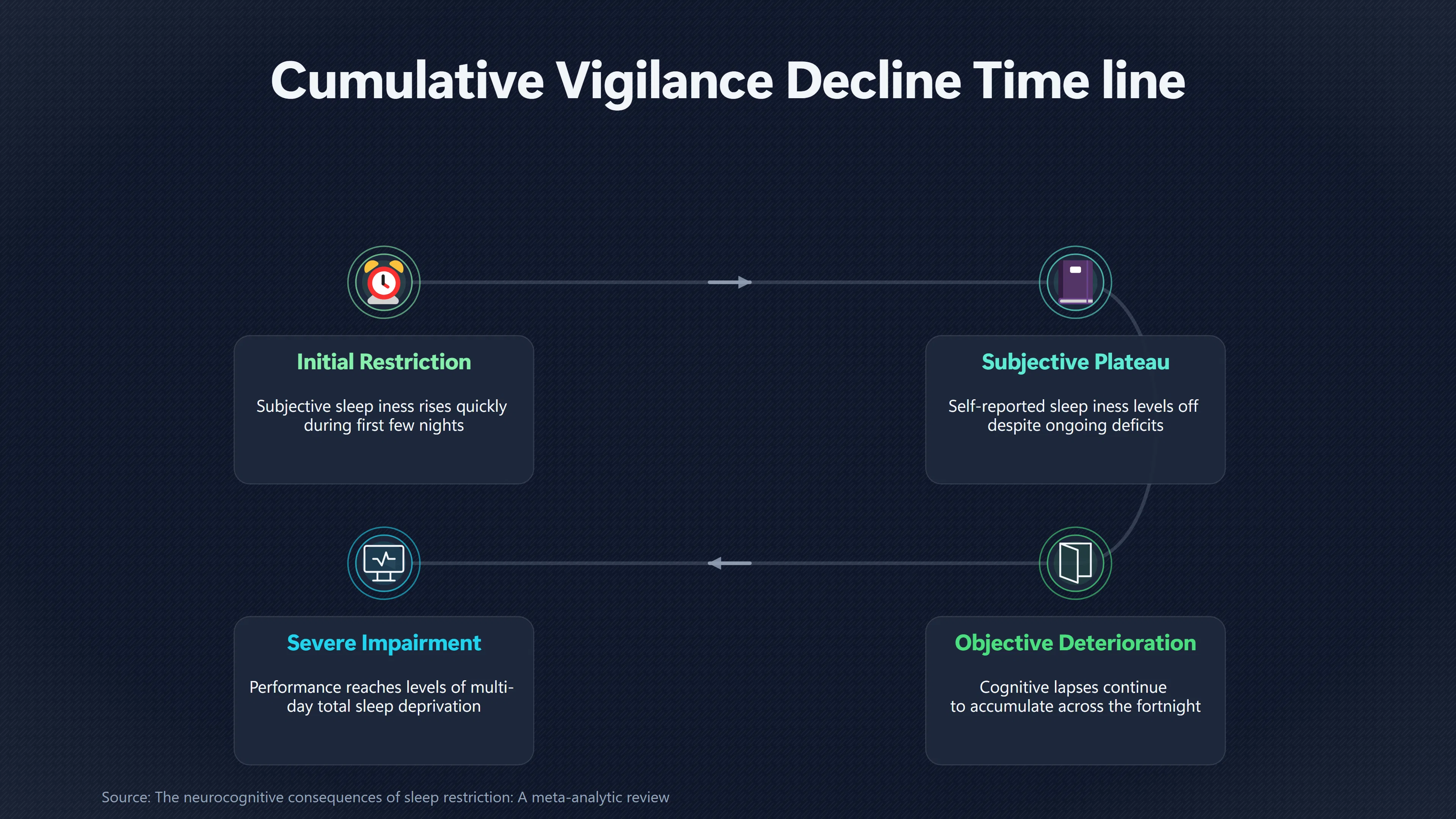
The particularly important finding for self-improvement is that feeling accustomed to short sleep is not the same as performing normally on it. In the same experiment, participants’ subjective sleepiness rose early and then changed relatively little, even while objective attention continued to deteriorate.[PubMed]pubmed.ncbi.nlm.nih.govThe cumulative cost of additional wakefulness: dose-response effects on neurobehavioral functions and sleep physiology from chronic… That mismatch makes repeated restriction different from an obviously exhausting all-nighter: a person can become familiar with the feeling of the schedule while vigilance failures continue to accumulate.
How vigilance declines across repeated restricted nights
The landmark 2003 experiment led by Hans Van Dongen randomised healthy adults to four, six or eight hours of time in bed per night for 14 consecutive nights. Participants repeatedly completed the PVT, a simple sustained-attention task in which they respond as quickly as possible to unpredictable signals. One of its most useful measures is the number of unusually slow responses, conventionally called lapses.[PubMed]pubmed.ncbi.nlm.nih.govThe cumulative cost of additional wakefulness: dose-response effects on neurobehavioral functions and sleep physiology from chronic…
The result was a dose-response pattern across both sleep duration and time. Four-hour nights produced the steepest deterioration. Six-hour nights produced a slower but still continuing build-up. Eight-hour nights did not produce a significant accumulation of PVT lapses. A later review of the experiment reports that by the seventh restricted day, participants in the six-hour condition averaged about 54 lapses across that day’s nine PVT sessions, compared with about 70 in the four-hour condition.[PubMed Central (PMC)]pmc.ncbi.nlm.nih.govPubMed Central (PMC)Behavioral and Physiological Consequences of Sleep Restriction - PMC…
That time course is crucial. If people simply adapted to reduced sleep, performance should deteriorate initially and then settle at a stable level as they became accustomed to the schedule. Instead, in this experiment the four- and six-hour groups continued to accumulate cognitive deficits across the two weeks. The original researchers found that chronic restriction to six hours or less eventually produced performance deficits comparable in magnitude to those observed after as much as two nights of total sleep deprivation.[PubMed]pubmed.ncbi.nlm.nih.govThe cumulative cost of additional wakefulness: dose-response effects on neurobehavioral functions and sleep physiology from chronic…
A later review of vigilant attention describes the four-hour condition as reaching PVT impairment comparable with roughly two to three days of acute total sleep deprivation by the end of the restriction period.[PubMed]pubmed.ncbi.nlm.nih.govPub Med Sleep deprivation, vigilant attention, and brain function: a reviewSleep deprivation, vigilant attention, and brain function: a review - PubMedJune 8, 2019… The comparison should not be read as saying that two weeks of four-hour nights and several sleepless nights are biologically identical. Rather, it illustrates how severe the measured vigilance deficit from repeated partial sleep loss can eventually become.
This cumulative pattern also helps distinguish repeated restriction from a single bad night. A 2024 meta-analysis of 44 studies found that even one night restricted to two to six hours can increase sustained-attention reaction times and lapses.[ScienceDirect]sciencedirect.comImpact of one night of sleep restriction on sleepiness and cognitive function: A systematic review and meta-analysis - Scien… Chronic experiments add the more consequential finding: when the short nights keep coming, the next day’s deficit need not simply repeat yesterday’s. It can build on it.
What four-, six- and seven-hour schedules show
Two influential sleep-dose experiments published in 2003 approached the question with somewhat different schedules. Together, they provide stronger evidence than either experiment alone — but they also show why it is too simple to claim that attention always deteriorates at exactly the same rate whenever sleep falls below a particular number of hours.
Four hours: In the Van Dongen experiment, four hours in bed for 14 nights produced a pronounced, continuing rise in vigilance lapses. The deficit was greater than in the six-hour group, establishing a clear dose-response effect.[PubMed]pubmed.ncbi.nlm.nih.govThe cumulative cost of additional wakefulness: dose-response effects on neurobehavioral functions and sleep physiology from chronic… Four hours is therefore not merely an example of feeling very sleepy after a short night; under repeated laboratory restriction, it produced progressively less reliable attention over a fortnight.
Six hours: Six hours is arguably the more instructive condition because it resembles a schedule that some people may regard as sustainable. Yet PVT lapses also accumulated across the 14-night experiment. The six-hour group deteriorated more slowly than the four-hour group, but it did not simply return to baseline performance after becoming accustomed to the routine.[PubMed Central (PMC)]pmc.ncbi.nlm.nih.govPubMed Central (PMC)Behavioral and Physiological Consequences of Sleep Restriction - PMC…
Seven hours: The picture becomes less uniform near the milder end of restriction. Gregory Belenky and colleagues assigned 66 volunteers to three, five, seven or nine hours in bed each night for seven days. PVT speed and lapses worsened steadily in the three-hour group. In the five- and seven-hour groups, response speed initially deteriorated and then appeared to stabilise at a reduced level; lapses were elevated in the five-hour condition, while the seven-hour condition showed reduced response speed without the same significant increase in lapses. The nine-hour group remained near baseline.[PubMed]pubmed.ncbi.nlm.nih.govOpen source on nih.gov.
The two experiments therefore should not be compressed into a rigid claim that every restricted schedule produces an indefinitely linear decline. Belenky’s study found evidence of lower-level stabilisation under milder restriction, whereas Van Dongen’s study found continuing cumulative impairment during six-hour nights across 14 days. A recent theoretical review explicitly notes this difference between the experiments.[PubMed Central (PMC)]pmc.ncbi.nlm.nih.govPub Med Central (PMC)The Sleep Opportunity, Need and Ability (SONA) TheoryPub Med Central (PMC)The Sleep Opportunity, Need and Ability (SONA) Theory
Their broader conclusions nevertheless converge. Across controlled sleep-dose studies, giving healthy adults progressively less sleep produces progressively poorer vigilant attention, and repeated restriction can leave performance substantially below the level maintained with adequate sleep opportunity. Reviews of this literature conclude that sustained attention is particularly sensitive to chronic restriction and that significant deficits are more likely to accumulate when healthy adults repeatedly receive less than about seven hours of sleep.[PubMed Central (PMC)]pmc.ncbi.nlm.nih.govPubMed Central (PMC)Behavioral and Physiological Consequences of Sleep Restriction - PMC…
Importantly, these are experimental time-in-bed conditions, not precise prescriptions for every individual. Four, six or seven hours in bed is not necessarily the same as four, six or seven hours actually asleep, and people differ considerably in their vulnerability to sleep loss. Controlled research has found substantial, relatively stable differences between individuals in how strongly their behavioural alertness deteriorates under sleep deprivation.[PubMed]pubmed.ncbi.nlm.nih.govOpen source on nih.gov. The experiments establish the population-level pattern without providing a personal threshold at which any particular individual will begin to lapse.
Why impairment can build instead of stabilising
The cumulative effect makes more sense when sleep restriction is viewed not merely as “missing some sleep” but as repeatedly extending wakefulness beyond what subsequent sleep fully compensates for. Van Dongen and colleagues found that PVT lapses across their experimental conditions were approximately related to accumulated wakefulness beyond an estimated threshold of about 15.8 hours per day. They therefore argued that sleep debt can be understood partly as the accumulating neurobehavioural cost of excess wakefulness.[PubMed]pubmed.ncbi.nlm.nih.govThe cumulative cost of additional wakefulness: dose-response effects on neurobehavioral functions and sleep physiology from chronic…
Modern reviews describe vigilant attention as being shaped by interacting sleep-regulatory processes. Pressure for sleep increases with time awake, while the circadian system changes the strength of alertness according to biological time of day. Evidence from chronic restriction additionally points towards a slower process operating across days or weeks, helping to explain why repeated inadequate sleep can create cumulative vigilance deficits rather than simply reproducing the effect of the preceding night.[PubMed Central (PMC)]pmc.ncbi.nlm.nih.govPubMed Central (PMC)Sleep deprivation, vigilant attention, and brain function: a review - PMC…
What deteriorates is not necessarily the ability to respond at all times. Sleep loss produces wake-state instability: periods of reasonably effective performance become interspersed with abnormally slow responses and attentional failures.[PubMed Central (PMC)]pmc.ncbi.nlm.nih.govPubMed Central (PMC)Behavioral and Physiological Consequences of Sleep Restriction - PMC… That is why the accumulation of PVT lapses matters. A person may still complete many responses normally while becoming increasingly prone to intermittent failures — exactly the pattern that can be missed by judging capability from moments when concentration feels intact.
Feeling adapted can hide continuing decline
Perhaps the most practically important result of the 14-night study was the divergence between subjective sleepiness and objective performance. Participants reported a substantial increase in sleepiness when restriction began. After that initial response, however, subjective ratings increased only slightly. They also did not clearly distinguish the four-hour condition from the six-hour condition. Meanwhile, objective cognitive deficits continued to accumulate in a dose-dependent fashion.[PubMed]pubmed.ncbi.nlm.nih.govThe cumulative cost of additional wakefulness: dose-response effects on neurobehavioral functions and sleep physiology from chronic…
By the end of the restriction period, PVT performance was at its poorest while participants in the four- and six-hour groups described themselves as only slightly sleepy.[PubMed Central (PMC)]pmc.ncbi.nlm.nih.govPubMed Central (PMC)Managing neurobehavioral capability when social expediency trumps biological imperatives - PMC… A 2019 review summarising the same findings describes a steady build-up of vigilance impairment across 14 days without a corresponding steady increase in self-reported sleepiness.[PubMed]pubmed.ncbi.nlm.nih.govPub Med Sleep deprivation, vigilant attention, and brain function: a reviewSleep deprivation, vigilant attention, and brain function: a review - PubMedJune 8, 2019…
This creates an important distinction between two kinds of adaptation. The experience of sleep restriction may become familiar without attention returning to normal. Someone may stop noticing much day-to-day change because the subjective sensation has levelled off, even as an objective test continues to reveal more failures.
That does not mean people are incapable of noticing any effect of inadequate sleep. It means subjective sleepiness is an unreliable gauge of the magnitude and trajectory of cognitive impairment during repeated restriction. Research on individual vulnerability reinforces the problem: people vary substantially in their response to sleep loss and generally do not assess their own vulnerability accurately.[PubMed]pubmed.ncbi.nlm.nih.govOpen source on nih.gov.
For self-improvement, this is a particularly relevant failure mode. A six-hour routine can begin to feel ordinary simply because it has become routine. Familiarity is weak evidence that sustained attention has recovered.
A stable routine is not necessarily stable performance
The historical comparison between the major sleep-dose studies supports a more precise conclusion than the slogan that “sleep debt always gets worse”. Severe restriction can produce striking cumulative deterioration; moderate restriction can accumulate more slowly; and under some experimental conditions performance appears to reach a reduced plateau.[PubMed]nih.govPub Med Patterns of performance degradation and restoration during sleep restriction and subsequent recovery: a sleep dose-response studyPub Med Patterns of performance degradation and restoration during sleep restriction and subsequent recovery: a sleep dose-response study What does not follow from the evidence is that repeated short sleep reliably trains the brain to perform as though adequate sleep had been restored.
Recovery studies strengthen that point. In one experiment, 159 healthy adults underwent five nights restricted to four hours in bed and then received between zero and ten hours in bed for a single recovery night. More recovery sleep produced greater improvement, but even the ten-hour opportunity — yielding an average of almost nine hours actually asleep — did not fully restore PVT performance to baseline.[PubMed]pubmed.ncbi.nlm.nih.govOpen source on nih.gov. Another study found residual PVT deficits after chronic restriction even when participants subsequently received multiple extended recovery opportunities.[PubMed]pubmed.ncbi.nlm.nih.govOpen source on nih.gov.
The bounded lesson from these experiments is therefore not simply that a short night makes concentration harder. It is that repeated short nights can change the trajectory of attention across time. Four hours tonight can leave tomorrow’s vigilance impaired; another four hours does not necessarily reset that impairment; and continuing the schedule can progressively increase the frequency of lapses. Six hours may accumulate deficits more slowly, while results around seven hours are less uniform and depend on the study and outcome measured.[PubMed Central (PMC)]pmc.ncbi.nlm.nih.govPubMed Central (PMC)Behavioral and Physiological Consequences of Sleep Restriction - PMC…
For a person trying to make reliable progress on demanding work, study or habits, that temporal pattern is the useful takeaway. A routine should not be judged solely by whether it has become comfortable. When sleep is repeatedly curtailed, subjective adaptation can occur faster than objective vigilance recovers — and attention can continue getting worse after the schedule has stopped feeling new.
Amazon book picks
Further Reading
Books and field guides related to Why Attention Gets Worse Across Short Nights. Use these as the next step if you want deeper reading beyond the article.
Why We Sleep
"Sleep is one of the most important but least understood aspects of our life, wellness, and longevity ... An explosion of scientific disc...
The Promise of Sleep
Sleep better, live longer with the groundbreaking information and step-by-step program in this revolutionary book. Healthful sleep has be...
The Sleep Solution
With cutting-edge sleep science and time-tested techniques, The Sleep Solution will help anyone achieve healthy sleep and eliminate pills...
The Sleep Fix
From Emmy Award-winning ABC News anchor/correspondent and former insomniac Diane Macedo comes a practical, user-friendly guide to getting...
eBay marketplace picks
Marketplace Samples
Example marketplace items related to this page. Use the search link to explore similar finds on eBay.
Selected fromfocus timer oneBay.co.uk.

Endnotes
1.
Source: sciencedirect.com
Link:https://www.sciencedirect.com/science/article/pii/S1087079224000443
Source snippet
Impact of one night of sleep restriction on sleepiness and cognitive function: A systematic review and meta-analysis - Scien...
2.
Source: sciencedirect.com
Title: The neurocognitive consequences of sleep restriction: A meta-analytic review
Link:https://www.sciencedirect.com/science/article/abs/pii/S0149763417301641
3.
Source: pubmed.ncbi.nlm.nih.gov
Link:https://pubmed.ncbi.nlm.nih.gov/12683469/?dopt=Abstract
Source snippet
The cumulative cost of additional wakefulness: dose-response effects on neurobehavioral functions and sleep physiology from chronic...
4.
Source: pmc.ncbi.nlm.nih.gov
Link:https://pmc.ncbi.nlm.nih.gov/articles/PMC1978335/
Source snippet
PubMed Central (PMC)Behavioral and Physiological Consequences of Sleep Restriction - PMC...
5.
Source: pubmed.ncbi.nlm.nih.gov
Link:https://pubmed.ncbi.nlm.nih.gov/12683469/
Source snippet
The cumulative cost of additional wakefulness: dose-response effects on neurobehavioral functions and sleep physiology from chronic...
6.
Source: pmc.ncbi.nlm.nih.gov
Link:https://pmc.ncbi.nlm.nih.gov/articles/PMC3600847/
Source snippet
PubMed Central (PMC)Managing neurobehavioral capability when social expediency trumps biological imperatives - PMC...
7.
Source: pubmed.ncbi.nlm.nih.gov
Title: Pub Med Behavioral and physiological consequences of sleep restriction
Link:https://pubmed.ncbi.nlm.nih.gov/17803017/
Source snippet
Behavioral and physiological consequences of sleep restriction - PubMed...
8.
Source: pubmed.ncbi.nlm.nih.gov
Title: Pub Med Sleep deprivation, vigilant attention, and brain function: a review
Link:https://pubmed.ncbi.nlm.nih.gov/31176308/
Source snippet
Sleep deprivation, vigilant attention, and brain function: a review - PubMedJune 8, 2019...
Published: June 8, 2019
9.
Source: pmc.ncbi.nlm.nih.gov
Link:https://pmc.ncbi.nlm.nih.gov/articles/PMC6879580/
Source snippet
PubMed Central (PMC)Sleep deprivation, vigilant attention, and brain function: a review - PMC...
10.
Source: pubmed.ncbi.nlm.nih.gov
Link:https://pubmed.ncbi.nlm.nih.gov/12603781/
11.
Source: pmc.ncbi.nlm.nih.gov
Title: Pub Med Central (PMC)The Sleep Opportunity, Need and Ability (SONA) Theory
Link:https://pmc.ncbi.nlm.nih.gov/articles/PMC12592830/
12.
Source: pmc.ncbi.nlm.nih.gov
Title: Pub Med Central (PMC)Neurocognitive Consequences of Sleep Deprivation
Link:https://pmc.ncbi.nlm.nih.gov/articles/PMC3564638/
13.
Source: pubmed.ncbi.nlm.nih.gov
Link:https://pubmed.ncbi.nlm.nih.gov/15164894/
14.
Source: pmc.ncbi.nlm.nih.gov
Title: Pub Med Central (PMC)Sleep Deprivation and Neurobehavioral Dynamics
Link:https://pmc.ncbi.nlm.nih.gov/articles/PMC3700596/
15.
Source: pubmed.ncbi.nlm.nih.gov
Link:https://pubmed.ncbi.nlm.nih.gov/19834261/
17.
Source: pubmed.ncbi.nlm.nih.gov
Link:https://pubmed.ncbi.nlm.nih.gov/20815182/
18.
Source: pmc.ncbi.nlm.nih.gov
Link:https://pmc.ncbi.nlm.nih.gov/articles/PMC2910531/
19.
Source: pubmed.ncbi.nlm.nih.gov
Link:https://pubmed.ncbi.nlm.nih.gov/33274389/
20.
Source: pubmed.ncbi.nlm.nih.gov
Link:https://pubmed.ncbi.nlm.nih.gov/38759474/
21.
Source: pubmed.ncbi.nlm.nih.gov
Link:https://pubmed.ncbi.nlm.nih.gov/38759474/?format=pubmed
22.
Source: pubmed.ncbi.nlm.nih.gov
Link:https://pubmed.ncbi.nlm.nih.gov/37193276/
23.
Source: pmc.ncbi.nlm.nih.gov
Link:https://pmc.ncbi.nlm.nih.gov/articles/PMC10108639/
24.
Source: pmc.ncbi.nlm.nih.gov
Link:https://pmc.ncbi.nlm.nih.gov/articles/PMC10104355/
25.
Source: pmc.ncbi.nlm.nih.gov
Link:https://pmc.ncbi.nlm.nih.gov/articles/PMC9389006/
26.
Source: pmc.ncbi.nlm.nih.gov
Link:https://pmc.ncbi.nlm.nih.gov/articles/PMC9388586/
27.
Source: pmc.ncbi.nlm.nih.gov
Link:https://pmc.ncbi.nlm.nih.gov/articles/PMC8996029/
28.
Source: pmc.ncbi.nlm.nih.gov
Link:https://pmc.ncbi.nlm.nih.gov/articles/PMC8117424/
29.
Source: pubmed.ncbi.nlm.nih.gov
Link:https://pubmed.ncbi.nlm.nih.gov/31784748/
30.
Source: pubmed.ncbi.nlm.nih.gov
Link:https://pubmed.ncbi.nlm.nih.gov/30722039/
31.
Source: pmc.ncbi.nlm.nih.gov
Link:https://pmc.ncbi.nlm.nih.gov/articles/PMC6519907/
32.
Source: pubmed.ncbi.nlm.nih.gov
Link:https://pubmed.ncbi.nlm.nih.gov/29097703/
33.
Source: pmc.ncbi.nlm.nih.gov
Link:https://pmc.ncbi.nlm.nih.gov/articles/PMC6251588/
34.
Source: pmc.ncbi.nlm.nih.gov
Link:https://pmc.ncbi.nlm.nih.gov/articles/PMC6143346/
35.
Source: pubmed.ncbi.nlm.nih.gov
Link:https://pubmed.ncbi.nlm.nih.gov/28364449/
36.
Source: pmc.ncbi.nlm.nih.gov
Link:https://pmc.ncbi.nlm.nih.gov/articles/PMC4457397/
37.
Source: pubmed.ncbi.nlm.nih.gov
Link:https://pubmed.ncbi.nlm.nih.gov/24987165/
38.
Source: pmc.ncbi.nlm.nih.gov
Link:https://pmc.ncbi.nlm.nih.gov/articles/PMC3602842/
39.
Source: pmc.ncbi.nlm.nih.gov
Link:https://pmc.ncbi.nlm.nih.gov/articles/PMC3397808/
40.
Source: pubmed.ncbi.nlm.nih.gov
Link:https://pubmed.ncbi.nlm.nih.gov/22851798/
41.
Source: pmc.ncbi.nlm.nih.gov
Link:https://pmc.ncbi.nlm.nih.gov/articles/PMC3397820/
42.
Source: pmc.ncbi.nlm.nih.gov
Link:https://pmc.ncbi.nlm.nih.gov/articles/PMC2888649/
43.
Source: pubmed.ncbi.nlm.nih.gov
Link:https://pubmed.ncbi.nlm.nih.gov/20371466/
44.
Source: pmc.ncbi.nlm.nih.gov
Link:https://pmc.ncbi.nlm.nih.gov/articles/PMC2647785/
45.
Source: pubmed.ncbi.nlm.nih.gov
Link:https://pubmed.ncbi.nlm.nih.gov/15892921/
46.
Source: pmc.ncbi.nlm.nih.gov
Link:https://pmc.ncbi.nlm.nih.gov/articles/PMC2656292/
47.
Source: ncbi.nlm.nih.gov
Link:https://www.ncbi.nlm.nih.gov/books/NBK19958/
48.
Source: pubmed.ncbi.nlm.nih.gov
Link:https://pubmed.ncbi.nlm.nih.gov/22877676/
49.
Source: pubmed.ncbi.nlm.nih.gov
Link:https://pubmed.ncbi.nlm.nih.gov/20681233/
50.
Source: pubmed.ncbi.nlm.nih.gov
Link:https://pubmed.ncbi.nlm.nih.gov/19294951/
51.
Source: pubmed.ncbi.nlm.nih.gov
Link:https://pubmed.ncbi.nlm.nih.gov/16171293/
52.
Source: pubmed.ncbi.nlm.nih.gov
Link:https://pubmed.ncbi.nlm.nih.gov/17190701/
53.
Source: pubmed.ncbi.nlm.nih.gov
Link:https://pubmed.ncbi.nlm.nih.gov/8570792/
Additional References
54.
Source: academic.oup.com
Link:https://academic.oup.com/sleep/article-abstract/26/2/117/2709164
Source snippet
Oxford AcademicCumulative Cost of Additional Wakefulness: Dose-Response Effects on Neurobehavioral Functions and Sleep Physiology From Ch...
55.
Source: youtube.com
Link:https://www.youtube.com/watch?v=2fVOu_dzt04
Source snippet
Dr. Matt Walker: How to Structure Your Sleep, Use Naps & Time Caffeine | Huberman Lab Guest Series...
56.
Source: youtube.com
Title: Talk 04
Link:https://www.youtube.com/watch?v=2SlDBsR9JXU
Source snippet
This STEM-Talk discussion with Dr. Hans Van Dongen directly features the lead researcher behind the landmark chronic sleep restriction st...
57.
Source: youtube.com
Title: Chronic sleep deprivation – The gradual destruction of our performance
Link:https://www.youtube.com/watch?v=nSfNIerdnNM
Source snippet
Talk 04 - David Dinges: Wakefulness in the 24/7 Society...
58.
Source: youtube.com
Link:https://www.youtube.com/watch?v=4F_RBc1akC8
Source snippet
PEBL Psychomotor Vigilance Task (PVT)...
59.
Source: youtube.com
Title: PEBL Psychomotor Vigilance Task (PVT)
Link:https://www.youtube.com/watch?v=eG4K4t6RweQ
Source snippet
Chronic sleep deprivation – The gradual destruction of our performance...
60.
Source: scispace.com
Link:https://scispace.com/papers/patterns-of-performance-degradation-and-restoration-during-37o2i72ygu
61.
Source: researchgate.net
Link:https://www.researchgate.net/publication/380133638_Impact_of_one_night_of_sleep_restriction_on_sleepiness_and_cognitive_function_A_systematic_review_and_meta-analysis
62.
Source: em-consulte.com
Link:https://www.em-consulte.com/article/1677672/impact-of-one-night-of-sleep-restriction-on-sleepi
63.
Source: em-consulte.com
Link:https://www.em-consulte.com/it/article/1677672/article/impact-of-one-night-of-sleep-restriction-on-sleepi