Within Useful Cues
Should a Habit Follow a Routine or a Clock?
Linking a behaviour to a recurring routine can work about as well as using a fixed time, provided the cue is dependable and the action is repeated.
On this page
- How routine based and time based cues differ
- What the randomized nutrition trial found
- Choosing the cue that recurs most reliably
Page outline Jump by section
Introduction
For building a habit, there is no good evidence that “after breakfast” is inherently better than “at 9 am”. The strongest direct comparison found that routine-based cues and clock-time cues produced similar increases in habit automaticity over 12 weeks. What mattered more was whether people repeatedly performed the intended behaviour when their chosen cue occurred.[PubMed]pubmed.ncbi.nlm.nih.govHabit formation following routine-based versus time-based cue planning: A randomized controlled trial - PubMedJanuary 6, 2021…

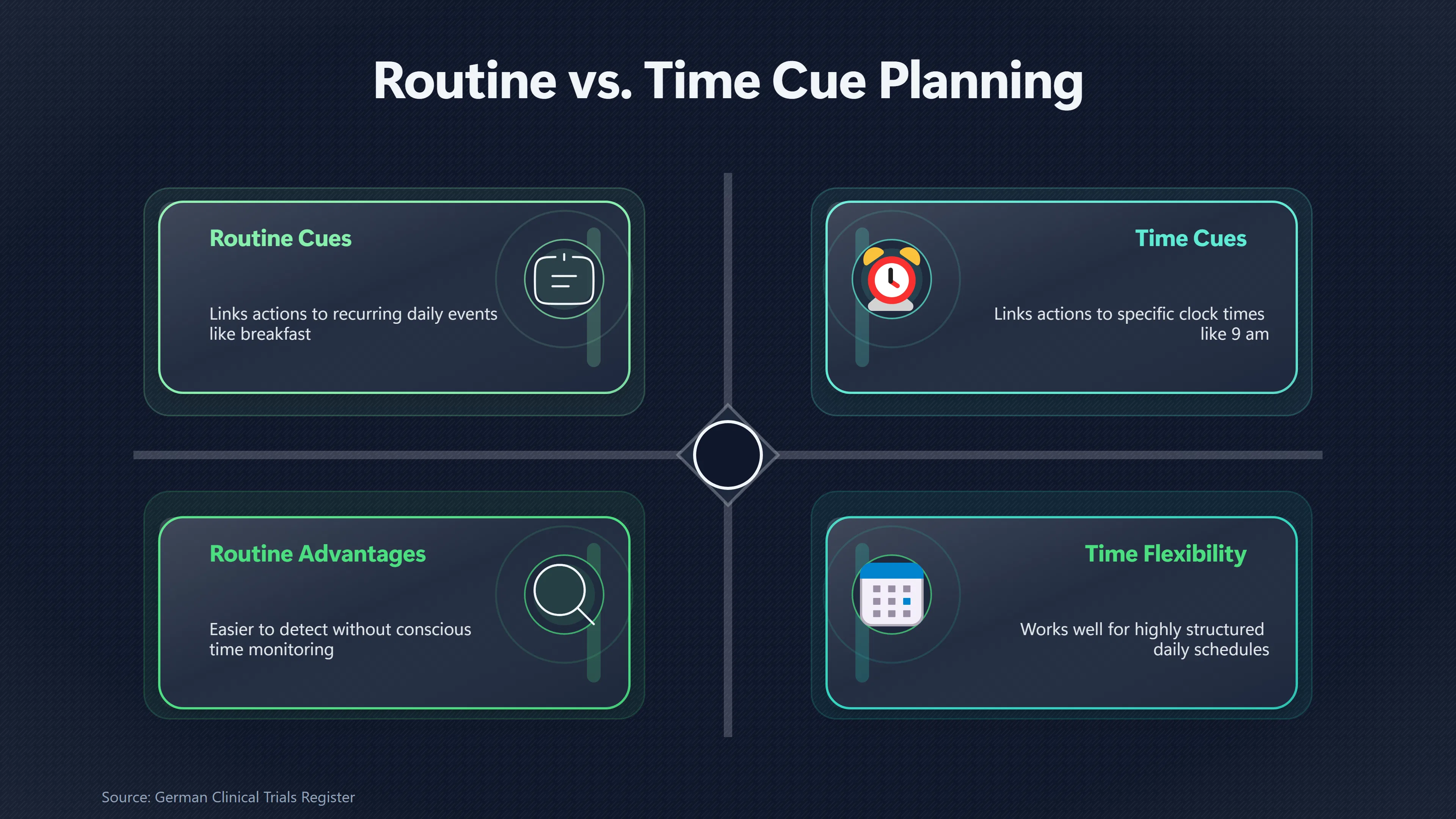
That distinction is useful for self-improvement. A routine cue links an action to another recurring event — “after breakfast, I will eat a piece of fruit”. A time cue links it to the clock — “at 9 am, I will eat a piece of fruit”. Either can provide the stable environmental context from which a habit develops. The practical question is therefore less “Which type of cue is scientifically superior?” and more “Which cue will I reliably encounter and act on?”
How routine and time cues differ
A routine-based cue is an event in the ordinary sequence of the day: getting out of bed, finishing breakfast, brushing your teeth, arriving at your desk or clearing away dinner. The event signals that the new behaviour should follow. A time-based cue uses a particular clock time instead: 8 am, 1 pm or 9.30 pm.
There are plausible reasons to expect routine cues to have an advantage. An established routine is already something a person repeatedly encounters without having to watch the clock. Habit researchers have therefore suggested that event-based cues may be easier to detect than time cues, which can require conscious time monitoring. A routine can also tolerate some variation in scheduling: if breakfast happens at 7.30 one morning and 8.15 the next, “after breakfast” still identifies the relevant moment.[BPS PsycHub]bpspsychub.onlinelibrary.wiley.comBPS PsycHubHabit formation following routine‐based versus time‐based cue planning: A randomized controlled trial - Keller - 2021 - Britis…
Earlier observational evidence appeared consistent with that idea. A study of 1,244 Australian adults examined the consistency of several cues surrounding physical activity, including time, location, people, mood and routines. More consistent routine cues were associated with greater physical-activity automaticity, whereas consistent time cues were associated with the amount of physical activity rather than its automaticity. Because this was observational rather than experimental evidence, however, it could not establish that choosing a routine cue actually causes a stronger habit.[PubMed]pubmed.ncbi.nlm.nih.govCue Consistency Associated with Physical Activity Automaticity and Behavior - PubMedApril 11, 2015…
That uncertainty made a direct randomised comparison particularly useful.
What the randomised nutrition trial found
The clearest head-to-head test was published by Jan Keller and colleagues in the British Journal of Health Psychology in 2021. The prospectively registered study recruited 192 adults aged 18–77 from the general population in Germany and randomly allocated 96 to each of two planning conditions. Participants chose a healthy nutrition behaviour they wanted to develop and were instructed to connect it either to a daily routine or to a particular time.[BPS PsycHub]bpspsychub.onlinelibrary.wiley.comBPS PsycHubHabit formation following routine‐based versus time‐based cue planning: A randomized controlled trial - Keller - 2021 - Britis…
The contrast was deliberately simple. Someone in the routine condition might plan the behaviour for after breakfast; someone in the time condition might plan it for 9 am. Both groups received a brief intervention of about five minutes and were asked to carry out their chosen behaviour in the planned context every day for 12 weeks. Daily questionnaires across 84 days measured whether they enacted the plan and how automatic the behaviour was becoming.[BPS PsycHub]bpspsychub.onlinelibrary.wiley.comBPS PsycHubHabit formation following routine‐based versus time‐based cue planning: A randomized controlled trial - Keller - 2021 - Britis…
The predicted superiority of one cue type did not emerge. At the group level:
- automaticity increased over time in both conditions;[nature.com]nature.comSource details in endnotes.
- enactment of the planned behaviour increased in both conditions;
- there was no significant between-group difference favouring routine cues or time cues;
- repeatedly performing the behaviour in response to the planned cue predicted greater automaticity.[PubMed]pubmed.ncbi.nlm.nih.govHabit formation following routine-based versus time-based cue planning: A randomized controlled trial - PubMedJanuary 6, 2021…
In other words, “after breakfast” and “at 9 am” were both viable ways to organise the repeated behaviour. The important ingredient was not which wording appeared in the plan, but whether the person repeatedly completed the action when that cue arrived.

Habit formation was highly individual
The same dataset also cautions against expecting habits to click into place after a standard number of days. Among participants whose habit-development trajectories could be modelled as successful asymptotic curves, the median estimated time to reach 95% of peak automaticity was 59 days. Individual estimates ranged from 4 to 335 days. Some participants showed continuous progress, others discontinuous development, and some did not successfully form the intended habit during the study.[DOI]doi.orgHabit formation following routine‐based versus time‐based cue planning: A randomized controlled trial - Keller - 2021 - British Journa…
That broad variation echoes the influential earlier study by Phillippa Lally and colleagues. In that research, participants repeated an eating, drinking or activity behaviour in a consistent daily context for 12 weeks. Estimated times to reach 95% of maximum automaticity ranged from 18 to 254 days, and greater consistency of performance was associated with better-fitting habit-development curves. Missing a single opportunity did not materially derail the process.[Wiley Online Library]onlinelibrary.wiley.comWiley Online LibraryHow are habits formed: Modelling habit formation in the real world - Lally - 2010 - European Journal of Social Psycho…
Taken together, these studies shift attention away from finding a supposedly perfect trigger. Habit formation is better understood as repeated learning in a sufficiently consistent context than as the result of choosing a special kind of cue.
Why the result does not prove that cues never matter
The nutrition trial supports equivalence within its tested circumstances, not the stronger claim that routine and time cues must work identically for every behaviour and every person. It involved self-selected healthy eating behaviours, relied on self-reported enactment and automaticity, and had no no-planning control group. The authors also noted that their sample contained comparatively many women and younger participants, limiting how confidently the results can be generalised to other populations.[DOI]doi.orgHabit formation following routine‐based versus time‐based cue planning: A randomized controlled trial - Keller - 2021 - British Journa…
There was also some inevitable fuzziness between the two cue categories. All retained participants in the time condition supplied a valid clock time, but only 55 of 65 retained participants in the routine condition supplied a cue that the researchers classified as an actual routine; several instead entered a general time of day or an internal state such as feeling stressed.[DOI]doi.orgHabit formation following routine‐based versus time‐based cue planning: A randomized controlled trial - Keller - 2021 - British Journa…
More fundamentally, routine and time cues often overlap in ordinary life. Breakfast may usually happen around 8 am; a lunch break may reliably begin around 1 pm. A person intending to act “after breakfast” is therefore exposed to a bundle of recurring contextual information — activity, approximate time, location and perhaps the same objects and people. The experiment compared two planning instructions, not perfectly isolated psychological stimuli.
This is why the result is best read as no demonstrated advantage for either planning strategy in this trial, rather than proof that cue characteristics are irrelevant. Earlier physical-activity research suggests that cue consistency can relate differently to automaticity and behaviour, but the randomised evidence does not justify telling everyone that routine anchors are categorically superior to clock times.[PubMed]pubmed.ncbi.nlm.nih.govCue Consistency Associated with Physical Activity Automaticity and Behavior - PubMedApril 11, 2015…
Choose the cue that recurs most reliably
For practical habit building, the comparison points towards a straightforward decision rule: choose the cue that gives you the most dependable opportunity to repeat the behaviour in the intended context.
A routine cue is attractive when the clock moves but the sequence of events remains stable. Someone whose breakfast varies between 7 and 9 am may find “take my vitamin after breakfast” more dependable than “take it at 8 am”. The existing event identifies the opportunity without requiring the person to notice a particular minute on the clock.
A time cue may be better when the schedule itself is highly structured. If a work break reliably starts at 10.30 am, a clock-based plan may be just as easy to encounter and act upon. There is little reason, based on the randomised trial, to replace a dependable time cue merely because routine anchoring sounds more like conventional habit-building advice.[PubMed]pubmed.ncbi.nlm.nih.govHabit formation following routine-based versus time-based cue planning: A randomized controlled trial - PubMedJanuary 6, 2021…
Reliability also means choosing a cue that genuinely happens often enough. The German Clinical Trials Register description of the experiment captures the underlying principle succinctly: successful habit formation depends on consistently repeating the behaviour when the recurring cue is encountered.[drks.de]drks.deGerman Clinical Trials RegisterGerman Clinical Trials Register A theoretically elegant anchor that disappears on busy days provides fewer learning opportunities than an ordinary cue that reliably recurs.
The evidence therefore supports three practical priorities. First, make the cue specific enough that you know when to act: “after I finish breakfast” is clearer than “in the morning”. Second, choose a cue that occurs on most of the days when you want the behaviour to occur. Third, judge the strategy by enactment: if the cue repeatedly arrives but the intended behaviour does not follow, changing the cue may be more useful than waiting for automaticity to appear.

Routine or clock?
For this particular habit-building choice, the evidence favours flexibility rather than a universal rule. Routine cues have a plausible practical advantage when daily timing varies, and observational research has associated consistent routines with stronger automaticity. But the direct randomised comparison did not find routine-based planning superior to time-based planning. Both approaches supported increasing enactment and automaticity.[PubMed]pubmed.ncbi.nlm.nih.govCue Consistency Associated with Physical Activity Automaticity and Behavior - PubMedApril 11, 2015…
The more consequential distinction is between a cue you can repeatedly act on and one you cannot. “After breakfast” is useful only if breakfast reliably occurs and leaves an opportunity for the desired action. “At 9 am” is useful only if 9 am reliably finds you able to act. Habit building is therefore less about choosing between the routine and the clock than about creating a dependable cue–behaviour pairing and giving that pairing enough repetitions to become increasingly automatic.
Amazon book picks
Further Reading
Books and field guides related to Should a Habit Follow a Routine or a Clock?. Use these as the next step if you want deeper reading beyond the article.
Atomic Habits
Rating: 3.5/5 from 7 Google Books ratings
The #1 New York Times bestseller. Over 25 million copies sold! Translated into 60+ languages! Tiny Changes, Remarkable Results No matter...
Tiny Habits
Improving your life is much easier than you think. Whether it’s losing weight, sleeping more, or restoring your work/life balance – the s...
The Power of Habit
Rating: 4.0/5 from 145 Google Books ratings
Duhigg takes us to the edge of scientific discoveries that explain why habits exist and how they can be changed. Distilling information i...
Good Habits, Bad Habits
'The world's leading expert on habits' - Matthew Syed, bestselling author of Black Box Thinking and Rebel IdeasWhat if you could harness...
eBay marketplace picks
Marketplace Samples
Live-tested eBay searches with available results related to this page.
Selected fromhabit motivation poster oneBay.co.uk.

Endnotes
1.
Source: drks.de
Title: German Clinical Trials Register
Link:https://drks.de/search/en/trial/DRKS00016720/details
2.
Source: bpspsychub.onlinelibrary.wiley.com
Link:https://bpspsychub.onlinelibrary.wiley.com/doi/abs/10.1111/bjhp.12504
Source snippet
BPS PsycHubHabit formation following routine‐based versus time‐based cue planning: A randomized controlled trial - Keller - 2021 - Britis...
3.
Source: doi.org
Link:https://doi.org/10.1111/bjhp.12504
Source snippet
Habit formation following routine‐based versus time‐based cue planning: A randomized controlled trial - Keller - 2021 - British Journa...
4.
Source: onlinelibrary.wiley.com
Link:https://onlinelibrary.wiley.com/doi/10.1002/ejsp.674
Source snippet
Wiley Online LibraryHow are habits formed: Modelling habit formation in the real world - Lally - 2010 - European Journal of Social Psycho...
5.
Source: onlinelibrary.wiley.com
Link:https://onlinelibrary.wiley.com/doi/pdf/10.1002/ejsp.674
Source snippet
Wiley Online LibraryHow are habits formed: Modelling habit formation in the real world - Lally - 2010 - European Journal of Social Psycho...
6.
Source: drks.de
Link:https://www.drks.de/search/de/trial/DRKS00016720/details
7.
Source: drks.de
Title: German Clinical Trials Register
Link:https://drks.de/search/en/trial/DRKS00016720
9.
Source: bpspsychub.onlinelibrary.wiley.com
Title: j.2044 8287.2012.02086.x
Link:https://bpspsychub.onlinelibrary.wiley.com/doi/10.1111/j.2044-8287.2012.02086.x
10.
Source: bpspsychub.onlinelibrary.wiley.com
Title: j.2044 8287.2012.02086.x
Link:https://bpspsychub.onlinelibrary.wiley.com/doi/abs/10.1111/j.2044-8287.2012.02086.x
11.
Source: onlinelibrary.wiley.com
Link:https://onlinelibrary.wiley.com/doi/abs/10.1002/ejsp.674?source=content_type%3Areact%7Cfirst_level_url%3Aarticle%7Csection%3Amain_content%7Cbutton%3Abody_link
12.
Source: onlinelibrary.wiley.com
Link:https://onlinelibrary.wiley.com/doi/abs/10.1002/ejsp.674?MixPanelId=15e3fe314440-0468d8411-64220f54-100000-15e3fe314460
13.
Source: onlinelibrary.wiley.com
Link:https://onlinelibrary.wiley.com/doi/abs/10.1002/ejsp.674
14.
Source: onlinelibrary.wiley.com
Link:https://onlinelibrary.wiley.com/doi/abs/10.1002/ejsp.674?msockid=038ed114f43667dd0790c4bef5146634
15.
Source: onlinelibrary.wiley.com
Link:https://onlinelibrary.wiley.com/doi/abs/10.1002/ejsp.674?cf_chl_jschl_tk=pmd_EwcJDaCFBR9OVEL1O_0qjioww0Gc86ZzpBvCBFhrDcE-1635261061-0-gqNtZGzNAjujcnBszQi9
16.
Source: pubmed.ncbi.nlm.nih.gov
Link:https://pubmed.ncbi.nlm.nih.gov/33405284/
Source snippet
Habit formation following routine-based versus time-based cue planning: A randomized controlled trial - PubMedJanuary 6, 2021...
Published: January 6, 2021
17.
Source: pmc.ncbi.nlm.nih.gov
Link:https://pmc.ncbi.nlm.nih.gov/articles/PMC12318445/
Source snippet
PubMed Central (PMC)Applying the Science of Habit Formation to Evidence-Based Psychological Treatments for Mental Illness - PMC...
18.
Source: pubmed.ncbi.nlm.nih.gov
Link:https://pubmed.ncbi.nlm.nih.gov/25864705/
Source snippet
Cue Consistency Associated with Physical Activity Automaticity and Behavior - PubMedApril 11, 2015...
Published: April 11, 2015
19.
Source: pmc.ncbi.nlm.nih.gov
Link:https://pmc.ncbi.nlm.nih.gov/articles/PMC12836306/
20.
Source: pmc.ncbi.nlm.nih.gov
Link:https://pmc.ncbi.nlm.nih.gov/articles/PMC11782107/
21.
Source: pmc.ncbi.nlm.nih.gov
Link:https://pmc.ncbi.nlm.nih.gov/articles/PMC11161714/
22.
Source: pmc.ncbi.nlm.nih.gov
Link:https://pmc.ncbi.nlm.nih.gov/articles/PMC9372943/
23.
Source: pmc.ncbi.nlm.nih.gov
Link:https://pmc.ncbi.nlm.nih.gov/articles/PMC6646716/
24.
Source: pubmed.ncbi.nlm.nih.gov
Link:https://pubmed.ncbi.nlm.nih.gov/30572936/
25.
Source: pmc.ncbi.nlm.nih.gov
Link:https://pmc.ncbi.nlm.nih.gov/articles/PMC6120700/
26.
Source: pubmed.ncbi.nlm.nih.gov
Link:https://pubmed.ncbi.nlm.nih.gov/29536800/
27.
Source: pubmed.ncbi.nlm.nih.gov
Link:https://pubmed.ncbi.nlm.nih.gov/28946819/
28.
Source: pmc.ncbi.nlm.nih.gov
Link:https://pmc.ncbi.nlm.nih.gov/articles/PMC4216661/
29.
Source: pubmed.ncbi.nlm.nih.gov
Link:https://pubmed.ncbi.nlm.nih.gov/22989272/
Additional References
30.
Source: tandfonline.com
Link:https://www.tandfonline.com/doi/full/10.1080/08964289.2015.1017549
31.
Source: hiperformanceculture.com
Title: Habit Stacking: Does Anchoring New Habits to Old Ones Actually Work?
Link:https://hiperformanceculture.com/habits/trend-habit-stacking/
Source snippet
HPC Trend BreakdownJune 18, 2026 — Habits 4 min read [Button: ☰] Trend Breakdown The Evidence DOES HABIT STACKING ACTUALLY MAKE NEW BEH...
Published: June 18, 2026
32.
Source: youtube.com
Title: How to Create New Habits and Change Existing Habits
Link:https://www.youtube.com/watch?v=GbmLiU-Symc
Source snippet
To understand how anchoring actions to sequential daily behaviors compares with fixed scheduling, watch Habit Stacking: Structure Your Da...
33.
Source: youtube.com
Link:https://www.youtube.com/watch?v=5g2Kyc8Ra5U
Source snippet
Hack Your Habits for Lasting Change: Insights from Wendy Wood and Adam Grant...
34.
Source: nature.com
Link:https://www.nature.com/nature-index/topics/l4/behavior-change-and-habit-formation-in-health-contexts
35.
Source: youtube.com
Title: Hack Your Habits for Lasting Change: Insights from Wendy Wood and Adam Grant
Link:https://www.youtube.com/watch?v=wOwZnv_sMds
Source snippet
Habit Coach Episode 4 – Finding Your Cue...
36.
Source: youtube.com
Title: How To Select Anchor Habits For Habit Stacking?
Link:https://www.youtube.com/watch?v=Wuc9DiLEWz8
Source snippet
How to Create New Habits and Change Existing Habits - The Habit Loop...
37.
Source: researchgate.net
Link:https://www.researchgate.net/publication/356209185_Developing_habit-based_health_behaviour_change_interventions_twenty-one_questions_to_guide_future_research
38.
Source: researchgate.net
Link:https://www.researchgate.net/publication/348328187_Habit_formation_following_routine-based_versus_time-based_cue_planning_A_randomized_controlled_trial
39.
Source: eurekamag.com
Link:https://eurekamag.com/research/057/541/057541410.php