Within Complex Habits
There Is No Universal Day When Habits Click
Research reports habit formation ranging from days to many months, making fixed rules like 21 or 66 days misleading for complex routines.
On this page
- Where the famous 66 day figure came from
- What the 4 to 335 day range actually shows
- Why complexity makes countdown rules especially unreliable
Page outline Jump by section
Introduction
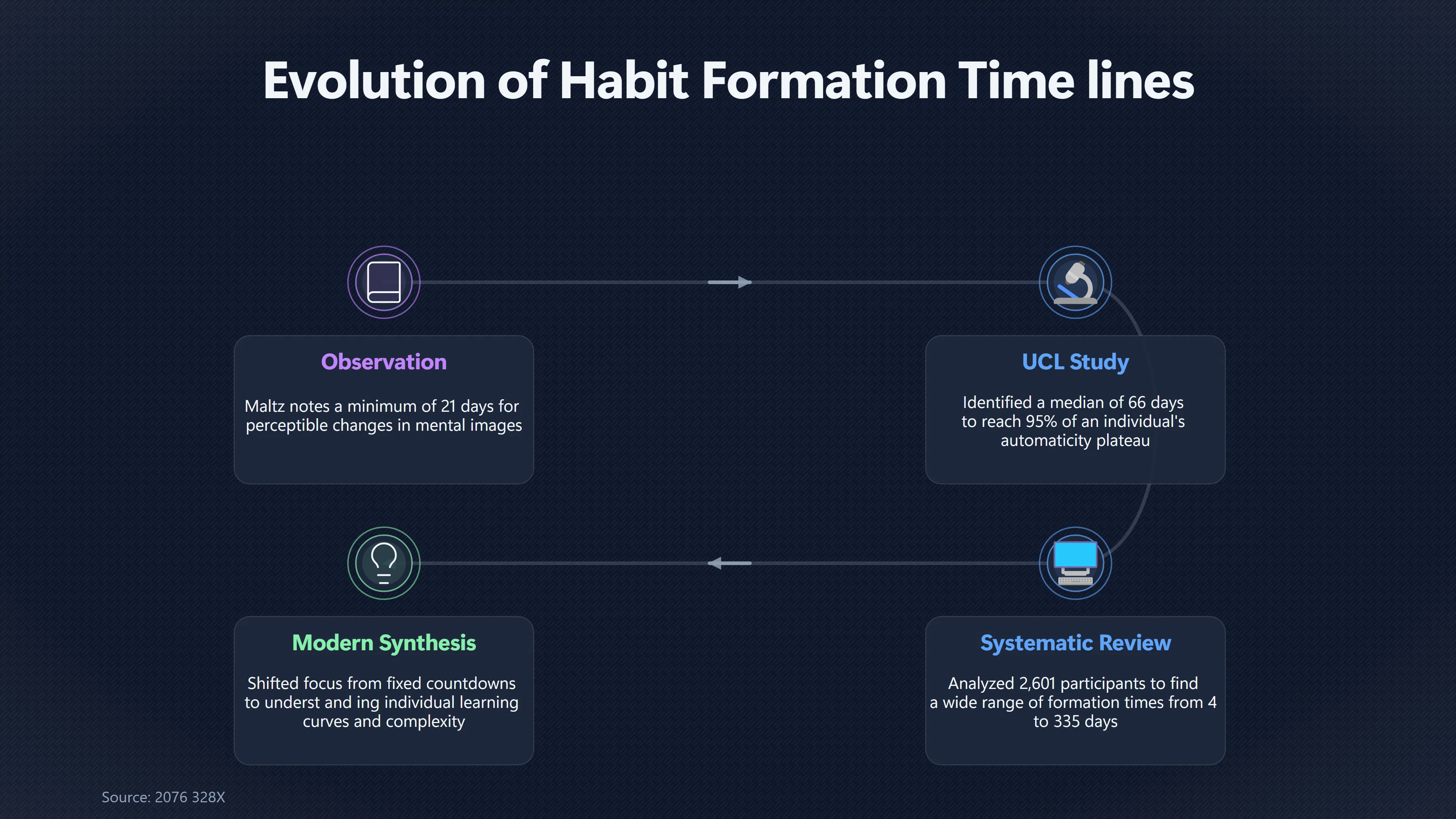
There is no universal day on which a complex behaviour suddenly “clicks” into being a habit. The familiar numbers — 21 days, 66 days, two months — describe very different things, and none is a scientifically established deadline. The strongest direct evidence instead shows a learning process whose duration varies sharply between people, behaviours and circumstances. A 2024 systematic review found individual habit-formation times ranging from 4 to 335 days, while noting that only four of its 20 included studies directly reported how long formation took.[PubMed Central (PMC)]pmc.ncbi.nlm.nih.govOpen source on nih.gov.
For complex routines, that variation matters more than any average. Exercise, meal preparation or a multi-step evening routine can contain several decisions and actions, and research increasingly distinguishes between automatically starting such a sequence and automatically executing every part of it.[BPS Psych Hub]bpspsychub.onlinelibrary.wiley.comBPS Psych HubHabitual instigation and habitual execution: Definition, measurement, and effects on behaviour frequency - Gardner - 2016… The useful lesson for self-improvement is therefore not to find the correct countdown. It is to understand what researchers actually timed.
Where the famous 66-day figure came from
The 66-day figure comes primarily from a University College London study by Phillippa Lally and colleagues, published online in 2009 and in the European Journal of Social Psychology in 2010. Ninety-six volunteers selected a new eating, drinking or activity behaviour and attempted it daily in a consistent context for 12 weeks. Examples included performing an action “after breakfast”. Participants recorded both whether they performed the behaviour and how automatic it felt.[Wiley Online Library]onlinelibrary.wiley.comWiley Online LibraryHow are habits formed: Modelling habit formation in the real world - Lally - 2010 - European Journal of Social Psycho…
Crucially, the researchers were not measuring the day on which a behaviour switched from “not a habit” to “habit”. They modelled each person’s repeated automaticity scores using an asymptotic curve: automaticity was expected to increase substantially at first, then improve by progressively smaller amounts as it approached a personal plateau. The reported formation time represented the estimated point at which someone had reached 95% of that eventual automaticity level.[Wiley Online Library]onlinelibrary.wiley.comWiley Online LibraryHow are habits formed: Modelling habit formation in the real world - Lally - 2010 - European Journal of Social Psycho…
That distinction changes the meaning of “66 days”. It was the median estimated time to reach that modelling criterion, not a biological threshold, a prescription to practise for exactly 66 days, or evidence that everybody should feel automatic on day 67. Individual estimates ranged from 18 to 254 days. The curve could be fitted for 62 participants and was judged a good fit for 39, another reason not to treat one summary statistic as a universal law.[Wiley Online Library]onlinelibrary.wiley.comWiley Online LibraryHow are habits formed: Modelling habit formation in the real world - Lally - 2010 - European Journal of Social Psycho…
The shape of the curve is arguably more useful than its midpoint. Habit formation was gradual and asymptotic rather than an on/off transition. Early repetitions could therefore produce meaningful gains in automaticity well before the estimated plateau, while later repetitions could continue strengthening the association without producing a dramatic subjective moment when the habit suddenly became effortless.[Wiley Online Library]onlinelibrary.wiley.comWiley Online LibraryHow are habits formed: Modelling habit formation in the real world - Lally - 2010 - European Journal of Social Psycho…
The same study also undermines the idea that a streak must be perfect. Missing one opportunity to perform the behaviour did not materially disrupt the formation process. Consistent repetition mattered, but a single omission did not reset an invisible habit clock to zero.[Wiley Online Library]onlinelibrary.wiley.comWiley Online LibraryHow are habits formed: Modelling habit formation in the real world - Lally - 2010 - European Journal of Social Psycho…
From 21 days to a 335-day range
The older 21-day rule has an even weaker connection to behavioural habit research. Maxwell Maltz’s 1960 Psycho-Cybernetics discussed observations such as patients becoming accustomed to changed appearances after surgery and explicitly referred to a minimum of about 21 days for perceptible changes in a mental image. It was not an experiment establishing that repeated behaviours become automatic in three weeks.[Penguin Random House Canada]penguinrandomhouse.caOpen source on penguinrandomhouse.ca.
Modern evidence does not simply replace 21 with 66. The 2024 systematic review and meta-analysis examined 20 health-habit studies involving 2,601 participants. Across the four studies that directly reported formation time, the headline results included median times of 59–66 days and mean estimates of 106–154 days. At the individual level, however, observed estimates stretched from 4 to 335 days.[MDPI]mdpi.comTime to Form a Habit: A Systematic Review and Meta-Analysis of Health Behaviour Habit Formation and Its Determinants…
That widest range came from a study of healthy eating habits in which the median among successful formations was 59 days, but only 23% of participants reached the study’s predetermined formation threshold. This is an important qualification: a formation-time statistic can describe those who crossed a particular measurement threshold without telling us that everyone attempting the behaviour eventually did so.[PubMed Central (PMC)]pmc.ncbi.nlm.nih.govOpen source on nih.gov.
Other results show why averages should not be transferred casually between routines. In a 90-day study of a daily stretching behaviour, researchers modelled automaticity at about 106 days when the stretch was performed after waking and 154 days when performed before bed. Because those estimates extended beyond the observation period, they involved extrapolating the fitted learning curves rather than watching every participant reach a literal finishing line.[PubMed]pubmed.ncbi.nlm.nih.govPub Med Effects of circadian cortisol on the development of a health habitPub Med Effects of circadian cortisol on the development of a health habit
The systematic review itself therefore deserves a careful reading. Its 4-to-335-day span is not a new universal “true range” within which every conceivable habit must fall. It is the range found in the available studies it reviewed. Only four studies directly supplied formation-time estimates, the behaviours were predominantly health-related, and the review judged most included studies to have a high risk of bias. The authors explicitly identified the limited direct evidence on formation duration as a research gap.[MDPI]mdpi.comTime to Form a Habit: A Systematic Review and Meta-Analysis of Health Behaviour Habit Formation and Its Determinants…
In other words, the progression from “21 days” to “66 days” to “4–335 days” should not be read as science repeatedly discovering a better countdown. It reflects a move away from a simple countdown altogether.
Why complexity breaks countdown rules
Complex behaviours make a single formation time particularly difficult to interpret because “the habit” may not be one indivisible action. Going to the gym, for example, can involve recognising a cue, deciding to exercise, changing clothes, travelling, beginning the session and then completing a sequence of exercises. Those components need not acquire the same degree of automaticity at the same rate.
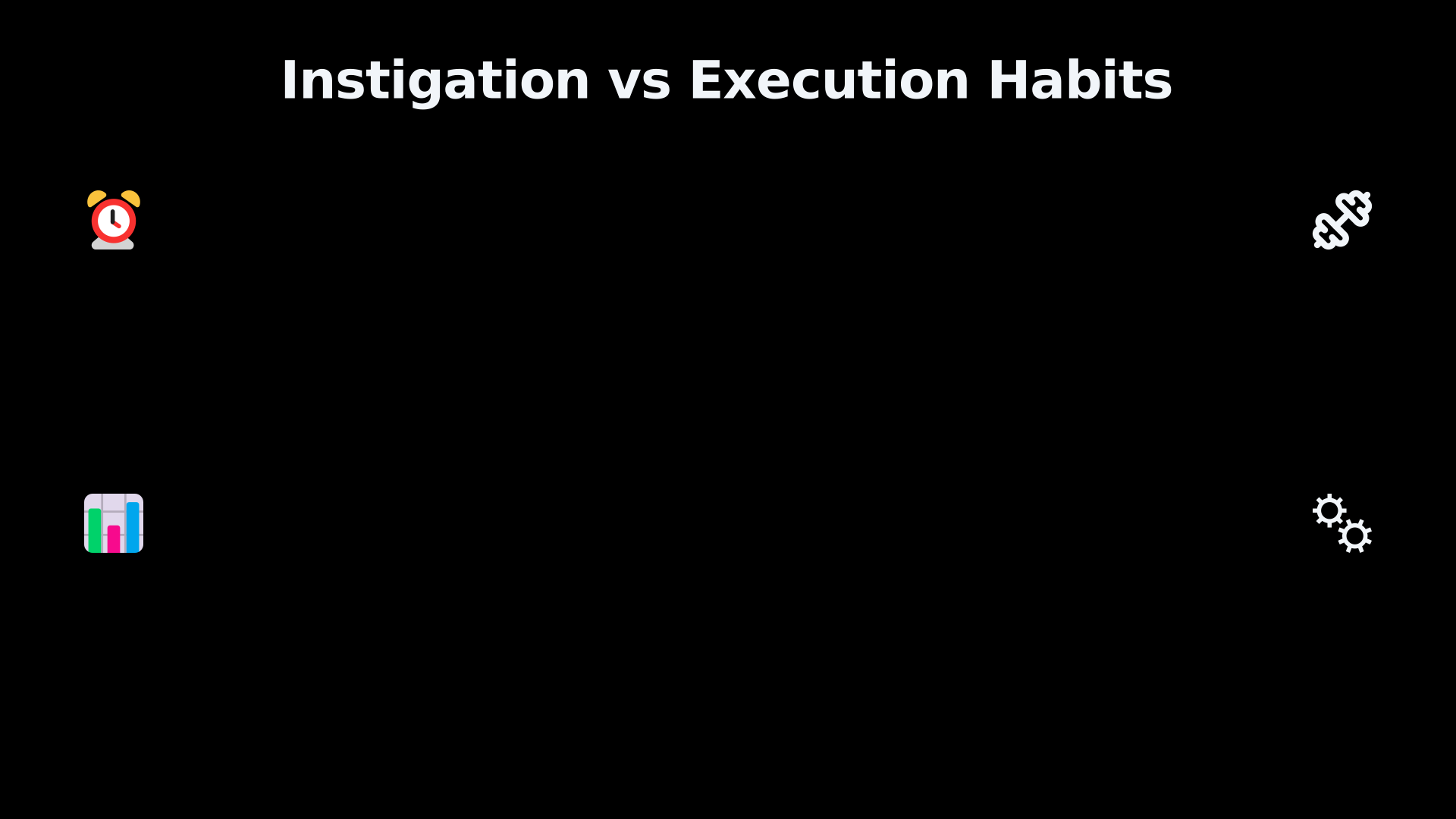
Research distinguishes habitual instigation — a cue automatically prompting the impulse to begin — from habitual execution, in which the sub-actions involved in performing the behaviour unfold automatically. In a study of 123 adults followed for a month, exercise-instigation habit was the unique habit predictor of exercise frequency; execution habit was not.[PubMed]pubmed.ncbi.nlm.nih.govOpen source on nih.gov. A separate study covering flossing, snacking and breakfast consumption similarly found instigation-specific habit measures more predictive of behaviour frequency than execution-specific measures.[BPS Psych Hub]bpspsychub.onlinelibrary.wiley.comBPS Psych HubHabitual instigation and habitual execution: Definition, measurement, and effects on behaviour frequency - Gardner - 2016…
This means a complex routine can legitimately become “habitual” without every component becoming mindless. A regular exerciser might automatically head for a workout when a familiar cue occurs but still deliberately choose what exercises to perform. Conversely, someone could consciously decide to begin an activity yet move through a highly rehearsed sequence almost automatically once started. A 2024 review of habit theory argues that intricate real-world behaviours commonly combine automatic and reflective control in precisely this way.[Compass]compass.onlinelibrary.wiley.comWhat is habit and how can it be used to change real‐world behaviour? Narrowing the theory‐reality gap - Gardner - 2024 - Social an…
Complexity also changes the conditions under which automaticity is observed. In a study of 459 participants rating 25 behaviours — including exercise, handwashing and medication adherence — perceived complexity was negatively associated with automaticity overall. Frequency, contextual stability and perceived reward were positively associated with automaticity, while the relationships involving stable context and reward varied with behavioural complexity. Exercise was rated the most complex of the behaviours examined, whereas handwashing was among the simplest.[Frontiers]frontiersin.orgOpen source on frontiersin.org.
These findings do not establish a formula such as “complex habits take twice as long”. That study was observational rather than a trial timing the formation of each behaviour from scratch. Instead, it shows why complexity is a plausible source of variation and why assigning one population average to everything from drinking water to establishing a workout routine loses important information.[PubMed Central (PMC)]pmc.ncbi.nlm.nih.govOpen source on nih.gov.
For multi-step behaviours, even the instigation/execution distinction is an approximation. A complex sequence can contain lower-level actions that develop their own cue-response relationships. A review of health-habit research gives the example of bicycle commuting: taking a bicycle from a shed and walking it towards the road could themselves become separately cued components within the larger routine. The same logic can apply to preparation, travel, set-up and completion stages in many self-improvement routines.[PubMed Central (PMC)]pmc.ncbi.nlm.nih.govOpen source on nih.gov.
What a formation time actually tells you
The most defensible interpretation of habit-formation research is therefore narrower than popular habit challenges imply. A reported number of days is an estimate produced for a specified behaviour, population, measurement method, cue structure and definition of sufficient automaticity. Change any of those and the number may change too.
For a simple action repeated daily under a stable cue, one automaticity curve can be a reasonably intuitive description. For a complex routine, a single number can conceal several learning processes. The cue to begin may become powerful while execution remains deliberate; preparatory actions may automate before the main activity; or changing locations and schedules may repeatedly alter the contexts in which learning occurs. Research on exercise reinforces this point: preparatory habit and temporal consistency have predicted subsequent exercise behaviour even when automaticity of the exercise performance itself did not.[PubMed]pubmed.ncbi.nlm.nih.govPub Med The role of habit in different phases of exercisePub Med The role of habit in different phases of exercise
This leads to three useful ways to read any claim about how long a habit “takes”:
- Ask what endpoint was measured. Reaching 95% of a modelled automaticity plateau, crossing a questionnaire threshold and reporting that an action feels habitual are not interchangeable definitions.
- Look at the spread, not just the middle. A median of 66 days accompanied by an 18-to-254-day range communicates substantial individual variation; the wider review range of 4–335 days makes fixed deadlines still less defensible.[Wiley Online Library]onlinelibrary.wiley.comWiley Online LibraryHow are habits formed: Modelling habit formation in the real world - Lally - 2010 - European Journal of Social Psycho…
- Ask what part of a complex routine became automatic. Automatically beginning a study session or workout can be behaviourally important even when the content of that session still requires conscious decisions.[PubMed]pubmed.ncbi.nlm.nih.govOpen source on nih.gov.
The practical significance is not that people should replace a 21-day challenge with a 335-day challenge. It is that elapsed time is a poor standalone measure of progress. In the original Lally study, automaticity strengthened through repeated behaviour in a consistent context and approached a plateau gradually. In broader research, frequency, context stability and behavioural characteristics help explain why different trajectories emerge.[Wiley Online Library]onlinelibrary.wiley.comWiley Online LibraryHow are habits formed: Modelling habit formation in the real world - Lally - 2010 - European Journal of Social Psycho…
For complex self-improvement behaviours, “this still takes some thought after two months” is therefore not evidence that habit formation has failed. The research gives no universal date by which the whole sequence should become effortless. A more evidence-consistent expectation is that automaticity can accumulate unevenly: the trigger to start, the preparation and individual components may become easier at different rates, while parts that require judgement remain intentional. That is not an exception to habit formation. For complex behaviour, it may be what successful habit formation normally looks like.[BPS Psych Hub]bpspsychub.onlinelibrary.wiley.comBPS Psych HubHabitual instigation and habitual execution: Definition, measurement, and effects on behaviour frequency - Gardner - 2016…

Amazon book picks
Further Reading
Books and field guides related to There Is No Universal Day When Habits Click. Use these as the next step if you want deeper reading beyond the article.
Atomic Habits
Rating: 3.5/5 from 7 Google Books ratings
The #1 New York Times bestseller. Over 25 million copies sold! Translated into 60+ languages! Tiny Changes, Remarkable Results No matter...
Good Habits, Bad Habits
'The world's leading expert on habits' - Matthew Syed, bestselling author of Black Box Thinking and Rebel IdeasWhat if you could harness...
Tiny Habits
Improving your life is much easier than you think. Whether it’s losing weight, sleeping more, or restoring your work/life balance – the s...

The Power of Habit
Rating: 4.0/5 from 145 Google Books ratings
Duhigg takes us to the edge of scientific discoveries that explain why habits exist and how they can be changed. Distilling information i...
eBay marketplace picks
Marketplace Samples
Live-tested eBay searches with available results related to this page.
Selected frommotivational wall art oneBay.co.uk.

Current eBay listing
Muhammad Ali Dream Motivational Quote Canvas Wall Art Picture Print


Current eBay listing
Gym Motivational Posters Work Out Insperational Quotes Wall Art
Endnotes
1.
Source: mdpi.com
Link:https://www.mdpi.com/2227-9032/12/23/2488
Source snippet
Time to Form a Habit: A Systematic Review and Meta-Analysis of Health Behaviour Habit Formation and Its Determinants...
2.
Source: bpspsychub.onlinelibrary.wiley.com
Link:https://bpspsychub.onlinelibrary.wiley.com/doi/10.1111/bjhp.12189
Source snippet
BPS Psych HubHabitual instigation and habitual execution: Definition, measurement, and effects on behaviour frequency - Gardner - 2016...
3.
Source: compass.onlinelibrary.wiley.com
Link:https://compass.onlinelibrary.wiley.com/doi/full/10.1111/spc3.12975
Source snippet
What is habit and how can it be used to change real‐world behaviour? Narrowing the theory‐reality gap - Gardner - 2024 - Social an...
4.
Source: onlinelibrary.wiley.com
Link:https://onlinelibrary.wiley.com/doi/pdf/10.1002/ejsp.674
Source snippet
Wiley Online LibraryHow are habits formed: Modelling habit formation in the real world - Lally - 2010 - European Journal of Social Psycho...
5.
Source: onlinelibrary.wiley.com
Link:https://onlinelibrary.wiley.com/doi/10.1002/ejsp.674
Source snippet
Wiley Online LibraryHow are habits formed: Modelling habit formation in the real world - Lally - 2010 - European Journal of Social Psycho...
6.
Source: onlinelibrary.wiley.com
Link:https://onlinelibrary.wiley.com/doi/abs/10.1002/ejsp.674
Source snippet
Wiley Online LibraryHow are habits formed: Modelling habit formation in the real world - Lally - 2010 - European Journal of Social Psycho...
7.
Source: iaap-journals.onlinelibrary.wiley.com
Link:https://iaap-journals.onlinelibrary.wiley.com/doi/10.1111/aphw.70016
8.
Source: mdpi.com
Link:https://www.mdpi.com/2227-9032/12/23/2488?_bhlid=47dee3946db8c7e6d3a6e92da693cbc5a7439e28
9.
Source: iaap-journals.onlinelibrary.wiley.com
Link:https://iaap-journals.onlinelibrary.wiley.com/doi/10.1111/aphw.12597
10.
Source: mdpi.com
Title: 2076 328X
Link:https://www.mdpi.com/2076-328X/14/8/730
11.
Source: compass.onlinelibrary.wiley.com
Link:https://compass.onlinelibrary.wiley.com/doi/10.1111/spc3.12975?af=R
12.
Source: compass.onlinelibrary.wiley.com
Link:https://compass.onlinelibrary.wiley.com/doi/10.1111/spc3.12975
13.
Source: bpspsychub.onlinelibrary.wiley.com
Link:https://bpspsychub.onlinelibrary.wiley.com/doi/abs/10.1111/bjhp.12504
14.
Source: bpspsychub.onlinelibrary.wiley.com
Link:https://bpspsychub.onlinelibrary.wiley.com/doi/10.1111/bjhp.12369
15.
Source: bpspsychub.onlinelibrary.wiley.com
Link:https://bpspsychub.onlinelibrary.wiley.com/doi/abs/10.1111/bjhp.12189
16.
Source: onlinelibrary.wiley.com
Link:https://onlinelibrary.wiley.com/doi/abs/10.1002/ejsp.674?msockid=038ed114f43667dd0790c4bef5146634
17.
Source: onlinelibrary.wiley.com
Link:https://onlinelibrary.wiley.com/doi/abs/10.1002/ejsp.674?538fcd4b_page=6&947f74f7_page=5
18.
Source: onlinelibrary.wiley.com
Link:https://onlinelibrary.wiley.com/doi/abs/10.1002/ejsp.674?MixPanelId=15e3fe314440-0468d8411-64220f54-100000-15e3fe314460
19.
Source: onlinelibrary.wiley.com
Link:https://onlinelibrary.wiley.com/doi/abs/10.1002/ejsp.674?msockid=2489864bf52b6612230d95d6f48167ef
20.
Source: pmc.ncbi.nlm.nih.gov
Link:https://pmc.ncbi.nlm.nih.gov/articles/PMC11641623/
21.
Source: penguinrandomhouse.ca
Link:https://www.penguinrandomhouse.ca/books/318795/psycho-cybernetics-by-maxwell-maltz-md-fics/9780399176135/excerpt
22.
Source: pubmed.ncbi.nlm.nih.gov
Title: Pub Med Effects of circadian cortisol on the development of a health habit
Link:https://pubmed.ncbi.nlm.nih.gov/28650196/
23.
Source: doi.org
Link:https://doi.org/10.1111/bjhp.12504
24.
Source: pubmed.ncbi.nlm.nih.gov
Link:https://pubmed.ncbi.nlm.nih.gov/26148187/
25.
Source: pubmed.ncbi.nlm.nih.gov
Link:https://pubmed.ncbi.nlm.nih.gov/26991427/
26.
Source: frontiersin.org
Link:https://www.frontiersin.org/journals/psychology/articles/10.3389/fpsyg.2019.01556/full
27.
Source: pubmed.ncbi.nlm.nih.gov
Link:https://pubmed.ncbi.nlm.nih.gov/31396122/
28.
Source: pmc.ncbi.nlm.nih.gov
Link:https://pmc.ncbi.nlm.nih.gov/articles/PMC6667662/
29.
Source: pmc.ncbi.nlm.nih.gov
Link:https://pmc.ncbi.nlm.nih.gov/articles/PMC4566897/
30.
Source: pubmed.ncbi.nlm.nih.gov
Title: Pub Med The role of habit in different phases of exercise
Link:https://pubmed.ncbi.nlm.nih.gov/28374463/
31.
Source: pmc.ncbi.nlm.nih.gov
Link:https://pmc.ncbi.nlm.nih.gov/articles/PMC13375744/
32.
Source: doi.org
Link:https://doi.org/10.3390/healthcare12232488
33.
Source: pubmed.ncbi.nlm.nih.gov
Link:https://pubmed.ncbi.nlm.nih.gov/39685110/
34.
Source: pmc.ncbi.nlm.nih.gov
Link:https://pmc.ncbi.nlm.nih.gov/articles/PMC11635905/
35.
Source: pubmed.ncbi.nlm.nih.gov
Link:https://pubmed.ncbi.nlm.nih.gov/38450535/
36.
Source: frontiersin.org
Link:https://www.frontiersin.org/journals/psychology/articles/10.3389/fpsyg.2022.883795/full?infclid=98ed75048fad41069048c53e63b2394c
37.
Source: pmc.ncbi.nlm.nih.gov
Link:https://pmc.ncbi.nlm.nih.gov/articles/PMC12318445/
38.
Source: frontiersin.org
Link:https://www.frontiersin.org/journals/psychology/articles/10.3389/fpsyg.2021.626750/full
39.
Source: pubmed.ncbi.nlm.nih.gov
Link:https://pubmed.ncbi.nlm.nih.gov/33405284/
40.
Source: pmc.ncbi.nlm.nih.gov
Link:https://pmc.ncbi.nlm.nih.gov/articles/PMC7321770/
41.
Source: frontiersin.org
Title: Frontiers | On How Definitions of Habits Can Complicate Habit Research
Link:https://www.frontiersin.org/journals/psychology/articles/10.3389/fpsyg.2019.02642/full
42.
Source: pubmed.ncbi.nlm.nih.gov
Link:https://pubmed.ncbi.nlm.nih.gov/30898975/
43.
Source: pmc.ncbi.nlm.nih.gov
Link:https://pmc.ncbi.nlm.nih.gov/articles/3505409/
44.
Source: pmc.ncbi.nlm.nih.gov
Link:https://pmc.ncbi.nlm.nih.gov/articles/PMC3505409/
45.
Source: pmc.ncbi.nlm.nih.gov
Link:https://pmc.ncbi.nlm.nih.gov/articles/PMC4826769/
46.
Source: ouci.dntb.gov.ua
Link:https://ouci.dntb.gov.ua/en/works/7nNN23j7/
Additional References
47.
Source: ucl.ac.uk
Title: University College London How long does it take to form a habit? | UCL News
Link:https://www.ucl.ac.uk/news/2009/aug/how-long-does-it-take-form-habit%20
Source snippet
University College LondonHow long does it take to form a habit? | UCL News - UCL – University College London...
48.
Source: youtube.com
Title: Healthy Habits Take Time: Systematic Review Debunks 21-Day Habit Myth
Link:https://www.youtube.com/watch?v=y4bft0nAGQs
Source snippet
Hack Your Habits for Lasting Change: Insights from Wendy Wood and Adam Grant...
49.
Source: youtube.com
Title: Hack Your Habits for Lasting Change: Insights from Wendy Wood and Adam Grant
Link:https://www.youtube.com/watch?v=wOwZnv_sMds
Source snippet
The Science of Making & Breaking Habits | Huberman Lab Essentials...
50.
Source: youtube.com
Title: The Psychology of Habits | Dr. Benjamin Gardner
Link:https://www.youtube.com/watch?v=83cKQylK7zo
Source snippet
Healthy Habits Take Time: Systematic Review Debunks 21-Day Habit Myth...
51.
Source: youtube.com
Title: Debunking Popular Self-Improvement Advice Using SCIENCE
Link:https://www.youtube.com/watch?v=V2rnlfXTlcU
Source snippet
The Psychology of Habits | Dr. Benjamin Gardner...
52.
Source: researchgate.net
Link:https://www.researchgate.net/publication/362509175_Habit_and_behavioural_complexity_habitual_instigation_and_execution_as_predictors_of_simple_and_complex_behaviours
53.
Source: researchgate.net
Link:https://www.researchgate.net/publication/348328187_Habit_formation_following_routine-based_versus_time-based_cue_planning_A_randomized_controlled_trial
54.
Source: researchgate.net
Link:https://www.researchgate.net/publication/386593213_Time_to_Form_a_Habit_A_Systematic_Review_and_Meta-Analysis_of_Health_Behaviour_Habit_Formation_and_Its_Determinants
55.
Source: visualize.jove.com
Link:https://visualize.jove.com/39685110-time-to-form-a-habit-a-systematic-review-and-meta-analysis-of-health-behaviour-habit-formation-and-its-determinants
56.
Source: surrey.ac.uk
Link:https://www.surrey.ac.uk/news/does-it-really-take-66-days-form-habit-we-asked-expert-dr-pippa-lally