Within Immediate Rewards
Pick the Habit Version You Actually Enjoy
When several activities offer similar long-term benefits, choosing the one you actually enjoy can make persistence easier.
On this page
- Enjoyment versus instrumental usefulness
- Examples in exercise, study and food
- How to choose between equally useful options
Page outline Jump by section
Introduction
When several habits can deliver roughly the same long-term benefit, the version you genuinely enjoy is often the better choice. The reason is practical rather than indulgent: enjoyment gives the behaviour an immediate payoff, while benefits such as better health, stronger knowledge or improved nutrition may take months or years to become visible. Research on long-term goals has found that immediate rewards such as enjoyment predict persistence more strongly than delayed rewards, even though people commonly say the delayed benefit is their main reason for pursuing the goal.[Sage Journals]journals.sagepub.comSage Journals Immediate Rewards Predict Adherence to Long-Term GoalsSage JournalsImmediate Rewards Predict Adherence to Long-Term Goals - Kaitlin Woolley, Ayelet Fishbach, 2017November 29, 2016…
This does not mean that the most enjoyable activity is automatically the most effective. The useful rule is narrower: first identify options that genuinely serve the goal; then, where several are good enough, favour the one you look forward to doing. Exercise, study and food all offer room for this kind of choice. The aim is not to make self-improvement effortless. It is to stop treating unnecessary unpleasantness as evidence that a habit is working.
Enjoyment and usefulness are different tests
A useful habit has to pass two tests. Instrumental usefulness asks whether the behaviour actually advances the goal. Immediate enjoyment asks whether there is something rewarding about doing it now. A strong habit can satisfy both.
That distinction matters because people can overvalue either side. Choosing purely for long-term usefulness may produce an impressive routine that is repeatedly avoided. Choosing purely for enjoyment may produce an activity that feels good but does little for the intended outcome. For example, an enjoyable but extremely easy workout may not provide the training stimulus required for a particular fitness goal; similarly, a pleasant hour rereading familiar notes is not necessarily equivalent to a more demanding hour of retrieval practice.
The research on immediate rewards makes the case for considering enjoyment, not for ignoring effectiveness. Woolley and Fishbach found that people tended to cite delayed rewards as their reason for pursuing exercise and study, yet immediate rewards were more closely associated with persistence within sessions and across longer periods. A useful interpretation is that the delayed benefit helps answer “Is this goal worth having?”, while the immediate experience helps answer “Will I keep doing the work?”[Sage Journals]journals.sagepub.comSage Journals Immediate Rewards Predict Adherence to Long-Term GoalsSage JournalsImmediate Rewards Predict Adherence to Long-Term Goals - Kaitlin Woolley, Ayelet Fishbach, 2017November 29, 2016…
This suggests a better optimisation problem than simply looking for the theoretically “best” habit. Establish a threshold of usefulness first. Once several options clear that threshold, enjoyment becomes a legitimate decision criterion because adherence affects the amount of useful behaviour actually completed. A slightly less optimised routine performed consistently can outperform a theoretically superior one that exists mostly on a timetable.
Exercise makes the choice especially visible
Exercise is an unusually clear example because there are many legitimate ways to be active. World Health Organization guidance counts physical activity undertaken through leisure, transport, work and household activities, and notes that different types and domains of activity can provide health benefits. Adults can accumulate aerobic activity through options as varied as brisk walking, cycling, running, sport and other forms of movement, while muscle-strengthening activity adds benefits of its own.[NCBI]ncbi.nlm.nih.govWHO Guidelines on Physical Activity and Sedentary Behaviour - NCBI Bookshelf…
That creates room for preference. Someone who dislikes running does not generally need to decide between running and inactivity. Depending on the goal, brisk walking, cycling, swimming, dancing or a sport may offer a workable route to regular aerobic activity. The UK Chief Medical Officers’ guidance makes the implementation point unusually explicit: lasting change is more likely when activity is enjoyable, useful or incorporated into everyday routines, and it identifies walking, cycling, wheeling, sport, dancing and running as valuable forms of activity.[GOV.UK]GOV.UKU K Chief Medical Officers' physical activity guidelinesUK Chief Medical Officers' physical activity guidelines - GOV.UKJuly 10, 2026…
The behavioural evidence supports taking those preferences seriously. A meta-analysis of 114 independent adult samples found a positive association between affective judgements — constructs including enjoyment, affective attitude and intrinsic motivation — and physical activity, with a summary correlation of 0.42. A later systematic review found that a more positive affective response during moderate-intensity exercise was linked to subsequent physical activity. These findings are not proof that simply selecting your favourite exercise will guarantee adherence, but they make the experience of exercising relevant rather than cosmetic.[PubMed]pubmed.ncbi.nlm.nih.govA review and meta-analysis of affective judgments and physical activity in adult populations - PubMed…
There is also no universal winner on enjoyment. A 2021 review, for example, found that moderate continuous exercise produced a more positive post-exercise affective response than high-intensity interval training (HIIT), while HIIT scored higher on enjoyment. That apparent contradiction is useful: people may enjoy different features of an activity — comfort, variety, intensity, challenge or time efficiency — and a population average cannot tell an individual which form will feel most sustainable.[PubMed]pubmed.ncbi.nlm.nih.govExercisers' Affective and Enjoyment Responses: A Meta-Analytic and Meta-Regression Review - PubMedJune 10, 2021…
So the practical comparison is not “Which exercise is scientifically best?” in the abstract. It is “Which options meet the demands of my goal, and which of those would I willingly repeat?” If cardiovascular fitness is the target, compare credible aerobic options. If strength is the target, compare forms of resistance training. Do not substitute an enjoyable activity that misses the goal entirely; choose enjoyably within the set that serves it.

Study methods need a usefulness floor
Studying requires a little more caution because methods that feel easiest can also create an illusion of learning. Reviews of learning science consistently support retrieval practice — actively trying to recall material — and spaced practice, while passive strategies such as repeated rereading and highlighting tend to have weaker or less consistent evidence. A 2022 review describes spacing and retrieval practice as well-supported ways to enhance learning across domains and ages, and a 2025 systematic review likewise found retrieval practice consistently more beneficial than simple restudy.[Nature]nature.comOpen source on nature.com.
“Choose what you enjoy” therefore should not become permission to replace effective study with whatever feels most comfortable. Instead, preserve the effective mechanism and make choices inside it.
A student who needs retrieval practice, for instance, could choose among flashcards, self-written quizzes, answering questions with a friend, practising past-paper questions or trying to explain material from memory before checking the source. Spacing can likewise be implemented through different schedules and tools. The enjoyable variable might be the format, subject order, location, social setting or type of challenge rather than the underlying learning principle.
Research on motivation regulation supports this idea of modifying a task to increase interest. Interest-enhancement can involve changing how an activity is performed so that it becomes more engaging, and recent work distinguishes such strategies from simply concentrating on future outcomes or promising oneself an external reward.[ScienceDirect]sciencedirect.comOpen source on sciencedirect.com.
That produces a useful hierarchy for studying: protect the learning mechanism first, personalise the experience second. If practice questions work but one format feels punishing, try a different question source, shorter rounds, competitive quizzes or a study partner before abandoning retrieval practice altogether. Enjoyment is most useful when it increases exposure to an effective method rather than replacing one.
Healthy food can be chosen for pleasure too
Food offers another important correction to the idea that useful choices ought to feel virtuous rather than pleasurable. Taste is a major driver of food choice: analysis of US survey data found that 77% of adults rated taste as “very important”, ahead of nutrition, cost and convenience.[PubMed]pubmed.ncbi.nlm.nih.govOpen source on nih.gov.
The implication is not that taste should override nutrition. It is that a healthy eating pattern designed without regard to taste is competing against one of the strongest influences on everyday food decisions. Where several nutritious foods can play a similar role, selecting the ones a person actually likes — and preparing them in appealing ways — makes use of preference rather than constantly fighting it.
Large field experiments provide a particularly concrete demonstration. In a preregistered study across five US university dining halls, researchers observed 137,842 diner decisions involving 24 types of vegetables. Describing vegetable dishes in taste-focused terms increased selection by 29% compared with health-focused descriptions and by 14% compared with basic descriptions; vegetable consumption increased as well. Crucially, the effect was stronger where the vegetables themselves were prepared to be tastier. Attractive language alone was not the whole intervention: the underlying experience had to support the expectation.[PubMed Central (PMC)]pmc.ncbi.nlm.nih.govOpen source on nih.gov.
Earlier field studies similarly found that taste-focused descriptions increased selection of vegetables, salads and vegetable wraps and improved ratings of how delicious the vegetables were.[PubMed]pubmed.ncbi.nlm.nih.govOpen source on nih.gov.
For an individual, this means “eat more vegetables” need not translate into repeatedly forcing down the vegetable believed to be most virtuous. If roasted peppers, spiced cauliflower, tomato-based dishes or crunchy salads all fit the dietary objective, preference is useful information. The same principle applies to whole grains, pulses, fruit and other food categories: work within the nutritional requirement, then search for versions, recipes and combinations that are genuinely satisfying.
There is an important boundary here. Enjoyability does not make foods nutritionally interchangeable. Preferences should guide choices among options that adequately serve the dietary objective, not erase meaningful differences in nutritional composition.
How to choose between equally useful options
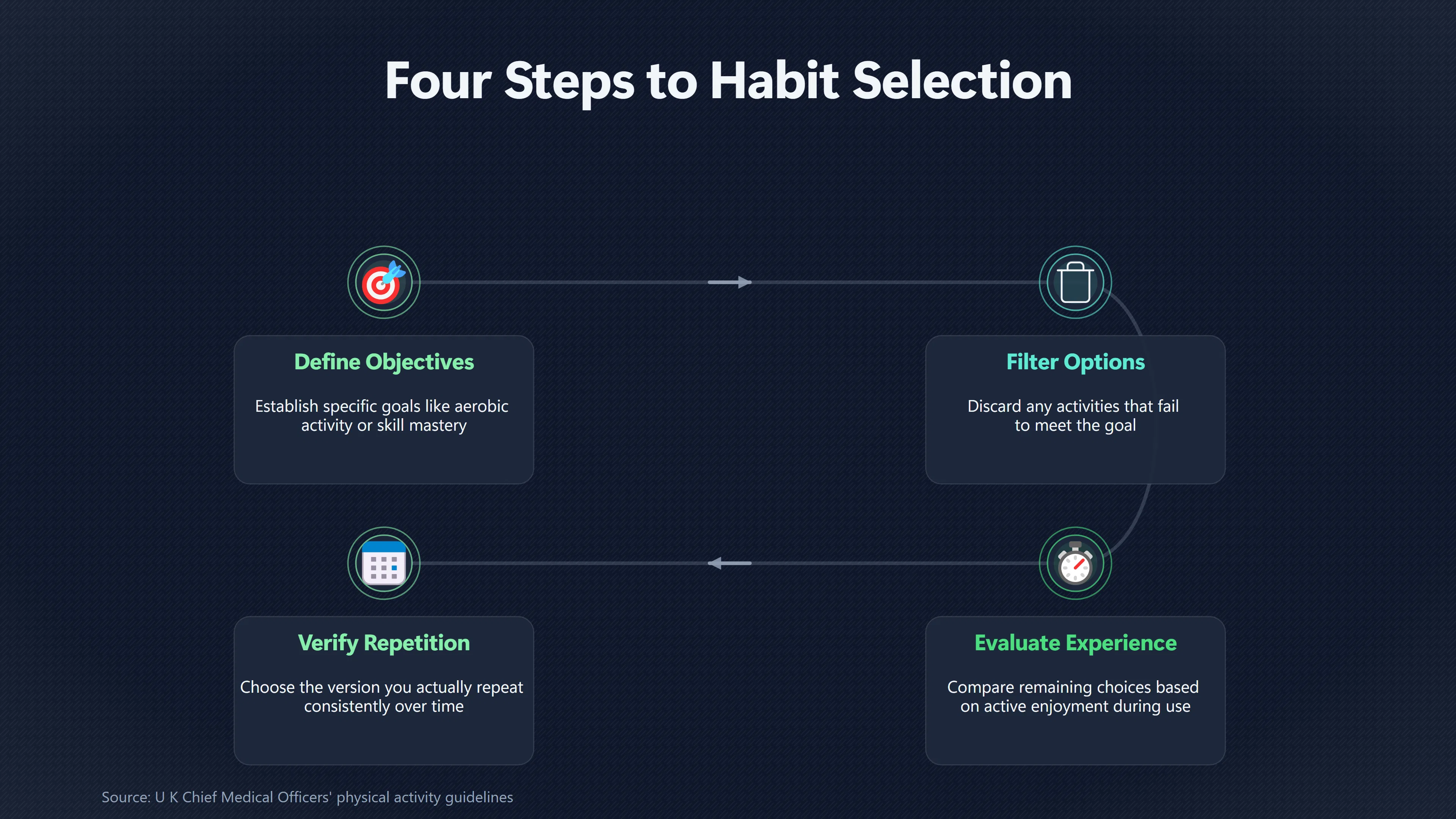
The most reliable way to use enjoyment is as a tie-breaker among credible options, rather than as the first and only filter. A practical decision can be made in four moves:
- Define what the habit must accomplish. “Exercise more” is vague; “accumulate regular moderate aerobic activity” or “strengthen major muscle groups” gives you a basis for comparison. Likewise, “study” becomes more useful when translated into remembering material, solving problems or practising a skill.
- Discard options that do not adequately serve that purpose. An enjoyable study ritual that produces little learning should not beat an effective method merely because it is pleasant. The same applies to exercise or food substitutions that miss the intended outcome.
-
Compare the remaining options by lived experience. Ask which one you enjoy during the activity, not merely which produces satisfaction afterwards. This distinction is particularly relevant in exercise, where research has connected affect during activity with later behaviour. PubMed
-
Judge the winner by repetition, not fantasy. The useful question is not “Which version sounds most enjoyable?” but “Which version have I actually been willing to repeat?” Try credible alternatives long enough to observe attendance, completion or consumption. Preference becomes behaviourally valuable when it translates into more consistent action.
This approach also avoids the trap of assuming there must be one permanent favourite. Enjoyment can change with skill, social context, weather, boredom and life circumstances. Variety can therefore be part of the policy: cycling in summer and swimming in winter, alternating two forms of retrieval practice, or rotating several nutritious meals may preserve both usefulness and appeal.
Enjoyment can be built into the activity
Sometimes there is no attractive alternative to the core task. A particular examination must be revised for; rehabilitation may require a prescribed movement; an administrative routine may simply need doing. In those cases, the same principle can be applied one level down: keep the useful behaviour but improve its immediate experience.
One well-studied example is temptation bundling, in which an immediately enjoyable activity is paired with a useful behaviour whose main rewards are delayed. In an early field experiment, people were given access to tempting audio novels while exercising. Gym attendance initially increased by 51% in the group whose audiobooks were restricted to the gym and by 29% in a group encouraged to impose the restriction themselves, relative to controls, although the effects weakened over time. PubMed Central (PMC)
A much larger four-week field experiment involving 6,792 participants later found that providing an audiobook and encouraging people to bundle it with exercise increased the probability of a weekly workout by roughly 10–14% and average weekly workouts by 10–12% during the intervention and follow-up period examined. ScienceDirect
Temptation bundling is adjacent to, but distinct from, choosing an enjoyable habit version. The stronger first move is often to make the activity itself something you like: choose swimming instead of reluctantly running, a satisfying vegetable dish instead of a joyless one, or an effective study format you find engaging. Added entertainment is useful when the underlying task cannot readily be changed.
The best version is the one that remains both useful and repeatable
Enjoyment should not be treated as a reward for weakness or as something that must be earned after “real” work. When multiple routes genuinely lead towards the same goal, how those routes feel is part of the implementation problem.
The evidence is strongest for a modest principle rather than a universal promise. Immediate enjoyment is associated with persistence; affect matters for physical activity; effective study methods can be implemented in different formats; and healthy foods can be presented and prepared around taste rather than healthfulness alone. PubMed Central (PMC)+3PubMed+3PubMed
The qualification is equally important: equivalence has to come before preference. Running and dancing may both provide useful aerobic activity, but aerobic exercise and strength training are not interchangeable for every goal. Two retrieval-practice formats may both be effective, while passive rereading may not be an equal substitute. Two vegetable dishes may fit the same broad dietary purpose, while a nutritionally different food may not.
Within those boundaries, enjoyment is not a frivolous extra. It is one of the characteristics that can turn a beneficial option from something you believe you should do into something you are willing to do again tomorrow.
Amazon book picks
Further Reading
Books and field guides related to Pick the Habit Version You Actually Enjoy. Use these as the next step if you want deeper reading beyond the article.
How to Change
Wall Street Journal bestseller “A welcome revelation.” --The Financial Times Award-winning Wharton Professor and Choiceology podcast host...
Atomic Habits
Rating: 3.5/5 from 7 Google Books ratings
The #1 New York Times bestseller. Over 25 million copies sold! Translated into 60+ languages! Tiny Changes, Remarkable Results No matter...
Tiny Habits
Improving your life is much easier than you think. Whether it’s losing weight, sleeping more, or restoring your work/life balance – the s...
The Power of Habit
Rating: 4.0/5 from 145 Google Books ratings
Duhigg takes us to the edge of scientific discoveries that explain why habits exist and how they can be changed. Distilling information i...
eBay marketplace picks
Marketplace Samples
Live-tested eBay searches with available results related to this page.
Selected frommotivation poster oneBay.co.uk.

Current eBay listing
Motivation Quotes Framed Wall Art Poster Canvas Print Picture
Current eBay listing
Gym Motivation Quote Framed Wall Art Poster Canvas Print Picture

Current eBay listing
Gym Motivation Framed Wall Art Poster Canvas Print Picture
Endnotes
1.
Source: GOV.UK
Title: U K Chief Medical Officers’ physical activity guidelines
Link:https://www.gov.uk/government/publications/physical-activity-guidelines-uk-chief-medical-officers-report/uk-chief-medical-officers-physical-activity-guidelines
Source snippet
UK Chief Medical Officers' physical activity guidelines - GOV.UKJuly 10, 2026...
Published: July 10, 2026
2.
Source: nature.com
Link:https://www.nature.com/articles/s44159-022-00089-1.pdf
3.
Source: sciencedirect.com
Link:https://www.sciencedirect.com/science/article/abs/pii/S1041608016302862
4.
Source: sciencedirect.com
Title: ScienceDirect Teaching temptation bundling to boost exercise: A field experiment
Link:https://www.sciencedirect.com/science/article/pii/S074959782030385X
5.
Source: GOV.UK
Title: www.gov.uk Nutrition and maternal weight outcomes: SACN report
Link:https://www.gov.uk/government/publications/nutrition-and-maternal-weight-outcomes-sacn-report/nutrition-and-maternal-weight-outcomes-sacn-report-summary
6.
Source: who.int
Title: Healthy diet
Link:https://www.who.int/en/news-room/fact-sheets/detail/healthy-diet
7.
Source: GOV.UK
Title: www.gov.uk Processed foods and health: SACN’s rapid evidence update
Link:https://www.gov.uk/government/publications/processed-foods-and-health-sacns-rapid-evidence-update/processed-foods-and-health-sacns-rapid-evidence-update-summary
8.
Source: GOV.UK
Link:https://www.gov.uk/government/publications/government-response-to-the-house-of-lords-food-and-health-report/government-response-to-the-house-of-lords-food-diet-and-obesity-committees-report-recipe-for-health-a-plan-to-fix-our-broken-food-system
9.
Source: GOV.UK
Title: www.gov.uk Feeding young children aged 1 to 5 years
Link:https://www.gov.uk/government/publications/sacn-report-feeding-young-children-aged-1-to-5-years/feeding-young-children-aged-1-to-5-years-summary-report
10.
Source: GOV.UK
Title: www.gov.uk Healthy eating: applying All Our Health
Link:https://www.gov.uk/government/publications/healthy-eating-applying-all-our-health/healthy-eating-applying-all-our-health
11.
Source: sciencedirect.com
Link:https://www.sciencedirect.com/science/article/pii/S0010945222000144
12.
Source: who.int
Link:https://www.who.int/news-room/articles-detail/public-consultation-on-the-draft-who-guidelines-on-physical-activity-and-sedentary-behaviour-for-children-and-adolescents-adults-and-older-adults-2020
13.
Source: sciencedirect.com
Link:https://www.sciencedirect.com/science/article/abs/pii/S1041608019301487
14.
Source: who.int
Link:https://www.who.int/news-room/events/detail/2019/06/12/default-calendar/who-guideline-development-group-for-the-updating-of-the-2010-global-recommendations-on-physical-activity-in-youth-adults-and-older-adults
15.
Source: sciencedirect.com
Link:https://www.sciencedirect.com/science/article/pii/S0195666316301040
16.
Source: sciencedirect.com
Link:https://www.sciencedirect.com/science/article/abs/pii/S0361476X12000288
17.
Source: sciencedirect.com
Link:https://www.sciencedirect.com/science/article/abs/pii/S1096751611000716
18.
Source: sciencedirect.com
Title: Coping with boredom in school: An experience sampling perspective
Link:https://www.sciencedirect.com/science/article/pii/S0361476X10000548
19.
Source: sciencedirect.com
Title: The effect of choice of exercise mode on psychological responses
Link:https://www.sciencedirect.com/science/article/pii/S1469029202000535
20.
Source: sciencedirect.com
Title: Preferred exercise mode and affective responses in physically active adults
Link:https://www.sciencedirect.com/science/article/abs/pii/S1469029202000183
21.
Source: sciencedirect.com
Link:https://www.sciencedirect.com/science/article/pii/S0091743518303669
22.
Source: sciencedirect.com
Link:https://www.sciencedirect.com/science/article/pii/S1469029219304212
23.
Source: sciencedirect.com
Link:https://www.sciencedirect.com/science/article/abs/pii/S1469029219304212
24.
Source: sciencedirect.com
Link:https://www.sciencedirect.com/science/article/pii/S1469029226001020
25.
Source: sciencedirect.com
Link:https://www.sciencedirect.com/science/article/abs/pii/S1469029226001020
26.
Source: sciencedirect.com
Link:https://www.sciencedirect.com/science/article/abs/pii/S1469029225001116
27.
Source: sciencedirect.com
Link:https://www.sciencedirect.com/science/article/pii/S0959475217301810
28.
Source: journals.sagepub.com
Title: Sage Journals Immediate Rewards Predict Adherence to Long-Term Goals
Link:https://journals.sagepub.com/doi/pdf/10.1177/0146167216676480
Source snippet
Sage JournalsImmediate Rewards Predict Adherence to Long-Term Goals - Kaitlin Woolley, Ayelet Fishbach, 2017November 29, 2016...
Published: November 29, 2016
29.
Source: pubmed.ncbi.nlm.nih.gov
Title: Pub Med Immediate Rewards Predict Adherence to Long-Term Goals
Link:https://pubmed.ncbi.nlm.nih.gov/27899467/
Source snippet
Immediate Rewards Predict Adherence to Long-Term Goals - PubMed...
30.
Source: journals.sagepub.com
Title: Sage Journals Immediate Rewards Predict Adherence to Long-Term Goals
Link:https://journals.sagepub.com/doi/abs/10.1177/0146167216676480
Source snippet
Sage JournalsImmediate Rewards Predict Adherence to Long-Term Goals - Kaitlin Woolley, Ayelet Fishbach, 2017November 29, 2016...
Published: November 29, 2016
31.
Source: ncbi.nlm.nih.gov
Link:https://www.ncbi.nlm.nih.gov/books/NBK566046/
Source snippet
WHO Guidelines on Physical Activity and Sedentary Behaviour - NCBI Bookshelf...
32.
Source: pmc.ncbi.nlm.nih.gov
Link:https://pmc.ncbi.nlm.nih.gov/articles/7719906/
Source snippet
PubMed Central (PMC)World Health Organization 2020 guidelines on physical activity and sedentary behaviour - PMC...
33.
Source: pubmed.ncbi.nlm.nih.gov
Link:https://pubmed.ncbi.nlm.nih.gov/20082164/
Source snippet
A review and meta-analysis of affective judgments and physical activity in adult populations - PubMed...
35.
Source: pubmed.ncbi.nlm.nih.gov
Link:https://pubmed.ncbi.nlm.nih.gov/34112041/
Source snippet
Exercisers' Affective and Enjoyment Responses: A Meta-Analytic and Meta-Regression Review - PubMedJune 10, 2021...
Published: June 10, 2021
36.
Source: doi.org
Link:https://doi.org/10.1007/s10648-025-10076-6
37.
Source: pubmed.ncbi.nlm.nih.gov
Title: Pub Med Metamotivational beliefs about intrinsic and extrinsic motivation
Link:https://pubmed.ncbi.nlm.nih.gov/37902708/
38.
Source: pubmed.ncbi.nlm.nih.gov
Link:https://pubmed.ncbi.nlm.nih.gov/27374943/
39.
Source: pmc.ncbi.nlm.nih.gov
Link:https://pmc.ncbi.nlm.nih.gov/articles/PMC6843749/
40.
Source: pubmed.ncbi.nlm.nih.gov
Link:https://pubmed.ncbi.nlm.nih.gov/30508553/
41.
Source: pmc.ncbi.nlm.nih.gov
Link:https://pmc.ncbi.nlm.nih.gov/articles/PMC7608647/
43.
Source: pubmed.ncbi.nlm.nih.gov
Link:https://pubmed.ncbi.nlm.nih.gov/25843979/
44.
Source: pmc.ncbi.nlm.nih.gov
Link:https://pmc.ncbi.nlm.nih.gov/articles/PMC12939115/
45.
Source: pmc.ncbi.nlm.nih.gov
Link:https://pmc.ncbi.nlm.nih.gov/articles/PMC12686233/
46.
Source: pubmed.ncbi.nlm.nih.gov
Link:https://pubmed.ncbi.nlm.nih.gov/41368562/
47.
Source: journals.sagepub.com
Link:https://journals.sagepub.com/doi/full/10.1177/09567976251350960
48.
Source: journals.sagepub.com
Link:https://journals.sagepub.com/doi/10.1177/09567976251350960
49.
Source: doi.org
Title: The role of rewards in motivation—Beyond dichotomies
Link:https://doi.org/10.1016%2Fj.learninstruc.2024.102056
50.
Source: pubmed.ncbi.nlm.nih.gov
Link:https://pubmed.ncbi.nlm.nih.gov/39940456/
51.
Source: pmc.ncbi.nlm.nih.gov
Link:https://pmc.ncbi.nlm.nih.gov/articles/PMC11851994/
52.
Source: pmc.ncbi.nlm.nih.gov
Link:https://pmc.ncbi.nlm.nih.gov/articles/PMC11451574/
53.
Source: pmc.ncbi.nlm.nih.gov
Link:https://pmc.ncbi.nlm.nih.gov/articles/PMC11299270/
54.
Source: pubmed.ncbi.nlm.nih.gov
Link:https://pubmed.ncbi.nlm.nih.gov/39103923/
55.
Source: pmc.ncbi.nlm.nih.gov
Link:https://pmc.ncbi.nlm.nih.gov/articles/PMC11227488/
56.
Source: pubmed.ncbi.nlm.nih.gov
Link:https://pubmed.ncbi.nlm.nih.gov/38576064/
57.
Source: journals.sagepub.com
Link:https://journals.sagepub.com/doi/10.1177/23792981231190590
58.
Source: pubmed.ncbi.nlm.nih.gov
Link:https://pubmed.ncbi.nlm.nih.gov/37128940/
59.
Source: pubmed.ncbi.nlm.nih.gov
Link:https://pubmed.ncbi.nlm.nih.gov/37169353/
60.
Source: pubmed.ncbi.nlm.nih.gov
Link:https://pubmed.ncbi.nlm.nih.gov/38107165/
61.
Source: doi.org
Link:https://doi.org/10.3758/s13423-022-02170-5
62.
Source: pmc.ncbi.nlm.nih.gov
Link:https://pmc.ncbi.nlm.nih.gov/articles/PMC9311762/
63.
Source: pmc.ncbi.nlm.nih.gov
Link:https://pmc.ncbi.nlm.nih.gov/articles/PMC9767299/
64.
Source: pubmed.ncbi.nlm.nih.gov
Link:https://pubmed.ncbi.nlm.nih.gov/35250719/
65.
Source: pmc.ncbi.nlm.nih.gov
Link:https://pmc.ncbi.nlm.nih.gov/articles/8894246/
66.
Source: journals.sagepub.com
Link:https://journals.sagepub.com/doi/10.1177/00315125211024212
67.
Source: pmc.ncbi.nlm.nih.gov
Link:https://pmc.ncbi.nlm.nih.gov/articles/PMC7922504/
68.
Source: pubmed.ncbi.nlm.nih.gov
Link:https://pubmed.ncbi.nlm.nih.gov/33669679/
69.
Source: pubmed.ncbi.nlm.nih.gov
Link:https://pubmed.ncbi.nlm.nih.gov/33305689/
70.
Source: pmc.ncbi.nlm.nih.gov
Link:https://pmc.ncbi.nlm.nih.gov/articles/PMC7735992/
71.
Source: doi.org
Title: bjsports 2020 102955
Link:https://doi.org/10.1136/bjsports-2020-102955
72.
Source: pmc.ncbi.nlm.nih.gov
Link:https://pmc.ncbi.nlm.nih.gov/articles/PMC7691077/
73.
Source: pmc.ncbi.nlm.nih.gov
Link:https://pmc.ncbi.nlm.nih.gov/articles/PMC7719906/
74.
Source: pubmed.ncbi.nlm.nih.gov
Link:https://pubmed.ncbi.nlm.nih.gov/31722291/
75.
Source: journals.sagepub.com
Link:https://journals.sagepub.com/doi/10.1177/0956797619872191
76.
Source: journals.sagepub.com
Link:https://journals.sagepub.com/doi/abs/10.1177/0956797619872191
77.
Source: journals.sagepub.com
Link:https://journals.sagepub.com/doi/abs/10.1177/0956797619872191?__ac_lkid=14b0-f639-efd2-f4de17606ffdcc9&journalCode=pssa
78.
Source: journals.sagepub.com
Link:https://journals.sagepub.com/doi/abs/10.1177/0956797619872191?__ac_lkid=14b0-f639-efd2-f4de175298e68ca&journalCode=pssa
79.
Source: pubmed.ncbi.nlm.nih.gov
Link:https://pubmed.ncbi.nlm.nih.gov/30261826/
80.
Source: pmc.ncbi.nlm.nih.gov
Link:https://pmc.ncbi.nlm.nih.gov/articles/PMC6232376/
81.
Source: pubmed.ncbi.nlm.nih.gov
Link:https://pubmed.ncbi.nlm.nih.gov/30459690/
82.
Source: pubmed.ncbi.nlm.nih.gov
Link:https://pubmed.ncbi.nlm.nih.gov/29244841/
83.
Source: pubmed.ncbi.nlm.nih.gov
Link:https://pubmed.ncbi.nlm.nih.gov/28792851/
84.
Source: pmc.ncbi.nlm.nih.gov
Link:https://pmc.ncbi.nlm.nih.gov/articles/PMC6104631/
85.
Source: doi.org
Link:https://doi.org/10.1371/journal.pone.0166299
86.
Source: pubmed.ncbi.nlm.nih.gov
Link:https://pubmed.ncbi.nlm.nih.gov/27808004/
87.
Source: pmc.ncbi.nlm.nih.gov
Link:https://pmc.ncbi.nlm.nih.gov/articles/PMC5303533/
88.
Source: pubmed.ncbi.nlm.nih.gov
Link:https://pubmed.ncbi.nlm.nih.gov/26972352/
89.
Source: pmc.ncbi.nlm.nih.gov
Link:https://pmc.ncbi.nlm.nih.gov/articles/PMC4129110/
90.
Source: pubmed.ncbi.nlm.nih.gov
Link:https://pubmed.ncbi.nlm.nih.gov/25086646/
91.
Source: pmc.ncbi.nlm.nih.gov
Link:https://pmc.ncbi.nlm.nih.gov/articles/PMC3441783/
92.
Source: doi.org
Link:https://doi.org/10.1186/1479
93.
Source: pubmed.ncbi.nlm.nih.gov
Link:https://pubmed.ncbi.nlm.nih.gov/21557865/
94.
Source: journals.sagepub.com
Title: pms.101.1.283 294
Link:https://journals.sagepub.com/doi/10.2466/pms.101.1.283-294
95.
Source: pubmed.ncbi.nlm.nih.gov
Link:https://pubmed.ncbi.nlm.nih.gov/1403621/
96.
Source: pubmed.ncbi.nlm.nih.gov
Link:https://pubmed.ncbi.nlm.nih.gov/10444855/
97.
Source: ncbi.nlm.nih.gov
Link:https://www.ncbi.nlm.nih.gov/books/NBK566040/
98.
Source: ncbi.nlm.nih.gov
Link:https://www.ncbi.nlm.nih.gov/books/NBK566039/
99.
Source: ncbi.nlm.nih.gov
Link:https://ncbi.nlm.nih.gov/books/NBK566037/
100.
Source: pubmed.ncbi.nlm.nih.gov
Link:https://pubmed.ncbi.nlm.nih.gov/18065065/
101.
Source: pubmed.ncbi.nlm.nih.gov
Link:https://pubmed.ncbi.nlm.nih.gov/18694433/
102.
Source: doi.org
Link:https://doi.org/10.1016/j.foodqual.2026.105858
Additional References
103.
Source: youtube.com
Title: How to become 37.78 times better at anything | Atomic Habits
Link:https://www.youtube.com/watch?v=PZ7lDrwYdZc
Source snippet
Katy Milkman make habits fun temptation bundling Cartoon about Temptation Bundling...
104.
Source: youtube.com
Title: How to Build Habits That Actually Last: A Neuroscience Approach
Link:https://www.youtube.com/watch?v=ObA4ne4TVsE
Source snippet
How to become 37.78 times better at anything | Atomic Habits summary (by James Clear)...
105.
Source: kaitlinwoolley.com
Link:https://kaitlinwoolley.com/wp-content/uploads/2017/08/woolleyfishbachpspb.pdf
Source snippet
Kaitlin Woolley676480 PSPXXX10.1177/0146167216676480Personality and Social Psychology BulletinWoolley and Fishbach...
106.
Source: psychologicalscience.org
Link:https://www.psychologicalscience.org/journals/psychological-science/0956797619872191/
107.
Source: youtube.com
Title: Changing Behavior With ‘Temptation Bundling’
Link:https://www.youtube.com/watch?v=GKIUMOKkXPg
Source snippet
How to Build Habits That Actually Last: A Neuroscience Approach...
108.
Source: researchgate.net
Link:https://www.researchgate.net/publication/41041817_A_Review_and_Meta-Analysis_of_Affective_Judgments_and_Physical_Activity_in_Adult_Populations
109.
Source: researchgate.net
Link:https://www.researchgate.net/publication/348915439_CAN_GAMIFIED_TRAINING_CREATE_COMPETITIVE_ADVANTAGE
110.
Source: researchgate.net
Link:https://www.researchgate.net/publication/294576232_For_the_Fun_of_It_Harnessing_Immediate_Rewards_to_Increase_Persistence_in_Long-Term_Goals
111.
Source: researchgate.net
Link:https://www.researchgate.net/publication/256040779_Holding_the_Hunger_Games_Hostage_at_the_Gym_An_Evaluation_of_Temptation_Bundling
112.
Source: nutrition.org.uk
Link:https://www.nutrition.org.uk/creating-a-healthy-diet/a-healthy-balanced-diet/?level=Consumer