Within Habit Timelines
Does the Time of Day Change Habit Formation?
A stretching study estimated faster automaticity in the morning than evening, showing that timing can influence habit development.
On this page
- What the morning versus evening stretching study found
- Why timing might affect automaticity
- Why one timing result should not become another rule
Page outline Jump by section
Introduction
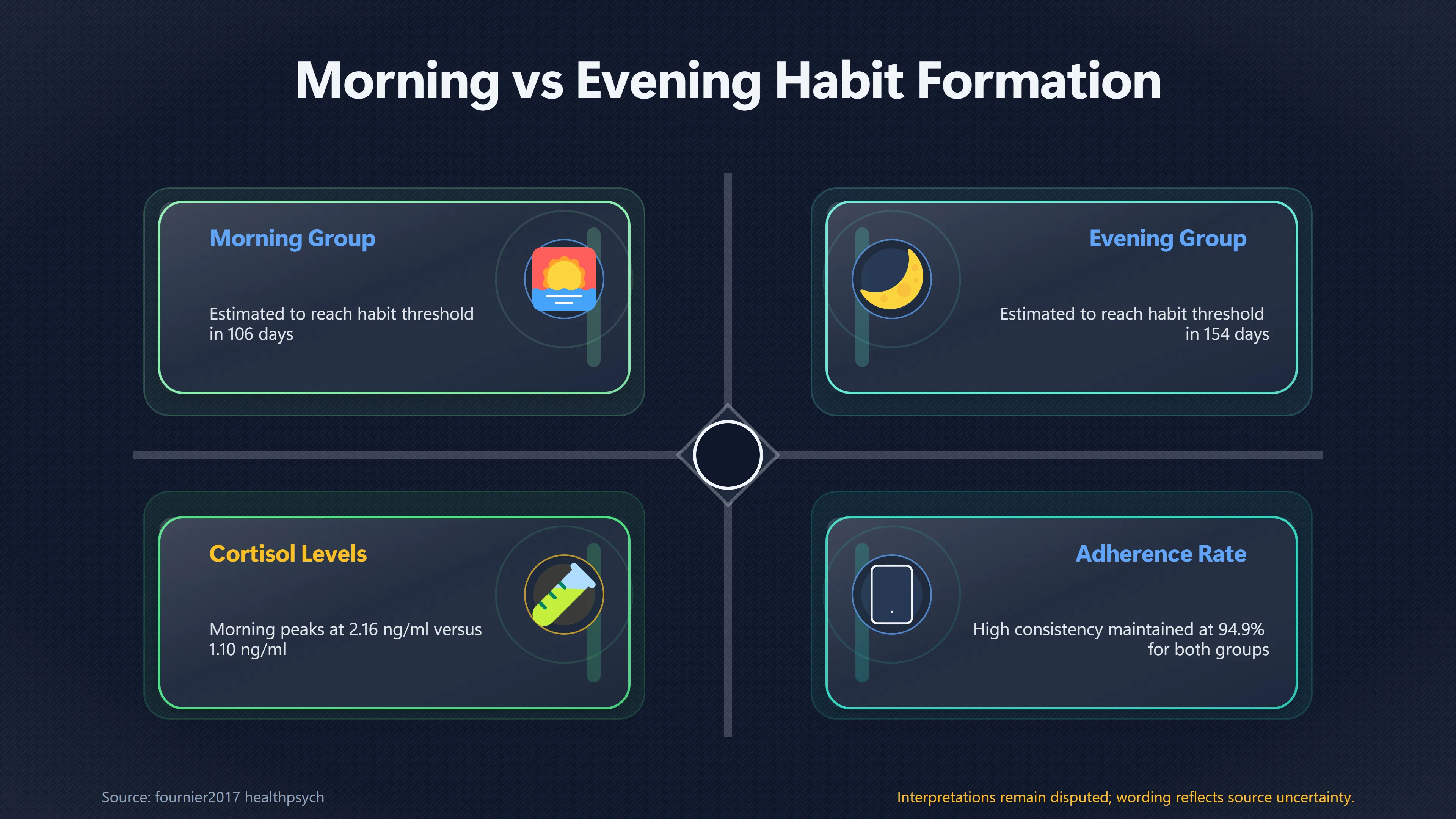
The time of day may affect how quickly a repeated behaviour becomes automatic, but the evidence does not support a simple rule that morning habits are always easier to form than evening ones. The clearest direct evidence comes from one small 2017 experiment in which students repeated the same stretching exercise either after waking or before bed. Researchers estimated that automaticity developed substantially sooner in the morning group: about 106 days versus 154 days.[PubMed]pubmed.ncbi.nlm.nih.govPub Med Effects of circadian cortisol on the development of a health habitEffects of circadian cortisol on the development of a health habit - PubMedNovember 1, 2017…

That difference is interesting because the behaviour itself was held broadly constant while its place in the daily routine changed. The researchers proposed that higher morning cortisol helped explain the result. Yet the study was small, its habit-formation dates extended beyond the 90-day observation period, and the morning and evening cues were not perfectly equivalent. Later research also suggests that routine stability, individual morning-or-evening preference and the nature of the behaviour may matter. The useful lesson is therefore about finding a favourable, repeatable context, not automatically moving every self-improvement habit to breakfast time.[psy.uni-hamburg.de]psy.uni-hamburg.defournier2017 healthpsychfournier2017 healthpsych

What the morning-versus-evening stretching study found
Marion Fournier and colleagues recruited 48 students and randomly assigned them to practise a psoas iliac stretch once a day for 90 days. One group stretched in bed after waking; the other did so before sleeping. Participants recorded their behaviour and completed a daily measure of automaticity using a smartphone app, while saliva samples taken every 30 days allowed the researchers to measure cortisol. Forty-two participants completed the experiment: 19 in the morning group and 23 in the evening group. Adherence was high, at 94.9%, and did not significantly differ between groups.[psy.uni-hamburg.de]psy.uni-hamburg.defournier2017 healthpsychfournier2017 healthpsych
The researchers fitted learning curves to each participant’s automaticity scores and defined habit formation as reaching 95% of the person’s modelled maximum automaticity. On that measure, the morning group was estimated to reach the threshold after an average 105.95 days, compared with 154.01 days for the evening group. Morning cortisol concentrations were also higher, averaging 2.16 ng/ml compared with 1.10 ng/ml in the evening group. Statistical mediation analysis suggested that cortisol accounted for part of the relationship between time of day and faster automaticity.[psy.uni-hamburg.de]psy.uni-hamburg.defournier2017 healthpsychfournier2017 healthpsych
There is an important detail behind those memorable numbers: participants were followed for only 90 days. The portions of the fitted curves after day 90 were extrapolations, including both average estimates of the point at which 95% automaticity was reached. In other words, researchers did not literally observe the average morning participant becoming habitual on day 106 and the average evening participant on day 154. They observed 90 days of changing automaticity and used those data to estimate where the curves would subsequently reach the specified threshold.[psy.uni-hamburg.de]psy.uni-hamburg.defournier2017 healthpsychfournier2017 healthpsych
That distinction matters when this study is used in discussions about how many days habits take to form. A 2024 systematic review identified only four studies that directly reported a mean or median time to health-habit formation. It included the stretching study’s 106- and 154-day figures but emphasised that the evidence base for habit-formation timelines remains modest and heterogeneous. Of the 20 studies in the broader review, 11 were judged to have a high risk of bias.[PubMed Central (PMC)]pmc.ncbi.nlm.nih.govOpen source on nih.gov.
Why timing might affect automaticity
The stretching experiment offers one biological explanation. Cortisol follows a strong daily rhythm: in healthy people, much of its secretion occurs around morning awakening, including a rapid rise during roughly the first 30–45 minutes after waking. Cortisol is involved in systems governing metabolism, cognition and responses to daily demands.[Endocrine Society]endocrine.orgSociety The Cortisol Awakening Response | Endocrine SocietyEndocrine SocietyThe Cortisol Awakening Response | Endocrine SocietyOctober 1, 2024…
Fournier and colleagues therefore proposed that performing the stretch during this higher-cortisol period could favour the learning processes involved in automatic behaviour. Their mediation results were consistent with that possibility. Separate laboratory research has also connected cortisol responses with greater reliance on habitual rather than goal-directed behaviour under some experimental conditions, although those studies investigate different processes and cannot by themselves prove that ordinary morning routines become habits faster.[PubMed]pubmed.ncbi.nlm.nih.govPub Med Effects of circadian cortisol on the development of a health habitEffects of circadian cortisol on the development of a health habit - PubMedNovember 1, 2017…
The biology is not the only plausible explanation, however. Morning and evening can provide different behavioural contexts. A habit becomes easier to trigger automatically when the relevant cues and surroundings recur reliably. Research specifically manipulating context stability has found that people building habits in more stable contexts reported greater automaticity; an additional observational dataset showed a similar association.[PubMed Central (PMC)]pmc.ncbi.nlm.nih.govPubMed Central (PMC)Context Stability in Habit Building Increases Automaticity and Goal Attainment - PMCJune 10, 2022…
For some people, mornings contain unusually predictable anchors: waking, getting out of bed, showering, making breakfast or starting work. Evening schedules may accumulate more variation from work finishing late, social plans, travel, tiredness or changing bedtimes. That makes it plausible that a morning behaviour could receive a cleaner and more consistently encountered cue. Researchers examining medication habits have explicitly proposed this morning-stability explanation, although they also stress that it has not been established as a general mechanism.[OUP Academic]academic.oup.comOUP AcademicTime-of-Day Differences in Treatment-Related Habit Strength and Adherence | Annals of Behavioral Medicine | Oxford AcademicJu…
There is supporting evidence for a morning advantage in performing planned behaviours, but it should not be confused with direct evidence of faster habit formation. In one study of 92 people making fruit-and-vegetable action plans, enactment declined over the course of the day. Similarly, an observational analysis of 14,879 users of a meditation app found that morning meditation was associated with greater persistence: over the first 180 days, the probability of meditation declined by 63.4% for morning sessions compared with reductions of 67.8% to 74.5% at other times. Because users chose when to meditate, however, this cannot establish that morning timing caused better persistence or faster automaticity.[ScienceDirect]sciencedirect.comScienceDirect Nina Knoll | ScienceDirectScienceDirect Nina Knoll | ScienceDirect
Taken together, these findings point towards at least two plausible routes by which time of day could matter: circadian biology may alter the conditions under which automaticity develops, while daily schedules may make some time periods more reliable sources of cues than others. The existing evidence does not yet establish how much each contributes.
Why one timing result should not become another rule
The most important limitation of the stretching study is its scale. Only 42 participants completed it, and the authors themselves called for replication because of the relatively small sample and attrition. They also acknowledged that cortisol did not fully explain the findings and that other psychological or contextual factors could have contributed.[psy.uni-hamburg.de]psy.uni-hamburg.defournier2017 healthpsychfournier2017 healthpsych
There was also a subtle asymmetry in the instructions. Morning participants stretched after waking, giving them a preceding event that could act as a clear cue. Evening participants were told to stretch before going to bed, which does not provide an equivalent preceding cue. Because reliable cues are central to habit learning, the researchers acknowledged that this difference could have strengthened automaticity in the morning condition independently of cortisol.[psy.uni-hamburg.de]psy.uni-hamburg.defournier2017 healthpsychfournier2017 healthpsych
More recent evidence makes a universal morning prescription still harder to defend. A 2024 randomised study of 317 young women examined planning interventions for calcium supplementation and exercise while also considering participants’ morningness or eveningness. Behavioural engagement depended partly on the combination of behaviour, planned timing and individual diurnal preference: morning-type participants did better with morning cues for exercise, while evening types did better with evening cues. For calcium supplementation, the pattern was different. The study reinforces the idea that the best timing can depend on both the person and the task rather than on the clock alone.[PubMed]pubmed.ncbi.nlm.nih.govEvaluating the impact of individuals' morningness-eveningness on the effectiveness of a habit-formation intervention for a simple a…
Evidence from medication routines provides another useful check. In an observational study of 51 people taking twice-daily medication for type 2 diabetes, participants missed fewer morning doses than evening doses. Yet the exact timing of doses — used as a proxy for habitual consistency — was not significantly less variable in the morning. Better morning adherence therefore did not clearly translate into evidence of stronger morning habits.[PubMed]pubmed.ncbi.nlm.nih.govOpen source on nih.gov.
Even consistency itself is more nuanced than “same minute every day”. The large meditation-app study found morning practice associated with longer persistence, but greater long-term persistence was also associated with more flexibility in the exact timing of meditation sessions. That suggests that repeatedly fitting a behaviour into a workable part of the day may sometimes be more sustainable than rigidly protecting an exact clock time.[JMIR]jmir.orgJournal of Medical Internet ResearchJournal of Medical Internet Research
For practical self-improvement, then, the stretching experiment should change the question rather than supply another magic formula. Instead of asking, “Are habits formed faster in the morning?”, a more evidence-aligned question is: “At what point in my day can this behaviour repeatedly meet a clear, stable cue with the least friction?” For one person that may be immediately after waking; for another it may be after arriving home, finishing dinner or brushing their teeth at night.
The morning-versus-evening result is valuable precisely because it shows why habit timelines cannot be reduced to a universal number of days. Even the same simple stretch, repeated daily, followed different estimated automaticity trajectories when embedded at different points in the day. But turning 106 versus 154 days into “morning habits form 48 days faster” would repeat the mistake behind the 21-day myth: converting a specific finding from a limited study into a general rule. The stronger conclusion is narrower and more useful — timing can be one of the conditions that changes the pace of habit formation, and the best timing is likely to depend on biology, context, behaviour and the individual.[PubMed Central (PMC)]pmc.ncbi.nlm.nih.govOpen source on nih.gov.
Amazon book picks
Further Reading
Books and field guides related to Does the Time of Day Change Habit Formation?. Use these as the next step if you want deeper reading beyond the article.
Good Habits, Bad Habits
'The world's leading expert on habits' - Matthew Syed, bestselling author of Black Box Thinking and Rebel IdeasWhat if you could harness...
Atomic Habits
Rating: 3.5/5 from 7 Google Books ratings
The #1 New York Times bestseller. Over 25 million copies sold! Translated into 60+ languages! Tiny Changes, Remarkable Results No matter...
Tiny Habits
Improving your life is much easier than you think. Whether it’s losing weight, sleeping more, or restoring your work/life balance – the s...

The Power of Habit
Rating: 4.0/5 from 145 Google Books ratings
Duhigg takes us to the edge of scientific discoveries that explain why habits exist and how they can be changed. Distilling information i...
eBay marketplace picks
Marketplace Samples
Live-tested eBay searches with available results related to this page.
Selected fromself improvement wall art oneBay.co.uk.


Endnotes
1.
Source: psy.uni-hamburg.de
Title: fournier2017 healthpsych
Link:https://www.psy.uni-hamburg.de/arbeitsbereiche/kognitionspsychologie/publikationen-alt/fournier2017-healthpsych.pdf
2.
Source: endocrine.org
Title: Society The Cortisol Awakening Response | Endocrine Society
Link:https://www.endocrine.org/journals/endocrine-reviews/the-cortisol-awakening-response
Source snippet
Endocrine SocietyThe Cortisol Awakening Response | Endocrine SocietyOctober 1, 2024...
Published: October 1, 2024
3.
Source: academic.oup.com
Link:https://academic.oup.com/abm/article/55/3/280/5857734
Source snippet
OUP AcademicTime-of-Day Differences in Treatment-Related Habit Strength and Adherence | Annals of Behavioral Medicine | Oxford AcademicJu...
4.
Source: sciencedirect.com
Title: ScienceDirect Nina Knoll | ScienceDirect
Link:https://www.sciencedirect.com/author/6506029556/nina-knoll
5.
Source: jmir.org
Title: Journal of Medical Internet Research
Link:https://www.jmir.org/2023/1/e42482
7.
Source: sciencedirect.com
Link:https://www.sciencedirect.com/science/article/pii/S0956053X25002739
8.
Source: academic.oup.com
Link:https://academic.oup.com/jcem/article/110/2/e515/7745047
9.
Source: academic.oup.com
Link:https://academic.oup.com/edrv/article/46/1/43/7739741
10.
Source: academic.oup.com
Link:https://academic.oup.com/edrv/article/46/1/43/7739741?login=false
11.
Source: sciencedirect.com
Link:https://www.sciencedirect.com/science/article/pii/S0165032723013125
12.
Source: sciencedirect.com
Link:https://www.sciencedirect.com/org/science/article/pii/S1438887123002571
13.
Source: sciencedirect.com
Link:https://www.sciencedirect.com/science/article/pii/S2352289523000164
14.
Source: orbilu.uni.lu
Link:https://orbilu.uni.lu/handle/10993/51220
15.
Source: sciencedirect.com
Link:https://www.sciencedirect.com/science/article/abs/pii/S1389945721003075
16.
Source: sciencedirect.com
Link:https://www.sciencedirect.com/science/article/abs/pii/S0195666319305689
17.
Source: nature.com
Title: The human stress response | Nature Reviews Endocrinology
Link:https://www.nature.com/articles/s41574
18.
Source: sciencedirect.com
Title: Habits under stress: mechanistic insights across different types of learning
Link:https://www.sciencedirect.com/science/article/pii/S2352154617300840
19.
Source: sciencedirect.com
Link:https://www.sciencedirect.com/science/article/abs/pii/S0306453017302652
20.
Source: sciencedirect.com
Title: Habit formation in consumption: A meta-analysis
Link:https://www.sciencedirect.com/science/article/pii/S0014292117300569
21.
Source: sciencedirect.com
Link:https://www.sciencedirect.com/science/article/abs/pii/S0306453016310289
22.
Source: sciencedirect.com
Link:https://www.sciencedirect.com/science/article/pii/S0306453016310289
23.
Source: nature.com
Link:https://www.nature.com/articles/npjscilearn201611
24.
Source: sciencedirect.com
Link:https://www.sciencedirect.com/science/article/pii/S0166432811000258
25.
Source: sciencedirect.com
Link:https://www.sciencedirect.com/science/article/pii/S0301051106001955
26.
Source: sciencedirect.com
Link:https://www.sciencedirect.com/science/article/abs/pii/S0005796725000890
27.
Source: sciencedirect.com
Link:https://www.sciencedirect.com/science/article/pii/S0301051117302272
28.
Source: sciencedirect.com
Link:https://www.sciencedirect.com/science/article/pii/S0765159716301526
29.
Source: sciencedirect.com
Title: Morning and evening type: The cortisol awakening response in a sleep laboratory
Link:https://www.sciencedirect.com/science/article/pii/S0306453019312600
30.
Source: sciencedirect.com
Title: Stress-induced reliance on habitual behavior is moderated by cortisol reactivity
Link:https://www.sciencedirect.com/science/article/pii/S0278262618300460
31.
Source: sciencedirect.com
Title: Cortisol Awakening Response
Link:https://www.sciencedirect.com/topics/medicine-and-dentistry/cortisol-awakening-response
32.
Source: sciencedirect.com
Title: Time to decide: Diurnal variations on the speed and quality of human decisions
Link:https://www.sciencedirect.com/science/article/pii/S0010027716302414
33.
Source: time.com
Link:https://time.com/4997507/healthy-habit/
34.
Source: pubmed.ncbi.nlm.nih.gov
Title: Pub Med Effects of circadian cortisol on the development of a health habit
Link:https://pubmed.ncbi.nlm.nih.gov/28650196/
Source snippet
Effects of circadian cortisol on the development of a health habit - PubMedNovember 1, 2017...
Published: November 1, 2017
35.
Source: pubmed.ncbi.nlm.nih.gov
Link:https://pubmed.ncbi.nlm.nih.gov/39014034/
Source snippet
Evaluating the impact of individuals' morningness-eveningness on the effectiveness of a habit-formation intervention for a simple a...
36.
Source: pmc.ncbi.nlm.nih.gov
Link:https://pmc.ncbi.nlm.nih.gov/articles/PMC11641623/
37.
Source: pubmed.ncbi.nlm.nih.gov
Link:https://pubmed.ncbi.nlm.nih.gov/39685110/
Source snippet
Time to Form a Habit: A Systematic Review and Meta-Analysis of Health Behaviour Habit Formation and Its Determinants - PubMed...
38.
Source: pubmed.ncbi.nlm.nih.gov
Link:https://pubmed.ncbi.nlm.nih.gov/29807661/
Source snippet
Stress-induced reliance on habitual behavior is moderated by cortisol reactivity - PubMed...
39.
Source: pmc.ncbi.nlm.nih.gov
Link:https://pmc.ncbi.nlm.nih.gov/articles/PMC9226889/
Source snippet
PubMed Central (PMC)Context Stability in Habit Building Increases Automaticity and Goal Attainment - PMCJune 10, 2022...
Published: June 10, 2022
40.
Source: pubmed.ncbi.nlm.nih.gov
Link:https://pubmed.ncbi.nlm.nih.gov/37036755/
41.
Source: pubmed.ncbi.nlm.nih.gov
Link:https://pubmed.ncbi.nlm.nih.gov/32542355/
42.
Source: pmc.ncbi.nlm.nih.gov
Link:https://pmc.ncbi.nlm.nih.gov/articles/PMC7980763/
43.
Source: pubmed.ncbi.nlm.nih.gov
Link:https://pubmed.ncbi.nlm.nih.gov/42053513/
44.
Source: pubmed.ncbi.nlm.nih.gov
Link:https://pubmed.ncbi.nlm.nih.gov/41664442/
45.
Source: pubmed.ncbi.nlm.nih.gov
Link:https://pubmed.ncbi.nlm.nih.gov/40920670/
46.
Source: pmc.ncbi.nlm.nih.gov
Link:https://pmc.ncbi.nlm.nih.gov/articles/PMC12035071/
47.
Source: pmc.ncbi.nlm.nih.gov
Link:https://pmc.ncbi.nlm.nih.gov/articles/PMC11939581/
48.
Source: pubmed.ncbi.nlm.nih.gov
Link:https://pubmed.ncbi.nlm.nih.gov/39207206/
49.
Source: pubmed.ncbi.nlm.nih.gov
Link:https://pubmed.ncbi.nlm.nih.gov/39177247/
50.
Source: pmc.ncbi.nlm.nih.gov
Link:https://pmc.ncbi.nlm.nih.gov/articles/PMC11635905/
51.
Source: pmc.ncbi.nlm.nih.gov
Link:https://pmc.ncbi.nlm.nih.gov/articles/PMC10131734/
52.
Source: pmc.ncbi.nlm.nih.gov
Link:https://pmc.ncbi.nlm.nih.gov/articles/PMC9969070/
53.
Source: pubmed.ncbi.nlm.nih.gov
Link:https://pubmed.ncbi.nlm.nih.gov/36716563/
54.
Source: pmc.ncbi.nlm.nih.gov
Link:https://pmc.ncbi.nlm.nih.gov/articles/PMC9529170/
55.
Source: pubmed.ncbi.nlm.nih.gov
Link:https://pubmed.ncbi.nlm.nih.gov/35962435/
56.
Source: pmc.ncbi.nlm.nih.gov
Link:https://pmc.ncbi.nlm.nih.gov/articles/PMC9792630/
57.
Source: pubmed.ncbi.nlm.nih.gov
Link:https://pubmed.ncbi.nlm.nih.gov/35756236/
58.
Source: pmc.ncbi.nlm.nih.gov
Link:https://pmc.ncbi.nlm.nih.gov/articles/PMC7969808/
59.
Source: pubmed.ncbi.nlm.nih.gov
Link:https://pubmed.ncbi.nlm.nih.gov/33502088/
60.
Source: pmc.ncbi.nlm.nih.gov
Link:https://pmc.ncbi.nlm.nih.gov/articles/PMC7135855/
61.
Source: pubmed.ncbi.nlm.nih.gov
Link:https://pubmed.ncbi.nlm.nih.gov/32729400/
62.
Source: pubmed.ncbi.nlm.nih.gov
Link:https://pubmed.ncbi.nlm.nih.gov/31267674/
63.
Source: pubmed.ncbi.nlm.nih.gov
Link:https://pubmed.ncbi.nlm.nih.gov/30503527/
64.
Source: pmc.ncbi.nlm.nih.gov
Link:https://pmc.ncbi.nlm.nih.gov/articles/5673546/
65.
Source: pmc.ncbi.nlm.nih.gov
Link:https://pmc.ncbi.nlm.nih.gov/articles/PMC5673546/
66.
Source: pmc.ncbi.nlm.nih.gov
Link:https://pmc.ncbi.nlm.nih.gov/articles/PMC6380371/
67.
Source: pubmed.ncbi.nlm.nih.gov
Link:https://pubmed.ncbi.nlm.nih.gov/30792896/
68.
Source: pubmed.ncbi.nlm.nih.gov
Link:https://pubmed.ncbi.nlm.nih.gov/26563991/
69.
Source: pmc.ncbi.nlm.nih.gov
Link:https://pmc.ncbi.nlm.nih.gov/articles/PMC4564197/
70.
Source: pmc.ncbi.nlm.nih.gov
Link:https://pmc.ncbi.nlm.nih.gov/articles/PMC3505409/
71.
Source: pubmed.ncbi.nlm.nih.gov
Link:https://pubmed.ncbi.nlm.nih.gov/20026350/
72.
Source: pmc.ncbi.nlm.nih.gov
Link:https://pmc.ncbi.nlm.nih.gov/articles/PMC6666491/
73.
Source: pubmed.ncbi.nlm.nih.gov
Link:https://pubmed.ncbi.nlm.nih.gov/20970005/
74.
Source: pubmed.ncbi.nlm.nih.gov
Link:https://pubmed.ncbi.nlm.nih.gov/12689474/
75.
Source: pmc.ncbi.nlm.nih.gov
Link:https://pmc.ncbi.nlm.nih.gov/articles/PMC9015818/
76.
Source: pubmed.ncbi.nlm.nih.gov
Link:https://pubmed.ncbi.nlm.nih.gov/17101207/
77.
Source: science.gov
Link:https://www.science.gov/topicpages/b/basal%2Bcortisol%2Blevel
Additional References
78.
Source: youtube.com
Link:https://www.youtube.com/watch?v=fciGNBN0nKM
Source snippet
Master Your Sleep & Be More Alert When Awake | Huberman Lab Essentials...
79.
Source: youtube.com
Title: Everything You Need To Know About The Circadian Rhythm
Link:https://www.youtube.com/watch?v=dfnU1a6ShXE
Source snippet
Morning vs evening habit formation cortisol circadian The Optimal Morning Routine - Andrew Huberman...
80.
Source: youtube.com
Title: Master Your Sleep & Be More Alert When Awake | Huberman Lab Essentials
Link:https://www.youtube.com/watch?v=lIo9FcrljDk
Source snippet
Everything You Need To Know About The Circadian Rhythm...
81.
Source: youtube.com
Title: The Optimal Morning Routine
Link:https://www.youtube.com/watch?v=gR_f-iwUGY4
Source snippet
How optimizing circadian rhythms can increase healthy years | Satchin Panda | TEDxBoston...
82.
Source: researchgate.net
Link:https://www.researchgate.net/publication/348328187_Habit_formation_following_routine-based_versus_time-based_cue_planning_A_randomized_controlled_trial
83.
Source: researchgate.net
Link:https://www.researchgate.net/publication/325371613_Stress-induced_reliance_on_habitual_behavior_is_moderated_by_cortisol_reactivity
84.
Source: researchgate.net
Link:https://www.researchgate.net/publication/369925427_Time_of_Day_Preferences_and_Daily_Temporal_Consistency_for_Predicting_the_Sustained_Use_of_a_Commercial_Meditation_App_Longitudinal_Observational_Study
85.
Source: researchgate.net
Link:https://www.researchgate.net/publication/386593213_Time_to_Form_a_Habit_A_Systematic_Review_and_Meta-Analysis_of_Health_Behaviour_Habit_Formation_and_Its_Determinants
86.
Source: researchgate.net
Link:https://www.researchgate.net/publication/319192726_What_contributes_to_action_plan_enactment_Examining_characteristics_of_physical_activity_plans
87.
Source: eurekamag.com
Link:https://eurekamag.com/research/052/061/052061366.php