Within Exercise
Is the Best Gym Simply the One You Will Reach?
A slightly less impressive gym or workout space may support more exercise when it is easier to reach and simpler to use.
On this page
- How accessibility changes the effort required to exercise
- Comparing commute friendly gyms with higher friction options
- Designing an immediately available home workout space
Page outline Jump by section
Introduction
The best gym is often not the gym with the best equipment. It may be the place you can reach with the least disruption to an ordinary day. A modest gym beside work, a weights room on the route home, or a small exercise area already set up in the house can turn a workout from a separate expedition into an immediately available action.

Research does not support a simplistic rule that the nearest facility automatically produces the most exercise. Studies of neighbourhood recreational facilities are mixed, and convenience cannot replace a programme that is safe, suitable and enjoyable. But the evidence consistently makes accessibility part of the behavioural equation: long journeys, awkward transport, inaccessible buildings and unavailable equipment create barriers, while easy access and usable facilities remove them. A large scoping review of fitness-centre research, for example, identified long travel time or distance as a barrier and easy access as a facilitator among adults without physical disabilities.[PubMed Central (PMC)]pmc.ncbi.nlm.nih.govOpen source on nih.gov.
The useful question is therefore not simply, “Which gym is best?” It is: which location makes starting exercise easiest on the days when enthusiasm is ordinary rather than exceptional?
How accessibility changes the effort required to exercise
A 45-minute workout is not necessarily a 45-minute behavioural task. If it requires a 20-minute journey each way, parking, changing clothes, finding equipment and travelling home, the real commitment may approach 90 minutes. The same training done in a gym downstairs from an office, in a nearby leisure centre or with equipment already available at home has a different practical cost.
That distinction matters because location creates demands before the exercise begins. Distance adds travel time; a car-dependent facility adds traffic and parking; limited opening hours add scheduling constraints; crowded equipment can add waiting; and poor physical accessibility can make the facility unusable altogether. The 2021 scoping review of 102 papers on fitness-centre participation found that adults without physical disabilities commonly encountered long transport time or distance as a barrier, whereas easy access appeared repeatedly as a facilitator. Flexible opening hours also mattered.[PubMed Central (PMC)]pmc.ncbi.nlm.nih.govOpen source on nih.gov.
The effect is particularly stark for people with physical disabilities, for whom “nearby” and “accessible” are not interchangeable. The same review identified poor transport, stairs, unsuitable doors, inaccessible changing facilities and non-adjustable equipment among barriers. A separate systematic review covering 533 fitness centres found shortcomings across every accessibility domain it assessed, concluding that physical and system-level barriers continued to limit participation.[PubMed]pubmed.ncbi.nlm.nih.govThe accessibility of fitness centers for people with disabilities: A systematic review - PubMedMay 24, 2018…
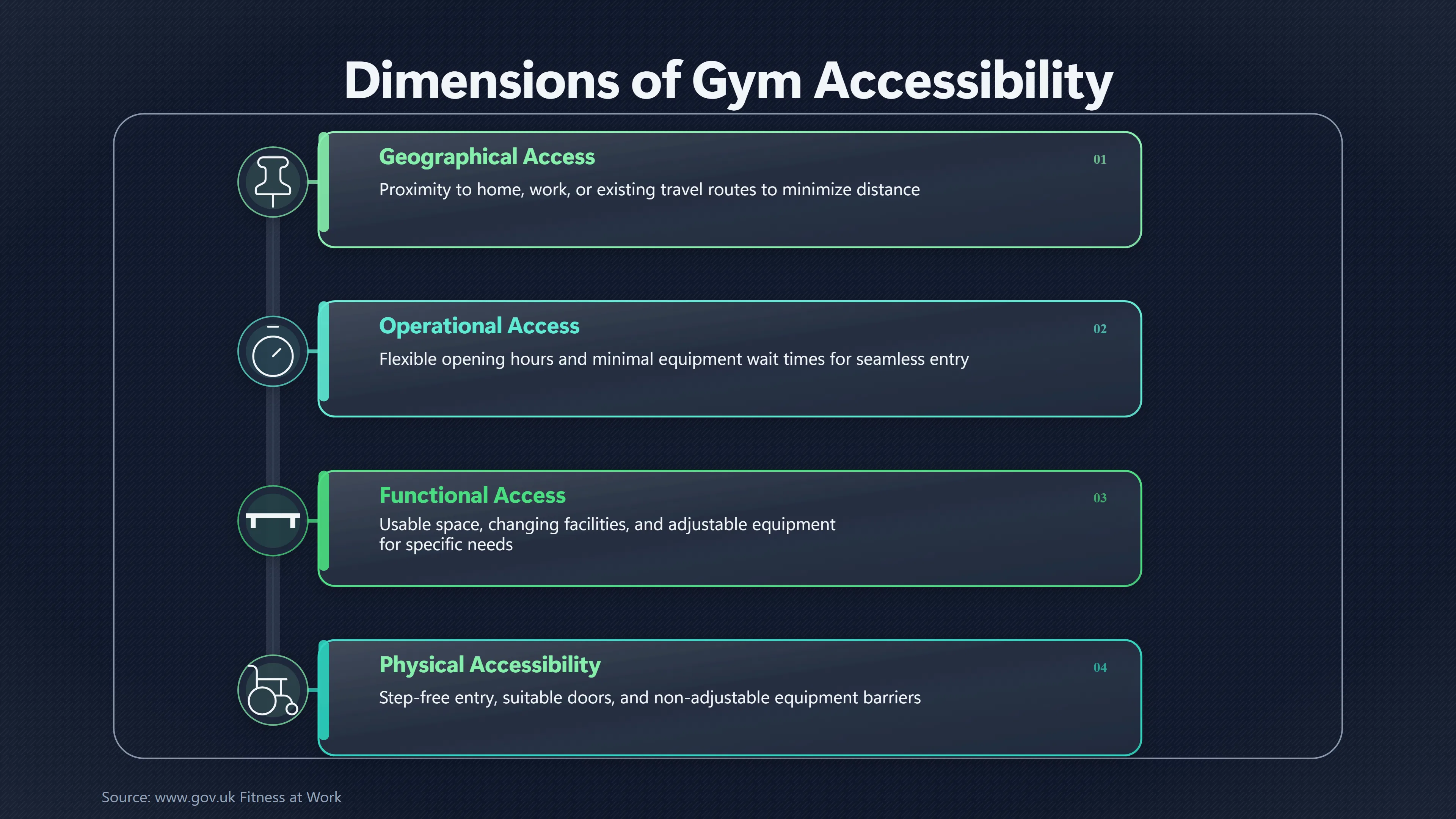
This makes convenience broader than mileage. A useful workout location has at least three kinds of accessibility:
- Geographical access: it is close to home, work or a journey already being made.
- Operational access: it is open when the person can realistically train, without excessive waiting or setup.
- Functional access: the space, changing facilities and necessary equipment can actually be used by that individual.
A facility can score well on one and badly on another. The gym 300 metres away is not especially convenient if its opening hours clash with work. A home workout is not frictionless if the equipment has to be excavated from a cupboard and furniture moved before every session.
There is also an important limit to the evidence. Research on the wider built environment does not show that simply putting recreational facilities closer to everybody automatically increases activity. A European systematic review found no consistent relationship between access to recreational facilities and several physical-activity domains, while a US review of objectively measured activity and park proximity found positive, null and mixed results.[PubMed Central (PMC)]pmc.ncbi.nlm.nih.govPubMed Central (PMC)Relationship between the physical environment and different domains of physical activity in European adults: a system… More recent built-environment research likewise warns that studies differ considerably in how both environmental access and physical activity are measured.[Springer]link.springer.comObjectively measuring the association between the built environment and physical activity: a systematic review and reporting fram…
So proximity should be treated as a friction-reducing opportunity, not a causal guarantee. People still have to use what is nearby.
When the less impressive gym is the better choice
Consider two otherwise suitable gyms. Gym A is a ten-minute walk from work and lies directly on the journey home. Gym B has better machines, more classes and a swimming pool, but requires a 25-minute drive in the opposite direction.
If somebody reliably uses Gym B, its extra facilities may justify the journey. But for a person whose main failure point is getting started, Gym A has an important advantage: fewer things must go right before training begins. Leaving work can flow directly into walking to the gym. There is less opportunity for a delayed meeting, traffic, bad weather, an errand or the temptation to sit down at home to derail the session.
This is the practical significance of fitness-centre research identifying both easy access and flexible opening hours as facilitators.[PubMed Central (PMC)]pmc.ncbi.nlm.nih.govOpen source on nih.gov. It also fits the wider built-environment literature, although that evidence should not be overstated. A systematic review concerned with causal evidence found that greater proximity and a greater mixture of destinations generally supported physical activity, and noted longitudinal evidence in which moving to an area with more recreational facilities was associated with changes in moderate-to-vigorous activity. The authors nevertheless emphasised the difficulty of establishing causality because people partly choose environments that suit their existing preferences.[PubMed Central (PMC)]pmc.ncbi.nlm.nih.govPubMed Central (PMC)In search of causality: a systematic review of the relationship between the built environment and physical activity a…
For older adults, the environmental signal is somewhat clearer. A systematic review and meta-analysis of 100 articles found positive associations between physical activity and several environmental features, including recreational facilities, overall access to destinations, walkability and public transport.[PubMed]pubmed.ncbi.nlm.nih.govBuilt environmental correlates of older adults' total physical activity and walking: a systematic review and meta-analysis - PubMed… An umbrella review published later reached a broadly compatible conclusion but stressed that much of the underlying evidence remained cross-sectional, meaning association should not be mistaken for proof that adding a nearby facility causes a particular person to exercise.[PubMed Central (PMC)]pmc.ncbi.nlm.nih.govPubMed Central (PMC)An Umbrella Review of the Best and Most Up-to-Date Evidence on the Built Environment and Physical Activity in Older A…
The sensible comparison, then, is not “cheap gym versus premium gym” or even “near versus far” in isolation. It is total usable value after friction is included. When choosing between plausible locations, ask which one is easiest to use during the actual week:
Count the whole journey. Compare door-to-door time, not just kilometres. Include parking, public-transport connections, changing and the return trip.
Look for route compatibility. A facility between work and home may impose less behavioural cost than an equally distant facility requiring a special journey.
Check the hours you will really use. A nearby gym that closes before your likely workout window has poor practical accessibility.
Inspect the bottleneck equipment. Twenty machines you never use do not compensate for persistent queues at the two pieces of equipment your programme requires.
Test the inconvenient day. Imagine rain, tiredness, a late meeting or only 35 spare minutes. The location that still permits some exercise under those conditions has a meaningful advantage.
This is why paying for an impressive facility can sometimes be a false economy. The unused features are irrelevant if the journey suppresses attendance. Conversely, convenience is not always decisive: supervision, social support and structured sessions can make a centre worth travelling to.
An older randomised trial illustrates that counterweight. In the S.W.E.A.T. study, 126 previously sedentary women aged 40–65 were allocated to centre- or home-based programmes. Contrary to the assumption that home must be easier to sustain, the initially centre-based group achieved higher six-month adherence (84% versus 63%) and better retention over the 18-month study. The centre provided supervision and structure that convenience alone could not reproduce.[PubMed]pubmed.ncbi.nlm.nih.govOpen source on nih.gov.
Location therefore should not be optimised in isolation. The better choice is the lowest-friction setting that still supplies the ingredients you personally need to continue — perhaps equipment, instruction, accessibility, other people or simply a pleasant environment.
Home can remove the commute — but not every barrier
Home is the extreme case of geographical convenience. There is no journey, opening time or queue at reception. A session can begin immediately, and short bouts become possible in gaps too small to accommodate a return trip to a gym.
There is experimental evidence that immediate equipment access can matter. In a notable 1999 JAMA randomised trial, 148 sedentary women in an 18-month behavioural weight-management programme were assigned to long exercise bouts, multiple short bouts, or short bouts with a treadmill supplied at home. During months 13–18, the home-equipment group maintained a higher level of exercise than either of the other groups. The researchers concluded that access to home equipment facilitated maintenance of the short-bout programme.[JAMA Network]jamanetwork.comOpen source on jamanetwork.com.
The result is especially useful because the treadmill changed more than the workout itself. It changed availability. Walking for exercise no longer depended entirely on leaving home and finding an appropriate external setting. Yet the trial should not be generalised into a claim that everybody needs a treadmill: it involved a particular population, incorporated an extensive behavioural programme, and is now more than two decades old. Its enduring lesson is narrower — placing the means of exercise where it can be used immediately can alter participation.
Recent small feasibility studies show how far that idea has developed. An eight-week home programme delivered by tablet to 20 independently living adults aged 65 or over reported 95% retention and mean adherence of 84%.[PubMed Central (PMC)]pmc.ncbi.nlm.nih.govOpen source on nih.gov. Another 12-week feasibility study involving 15 older adults living alone used voice-controlled technology to deliver short home exercise sessions; all completed the study and recorded high programme adherence. These small uncontrolled studies cannot establish that home delivery is superior to a gym, but they demonstrate that a usable home setting can support structured exercise rather than merely improvised activity.[PubMed Central (PMC)]pmc.ncbi.nlm.nih.govOpen source on nih.gov.
The crucial word, however, is usable. A pair of dumbbells hidden behind luggage in a cupboard is geographically close but behaviourally distant. Every recurring setup step recreates friction inside the home.
A practical home exercise space therefore does not need to resemble a commercial gym. It needs to make the first useful movement immediately available. That might mean a mat already accessible beside a desk, adjustable dumbbells beside a clear patch of floor, resistance bands hanging where they are visible, or a stationary bicycle that does not double as clothes storage. Where space is tight, equipment can still live in one dedicated container rather than being scattered across several rooms.
The design test is simple: how many actions separate the decision to exercise from the first repetition? If the answer involves moving a coffee table, finding a mat, searching for bands, charging a device and choosing a video, the commute has disappeared but a miniature preparation ritual has replaced it.
Convenience should survive real life
The strongest version of a convenient workout location is not necessarily the absolute closest one. It is the location whose advantages remain intact when ordinary complications appear.
That means examining the whole system rather than a map pin. Someone who works from home might benefit most from equipment that is permanently ready in the next room. A commuter might do better with a gym at the railway station, even if another facility is technically closer to home. Someone who needs specialist equipment or supervision may reasonably accept more travel because the nearest alternatives are not functionally equivalent. For a wheelchair user, step-free entry, usable changing facilities and suitable machines may matter more than a small difference in distance. Research on fitness-centre accessibility makes clear that transportation, building design and equipment usability can compound rather than operate separately.[PubMed]pubmed.ncbi.nlm.nih.govThe accessibility of fitness centers for people with disabilities: A systematic review - PubMedMay 24, 2018…
There is also no need to demand one perfect location for every workout. A useful arrangement can have a default location and a lower-friction fallback: the nearby gym for normal training and a small home setup when travel would cause the session to disappear altogether. The point is not to make every workout identical. It is to prevent location and setup demands from turning an otherwise feasible session into a task that is too cumbersome to start.
This fits the broader evidence better than the slogan “always choose the nearest gym”. Built-environment studies show that accessible destinations and recreational opportunities can support physical activity, but effects differ by population, activity type and study design.[Springer]link.springer.comObjectively measuring the association between the built environment and physical activity: a systematic review and reporting fram… Fitness-centre research adds the more immediately useful behavioural detail: travel time, opening hours, physical accessibility, equipment and the character of the facility all affect whether “access” exists in practice.[PubMed Central (PMC)]pmc.ncbi.nlm.nih.govOpen source on nih.gov.
For self-improvement that has to survive months rather than a burst of motivation, that distinction matters. A workout location is not merely the backdrop to an exercise routine. It determines how much work has to happen before the workout can even begin. The best location is therefore often not the most impressive place you could exercise, but the sufficiently good place that makes exercising an ordinary, reachable part of the day.

Amazon book picks
Further Reading
Books and field guides related to Is the Best Gym Simply the One You Will Reach?. Use these as the next step if you want deeper reading beyond the article.
No Sweat
Do you secretly hate exercising? Struggle to stick with a program? Millions of people try and fail to stay fit. But what if "exercising"...
Built to Move
INSTANT NEW YORK TIMES BEST SELLER • Simple but powerful physical practices to dramatically improve the way your body feels and prolong y...
Atomic Habits
Rating: 3.5/5 from 7 Google Books ratings
The #1 New York Times bestseller. Over 25 million copies sold! Translated into 60+ languages! Tiny Changes, Remarkable Results No matter...
The One Minute Workout
We all know we should exercise more – but many of us just don’t have time. The current NHS guidelines advise 150 minutes of moderate exer...
eBay marketplace picks
Marketplace Samples
Live-tested eBay searches with available results related to this page.
Selected fromfitness poster oneBay.co.uk.
Endnotes
1.
Source: link.springer.com
Link:https://link.springer.com/article/10.1186/s12966-022-01352-7
Source snippet
Objectively measuring the association between the built environment and physical activity: a systematic review and reporting fram...
2.
Source: link.springer.com
Link:https://link.springer.com/article/10.1186/s12966
3.
Source: link.springer.com
Link:https://link.springer.com/article/10.1186/s12966-025-01753-4
4.
Source: link.springer.com
Link:https://link.springer.com/article/10.1007/s10882-025-10016-w
5.
Source: link.springer.com
Link:https://link.springer.com/article/10.1186/s12889-022-14444-7
6.
Source: link.springer.com
Link:https://link.springer.com/article/10.1186/s12942-019-0166-z
7.
Source: link.springer.com
Link:https://link.springer.com/article/10.1186/s12966
8.
Source: link.springer.com
Link:https://link.springer.com/article/10.1186/1471
9.
Source: link.springer.com
Link:https://link.springer.com/article/10.1007/s11556
10.
Source: link.springer.com
Link:https://link.springer.com/article/10.1007/s10198
11.
Source: link.springer.com
Link:https://link.springer.com/article/10.1186/1479
12.
Source: pmc.ncbi.nlm.nih.gov
Link:https://pmc.ncbi.nlm.nih.gov/articles/PMC8304633/
13.
Source: pubmed.ncbi.nlm.nih.gov
Link:https://pubmed.ncbi.nlm.nih.gov/29936142/
Source snippet
The accessibility of fitness centers for people with disabilities: A systematic review - PubMedMay 24, 2018...
Published: May 24, 2018
14.
Source: pmc.ncbi.nlm.nih.gov
Link:https://pmc.ncbi.nlm.nih.gov/articles/PMC3507898/
Source snippet
PubMed Central (PMC)Relationship between the physical environment and different domains of physical activity in European adults: a system...
15.
Source: pmc.ncbi.nlm.nih.gov
Link:https://pmc.ncbi.nlm.nih.gov/articles/PMC3306205/
Source snippet
PubMed Central (PMC)In search of causality: a systematic review of the relationship between the built environment and physical activity a...
16.
Source: pubmed.ncbi.nlm.nih.gov
Link:https://pubmed.ncbi.nlm.nih.gov/28784183/
Source snippet
Built environmental correlates of older adults' total physical activity and walking: a systematic review and meta-analysis - PubMed...
17.
Source: pmc.ncbi.nlm.nih.gov
Link:https://pmc.ncbi.nlm.nih.gov/articles/PMC10037345/
Source snippet
PubMed Central (PMC)An Umbrella Review of the Best and Most Up-to-Date Evidence on the Built Environment and Physical Activity in Older A...
18.
Source: pubmed.ncbi.nlm.nih.gov
Link:https://pubmed.ncbi.nlm.nih.gov/12473421/
19.
Source: jamanetwork.com
Link:https://jamanetwork.com/journals/jama/fullarticle/192033
20.
Source: pubmed.ncbi.nlm.nih.gov
Link:https://pubmed.ncbi.nlm.nih.gov/10546695/
21.
Source: pmc.ncbi.nlm.nih.gov
Link:https://pmc.ncbi.nlm.nih.gov/articles/PMC7840282/
22.
Source: pmc.ncbi.nlm.nih.gov
Link:https://pmc.ncbi.nlm.nih.gov/articles/PMC12275629/
23.
Source: pubmed.ncbi.nlm.nih.gov
Link:https://pubmed.ncbi.nlm.nih.gov/35067710/
24.
Source: pubmed.ncbi.nlm.nih.gov
Link:https://pubmed.ncbi.nlm.nih.gov/41330359/
25.
Source: pmc.ncbi.nlm.nih.gov
Link:https://pmc.ncbi.nlm.nih.gov/articles/PMC12380975/
26.
Source: pmc.ncbi.nlm.nih.gov
Link:https://pmc.ncbi.nlm.nih.gov/articles/PMC12183869/
27.
Source: pubmed.ncbi.nlm.nih.gov
Link:https://pubmed.ncbi.nlm.nih.gov/40479773/
28.
Source: pmc.ncbi.nlm.nih.gov
Link:https://pmc.ncbi.nlm.nih.gov/articles/PMC11830679/
29.
Source: pubmed.ncbi.nlm.nih.gov
Link:https://pubmed.ncbi.nlm.nih.gov/40131764/
30.
Source: pmc.ncbi.nlm.nih.gov
Link:https://pmc.ncbi.nlm.nih.gov/articles/PMC12392820/
31.
Source: pmc.ncbi.nlm.nih.gov
Link:https://pmc.ncbi.nlm.nih.gov/articles/PMC10904198/
32.
Source: pubmed.ncbi.nlm.nih.gov
Link:https://pubmed.ncbi.nlm.nih.gov/38335945/
33.
Source: pubmed.ncbi.nlm.nih.gov
Link:https://pubmed.ncbi.nlm.nih.gov/37883059/
34.
Source: pmc.ncbi.nlm.nih.gov
Link:https://pmc.ncbi.nlm.nih.gov/articles/PMC9841711/
35.
Source: pmc.ncbi.nlm.nih.gov
Link:https://pmc.ncbi.nlm.nih.gov/articles/PMC9641919/
36.
Source: pubmed.ncbi.nlm.nih.gov
Link:https://pubmed.ncbi.nlm.nih.gov/36344975/
37.
Source: pmc.ncbi.nlm.nih.gov
Link:https://pmc.ncbi.nlm.nih.gov/articles/PMC9566024/
38.
Source: pubmed.ncbi.nlm.nih.gov
Link:https://pubmed.ncbi.nlm.nih.gov/36081385/
39.
Source: pmc.ncbi.nlm.nih.gov
Link:https://pmc.ncbi.nlm.nih.gov/articles/PMC9367711/
40.
Source: pmc.ncbi.nlm.nih.gov
Link:https://pmc.ncbi.nlm.nih.gov/articles/PMC9233333/
41.
Source: pmc.ncbi.nlm.nih.gov
Link:https://pmc.ncbi.nlm.nih.gov/articles/PMC9344112/
42.
Source: pmc.ncbi.nlm.nih.gov
Link:https://pmc.ncbi.nlm.nih.gov/articles/PMC8900522/
43.
Source: pmc.ncbi.nlm.nih.gov
Link:https://pmc.ncbi.nlm.nih.gov/articles/PMC8626598/
44.
Source: pmc.ncbi.nlm.nih.gov
Link:https://pmc.ncbi.nlm.nih.gov/articles/PMC8631444/
45.
Source: pmc.ncbi.nlm.nih.gov
Link:https://pmc.ncbi.nlm.nih.gov/articles/PMC10233647/
46.
Source: pmc.ncbi.nlm.nih.gov
Link:https://pmc.ncbi.nlm.nih.gov/articles/PMC8607248/
47.
Source: pubmed.ncbi.nlm.nih.gov
Link:https://pubmed.ncbi.nlm.nih.gov/34333371/
48.
Source: pmc.ncbi.nlm.nih.gov
Link:https://pmc.ncbi.nlm.nih.gov/articles/PMC7678125/
49.
Source: pmc.ncbi.nlm.nih.gov
Link:https://pmc.ncbi.nlm.nih.gov/articles/PMC7551110/
50.
Source: pmc.ncbi.nlm.nih.gov
Link:https://pmc.ncbi.nlm.nih.gov/articles/PMC7488407/
51.
Source: pmc.ncbi.nlm.nih.gov
Link:https://pmc.ncbi.nlm.nih.gov/articles/PMC7395376/
52.
Source: pubmed.ncbi.nlm.nih.gov
Link:https://pubmed.ncbi.nlm.nih.gov/32738916/
53.
Source: pmc.ncbi.nlm.nih.gov
Link:https://pmc.ncbi.nlm.nih.gov/articles/PMC7305624/
54.
Source: pubmed.ncbi.nlm.nih.gov
Link:https://pubmed.ncbi.nlm.nih.gov/32182278/
55.
Source: pubmed.ncbi.nlm.nih.gov
Link:https://pubmed.ncbi.nlm.nih.gov/31505300/
56.
Source: pubmed.ncbi.nlm.nih.gov
Link:https://pubmed.ncbi.nlm.nih.gov/31588417/
57.
Source: pubmed.ncbi.nlm.nih.gov
Link:https://pubmed.ncbi.nlm.nih.gov/31162919/
58.
Source: ncbi.nlm.nih.gov
Link:https://www.ncbi.nlm.nih.gov/books/NBK541945/
59.
Source: pmc.ncbi.nlm.nih.gov
Link:https://pmc.ncbi.nlm.nih.gov/articles/PMC6677841/
60.
Source: pmc.ncbi.nlm.nih.gov
Link:https://pmc.ncbi.nlm.nih.gov/articles/PMC6878109/
61.
Source: pmc.ncbi.nlm.nih.gov
Link:https://pmc.ncbi.nlm.nih.gov/articles/PMC6352429/
62.
Source: pubmed.ncbi.nlm.nih.gov
Link:https://pubmed.ncbi.nlm.nih.gov/31534816/
63.
Source: pubmed.ncbi.nlm.nih.gov
Link:https://pubmed.ncbi.nlm.nih.gov/29721838/
64.
Source: pmc.ncbi.nlm.nih.gov
Link:https://pmc.ncbi.nlm.nih.gov/articles/PMC6011385/
65.
Source: pmc.ncbi.nlm.nih.gov
Link:https://pmc.ncbi.nlm.nih.gov/articles/PMC6241630/
66.
Source: GOV.UK
Title: www.gov.uk Fitness at Work
Link:https://www.gov.uk/guidance/fitness-at-work
67.
Source: pmc.ncbi.nlm.nih.gov
Link:https://pmc.ncbi.nlm.nih.gov/articles/PMC5981936/
68.
Source: pubmed.ncbi.nlm.nih.gov
Link:https://pubmed.ncbi.nlm.nih.gov/29653900/
69.
Source: pubmed.ncbi.nlm.nih.gov
Link:https://pubmed.ncbi.nlm.nih.gov/29477950/
70.
Source: pmc.ncbi.nlm.nih.gov
Link:https://pmc.ncbi.nlm.nih.gov/articles/PMC5365378/
71.
Source: pmc.ncbi.nlm.nih.gov
Link:https://pmc.ncbi.nlm.nih.gov/articles/PMC5712314/
72.
Source: pmc.ncbi.nlm.nih.gov
Link:https://pmc.ncbi.nlm.nih.gov/articles/PMC5927093/
73.
Source: pmc.ncbi.nlm.nih.gov
Link:https://pmc.ncbi.nlm.nih.gov/articles/PMC4979148/
74.
Source: pubmed.ncbi.nlm.nih.gov
Link:https://pubmed.ncbi.nlm.nih.gov/27293890/
75.
Source: pubmed.ncbi.nlm.nih.gov
Link:https://pubmed.ncbi.nlm.nih.gov/26303347/
76.
Source: pmc.ncbi.nlm.nih.gov
Link:https://pmc.ncbi.nlm.nih.gov/articles/PMC4172973/
77.
Source: pmc.ncbi.nlm.nih.gov
Link:https://pmc.ncbi.nlm.nih.gov/articles/PMC4119420/
78.
Source: pubmed.ncbi.nlm.nih.gov
Link:https://pubmed.ncbi.nlm.nih.gov/24730752/
79.
Source: pmc.ncbi.nlm.nih.gov
Link:https://pmc.ncbi.nlm.nih.gov/articles/PMC3968093/
80.
Source: pubmed.ncbi.nlm.nih.gov
Link:https://pubmed.ncbi.nlm.nih.gov/24675689/
81.
Source: pubmed.ncbi.nlm.nih.gov
Link:https://pubmed.ncbi.nlm.nih.gov/24411504/
82.
Source: pubmed.ncbi.nlm.nih.gov
Link:https://pubmed.ncbi.nlm.nih.gov/23922717/
83.
Source: pubmed.ncbi.nlm.nih.gov
Link:https://pubmed.ncbi.nlm.nih.gov/23781907/
84.
Source: pubmed.ncbi.nlm.nih.gov
Link:https://pubmed.ncbi.nlm.nih.gov/23618111/
85.
Source: ncbi.nlm.nih.gov
Link:https://www.ncbi.nlm.nih.gov/books/NBK114683/
86.
Source: pubmed.ncbi.nlm.nih.gov
Link:https://pubmed.ncbi.nlm.nih.gov/22992438/
87.
Source: pmc.ncbi.nlm.nih.gov
Link:https://pmc.ncbi.nlm.nih.gov/articles/PMC3359721/
88.
Source: pmc.ncbi.nlm.nih.gov
Link:https://pmc.ncbi.nlm.nih.gov/articles/PMC2733105/
89.
Source: pmc.ncbi.nlm.nih.gov
Link:https://pmc.ncbi.nlm.nih.gov/articles/PMC3091349/
90.
Source: pmc.ncbi.nlm.nih.gov
Link:https://pmc.ncbi.nlm.nih.gov/articles/PMC1832127/
91.
Source: pubmed.ncbi.nlm.nih.gov
Link:https://pubmed.ncbi.nlm.nih.gov/16911871/
92.
Source: pmc.ncbi.nlm.nih.gov
Link:https://pmc.ncbi.nlm.nih.gov/articles/PMC1557534/
93.
Source: pubmed.ncbi.nlm.nih.gov
Link:https://pubmed.ncbi.nlm.nih.gov/17767899/
94.
Source: pubmed.ncbi.nlm.nih.gov
Link:https://pubmed.ncbi.nlm.nih.gov/26466435/
95.
Source: pubmed.ncbi.nlm.nih.gov
Link:https://pubmed.ncbi.nlm.nih.gov/2108465/
96.
Source: pmc.ncbi.nlm.nih.gov
Link:https://pmc.ncbi.nlm.nih.gov/articles/PMC1805017/
97.
Source: pubmed.ncbi.nlm.nih.gov
Link:https://pubmed.ncbi.nlm.nih.gov/17533066/
98.
Source: pubmed.ncbi.nlm.nih.gov
Link:https://pubmed.ncbi.nlm.nih.gov/17533065/
99.
Source: pubmed.ncbi.nlm.nih.gov
Link:https://pubmed.ncbi.nlm.nih.gov/16627126/
100.
Source: pmc.ncbi.nlm.nih.gov
Link:https://pmc.ncbi.nlm.nih.gov/articles/PMC1551946/
101.
Source: pubmed.ncbi.nlm.nih.gov
Link:https://pubmed.ncbi.nlm.nih.gov/16355081/
102.
Source: ncbi.nlm.nih.gov
Link:https://www.ncbi.nlm.nih.gov/books/NBK114684/
103.
Source: pubmed.ncbi.nlm.nih.gov
Link:https://pubmed.ncbi.nlm.nih.gov/19285216/
104.
Source: pubmed.ncbi.nlm.nih.gov
Link:https://pubmed.ncbi.nlm.nih.gov/22217568/
105.
Source: pubmed.ncbi.nlm.nih.gov
Link:https://pubmed.ncbi.nlm.nih.gov/25203058/
106.
Source: pubmed.ncbi.nlm.nih.gov
Link:https://pubmed.ncbi.nlm.nih.gov/12460528/
107.
Source: ausport.gov.au
Link:https://www.ausport.gov.au/clearinghouse/evidence/women-in-sport/factors/facilities
Additional References
108.
Source: mdpi.com
Link:https://www.mdpi.com/1660-4601/18/14/7341
Source snippet
Barriers to, and Facilitators of, Exercising in Fitness Centres among Adults with and without Physical Disabilities: A Scoping Review...
109.
Source: sciencedirect.com
Link:https://www.sciencedirect.com/science/article/pii/S0277953615003160
Source snippet
Association of proximity and density of parks and objectively measured physical activity in the United States: A systematic...
110.
Source: youtube.com
Title: How I Designed My Environment for Success (Stop Relying on Willpower)
Link:https://www.youtube.com/watch?v=xttbEouW0pM
Source snippet
In 5 Science-Backed Cheat Codes to Stay Consistent With Your Workouts, behavioral science concepts and [environment design]({{ 'design-around-temptation/' | relative_url }}) strategies are...
111.
Source: youtube.com
Title: 5 Science-Backed Cheat Codes to Stay Consistent With Your Workouts
Link:https://www.youtube.com/watch?v=q5k1XUzg7yo
Source snippet
Best Ways to Build Better Habits & Break Bad Ones | James Clear...
112.
Source: youtube.com
Title: Best Ways to Build Better Habits & Break Bad Ones | James Clear
Link:https://www.youtube.com/watch?v=bdsc3Spm6Sw
Source snippet
Home Gym vs Gym Membership — Which Is ACTUALLY Worth It?...
113.
Source: researchgate.net
Link:https://www.researchgate.net/publication/280688333_Built_Environment_and_Physical_Activity_for_Adults_GIS_Templates_and_Variable_Naming_Conventions
114.
Source: researchgate.net
Link:https://www.researchgate.net/publication/51127337_Geographic_Determinants_of_Healthy_Lifestyle_Change_in_a_Community-Based_Exercise_Prescription_Delivered_in_Family_Practice
115.
Source: sciencedirect.com
Link:https://www.sciencedirect.com/science/article/abs/pii/S1526590024003699
116.
Source: doi.org
Link:https://doi.org/10.1186/s12966-024-01582-x
117.
Source: tandfonline.com
Link:https://www.tandfonline.com/doi/full/10.1080/14927713.2024.2437414