Within Track Progress
Do Objective Trackers Help People Sit Less?
Trials of sedentary-behaviour programmes found clearer short-term effects when monitoring used objective tools and targeted sitting directly.
On this page
- What the sedentary behaviour meta analysis found
- Objective monitoring versus less direct tracking
- Why matching the tracker to the target behaviour matters
Page outline Jump by section
Introduction
Objective trackers appear to help people sit less, at least in the short term, and the most revealing evidence comes from trials that treated sitting itself as the behaviour to change. A 2019 systematic review and meta-analysis of adult interventions found that programmes incorporating self-monitoring reduced total sedentary time by roughly 34 minutes a day more than control conditions. More importantly for progress tracking, the benefit was concentrated in studies using objective monitoring devices rather than subjective self-recording.[PubMed Central (PMC)]pmc.ncbi.nlm.nih.govOpen source on nih.gov.
That distinction makes sedentary behaviour a useful test case for self-improvement. Sitting is repetitive, easily overlooked and surprisingly difficult to reconstruct from memory. A sensor can make an otherwise largely automatic behaviour visible while there is still time to change it. But the evidence does not show that simply wearing any activity tracker reliably solves the problem. The clearest results came when the measurement matched the target: track sitting if the goal is to sit less.
What the sedentary-behaviour meta-analysis found
The key dataset is Sofie Compernolle and colleagues’ 2019 review in the International Journal of Behavioral Nutrition and Physical Activity. The researchers examined interventions in adults that deliberately used self-monitoring to reduce sedentary behaviour. Nineteen intervention studies involving 2,800 participants met the review’s eligibility criteria.[PubMed Central (PMC)]pmc.ncbi.nlm.nih.govOpen source on nih.gov.
Across the relevant studies, self-monitoring interventions produced a statistically significant reduction in total sedentary time, with a standardised effect size of Hedges’ g = 0.32 (95% confidence interval 0.14 to 0.50). Expressed in a more intuitive unit, the intervention groups reduced their total sedentary time by an average of 34.37 minutes per day more than control groups. For occupational sedentary time, the pooled standardised effect was larger, g = 0.56, although its confidence interval was considerably wider. The interventions did not produce a significant overall effect on the number of breaks in sedentary behaviour.[PubMed Central (PMC)]pmc.ncbi.nlm.nih.govOpen source on nih.gov.
The headline result is useful, but the subgroup comparisons are more informative for someone deciding how to track progress. The researchers tested whether results differed according to factors including intervention duration, age, health status, the purpose of the monitoring tool and whether monitoring was subjective or objective. The method of self-monitoring was the only statistically significant moderator of total sedentary-time effects.[PubMed Central (PMC)]pmc.ncbi.nlm.nih.govOpen source on nih.gov.
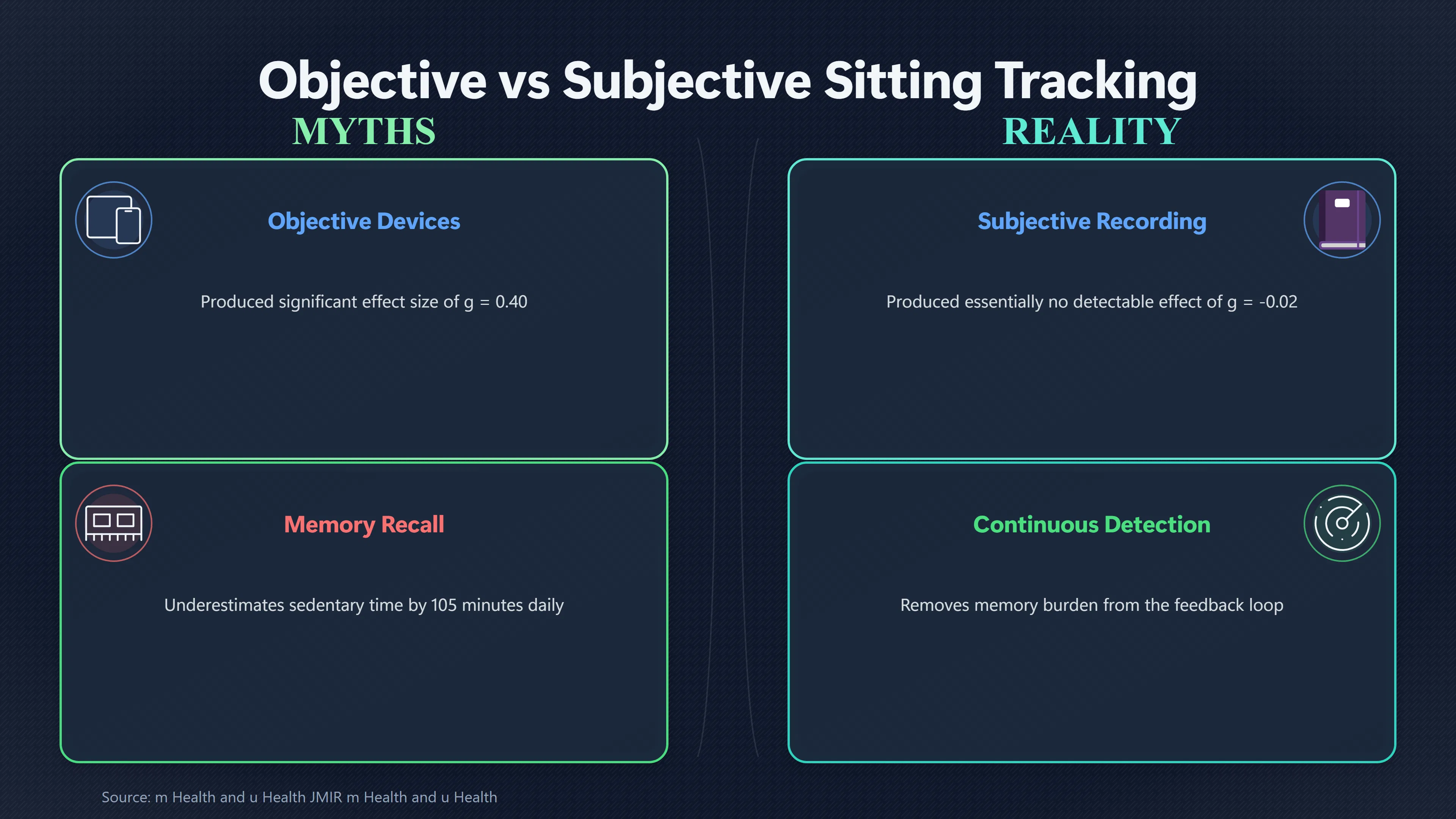
Interventions using objective self-monitoring devices produced a significant effect of g = 0.40 (95% CI 0.19 to 0.60). Interventions relying on subjective monitoring produced essentially no detectable effect: g = −0.02 (95% CI −0.29 to 0.26). The difference between these subgroups was itself statistically significant.[PubMed Central (PMC)]pmc.ncbi.nlm.nih.govOpen source on nih.gov.
That is a much more specific finding than saying that “tracking works”. In these trials, automatically measured behavioural feedback was associated with clearer short-term reductions in sitting than asking people to monitor the behaviour subjectively.
There was a second revealing comparison. Programmes focused only on sedentary behaviour had a significant effect of g = 0.45 (95% CI 0.15 to 0.75), whereas programmes simultaneously targeting sedentary behaviour and physical activity had a smaller effect that did not reach statistical significance. The difference between those categories was suggestive rather than conclusive—the moderator test had a p-value of 0.09—but it points in the same practical direction: tightly defining the behaviour may make feedback easier to act upon.[PubMed Central (PMC)]pmc.ncbi.nlm.nih.govOpen source on nih.gov.
Objective monitoring versus less direct tracking
“Objective tracker” did not mean one standardised gadget. The interventions in the review used a varied collection of technologies, including the Gruve, Lumoback, Jawbone Up24, Fitbit One, Garmin Vivofit 2, SitFIT, a Shimmer accelerometer paired with a smartphone application and a sensor-equipped Darma cushion. Other studies used pedometers, while subjective approaches included logbooks and questionnaires. Intervention periods ranged from one week to one year.[Springer]link.springer.comEffectiveness of interventions using self-monitoring to reduce sedentary behavior in adults: a systematic review and meta-analysi…
The important distinction is therefore not a particular brand. It is the difference between requiring someone to estimate and record their behaviour and having a device continuously detect relevant movement or posture and turn it into feedback.
That matters unusually strongly for sitting. A person can probably remember whether they went for a run this morning. Reconstructing every period spent sitting across an entire working day is another problem. A large systematic review comparing self-report with device measurement illustrates the scale of that difficulty. Across 123 studies and more than 55,000 participants, self-report measures underestimated overall sedentary time by an average of about 105 minutes per day compared with device measures. Results varied substantially between instruments, and better-designed diaries and questionnaires performed better than simple single-item estimates, but recall was clearly an imperfect substitute for direct measurement.[PubMed]pubmed.ncbi.nlm.nih.govA comparison of self-reported and device measured sedentary behaviour in adults: a systematic review and meta-analysis - PubMedMarc…
That does not prove that measurement accuracy caused the stronger behavioural effects in Compernolle’s meta-analysis. It does, however, provide a plausible explanation. Objective monitoring can remove some of the memory and estimation burden from the feedback loop. Instead of asking, “How much do I think I sat today?”, the user can respond to a recorded pattern of sitting as it accumulates.
Some interventions made that feedback particularly immediate. The SitFIT feasibility trial, for example, tested a pocket-worn monitor that gave sedentary men real-time information about either sedentary or upright time alongside their step counts. Participants generally regarded it as practical and motivating. The study was small—only 40 men—and was designed for feasibility rather than a definitive test of effectiveness, so its modest changes should not be overinterpreted. It nevertheless demonstrates what behaviour-specific monitoring looks like in practice: the tracker exposes the behaviour during everyday life rather than asking for a retrospective estimate.[BMJ Open Seminars]bmjopensem.bmj.comBMJ Open SeminarsFeasibility of a real-time self-monitoring device for sitting less and moving more: a randomised controlled trial | BMJ…
Another example comes from the SMArT Work workplace intervention. Participants received baseline feedback from a thigh-worn activPAL monitor showing sitting, prolonged sitting, standing and stepping. They then set goals specifically around sitting less. A sensor-equipped cushion could provide continuing sitting-time feedback and vibrate after a user-selected period of prolonged sitting. At 12 months, the intervention group sat 83 minutes less during work hours per day than the control group.[BMJ]bmj.comEffectiveness of the Stand More AT (SMArT) Work intervention: cluster randomised controlled trial | The BMJOctober 10, 2018…
That trial should not be read as evidence that the tracker alone caused an 83-minute reduction. SMArT Work was deliberately multicomponent: it also included education, goal setting, action planning, coaching and changes to the workplace, including height-adjustable desks or desk platforms. It is better understood as an example of how objective measurement can sit inside a broader feedback-and-action system.[BMJ]bmj.comEffectiveness of the Stand More AT (SMArT) Work intervention: cluster randomised controlled trial | The BMJOctober 10, 2018…
Why matching the tracker to the target behaviour matters
A conventional activity tracker can tell someone that they took 8,000 steps. That is useful if their goal is to walk more. It does not necessarily answer a different question: did they spend too much of the remaining day sitting?
The distinction sounds minor but is central to the sedentary-behaviour evidence. Someone can accumulate substantial physical activity and still spend long periods sedentary. A tracker or dashboard dominated by steps therefore provides only indirect feedback on a sit-less goal. In Compernolle and colleagues’ review, some devices were principally physical-activity tools, whereas others were designed specifically to expose sedentary behaviour. The review did not find the tool’s primary purpose to be a statistically significant moderator by itself, so the evidence does not justify claiming that every specialist sitting sensor beats every general activity tracker.[Springer]link.springer.comEffectiveness of interventions using self-monitoring to reduce sedentary behavior in adults: a systematic review and meta-analysi…
What was clearer was the advantage associated with objective rather than subjective monitoring, together with the stronger results among interventions concentrating specifically on sedentary behaviour. The practical lesson is consequently narrower: the progress signal should be as close as possible to the behaviour the person intends to change.
For a sit-less goal, useful feedback might therefore include total sitting time, prolonged sitting bouts or accumulated upright time rather than relying only on step counts or exercise minutes. The purpose is not to collect more data. It is to make the relevant discrepancy visible: “I intended to sit less, and this is how much I actually sat.”
A small Scottish pilot provides a concrete illustration. Twenty-four older adults received an individual consultation built around their own activPAL measurements. Rather than working from a generic estimate of inactivity, they could see their recorded sedentary pattern and discuss ways to change it. Objectively measured sitting/lying subsequently fell by 24 minutes per day, while stepping increased by 13 minutes per day. Because this was a one-group feasibility study rather than a controlled efficacy trial, those changes cannot securely be attributed to the feedback itself, but the design demonstrates the principle of turning personal behavioural data into a specific target for action.[PubMed]pubmed.ncbi.nlm.nih.govOpen source on nih.gov.
A tracker is feedback, not the whole intervention
The strongest caution in the 2019 meta-analysis is easy to miss. None of its interventions isolated self-monitoring perfectly. Programmes commonly combined monitoring with other behaviour-change techniques, such as goal setting, prompts, education, action planning, problem solving or social support. The review therefore could not establish that the tracker itself caused the observed reduction in sedentary time.[PubMed Central (PMC)]pmc.ncbi.nlm.nih.govOpen source on nih.gov.
Individual trials reinforce that warning. In the STAND programme for adults at risk of type 2 diabetes, participants received education plus a Gruve waist-worn accelerometer that showed sedentary and activity levels and could vibrate after prolonged inactivity. Despite that sophisticated feedback loop, the trial found no significant change in sedentary behaviour at 12 months.[PubMed Central (PMC)]pmc.ncbi.nlm.nih.govOpen source on nih.gov.
Similarly, a later four-week intervention in older adults found that an objective self-monitoring system increased awareness but did not significantly reduce objectively measured sitting time. Participants often described the feedback as motivating or interesting, yet some explicitly reported a change in how they thought about sitting without a corresponding change in what they did.[JMIR mHealth and uHealth]mhealth.jmir.orgm Health and u Health JMIR m Health and u Healthm Health and u Health JMIR m Health and u Health
This distinction is important for progress tracking generally. Awareness is an intermediate outcome, not the goal. A tracker may accurately reveal six, eight or ten hours of sitting, but the number still has to trigger an alternative behaviour: standing during a call, leaving the chair between tasks, changing workstation position or otherwise interrupting the routine.
There is also a durability problem. A separate meta-analysis of technology-assisted sedentary-behaviour interventions found an average reduction of about 41 minutes per day, but effects were substantially stronger at short and medium follow-up than beyond six months. The estimated pooled reduction was approximately 42 minutes a day at three months or less, 37 minutes between three and six months, but only 1.65 minutes beyond six months. Most studies also had high or unclear risk of bias.[PubMed Central (PMC)]pmc.ncbi.nlm.nih.govOpen source on nih.gov.
So objective tracking should not be treated as a permanent source of motivation. Its more defensible role is to provide timely, behaviour-specific feedback that can support decisions and goal adjustment.
What this case says about progress tracking
Sedentary-behaviour trials offer an unusually concrete demonstration of what makes tracking useful for follow-through. The strongest finding is not that more measurement is always better. It is that monitoring becomes more promising when it reduces ambiguity about the exact behaviour a person is trying to change.
For sitting, objective devices have several advantages: they can record behaviour without depending on memory, reveal patterns that would otherwise pass unnoticed and, in some systems, provide feedback while a prolonged bout is still happening. The 2019 meta-analysis found a meaningful short-term effect for objective self-monitoring while finding no detectable effect for subjective monitoring, and it also found clearer reductions when programmes concentrated specifically on sedentary behaviour.[PubMed Central (PMC)]pmc.ncbi.nlm.nih.govOpen source on nih.gov.
But those findings remain promising rather than definitive. The studies were heterogeneous, many were small, interventions bundled tracking with other techniques, and longer-term evidence is less convincing. A tracker can expose a discrepancy between a goal and actual behaviour; it cannot guarantee that the person will respond to it.[PubMed Central (PMC)]pmc.ncbi.nlm.nih.govOpen source on nih.gov.
For self-improvement, that produces a useful design rule: measure the behaviour you actually intend to change, make the feedback easy to interpret, and connect it to an action you can take now. If the aim is to sit less, an objective record of sitting is a more direct progress signal than a vague recollection of being active—or an impressive step count that never answers the sitting question.
Amazon book picks
Further Reading
Books and field guides related to Do Objective Trackers Help People Sit Less?. Use these as the next step if you want deeper reading beyond the article.
Built to Move
INSTANT NEW YORK TIMES BEST SELLER • Simple but powerful physical practices to dramatically improve the way your body feels and prolong y...
Move Your DNA
A new expanded edition of the bestselling Move Your DNA. Now with an exercise glossary and three-level exercise program! Accessible and f...
The Power of Habit
Rating: 4.0/5 from 145 Google Books ratings
Duhigg takes us to the edge of scientific discoveries that explain why habits exist and how they can be changed. Distilling information i...
The Joy of Movement
The bestselling author of The Willpower Instinct introduces a surprising science-based book that doesn't tell us why we should exercise b...
eBay marketplace picks
Marketplace Samples
Example marketplace items related to this page. Use the search link to explore similar finds on eBay.
Selected fromgoal tracking board oneBay.co.uk.

Endnotes
1.
Source: link.springer.com
Link:https://link.springer.com/article/10.1186/s12966
Source snippet
Effectiveness of interventions using self-monitoring to reduce sedentary behavior in adults: a systematic review and meta-analysi...
2.
Source: link.springer.com
Link:https://link.springer.com/article/10.1186/s12966-020-00938-3
Source snippet
A comparison of self-reported and device measured sedentary behaviour in adults: a systematic review and meta-analysis | Internat...
3.
Source: bmjopensem.bmj.com
Link:https://bmjopensem.bmj.com/content/3/1/e000285
Source snippet
BMJ Open SeminarsFeasibility of a real-time self-monitoring device for sitting less and moving more: a randomised controlled trial | BMJ...
4.
Source: bmj.com
Link:https://www.bmj.com/content/363/bmj.k3870
Source snippet
Effectiveness of the Stand More AT (SMArT) Work intervention: cluster randomised controlled trial | The BMJOctober 10, 2018...
Published: October 10, 2018
5.
Source: link.springer.com
Link:https://link.springer.com/article/10.1186/s12889
6.
Source: mhealth.jmir.org
Title: m Health and u Health JMIR m Health and u Health
Link:https://mhealth.jmir.org/2020/10/e18653/
7.
Source: jmir.org
Title: Journal of Medical Internet Research
Link:https://www.jmir.org/2026/1/e79677/
8.
Source: mhealth.jmir.org
Link:https://mhealth.jmir.org/2025/1/e59943/
9.
Source: cancer.jmir.org
Link:https://cancer.jmir.org/2021/2/e18819/
10.
Source: link.springer.com
Link:https://link.springer.com/article/10.1186/s12966-020-00972-1
11.
Source: link.springer.com
Link:https://link.springer.com/article/10.1186/s12966-020-00957-0
12.
Source: link.springer.com
Link:https://link.springer.com/article/10.1186/s12966
13.
Source: bmjopen.bmj.com
Link:https://bmjopen.bmj.com/content/7/4/e013844
14.
Source: link.springer.com
Link:https://link.springer.com/article/10.1186/1477
15.
Source: bjsm.bmj.com
Link:https://bjsm.bmj.com/content/55/8/422
16.
Source: bjsm.bmj.com
Link:https://bjsm.bmj.com/content/56/23/1366
17.
Source: pmc.ncbi.nlm.nih.gov
Link:https://pmc.ncbi.nlm.nih.gov/articles/PMC6693254/
18.
Source: pubmed.ncbi.nlm.nih.gov
Link:https://pubmed.ncbi.nlm.nih.gov/31409357/
19.
Source: pubmed.ncbi.nlm.nih.gov
Link:https://pubmed.ncbi.nlm.nih.gov/32131845/
Source snippet
A comparison of self-reported and device measured sedentary behaviour in adults: a systematic review and meta-analysis - PubMedMarc...
20.
Source: pmc.ncbi.nlm.nih.gov
Link:https://pmc.ncbi.nlm.nih.gov/articles/PMC6174726/
Source snippet
PubMed Central (PMC)Effectiveness of the Stand More AT (SMArT) Work intervention: cluster randomised controlled trial - PMC...
21.
Source: pubmed.ncbi.nlm.nih.gov
Link:https://pubmed.ncbi.nlm.nih.gov/23891853/
22.
Source: pmc.ncbi.nlm.nih.gov
Link:https://pmc.ncbi.nlm.nih.gov/articles/PMC5237565/
23.
Source: pmc.ncbi.nlm.nih.gov
Link:https://pmc.ncbi.nlm.nih.gov/articles/PMC5553917/
24.
Source: pubmed.ncbi.nlm.nih.gov
Link:https://pubmed.ncbi.nlm.nih.gov/28800736/
25.
Source: pmc.ncbi.nlm.nih.gov
Link:https://pmc.ncbi.nlm.nih.gov/articles/PMC13147802/
26.
Source: pubmed.ncbi.nlm.nih.gov
Link:https://pubmed.ncbi.nlm.nih.gov/40554804/
27.
Source: pubmed.ncbi.nlm.nih.gov
Link:https://pubmed.ncbi.nlm.nih.gov/40340833/
28.
Source: pmc.ncbi.nlm.nih.gov
Link:https://pmc.ncbi.nlm.nih.gov/articles/PMC11574415/
29.
Source: pubmed.ncbi.nlm.nih.gov
Link:https://pubmed.ncbi.nlm.nih.gov/39551583/
30.
Source: pmc.ncbi.nlm.nih.gov
Link:https://pmc.ncbi.nlm.nih.gov/articles/PMC10729557/
31.
Source: ncbi.nlm.nih.gov
Link:https://www.ncbi.nlm.nih.gov/books/NBK595279/?report=printable
32.
Source: pmc.ncbi.nlm.nih.gov
Link:https://pmc.ncbi.nlm.nih.gov/articles/PMC8423252/
33.
Source: pmc.ncbi.nlm.nih.gov
Link:https://pmc.ncbi.nlm.nih.gov/articles/PMC8329761/
34.
Source: pmc.ncbi.nlm.nih.gov
Link:https://pmc.ncbi.nlm.nih.gov/articles/PMC8087341/
35.
Source: pmc.ncbi.nlm.nih.gov
Link:https://pmc.ncbi.nlm.nih.gov/articles/PMC7539442/
36.
Source: pmc.ncbi.nlm.nih.gov
Link:https://pmc.ncbi.nlm.nih.gov/articles/PMC7294635/
37.
Source: pubmed.ncbi.nlm.nih.gov
Link:https://pubmed.ncbi.nlm.nih.gov/32539720/
38.
Source: pmc.ncbi.nlm.nih.gov
Link:https://pmc.ncbi.nlm.nih.gov/articles/7055033/
39.
Source: pmc.ncbi.nlm.nih.gov
Link:https://pmc.ncbi.nlm.nih.gov/articles/PMC7055033/
40.
Source: pmc.ncbi.nlm.nih.gov
Link:https://pmc.ncbi.nlm.nih.gov/articles/PMC6926609/
41.
Source: pmc.ncbi.nlm.nih.gov
Link:https://pmc.ncbi.nlm.nih.gov/articles/PMC6484266/
42.
Source: pubmed.ncbi.nlm.nih.gov
Link:https://pubmed.ncbi.nlm.nih.gov/30957508/
43.
Source: pmc.ncbi.nlm.nih.gov
Link:https://pmc.ncbi.nlm.nih.gov/articles/PMC6499358/
44.
Source: pubmed.ncbi.nlm.nih.gov
Link:https://pubmed.ncbi.nlm.nih.gov/30723663/
45.
Source: pubmed.ncbi.nlm.nih.gov
Link:https://pubmed.ncbi.nlm.nih.gov/30352864/
46.
Source: pmc.ncbi.nlm.nih.gov
Link:https://pmc.ncbi.nlm.nih.gov/articles/PMC6164528/
47.
Source: pubmed.ncbi.nlm.nih.gov
Link:https://pubmed.ncbi.nlm.nih.gov/29980329/
48.
Source: pmc.ncbi.nlm.nih.gov
Link:https://pmc.ncbi.nlm.nih.gov/articles/PMC5917078/
49.
Source: pmc.ncbi.nlm.nih.gov
Link:https://pmc.ncbi.nlm.nih.gov/articles/PMC5840779/
50.
Source: pmc.ncbi.nlm.nih.gov
Link:https://pmc.ncbi.nlm.nih.gov/articles/PMC5856932/
51.
Source: pubmed.ncbi.nlm.nih.gov
Link:https://pubmed.ncbi.nlm.nih.gov/29500158/
52.
Source: pubmed.ncbi.nlm.nih.gov
Link:https://pubmed.ncbi.nlm.nih.gov/29434012/
53.
Source: pmc.ncbi.nlm.nih.gov
Link:https://pmc.ncbi.nlm.nih.gov/articles/PMC5826980/
54.
Source: pmc.ncbi.nlm.nih.gov
Link:https://pmc.ncbi.nlm.nih.gov/articles/PMC5997558/
55.
Source: pmc.ncbi.nlm.nih.gov
Link:https://pmc.ncbi.nlm.nih.gov/articles/PMC5630153/
56.
Source: pubmed.ncbi.nlm.nih.gov
Link:https://pubmed.ncbi.nlm.nih.gov/28391233/
57.
Source: pmc.ncbi.nlm.nih.gov
Link:https://pmc.ncbi.nlm.nih.gov/articles/PMC5097432/
58.
Source: pubmed.ncbi.nlm.nih.gov
Link:https://pubmed.ncbi.nlm.nih.gov/27814738/
59.
Source: pubmed.ncbi.nlm.nih.gov
Link:https://pubmed.ncbi.nlm.nih.gov/27226457/
60.
Source: pmc.ncbi.nlm.nih.gov
Link:https://pmc.ncbi.nlm.nih.gov/articles/PMC4909392/
61.
Source: pmc.ncbi.nlm.nih.gov
Link:https://pmc.ncbi.nlm.nih.gov/articles/PMC4871995/
62.
Source: pmc.ncbi.nlm.nih.gov
Link:https://pmc.ncbi.nlm.nih.gov/articles/PMC4666612/
63.
Source: pmc.ncbi.nlm.nih.gov
Link:https://pmc.ncbi.nlm.nih.gov/articles/PMC4306870/
64.
Source: pubmed.ncbi.nlm.nih.gov
Link:https://pubmed.ncbi.nlm.nih.gov/25568971/
65.
Source: pmc.ncbi.nlm.nih.gov
Link:https://pmc.ncbi.nlm.nih.gov/articles/PMC4233995/
66.
Source: pmc.ncbi.nlm.nih.gov
Link:https://pmc.ncbi.nlm.nih.gov/articles/PMC4228472/
67.
Source: pubmed.ncbi.nlm.nih.gov
Link:https://pubmed.ncbi.nlm.nih.gov/24168638/
68.
Source: pmc.ncbi.nlm.nih.gov
Link:https://pmc.ncbi.nlm.nih.gov/articles/PMC3262766/
69.
Source: ncbi.nlm.nih.gov
Link:https://www.ncbi.nlm.nih.gov/books/NBK595279/?report=reader
Additional References
70.
Source: d-nb.info
Link:https://d-nb.info/1202281265/34
Source snippet
Deutsche NationalbibliothekEffectiveness of interventions using self-monitoring to reduce sedentary behavior in adults: a systematic revi...
71.
Source: research.ed.ac.uk
Link:https://www.research.ed.ac.uk/en/publications/feasibility-of-a-real-time-self-monitoring-device-for-sitting-les/
Source snippet
University of Edinburgh ResearchFeasibility of a real-time self-monitoring device for sitting less and moving more: A randomised controll...
72.
Source: youtube.com
Title: Dr Neville Owen
Link:https://www.youtube.com/watch?v=mbJZ_t5Bbd0
Source snippet
For a direct breakdown of how posture-allocating devices and wearable sensors measure sitting posture versus general physical activity, e...
73.
Source: youtube.com
Link:https://www.youtube.com/watch?v=3O0INfPFLck
Source snippet
Data Analysis for Sedentary Behavior: Interpreting Measurement Techniques...
74.
Source: youtube.com
Title: Data Analysis for Sedentary Behavior: Interpreting Measurement Techniques
Link:https://www.youtube.com/watch?v=VETr3Oums5o
Source snippet
Fibion vs. ActivPAL: Validity of Sedentary Behaviour Measurements...
75.
Source: youtube.com
Title: The Best Accelerometers and Activity Trackers for Research
Link:https://www.youtube.com/watch?v=Hnb1Sh8tiWQ
Source snippet
Accelerometer-Measured Sedentary Behavior & Risk of Future Cardiovascular Disease...
76.
Source: youtube.com
Title: Fibion vs. Activ PAL: Validity of Sedentary Behaviour Measurements
Link:https://www.youtube.com/watch?v=SdgOiH1ShBc
Source snippet
Dr Neville Owen - PA | SB | Measurement | Mechanisms | Interventions...
77.
Source: researchgate.net
Link:https://www.researchgate.net/publication/335156630_Effectiveness_of_interventions_using_self-monitoring_to_reduce_sedentary_behavior_in_adults_A_systematic_review_and_meta-analysis
78.
Source: researchgate.net
Link:https://www.researchgate.net/publication/354449924_Effects_of_a_three-armed_randomised_controlled_trial_using_self-monitoring_of_daily_steps_with_and_without_counselling_in_prediabetes_and_type_2_diabetes-the_Sophia_Step_Study
79.
Source: researchgate.net
Link:https://www.researchgate.net/publication/354425605_Efficacy_characteristics_behavioural_models_and_behaviour_change_strategies_of_non-workplace_interventions_specifically_targeting_sedentary_behaviour_a_systematic_review_and_meta-analysis_of_randomise