Within Motivation Limits
Why Exercise Intentions So Often Stay Intentions
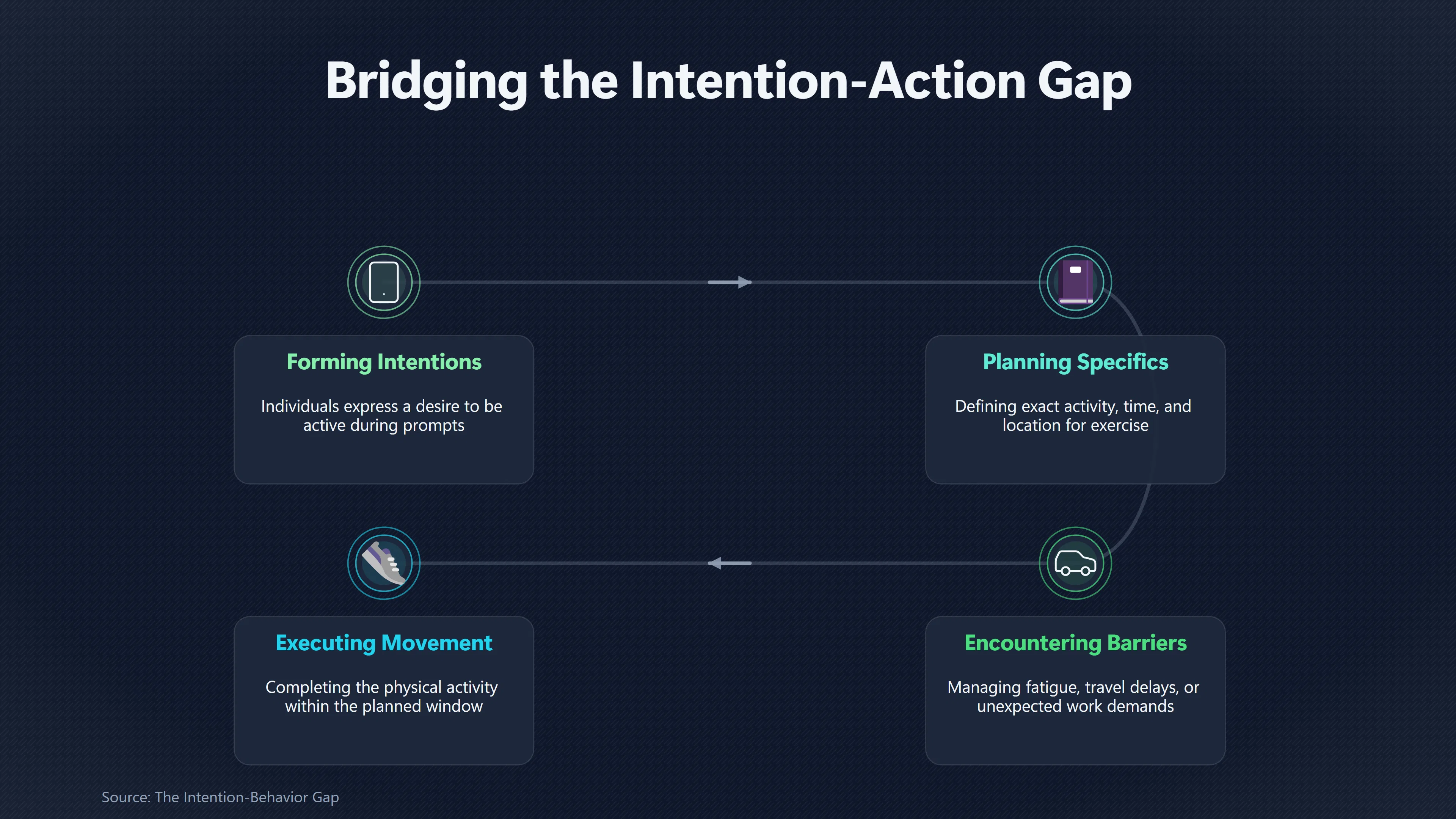
Daily-life studies show that intending to exercise often fails to produce activity when the actual opportunity to act arrives.
On this page
- What momentary activity studies found
- Where intention breaks down before action
- What improves the odds of follow through
Page outline Jump by section
Introduction
A sincere intention to exercise is not the same thing as exercising when the opportunity actually arrives. Studies that repeatedly ask people about their intentions during ordinary days, then measure what they do over the next few hours, make this gap unusually visible. In one accelerometer study, adults reported short-term intentions to be active at 41% of prompts, yet completed at least ten minutes of moderate-to-vigorous physical activity after only 16% of the prompts where they had intended to act.[PubMed Central (PMC)]pmc.ncbi.nlm.nih.govPubMed Central (PMC)Momentary assessment of physical activity intention-behavior coupling in adults - PMC…
That finding should not be read as a universal 84% failure rate. Other momentary studies have produced substantially smaller gaps, partly because they define intentions, activity and successful follow-through differently. The stronger conclusion is simpler: intention predicts exercise, but does not guarantee its enactment even over the next few hours. The practical problem in self-improvement is therefore not merely creating enough motivation. It is making an intended action sufficiently specific, feasible and resilient to survive the moment in which it must begin.
What momentary activity studies found
Much of the traditional intention–behaviour literature asks whether somebody who intends to be physically active now is active days, weeks or months later. Ecological momentary assessment (EMA) changes the question. Participants receive repeated smartphone prompts during normal life, report what they intend to do over the near future, and researchers then examine activity during the following hours. This allows the same person to supply many intention–action episodes rather than being classified simply as a generally motivated or unmotivated individual.
The distinction matters because exercise is enacted one occasion at a time. A person may have a strong general commitment to becoming fitter while repeatedly encountering individual moments in which today’s intended walk, run or gym visit does not happen. Across longer-term physical-activity research, a 2023 systematic review covering 25 independent samples and 29,600 participants classified 33.0% of all participants as unsuccessful intenders and 38.7% as successful intenders. Among people who intended to be active, the estimated intention–behaviour gap was 47.6%.[PubMed]pubmed.ncbi.nlm.nih.govThe intention-behaviour gap in physical activity: a systematic review and meta-analysis of the action control framework - PubMedJul… Momentary research shows what that broad statistical gap can look like during everyday life.
A particularly revealing study by Jaclyn Maher and colleagues followed 116 low-active adults through three four-day EMA periods. Participants reported near-term physical-activity intentions and wore accelerometers; the researchers looked for at least ten minutes of moderate-to-vigorous physical activity (MVPA) during the three hours following each prompt. Short-term intentions were reported at 41% of prompts, but qualifying activity followed just 16% of occasions on which an intention had been reported. By that deliberately strict definition, 84% of intention episodes were not followed by the measured activity criterion.[PubMed Central (PMC)]pmc.ncbi.nlm.nih.govPubMed Central (PMC)Momentary assessment of physical activity intention-behavior coupling in adults - PMC…
The study also exposed an important distinction between forming an intention and enacting it. Participants were more likely to intend to be active in the morning and at weekends, but time of day and weekday versus weekend did not significantly predict whether an already-formed intention became activity. In other words, circumstances associated with saying “I will exercise” were not necessarily the same circumstances associated with actually doing it.[PubMed Central (PMC)]pmc.ncbi.nlm.nih.govPubMed Central (PMC)Momentary assessment of physical activity intention-behavior coupling in adults - PMC…
An EMA study of women aged 40–60 with elevated cardiovascular-disease risk found an even more striking mismatch under its own measurement rules. Participants received five smartphone surveys per day for ten days while wearing accelerometers. They achieved their exercise intentions on only 13% of occasions on which intentions were set, and the within-person association between intended minutes of MVPA and observed MVPA during the following three hours was modest.[PubMed Central (PMC)]pmc.ncbi.nlm.nih.govOpen source on nih.gov.
These figures are not interchangeable. A later three-week EMA study of 35 adults, based on 2,341 completed prompts, reported that intentions were not enacted in about 25% of relevant episodes — a much smaller short-term gap. Its authors suggested that intentions formed close to the opportunity for action may sometimes be easier to fulfil because people can take immediate circumstances into account.[ScienceDirect]sciencedirect.comWithin-person association of volitional factors and physical activity: Insights from an ecological momentary assessment stud…
The apparent disagreement is useful rather than troublesome. “I intended to exercise but did not” depends on exactly what counts as an intention, how soon behaviour is assessed, what intensity or duration qualifies as exercise, whether activity is self-reported or objectively recorded, and who is being studied. The momentary literature therefore does not justify attaching one universal percentage to failed exercise intentions. It does justify treating the intention–action transition as a measurable behavioural event rather than assuming that motivation automatically carries a person across it.
Where intention breaks down before action
Momentary studies help separate two questions that ordinary resolutions tend to blur: Do I want to exercise? and Will I initiate exercise in this particular situation? An intention answers the first much better than the second.
One reason is that a general intention leaves operational details unresolved. “I want to exercise this afternoon” still permits several decisions at the critical moment: when exactly to start, what activity to do, where to do it, how long to continue, and what to do if work runs late or another demand intervenes. Evidence from the 2,341-prompt EMA study is consistent with this interpretation. When participants already had an intention, the probability of subsequent activity was higher on occasions when their plans were more specific and their self-efficacy — their confidence that they could perform the behaviour — was stronger. Intrinsic motivation was also positively associated with enactment; planning specificity and intrinsic motivation predicted greater activity duration and intensity as well.[PubMed]pubmed.ncbi.nlm.nih.govWithin-person association of volitional factors and physical activity: Insights from an ecological momentary assessment study - Pub…
Momentary emotional state can matter too, although the evidence is not uniform enough to reduce follow-through to “being in a good mood”. In Maher and colleagues’ study, an intention was more likely to be followed by measured activity when a participant’s positive affect was higher than was usual for that same person. The estimated odds of enactment were more than twice as high on those higher-positive-affect occasions. Negative affect, fatigue and energy did not show equivalent significant associations with intention enactment in that analysis.[PubMed Central (PMC)]pmc.ncbi.nlm.nih.govPubMed Central (PMC)Momentary assessment of physical activity intention-behavior coupling in adults - PMC…
The midlife-women study likewise found that the strength of the intention–activity relationship varied with momentary positive affect and body satisfaction.[PubMed Central (PMC)]pmc.ncbi.nlm.nih.govOpen source on nih.gov. These findings illustrate why a person’s average motivation can conceal the important part of the story. Someone can be “motivated to exercise” in a questionnaire while the probability of acting on Tuesday at 6 pm differs from the probability of acting on Saturday morning.
More recent EMA evidence adds a useful qualification. A study of 41 adults surveyed four times daily for three weeks found that feeling happy, active or energetic was associated with forming physical-activity intentions, while tiredness and anticipated contextual barriers made intention formation less likely. Yet once the researchers modelled subsequent behaviour, intention itself was the significant precursor; the measured affective states and contextual barriers did not independently predict activity.[PubMed]pubmed.ncbi.nlm.nih.govOpen source on nih.gov. The emerging picture is therefore not a neat chain in which one mood or barrier reliably explains every missed workout. Intention formation and intention enactment appear to be partly distinct processes, and predictors can differ between studies and populations.
That is the key limit of treating motivation as the whole explanation. A missed exercise episode need not mean that the earlier intention was insincere. Between “I will do it” and the start of movement lies an action-control problem: translating a prospective decision into behaviour under the conditions that actually exist when action becomes possible.

What improves the odds of follow-through
The momentary evidence points most consistently towards reducing what remains undecided at the point of action. In practical terms, specific planning is more useful than merely repeating the desired outcome. “Exercise tomorrow” leaves the initiation problem largely intact; specifying an activity, time and setting gives the intention a recognisable opportunity for execution.
Evidence beyond the small EMA datasets supports that direction, while also showing that planning is not magic. A systematic review and meta-analysis of planning interventions identified 41 randomised trials involving 5,439 participants, with 35 trials entering its quantitative synthesis. Physical activity was higher in planning-intervention groups, with a standardised mean difference of 0.35. Action-planning interventions and interventions reinforced during follow-up showed stronger effects in subgroup analyses.[PubMed Central (PMC)]pmc.ncbi.nlm.nih.govOpen source on nih.gov.
Implementation intentions are a related technique: a person links a specified situation to a specified response — essentially deciding in advance what they will do when a cue or opportunity occurs. A systematic review of 24 studies concluded that their effectiveness depends partly on the person already having an intention and sufficient self-efficacy; the technique is better understood as helping an existing intention reach behaviour than as creating motivation from nothing.[PubMed]pubmed.ncbi.nlm.nih.govOpen source on nih.gov.
There are also important null results. In a randomised field experiment involving 877 gym members, asking participants to choose the days and times they intended to attend during the following two weeks did not increase attendance. Participants engaged with the exercise and generally believed planning was useful, yet the simple planning intervention produced a tightly estimated null effect.[PubMed Central (PMC)]pmc.ncbi.nlm.nih.govOpen source on nih.gov. An earlier meta-analysis of implementation-intention trials similarly found no statistically significant overall effect when all studies were combined, while the subgroup in which implementation intentions were reinforced during follow-up did show a positive effect.[PubMed Central (PMC)]pmc.ncbi.nlm.nih.govOpen source on nih.gov.
That qualification is important for self-improvement advice. Writing “gym, Wednesday, 6 pm” does not eliminate tiredness, travel delays, childcare, an unexpectedly long meeting or the temptation to remain on the sofa. A plan can make the desired response easier to identify without making every obstacle disappear.
The momentary evidence suggests three especially defensible ways to strengthen the bridge from intention to action:
- Make the immediate plan concrete. Specify what activity will happen, where and at roughly what opportunity. In momentary data, greater planning specificity accompanies a higher likelihood that an existing intention becomes activity.[ScienceDirect]sciencedirect.comWithin-person association of volitional factors and physical activity: Insights from an ecological momentary assessment stud…
- Plan for foreseeable disruption, not only the ideal scenario. Planning research distinguishes action plans from coping plans that anticipate obstacles and alternative responses. Reviews indicate that planning can improve physical activity, but effectiveness varies and may benefit from reinforcement rather than a single one-off planning exercise.[PubMed Central (PMC)]pmc.ncbi.nlm.nih.govOpen source on nih.gov.
- Treat confidence and feasibility as part of the intention. Momentary self-efficacy predicts better enactment, and a broader review of implementation intentions found stronger benefits among people who already wanted to be active and believed they could perform the behaviour.[PubMed]pubmed.ncbi.nlm.nih.govWithin-person association of volitional factors and physical activity: Insights from an ecological momentary assessment study - Pub…
None of these findings makes motivation irrelevant. Across 92 empirical studies and 47,548 participants, a 2025 meta-analysis still found a moderate positive relationship between exercise intention and exercise behaviour.[PubMed Central (PMC)]pmc.ncbi.nlm.nih.govOpen source on nih.gov. The more precise lesson is that motivation and execution answer different questions. Wanting to exercise makes exercise more likely; it does not settle whether a particular intention survives contact with the particular moment in which it must be enacted.
For self-improvement that has to work repeatedly rather than occasionally, that distinction changes the target. Instead of interpreting every missed workout as evidence that the goal was not wanted badly enough, the more useful question is what remained unresolved between intending and starting. Momentary exercise studies show that this transition can fail within only a few hours — and that specificity, confidence and preparation for the actual opportunity to act can improve the odds of getting across it.
Amazon book picks
Further Reading
Books and field guides related to Why Exercise Intentions So Often Stay Intentions. Use these as the next step if you want deeper reading beyond the article.
Atomic Habits
Rating: 3.5/5 from 7 Google Books ratings
The #1 New York Times bestseller. Over 25 million copies sold! Translated into 60+ languages! Tiny Changes, Remarkable Results No matter...
Tiny Habits
Improving your life is much easier than you think. Whether it’s losing weight, sleeping more, or restoring your work/life balance – the s...
No Sweat
Do you secretly hate exercising? Struggle to stick with a program? Millions of people try and fail to stay fit. But what if "exercising"...
Spark
A groundbreaking and fascinating investigation into the transformative effects of exercise on the brain, from the bestselling author and...
eBay marketplace picks
Marketplace Samples
Live-tested eBay searches with available results related to this page.
Selected fromfitness motivation t shirt oneBay.co.uk.



Endnotes
1.
Source: sciencedirect.com
Link:https://www.sciencedirect.com/science/article/pii/S1469029223000699
Source snippet
Within-person association of volitional factors and physical activity: Insights from an ecological momentary assessment stud...
2.
Source: sciencedirect.com
Link:https://www.sciencedirect.com/science/article/pii/S1469029224002073
3.
Source: sciencedirect.com
Link:https://www.sciencedirect.com/science/article/pii/S1440244014006239
4.
Source: sciencedirect.com
Link:https://www.sciencedirect.com/science/article/pii/S0277953617304598
5.
Source: sciencedirect.com
Link:https://www.sciencedirect.com/science/article/abs/pii/S1469029223000699
6.
Source: sciencedirect.com
Link:https://www.sciencedirect.com/science/article/pii/S1469029222000061
7.
Source: sciencedirect.com
Link:https://www.sciencedirect.com/science/article/abs/pii/S1469029222000061
8.
Source: sciencedirect.com
Link:https://www.sciencedirect.com/science/article/abs/pii/S1469029218307052
9.
Source: sciencedirect.com
Link:https://www.sciencedirect.com/science/article/pii/S1469029225000214
10.
Source: sciencedirect.com
Link:https://www.sciencedirect.com/science/article/pii/S146902922300047X
11.
Source: sciencedirect.com
Link:https://www.sciencedirect.com/science/article/abs/pii/S146902922300047X
12.
Source: sciencedirect.com
Link:https://www.sciencedirect.com/science/article/pii/S1469029210001299
13.
Source: pmc.ncbi.nlm.nih.gov
Link:https://pmc.ncbi.nlm.nih.gov/articles/PMC5684065/
Source snippet
PubMed Central (PMC)Momentary assessment of physical activity intention-behavior coupling in adults - PMC...
14.
Source: pubmed.ncbi.nlm.nih.gov
Link:https://pubmed.ncbi.nlm.nih.gov/28155108/
Source snippet
Momentary assessment of physical activity intention-behavior coupling in adults - PubMed...
15.
Source: pubmed.ncbi.nlm.nih.gov
Link:https://pubmed.ncbi.nlm.nih.gov/37460164/
Source snippet
The intention-behaviour gap in physical activity: a systematic review and meta-analysis of the action control framework - PubMedJul...
16.
Source: pmc.ncbi.nlm.nih.gov
Link:https://pmc.ncbi.nlm.nih.gov/articles/PMC9075694/
17.
Source: pubmed.ncbi.nlm.nih.gov
Link:https://pubmed.ncbi.nlm.nih.gov/35531355/
18.
Source: pubmed.ncbi.nlm.nih.gov
Link:https://pubmed.ncbi.nlm.nih.gov/37665897/
Source snippet
Within-person association of volitional factors and physical activity: Insights from an ecological momentary assessment study - Pub...
19.
Source: pubmed.ncbi.nlm.nih.gov
Link:https://pubmed.ncbi.nlm.nih.gov/39647677/
20.
Source: pmc.ncbi.nlm.nih.gov
Link:https://pmc.ncbi.nlm.nih.gov/articles/PMC9223740/
21.
Source: pubmed.ncbi.nlm.nih.gov
Link:https://pubmed.ncbi.nlm.nih.gov/35742582/
22.
Source: pubmed.ncbi.nlm.nih.gov
Link:https://pubmed.ncbi.nlm.nih.gov/31923898/
23.
Source: pmc.ncbi.nlm.nih.gov
Link:https://pmc.ncbi.nlm.nih.gov/articles/PMC7872013/
24.
Source: pubmed.ncbi.nlm.nih.gov
Link:https://pubmed.ncbi.nlm.nih.gov/30336306/
25.
Source: pmc.ncbi.nlm.nih.gov
Link:https://pmc.ncbi.nlm.nih.gov/articles/PMC6235272/
26.
Source: pmc.ncbi.nlm.nih.gov
Link:https://pmc.ncbi.nlm.nih.gov/articles/PMC12133765/
27.
Source: pubmed.ncbi.nlm.nih.gov
Link:https://pubmed.ncbi.nlm.nih.gov/40470022/
28.
Source: pmc.ncbi.nlm.nih.gov
Link:https://pmc.ncbi.nlm.nih.gov/articles/PMC13295560/
29.
Source: pmc.ncbi.nlm.nih.gov
Link:https://pmc.ncbi.nlm.nih.gov/articles/PMC12750492/
30.
Source: pubmed.ncbi.nlm.nih.gov
Link:https://pubmed.ncbi.nlm.nih.gov/39952422/
31.
Source: pubmed.ncbi.nlm.nih.gov
Link:https://pubmed.ncbi.nlm.nih.gov/39865572/
32.
Source: pubmed.ncbi.nlm.nih.gov
Link:https://pubmed.ncbi.nlm.nih.gov/39662424/
33.
Source: pubmed.ncbi.nlm.nih.gov
Link:https://pubmed.ncbi.nlm.nih.gov/38777385/
34.
Source: pmc.ncbi.nlm.nih.gov
Link:https://pmc.ncbi.nlm.nih.gov/articles/PMC10842154/
35.
Source: pmc.ncbi.nlm.nih.gov
Link:https://pmc.ncbi.nlm.nih.gov/articles/PMC11357741/
36.
Source: pubmed.ncbi.nlm.nih.gov
Link:https://pubmed.ncbi.nlm.nih.gov/37805039/
37.
Source: pmc.ncbi.nlm.nih.gov
Link:https://pmc.ncbi.nlm.nih.gov/articles/PMC10552305/
38.
Source: pubmed.ncbi.nlm.nih.gov
Link:https://pubmed.ncbi.nlm.nih.gov/35995541/
39.
Source: pubmed.ncbi.nlm.nih.gov
Link:https://pubmed.ncbi.nlm.nih.gov/35362807/
40.
Source: pubmed.ncbi.nlm.nih.gov
Link:https://pubmed.ncbi.nlm.nih.gov/35409564/
41.
Source: pmc.ncbi.nlm.nih.gov
Link:https://pmc.ncbi.nlm.nih.gov/articles/PMC8714894/
42.
Source: pubmed.ncbi.nlm.nih.gov
Link:https://pubmed.ncbi.nlm.nih.gov/31550923/
43.
Source: pmc.ncbi.nlm.nih.gov
Link:https://pmc.ncbi.nlm.nih.gov/articles/PMC6440859/
44.
Source: pubmed.ncbi.nlm.nih.gov
Link:https://pubmed.ncbi.nlm.nih.gov/30427874/
45.
Source: pmc.ncbi.nlm.nih.gov
Link:https://pmc.ncbi.nlm.nih.gov/articles/PMC5161656/
46.
Source: pubmed.ncbi.nlm.nih.gov
Link:https://pubmed.ncbi.nlm.nih.gov/26284314/
47.
Source: pubmed.ncbi.nlm.nih.gov
Link:https://pubmed.ncbi.nlm.nih.gov/26053885/?dopt=Abstract
48.
Source: pubmed.ncbi.nlm.nih.gov
Link:https://pubmed.ncbi.nlm.nih.gov/22468716/
49.
Source: pmc.ncbi.nlm.nih.gov
Link:https://pmc.ncbi.nlm.nih.gov/articles/PMC4137572/
50.
Source: pubmed.ncbi.nlm.nih.gov
Link:https://pubmed.ncbi.nlm.nih.gov/17553212/
51.
Source: pubmed.ncbi.nlm.nih.gov
Link:https://pubmed.ncbi.nlm.nih.gov/41467472/
52.
Source: pubmed.ncbi.nlm.nih.gov
Link:https://pubmed.ncbi.nlm.nih.gov/22262706/
53.
Source: pubmed.ncbi.nlm.nih.gov
Link:https://pubmed.ncbi.nlm.nih.gov/23121209/
Additional References
54.
Source: doi.org
Link:https://doi.org/10.1136%2Fbjsports-2022-106640
Source snippet
The intention-behaviour gap in physical activity: a systematic review and meta-analysis of the action control framework | British Jour...
55.
Source: youtube.com
Title: The Intention-Behavior Gap
Link:https://www.youtube.com/watch?v=ngVsSURs0oY
Source snippet
To understand the practical science of turning exercise plans into real-world behavior, check out Using action plans to promote exercise...
56.
Source: youtube.com
Link:https://www.youtube.com/watch?v=N7SDVVbxgNU
Source snippet
If People Can Change, Why Is It So Hard?...
57.
Source: youtube.com
Title: Using action plans to promote exercise adherence
Link:https://www.youtube.com/watch?v=GEBsCTed0B0
Source snippet
Implementation Intention Explained: How to DOUBLE YOUR SUCCESS with a Goal or Habit...
58.
Source: youtube.com
Title: If People Can Change, Why Is It So Hard?
Link:https://www.youtube.com/watch?v=N49EIgY2Jao
Source snippet
The Intention-Behavior Gap - Why You Can't Do What You Say You Want to Do...
59.
Source: youtube.com
Title: Psychology of People Who Plan Everything But Never Start
Link:https://www.youtube.com/watch?v=M1PTdqtNy1c
Source snippet
Using action plans to promote exercise adherence...
60.
Source: researchgate.net
Link:https://www.researchgate.net/publication/233472164_A_meta-analytic_review_of_the_effect_of_implementation_intentions_on_physical_activity
61.
Source: researchgate.net
Link:https://www.researchgate.net/publication/236036780_How_big_is_the_physical_activity_intention-behaviour_gap_A_meta-analysis_using_the_action_control_framework
62.
Source: researchgate.net
Link:https://www.researchgate.net/publication/372424600_The_intention-behaviour_gap_in_physical_activity_a_systematic_review_and_meta-analysis_of_the_action_control_framework
63.
Source: expedia.com.ph
Link:https://www.expedia.com.ph/things-to-do/3-hour-small-group-cebu-city-tour.a2147560.activity-details?location=Cordova&rid=6130563&swp=off