Within Scale Up
Why Scaling Works Better When Cues Stay Stable
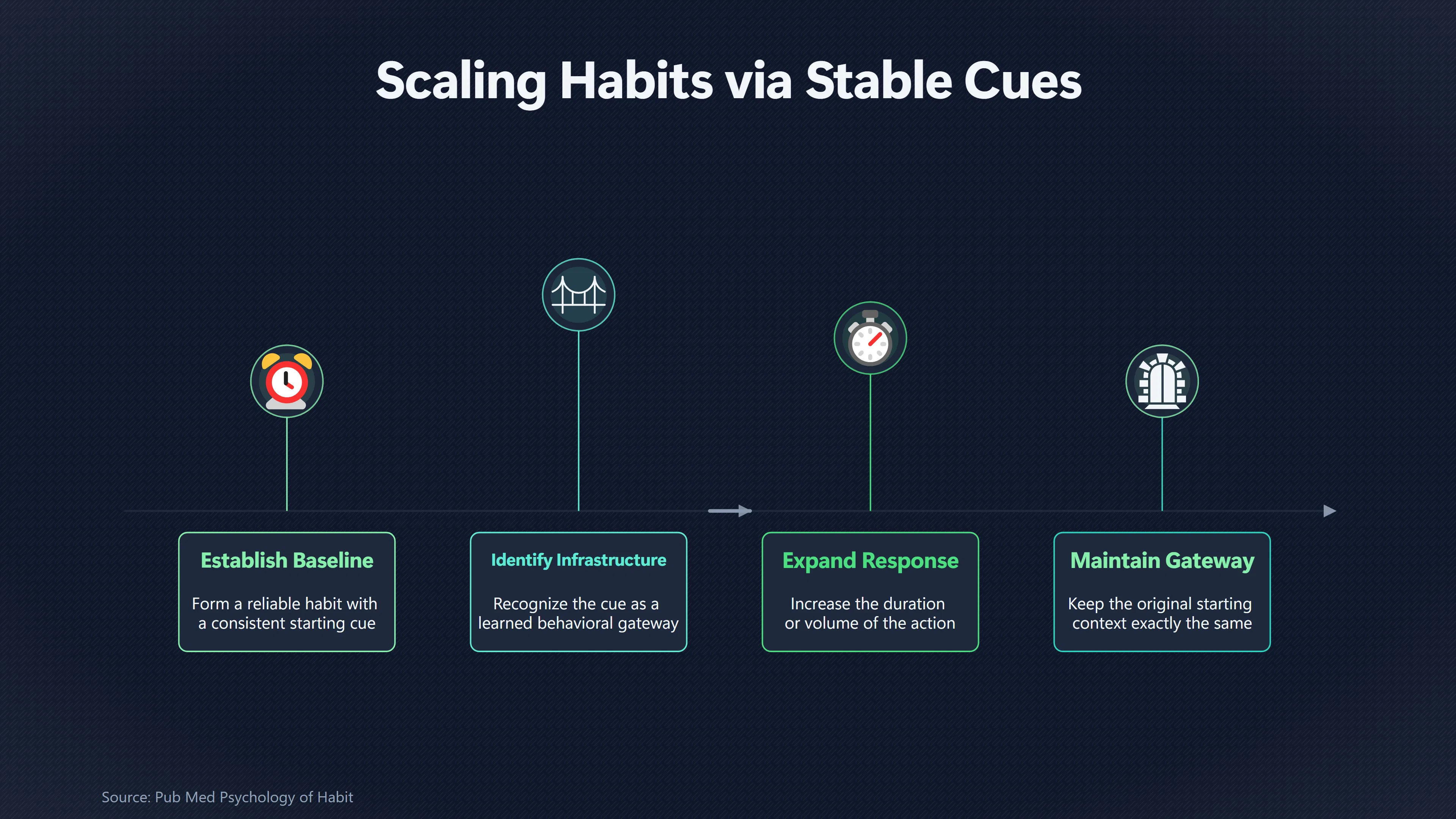
Keeping the same reliable cue while enlarging the response can reduce the need to rebuild a routine from scratch.
On this page
- How cue behaviour links support automaticity
- Expanding the response without changing the context
- When a new time or place creates a new habit
Page outline Jump by section
Introduction
Once a habit is reliable, the simplest way to make it bigger is often to increase the response while keeping its established cue intact. If five minutes of reading reliably follows breakfast, the next version might be ten minutes after breakfast — not ten minutes at a new time, in a new room, under a new set of conditions. The reason is mechanical rather than motivational: habits develop partly because repeated behaviour becomes associated with recurring features of its context, allowing those features to prompt action with less deliberate decision-making.[PubMed]pubmed.ncbi.nlm.nih.govPub Med Psychology of HabitPsychology of Habit - PubMedSeptember 10, 2015…
This makes a stable cue a useful piece of behavioural infrastructure. Scaling the action while retaining that infrastructure changes one problem at a time: the person has to adapt to doing more, but does not also have to learn when to start. Research has not directly established a universal formula for scaling an already formed habit, so this principle should not be treated as a proven optimisation rule. But it follows closely from evidence showing that stable contexts support automaticity, that contextual changes can disrupt established habits, and that automatic initiation can remain important even when the behaviour itself is complex.[PubMed]pubmed.ncbi.nlm.nih.govContext Stability in Habit Building Increases Automaticity and Goal Attainment - PubMedJune 10, 2022…
How cue–behaviour links support automaticity
In habit research, a cue is not merely a reminder pasted onto an otherwise unchanged decision. Through repetition, features of a recurring situation can become associated with a response. Wood and Neal’s influential account describes habits as emerging from learned associations between responses and features of the contexts in which those responses have repeatedly occurred — including physical settings and preceding actions. Later reviews similarly describe a habit as a process in which encountering a contextual cue automatically activates an impulse to act.[PubMed]pubmed.ncbi.nlm.nih.govPub Med A new look at habits and the habit-goal interfaceA new look at habits and the habit-goal interface - PubMed…
That context can be something quite ordinary. Breakfast can precede taking a vitamin; arriving home can precede changing into exercise clothes; opening a laptop can precede reviewing the day’s priorities. The important property is not that the cue is unusual or psychologically powerful in isolation. It is that it is encountered reliably enough for the same response to be repeatedly paired with it.
A classic real-world study by Phillippa Lally and colleagues illustrates the principle. Ninety-six participants selected an eating, drinking or activity behaviour and attempted it daily in the same context — for example, “after breakfast” — for 12 weeks. Repetition in that consistent context was associated with increasing automaticity, although the rate of development varied substantially between people.[Wiley Online Library]onlinelibrary.wiley.comWiley Online LibraryHow are habits formed: Modelling habit formation in the real world - Lally - 2010 - European Journal of Social Psycho…
More direct evidence comes from a 2022 study of context stability. In one experiment, 95 university students building study habits over six weeks were instructed either to keep their time and place stable or deliberately vary them. A second dataset covered 308 habits recorded by 218 users of a habit-building app. Across both datasets, greater context stability predicted greater automaticity and better attainment of repetition goals; automaticity partly mediated the relationship between context stability and goal attainment.[PubMed]pubmed.ncbi.nlm.nih.govContext Stability in Habit Building Increases Automaticity and Goal Attainment - PubMedJune 10, 2022…
The practical point for scaling is therefore easy to miss: the cue is part of what has been learned. When a routine has become dependable after breakfast, “after breakfast” is not incidental packaging around the behaviour. It may be helping to initiate it.
Expand the response, not the starting context
Suppose someone has reached the point where opening their laptop in the morning reliably leads to five minutes of language practice. They now want 15 minutes. There are at least two ways to make that change:
- keep opening the same laptop in the same part of the morning and extend the practice from five to 15 minutes; or
- move the longer session to 7 pm, use a different device and expect themselves to remember it independently.
Both produce a nominally larger goal, but the second also removes much of the context associated with starting the established routine. It is therefore not simply a change in quantity. From a habit-learning perspective, it changes the cue conditions as well.
This distinction becomes especially useful when separating habitual instigation from habitual execution. Habitual instigation means that a cue automatically prompts the selection or initiation of an activity; habitual execution concerns automaticity within the sequence after it has begun. In a study covering flossing, snacking and breakfast consumption, instigation habit was more consistently predictive of behaviour frequency than execution habit.[BPS Psych Hub]bpspsychub.onlinelibrary.wiley.comBPS Psych HubHabitual instigation and habitual execution: Definition, measurement, and effects on behaviour frequency - Gardner - 2016…
Exercise provides an especially clear example because the activity itself can be long and complicated. In a month-long study of 123 healthy adults, habitual exercise instigation — automatically getting started — was the unique habit-related predictor of exercise frequency, whereas automatic execution of the whole exercise sequence was not.[PubMed]pubmed.ncbi.nlm.nih.govHabitual exercise instigation (vs. execution) predicts healthy adults' exercise frequency - PubMed… This helps explain why keeping the start of a scaled routine recognisable can matter even when what follows becomes more ambitious. The cue does not necessarily have to automate every repetition, kilometre, page or study problem. Its useful job may simply be to get the larger episode under way.
A sensible scaling pattern therefore looks like this:
Established version: After breakfast → read for 10 minutes.
Scaled version: After breakfast → read for 20 minutes.
Or:
Established version: Arrive home → change clothes → walk for 15 minutes.
Scaled version: Arrive home → change clothes → walk for 30 minutes.
Or:
Established version: Open laptop → review five flashcards.
Scaled version: Open laptop → complete a 15-minute review session.
In each case, the response grows while the familiar gateway remains recognisable. This is not a claim that the larger behaviour will instantly inherit all the automaticity of the smaller one. The extra work may still require conscious effort and repeated experience. The narrower advantage is that the person is not deliberately discarding an already learned starting condition while asking themselves to tolerate a greater behavioural demand.

Stable does not have to mean an exact clock time
Keeping a cue stable should not be confused with performing a behaviour at precisely the same minute every day. Context can include location, preceding activities, other people and other recurring features of a situation. Researchers still do not know exactly which contextual features dominate habit triggering in every real-world setting, and their importance can vary between behaviours and individuals.[PubMed Central (PMC)]pmc.ncbi.nlm.nih.govPubMed Central (PMC)Context Stability in Habit Building Increases Automaticity and Goal Attainment - PMC…
For many routines, an event can provide the anchor: after breakfast, when I arrive at work, after I put the children to bed or when I open my laptop for the day. A practical review of habit formation notes that an existing daily routine can provide a convenient, stable context because it supplies an event that is repeatedly encountered.[PubMed Central (PMC)]pmc.ncbi.nlm.nih.govOpen source on nih.gov.
That does not mean event-based cues are always scientifically superior to clock-based ones. A randomised controlled trial involving 192 adults compared planning an everyday nutrition behaviour around a daily routine with planning it around a specific time. Both groups showed increases in automaticity and enactment, with no significant difference between the two cue types; repeated performance in response to the planned cue was the important predictor of automaticity.[PubMed]pubmed.ncbi.nlm.nih.govOpen source on nih.gov.
So the useful criterion is reliable recurrence, not an unnecessarily rigid schedule. If breakfast occurs at 7.15 on one day and 8.00 on another, “after breakfast” can still provide a recognisable behavioural context. Conversely, a nominally precise 7.30 pm cue is of little practical value if the person rarely notices it or is routinely doing incompatible things when it arrives.
When a new time or place creates a new habit problem
Changing context is sometimes unavoidable. A longer workout may no longer fit before work. A study session may outgrow a commute. Moving house, changing jobs, having a child or adopting a different work schedule can remove the circumstances around which an old routine was organised.
The important distinction is that a substantial context change should not be treated as a neutral scaling adjustment. Research on habit discontinuity shows why. In a study of university students who transferred to a new university, established behaviours including exercising, newspaper reading and television viewing were more likely to survive the move when relevant aspects of their performance contexts remained unchanged. When usual contexts changed, habitual performance was disrupted and behaviour could return to greater intentional control.[PubMed]pubmed.ncbi.nlm.nih.govPub Med Changing circumstances, disrupting habitsChanging circumstances, disrupting habits - PubMed…
Larger population research points in the same direction. Analysis of 18,053 participants in the UK Understanding Society survey found evidence consistent with the idea that moving home disrupts contextual cues around habitual travel, temporarily making behaviour more responsive to people’s values and intentions.[PubMed]pubmed.ncbi.nlm.nih.govOpen source on nih.gov. Context change can therefore be useful when the aim is to break an unwanted habit. It is less obviously helpful when the aim is simply to enlarge a wanted one.
If a new context is necessary, it is clearer to think of the change as establishing a new cue–response relationship rather than assuming the old automaticity will transfer intact. A person whose reliable routine is “after breakfast, write for ten minutes” but who now needs an hour at the library after work may retain useful skills, motivation and identity from the old practice. What they cannot safely assume is that entering the library after work already possesses the same power to trigger writing that breakfast acquired through repeated pairing.
This is also why changing several dimensions simultaneously can make a failed expansion difficult to diagnose. If someone doubles the workload, changes location and moves the behaviour to another part of the day, a subsequent fall in consistency could reflect the increased demand, the loss of the old cue, practical incompatibility with the new setting, or some combination of all three. Preserving the cue while first increasing the response creates a cleaner behavioural test.
Keep the gateway recognisable
The strongest evidence supports a modest principle rather than a rigid rule. Habits are strengthened through repeated behaviour in recurring contexts; greater context stability can support automaticity; and meaningful changes in context can disrupt habitual responding.[PubMed]pubmed.ncbi.nlm.nih.govPub Med Psychology of HabitPsychology of Habit - PubMedSeptember 10, 2015… What has not been directly demonstrated is that every established habit should always be scaled by holding every cue perfectly constant.
For practical self-improvement, the evidence points towards a useful default: when the existing cue is reliable and still compatible with the larger behaviour, keep it. Increase the pages read, minutes practised, distance walked or amount of work completed without casually replacing the moment that already gets the behaviour started.
The goal is not to freeze a routine forever. It is to avoid rebuilding more of it than necessary. When breakfast already prompts reading, arriving home already prompts walking, or opening the laptop already prompts practice, that dependable transition is an asset. Scaling works more cleanly when the behaviour grows on the far side of that transition, while the gateway itself stays familiar.
Amazon book picks
Further Reading
Books and field guides related to Why Scaling Works Better When Cues Stay Stable. Use these as the next step if you want deeper reading beyond the article.
Good Habits, Bad Habits
'The world's leading expert on habits' - Matthew Syed, bestselling author of Black Box Thinking and Rebel IdeasWhat if you could harness...
Atomic Habits
Rating: 3.5/5 from 7 Google Books ratings
The #1 New York Times bestseller. Over 25 million copies sold! Translated into 60+ languages! Tiny Changes, Remarkable Results No matter...
Tiny Habits
Improving your life is much easier than you think. Whether it’s losing weight, sleeping more, or restoring your work/life balance – the s...

The Power of Habit
Rating: 4.0/5 from 145 Google Books ratings
Duhigg takes us to the edge of scientific discoveries that explain why habits exist and how they can be changed. Distilling information i...
eBay marketplace picks
Marketplace Samples
Live-tested eBay searches with available results related to this page.
Selected frominspirational sign oneBay.co.uk.



Endnotes
1.
Source: compass.onlinelibrary.wiley.com
Link:https://compass.onlinelibrary.wiley.com/doi/full/10.1111/spc3.12975
Source snippet
What is habit and how can it be used to change real‐world behaviour? Narrowing the theory‐reality gap - Gardner - 2024 - Social an...
2.
Source: onlinelibrary.wiley.com
Link:https://onlinelibrary.wiley.com/doi/10.1002/ejsp.674
Source snippet
Wiley Online LibraryHow are habits formed: Modelling habit formation in the real world - Lally - 2010 - European Journal of Social Psycho...
3.
Source: bpspsychub.onlinelibrary.wiley.com
Link:https://bpspsychub.onlinelibrary.wiley.com/doi/10.1111/bjhp.12189
Source snippet
BPS Psych HubHabitual instigation and habitual execution: Definition, measurement, and effects on behaviour frequency - Gardner - 2016...
4.
Source: bpspsychub.onlinelibrary.wiley.com
Link:https://bpspsychub.onlinelibrary.wiley.com/doi/10.1111/bjop.70065
5.
Source: compass.onlinelibrary.wiley.com
Link:https://compass.onlinelibrary.wiley.com/doi/epdf/10.1111/spc3.12975
6.
Source: compass.onlinelibrary.wiley.com
Link:https://compass.onlinelibrary.wiley.com/doi/abs/10.1111/spc3.12553
7.
Source: compass.onlinelibrary.wiley.com
Link:https://compass.onlinelibrary.wiley.com/doi/10.1111/spc3.12323
8.
Source: bpspsychub.onlinelibrary.wiley.com
Link:https://bpspsychub.onlinelibrary.wiley.com/doi/abs/10.1111/bjhp.12189
9.
Source: iaap-journals.onlinelibrary.wiley.com
Link:https://iaap-journals.onlinelibrary.wiley.com/doi/10.1111/aphw.12017
10.
Source: myscp.onlinelibrary.wiley.com
Link:https://myscp.onlinelibrary.wiley.com/doi/10.1016/j.jcps.2009.08.003
11.
Source: myscp.onlinelibrary.wiley.com
Link:https://myscp.onlinelibrary.wiley.com/doi/abs/10.1016/j.jcps.2009.08.003
12.
Source: onlinelibrary.wiley.com
Link:https://onlinelibrary.wiley.com/doi/pdf/10.1002/ejsp.674
13.
Source: onlinelibrary.wiley.com
Link:https://onlinelibrary.wiley.com/doi/abs/10.1002/ejsp.674
14.
Source: onlinelibrary.wiley.com
Link:https://onlinelibrary.wiley.com/doi/abs/10.1002/ejsp.674?source=content_type%3Areact%7Cfirst_level_url%3Aarticle%7Csection%3Amain_content%7Cbutton%3Abody_link
15.
Source: onlinelibrary.wiley.com
Link:https://onlinelibrary.wiley.com/doi/abs/10.1002/ejsp.674?msockid=038ed114f43667dd0790c4bef5146634
16.
Source: onlinelibrary.wiley.com
Link:https://onlinelibrary.wiley.com/doi/abs/10.1002/ejsp.674?MixPanelId=15e3fe314440-0468d8411-64220f54-100000-15e3fe314460
17.
Source: pubmed.ncbi.nlm.nih.gov
Title: Pub Med Psychology of Habit
Link:https://pubmed.ncbi.nlm.nih.gov/26361052/
Source snippet
Psychology of Habit - PubMedSeptember 10, 2015...
Published: September 10, 2015
18.
Source: pubmed.ncbi.nlm.nih.gov
Link:https://pubmed.ncbi.nlm.nih.gov/35756236/
Source snippet
Context Stability in Habit Building Increases Automaticity and Goal Attainment - PubMedJune 10, 2022...
Published: June 10, 2022
19.
Source: pubmed.ncbi.nlm.nih.gov
Title: Pub Med Changing circumstances, disrupting habits
Link:https://pubmed.ncbi.nlm.nih.gov/15982113/
Source snippet
Changing circumstances, disrupting habits - PubMed...
20.
Source: pubmed.ncbi.nlm.nih.gov
Link:https://pubmed.ncbi.nlm.nih.gov/26148187/
Source snippet
Habitual exercise instigation (vs. execution) predicts healthy adults' exercise frequency - PubMed...
21.
Source: pubmed.ncbi.nlm.nih.gov
Title: Pub Med A new look at habits and the habit-goal interface
Link:https://pubmed.ncbi.nlm.nih.gov/17907866/
Source snippet
A new look at habits and the habit-goal interface - PubMed...
22.
Source: pmc.ncbi.nlm.nih.gov
Link:https://pmc.ncbi.nlm.nih.gov/articles/PMC9226889/
Source snippet
PubMed Central (PMC)Context Stability in Habit Building Increases Automaticity and Goal Attainment - PMC...
23.
Source: pubmed.ncbi.nlm.nih.gov
Link:https://pubmed.ncbi.nlm.nih.gov/26991427/
Source snippet
Habitual instigation and habitual execution: Definition, measurement, and effects on behaviour frequency - PubMed...
24.
Source: pmc.ncbi.nlm.nih.gov
Link:https://pmc.ncbi.nlm.nih.gov/articles/PMC3505409/
25.
Source: pubmed.ncbi.nlm.nih.gov
Link:https://pubmed.ncbi.nlm.nih.gov/33405284/
26.
Source: pubmed.ncbi.nlm.nih.gov
Link:https://pubmed.ncbi.nlm.nih.gov/27120333/
27.
Source: pmc.ncbi.nlm.nih.gov
Link:https://pmc.ncbi.nlm.nih.gov/articles/PMC4847906/
28.
Source: pmc.ncbi.nlm.nih.gov
Link:https://pmc.ncbi.nlm.nih.gov/articles/PMC13114073/
29.
Source: doi.org
Link:https://doi.org/10.3389/fdgth.2025.1713334?urlappend=%3Futm_source%3Dresearchgate.net%26utm_medium%3Darticle
30.
Source: pubmed.ncbi.nlm.nih.gov
Link:https://pubmed.ncbi.nlm.nih.gov/40965419/
31.
Source: pmc.ncbi.nlm.nih.gov
Link:https://pmc.ncbi.nlm.nih.gov/articles/PMC11683171/
32.
Source: pmc.ncbi.nlm.nih.gov
Link:https://pmc.ncbi.nlm.nih.gov/articles/PMC11578820/
33.
Source: pmc.ncbi.nlm.nih.gov
Link:https://pmc.ncbi.nlm.nih.gov/articles/PMC11161714/
34.
Source: pmc.ncbi.nlm.nih.gov
Link:https://pmc.ncbi.nlm.nih.gov/articles/PMC10669490/
35.
Source: pmc.ncbi.nlm.nih.gov
Link:https://pmc.ncbi.nlm.nih.gov/articles/PMC9372943/
36.
Source: doi.org
Link:https://doi.org/10.1186/s12966-022-01343-8
37.
Source: pmc.ncbi.nlm.nih.gov
Link:https://pmc.ncbi.nlm.nih.gov/articles/PMC12318445/
38.
Source: pmc.ncbi.nlm.nih.gov
Link:https://pmc.ncbi.nlm.nih.gov/articles/PMC8446276/
39.
Source: pmc.ncbi.nlm.nih.gov
Link:https://pmc.ncbi.nlm.nih.gov/articles/PMC8250330/
40.
Source: pubmed.ncbi.nlm.nih.gov
Link:https://pubmed.ncbi.nlm.nih.gov/33502088/
41.
Source: pubmed.ncbi.nlm.nih.gov
Link:https://pubmed.ncbi.nlm.nih.gov/31396122/
42.
Source: pubmed.ncbi.nlm.nih.gov
Link:https://pubmed.ncbi.nlm.nih.gov/29411951/
43.
Source: doi.org
Link:https://doi.org/10.1111/spc3.12323
44.
Source: pubmed.ncbi.nlm.nih.gov
Link:https://pubmed.ncbi.nlm.nih.gov/26361052/?dopt=Abstract
45.
Source: pmc.ncbi.nlm.nih.gov
Link:https://pmc.ncbi.nlm.nih.gov/articles/PMC4500900/
46.
Source: pubmed.ncbi.nlm.nih.gov
Link:https://pubmed.ncbi.nlm.nih.gov/26236214/
47.
Source: pmc.ncbi.nlm.nih.gov
Link:https://pmc.ncbi.nlm.nih.gov/articles/PMC4566897/
48.
Source: doi.org
Link:https://doi.org/10.1111/BJHP.12060
49.
Source: pubmed.ncbi.nlm.nih.gov
Link:https://pubmed.ncbi.nlm.nih.gov/21749245/
50.
Source: pubmed.ncbi.nlm.nih.gov
Link:https://pubmed.ncbi.nlm.nih.gov/20658824/
51.
Source: sk.sagepub.com
Link:https://sk.sagepub.com/ency/edvol/embed/encyclopedia-of-sport-and-exercise-psychology/chpt/habit
Additional References
52.
Source: chinarxiv.org
Link:https://chinarxiv.org/items/chinaxiv-202510.00112
53.
Source: youtube.com
Title: How to Build Habits That Actually Last: A Neuroscience Approach
Link:https://www.youtube.com/watch?v=ObA4ne4TVsE
Source snippet
5 Lessons from "The Power of Habit" by Charles Duhigg...
54.
Source: youtube.com
Title: 5 Lessons from “The Power of Habit” by Charles Duhigg
Link:https://www.youtube.com/watch?v=5Ws2WfeD6d8
Source snippet
The Habit Blueprint: Unlocking Lasting Change with Dr. Wendy Wood...
55.
Source: youtube.com
Title: The Power of Habit Animated
Link:https://www.youtube.com/watch?v=UMOZZ5uZgxA
Source snippet
Contextual cues habit formation Wendy Wood Wendy Wood: How Habits Guide Behavior...
56.
Source: researchgate.net
Link:https://www.researchgate.net/publication/385982601_The_inclusion_of_habits_in_the_stage_model_of_self-regulated_behavior_change_an_investigation_of_life_events_and_red_meat_consumption_in_the_UK
57.
Source: researchgate.net
Link:https://www.researchgate.net/publication/298790980_Habitual_instigation_and_habitual_execution_Definition_measurement_and_effects_on_behaviour_frequency
58.
Source: researchgate.net
Link:https://www.researchgate.net/publication/328620298_Habit_Mechanisms_and_Behavioural_Complexity_Theory_Mechanisms_Change_and_Contexts
59.
Source: benchchem.com
Link:https://www.benchchem.com/product/B13678469/docs
60.
Source: researchgate.net
Link:https://www.researchgate.net/publication/5936907_A_New_Look_at_Habits_and_the_Habit-Goal_Interface
61.
Source: womensbrainhealth.org
Link:https://womensbrainhealth.org/think-tank/change-of-habit