Within Small Habits
Automate the Start, Not the Whole Routine
Complex routines may never become fully automatic, but making the first action cue-driven can still make them happen more reliably.
On this page
- The difference between habitual starting and habitual execution
- Why complex routines still require deliberate regulation
- Choosing a first action that reliably launches the routine
Page outline Jump by section
Introduction
For a complex routine, the most realistic habit target may be the start rather than the whole sequence. A workout, study session, weekly planning ritual or meal-preparation routine contains too many decisions, changing conditions and separate actions to become wholly automatic. Yet the cue that launches it can become much more automatic. Habit researchers call this distinction habitual instigation versus habitual execution: the first concerns automatically selecting and beginning an activity; the second concerns automatically progressing through its component steps.[BPS Psych Hub]bpspsychub.onlinelibrary.wiley.comBPS Psych HubHabitual instigation and habitual execution: Definition, measurement, and effects on behaviour frequency - Gardner - 2016…
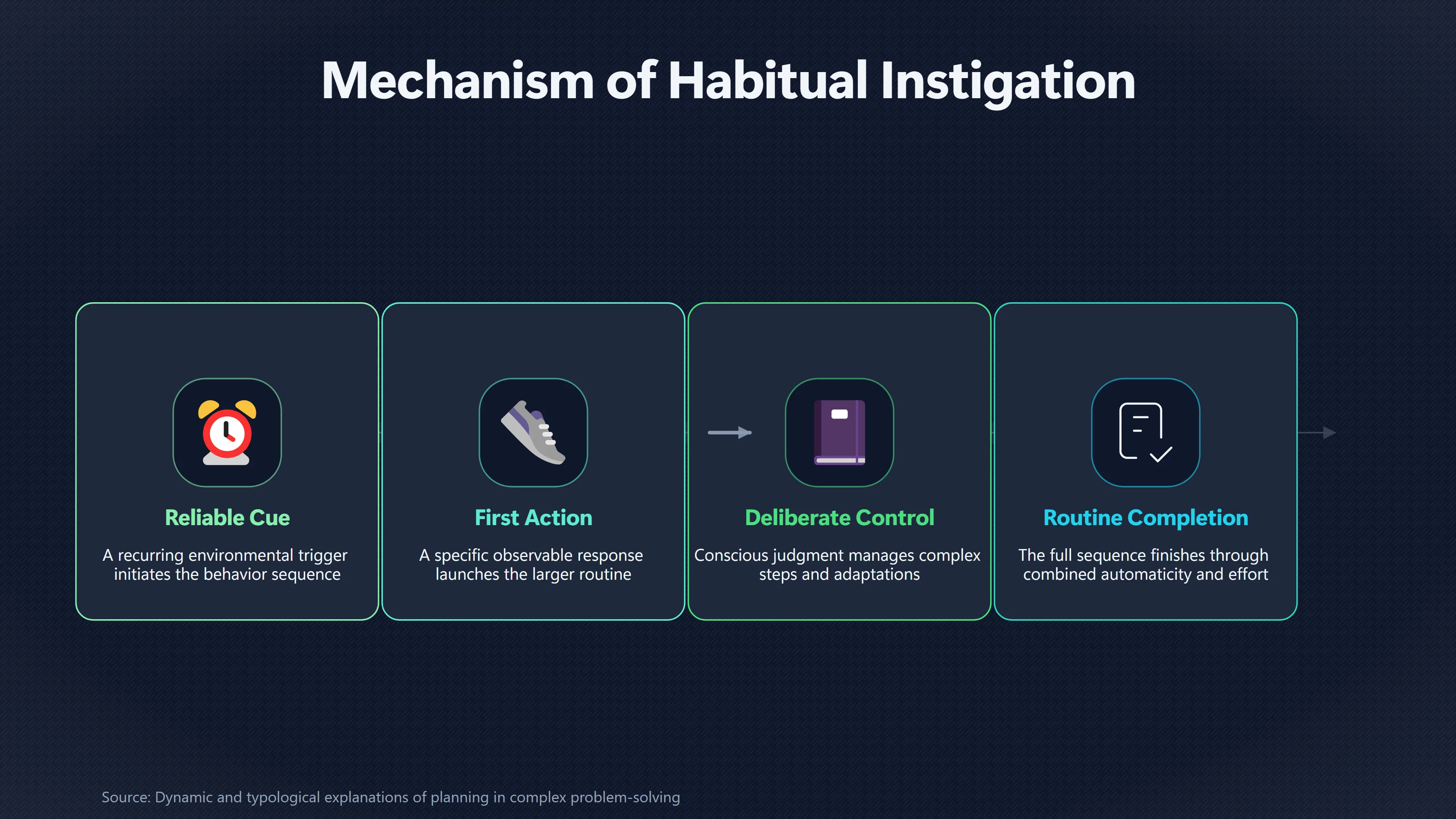
That distinction changes what “building a habit” can sensibly mean. Success does not require reaching a state where an elaborate routine runs without thought. Research suggests that complex behaviours continue to draw on deliberate self-regulation even when their starts are strongly habitual.[PubMed Central (PMC)]pmc.ncbi.nlm.nih.govOpen source on nih.gov. The useful goal is narrower: make a reliable cue produce a reliable first action, then use ordinary deliberate control to do the rest.
Starting automatically is not the same as doing everything automatically
Consider going for a run. There are at least two ways in which it could feel habitual. At a familiar cue — perhaps finishing work — you might find yourself automatically beginning the running routine. That is habitual instigation. Alternatively, the individual actions after that point might flow with little conscious direction: changing clothes, putting on shoes, leaving the house, following a familiar route. That is habitual execution. Gardner, Phillips and Judah formalised this distinction in 2016, arguing that the same underlying habit process can operate at different levels of an action.[BPS Psych Hub]bpspsychub.onlinelibrary.wiley.comBPS Psych HubHabitual instigation and habitual execution: Definition, measurement, and effects on behaviour frequency - Gardner - 2016…
The distinction is more than terminology. In their prospective study of 229 students, measures of habitual instigation were consistently more predictive of subsequent frequency of flossing, snacking and eating breakfast than measures of habitual execution. The authors concluded that the relationship between habit and repeated behaviour appeared to be attributable mainly to instigation rather than automatic execution.[Open Research Surrey]openresearch.surrey.ac.ukOpen Research SurreyHabitual instigation and habitual execution: Definition, measurement, and effects on behaviour frequency - University… An earlier exercise study likewise found that habitual exercise instigation, rather than habitual execution, predicted how frequently healthy adults exercised.[PubMed]pubmed.ncbi.nlm.nih.govHabitual exercise instigation (vs. execution) predicts healthy adults' exercise frequency - PubMedJanuary 1, 2016…
A later study tested the idea directly across behaviours that differed in complexity. Participants considered drinking sugary drinks, checking a phone, using social media and using public transport, with public transport rated as the most complex. Habitual instigation predicted behaviour frequency across this range, whereas habitual execution did not. The researchers’ interpretation was that complexity does not prevent a habit from helping to regulate whether an action episode gets started.[ScienceDirect]sciencedirect.comHabit and behavioural complexity: habitual instigation and execution as predictors of simple and complex behaviours - Scienc…
This provides a more useful model of a complex habit. Instead of imagining:
cue → entire routine runs automatically
think:
cue → first action starts readily → deliberate and partly practised processes carry the routine forward
The first link can become strong even when everything after it remains cognitively demanding.
Why complex routines still need deliberate regulation
Complexity creates demands that repetition cannot necessarily remove. A complex behaviour contains distinguishable steps, takes time, may require planning and effort, and often has to adapt to circumstances.[Wiley Online Library]onlinelibrary.wiley.comWiley Online LibrarySome habits are more work than others: Deliberate self‐regulation strategy use increases with behavioral complexity… A morning planning session, for example, may reliably begin when someone opens their laptop after breakfast, but what happens next depends on today’s calendar, unfinished work, priorities and new information. Automatic execution of one invariant sequence would not even be desirable.
Recent evidence makes this limitation unusually clear. Blair Saunders and Kimberly More recruited 239 UK adults and had them identify personally relevant simple and complex behaviours, both established and not yet established. Simple examples included handwashing and flossing; complex examples included moderate or vigorous exercise, active travel, preparing vegetables and recycling. Participants also reported the deliberate strategies they used to regulate these behaviours.[PubMed Central (PMC)]pmc.ncbi.nlm.nih.govOpen source on nih.gov.
Strategy use increased as behavioural complexity increased. Importantly, that relationship persisted even for complex behaviours that participants reported starting with high automaticity. At particularly high levels of complexity, the usual difference in strategy use between habitually and non-habitually instigated behaviour disappeared. In other words, an automatic start did not eliminate the need for deliberate regulation once the activity became sufficiently complicated.[PubMed Central (PMC)]pmc.ncbi.nlm.nih.govOpen source on nih.gov.
That finding guards against a common misconception about successful routines. Having to think during a well-established routine is not evidence that the habit has failed. A person can habitually begin exercising and still decide how hard to train; habitually begin studying and still choose which problem deserves attention; habitually start a weekly review and still reason carefully about next week’s priorities.
The automatic and deliberate parts can therefore complement one another. The habit reduces one recurring self-regulation problem — getting into the activity at all — without pretending to remove the judgement required to perform it well.
Choose a first action that reliably launches the routine
The practical challenge is deciding what, exactly, should become cue-driven. “Exercise after work” is still an umbrella behaviour. A stronger habit-start design specifies both a recognisable cue and an observable first response.
For example:
- after putting the dinner plate in the dishwasher → open the language-learning material;
- after making the first morning drink → open the planning document;
- after arriving home from work → change into exercise clothes;
- after brushing teeth in the evening → put the book on the bed and open it;
- after sitting at the desk for a scheduled writing session → open the working document.
These examples deliberately stop near the beginning. The target is not to automate every subsequent decision. It is to reduce the gap between encountering the cue and entering the routine.
There are two evidence-based reasons for being precise. First, habits are learned through repeated associations between contexts and responses. In a six-week study of new study habits, and a second dataset drawn from a habit-building app, greater context stability was associated with greater automaticity and better attainment of the intended repetition goal. The researchers concluded that clearly specifying when and where a habit occurs is a useful starting point for establishing a stable context.[Frontiers]frontiersin.orgOpen source on frontiersin.org.
Second, planning research shows that linking a specific situation to a specific response can help people translate intentions into action. A major meta-analysis of 94 independent tests found that implementation intentions — plans of the form “if situation Y occurs, then I will do X” — improved goal attainment, with evidence that such plans increase the accessibility of the cue and strengthen the cue-response connection.[ScienceDirect]sciencedirect.comOpen source on sciencedirect.com. That literature is broader than habit formation itself, so an if–then plan should not be treated as identical to an established habit. It nevertheless supports the same practical principle: specify the point at which action should begin rather than relying on a vague intention to do the routine sometime.
The best cue is the one you actually encounter
A useful cue needs to recur reliably in ordinary life. It can be tied to a clock time or to an existing routine. A randomised trial involving 192 adults compared those two approaches for everyday nutrition habits: participants linked their chosen behaviour either to a particular time or to a daily routine. Both groups increased automaticity and plan enactment, with no significant advantage for either cue type. Repeatedly carrying out the behaviour in response to the planned cue was the important predictor of automaticity.[PubMed]pubmed.ncbi.nlm.nih.govOpen source on nih.gov.
That means there is little reason to insist that everyone use the same kind of trigger. “At 7.30 pm” may work for someone whose evenings are predictable. “After I clear dinner away” may be more robust for someone whose meal time varies. The practical test is whether the cue is distinctive enough to notice, occurs on the days the routine is meant to happen and normally arrives when beginning is feasible.
The first action also needs to have launch value. “Think about exercising” is easy but does not change the situation much. “Put on my running shoes” moves the person into the action sequence. “Remember to study” leaves the routine abstract; “open the problem set” puts the task directly in front of the person. A good starting action is small enough to repeat reliably but concrete enough to make the next step easier.
This is where small habits and complex routines fit together. The small action need not be a miniature substitute for the worthwhile activity. It can instead be its entry point.
Do not mistake an automatic start for guaranteed completion
Habitual instigation improves the odds of beginning; it does not make what follows immune to disruption. The evidence on behavioural complexity is especially important here. Complex established behaviours continued to require self-regulation strategies even at high levels of instigation automaticity.[PubMed Central (PMC)]pmc.ncbi.nlm.nih.govOpen source on nih.gov. A person who reliably starts a workout can still stop because of pain, an unexpected phone call or lack of time. Someone who automatically opens a document each morning can still struggle with a difficult paragraph.
Nor should the research be read as proving that every complex routine can acquire a perfectly automatic start. Much of the evidence relies on self-reported habit strength and behaviour, and the 2022 complexity study had 173 initial participants, of whom 118 subsequently supplied behaviour-frequency data. Its findings support the distinction between instigation and execution, but they do not establish a universal causal rule for every kind of routine.[ScienceDirect]sciencedirect.comHabit and behavioural complexity: habitual instigation and execution as predictors of simple and complex behaviours - Scienc…
The more defensible conclusion is narrower and more useful: complexity is a reason to reduce the scope of what you expect habit to automate, not a reason to abandon habit formation altogether. Research across exercise, health behaviours and behaviours varying in complexity repeatedly points towards initiation as an especially consequential target.[nih.gov]pubmed.ncbi.nlm.nih.govHabitual exercise instigation (vs. execution) predicts healthy adults' exercise frequency - PubMedJanuary 1, 2016…
Automate the threshold
For routines that involve planning, adaptation or sustained effort, “make the whole thing automatic” sets the wrong standard. Some routines are valuable precisely because they require thought. What can become easier is crossing the threshold into them.
A workable habit start therefore has three parts: a recurring cue, a specific first action and repeated pairing between the two. Context can be a time, place or preceding routine; the first action should unmistakably begin the larger activity; and repetition should occur often enough for the cue-response association to strengthen. Evidence from cue-planning and context-stability studies supports that emphasis on consistent enactment rather than simply possessing a strong intention.[PubMed]pubmed.ncbi.nlm.nih.govOpen source on nih.gov.
Once the routine has started, deliberate regulation can take over without being treated as a failure of habit. That division of labour is particularly well suited to self-improvement that has to survive ordinary life: let habit answer “Do I start?”, and reserve attention and judgement for “What do I do now?”.
Amazon book picks
Further Reading
Books and field guides related to Automate the Start, Not the Whole Routine. Use these as the next step if you want deeper reading beyond the article.
Tiny Habits
Improving your life is much easier than you think. Whether it’s losing weight, sleeping more, or restoring your work/life balance – the s...
Atomic Habits
Rating: 3.5/5 from 7 Google Books ratings
The #1 New York Times bestseller. Over 25 million copies sold! Translated into 60+ languages! Tiny Changes, Remarkable Results No matter...
Good Habits, Bad Habits
'The world's leading expert on habits' - Matthew Syed, bestselling author of Black Box Thinking and Rebel IdeasWhat if you could harness...
The Power of Habit
Rating: 4.0/5 from 145 Google Books ratings
Duhigg takes us to the edge of scientific discoveries that explain why habits exist and how they can be changed. Distilling information i...
eBay marketplace picks
Marketplace Samples
Live-tested eBay searches with available results related to this page.
Selected fromhabit tracker board oneBay.co.uk.


Endnotes
1.
Source: bpspsychub.onlinelibrary.wiley.com
Link:https://bpspsychub.onlinelibrary.wiley.com/doi/10.1111/bjhp.12189
Source snippet
BPS Psych HubHabitual instigation and habitual execution: Definition, measurement, and effects on behaviour frequency - Gardner - 2016...
2.
Source: sciencedirect.com
Link:https://www.sciencedirect.com/science/article/pii/S266651822200016X
Source snippet
Habit and behavioural complexity: habitual instigation and execution as predictors of simple and complex behaviours - Scienc...
3.
Source: onlinelibrary.wiley.com
Link:https://onlinelibrary.wiley.com/doi/abs/10.1111/jopy.12926
Source snippet
Wiley Online LibrarySome habits are more work than others: Deliberate self‐regulation strategy use increases with behavioral complexity...
4.
Source: sciencedirect.com
Link:https://www.sciencedirect.com/science/chapter/bookseries/abs/pii/S0065260106380021
5.
Source: sciencedirect.com
Link:https://www.sciencedirect.com/science/article/abs/pii/S002210310600028X
6.
Source: iaap-journals.onlinelibrary.wiley.com
Link:https://iaap-journals.onlinelibrary.wiley.com/doi/10.1111/aphw.70144?af=R
7.
Source: bpspsychub.onlinelibrary.wiley.com
Link:https://bpspsychub.onlinelibrary.wiley.com/doi/10.1111/bjop.70065
8.
Source: sciencedirect.com
Link:https://www.sciencedirect.com/science/article/pii/S0361476X25000876
9.
Source: iaap-journals.onlinelibrary.wiley.com
Link:https://iaap-journals.onlinelibrary.wiley.com/doi/10.1111/aphw.12597
10.
Source: compass.onlinelibrary.wiley.com
Link:https://compass.onlinelibrary.wiley.com/doi/full/10.1111/spc3.12975
11.
Source: compass.onlinelibrary.wiley.com
Link:https://compass.onlinelibrary.wiley.com/doi/10.1111/spc3.12975
12.
Source: sciencedirect.com
Title: Dynamic and typological explanations of planning in complex problem-solving
Link:https://www.sciencedirect.com/science/article/pii/S1041608024000104
13.
Source: onlinelibrary.wiley.com
Link:https://onlinelibrary.wiley.com/doi/full/10.1111/dar.13553
14.
Source: bpspsychub.onlinelibrary.wiley.com
Link:https://bpspsychub.onlinelibrary.wiley.com/doi/abs/10.1111/bjhp.12504
15.
Source: onlinelibrary.wiley.com
Link:https://onlinelibrary.wiley.com/doi/10.1002/9781119568124.ch48
16.
Source: bpspsychub.onlinelibrary.wiley.com
Link:https://bpspsychub.onlinelibrary.wiley.com/doi/abs/10.1111/bjhp.12189
17.
Source: sciencedirect.com
Link:https://www.sciencedirect.com/science/article/pii/S0165178115000360
18.
Source: bpspsychub.onlinelibrary.wiley.com
Link:https://bpspsychub.onlinelibrary.wiley.com/share/SFKV2IDZIZUZFJF4X9N2?target=10.1111%2Fbjhp.12504
19.
Source: sciencedirect.com
Link:https://www.sciencedirect.com/science/article/abs/pii/S0005796725000890
20.
Source: sciencedirect.com
Link:https://www.sciencedirect.com/science/article/abs/pii/S0065260106380021
21.
Source: sciencedirect.com
Link:https://www.sciencedirect.com/science/article/abs/pii/S2352550925000260
22.
Source: sciencedirect.com
Title: Autonomous behaviour and the limits of human volition
Link:https://www.sciencedirect.com/science/article/pii/S0010027723003189
23.
Source: sciencedirect.com
Link:https://www.sciencedirect.com/science/article/abs/pii/S0022096516300285
24.
Source: pmc.ncbi.nlm.nih.gov
Link:https://pmc.ncbi.nlm.nih.gov/articles/PMC11891988/
25.
Source: pubmed.ncbi.nlm.nih.gov
Link:https://pubmed.ncbi.nlm.nih.gov/38450535/
Source snippet
Some habits are more work than others: Deliberate self-regulation strategy use increases with behavioral complexity, even for estab...
26.
Source: openresearch.surrey.ac.uk
Link:https://openresearch.surrey.ac.uk/esploro/outputs/journalArticle/Habitual-instigation-and-habitual-execution-Definition/99648859402346
Source snippet
Open Research SurreyHabitual instigation and habitual execution: Definition, measurement, and effects on behaviour frequency - University...
27.
Source: pubmed.ncbi.nlm.nih.gov
Link:https://pubmed.ncbi.nlm.nih.gov/26148187/
Source snippet
Habitual exercise instigation (vs. execution) predicts healthy adults' exercise frequency - PubMedJanuary 1, 2016...
Published: January 1, 2016
28.
Source: frontiersin.org
Link:https://www.frontiersin.org/journals/psychology/articles/10.3389/fpsyg.2022.883795/full
29.
Source: pmc.ncbi.nlm.nih.gov
Link:https://pmc.ncbi.nlm.nih.gov/articles/PMC9226889/
30.
Source: pubmed.ncbi.nlm.nih.gov
Link:https://pubmed.ncbi.nlm.nih.gov/33405284/
31.
Source: pubmed.ncbi.nlm.nih.gov
Link:https://pubmed.ncbi.nlm.nih.gov/40965419/
32.
Source: pmc.ncbi.nlm.nih.gov
Link:https://pmc.ncbi.nlm.nih.gov/articles/PMC12798269/
33.
Source: pmc.ncbi.nlm.nih.gov
Link:https://pmc.ncbi.nlm.nih.gov/articles/PMC11885360/
34.
Source: pmc.ncbi.nlm.nih.gov
Link:https://pmc.ncbi.nlm.nih.gov/articles/PMC11635918/
35.
Source: pmc.ncbi.nlm.nih.gov
Link:https://pmc.ncbi.nlm.nih.gov/articles/PMC11297519/
36.
Source: doi.org
Link:https://doi.org/10.1080/10463283.2024.2334563
37.
Source: doi.org
Link:https://doi.org/10.1111/jopy.12926
38.
Source: pmc.ncbi.nlm.nih.gov
Link:https://pmc.ncbi.nlm.nih.gov/articles/PMC10087331/
39.
Source: pmc.ncbi.nlm.nih.gov
Link:https://pmc.ncbi.nlm.nih.gov/articles/PMC9372943/
40.
Source: openresearch.surrey.ac.uk
Link:https://openresearch.surrey.ac.uk/esploro/outputs/journalArticle/Habit-and-behavioural-complexity-habitual-instigation/99671666302346
41.
Source: pmc.ncbi.nlm.nih.gov
Link:https://pmc.ncbi.nlm.nih.gov/articles/PMC9274250/
42.
Source: frontiersin.org
Link:https://www.frontiersin.org/journals/psychology/articles/10.3389/fpsyg.2022.883795/full?infclid=98ed75048fad41069048c53e63b2394c
43.
Source: pmc.ncbi.nlm.nih.gov
Link:https://pmc.ncbi.nlm.nih.gov/articles/PMC12318445/
44.
Source: openresearch.surrey.ac.uk
Link:https://openresearch.surrey.ac.uk/esploro/outputs/journalArticle/Habit-formation-following-routine-based-versus-time-based/99783227002346
45.
Source: pmc.ncbi.nlm.nih.gov
Link:https://pmc.ncbi.nlm.nih.gov/articles/PMC8149892/
46.
Source: doi.org
Link:https://doi.org/10.1111/bjhp.12504
47.
Source: frontiersin.org
Title: Frontiers | (How) Does Affect Influence the Formation of Habits in Exercise?
Link:https://www.frontiersin.org/journals/psychology/articles/10.3389/fpsyg.2020.578108/full
48.
Source: pubmed.ncbi.nlm.nih.gov
Link:https://pubmed.ncbi.nlm.nih.gov/31414843/
49.
Source: pmc.ncbi.nlm.nih.gov
Link:https://pmc.ncbi.nlm.nih.gov/articles/PMC6667662/
50.
Source: pubmed.ncbi.nlm.nih.gov
Link:https://pubmed.ncbi.nlm.nih.gov/31396122/
51.
Source: doi.org
Title: A matter of habit: Recognizing the multiple roles of habit in health behaviour
Link:https://doi.org/10.1111/bjhp.12369
52.
Source: pubmed.ncbi.nlm.nih.gov
Link:https://pubmed.ncbi.nlm.nih.gov/26991427/
53.
Source: openresearch.surrey.ac.uk
Link:https://openresearch.surrey.ac.uk/esploro/outputs/journalArticle/Habitual-exercise-instigation-vs-execution-predicts/99648859102346
54.
Source: openresearch.surrey.ac.uk
Link:https://openresearch.surrey.ac.uk/esploro/outputs/website/Habitual-exercise-instigation-vs-execution-predicts/99783545702346
55.
Source: pmc.ncbi.nlm.nih.gov
Link:https://pmc.ncbi.nlm.nih.gov/articles/PMC4500900/
56.
Source: pmc.ncbi.nlm.nih.gov
Link:https://pmc.ncbi.nlm.nih.gov/articles/PMC4216661/
57.
Source: pmc.ncbi.nlm.nih.gov
Link:https://pmc.ncbi.nlm.nih.gov/articles/PMC4566897/
58.
Source: doi.org
Link:https://doi.org/10.1007/978
59.
Source: surrey.ac.uk
Title: benjamin gardner
Link:https://www.surrey.ac.uk/people/benjamin-gardner
Additional References
60.
Source: doaj.org
Link:https://doaj.org/article/db83a09493274ca292a497f71922ed61
Source snippet
Directory of Open Access JournalsHabit and behavioural complexity: habitual instigation and execution as predictors of simple and complex...
61.
Source: researchportal.bath.ac.uk
Link:https://researchportal.bath.ac.uk/en/publications/some-habits-are-more-work-than-others-deliberate-self-regulation-/
Source snippet
the University of Bath's research portalSome habits are more work than others: Deliberate self-regulation strategy use increases with beh...
62.
Source: youtube.com
Link:https://www.youtube.com/watch?v=SihwUFcKAwk
Source snippet
How to Build Habits That Actually Last: A Neuroscience Approach...
63.
Source: youtube.com
Title: How to Build Habits That Actually Last: A Neuroscience Approach
Link:https://www.youtube.com/watch?v=ObA4ne4TVsE
Source snippet
Forget big change, start with a tiny habit: BJ Fogg at TEDxFremont...
64.
Source: youtube.com
Title: Forget big change, start with a tiny habit: BJ Fogg at TEDx Fremont
Link:https://www.youtube.com/watch?v=AdKUJxjn-R8
Source snippet
Atomic Habits: How to Get 1% Better Every Day - James Clear...
65.
Source: youtube.com
Title: The Science of Making & Breaking Habits
Link:https://www.youtube.com/watch?v=Wcs2PFz5q6g
Source snippet
Habit Expert, Wendy Wood, breaks down the three bases of habit formation! (Behavioral Science)...
66.
Source: researchgate.net
Link:https://www.researchgate.net/publication/362509175_Habit_and_behavioural_complexity_habitual_instigation_and_execution_as_predictors_of_simple_and_complex_behaviours
67.
Source: researchgate.net
Link:https://www.researchgate.net/publication/348328187_Habit_formation_following_routine-based_versus_time-based_cue_planning_A_randomized_controlled_trial
68.
Source: researchgate.net
Link:https://www.researchgate.net/publication/37367696_Implementation_Intentions_and_Goal_Achievement_A_Meta-Analysis_of_Effects_and_Processes
69.
Source: researchgate.net
Link:https://www.researchgate.net/publication/378796895_Some_habits_are_more_work_than_others_Deliberate_self-regulation_strategy_use_increases_with_behavioral_complexity_even_for_established_habits