Within Useful Cues
When Do Environmental Reminders Stop Getting Noticed?
Adding more reminders is not always better because prompts that are vague, poorly placed, or constantly visible can become easy to overlook.
On this page
- Why noticeability depends on contrast and relevance
- How vague or badly timed prompts lose practical value
- Using fewer cues with clearer actions and locations
Page outline Jump by section
Introduction
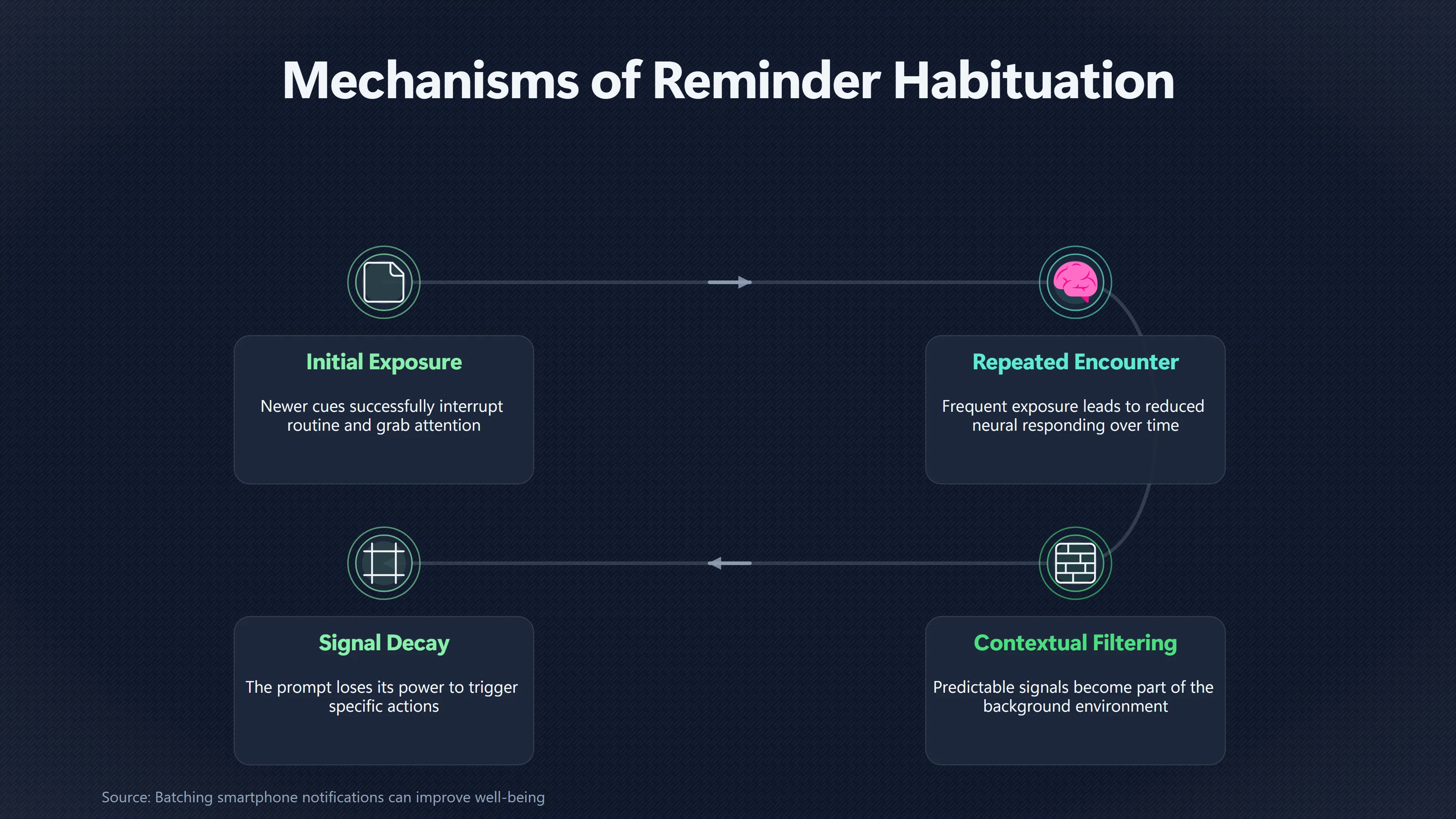
Repeated reminders can stop working precisely because they remain present. A note on the fridge, a poster above a desk or the same phone alert every afternoon may initially interrupt routine and bring an intention to mind. With repeated exposure, however, familiar stimuli tend to capture less attention. Research on habituation describes this as a reduction in responding to repeated stimulation, while field studies of behavioural prompts show that an intervention can produce a strong initial effect that later decays.[nih.gov]pmc.ncbi.nlm.nih.govPubMed Central (PMC)Novelty, attention, and challenges for developmental psychology - PMCAugust 1, 2013…
The practical lesson is not that reminders are useless. Well-placed prompts can change behaviour, sometimes substantially. The problem is treating visibility as equivalent to noticeability. A useful environmental cue needs to stand out, appear when action is possible and point towards something sufficiently specific to do. Adding more permanent reminders can instead create a landscape of familiar signals that the brain learns it can safely ignore.
Why contrast and relevance determine what gets noticed
Attention is selective. If every object in view received the same continuing scrutiny, ordinary environments would be overwhelming. Habituation provides one way of filtering predictable information: responses to a repeatedly encountered stimulus decline, while a sufficiently different or novel stimulus can recover attention. Research on visual attention has found that attentional capture itself can habituate, and that the filtering of familiar stimuli can become tied to the context in which they repeatedly appear.[PubMed]pubmed.ncbi.nlm.nih.govShort-term and long-term plasticity in the visual-attention system: Evidence from habituation of attentional capture - PubMed…
That helps explain the familiar experience of no longer really seeing a reminder that remains in the same place. A sticky note reading “READ” may be conspicuous when first attached to a monitor. After dozens of encounters in which nothing consequential happens, it becomes part of the monitor. The eyes may still receive the visual information, but the cue is less successful at interrupting whatever else is occupying attention.
Real-world prompt research shows both sides of this effect. A meta-analysis of 50 studies of signs encouraging stair use found a median absolute increase of 2.2 percentage points after signage was introduced and an overall adjusted odds ratio of 1.52 for stair use. In other words, prompts clearly can influence behaviour.[BMJ Open]bmjopen.bmj.comBMJ OpenIs there sufficient evidence regarding signage-based stair use interventions? A sequential meta-analysis | BMJ OpenNovember 1, 2017… But effectiveness at introduction does not establish that an unchanged cue will retain the same force indefinitely.
A particularly revealing field experiment followed 205 people in three Paris Metro stations during an eight-week stair-promotion intervention. Point-of-decision prompts produced an immediate effect on stair use, but that effect peaked and decayed. The researchers found no evidence that the intervention produced a lasting change in stair-use habits and suggested that people eventually became accustomed to the cues and ceased noticing them sufficiently to influence the decision.[PubMed]pubmed.ncbi.nlm.nih.govGetting more people on the stairs: The impact of point-of-decision prompts - PubMed…
That distinction matters for self-improvement. Repetition of the desired behaviour can strengthen a routine; repetition of an ignored reminder can simply make the reminder familiar. Seeing “stretch” 40 times is not equivalent to stretching 40 times.
Vague prompts lose practical value
Noticeability is only part of the problem. Even a reminder that successfully attracts attention may be weak if it does not make the next action obvious.
A university worksite study illustrates the difference. Researchers recorded 2,997 stair-or-lift choices while comparing a general stair-promotion message with a more specific one. The specific sign significantly increased the odds of stair use relative to baseline, with an odds ratio of 2.04, and also performed significantly better than the general message. The general sign alone did not significantly increase stair use.[Sage Journals]journals.sagepub.comSage JournalsPoint-of-Decision Signs and Stair Use in a University Worksite Setting: General versus Specific Messages - Mary R. Eckhardt…
Research on prospective memory — remembering to carry out an intention later — likewise suggests that cue specificity can matter. A 2023 experimental study found prospective-memory accuracy consistently favoured specific cues over general ones.[PubMed]pubmed.ncbi.nlm.nih.govA thorough examination of cue specificity and task-appropriateness in defining focal and nonfocal prospective memory tasks - PubMed… Implementation-intention research takes the same basic problem seriously by connecting an identifiable situation to a defined response: when a specified situation occurs, perform the specified behaviour. Research has found that such plans can improve detection of opportunities to act.[DOI]doi.orgOpen source on doi.org.
For an environmental reminder, therefore, compare:
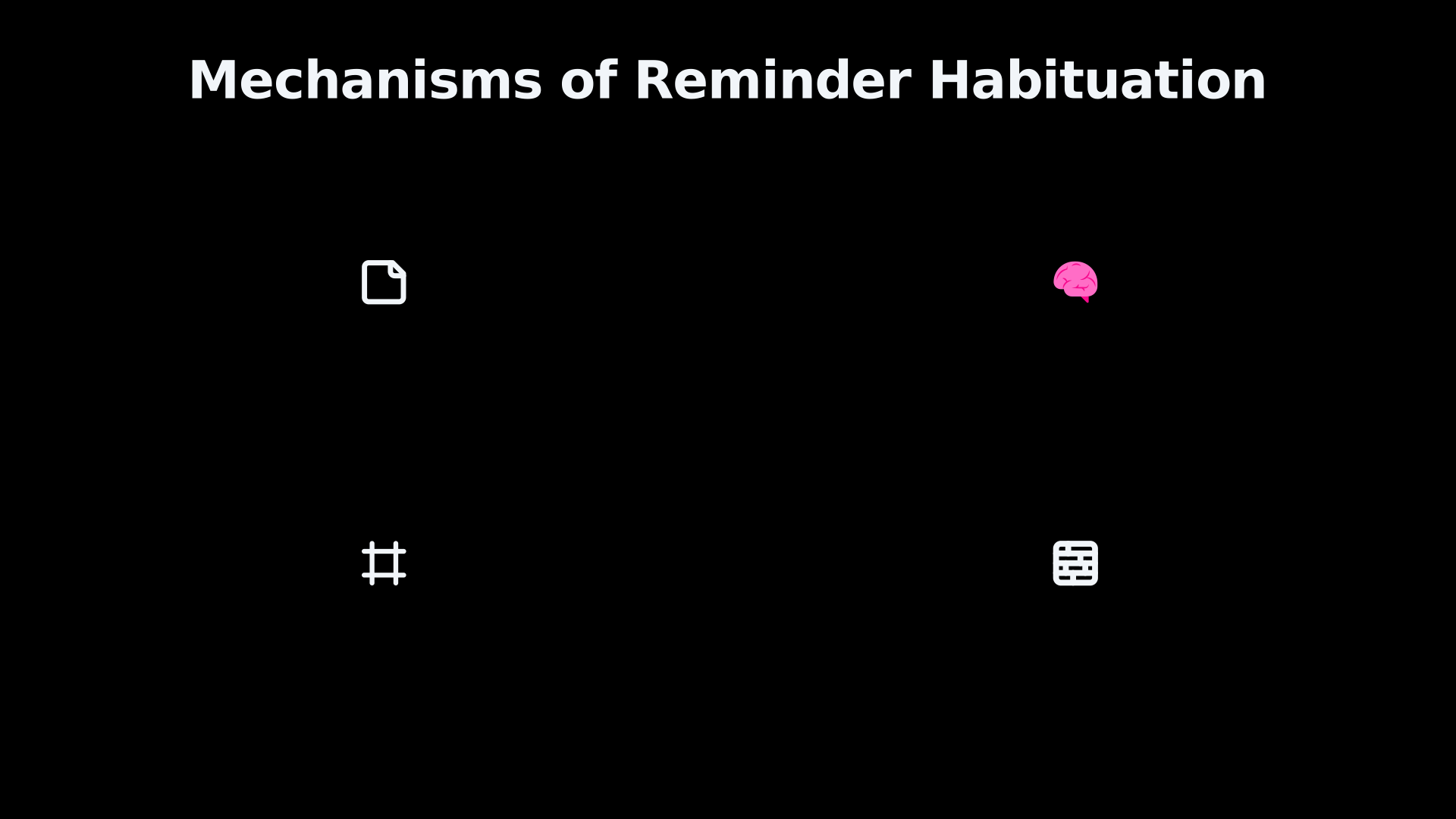
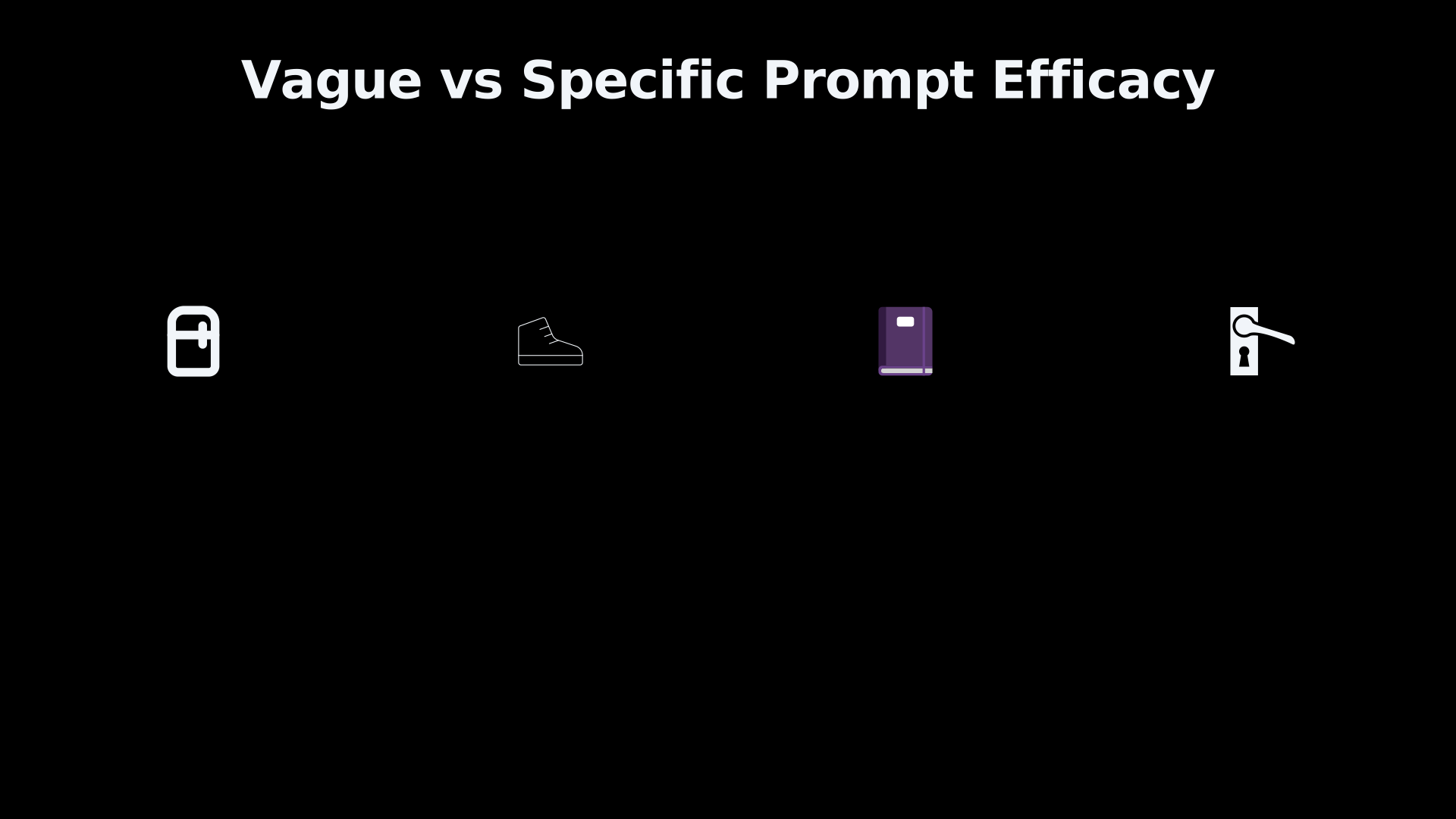
- “Be healthier” on the fridge with fruit already washed and visible at the point where a snack is chosen.
- “Exercise!” on a bedroom wall with walking shoes beside the door used for the planned lunchtime walk.
- “Read more” permanently on the desk with the intended book placed on the pillow before the evening routine.
- “Plan tomorrow” on a general to-do list with the planning notebook open beside the object that reliably marks the end of the working day.
The stronger examples reduce interpretation. They make the cue and the opportunity to act overlap.
This does not mean every prompt needs lengthy instructions. Quite the opposite: specificity often means narrowing the behaviour. “Do ten squats after brushing my teeth” gives the cue one job. “Improve fitness” asks a reminder to reactivate an entire goal, choose an activity, decide when to perform it and overcome whatever friction follows.
Bad timing turns reminders into dismissals
A reminder can also fail because it appears when the requested behaviour cannot sensibly happen. A prompt to practise guitar during a commute may successfully remind someone of the goal but cannot initiate the behaviour. By the time the person reaches the guitar, the prompt is gone and another context has taken over.
This is why point-of-decision prompts are an instructive model. Signs encouraging stair use are placed where people actually choose between stairs and a lift or escalator. A systematic review covering 16 qualifying studies found strong evidence that these prompts increased stair use. Current US Centers for Disease Control and Prevention guidance similarly describes them as prompts delivered in specific places where an opportunity to be active is immediately available.[PubMed]pubmed.ncbi.nlm.nih.govOpen source on nih.gov.
Timing affects digital reminders too. In a 28-day mobile-health study, 64 adults pursued goals such as walking more, eating vegetables or eating more slowly while researchers manipulated reminder schedules. Reminders improved daily goal achievement overall, but their effects varied with their frequency and distribution; success was also related to how recently a reminder had been acknowledged. The study supports the broader point that reminders have a schedule and a context, rather than functioning as an unlimited dose of motivation.[PubMed Central (PMC)]pmc.ncbi.nlm.nih.govOpen source on nih.gov.
More generally, repeated prompts can become costly when they repeatedly demand attention without supplying useful new information. Evidence from clinical decision-support systems offers an unusually clear demonstration. In a study of 112 primary-care clinicians, the likelihood of accepting a reminder fell by about 30% for each additional reminder received during an encounter and by about 10% for every five-percentage-point increase in the proportion of repeated reminders. The authors found repeated, low-information alerts particularly important to alert fatigue.[PubMed]pubmed.ncbi.nlm.nih.govOpen source on nih.gov.
Clinical alarms are far higher-stakes than personal sticky notes, so those figures should not be transferred directly to everyday self-improvement. But the mechanism provides a useful warning: a signal becomes less trustworthy when experience teaches the recipient that responding to it usually has little immediate value. Reviews of alarm fatigue similarly associate frequent or non-actionable alerts with reduced responsiveness and desensitisation.[PubMed Central (PMC)]pmc.ncbi.nlm.nih.govOpen source on nih.gov.
In everyday terms, every routinely dismissed reminder rehearses dismissal as well as remembrance.
More reminders do not necessarily restore attention
An obvious response to a fading reminder is to make it louder, brighter, more frequent or constantly different. Evidence suggests that this is not a dependable solution.
A cluster-randomised trial across 58 inpatient units in nine US hospitals tested whether regularly changing hand-hygiene reminder signs would prevent them from fading into the background. Units either kept the same signs or changed them monthly or weekly. Overall hand-hygiene adherence did not significantly improve. More strikingly, the units changing signs weekly showed declining adherence over the intervention period. The researchers concluded that changing signs more frequently was not, by itself, a sufficiently strong behavioural cue in an environment already crowded with signage.[JAMA Network]jamanetwork.comOpen source on jamanetwork.com.
That result puts an important limit on the simple “novelty fixes habituation” story. Novel stimuli can regain attention in laboratory research, but endlessly redesigning reminders does not guarantee better behaviour in a busy real-world environment. A new colour can make a message more perceptually distinctive without making the requested action more relevant, convenient or worthwhile.
The same caution applies to reminder volume. A cohort study involving 428,242 adults receiving automated healthcare communications found that people receiving higher volumes of automated text messages or telephone calls were more likely to opt out of future messages. The finding does not establish a universal numerical threshold for reminder overload, but it illustrates a practical cost of indiscriminate prompting: increasing exposure can eventually encourage people to remove the channel itself.[PubMed Central (PMC)]pmc.ncbi.nlm.nih.govOpen source on nih.gov.
The goal, then, is not maximum stimulation. It is a high ratio of useful signals to ignorable signals.
Use fewer cues with clearer jobs
A better environmental-cue strategy is usually subtraction before addition. Instead of asking, “Where else can I put a reminder?”, ask which moments genuinely need an external prompt.
A cue is most defensible when four things coincide: the behaviour matters, there is a recognisable opportunity to perform it, the action can begin immediately or nearly immediately, and the reminder tells you what that action is. This fits evidence from point-of-decision prompting, prospective-memory research and implementation-intention studies: prompts are most useful when they connect an intention to a meaningful opportunity rather than merely keeping a goal permanently visible.[sagepub.com]journals.sagepub.comSage JournalsPoint-of-Decision Signs and Stair Use in a University Worksite Setting: General versus Specific Messages - Mary R. Eckhardt…
For personal use, that suggests a few practical design rules:
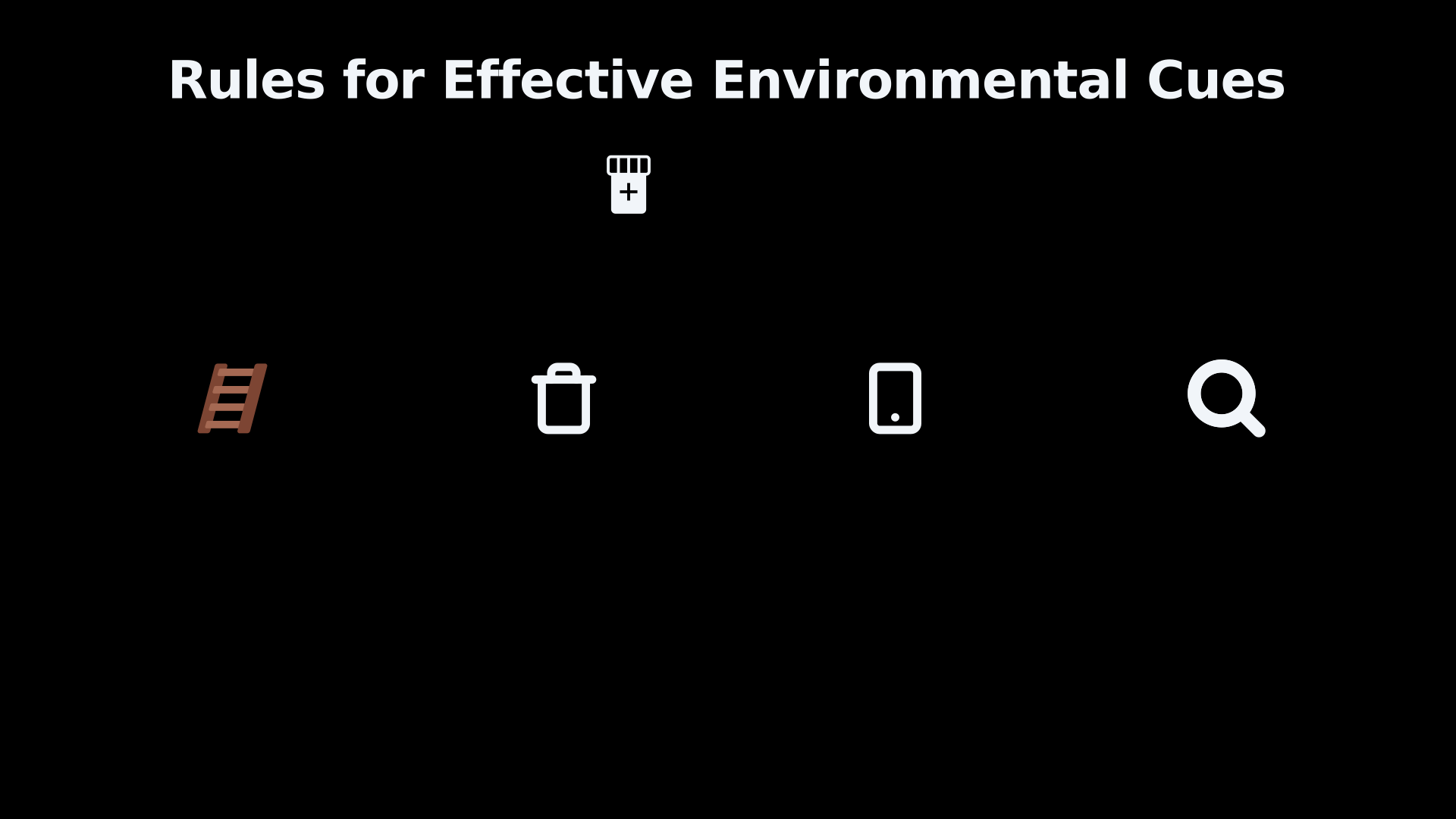
- Give each cue one behavioural job. “Put tomorrow’s medication beside the breakfast bowl” is clearer than surrounding the kitchen with generic health reminders.
- Place it at the decision point. Put the cue where the behaviour starts, not somewhere that merely receives plenty of traffic.
- Remove obsolete prompts. A reminder that is no longer needed, repeatedly ignored or attached to an abandoned goal adds clutter without useful information.
- Avoid duplicating the same message everywhere. Five reminders for one action may make that instruction more ubiquitous without making any individual encounter more meaningful.
- Treat persistent non-response as diagnostic information. Before adding another prompt, check whether the problem is actually timing, friction, an unclear action or an unrealistic intention.
- Let successful repetition replace prompting where possible. The eventual aim is not to maintain an ever-growing reminder system, but to make the desired response reliably associated with the relevant situation.
There is no universal exposure count after which a reminder “wears out”. Field evidence is heterogeneous: some signage interventions retain effects for extended periods, and a six-month university-building study, for example, found a significant increase in stair climbing at its later measurement despite very high potential exposure to the posters.[PubMed Central (PMC)]pmc.ncbi.nlm.nih.govOpen source on nih.gov. That is an important corrective to any claim that habituation is inevitable on a fixed timetable.
What the evidence supports is a more conditional conclusion. Repeated exposure can reduce attentional capture, and behavioural prompt effects can decay, particularly when the cue becomes predictable or supplies little useful information. Yet persistence depends on the behaviour, context, cue design and opportunity to act.[PubMed]pubmed.ncbi.nlm.nih.govPub Med Habituation (of attentional capture) is not what you think it isHabituation (of attentional capture) is not what you think it is - PubMed…
For self-improvement, the useful principle is therefore not “keep reminders fresh” so much as keep reminders consequential. A cue earns its place when noticing it leads naturally towards a clear action at the right moment. Once it becomes another object to look past, adding more of the same is unlikely to solve the underlying problem.
Amazon book picks
Further Reading
Books and field guides related to When Do Environmental Reminders Stop Getting Noticed?. Use these as the next step if you want deeper reading beyond the article.
Tiny Habits
Improving your life is much easier than you think. Whether it’s losing weight, sleeping more, or restoring your work/life balance – the s...
Atomic Habits
Rating: 3.5/5 from 7 Google Books ratings
The #1 New York Times bestseller. Over 25 million copies sold! Translated into 60+ languages! Tiny Changes, Remarkable Results No matter...
The Power of Habit
Rating: 4.0/5 from 145 Google Books ratings
Duhigg takes us to the edge of scientific discoveries that explain why habits exist and how they can be changed. Distilling information i...
Nudge
Rating: 3.5/5 from 29 Google Books ratings
Thaler and Sunstein offer a groundbreaking discussion of how to apply the science of choice to nudge people toward decisions that can imp...
eBay marketplace picks
Marketplace Samples
Live-tested eBay searches with available results related to this page.
Selected frommotivational poster oneBay.co.uk.


Endnotes
1.
Source: bmjopen.bmj.com
Link:https://bmjopen.bmj.com/content/7/11/e012459
Source snippet
BMJ OpenIs there sufficient evidence regarding signage-based stair use interventions? A sequential meta-analysis | BMJ OpenNovember 1, 2017...
Published: November 1, 2017
2.
Source: doi.org
Link:https://doi.org/10.1002/EJSP.205
3.
Source: doi.org
Link:https://doi.org/10.1521/SOCO.2007.25.2.248
4.
Source: doi.org
Title: Batching smartphone [notifications]({{ ‘notifications/’ | relative_url }}) can improve well-being
Link:https://doi.org/10.1016/j.chb.2019.07.016
5.
Source: pmc.ncbi.nlm.nih.gov
Link:https://pmc.ncbi.nlm.nih.gov/articles/PMC3730051/
Source snippet
PubMed Central (PMC)Novelty, attention, and challenges for developmental psychology - PMCAugust 1, 2013...
Published: August 1, 2013
6.
Source: pubmed.ncbi.nlm.nih.gov
Link:https://pubmed.ncbi.nlm.nih.gov/26927305/
Source snippet
Short-term and long-term plasticity in the visual-attention system: Evidence from habituation of attentional capture - PubMed...
7.
Source: pubmed.ncbi.nlm.nih.gov
Link:https://pubmed.ncbi.nlm.nih.gov/28950159/
Source snippet
Getting more people on the stairs: The impact of point-of-decision prompts - PubMed...
8.
Source: pubmed.ncbi.nlm.nih.gov
Title: Pub Med Habituation (of attentional capture) is not what you think it is
Link:https://pubmed.ncbi.nlm.nih.gov/37339053/
Source snippet
Habituation (of attentional capture) is not what you think it is - PubMed...
9.
Source: pubmed.ncbi.nlm.nih.gov
Link:https://pubmed.ncbi.nlm.nih.gov/28547537/
Source snippet
Filtering visual onsets via habituation: A context-specific long-term memory of irrelevant stimuli - PubMed...
10.
Source: journals.sagepub.com
Link:https://journals.sagepub.com/doi/10.4278/ajhp.120816-ARB-398
Source snippet
Sage JournalsPoint-of-Decision Signs and Stair Use in a University Worksite Setting: General versus Specific Messages - Mary R. Eckhardt...
11.
Source: pubmed.ncbi.nlm.nih.gov
Link:https://pubmed.ncbi.nlm.nih.gov/36945870/
Source snippet
A thorough examination of cue specificity and task-appropriateness in defining focal and nonfocal prospective memory tasks - PubMed...
12.
Source: pubmed.ncbi.nlm.nih.gov
Link:https://pubmed.ncbi.nlm.nih.gov/19130080/
13.
Source: pubmed.ncbi.nlm.nih.gov
Link:https://pubmed.ncbi.nlm.nih.gov/20117614/
14.
Source: pmc.ncbi.nlm.nih.gov
Link:https://pmc.ncbi.nlm.nih.gov/articles/PMC5730820/
15.
Source: pubmed.ncbi.nlm.nih.gov
Link:https://pubmed.ncbi.nlm.nih.gov/29191800/
16.
Source: pubmed.ncbi.nlm.nih.gov
Link:https://pubmed.ncbi.nlm.nih.gov/28395667/
17.
Source: pmc.ncbi.nlm.nih.gov
Link:https://pmc.ncbi.nlm.nih.gov/articles/PMC5387195/
18.
Source: pmc.ncbi.nlm.nih.gov
Link:https://pmc.ncbi.nlm.nih.gov/articles/PMC12181921/
19.
Source: pmc.ncbi.nlm.nih.gov
Link:https://pmc.ncbi.nlm.nih.gov/articles/PMC4778561/
20.
Source: jamanetwork.com
Link:https://jamanetwork.com/journals/jamanetworkopen/fullarticle/2753399
21.
Source: pmc.ncbi.nlm.nih.gov
Link:https://pmc.ncbi.nlm.nih.gov/articles/PMC6820039/
22.
Source: pmc.ncbi.nlm.nih.gov
Link:https://pmc.ncbi.nlm.nih.gov/articles/PMC7998073/
23.
Source: pmc.ncbi.nlm.nih.gov
Link:https://pmc.ncbi.nlm.nih.gov/articles/PMC10151484/
24.
Source: pmc.ncbi.nlm.nih.gov
Link:https://pmc.ncbi.nlm.nih.gov/articles/PMC13032586/
25.
Source: pmc.ncbi.nlm.nih.gov
Link:https://pmc.ncbi.nlm.nih.gov/articles/PMC12860545/
26.
Source: pubmed.ncbi.nlm.nih.gov
Link:https://pubmed.ncbi.nlm.nih.gov/40594143/
27.
Source: pubmed.ncbi.nlm.nih.gov
Link:https://pubmed.ncbi.nlm.nih.gov/40569721/
28.
Source: pmc.ncbi.nlm.nih.gov
Link:https://pmc.ncbi.nlm.nih.gov/articles/PMC11992819/
29.
Source: pubmed.ncbi.nlm.nih.gov
Link:https://pubmed.ncbi.nlm.nih.gov/38888717/
30.
Source: dictionary.apa.org
Link:https://dictionary.apa.org/habituation
31.
Source: pmc.ncbi.nlm.nih.gov
Link:https://pmc.ncbi.nlm.nih.gov/articles/PMC10621293/
32.
Source: pmc.ncbi.nlm.nih.gov
Link:https://pmc.ncbi.nlm.nih.gov/articles/PMC10377027/
33.
Source: pubmed.ncbi.nlm.nih.gov
Link:https://pubmed.ncbi.nlm.nih.gov/37294612/
34.
Source: pmc.ncbi.nlm.nih.gov
Link:https://pmc.ncbi.nlm.nih.gov/articles/PMC9714722/
35.
Source: pmc.ncbi.nlm.nih.gov
Link:https://pmc.ncbi.nlm.nih.gov/articles/PMC10305802/
36.
Source: pmc.ncbi.nlm.nih.gov
Link:https://pmc.ncbi.nlm.nih.gov/articles/PMC9424650/
37.
Source: pmc.ncbi.nlm.nih.gov
Link:https://pmc.ncbi.nlm.nih.gov/articles/PMC8818949/
38.
Source: pmc.ncbi.nlm.nih.gov
Link:https://pmc.ncbi.nlm.nih.gov/articles/PMC8381742/
39.
Source: pubmed.ncbi.nlm.nih.gov
Link:https://pubmed.ncbi.nlm.nih.gov/34864068/
40.
Source: pmc.ncbi.nlm.nih.gov
Link:https://pmc.ncbi.nlm.nih.gov/articles/PMC9233633/
41.
Source: pubmed.ncbi.nlm.nih.gov
Link:https://pubmed.ncbi.nlm.nih.gov/34253661/
42.
Source: pmc.ncbi.nlm.nih.gov
Link:https://pmc.ncbi.nlm.nih.gov/articles/PMC8168884/
43.
Source: jamanetwork.com
Link:https://jamanetwork.com/journals/jamanetworkopen/fullarticle/2777872
44.
Source: pubmed.ncbi.nlm.nih.gov
Link:https://pubmed.ncbi.nlm.nih.gov/33769509/
45.
Source: communications.gov.uk
Title: The principles of behaviour change
Link:https://www.communications.gov.uk/publication/the-principles-of-behaviour-change-communications/
46.
Source: pubmed.ncbi.nlm.nih.gov
Link:https://pubmed.ncbi.nlm.nih.gov/33352252/
47.
Source: pmc.ncbi.nlm.nih.gov
Link:https://pmc.ncbi.nlm.nih.gov/articles/PMC7751389/
48.
Source: pmc.ncbi.nlm.nih.gov
Link:https://pmc.ncbi.nlm.nih.gov/articles/PMC8091486/
49.
Source: pmc.ncbi.nlm.nih.gov
Link:https://pmc.ncbi.nlm.nih.gov/articles/PMC7140383/
50.
Source: pubmed.ncbi.nlm.nih.gov
Link:https://pubmed.ncbi.nlm.nih.gov/32250138/
51.
Source: pmc.ncbi.nlm.nih.gov
Link:https://pmc.ncbi.nlm.nih.gov/articles/PMC7106637/
52.
Source: pubmed.ncbi.nlm.nih.gov
Link:https://pubmed.ncbi.nlm.nih.gov/31642930/
53.
Source: pubmed.ncbi.nlm.nih.gov
Link:https://pubmed.ncbi.nlm.nih.gov/31642930/?dopt=Abstract
54.
Source: pmc.ncbi.nlm.nih.gov
Link:https://pmc.ncbi.nlm.nih.gov/articles/PMC6724306/
55.
Source: pmc.ncbi.nlm.nih.gov
Link:https://pmc.ncbi.nlm.nih.gov/articles/PMC6688541/
56.
Source: pmc.ncbi.nlm.nih.gov
Link:https://pmc.ncbi.nlm.nih.gov/articles/PMC6748819/
57.
Source: pubmed.ncbi.nlm.nih.gov
Link:https://pubmed.ncbi.nlm.nih.gov/30445047/
58.
Source: pmc.ncbi.nlm.nih.gov
Link:https://pmc.ncbi.nlm.nih.gov/articles/PMC6969219/
59.
Source: pmc.ncbi.nlm.nih.gov
Link:https://pmc.ncbi.nlm.nih.gov/articles/PMC6293241/
60.
Source: pmc.ncbi.nlm.nih.gov
Link:https://pmc.ncbi.nlm.nih.gov/articles/PMC6070398/
61.
Source: pmc.ncbi.nlm.nih.gov
Link:https://pmc.ncbi.nlm.nih.gov/articles/PMC6263784/
62.
Source: pubmed.ncbi.nlm.nih.gov
Link:https://pubmed.ncbi.nlm.nih.gov/30077422/
63.
Source: dictionary.apa.org
Link:https://dictionary.apa.org/attention
64.
Source: pmc.ncbi.nlm.nih.gov
Link:https://pmc.ncbi.nlm.nih.gov/articles/PMC5719260/
65.
Source: pubmed.ncbi.nlm.nih.gov
Link:https://pubmed.ncbi.nlm.nih.gov/28550001/
66.
Source: pmc.ncbi.nlm.nih.gov
Link:https://pmc.ncbi.nlm.nih.gov/articles/PMC5466696/
67.
Source: pmc.ncbi.nlm.nih.gov
Link:https://pmc.ncbi.nlm.nih.gov/articles/5387195/
68.
Source: pubmed.ncbi.nlm.nih.gov
Link:https://pubmed.ncbi.nlm.nih.gov/27274015/
69.
Source: pmc.ncbi.nlm.nih.gov
Link:https://pmc.ncbi.nlm.nih.gov/articles/PMC6987850/
70.
Source: pmc.ncbi.nlm.nih.gov
Link:https://pmc.ncbi.nlm.nih.gov/articles/PMC7651895/
71.
Source: pubmed.ncbi.nlm.nih.gov
Link:https://pubmed.ncbi.nlm.nih.gov/27207873/
72.
Source: pmc.ncbi.nlm.nih.gov
Link:https://pmc.ncbi.nlm.nih.gov/articles/PMC4868976/
73.
Source: pubmed.ncbi.nlm.nih.gov
Link:https://pubmed.ncbi.nlm.nih.gov/27185531/
74.
Source: pubmed.ncbi.nlm.nih.gov
Link:https://pubmed.ncbi.nlm.nih.gov/26663904/
75.
Source: pubmed.ncbi.nlm.nih.gov
Link:https://pubmed.ncbi.nlm.nih.gov/26121498/
76.
Source: journals.sagepub.com
Link:https://journals.sagepub.com/doi/full/10.1089/env.2014.0031
77.
Source: pubmed.ncbi.nlm.nih.gov
Link:https://pubmed.ncbi.nlm.nih.gov/24670074/
78.
Source: pubmed.ncbi.nlm.nih.gov
Link:https://pubmed.ncbi.nlm.nih.gov/21864319/
79.
Source: pmc.ncbi.nlm.nih.gov
Link:https://pmc.ncbi.nlm.nih.gov/articles/PMC2864946/
80.
Source: pubmed.ncbi.nlm.nih.gov
Link:https://pubmed.ncbi.nlm.nih.gov/20190266/
81.
Source: pmc.ncbi.nlm.nih.gov
Link:https://pmc.ncbi.nlm.nih.gov/articles/PMC3167676/
82.
Source: pmc.ncbi.nlm.nih.gov
Link:https://pmc.ncbi.nlm.nih.gov/articles/PMC2758574/
83.
Source: pmc.ncbi.nlm.nih.gov
Link:https://pmc.ncbi.nlm.nih.gov/articles/PMC2605404/
84.
Source: pmc.ncbi.nlm.nih.gov
Link:https://pmc.ncbi.nlm.nih.gov/articles/PMC2684766/
85.
Source: pmc.ncbi.nlm.nih.gov
Link:https://pmc.ncbi.nlm.nih.gov/articles/PMC3645482/
86.
Source: pubmed.ncbi.nlm.nih.gov
Link:https://pubmed.ncbi.nlm.nih.gov/11011871/
87.
Source: pubmed.ncbi.nlm.nih.gov
Link:https://pubmed.ncbi.nlm.nih.gov/25957368/
88.
Source: pmc.ncbi.nlm.nih.gov
Link:https://pmc.ncbi.nlm.nih.gov/articles/PMC10983371/
89.
Source: pubmed.ncbi.nlm.nih.gov
Link:https://pubmed.ncbi.nlm.nih.gov/25087519/
90.
Source: pubmed.ncbi.nlm.nih.gov
Link:https://pubmed.ncbi.nlm.nih.gov/8975233/
91.
Source: pubmed.ncbi.nlm.nih.gov
Link:https://pubmed.ncbi.nlm.nih.gov/20205020/
92.
Source: pubmed.ncbi.nlm.nih.gov
Link:https://pubmed.ncbi.nlm.nih.gov/3760775/
93.
Source: pubmed.ncbi.nlm.nih.gov
Link:https://pubmed.ncbi.nlm.nih.gov/7056900/
94.
Source: pubmed.ncbi.nlm.nih.gov
Link:https://pubmed.ncbi.nlm.nih.gov/29435962/
95.
Source: pubmed.ncbi.nlm.nih.gov
Link:https://pubmed.ncbi.nlm.nih.gov/20234020/
96.
Source: pubmed.ncbi.nlm.nih.gov
Link:https://pubmed.ncbi.nlm.nih.gov/22839984/
97.
Source: pubmed.ncbi.nlm.nih.gov
Link:https://pubmed.ncbi.nlm.nih.gov/29112077/
98.
Source: pubmed.ncbi.nlm.nih.gov
Link:https://pubmed.ncbi.nlm.nih.gov/18648124/
99.
Source: pubmed.ncbi.nlm.nih.gov
Link:https://pubmed.ncbi.nlm.nih.gov/17658143/
100.
Source: cdc.thehcn.net
Link:https://cdc.thehcn.net/promisepractice/index/view?pid=4050
101.
Source: journals.sagepub.com
Link:https://journals.sagepub.com/doi/10.2466/pms.2000.91.1.55
102.
Source: journals.sagepub.com
Link:https://journals.sagepub.com/doi/abs/10.1177/154193120104502204
103.
Source: ten2030.org
Link:https://www.ten2030.org/promisepractice/index/view?pid=4050
Additional References
104.
Source: sciencedirect.com
Link:https://www.sciencedirect.com/science/article/abs/pii/S0277953617305403
Source snippet
Getting more people on the stairs: The impact of point-of-decision prompts - ScienceDirect...
105.
Source: youtube.com
Title: Response & Stimulus Prompts Explained — How Small Cues Shape Big Behaviors
Link:https://www.youtube.com/watch?v=CCLWjSFrvE8
Source snippet
Alert fatigue why reminders stop working psychology habituation ⚠️ 4 Signs Of Burnout 🔥 - Dr Julie #shorts...
106.
Source: youtube.com
Title: Habituation, “clutter blindness”, and hoarding with Dr Jan Eppingstall
Link:https://www.youtube.com/watch?v=tM-stYWmVbQ
Source snippet
Habituation in Psychology – Why We Stop Noticing Things...
107.
Source: youtube.com
Title: Habituation in Psychology – Why We Stop Noticing Things
Link:https://www.youtube.com/watch?v=ipw6UtO0_u0
Source snippet
Response & Stimulus Prompts Explained — How Small Cues Shape Big Behaviors...
108.
Source: youtube.com
Title: Non associative learning | Behavior | MCAT | Khan Academy
Link:https://www.youtube.com/watch?v=ABUzqfD8vWg
Source snippet
Habituation, "clutter blindness", and hoarding with Dr Jan Eppingstall...
109.
Source: cdc.gov
Title: Strategies for Prompts to Encourage [Physical Activity]({{ ‘physical-capacity/’ | relative_url }}) | Physical Activity | CDC
Link:https://www.cdc.gov/physical-activity/php/strategies/encouraging-physical-activity.html
110.
Source: youtube.com
Title: Habituation in Psychology (Explained in 3 Minutes)
Link:https://www.youtube.com/watch?v=o3lv69rntdQ
Source snippet
Non associative learning | Behavior | MCAT | Khan Academy...
111.
Source: researchgate.net
Link:https://www.researchgate.net/publication/325052703_Altering_micro-environments_to_change_population_health_behaviour_towards_an_evidence_base_for_choice_architecture_interventions
112.
Source: researchgate.net
Link:https://www.researchgate.net/publication/336764853_Effect_of_Frequency_of_Changing_Point-of-Use_Reminder_Signs_on_Health_Care_Worker_Hand_Hygiene_Adherence_A_Cluster_Randomized_Clinical_Trial
113.
Source: researchgate.net
Link:https://www.researchgate.net/publication/335598731_Nudging_to_move_a_scoping_review_of_the_use_of_choice_architecture_interventions_to_promote_physical_activity_in_the_general_population