Within The Idea That Inconsistent People Simply Need “more Willpower”
How a Few Extra Steps Can Change Behavior
Adding or removing a few steps can shift behavior by changing how easy an action is at the moment of choice.
On this page
- What behavioral friction means
- The workplace snack station example
- Where friction helps and where its effects fade
Page outline Jump by section
Introduction
A habit can become easier or harder without changing the person’s motivation at all. Sometimes the decisive change is mundane: putting an object within reach, moving food a few metres away, removing a login step, preparing equipment in advance, or inserting a short delay before an impulsive action. Behavioural researchers often describe these small physical and procedural obstacles as friction costs. They matter because intentions have to survive the practical effort required at the moment of action. The OECD notes that even minor obstacles can encourage delay and inertia, while reducing clicks, questions or other required actions can increase follow-through.[OECD]oecd.orgcomponent 6The BASIC Manual: Tools and Ethics for Applied Behavioural Insights: The BASIC Toolkit | OECDJune 18, 2019…
This is one reason effective self-improvement need not depend on repeatedly winning battles of willpower. Instead of asking only, “How do I become more disciplined?”, it can be useful to ask a narrower implementation question: Which behaviour is currently easiest to perform, and can a few steps be moved from the behaviour I want to the behaviour I do not?
What behavioural friction means
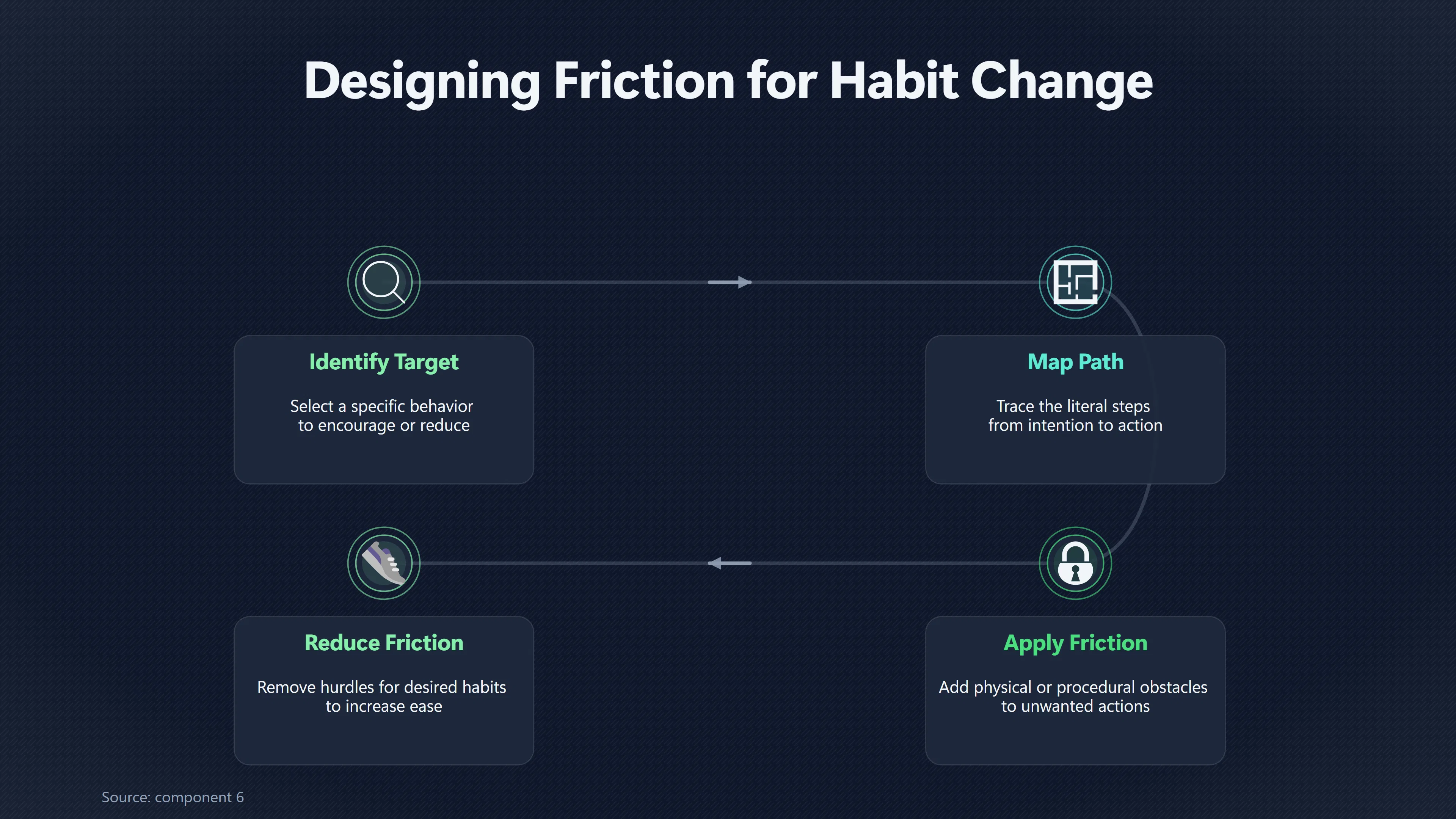
Friction is the effort separating an intention from an action. In its most literal form it is physical: standing up, walking across a room, opening a cupboard or retrieving something from another floor. But the same principle can apply procedurally. Finding a password, navigating several screens, completing another form or waiting through a delay all make an action slightly more troublesome.
The important point is that friction need not make an action impossible. It changes its relative convenience at the moment of choice. The UK Behavioural Insights Team’s EAST framework therefore recommends reducing the “hassle factor” when trying to encourage behaviour. Its examples include sending taxpayers directly to the relevant form rather than making them navigate through an intermediate webpage. The OECD similarly recommends examining the actual sequence people must follow and reducing unnecessary actions, clicks and questions.[Behaviour Change]behaviourchange.hee.nhs.ukBehaviour Change EASYTIMELY ATTRACTIVE SOCIAL EAST Four simple wayApril 14, 2014…
For personal habits, this suggests a practical distinction between two kinds of environmental change:
- Reduce friction for the behaviour you want. Put running shoes where they are encountered before a planned run; keep the document you need to work on readily accessible; prepare ingredients before the point when cooking competes with ordering food.
- Add modest friction to the behaviour you want less of. Put tempting food somewhere that requires getting up; keep a distracting device out of immediate reach; log out of an attention-grabbing service rather than leaving it continuously available.
These interventions are deliberately small. Their purpose is not to create an impregnable barrier. It is to alter what happens during the brief interval in which an intention either becomes behaviour or disappears.
That distinction also prevents “friction” becoming a vague synonym for every influence on behaviour. A motivational speech may change how much somebody wants to exercise; a reminder may make the intention salient; a social commitment may create accountability. Friction specifically concerns how much effort or inconvenience lies on the path to acting.
A few metres changed workplace snacking
One unusually concrete illustration comes from a 2016 field study conducted in a heavily used micro-kitchen at Google’s New York office. Employees could obtain drinks from two otherwise identical beverage stations. One was about 6 feet 5 inches (roughly 2 metres) from a snack station; the other was 17 feet 6 inches (roughly 5.3 metres) away. The snacks remained available either way. The researchers were testing whether those additional metres were enough to influence what employees did.[ScienceDirect]sciencedirect.comProximity of snacks to beverages increases food consumption in the workplace: A field study - ScienceDirectAugust 1, 2016…
They were. Among men, the observed likelihood of taking a snack was 23% when they used the nearer beverage station versus 12% at the farther station. Among women, it was 17% versus 13%. Nothing had been banned, nobody had to pay more and the distant station was hardly an expedition. The relevant environmental difference was simply that pairing a drink with a snack required a little more movement.[ScienceDirect]sciencedirect.comProximity of snacks to beverages increases food consumption in the workplace: A field study - ScienceDirectAugust 1, 2016…
That makes the study useful for understanding friction rather than merely workplace nutrition. An additional eleven feet or so seems trivial when considered abstractly. At the exact moment when somebody already has their drink, however, those feet separate an effortless add-on from a separate action. The intervention therefore works upstream of a classic self-control struggle: fewer people arrive at the point of physically taking the snack.
The finding is consistent with a broader experimental literature on food proximity. A 2019 Cochrane review identified 18 randomised studies manipulating proximity. In a meta-analysis of 15 comparisons from 12 studies involving 1,098 participants, placing food farther away was associated with moderately lower consumption. Greater distances tended to produce larger effects.[Cochrane]cochrane.orgAltering the availability or proximity of food, alcohol, and tobacco products to change their selection and consumption | Cochran…
That broader evidence matters because a memorable workplace experiment can otherwise invite an overly tidy conclusion. The Cochrane authors rated the certainty of the evidence for the consumption result as low, noting risk-of-bias concerns, the predominance of laboratory research and a need for better long-term real-world studies. The safer conclusion is therefore not that moving something a precise number of metres reliably produces a particular percentage reduction. It is that proximity is capable of changing consumption, while the size and durability of that effect depend on context.[Cochrane]cochrane.orgAltering the availability or proximity of food, alcohol, and tobacco products to change their selection and consumption | Cochran…
Friction works beyond physical distance
The same implementation logic can operate in digital environments. A distracting action may require virtually no physical movement, yet designers can still change the number of moments separating impulse from consumption.
A preregistered field experiment involving 112 participants compared strategies for reducing smartphone screen time. A design-friction intervention using greyscale produced an immediate significant reduction in objectively measured screen time relative to a self-monitoring control, whereas goal-setting produced a smaller, more gradual reduction. The study did not find corresponding immediate improvements in subjective wellbeing or academic performance, which is an important boundary: changing a behaviour is not automatically the same thing as producing every hoped-for downstream benefit.[PubMed]pubmed.ncbi.nlm.nih.govDigital Strategies for Screen Time Reduction: A Randomized Field Experiment - PubMedDecember 26, 2022…
Research on the self-nudge app One Sec provides another example of inserting a break into digital consumption. Experimental work testing features including a delay before content consumption found that time-based friction reduced consumption behaviour; importantly, offering users an explicit opportunity to dismiss the content was particularly effective. A message alone was not. The result fits the broader implementation principle: changing the action sequence can matter more than simply telling somebody what they ought to do.[PubMed Central (PMC)]pmc.ncbi.nlm.nih.govPub Med Central (PMC)Directing smartphone use through the self-nudge app one secPub Med Central (PMC)Directing smartphone use through the self-nudge app one sec
Procedural friction can matter on a much larger scale too. In a randomised experiment involving Massachusetts health-insurance enrolment, simplifying the process with a “check the box” intervention increased enrolment by 11%, outperforming personalised and generic reminder letters. The effect was concentrated among people eligible for zero-premium plans, for whom additional payment-related administrative barriers did not remain. That is a particularly clean illustration of why motivation or economic incentives alone cannot explain behaviour: even when the financial price is zero, the process can still carry a meaningful behavioural cost.[National Bureau of Economic Research]nber.orgOpen source on nber.org.
For everyday self-improvement, the analogy should not be pushed too far: enrolling in health insurance is not the same as establishing a morning routine. But the implementation lesson transfers. When somebody repeatedly intends to perform an action yet fails at the same procedural point, adding more reasons to want the outcome may be less useful than inspecting that point of failure.
Where friction helps — and where its effects fade
Friction is most useful when the desired or undesired behaviour is already close to a threshold. If someone is mildly tempted to check a distracting app, having to retrieve the phone from another room may be enough to interrupt the impulse. If someone strongly intends to use it, the walk will probably only delay them. Likewise, laying out exercise clothes can remove a small obstacle to an intended workout; it cannot reliably manufacture a desire to exercise where none exists.
That is why friction should be treated as an implementation lever, not a universal theory of behaviour. The food-proximity evidence illustrates the limitation particularly well. Systematic reviews generally find that positioning can influence food choice or consumption, but they also flag weak study designs, limited real-world evidence and uncertainty about longer-term or compensatory effects. A 2016 systematic review concluded that food order and proximity can influence choice while calling for stronger studies that measure actual intake and examine whether people compensate later.[PubMed]pubmed.ncbi.nlm.nih.govOpen source on nih.gov.
There is also no law saying that less friction is always better. Recent evidence offers an interesting counterexample. A 2026 field experiment involving 27,227 people signing up for a carpool platform found that a more effortful sign-up process produced 25% fewer sign-ups but more subsequent use: participants assigned to the higher-friction process took 1.6 times as many carpool trips per week over four months on an intention-to-treat basis. A second experiment found greater next-day return among participants who faced a more effortful sign-up. The researchers describe this as a potential “buy-in effect”.[CEPR]cepr.orgOpen source on cepr.org.
That finding does not overturn the larger evidence that unnecessary hassle suppresses action. It shows that the outcome being optimised matters. Removing friction can increase initial uptake; in some circumstances, requiring a modest initial investment may screen for commitment or strengthen subsequent engagement. For habit design, therefore, “make everything effortless” is too crude a rule.
A better implementation test is to identify the behaviour and the precise stage that matters:
For initiation, remove avoidable preparation. If exercise repeatedly dies between “I should go” and “I am ready to leave”, preparing clothing and equipment beforehand targets the relevant friction.
For unwanted impulses, add a small interruption. Distance, an extra retrieval step or a short digital delay can create a point at which an automatic sequence can stop.
For repetition, avoid making the desired routine unnecessarily elaborate. A system that requires several preparatory rituals may work while enthusiasm is high but become fragile on busy days.
For consequential actions, retain useful friction. Confirmation screens, deliberate review and other pauses can protect against mistakes. Convenience is not automatically desirable when impulsive action itself is the problem.
Design the path, not just the intention
The practical value of friction is that it turns an abstract goal into something observable. Instead of asking why discipline failed, trace the literal path from intention to behaviour: Where is the object? How many actions are required? What has to be found, opened, remembered or prepared? Which alternative is immediately available?
Then make a deliberately small change. A useful habit might be moved one step closer: equipment prepared, materials placed at the point of use, an unnecessary screen removed. An unwanted habit might be moved one step farther away: the object relocated, automatic access disabled or a brief pause inserted. Behavioural-insights guidance explicitly recommends mapping real behaviour in this way rather than assuming people follow the process designers imagine for them.[OECD]oecd.orgIntroductory guide to BASIC: Tools and Ethics for Applied Behavioural Insights: The BASIC Toolkit | OECD…
The evidence does not support the magical version of this idea, in which moving a biscuit tin or adding a login screen permanently transforms behaviour. Effects vary, people adapt, strong preferences can overwhelm modest barriers, and downstream outcomes may not change merely because one behaviour does. But that is precisely why friction is a useful systems tool rather than a motivational slogan. It asks for no new personality trait. It changes the small piece of the environment that repeatedly meets a person at the moment of choice.
For self-improvement that survives ordinary fluctuations in motivation, that can be enough to matter: make the behaviour you want slightly easier to begin, and make the behaviour you want less of slightly less automatic.
Amazon book picks
Further Reading
Books and field guides related to How a Few Extra Steps Can Change Behavior. Use these as the next step if you want deeper reading beyond the article.
Nudge
Rating: 3.5/5 from 29 Google Books ratings
Thaler and Sunstein offer a groundbreaking discussion of how to apply the science of choice to nudge people toward decisions that can imp...
Atomic Habits
Rating: 3.5/5 from 7 Google Books ratings
The #1 New York Times bestseller. Over 25 million copies sold! Translated into 60+ languages! Tiny Changes, Remarkable Results No matter...
Tiny Habits
Improving your life is much easier than you think. Whether it’s losing weight, sleeping more, or restoring your work/life balance – the s...
Thinking, Fast and Slow
Why is there more chance we'll believe something if it's in a bold type face? Why are judges more likely to deny parole before lunch? Why...
eBay marketplace picks
Marketplace Samples
Live-tested eBay searches with available results related to this page.
Selected fromdesk organizer oneBay.co.uk.

Endnotes
1.
Source: oecd.org
Title: component 6
Link:https://www.oecd.org/en/publications/tools-and-ethics-for-applied-behavioural-insights-the-basic-toolkit_9ea76a8f-en/full-report/component-6.html
Source snippet
The BASIC Manual: Tools and Ethics for Applied Behavioural Insights: The BASIC Toolkit | OECDJune 18, 2019...
Published: June 18, 2019
2.
Source: oecd.org
Link:https://www.oecd.org/en/publications/tools-and-ethics-for-applied-behavioural-insights-the-basic-toolkit_9ea76a8f-en/full-report/component-5.html
Source snippet
Introductory guide to BASIC: Tools and Ethics for Applied Behavioural Insights: The BASIC Toolkit | OECD...
3.
Source: sciencedirect.com
Link:https://www.sciencedirect.com/science/article/pii/S0195666316301465
Source snippet
Proximity of snacks to beverages increases food consumption in the workplace: A field study - ScienceDirectAugust 1, 2016...
Published: August 1, 2016
4.
Source: cochrane.org
Link:https://www.cochrane.org/evidence/CD012573_altering-availability-or-proximity-food-alcohol-and-tobacco-products-change-their-selection-and
Source snippet
Altering the availability or proximity of food, alcohol, and tobacco products to change their selection and consumption | Cochran...
5.
Source: cepr.org
Link:https://cepr.org/publications/dp21442
6.
Source: sciencedirect.com
Link:https://www.sciencedirect.com/org/science/article/pii/S2561326X26003124
7.
Source: sciencedirect.com
Link:https://www.sciencedirect.com/org/science/article/pii/S2291522226000781
8.
Source: oecd.org
Title: bpa for administrative processes 18845aae
Link:https://www.oecd.org/en/publications/applying-behavioural-science-in-the-italian-public-administration_a7d9d7d9-en/full-report/bpa-for-administrative-processes_18845aae.html
9.
Source: sciencedirect.com
Title: Present focus and billing systems: Testing ‘pay-as-you-go’ vs. ‘pay-later’
Link:https://www.sciencedirect.com/science/article/pii/S0167268123001853
10.
Source: sciencedirect.com
Link:https://www.sciencedirect.com/science/article/pii/S0195666322000691
11.
Source: cochrane.org
Link:https://www.cochrane.org/fr/CD012573/PUBHLTH_modification-de-la-disponibilite-ou-la-proximite-daliments-de-lalcool-et-des-produits-du-tabac-pour
12.
Source: ph.cochrane.org
Title: can changes food environments influence consumption
Link:https://ph.cochrane.org/news/can-changes-food-environments-influence-consumption
13.
Source: cochrane.org
Link:https://www.cochrane.org/news/featured-review-how-simple-changes-food-environments-could-reduce-overconsumption
14.
Source: cochrane.org
Link:https://www.cochrane.org/about-us/news/featured-review-how-simple-changes-food-environments-could-reduce-overconsumption
15.
Source: oecd.org
Title: tools and ethics for applied behavioural insights the basic toolkit 9ea76a8f en
Link:https://www.oecd.org/en/publications/tools-and-ethics-for-applied-behavioural-insights-the-basic-toolkit_9ea76a8f-en.html
16.
Source: sciencedirect.com
Link:https://www.sciencedirect.com/science/article/abs/pii/S0195666316301465
17.
Source: sciencedirect.com
Link:https://www.sciencedirect.com/journal/appetite/vol/103/suppl/C
18.
Source: sciencedirect.com
Link:https://www.sciencedirect.com/journal/appetite/vol/103
19.
Source: sciencedirect.com
Title: It takes some effort. How minimal physical effort reduces consumption volume
Link:https://www.sciencedirect.com/science/article/pii/S0195666313003437
20.
Source: books.google.com
Title: The Office Candy Dish
Link:https://books.google.com/books/about/The_Office_Candy_Dish.html?id=pofbzwEACAAJ
21.
Source: ph.cochrane.org
Title: nutrition food supply and access reviews
Link:https://ph.cochrane.org/nutrition-food-supply-and-access-reviews
22.
Source: ph.cochrane.org
Title: systems health reviews
Link:https://ph.cochrane.org/systems-health-reviews
23.
Source: sciencedirect.com
Title: ravi dhar
Link:https://www.sciencedirect.com/author/35268569400/ravi-dhar
24.
Source: oecd.org
Link:https://www.oecd.org/en/topics/sub-issues/consumer-behavioural-insights.html
25.
Source: ajcn.nutrition.org
Link:https://ajcn.nutrition.org/article/S0002-9165%2822%2902785-X/fulltext
26.
Source: behaviourchange.hee.nhs.uk
Title: Behaviour Change EASY
Link:https://behaviourchange.hee.nhs.uk/downloads/toolkit/BIT-Publication-EAST_FA_WEB%2818%29.pdf
Source snippet
TIMELY ATTRACTIVE SOCIAL EAST Four simple wayApril 14, 2014...
Published: April 14, 2014
27.
Source: pubmed.ncbi.nlm.nih.gov
Link:https://pubmed.ncbi.nlm.nih.gov/27112315/
Source snippet
Proximity of snacks to beverages increases food consumption in the workplace: A field study - PubMed...
28.
Source: pmc.ncbi.nlm.nih.gov
Link:https://pmc.ncbi.nlm.nih.gov/articles/PMC6710643/
Source snippet
PubMed Central (PMC)Altering the availability or proximity of food, alcohol, and tobacco products to change their selection and consumpti...
29.
Source: pubmed.ncbi.nlm.nih.gov
Link:https://pubmed.ncbi.nlm.nih.gov/31452193/
Source snippet
Altering the availability or proximity of food, alcohol, and tobacco products to change their selection and consumption - PubMed...
30.
Source: pubmed.ncbi.nlm.nih.gov
Link:https://pubmed.ncbi.nlm.nih.gov/36577008/
Source snippet
Digital Strategies for Screen Time Reduction: A Randomized Field Experiment - PubMedDecember 26, 2022...
Published: December 26, 2022
31.
Source: pmc.ncbi.nlm.nih.gov
Title: Pub Med Central (PMC)Directing smartphone use through the self-nudge app one sec
Link:https://pmc.ncbi.nlm.nih.gov/articles/PMC9974409/
32.
Source: nber.org
Link:https://www.nber.org/papers/w30885
33.
Source: pubmed.ncbi.nlm.nih.gov
Link:https://pubmed.ncbi.nlm.nih.gov/27185414/
34.
Source: GOV.UK
Link:https://www.gov.uk/government/publications/social-media-restriction-pilots-qualitative-research-with-13-to-17-year-olds-in-the-uk/social-media-intervention-research-2026-social-media-restriction-pilots-qualitative-research-with-13-to-17-year-olds-in-the-uk
35.
Source: pubmed.ncbi.nlm.nih.gov
Link:https://pubmed.ncbi.nlm.nih.gov/41950504/
36.
Source: pmc.ncbi.nlm.nih.gov
Link:https://pmc.ncbi.nlm.nih.gov/articles/PMC13062480/
37.
Source: pmc.ncbi.nlm.nih.gov
Link:https://pmc.ncbi.nlm.nih.gov/articles/PMC12236104/
38.
Source: pmc.ncbi.nlm.nih.gov
Link:https://pmc.ncbi.nlm.nih.gov/articles/PMC11758673/
39.
Source: pmc.ncbi.nlm.nih.gov
Link:https://pmc.ncbi.nlm.nih.gov/articles/PMC11616344/
40.
Source: pmc.ncbi.nlm.nih.gov
Link:https://pmc.ncbi.nlm.nih.gov/articles/PMC10986070/
41.
Source: pubmed.ncbi.nlm.nih.gov
Link:https://pubmed.ncbi.nlm.nih.gov/36795756/
42.
Source: pubmed.ncbi.nlm.nih.gov
Link:https://pubmed.ncbi.nlm.nih.gov/35278590/
43.
Source: pmc.ncbi.nlm.nih.gov
Link:https://pmc.ncbi.nlm.nih.gov/articles/PMC9112639/
44.
Source: pubmed.ncbi.nlm.nih.gov
Link:https://pubmed.ncbi.nlm.nih.gov/34983836/
45.
Source: pmc.ncbi.nlm.nih.gov
Link:https://pmc.ncbi.nlm.nih.gov/articles/PMC8538928/
46.
Source: pmc.ncbi.nlm.nih.gov
Link:https://pmc.ncbi.nlm.nih.gov/articles/PMC8146080/
47.
Source: pubmed.ncbi.nlm.nih.gov
Link:https://pubmed.ncbi.nlm.nih.gov/33922185/
48.
Source: pmc.ncbi.nlm.nih.gov
Link:https://pmc.ncbi.nlm.nih.gov/articles/PMC7846383/
49.
Source: pmc.ncbi.nlm.nih.gov
Link:https://pmc.ncbi.nlm.nih.gov/articles/PMC6953356/
50.
Source: pmc.ncbi.nlm.nih.gov
Link:https://pmc.ncbi.nlm.nih.gov/articles/PMC6706889/
51.
Source: pubmed.ncbi.nlm.nih.gov
Link:https://pubmed.ncbi.nlm.nih.gov/31438908/
52.
Source: pmc.ncbi.nlm.nih.gov
Link:https://pmc.ncbi.nlm.nih.gov/articles/PMC6467569/
53.
Source: pubmed.ncbi.nlm.nih.gov
Link:https://pubmed.ncbi.nlm.nih.gov/29885662/
54.
Source: pubmed.ncbi.nlm.nih.gov
Link:https://pubmed.ncbi.nlm.nih.gov/30135771/
55.
Source: pubmed.ncbi.nlm.nih.gov
Link:https://pubmed.ncbi.nlm.nih.gov/29183701/
56.
Source: pmc.ncbi.nlm.nih.gov
Link:https://pmc.ncbi.nlm.nih.gov/articles/PMC5768324/
57.
Source: pmc.ncbi.nlm.nih.gov
Link:https://pmc.ncbi.nlm.nih.gov/articles/PMC6464351/
58.
Source: GOV.UK
Title: www.gov.uk Open Policy Making toolkit
Link:https://www.gov.uk/guidance/open-policy-making-toolkit/sensitive-policy-tools
59.
Source: pmc.ncbi.nlm.nih.gov
Link:https://pmc.ncbi.nlm.nih.gov/articles/PMC4376637/
60.
Source: pmc.ncbi.nlm.nih.gov
Link:https://pmc.ncbi.nlm.nih.gov/articles/PMC1935433/
61.
Source: pubmed.ncbi.nlm.nih.gov
Link:https://pubmed.ncbi.nlm.nih.gov/16418755/
62.
Source: pubmed.ncbi.nlm.nih.gov
Link:https://pubmed.ncbi.nlm.nih.gov/22294661/
63.
Source: pubmed.ncbi.nlm.nih.gov
Link:https://pubmed.ncbi.nlm.nih.gov/23164089/
64.
Source: nber.org
Link:https://www.nber.org/papers/w30372
65.
Source: faculty.som.yale.edu
Link:https://faculty.som.yale.edu/zoechance/papers/
66.
Source: foodservicedirector.com
Link:https://www.foodservicedirector.com/2017-top-100-noncommercial-operators/google-new-york
Additional References
67.
Source: youtube.com
Link:https://www.youtube.com/watch?v=KXX5lZS2Akk
Source snippet
EAST Framework for Behavioural Nudges | Head Start in A-Level Economics...
68.
Source: youtube.com
Link:https://www.youtube.com/watch?v=X-BD2-xgriE
Source snippet
The secret habits that control your life | Wendy Wood...
69.
Source: nature.com
Link:https://www.nature.com/articles/s41599-024-03555-8
70.
Source: psychologicalscience.org
Link:https://www.psychologicalscience.org/news/a-recent-experiment-at-google-suggests-theres-a-simple-way-to-stop-mindless-snacking-at-work.html
71.
Source: nature.com
Link:https://www.nature.com/articles/0803217
72.
Source: youtube.com
Title: The secret habits that control your life | Wendy Wood
Link:https://www.youtube.com/watch?v=Ywec1MbeQDk
Source snippet
How to Make Positive Changes that Stick with Wendy Wood || The Psychology Podcast...
73.
Source: youtube.com
Title: EAST Framework for Behavioural Nudges | Head Start in A-Level Economics
Link:https://www.youtube.com/watch?v=Dsd-6qrPtNI
Source snippet
Overview of the BASIC and the EAST Frameworks...
74.
Source: cdc.gov
Link:https://www.cdc.gov/pcd/issues/2018/17_0377.htm
75.
Source: youtube.com
Title: Overview of the BASIC and the EAST Frameworks
Link:https://www.youtube.com/watch?v=9qoq0mJMxKA
Source snippet
"Friction" habits "Wendy Wood" How Context Shapes Habits: The Power of Friction with Dr. Wendy Wood and Charles Good...
76.
Source: researchgate.net
Link:https://www.researchgate.net/publication/321304848_Effect_of_snack-food_proximity_on_intake_in_general_population_samples_with_higher_and_lower_cognitive_resource