Within Missed Days
When Does a Habit Break Become a Problem?
Evidence on longer interruptions is less certain, but repeated or prolonged inconsistency poses a greater risk than an isolated missed day.
On this page
- What studies can tell US about longer pauses
- Why evidence beyond single day lapses is limited
- When an interruption becomes a pattern of inconsistency
Page outline Jump by section
Introduction
There is no scientifically established number of missed days after which a habit suddenly “breaks”. Research supports a much narrower conclusion: one missed opportunity is usually not enough to derail habit formation, whereas longer or repeated interruptions become more concerning because they reduce repetition and may separate the behaviour from the cues that normally trigger it. Exactly where that change becomes harmful is not known.[Wiley Online Library]onlinelibrary.wiley.comWiley Online LibraryHow are habits formed: Modelling habit formation in the real world - Lally - 2010 - European Journal of Social Psycho…
That uncertainty matters because popular rules such as “never miss twice” can sound like research-backed thresholds when they are better understood as practical heuristics. The evidence suggests a continuum rather than a cliff edge. A weekend away, an illness or a short holiday may interrupt performance without erasing an established cue–behaviour association. By contrast, repeated gaps, declining frequency or a lasting change in routine can prevent a developing behaviour from becoming reliably automatic.[PubMed]pubmed.ncbi.nlm.nih.govPub Med Experiences of habit formation: a qualitative studyExperiences of habit formation: a qualitative study - PubMedAugust 1, 2011…
What Studies Can Tell Us About Longer Pauses
The landmark real-world habit study by Phillippa Lally and colleagues followed 96 people attempting to establish daily eating, drinking or activity behaviours over 12 weeks. Automaticity generally increased with repetition, and missing one opportunity did not materially disrupt that process. But the same research also found that people who performed their behaviour more consistently were more likely to show the expected habit-development trajectory.[Wiley Online Library]onlinelibrary.wiley.comWiley Online LibraryHow are habits formed: Modelling habit formation in the real world - Lally - 2010 - European Journal of Social Psycho…
That gives researchers a strong comparison point for an isolated lapse, but it does not tell us what happens after three, seven or fourteen missed days. Later work has tried to get closer to that question.
A six-week study of university students building study habits recorded 2,483 repetitions after participants’ initial attempts. Of these, 530 — about 21% — followed a pause of at least one day. The researchers explicitly tested whether the number of days since the previous repetition predicted automaticity and found no statistically significant effect. The apparent reassurance has an important limitation, however: pauses longer than one day were rare, leaving the study with relatively little evidence about genuinely prolonged interruptions.[PubMed Central (PMC)]pmc.ncbi.nlm.nih.govPubMed Central (PMC)App-Based Habit Building Reduces Motivational Impairments During Studying – An Event Sampling Study - PMCFebruary 7…
A separate app-based dataset produced a less reassuring result. Users were building habits in areas including studying, exercise and mental-focusing practices. Here, roughly 16% of recorded repetitions followed a one-day pause and about 21% followed pauses of two days or more. In analyses using these data, time since the previous repetition negatively predicted automaticity. A later paper examining both datasets therefore treated “habit pausing” — days since the previous performance — as a potentially important control variable and reported a negative relationship with automaticity in both datasets.[PubMed Central (PMC)]pmc.ncbi.nlm.nih.govPubMed Central (PMC)Self-Efficacy in Habit Building: How General and Habit-Specific Self-Efficacy Influence Behavioral Automatization and…
These findings should not be converted into a precise countdown. They come from different samples and designs, and much of the evidence is observational rather than an experiment randomly assigning people to, say, two-day versus seven-day breaks. They do, however, undermine the stronger claim that the length of an interruption simply does not matter.
Why There Is No Reliable “Maximum Break”
A major obstacle is that habit-formation studies have generally been designed to investigate repetition and the growth of automaticity, not to determine the maximum interruption a habit can survive.
The 2024 systematic review and meta-analysis of health-related habit formation illustrates the problem. It identified 20 experimental or quasi-experimental studies involving 2,601 participants. Only four reported mean or median times to habit formation, and individual estimates varied dramatically, from 4 to 335 days. Eleven of the 20 included studies were rated as having a high risk of bias. The review concluded that frequency and stable repetition matter but also explicitly noted that the degree of consistency required remains unclear.[PubMed Central (PMC)]pmc.ncbi.nlm.nih.govOpen source on nih.gov.
This makes universal claims such as “a habit survives X days without practice” difficult to justify. Several variables are entangled:
How developed the habit already is. A new behaviour is still acquiring automaticity, so a long gap deprives it of repetitions during a period when repetition is doing substantial learning work. Lally’s study found that early repetitions produced larger automaticity gains before improvements gradually approached a plateau.[Wiley Online Library]onlinelibrary.wiley.comWiley Online LibraryHow are habits formed: Modelling habit formation in the real world - Lally - 2010 - European Journal of Social Psycho…
Whether the original cue remains available. A person may stop doing a workday habit during a holiday simply because the workday cue has disappeared. That is not necessarily equivalent to repeatedly encountering the normal cue and failing to respond to it.
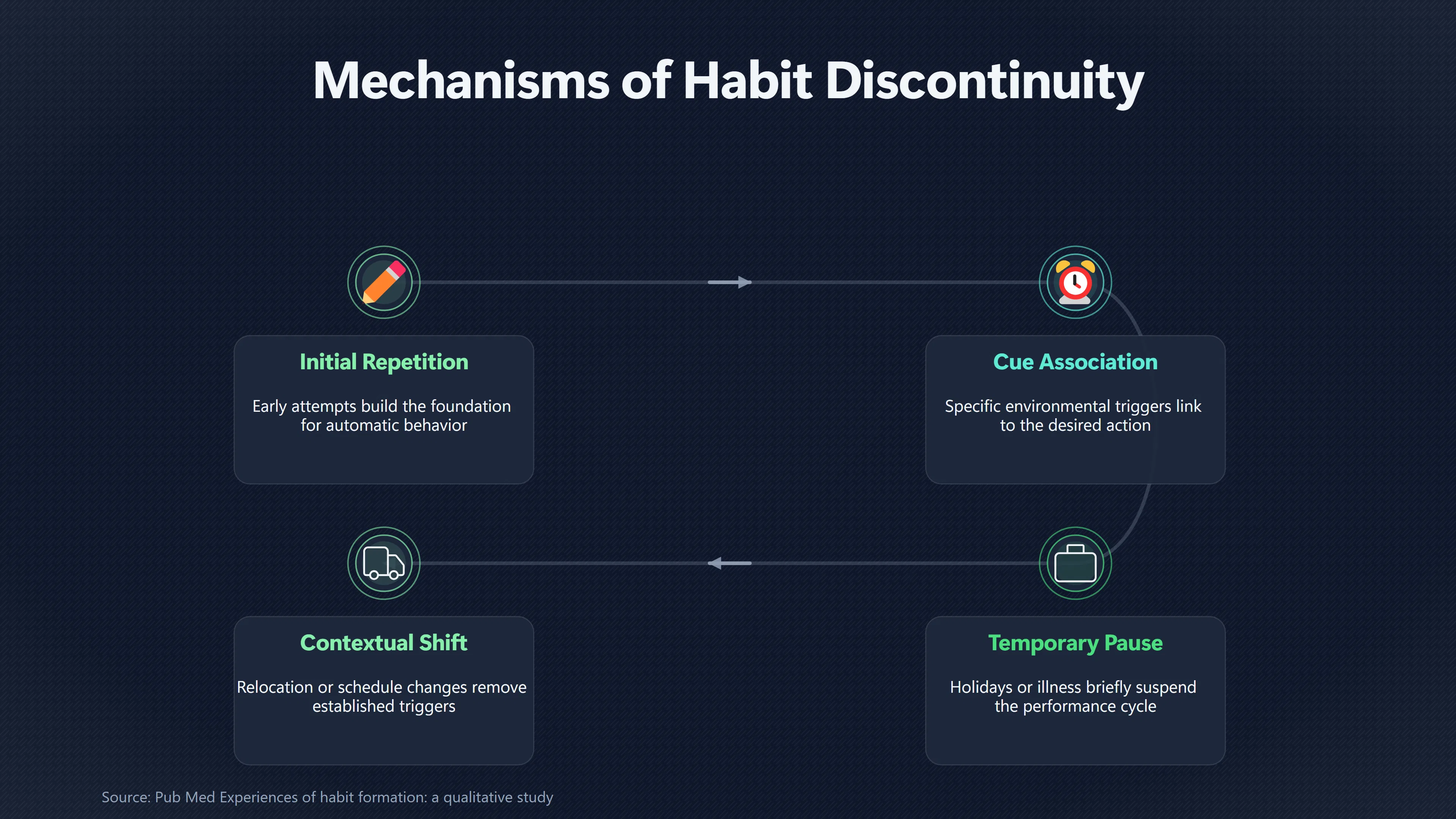
Whether the context changes permanently. Moving home, changing workplace or adopting a new daily schedule can remove or alter the cues associated with an established response. Research on “habit discontinuity” shows that behaviours can be disrupted when their usual contexts change.[PubMed]pubmed.ncbi.nlm.nih.govPub Med Changing circumstances, disrupting habitsChanging circumstances, disrupting habits - PubMed…
How frequently the behaviour was supposed to occur. Seven days without a daily behaviour means seven lost opportunities. Seven days without a Saturday-only behaviour may contain no missed opportunity at all. Counting elapsed days therefore makes less sense than considering missed repetitions relative to the behaviour’s intended frequency.
The research consequently offers no defensible equivalent of an expiry date. The evidence supports increasing concern as interruptions become repeated or prolonged, not a universal day on which previous progress disappears.
A Holiday Can Pause Performance Without Erasing the Habit
One particularly useful distinction is between not performing a habit because its cue is temporarily absent and repeatedly failing to perform it when its normal cue is present.
A small qualitative study by Lally, Jane Wardle and Benjamin Gardner provides a concrete example. Ten participants in a habit-based weight-management intervention described how their new behaviours developed in everyday life. Many habits became tied to work-based contexts. Weekends and holidays disrupted performance because the familiar cues were absent — yet participants commonly resumed the behaviours when they returned to work.[PubMed]pubmed.ncbi.nlm.nih.govPub Med Experiences of habit formation: a qualitative studyExperiences of habit formation: a qualitative study - PubMedAugust 1, 2011…
This suggests that a temporary interruption in behaviour does not necessarily mean that the underlying association has vanished. A habit can effectively become dormant when the situation that normally triggers it is missing, then reappear when that situation returns. The study was qualitative and involved only ten people, so it cannot establish how long such dormancy lasts. It nevertheless illustrates why elapsed time alone is a poor measure of habit loss.[King's College London]kclpure.kcl.ac.ukKing's College London Experiences of habit formation: A qualitative studyKing's College London Experiences of habit formation: A qualitative study
Broader habit-discontinuity research reinforces the importance of context. In one study, students’ habits involving exercise, newspaper reading and television viewing were examined across a university transfer. Habits were more likely to survive when relevant features of the performance context remained stable; changing those circumstances disrupted habitual performance and sometimes brought behaviour back under more deliberate control.[PubMed]pubmed.ncbi.nlm.nih.govPub Med Changing circumstances, disrupting habitsChanging circumstances, disrupting habits - PubMed…
Similarly, an analysis of 18,053 participants in the UK Understanding Society survey found evidence consistent with habits being disrupted following residential relocation. The research concerned commuting rather than self-improvement routines, so it cannot tell someone how many days they may safely stop exercising or studying. Its value here is different: it shows why what changes during an interruption may matter as much as how long the interruption lasts.[PubMed Central (PMC)]pmc.ncbi.nlm.nih.govPubMed Central (PMC)Habit Discontinuity, Self-Activation, and the Diminishing Influence of Context Change: Evidence from the UK Understan…
When an Interruption Becomes a Pattern
The most useful boundary is therefore behavioural rather than numerical. An interruption starts to look more problematic when it stops being an isolated exception and begins altering the normal relationship between cue, repetition and behaviour.
Research comparing stable and variable habit-building contexts supports this interpretation. In a controlled six-week study involving 95 students and 2,482 habit repetitions, participants instructed to maintain more stable contexts developed greater automaticity and achieved their repetition goals more successfully than those instructed to vary times and locations. A second dataset covering 308 habits and 2,368 repetitions showed the same broad relationship between context stability, automaticity and goal attainment.[PubMed]pubmed.ncbi.nlm.nih.govOpen source on nih.gov.
For someone assessing a longer break, this shifts attention away from protecting an arbitrary streak. More informative warning signs are that missed opportunities are becoming common rather than exceptional; the original cue is repeatedly occurring without the intended response; the behaviour’s overall frequency is falling; returning now requires substantially more conscious prompting than before; or a life change has removed the context in which the habit was learned.
None of those signs proves that a habit has been “reset”. Habit strength is not a score that research shows falling neatly back to zero. They instead indicate that the conditions responsible for building and expressing automaticity — sufficiently frequent repetition in recognisable contexts — are becoming less reliable. The 2024 systematic review found context stability and repetition among the important determinants of habit strength while emphasising that the required level of consistency has yet to be established.[PubMed Central (PMC)]pmc.ncbi.nlm.nih.govOpen source on nih.gov.
The Practical Meaning of a Longer Break
The safest evidence-based interpretation is not “missing days never matters” and not “after X days you must start again”. It is that interruptions matter progressively and contextually.
A short break can simply mean several lost opportunities to reinforce a developing response. A holiday can temporarily suppress a work-cued habit and leave it ready to return with the old routine. Repeated gaps can reduce the frequency and consistency that support automaticity. A major contextual change can be more disruptive still because the cues themselves may disappear. Research can distinguish these situations conceptually and has observed examples of each, but it cannot currently assign them a universal numerical threshold.[nih.gov]pmc.ncbi.nlm.nih.govPubMed Central (PMC)App-Based Habit Building Reduces Motivational Impairments During Studying – An Event Sampling Study - PMCFebruary 7…
That makes the return after an interruption more informative than the streak length itself. If the familiar situation again prompts the behaviour fairly readily, the break may have interrupted performance more than the underlying habit. If repeated exposure to the old cue no longer produces the response, or performance remains chronically irregular, the interruption has become part of a broader consistency problem.
For self-improvement habits, the evidence therefore supports a forgiving but not indifferent approach: do not treat an isolated or temporary break as proof that all progress has vanished, but do pay attention when missed repetitions accumulate into a new normal. Current research gives good reason to protect repetition and stable cues; it does not give a scientifically justified day count at which a habit suddenly ceases to exist.[Wiley Online Library]onlinelibrary.wiley.comWiley Online LibraryHow are habits formed: Modelling habit formation in the real world - Lally - 2010 - European Journal of Social Psycho…
Amazon book picks
Further Reading
Books and field guides related to When Does a Habit Break Become a Problem?. Use these as the next step if you want deeper reading beyond the article.
Atomic Habits
Rating: 3.5/5 from 7 Google Books ratings
The #1 New York Times bestseller. Over 25 million copies sold! Translated into 60+ languages! Tiny Changes, Remarkable Results No matter...
Good Habits, Bad Habits
'The world's leading expert on habits' - Matthew Syed, bestselling author of Black Box Thinking and Rebel IdeasWhat if you could harness...
Tiny Habits
Improving your life is much easier than you think. Whether it’s losing weight, sleeping more, or restoring your work/life balance – the s...
eBay marketplace picks
Marketplace Samples
Live-tested eBay searches with available results related to this page.
Selected fromhabit tracker board oneBay.co.uk.

Endnotes
1.
Source: onlinelibrary.wiley.com
Link:https://onlinelibrary.wiley.com/doi/10.1002/ejsp.674
Source snippet
Wiley Online LibraryHow are habits formed: Modelling habit formation in the real world - Lally - 2010 - European Journal of Social Psycho...
2.
Source: compass.onlinelibrary.wiley.com
Link:https://compass.onlinelibrary.wiley.com/doi/full/10.1111/spc3.12975
3.
Source: compass.onlinelibrary.wiley.com
Link:https://compass.onlinelibrary.wiley.com/doi/epdf/10.1111/spc3.12975
4.
Source: onlinelibrary.wiley.com
Link:https://onlinelibrary.wiley.com/doi/abs/10.1002/ejsp.674?MixPanelId=15e3fe314440-0468d8411-64220f54-100000-15e3fe314460
5.
Source: onlinelibrary.wiley.com
Link:https://onlinelibrary.wiley.com/doi/abs/10.1002/ejsp.674
6.
Source: onlinelibrary.wiley.com
Link:https://onlinelibrary.wiley.com/doi/abs/10.1002/ejsp.674?msockid=2489864bf52b6612230d95d6f48167ef
7.
Source: onlinelibrary.wiley.com
Link:https://onlinelibrary.wiley.com/doi/abs/10.1002/ejsp.674?cf_chl_jschl_tk=pmd_EwcJDaCFBR9OVEL1O_0qjioww0Gc86ZzpBvCBFhrDcE-1635261061-0-gqNtZGzNAjujcnBszQi9
8.
Source: pmc.ncbi.nlm.nih.gov
Link:https://pmc.ncbi.nlm.nih.gov/articles/PMC11641623/
9.
Source: pubmed.ncbi.nlm.nih.gov
Title: Pub Med Experiences of habit formation: a qualitative study
Link:https://pubmed.ncbi.nlm.nih.gov/21749245/
Source snippet
Experiences of habit formation: a qualitative study - PubMedAugust 1, 2011...
Published: August 1, 2011
10.
Source: pmc.ncbi.nlm.nih.gov
Link:https://pmc.ncbi.nlm.nih.gov/articles/PMC9226889/
Source snippet
PubMed Central (PMC)Context Stability in Habit Building Increases Automaticity and Goal Attainment - PMC...
11.
Source: pmc.ncbi.nlm.nih.gov
Link:https://pmc.ncbi.nlm.nih.gov/articles/PMC7020232/
Source snippet
PubMed Central (PMC)App-Based Habit Building Reduces Motivational Impairments During Studying – An Event Sampling Study - PMCFebruary 7...
12.
Source: pmc.ncbi.nlm.nih.gov
Link:https://pmc.ncbi.nlm.nih.gov/articles/PMC8137900/
Source snippet
PubMed Central (PMC)Self-Efficacy in Habit Building: How General and Habit-Specific Self-Efficacy Influence Behavioral Automatization and...
13.
Source: pubmed.ncbi.nlm.nih.gov
Title: Pub Med Changing circumstances, disrupting habits
Link:https://pubmed.ncbi.nlm.nih.gov/15982113/
Source snippet
Changing circumstances, disrupting habits - PubMed...
14.
Source: pmc.ncbi.nlm.nih.gov
Link:https://pmc.ncbi.nlm.nih.gov/articles/PMC4847906/
Source snippet
PubMed Central (PMC)Habit Discontinuity, Self-Activation, and the Diminishing Influence of Context Change: Evidence from the UK Understan...
15.
Source: kclpure.kcl.ac.uk
Title: King’s College London Experiences of habit formation: A qualitative study
Link:https://kclpure.kcl.ac.uk/portal/en/publications/experiences-of-habit-formation-a-qualitative-study
16.
Source: pubmed.ncbi.nlm.nih.gov
Link:https://pubmed.ncbi.nlm.nih.gov/27120333/
17.
Source: pubmed.ncbi.nlm.nih.gov
Link:https://pubmed.ncbi.nlm.nih.gov/35756236/
18.
Source: pubmed.ncbi.nlm.nih.gov
Link:https://pubmed.ncbi.nlm.nih.gov/41529169/
19.
Source: pubmed.ncbi.nlm.nih.gov
Link:https://pubmed.ncbi.nlm.nih.gov/39685110/
20.
Source: doi.org
Link:https://doi.org/10.3390/healthcare12232488
21.
Source: pubmed.ncbi.nlm.nih.gov
Link:https://pubmed.ncbi.nlm.nih.gov/39456116/
22.
Source: pmc.ncbi.nlm.nih.gov
Link:https://pmc.ncbi.nlm.nih.gov/articles/PMC12318445/
23.
Source: kclpure.kcl.ac.uk
Link:https://kclpure.kcl.ac.uk/portal/en/publications/how-does-habit-form-guidelines-for-tracking-real-world-habit-form/
24.
Source: doi.org
Link:https://doi.org/10.1111/bjhp.12504
25.
Source: pubmed.ncbi.nlm.nih.gov
Link:https://pubmed.ncbi.nlm.nih.gov/32116961/
26.
Source: pmc.ncbi.nlm.nih.gov
Link:https://pmc.ncbi.nlm.nih.gov/articles/PMC6548181/
27.
Source: pmc.ncbi.nlm.nih.gov
Link:https://pmc.ncbi.nlm.nih.gov/articles/PMC6012009/
28.
Source: pmc.ncbi.nlm.nih.gov
Link:https://pmc.ncbi.nlm.nih.gov/articles/PMC3505409/
29.
Source: pmc.ncbi.nlm.nih.gov
Link:https://pmc.ncbi.nlm.nih.gov/articles/3505409/
30.
Source: pubmed.ncbi.nlm.nih.gov
Link:https://pubmed.ncbi.nlm.nih.gov/42053513/
31.
Source: ouci.dntb.gov.ua
Title: 7n NN23j7
Link:https://ouci.dntb.gov.ua/en/works/7nNN23j7/
Additional References
32.
Source: mdpi.com
Link:https://www.mdpi.com/2227-9032/12/23/2488
Source snippet
Time to Form a Habit: A Systematic Review and Meta-Analysis of Health Behaviour Habit Formation and Its Determinants...
33.
Source: youtube.com
Title: Habit Expert Wendy Wood Breaks Down the Bases of Habit Formation
Link:https://www.youtube.com/watch?v=SihwUFcKAwk
Source snippet
How to Build Habits That Actually Last: A Neuroscience Approach...
34.
Source: youtube.com
Title: Why Is It So Hard to Break a Bad Habit?
Link:https://www.youtube.com/watch?v=wr6fQ4KpbRM
Source snippet
Habit formation missing days never miss twice science The 21-Day Habit Myth: What Science Really Says...
35.
Source: researchgate.net
Link:https://www.researchgate.net/publication/339099388App-Based_Habit_Building_Reduces_Motivational_Impairments_During_Studying-_An_Event_Sampling_Study
36.
Source: researchgate.net
Link:https://www.researchgate.net/publication/223364167_Context_change_and_travel_mode_choice_Combining_the_habit_discontinuity_and_self-activation_hypotheses
37.
Source: researchgate.net
Link:https://www.researchgate.net/publication/351373903_Self-Efficacy_in_Habit_Building_How_General_and_Habit-Specific_Self-Efficacy_Influence_Behavioral_Automatization_and_Motivational_Interference
38.
Source: researchgate.net
Link:https://www.researchgate.net/publication/386593213_Time_to_Form_a_Habit_A_Systematic_Review_and_Meta-Analysis_of_Health_Behaviour_Habit_Formation_and_Its_Determinants
39.
Source: sciencedirect.com
Link:https://www.sciencedirect.com/science/article/pii/S0272494407000898
40.
Source: surrey.ac.uk
Link:https://www.surrey.ac.uk/people/phillippa-lally
41.
Source: sciencedirect.com
Link:https://www.sciencedirect.com/science/article/pii/S0272494415300487