Within Sleep and Mood
Why Tiredness Can Hit Mental Habits First
Mental habits such as studying, planning and writing may become harder after restricted sleep even when simpler physical actions remain manageable.
On this page
- Evidence from partial sleep restriction
- Cognitive effort versus physical effort
- Choosing lower friction actions after poor sleep
Page outline Jump by section
Introduction
Partial sleep restriction can make mental habits harder before it makes every kind of action feel equally difficult. The clearest controlled evidence comes from an experiment in which healthy young adults were still capable of completing demanding cognitive tasks after three nights of severely restricted sleep, yet became less willing to choose those tasks for reward. Their willingness to undertake comparable physical effort did not fall.[PubMed Central (PMC)]pmc.ncbi.nlm.nih.govPubMed Central (PMC)Sleep Restriction Reduces Cognitive but Not Physical Motivation - PMCNovember 4, 2022…
That distinction matters for self-improvement. After poor sleep, the problem may not simply be that studying, planning or writing has become impossible. The person may still be capable of doing the work while becoming more inclined to choose an easier alternative. Meanwhile, a straightforward physical action may remain comparatively approachable. Longer-running sleep-restriction experiments add another complication: objective cognitive deficits can accumulate faster than people recognise them subjectively.[PubMed]pubmed.ncbi.nlm.nih.govThe cumulative cost of additional wakefulness: dose-response effects on neurobehavioral functions and sleep physiology from chronic…
The practical lesson is not that mental habits should be abandoned whenever sleep is imperfect. It is that their activation cost matters more on tired days. Reducing unnecessary cognitive friction can help preserve the habit without pretending that restricted sleep has left the decision-making environment unchanged.
Restricted sleep changed which effort people chose
A particularly useful experiment published in Nature and Science of Sleep in 2022 asked a more precise question than whether tired people perform worse: does restricted sleep change what kind of effort they are willing to undertake?
Twenty-four healthy young adults completed two laboratory conditions. In the rested condition they received nine hours of sleep opportunity on each of three nights; in the restricted condition, only three hours on each night. The same participants therefore made decisions under both conditions. Before the critical choice phase, researchers trained them on six levels of cognitive effort and six levels of physical effort.[PubMed Central (PMC)]pmc.ncbi.nlm.nih.govPubMed Central (PMC)Sleep Restriction Reduces Cognitive but Not Physical Motivation - PMCNovember 4, 2022…
The cognitive task involved monitoring rapidly presented streams of letters, with additional streams increasing the mental workload. The physical task involved maintaining specified percentages of each participant’s maximum handgrip force. During the subsequent choice phase, participants repeatedly chose between a low-effort, low-reward option and alternatives offering larger rewards in return for greater effort.[PubMed Central (PMC)]pmc.ncbi.nlm.nih.govPubMed Central (PMC)Sleep Restriction Reduces Cognitive but Not Physical Motivation - PMCNovember 4, 2022…
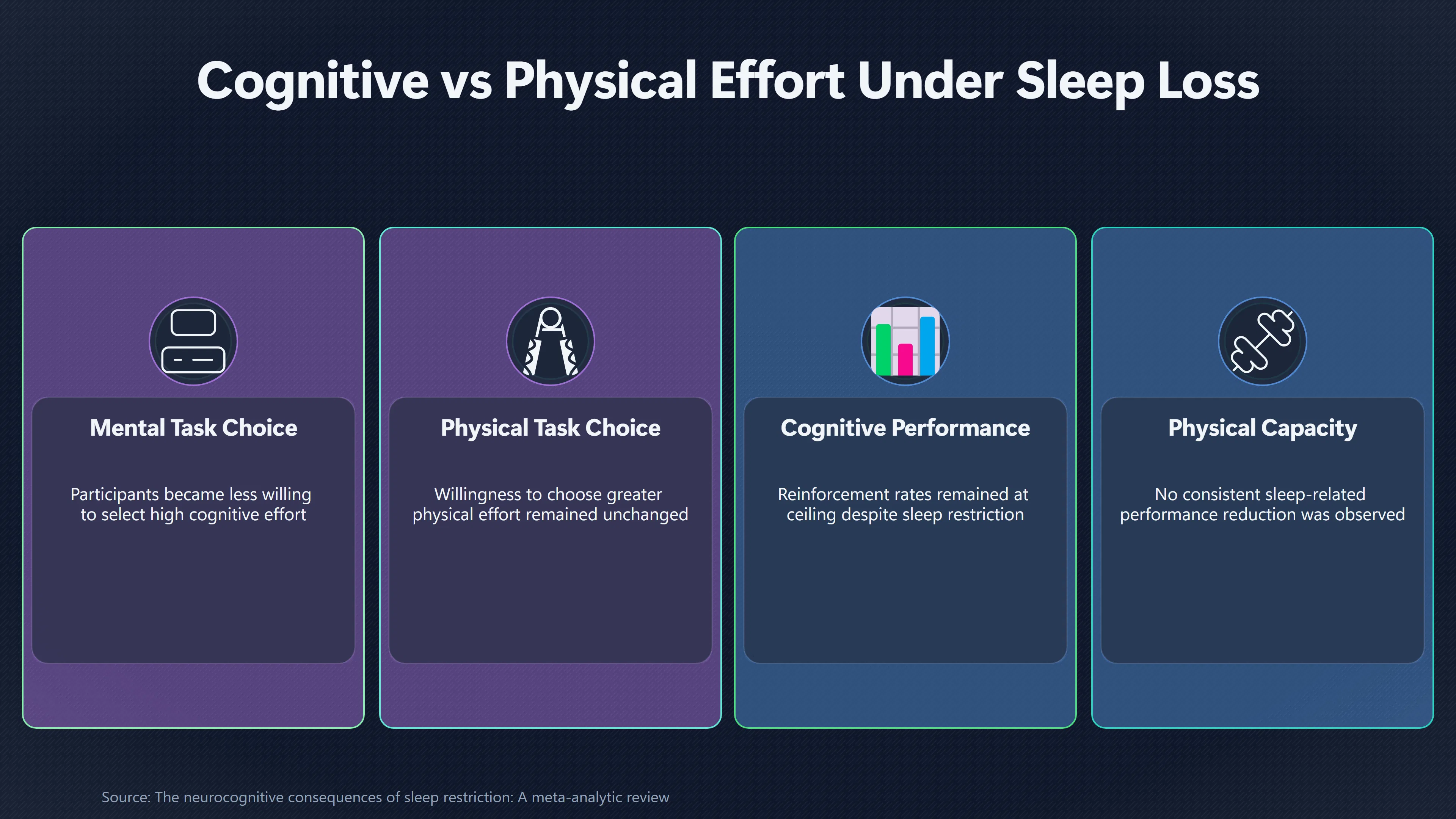
Restricted sleep produced an unusually informative split. Participants became less willing to select higher cognitive effort, with the effect appearing at all but the lowest of the higher effort levels. Yet their willingness to choose greater physical effort did not significantly change. The interaction between sleep condition, effort domain and effort level was statistically significant (p = 0.001).[PubMed Central (PMC)]pmc.ncbi.nlm.nih.govPubMed Central (PMC)Sleep Restriction Reduces Cognitive but Not Physical Motivation - PMCNovember 4, 2022…
This was not simply a case of tired participants discovering that they could no longer perform the mental task. Their reinforcement rates on the cognitive task remained at ceiling, and the researchers found no consistent sleep-related performance reduction capable of explaining their choices. A control analysis likewise found that performance at a particular cognitive effort level did not significantly predict whether participants chose it. Effort and reward did predict their choices.[PubMed Central (PMC)]pmc.ncbi.nlm.nih.govPubMed Central (PMC)Sleep Restriction Reduces Cognitive but Not Physical Motivation - PMCNovember 4, 2022…
That makes the finding particularly relevant to habits. Restricted sleep can apparently alter the decision to invest mental effort even when basic capacity to perform the task remains available. A tired student may therefore be able to study but choose something easier; a writer may be capable of drafting but keep postponing the document; someone intending to plan tomorrow’s work may instead perform a simpler routine task.
Those everyday examples are reasonable applications of the experimental finding, not behaviours directly tested in the study. The experiment was also small, involved healthy young adults and used an unusually severe restriction of only three hours’ sleep opportunity for three nights. It therefore demonstrates a controlled effect rather than establishing exactly how much ordinary short sleep will change anyone’s studying or writing behaviour.[PubMed]pubmed.ncbi.nlm.nih.govPub Med Sleep Restriction Reduces Cognitive but Not Physical MotivationSleep Restriction Reduces Cognitive but Not Physical Motivation - PubMed…
Cognitive effort and physical effort are not interchangeable
The experiment challenges an intuitively appealing model of tiredness: that sleep loss simply turns down one general-purpose supply of motivation. At least under these laboratory conditions, participants did not become uniformly unwilling to work. Their choices depended on what kind of work was being offered.[PubMed Central (PMC)]pmc.ncbi.nlm.nih.govPubMed Central (PMC)Sleep Restriction Reduces Cognitive but Not Physical Motivation - PMCNovember 4, 2022…
That result fits a broader literature showing that restricted sleep does not affect every cognitive measure identically. A 2017 meta-analysis covering 61 studies and 71 study populations found an overall adverse effect of experimentally restricted sleep on cognition (Hedges’ g = −0.383). Significant effects appeared for executive functioning (g = −0.324), sustained attention (g = −0.409) and long-term memory (g = −0.192), while the evidence was insufficient to establish effects in several other measured domains.[PubMed]pubmed.ncbi.nlm.nih.govThe neurocognitive consequences of sleep restriction: A meta-analytic review - PubMedJuly 28, 2017…
More recent evidence reinforces the importance of distinguishing cognitive functions. A 2024 meta-analysis of 44 studies examined a single night restricted to two to six hours of sleep opportunity. Sleepiness increased substantially and sustained attention deteriorated, including slower responses and more attentional lapses. Yet the pooled analysis did not find significant effects on working memory, inhibitory control, choice reaction time or cognitive throughput after that one restricted night.[ScienceDirect]sciencedirect.comImpact of one night of sleep restriction on sleepiness and cognitive function: A systematic review and meta-analysis - Scien…
The timescale matters too. In the classic 2003 dose-response experiment, 48 healthy adults were assigned to four, six or eight hours in bed per night for 14 days, with a separate total-sleep-deprivation comparison. Cognitive deficits accumulated progressively in the four- and six-hour groups. The researchers concluded that six hours or less per night could produce substantial cumulative neurobehavioural impairment.[PubMed]pubmed.ncbi.nlm.nih.govThe cumulative cost of additional wakefulness: dose-response effects on neurobehavioral functions and sleep physiology from chronic…
Together, these findings argue against treating “tired” as a single performance state. One short night may particularly expose sustained attention; repeated restriction can accumulate broader costs; and under severe multiday restriction, the willingness to choose cognitive effort may itself decline. The evidence does not establish a universal hierarchy in which every physical habit survives sleep loss better than every mental habit. It does show that cognitive and physical effort can respond differently enough that behaviour-change plans should not assume they rise and fall together.[nih.gov]pubmed.ncbi.nlm.nih.govImpact of one night of sleep restriction on sleepiness and cognitive function: A systematic review and meta-analysis - PubMed…
The hidden problem: feeling adapted before performance has adapted
Repeated partial sleep restriction creates a further difficulty for mental habits: people may not accurately sense how much their functioning has changed.
In the 14-day experiment, cognitive performance deteriorated cumulatively in the four- and six-hour sleep conditions, but subjective sleepiness behaved differently. Participants initially felt sleepier, after which their ratings increased only modestly. By the end of the restriction period, objective performance was at its worst even though participants reported being only slightly sleepy.[PubMed]pubmed.ncbi.nlm.nih.govThe cumulative cost of additional wakefulness: dose-response effects on neurobehavioral functions and sleep physiology from chronic…
This gap is important because subjective adaptation can be mistaken for functional adaptation. Someone who has slept six hours for several nights may think, “I am used to it now”, when what has actually happened is that the feeling of sleepiness has stabilised while measurable attentional performance continues to deteriorate. A review of vigilant attention research describes the same pattern: attention deficits built steadily across repeated four- and six-hour sleep opportunities without a matching progressive rise in reported sleepiness.[PubMed Central (PMC)]pmc.ncbi.nlm.nih.govOpen source on nih.gov.
There are substantial individual differences, however. A smaller experiment involving 15 healthy young men found that changes in reported motivation during five nights with five hours in bed were associated with differences in attentional performance. Participants whose motivation fell showed more premature responses and particularly slow responses, whereas some aspects of impairment were present regardless of whether motivation was preserved.[PubMed Central (PMC)]pmc.ncbi.nlm.nih.govOpen source on nih.gov.
For behaviour change, this means neither subjective motivation nor subjective sleepiness is a perfect diagnostic instrument. Feeling unmotivated does not prove that a person cannot perform a task; feeling reasonably normal does not prove that attention and performance have fully recovered.
Lower-friction mental habits make more sense after poor sleep
The laboratory evidence does not provide a validated productivity system for tired days. It does, however, suggest a useful design principle: when sleep has been restricted, reduce the amount of discretionary cognitive effort required to begin a valuable habit.
That is different from simply lowering every standard. In the cognitive-versus-physical effort experiment, the participants retained the ability to perform the demanding mental task but became less inclined to select it. For a habit designer, that makes the moment of choice especially important.[PubMed Central (PMC)]pmc.ncbi.nlm.nih.govPubMed Central (PMC)Sleep Restriction Reduces Cognitive but Not Physical Motivation - PMCNovember 4, 2022…
Several adaptations follow logically from that evidence:
- Shrink the starting decision. “Open yesterday’s notes and review one section” asks for less selection and organisation than “decide what to study tonight”.
- Pre-select the next action while rested. Leaving a specific reading, document or problem ready removes planning from the tired session.
- Separate continuity from maximum output. A short, clearly defined study or writing session can preserve contact with the habit without requiring the day’s most cognitively demanding workload.
- Use simpler execution where appropriate. If a useful action can be turned from an open-ended mental problem into a prepared sequence, poor sleep leaves fewer opportunities to choose the lower-effort alternative.
- Avoid interpreting one difficult session as evidence about identity. The relevant experimental comparison changed sleep within the same people. Their altered choices therefore did not require a change in personality, values or underlying ability.[PubMed Central (PMC)]pmc.ncbi.nlm.nih.govPubMed Central (PMC)Sleep Restriction Reduces Cognitive but Not Physical Motivation - PMCNovember 4, 2022…
There is an important limit to this strategy. Lowering friction may make initiation more realistic, but it cannot restore attention or memory that sleep restriction has impaired. A 2024 meta-analysis of 39 reports involving 1,234 participants found that restricting sleep to roughly three to 6.5 hours adversely affected memory formation, with a small pooled effect (Hedges’ g = 0.29).[PubMed]pubmed.ncbi.nlm.nih.govOpen source on nih.gov. If the purpose of a habit is intensive learning rather than simply maintaining continuity, shortening or simplifying the session cannot be assumed to make the learning outcome equivalent to one performed after adequate sleep.
The same caution applies to demanding decisions. “Make the habit easier to start” should not become “assume important thinking is unaffected”. Sleep restriction can alter sustained attention, executive functioning and memory as well as willingness to invest cognitive effort.[PubMed]pubmed.ncbi.nlm.nih.govThe neurocognitive consequences of sleep restriction: A meta-analytic review - PubMedJuly 28, 2017…
Mental habits need a tired-day version
The most useful distinction is therefore between ability, performance and willingness. They overlap, but they are not identical.
Partial sleep restriction can impair cognitive performance, particularly sustained attention and, with repeated restriction, broader aspects of functioning. Separately, controlled evidence indicates that severe multiday restriction can make people less willing to choose demanding cognitive effort even when they remain capable of completing the task. Physical effort did not show the same motivational decline in that experiment.[PubMed]pubmed.ncbi.nlm.nih.govImpact of one night of sleep restriction on sleepiness and cognitive function: A systematic review and meta-analysis - PubMed…
For self-improvement, this changes how a missed mental habit should be interpreted. Failing to start a difficult piece of writing after several short nights is not necessarily evidence that the goal has stopped mattering. The immediate choice may simply have become less favourable because the cognitive effort carries more behavioural resistance under restricted sleep.
A robust mental habit therefore benefits from two operating modes: a normal version for adequately rested days and a lower-friction version for restricted-sleep days. The latter should preserve the valuable action while demanding less planning, task switching and discretionary effort to get started. That approach respects both sides of the evidence: people can retain more capacity than their motivation suggests, but they can also be more cognitively impaired than their subjective sense of adaptation suggests.[PubMed Central (PMC)]pmc.ncbi.nlm.nih.govPubMed Central (PMC)Sleep Restriction Reduces Cognitive but Not Physical Motivation - PMCNovember 4, 2022…
Amazon book picks
Further Reading
Books and field guides related to Why Tiredness Can Hit Mental Habits First. Use these as the next step if you want deeper reading beyond the article.
Why We Sleep
"Sleep is one of the most important but least understood aspects of our life, wellness, and longevity ... An explosion of scientific disc...
The Sleep Solution
With cutting-edge sleep science and time-tested techniques, The Sleep Solution will help anyone achieve healthy sleep and eliminate pills...
The Willpower Instinct
Based on Stanford University psychologist Kelly McGonigal's wildly popular course "The Science of Willpower," The Willpower Instinct is t...
Peak Mind
***NATIONAL BESTSELLER*** STOP FOR A MOMENT. Are you here right now? Is your focus on this page? Or is it roaming elsewhere, to the past...
eBay marketplace picks
Marketplace Samples
Live-tested eBay searches with available results related to this page.
Selected frommotivational poster oneBay.co.uk.

Current eBay listing
Gym Motivational Posters Work Out Insperational Quotes Wall Art
Current eBay listing
Motivational Quotes Framed Wall Art Poster Canvas Print Picture

Endnotes
1.
Source: sciencedirect.com
Link:https://www.sciencedirect.com/science/article/pii/S0149763417301641
Source snippet
The neurocognitive consequences of sleep restriction: A meta-analytic review - ScienceDirect...
2.
Source: sciencedirect.com
Link:https://www.sciencedirect.com/science/article/pii/S1087079224000443
Source snippet
Impact of one night of sleep restriction on sleepiness and cognitive function: A systematic review and meta-analysis - Scien...
3.
Source: sciencedirect.com
Link:https://www.sciencedirect.com/science/article/pii/S1087079225001169
4.
Source: sciencedirect.com
Link:https://www.sciencedirect.com/science/article/pii/S0149763424003981
5.
Source: sciencedirect.com
Link:https://www.sciencedirect.com/science/article/pii/S0278584620305480
6.
Source: sciencedirect.com
Link:https://www.sciencedirect.com/science/article/pii/S0031938419311394
7.
Source: nature.com
Link:https://www.nature.com/articles/s41598-019-44237-9
8.
Source: nature.com
Link:https://www.nature.com/articles/s41386
9.
Source: sciencedirect.com
Link:https://www.sciencedirect.com/science/article/abs/pii/S0005791617301635
10.
Source: sciencedirect.com
Title: The neurocognitive consequences of sleep restriction: A meta-analytic review
Link:https://www.sciencedirect.com/science/article/abs/pii/S0149763417301641
11.
Source: sciencedirect.com
Link:https://www.sciencedirect.com/science/article/pii/S0166432814008468
12.
Source: sciencedirect.com
Link:https://www.sciencedirect.com/science/article/pii/S016787602400165X
13.
Source: sciencedirect.com
Link:https://www.sciencedirect.com/science/article/abs/pii/S1087079225001169
14.
Source: sciencedirect.com
Title: Psychomotor Vigilance Task
Link:https://www.sciencedirect.com/topics/medicine-and-dentistry/psychomotor-vigilance-task
15.
Source: sciencedirect.com
Title: Sleep deprivation, effort allocation and performance
Link:https://www.sciencedirect.com/science/chapter/bookseries/pii/S0079612319300378
16.
Source: sciencedirect.com
Link:https://www.sciencedirect.com/science/article/pii/S2451994425000148
17.
Source: pmc.ncbi.nlm.nih.gov
Link:https://pmc.ncbi.nlm.nih.gov/articles/PMC9642807/
Source snippet
PubMed Central (PMC)Sleep Restriction Reduces Cognitive but Not Physical Motivation - PMCNovember 4, 2022...
Published: November 4, 2022
18.
Source: pubmed.ncbi.nlm.nih.gov
Title: Pub Med Sleep Restriction Reduces Cognitive but Not Physical Motivation
Link:https://pubmed.ncbi.nlm.nih.gov/36394069/
Source snippet
Sleep Restriction Reduces Cognitive but Not Physical Motivation - PubMed...
19.
Source: pubmed.ncbi.nlm.nih.gov
Link:https://pubmed.ncbi.nlm.nih.gov/12683469/?dopt=Abstract
Source snippet
The cumulative cost of additional wakefulness: dose-response effects on neurobehavioral functions and sleep physiology from chronic...
20.
Source: pubmed.ncbi.nlm.nih.gov
Title: Pub Med Behavioral and physiological consequences of sleep restriction
Link:https://pubmed.ncbi.nlm.nih.gov/17803017/
Source snippet
Behavioral and physiological consequences of sleep restriction - PubMed...
21.
Source: pubmed.ncbi.nlm.nih.gov
Link:https://pubmed.ncbi.nlm.nih.gov/28757454/
Source snippet
The neurocognitive consequences of sleep restriction: A meta-analytic review - PubMedJuly 28, 2017...
Published: July 28, 2017
22.
Source: pubmed.ncbi.nlm.nih.gov
Link:https://pubmed.ncbi.nlm.nih.gov/38759474/
Source snippet
Impact of one night of sleep restriction on sleepiness and cognitive function: A systematic review and meta-analysis - PubMed...
23.
Source: pmc.ncbi.nlm.nih.gov
Link:https://pmc.ncbi.nlm.nih.gov/articles/PMC6879580/
24.
Source: pmc.ncbi.nlm.nih.gov
Link:https://pmc.ncbi.nlm.nih.gov/articles/PMC8286723/
25.
Source: pubmed.ncbi.nlm.nih.gov
Link:https://pubmed.ncbi.nlm.nih.gov/34285617/
26.
Source: pubmed.ncbi.nlm.nih.gov
Link:https://pubmed.ncbi.nlm.nih.gov/39427809/
27.
Source: pubmed.ncbi.nlm.nih.gov
Link:https://pubmed.ncbi.nlm.nih.gov/41206488/
28.
Source: pmc.ncbi.nlm.nih.gov
Link:https://pmc.ncbi.nlm.nih.gov/articles/PMC13017762/
29.
Source: pmc.ncbi.nlm.nih.gov
Link:https://pmc.ncbi.nlm.nih.gov/articles/PMC12452710/
30.
Source: pubmed.ncbi.nlm.nih.gov
Link:https://pubmed.ncbi.nlm.nih.gov/40946426/
31.
Source: pmc.ncbi.nlm.nih.gov
Link:https://pmc.ncbi.nlm.nih.gov/articles/PMC12321868/
32.
Source: pubmed.ncbi.nlm.nih.gov
Link:https://pubmed.ncbi.nlm.nih.gov/41425508/
33.
Source: pmc.ncbi.nlm.nih.gov
Link:https://pmc.ncbi.nlm.nih.gov/articles/PMC12716481/
34.
Source: pmc.ncbi.nlm.nih.gov
Link:https://pmc.ncbi.nlm.nih.gov/articles/PMC12148713/
35.
Source: pubmed.ncbi.nlm.nih.gov
Link:https://pubmed.ncbi.nlm.nih.gov/39488298/
36.
Source: pmc.ncbi.nlm.nih.gov
Link:https://pmc.ncbi.nlm.nih.gov/articles/PMC9807493/
37.
Source: pubmed.ncbi.nlm.nih.gov
Link:https://pubmed.ncbi.nlm.nih.gov/35034695/
38.
Source: pmc.ncbi.nlm.nih.gov
Link:https://pmc.ncbi.nlm.nih.gov/articles/PMC8117424/
39.
Source: pubmed.ncbi.nlm.nih.gov
Link:https://pubmed.ncbi.nlm.nih.gov/33994837/
40.
Source: pmc.ncbi.nlm.nih.gov
Link:https://pmc.ncbi.nlm.nih.gov/articles/PMC8274462/
41.
Source: pmc.ncbi.nlm.nih.gov
Link:https://pmc.ncbi.nlm.nih.gov/articles/PMC7321921/
42.
Source: pubmed.ncbi.nlm.nih.gov
Link:https://pubmed.ncbi.nlm.nih.gov/31176308/
43.
Source: pmc.ncbi.nlm.nih.gov
Link:https://pmc.ncbi.nlm.nih.gov/articles/PMC6561965/
44.
Source: pubmed.ncbi.nlm.nih.gov
Link:https://pubmed.ncbi.nlm.nih.gov/30722039/
45.
Source: pmc.ncbi.nlm.nih.gov
Link:https://pmc.ncbi.nlm.nih.gov/articles/PMC6519907/
46.
Source: pmc.ncbi.nlm.nih.gov
Link:https://pmc.ncbi.nlm.nih.gov/articles/PMC6005543/
47.
Source: pmc.ncbi.nlm.nih.gov
Link:https://pmc.ncbi.nlm.nih.gov/articles/PMC6251588/
48.
Source: pmc.ncbi.nlm.nih.gov
Link:https://pmc.ncbi.nlm.nih.gov/articles/PMC6143346/
49.
Source: pmc.ncbi.nlm.nih.gov
Link:https://pmc.ncbi.nlm.nih.gov/articles/PMC4457397/
50.
Source: pubmed.ncbi.nlm.nih.gov
Link:https://pubmed.ncbi.nlm.nih.gov/25549858/
51.
Source: pubmed.ncbi.nlm.nih.gov
Link:https://pubmed.ncbi.nlm.nih.gov/25850114/
52.
Source: pubmed.ncbi.nlm.nih.gov
Link:https://pubmed.ncbi.nlm.nih.gov/22754046/
53.
Source: pmc.ncbi.nlm.nih.gov
Link:https://pmc.ncbi.nlm.nih.gov/articles/PMC3369235/
54.
Source: pmc.ncbi.nlm.nih.gov
Link:https://pmc.ncbi.nlm.nih.gov/articles/PMC3260461/
55.
Source: pubmed.ncbi.nlm.nih.gov
Link:https://pubmed.ncbi.nlm.nih.gov/22239924/
56.
Source: pmc.ncbi.nlm.nih.gov
Link:https://pmc.ncbi.nlm.nih.gov/articles/PMC3119834/
57.
Source: pmc.ncbi.nlm.nih.gov
Link:https://pmc.ncbi.nlm.nih.gov/articles/PMC3079937/
58.
Source: pmc.ncbi.nlm.nih.gov
Link:https://pmc.ncbi.nlm.nih.gov/articles/PMC1978411/
59.
Source: pmc.ncbi.nlm.nih.gov
Link:https://pmc.ncbi.nlm.nih.gov/articles/PMC1978335/
60.
Source: pubmed.ncbi.nlm.nih.gov
Link:https://pubmed.ncbi.nlm.nih.gov/15892921/
61.
Source: pubmed.ncbi.nlm.nih.gov
Link:https://pubmed.ncbi.nlm.nih.gov/12683469/
62.
Source: pmc.ncbi.nlm.nih.gov
Link:https://pmc.ncbi.nlm.nih.gov/articles/PMC1626388/
63.
Source: pubmed.ncbi.nlm.nih.gov
Link:https://pubmed.ncbi.nlm.nih.gov/8776790/
64.
Source: pubmed.ncbi.nlm.nih.gov
Link:https://pubmed.ncbi.nlm.nih.gov/9231952/
65.
Source: pubmed.ncbi.nlm.nih.gov
Link:https://pubmed.ncbi.nlm.nih.gov/20681233/
66.
Source: pmc.ncbi.nlm.nih.gov
Link:https://pmc.ncbi.nlm.nih.gov/articles/PMC2656292/
67.
Source: ncbi.nlm.nih.gov
Link:https://www.ncbi.nlm.nih.gov/books/NBK214949/
68.
Source: pubmed.ncbi.nlm.nih.gov
Link:https://pubmed.ncbi.nlm.nih.gov/23171414/
69.
Source: pubmed.ncbi.nlm.nih.gov
Link:https://pubmed.ncbi.nlm.nih.gov/24336419/
70.
Source: ouci.dntb.gov.ua
Link:https://ouci.dntb.gov.ua/en/works/731xxZq6/
Additional References
71.
Source: research.monash.edu
Title: University Sleep Restriction Reduces Cognitive but Not Physical Motivation
Link:https://research.monash.edu/en/publications/sleep-restriction-reduces-cognitive-but-not-physical-motivation/
Source snippet
Monash UniversitySleep Restriction Reduces Cognitive but Not Physical Motivation - Monash University...
72.
Source: youtube.com
Title: What Happens To Your Body And Brain If You Don’t Get Sleep | The Human Body
Link:https://www.youtube.com/watch?v=Y-8b99rGpkM
Source snippet
Sleep restriction cognitive effort decision making Sleep deprivation and memory problems | Robbert Havekes | TEDxDenHelder...
73.
Source: youtube.com
Title: Dr. Matt Walker: Protocols to Improve Your Sleep | Huberman Lab Guest Series
Link:https://www.youtube.com/watch?v=hvPGfcAgk9Y
Source snippet
What Happens To Your Body And Brain If You Don't Get Sleep | The Human Body...
74.
Source: youtube.com
Title: Sleep deprivation and memory problems | Robbert Havekes | TEDx Den Helder
Link:https://www.youtube.com/watch?v=F39IBJZlsek
Source snippet
Dr. Matt Walker: Protocols to Improve Your Sleep | Huberman Lab Guest Series...
75.
Source: youtube.com
Title: Use Sleep to Enhance Learning, Memory & Emotional State | Dr. Gina Poe
Link:https://www.youtube.com/watch?v=BMTt8gSl13s
Source snippet
Sleep deprivation and memory problems | Robbert Havekes | TEDxDenHelder...
76.
Source: youtube.com
Title: Sleep Is Your Superpower | Matt Walker | TED
Link:https://www.youtube.com/watch?v=5MuIMqhT8DM
Source snippet
Use Sleep to Enhance Learning, Memory & Emotional State | Dr. Gina Poe...
77.
Source: researchgate.net
Link:https://www.researchgate.net/publication/380133638_Impact_of_one_night_of_sleep_restriction_on_sleepiness_and_cognitive_function_A_systematic_review_and_meta-analysis
78.
Source: cambridge.org
Link:https://www.cambridge.org/core/journals/judgment-and-decision-making/article/systematic-review-of-effort-discounting-research-in-humans-current-knowledge-recommendations-and-future-directions/F2E2339CB6115F92558ED543012932F2
79.
Source: academic.oup.com
Link:https://academic.oup.com/sleep/article-abstract/26/2/117/2709164
80.
Source: dovepress.com
Link:https://www.dovepress.com/sleep-restriction-reduces-cognitive-but-not-physical-motivation-peer-reviewed-fulltext-article-NSS