Within Automaticity
Should a Habit Follow a Time or Routine?
Both clock times and existing routines can support habit formation when the chosen cue is encountered consistently and followed by the action.
On this page
- How time based and routine based cues differ
- What the 84 day randomised trial found
- Choosing the cue that fits your real schedule
Page outline Jump by section
Introduction
A habit can be attached to a clock time — “at 8 am, drink a glass of water” — or to an existing routine — “after breakfast, drink a glass of water”. The strongest direct comparison suggests that neither type of cue is inherently better. In an 84-day randomised controlled trial, both time-based and routine-based plans supported increasing automaticity, with no significant difference between the groups. What mattered more was whether people actually performed the behaviour when their chosen cue occurred.
That changes the practical question. Rather than asking whether clocks or routines are universally superior, ask which cue will reliably appear inyourlife and give you a realistic opportunity to act. A precise time can work well in a regular timetable. A routine cue can accommodate a day that shifts by an hour or two. Either can support cue–response learning if it repeatedly precedes the intended behaviour.
How time-based and routine-based cues differ
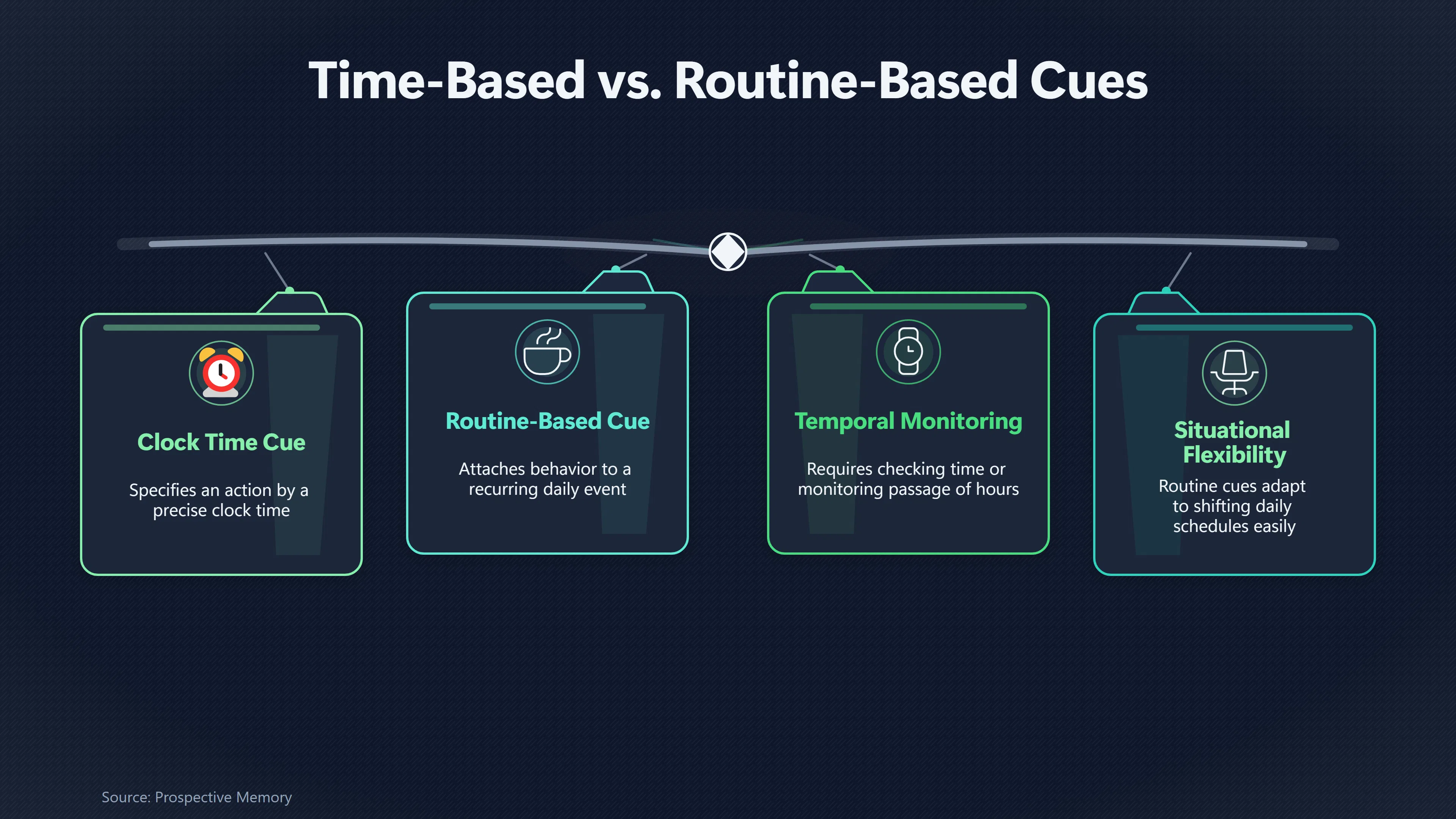
Atime-based cuespecifies when an action should happen by the clock: take a short walk at 1 pm, prepare tomorrow’s lunch at 8 pm, or eat a piece of fruit at 10.30 am. Aroutine-based cueattaches the new behaviour to an event already recurring in daily life: take the walk after lunch, prepare tomorrow’s lunch after washing the dinner dishes, or eat the fruit after making morning coffee.
Both approaches create a cue–behaviour plan. Their practical difference lies in what has to signal that it is time to act.
A routine supplies an event that can itself become the trigger. Finishing breakfast is observable: breakfast ends, and the planned behaviour follows. A clock-time plan depends on encountering or checking temporal information at approximately the appropriate moment. Research on prospective memory — remembering to carry out a future intention — distinguishes similarly between time-based tasks and event-based tasks. Time-based prospective remembering can require monitoring the passage of time, whereas an event in the environment can provide an external retrieval cue.
That difference gives routine cues an intuitively appealing advantage. “After breakfast” remains usable whether breakfast happens at 7.15 or 8.30, whereas “at 8 am” may collide with commuting, a meeting or an unusually late start. The authors of the direct habit trial noted earlier evidence suggesting that routine cues might allow greater situational flexibility and require less monitoring than time cues.
But this doesnotestablish a general superiority of routine cues. Clock time can itself be extremely stable, particularly when a person’s day follows a fixed timetable or when clocks, watches and alarms make the time highly noticeable. More importantly, direct experimental evidence did not reproduce the expected routine-cue advantage.
What the 84-day randomised trial found
The clearest head-to-head test was conducted in Germany by Jan Keller and colleagues and published in theBritish Journal of Health Psychology. The prospectively registered trial enrolled 192 adults and randomly assigned 96 to each of two brief planning interventions. Participants selected a healthy nutrition behaviour they did not already perform in the proposed cue–behaviour combination.
One group attached the behaviour to adaily routine, such as after breakfast. The other attached it to aspecific time, such as 9 am. Participants were then asked to perform the behaviour in that planned context every day for 12 weeks. Daily questionnaires measured whether they had enacted the plan and their behavioural automaticity — the extent to which the behaviour felt as though it happened automatically.
The headline result was unusually simple:both approaches worked similarly at group level. Automaticity increased over time in both conditions, as did plan enactment, and the researchers found no significant between-group difference favouring routine-based or time-based planning.
The more consequential difference was between people who repeatedly followed their plan and those who did not. On days when participants successfully enacted the behaviour in response to their planned cue, predicted automaticity was higher; across participants, people who enacted their plans more consistently also tended to develop greater automaticity.
The descriptive figures make the similarity between cue types particularly tangible. Among the 135 participants retained for the main analyses, average plan enactment during the first 28 days was about 69% in the routine group and 67% in the time group. During days 57–84, the figures were about 68% and 71% respectively. These are not cleanly diverging trajectories in which one cue type obviously wins.
The “59 days” result needs context
Among participants classified as successfully forming a habit, the median modelled time to reach 95% of their automaticity plateau was 59 days. But individual estimates varied dramatically — from 4 to 335 days — so 59 should not be treated as a countdown after which a behaviour suddenly becomes habitual.
There was another important qualification: only 27 participants were classified as showing successful habit formation according to the individual curve analyses, split almost evenly between routine cues (14) and time cues (13). The trial therefore offers useful evidence against a large, straightforward advantage for either cue type, but it is not proof that the two approaches are equivalent for every person, behaviour or schedule.
The analysed sample also skewed young and female. Of the original 192 participants, 86.5% were women and the mean age was about 25, although ages ranged from 18 to 77. The intervention concerned self-selected healthy eating behaviours, not every possible self-improvement habit. Generalising the precise results to exercise, studying, sleep routines or complex skills therefore requires caution.

Consistency matters more than the label on the cue
The trial points towards a more useful distinction than “time versus routine”:reliably encountered cue versus unreliable cue.
That interpretation fits broader habit research on context stability. In a 2022 study, researchers examined intentional habit building in two datasets. In the first, 95 university students formed study habits over six weeks; one group was instructed to keep the time and place stable while another varied them. The second dataset covered 308 habits from 218 users of a habit-building app. Across both datasets, greater context stability predicted stronger automaticity and better attainment of the intended habit-repetition goals.
A 2026 preregistered reanalysis of a six-month longitudinal habit study also found context stability among the factors associated with habit strength, alongside behaviour frequency and several motivational and experiential variables. This does not tell us that a clock or routine is the better cue, but it reinforces the importance of repeatedly performing a behaviour under sufficiently similar circumstances for a cue–response relationship to develop.
This helps explain why the same cue format can be excellent for one person and poor for another. “At 7 am” is stable for someone who reliably gets up at 6.30, but fragile for a shift worker whose waking time changes. “After breakfast” is stable for someone who eats breakfast every morning, but useless for someone who regularly skips it. The cue category is secondary to whether the cue actually occurs and whether the behaviour can realistically follow it.
Choosing the cue that fits your real schedule
A good cue should pass a simple practical test:Will I encounter this cue reliably, and when I do, can I normally perform the behaviour?The 84-day trial suggests that getting this pairing right is more important than choosing time-based planning merely because it sounds precise or routine-based planning because it sounds more “habit-like”.
Use atime cuewhen the relevant part of your schedule is genuinely clock-driven. Taking a work break at 11 am, beginning a shutdown routine at 5.30 pm or doing a two-minute posture exercise when a scheduled afternoon alarm sounds can all give the behaviour a recurring temporal context. The cue becomes weaker in practice if 11 am repeatedly finds you somewhere the action cannot be performed.
Use aroutine cuewhen an existing action is more predictable than its exact timing. “After I make my first coffee, I review my priorities” can survive differences in waking time. “After I put my dinner plate away, I prepare breakfast for tomorrow” moves naturally with dinner rather than competing with a fixed evening deadline.
Three criteria are especially useful:
- Frequency:choose a cue that occurs at least as often as you intend to perform the new behaviour. A daily habit needs a reliably daily opportunity.
- Compatibility:the behaviour must be feasible immediately or very soon after the cue. A cue that regularly appears when you are busy, travelling or without the required equipment creates missed pairings.
- Stability:prefer the cue whose surrounding circumstances change least. Research beyond the time-versus-routine trial indicates that stable performance contexts are associated with stronger automaticity.
Specificity still helps. “In the morning” leaves considerable ambiguity; “at 8.15 am” identifies a clearer time cue. Similarly, “after getting ready” can contain several possible moments, whereas “after I brush my teeth” identifies a more definite recurring event. The aim is to make it reasonably obvious when the opportunity to perform the behaviour has arrived.
When a theoretically good cue fails
The most important failure mode is choosing a cue that looks consistent on paper but is inconsistent in lived experience. A person may schedule reading for 9 pm and then discover that evenings vary between social plans, unfinished work and tiredness. Another may choose “after lunch” before noticing that lunch sometimes happens at a desk, sometimes outside and occasionally not at all.
In those cases, repeatedly missing the behaviour is not evidence that the person simply needs to wait longer for automaticity. Habit learning depends on repetitions of the cue–response pairing. In Keller and colleagues’ trial, repeated plan enactment was one of the central predictors of greater automaticity.
This also suggests a sensible reason to change cues. If several weeks reveal that the chosen trigger frequently occurs when the action is impossible, moving the behaviour to a more dependable cue may be more useful than preserving an elegant but poorly matched plan. The goal is not loyalty to “7.30 am” or “after breakfast”; it is to create enough reliable cue–behaviour pairings for the response to become easier to initiate.
The practical takeaway
The best available direct trial does not support a rule that routine cues beat clock times, or vice versa. Over 84 days, people assigned to either type of cue showed increasing automaticity without a significant difference between the two conditions. What stood out instead was repeated enactment: people who more consistently performed the intended behaviour in response to their planned cue tended to develop stronger automaticity.
For self-improvement, that makes cue selection a problem offit and repeatability, not finding a universally superior trigger. If 8 am reliably arrives during a quiet, controllable part of your day, use 8 am. If breakfast is dependable but its timing moves around, “after breakfast” may provide the better anchor. The useful cue is the one your real schedule keeps giving you — and that you can repeatedly answer with the same behaviour.
Amazon book picks
Further Reading
Books and field guides related to Should a Habit Follow a Time or Routine?. Use these as the next step if you want deeper reading beyond the article.
Atomic Habits
Rating: 3.5/5 from 7 Google Books ratings
The #1 New York Times bestseller. Over 25 million copies sold! Translated into 60+ languages! Tiny Changes, Remarkable Results No matter...
Tiny Habits
Improving your life is much easier than you think. Whether it’s losing weight, sleeping more, or restoring your work/life balance – the s...
The Power of Habit
Rating: 4.0/5 from 145 Google Books ratings
Duhigg takes us to the edge of scientific discoveries that explain why habits exist and how they can be changed. Distilling information i...
Good Habits, Bad Habits
'The world's leading expert on habits' - Matthew Syed, bestselling author of Black Box Thinking and Rebel IdeasWhat if you could harness...
eBay marketplace picks
Marketplace Samples
Live-tested eBay searches with available results related to this page.
Selected frommotivational desk sign oneBay.co.uk.

Endnotes
1.
Source: sciencedirect.com
Title: Prospective Memory
Link:https://www.sciencedirect.com/topics/social-sciences/prospective-memory
Additional References
2.
Source: pubmed.ncbi.nlm.nih.gov
Link:https://pubmed.ncbi.nlm.nih.gov/17324087/
Source snippet
Is time-based prospective remembering mediated by self-initiated rehearsals? Role of incidental cues, ongoing activity, age, and mo...
3.
Source: pmc.ncbi.nlm.nih.gov
Link:https://pmc.ncbi.nlm.nih.gov/articles/PMC12589293/
Source snippet
PubMed Central (PMC)Looking for cues over time: A study on self-initiated monitoring in event-based and time-based prospective memory - PMC...
4.
Source: pubmed.ncbi.nlm.nih.gov
Link:https://pubmed.ncbi.nlm.nih.gov/33405284/
Source snippet
Habit formation following routine-based versus time-based cue planning: A randomized controlled trial - PubMedJanuary 6, 2021...
Published: January 6, 2021
5.
Source: bpspsychub.onlinelibrary.wiley.com
Link:https://bpspsychub.onlinelibrary.wiley.com/doi/abs/10.1111/bjhp.12504
Source snippet
BPS Psych HubHabit formation following routine‐based versus time‐based cue planning: A randomized controlled trial - Keller - 2021 - Brit...
6.
Source: doi.org
Link:https://doi.org/10.1111/bjhp.12504
Source snippet
Habit formation following routine‐based versus time‐based cue planning: A randomized controlled trial - Keller - 2021 - British Journa...
7.
Source: minerva-access.unimelb.edu.au
Link:https://minerva-access.unimelb.edu.au/server/api/core/bitstreams/85b44c09-6a67-58ce-ac9d-8d12c3e421bb/content
Source snippet
Minerva AccessHabit formation following routine‐based versus time‐based cue planning: A randomized controlled trialMay 6, 2021...
Published: May 6, 2021
8.
Source: refubium.fu-berlin.de
Link:https://refubium.fu-berlin.de/bitstream/handle/fub188/31524/bjhp.12504.pdf?isAllowed=y&sequence=1
Source snippet
Habit formation following routine‐based versus time‐based cue planning: A randomized controlled trialAugust 4, 2021...
Published: August 4, 2021
9.
Source: youtube.com
Link:https://www.youtube.com/watch?v=N7SDVVbxgNU
Source snippet
Atomic Habits Chapter 5: How to Stop Waiting for Motivation is particularly relevant because it directly contrasts time-based implementat...
10.
Source: scribd.com
Link:https://www.scribd.com/document/955119400/Keller-Et-Al-2021-Habit-Formation-Following-Routine-Based-Versus-Time-Based-Cue-Planning-A
Source snippet
Habit Formation: Routine vs. Time Cues | PDF | Akaike Information Criterion | Habits...
11.
Source: youtube.com
Title: Atomic Habits Chapter 5: How to Stop Waiting for Motivation | Mug & Mindset
Link:https://www.youtube.com/watch?v=sHr2KqP2sR0
Source snippet
Stop Relying on Willpower | 5 Surprising Lessons from Atomic Habits...