Within Sleep and Focus
Feeling Used to Less Sleep Can Mislead You
People may stop feeling progressively sleepier during chronic sleep restriction even while objective attention performance continues to worsen.
On this page
- How subjective sleepiness and objective performance diverge
- Why feeling normal does not prove vigilance has recovered
- What this mismatch means for self assessment
Page outline Jump by section
Introduction
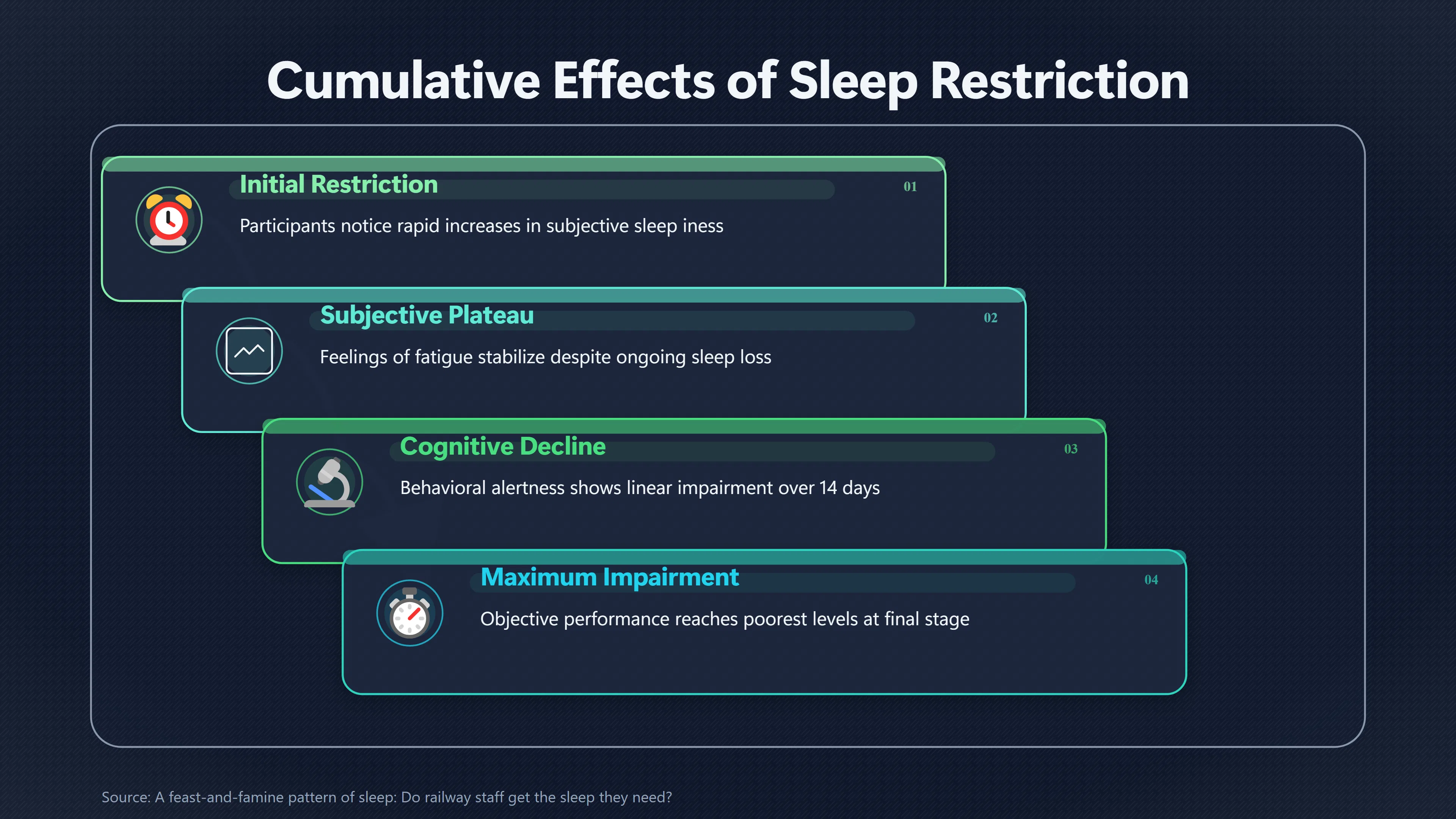
Repeatedly sleeping too little can create a deceptive sense of adaptation. After the first few restricted nights, people may stop feeling progressively sleepier even though their ability to sustain attention is still impaired or continuing to deteriorate. In the classic 14-day laboratory study behind this finding, participants restricted to four or six hours in bed showed cumulative cognitive deficits, while their subjective sleepiness rose sharply at first and then changed relatively little.[PubMed]pubmed.ncbi.nlm.nih.govThe cumulative cost of additional wakefulness: dose-response effects on neurobehavioral functions and sleep physiology from chronic…
That distinction matters for self-improvement because “I feel fine on this amount of sleep” is not a reliable performance test. Feeling accustomed to short sleep can reflect adaptation in how the sleep loss feels, without equivalent recovery in how reliably attention works. Later experiments have reproduced the broader mismatch between subjective alertness and objective vigilance, including situations in which sleep-restricted people reported alertness comparable with controls despite markedly worse reaction times and attentional lapses.[PubMed Central (PMC)]pmc.ncbi.nlm.nih.govPubMed Central (PMC)Chronic sleep curtailment, even without extended (>16-h) wakefulness, degrades human vigilance performance - PMCJune…
How feeling sleepy and performing poorly diverge
The clearest demonstration comes from Hans Van Dongen and colleagues’ controlled sleep-dose experiment. Healthy adults were assigned to four, six or eight hours of time in bed per night for 14 days, while another group underwent total sleep deprivation. Restricting sleep to four or six hours produced cumulative, dose-dependent deficits across cognitive tests. On measures of behavioural alertness, impairment continued to build as restricted nights accumulated.[PubMed]pubmed.ncbi.nlm.nih.govThe cumulative cost of additional wakefulness: dose-response effects on neurobehavioral functions and sleep physiology from chronic…
Subjective experience followed a different trajectory. Participants initially noticed the restriction: sleepiness increased rapidly. But subsequent increases were comparatively small. A later review of the experiment describes psychomotor vigilance test (PVT) lapses increasing approximately linearly across the 14 restricted nights, whereas subjective sleepiness and fatigue showed a much flatter trajectory. By the end, when objective performance was at its poorest, participants in the four- and six-hour conditions reported being only slightly sleepy.[PubMed Central (PMC)]pmc.ncbi.nlm.nih.govPubMed Central (PMC)Behavioral and Physiological Consequences of Sleep Restriction - PMC…
This is the phenomenon that can easily be mistaken for successful adaptation. The person has genuine evidence from experience that something has changed: getting through the day may no longer feel progressively harder. What does not follow is that their attention has returned to normal.
A separate seven-day sleep-dose experiment illustrates why the word “adaptation” needs care. Belenky and colleagues assigned participants three, five, seven or nine hours in bed. PVT performance deteriorated sharply under severe restriction; with five or seven hours, some performance measures eventually stabilised, but at an impaired level rather than returning to baseline. The researchers therefore discussed physiological adaptation that could stabilise performance at reduced capacity.[PubMed]pubmed.ncbi.nlm.nih.govOpen source on nih.gov.
The two findings are compatible rather than contradictory. Under some schedules objective deterioration can accumulate; under others it can level off below baseline. The important point for self-assessment is that neither a plateau in perceived sleepiness nor becoming accustomed to a schedule establishes that normal vigilance has been restored.
Why feeling normal does not prove vigilance has recovered
Subjective sleepiness and vigilant attention are related, but they are not interchangeable measurements. A sleepiness scale asks, in effect, “How sleepy or alert do I feel?” A vigilance task measures something different: whether attention can be maintained reliably enough to respond to unpredictable events without unusually slow responses or lapses.
Experiments designed specifically to compare these signals show how far apart they can move. In one forced-desynchrony study, 27 healthy young men underwent either a standard or sleep-restricted schedule while researchers separated the effects of biological time from time awake. Under restricted sleep, objective PVT impairment exceeded the deterioration participants reported in subjective alertness. The mismatch was particularly pronounced during the biological night, leading the researchers to conclude that sleep-restricted people were likely to underestimate their neurobehavioural impairment at that time.[PubMed]pubmed.ncbi.nlm.nih.govMismatch between subjective alertness and objective performance under sleep restriction is greatest during the biological night - P…
An especially revealing experiment later removed a possible alternative explanation. Perhaps chronic sleep restriction hurts performance simply because short sleepers spend unusually long periods awake each day. Researchers therefore used a 32-day inpatient protocol in which restricted participants received only 4.67 hours of sleep opportunity per cycle but were never awake for more than 15.33 hours at once. Even without unusually prolonged waking episodes, chronic short sleep produced reaction-time impairment reaching roughly twice the control level and as much as a fivefold increase in PVT lapses. Yet there were no significant overall differences between restricted and control groups in subjective alertness or sleepiness.[PubMed]pubmed.ncbi.nlm.nih.govOpen source on nih.gov.
That is stronger evidence than simply observing that tired people occasionally misjudge themselves. It shows that objective vigilance and the subjective experience of alertness can follow substantially different responses to chronic insufficient sleep.
The mismatch is not perfectly uniform from person to person. The same study found considerable individual variation in the relationship between subjective alertness and PVT performance. Another modelling study found that subjective alertness was informative about performance, but insufficient on its own: predictions of PVT performance improved when circadian phase, time awake and accumulated sleep loss were also included.[PubMed Central (PMC)]pmc.ncbi.nlm.nih.govPubMed Central (PMC)Chronic sleep curtailment, even without extended (>16-h) wakefulness, degrades human vigilance performance - PMCJune…
So the correct lesson is not that feelings are meaningless. Someone who feels profoundly sleepy has useful information. The problem is the reverse inference: not feeling very sleepy cannot safely be translated into “therefore my attention is unimpaired”.

The mismatch can hide inside an apparently good day
One reason false adaptation is persuasive is that sleep restriction does not necessarily make every moment feel or look dysfunctional. Circadian rhythms create periods when the biological clock promotes wakefulness, and motivation or engaging circumstances can also alter how alert someone feels. The resulting experience can be convincing: a person may work, talk and exercise without an obvious sensation of exhaustion while still being more vulnerable to attentional failures.
Research separating circadian timing from sleep loss makes this particularly clear. Under chronic restriction, objective performance becomes substantially worse around the biological night, while subjective ratings do not necessarily change by the same magnitude.[PubMed]pubmed.ncbi.nlm.nih.govMismatch between subjective alertness and objective performance under sleep restriction is greatest during the biological night - P… In the long inpatient experiment, the circadian system still produced the expected daily rhythm in both performance and feelings of alertness, but the daytime promotion of wakefulness did not erase the accumulated objective impairment from restricted sleep.[PubMed Central (PMC)]pmc.ncbi.nlm.nih.govPubMed Central (PMC)Chronic sleep curtailment, even without extended (>16-h) wakefulness, degrades human vigilance performance - PMCJune…
This distinction helps explain an otherwise puzzling everyday experience: “I was exhausted for the first few days, but now six hours feels normal.” The second half of that statement can be completely sincere without demonstrating cognitive recovery. “Normal” is a judgement relative to one’s recent internal experience; an objective vigilance test is comparing performance against a measurable baseline.
Recent experimental work reinforces that distinction. In a five-night study giving healthy young men five hours in bed, PVT lapses increased during restriction regardless of how participants’ subjective alertness changed. Participants whose alertness was relatively preserved were therefore not protected from impaired vigilance.[PubMed Central (PMC)]pmc.ncbi.nlm.nih.govOpen source on nih.gov.
Why self-assessment becomes a weak safety check
The practical danger is not simply being sleepy. It is being impaired without receiving a proportionately strong subjective warning.
That matters whenever someone uses their internal state as the deciding criterion for continuing a vigilance-dependent activity. “I still feel alert enough” sounds like evidence about performance capacity, but under accumulated sleep restriction it is partly measuring the wrong thing. Reviews of fatigue research consequently caution against treating subjective sleepiness alone as a dependable proxy for objective performance impairment.[PubMed Central (PMC)]pmc.ncbi.nlm.nih.govOpen source on nih.gov.
Driving research gives the mismatch a concrete form. In a controlled study combining laboratory measurements with driving on an open motorway, sleep restriction slowed reaction times, while prospective self-evaluation of performance did not reliably correspond to reaction-time performance under real driving conditions. The researchers concluded that self-monitoring in those conditions was poorly reliable.[PubMed]pubmed.ncbi.nlm.nih.govOpen source on nih.gov.
This does not mean every sleepy driver is unaware of being sleepy, nor that subjective ratings never predict behaviour. Indeed, other research has found that self-assessed ability can carry useful predictive information alongside objective tests.[PubMed]pubmed.ncbi.nlm.nih.govOpen source on nih.gov. The narrower and better-supported conclusion is that subjective confidence should not be treated as sufficient evidence of intact vigilance after repeated insufficient sleep.
That is the self-improvement trap. People naturally evaluate a routine partly by asking whether they have become used to it. For exercise discomfort, a new working environment or an unfamiliar habit, adaptation can sometimes be meaningful evidence of adjustment. Chronic sleep restriction is different because the internal warning signal and the performance outcome can adapt on different trajectories.

What this mismatch means for self-assessment
The useful response is to change the question. Instead of asking only, “Do I feel tired?”, ask “What has my recent sleep opportunity actually been, and does this task depend on sustained attention?”
Three distinctions keep that judgement grounded:
- Feeling better is not the same as performing at baseline. Subjective sleepiness can plateau while vigilance remains impaired or continues worsening.[PubMed]pubmed.ncbi.nlm.nih.govThe cumulative cost of additional wakefulness: dose-response effects on neurobehavioral functions and sleep physiology from chronic…
- A stable routine is not proof of physiological adequacy. Repeating the same short sleep schedule can make it familiar without demonstrating restoration of normal attention.
- The absence of obvious mistakes is weak evidence. Vigilance impairment often concerns the probability of intermittent lapses rather than continuous incapacity; a person can function adequately for stretches while becoming less reliable at catching unpredictable events.
There is also no simple universal conversion from “I feel 80% alert” to “my attention is 80% normal”. Individual vulnerability varies, circadian timing matters, accumulated sleep loss matters, and different cognitive abilities respond differently. A 2024 meta-analysis of 44 studies, for example, found that even a single restricted night increased subjective sleepiness and impaired sustained attention, while several other cognitive domains did not show clear overall impairment.[ScienceDirect]sciencedirect.comOpen source on sciencedirect.com. Chronic restriction then adds the further problem that subjective and objective trajectories can separate.
For self-improvement, this changes what counts as successful adaptation. Becoming capable of tolerating the feeling of a short-sleep schedule is not evidence that the schedule has stopped carrying an attentional cost. The stronger test is whether sufficient sleep is being obtained and whether objective performance remains dependable—not simply whether reduced sleep has stopped feeling unusual.
The central lesson is therefore deliberately narrow: you can adapt to how insufficient sleep feels without equivalently adapting to what insufficient sleep does to sustained attention. That is why feeling normal after several short nights should be treated as a potentially misleading signal rather than proof that vigilance has recovered.
Amazon book picks
Further Reading
Books and field guides related to Feeling Used to Less Sleep Can Mislead You. Use these as the next step if you want deeper reading beyond the article.
Why We Sleep
"Sleep is one of the most important but least understood aspects of our life, wellness, and longevity ... An explosion of scientific disc...
The Sleep Solution
With cutting-edge sleep science and time-tested techniques, The Sleep Solution will help anyone achieve healthy sleep and eliminate pills...
The Promise of Sleep
Sleep better, live longer with the groundbreaking information and step-by-step program in this revolutionary book. Healthful sleep has be...
Sleep for Success
Given the present, stress-inducing state of the economy and the world, there has never been a better time to provide a wake-up call on ho...
eBay marketplace picks
Marketplace Samples
Live-tested eBay searches with available results related to this page.
Selected fromsleep accessories oneBay.co.uk.
Endnotes
1.
Source: sciencedirect.com
Link:https://www.sciencedirect.com/science/article/pii/S1087079224000443
2.
Source: sciencedirect.com
Title: A feast-and-famine pattern of sleep: Do railway staff get the sleep they need?
Link:https://www.sciencedirect.com/science/article/pii/S0003687022000345
3.
Source: sciencedirect.com
Link:https://www.sciencedirect.com/science/article/abs/pii/S2352721820301145
4.
Source: sciencedirect.com
Link:https://www.sciencedirect.com/science/article/pii/S0031938419311394
5.
Source: sciencedirect.com
Link:https://www.sciencedirect.com/science/article/pii/S0031938497005386
6.
Source: sciencedirect.com
Link:https://www.sciencedirect.com/science/article/abs/pii/S0031938497005386
7.
Source: sciencedirect.com
Link:https://www.sciencedirect.com/science/article/pii/S0001457524001544
8.
Source: sciencedirect.com
Link:https://www.sciencedirect.com/science/article/pii/S0001457515300968
9.
Source: sciencedirect.com
Title: Fatigue, sleep restriction and driving performance
Link:https://www.sciencedirect.com/science/article/pii/S0001457505000114
10.
Source: sciencedirect.com
Link:https://www.sciencedirect.com/science/article/pii/S1369847821000875
11.
Source: sciencedirect.com
Link:https://www.sciencedirect.com/science/article/abs/pii/S0001457515300968
12.
Source: sciencedirect.com
Link:https://www.sciencedirect.com/science/article/pii/S1054139X19302514
13.
Source: sciencedirect.com
Title: EE G and behavioural correlates of mild sleep deprivation and vigilance
Link:https://www.sciencedirect.com/science/article/pii/S1388245720305241
14.
Source: pubmed.ncbi.nlm.nih.gov
Link:https://pubmed.ncbi.nlm.nih.gov/12683469/?dopt=Abstract
Source snippet
The cumulative cost of additional wakefulness: dose-response effects on neurobehavioral functions and sleep physiology from chronic...
15.
Source: pmc.ncbi.nlm.nih.gov
Link:https://pmc.ncbi.nlm.nih.gov/articles/PMC1978335/
Source snippet
PubMed Central (PMC)Behavioral and Physiological Consequences of Sleep Restriction - PMC...
16.
Source: pmc.ncbi.nlm.nih.gov
Link:https://pmc.ncbi.nlm.nih.gov/articles/PMC6003377/
Source snippet
PubMed Central (PMC)Chronic sleep curtailment, even without extended (>16-h) wakefulness, degrades human vigilance performance - PMCJune...
17.
Source: pubmed.ncbi.nlm.nih.gov
Link:https://pubmed.ncbi.nlm.nih.gov/21564364/
Source snippet
Mismatch between subjective alertness and objective performance under sleep restriction is greatest during the biological night - P...
18.
Source: pubmed.ncbi.nlm.nih.gov
Link:https://pubmed.ncbi.nlm.nih.gov/12683469/
Source snippet
The cumulative cost of additional wakefulness: dose-response effects on neurobehavioral functions and sleep physiology from chronic...
19.
Source: pubmed.ncbi.nlm.nih.gov
Link:https://pubmed.ncbi.nlm.nih.gov/22877676/
Source snippet
Managing neurobehavioral capability when social expediency trumps biological imperatives - PubMed...
20.
Source: pubmed.ncbi.nlm.nih.gov
Link:https://pubmed.ncbi.nlm.nih.gov/12603781
21.
Source: pubmed.ncbi.nlm.nih.gov
Link:https://pubmed.ncbi.nlm.nih.gov/29784810/
22.
Source: pubmed.ncbi.nlm.nih.gov
Link:https://pubmed.ncbi.nlm.nih.gov/27019198/
23.
Source: pubmed.ncbi.nlm.nih.gov
Link:https://pubmed.ncbi.nlm.nih.gov/26534845/
24.
Source: pmc.ncbi.nlm.nih.gov
Link:https://pmc.ncbi.nlm.nih.gov/articles/PMC8286723/
25.
Source: pubmed.ncbi.nlm.nih.gov
Link:https://pubmed.ncbi.nlm.nih.gov/34285617/
26.
Source: pmc.ncbi.nlm.nih.gov
Link:https://pmc.ncbi.nlm.nih.gov/articles/PMC9389006/
27.
Source: ncbi.nlm.nih.gov
Title: NCBIConsequences of Fatigue from Insufficient Sleep
Link:https://www.ncbi.nlm.nih.gov/books/NBK384963/
28.
Source: pubmed.ncbi.nlm.nih.gov
Link:https://pubmed.ncbi.nlm.nih.gov/12749545/
29.
Source: pmc.ncbi.nlm.nih.gov
Link:https://pmc.ncbi.nlm.nih.gov/articles/PMC12452710/
30.
Source: pmc.ncbi.nlm.nih.gov
Link:https://pmc.ncbi.nlm.nih.gov/articles/PMC12716481/
31.
Source: pubmed.ncbi.nlm.nih.gov
Link:https://pubmed.ncbi.nlm.nih.gov/38701560/
32.
Source: pmc.ncbi.nlm.nih.gov
Link:https://pmc.ncbi.nlm.nih.gov/articles/PMC11156797/
33.
Source: pmc.ncbi.nlm.nih.gov
Link:https://pmc.ncbi.nlm.nih.gov/articles/PMC10108639/
34.
Source: pubmed.ncbi.nlm.nih.gov
Link:https://pubmed.ncbi.nlm.nih.gov/33994837/
35.
Source: pubmed.ncbi.nlm.nih.gov
Link:https://pubmed.ncbi.nlm.nih.gov/32411513/
36.
Source: pubmed.ncbi.nlm.nih.gov
Link:https://pubmed.ncbi.nlm.nih.gov/31176308/
37.
Source: pmc.ncbi.nlm.nih.gov
Link:https://pmc.ncbi.nlm.nih.gov/articles/PMC6879580/
38.
Source: pubmed.ncbi.nlm.nih.gov
Link:https://pubmed.ncbi.nlm.nih.gov/30722039/
39.
Source: pubmed.ncbi.nlm.nih.gov
Link:https://pubmed.ncbi.nlm.nih.gov/29159907/
40.
Source: pubmed.ncbi.nlm.nih.gov
Link:https://pubmed.ncbi.nlm.nih.gov/29680427/
41.
Source: pubmed.ncbi.nlm.nih.gov
Link:https://pubmed.ncbi.nlm.nih.gov/29097703/
42.
Source: pmc.ncbi.nlm.nih.gov
Link:https://pmc.ncbi.nlm.nih.gov/articles/PMC6143346/
43.
Source: pmc.ncbi.nlm.nih.gov
Link:https://pmc.ncbi.nlm.nih.gov/articles/PMC5007844/
44.
Source: pubmed.ncbi.nlm.nih.gov
Link:https://pubmed.ncbi.nlm.nih.gov/27242464/
45.
Source: pmc.ncbi.nlm.nih.gov
Link:https://pmc.ncbi.nlm.nih.gov/articles/PMC4809494/
46.
Source: pmc.ncbi.nlm.nih.gov
Link:https://pmc.ncbi.nlm.nih.gov/articles/PMC4457397/
47.
Source: pmc.ncbi.nlm.nih.gov
Link:https://pmc.ncbi.nlm.nih.gov/articles/PMC4074968/
48.
Source: pmc.ncbi.nlm.nih.gov
Link:https://pmc.ncbi.nlm.nih.gov/articles/PMC3724779/
49.
Source: pmc.ncbi.nlm.nih.gov
Link:https://pmc.ncbi.nlm.nih.gov/articles/PMC3600847/
50.
Source: pmc.ncbi.nlm.nih.gov
Link:https://pmc.ncbi.nlm.nih.gov/articles/PMC3397820/
51.
Source: pmc.ncbi.nlm.nih.gov
Link:https://pmc.ncbi.nlm.nih.gov/articles/PMC3369235/
52.
Source: pubmed.ncbi.nlm.nih.gov
Link:https://pubmed.ncbi.nlm.nih.gov/22754046/
53.
Source: pmc.ncbi.nlm.nih.gov
Link:https://pmc.ncbi.nlm.nih.gov/articles/PMC3375037/
54.
Source: pubmed.ncbi.nlm.nih.gov
Link:https://pubmed.ncbi.nlm.nih.gov/17803017/
55.
Source: periodicos.capes.gov.br
Title: capes.gov.br Behavioral and Physiological Consequences of Sleep Restriction
Link:https://www.periodicos.capes.gov.br/index.php/acervo/buscador.html?id=W84689042&source=all&task=detalhes
56.
Source: pubmed.ncbi.nlm.nih.gov
Link:https://pubmed.ncbi.nlm.nih.gov/15912483/
57.
Source: pubmed.ncbi.nlm.nih.gov
Link:https://pubmed.ncbi.nlm.nih.gov/15885247/
58.
Source: pubmed.ncbi.nlm.nih.gov
Link:https://pubmed.ncbi.nlm.nih.gov/21564364/?dopt=Abstract
59.
Source: pubmed.ncbi.nlm.nih.gov
Link:https://pubmed.ncbi.nlm.nih.gov/9231952/
60.
Source: pubmed.ncbi.nlm.nih.gov
Link:https://pubmed.ncbi.nlm.nih.gov/18533328/
61.
Source: pubmed.ncbi.nlm.nih.gov
Link:https://pubmed.ncbi.nlm.nih.gov/15784201/
63.
Source: pmc.ncbi.nlm.nih.gov
Link:https://pmc.ncbi.nlm.nih.gov/articles/PMC2656292/
64.
Source: ncbi.nlm.nih.gov
Link:https://www.ncbi.nlm.nih.gov/medgen/709937
65.
Source: pmc.ncbi.nlm.nih.gov
Link:https://pmc.ncbi.nlm.nih.gov/articles/PMC3700596/
66.
Source: pubmed.ncbi.nlm.nih.gov
Link:https://pubmed.ncbi.nlm.nih.gov/9618002/
67.
Source: pubmed.ncbi.nlm.nih.gov
Link:https://pubmed.ncbi.nlm.nih.gov/27868260/
Additional References
68.
Source: onlinelibrary.wiley.com
Link:https://onlinelibrary.wiley.com/doi/10.1111/j.1365-2869.2011.00924.x
Source snippet
Wiley Online LibraryMismatch between subjective alertness and objective performance under sleep restriction is greatest during the biolog...
69.
Source: onlinelibrary.wiley.com
Link:https://onlinelibrary.wiley.com/doi/abs/10.1046/j.1365-2869.2003.00337.x
Source snippet
Wiley Online LibraryPatterns of performance degradation and restoration during sleep restriction and subsequent recovery: a sleep dose‐re...
70.
Source: youtube.com
Title: Hans Van Dongen on how fatigue and sleep loss lead to cognitive deficits
Link:https://www.youtube.com/watch?v=2fVOu_dzt04
Source snippet
Hans Van Dongen: Individual differences in sleep and wake performance...
71.
Source: youtube.com
Title: Sleep Is Your Superpower | Matt Walker | TED
Link:https://www.youtube.com/watch?v=5MuIMqhT8DM
Source snippet
Hans Van Dongen sleep restriction Hans Van Dongen: Individual differences in sleep and wake performance...
72.
Source: psychologicalscience.org
Link:https://www.psychologicalscience.org/conventions/archive/2023annual/paper/46380/
73.
Source: nature.com
Link:https://www.nature.com/articles/s41398-022-01909-x
74.
Source: nature.com
Link:https://www.nature.com/articles/s41598-017-14006-7
75.
Source: nature.com
Link:https://www.nature.com/nature-index/topics/l4/neurobehavioral-effects-of-sleep-deprivation-and-recovery
76.
Source: youtube.com
Title: Hans Van Dongen: Individual differences in sleep and wake performance
Link:https://www.youtube.com/watch?v=IuiVKB7QGg8
Source snippet
What Happens To Your Body And Brain If You Don't Get Sleep...
77.
Source: youtube.com
Title: What Happens To Your Body And Brain If You Don’t Get Sleep
Link:https://www.youtube.com/watch?v=Y-8b99rGpkM
Source snippet
David Dinges, PhD: Wakefulness in the 24/7 Society...