Within Consistency
The Best Time to Restart Is the Next Cue
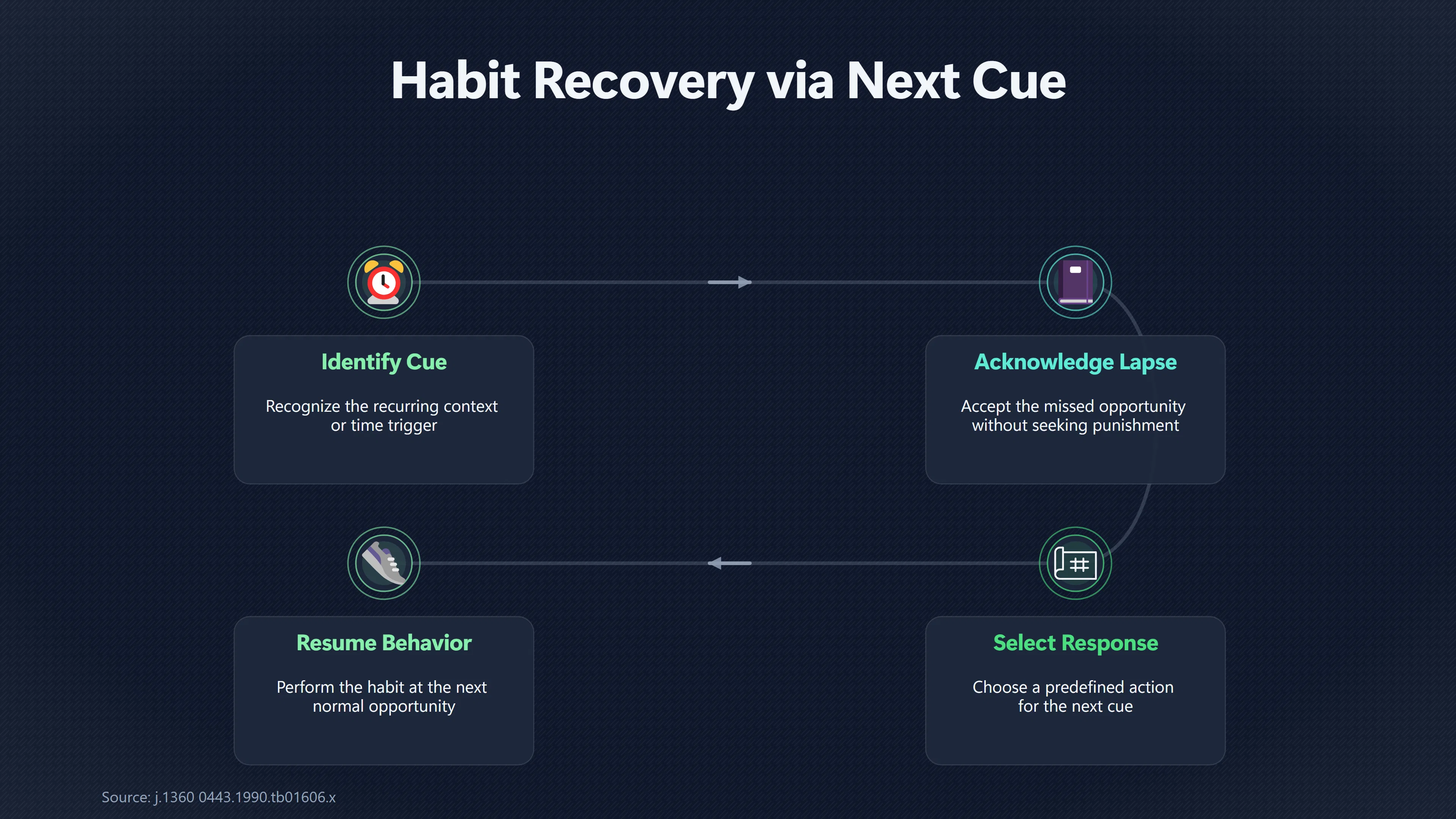
The most useful response to a lapse is often to resume at the next planned cue instead of inventing a dramatic restart.
On this page
- What counts as the next normal opportunity
- Why compensatory punishment can disrupt the original routine
- How a smaller version can preserve continuity on difficult days
Page outline Jump by section
Introduction
The best default response to a missed habit is usually simple: wait for the next normal cue and do the habit then. If the plan is “walk after lunch”, missing Tuesday’s walk does not require a punishing evening workout, a new programme or a ceremonial restart next Monday. Wednesday’s lunch is already the recovery point.
That rule fits what habit research actually suggests. Habits develop as behaviours are repeatedly performed in response to recurring contextual cues. In a landmark real-world study, one missed opportunity did not materially disrupt the development of automaticity; gains resumed when participants returned to the behaviour.[Wiley Online Library]onlinelibrary.wiley.comWiley Online LibraryHow are habits formed: Modelling habit formation in the real world - Lally - 2010 - European Journal of Social Psycho… The practical objective after a lapse is therefore not to erase the miss. It is to prevent one missing repetition from displacing the established cue–behaviour relationship.
A useful recovery policy can be stated in advance: “If I miss one planned opportunity, I resume at the next normal opportunity.”
What counts as the next normal opportunity?
The “next cue” is the next occurrence of whatever normally tells you it is time to act. That distinction matters because psychological habits are not simply behaviours performed frequently; they are actions increasingly triggered by recurring contexts. A cue might be a time, place, preceding activity or another reliable feature of a routine.[PubMed Central (PMC)]pmc.ncbi.nlm.nih.govPubMed Central (PMC)Making health habitual: the psychology of ‘habit-formation’ and general practice - PMC…
Suppose the habit is:
- read for 20 minutes after getting into bed;
- take a short walk after lunch;
- practise vocabulary on the train home;
- prepare tomorrow’s priorities after shutting down work;
- do a mobility routine after making morning coffee.
If Monday’s opportunity disappears because of travel, illness, an emergency or simple forgetfulness, the next normal opportunity is generally the next bedtime, lunch, train journey, work shutdown or morning coffee. It is not necessarily the earliest moment at which the missed behaviour could physically be squeezed into the day.
This is more than convenient wording. A random make-up session may achieve the behaviour once, but the normal cue supplies another repetition of the relationship that the person is actually trying to learn. Research comparing routine-based cues with time-based cues found that both approaches could support increases in automaticity when people repeatedly enacted their plans. In that randomised trial of 192 adults, successful habit formers took a median of 59 days to reach peak automaticity.[PubMed]pubmed.ncbi.nlm.nih.govHabit formation following routine-based versus time-based cue planning: A randomized controlled trial - PubMedJanuary 6, 2021…
Context stability also appears important. Research on habit building has found that stable contexts support automaticity and goal attainment, consistent with the broader view that habits emerge through learned links between situations and responses.[Frontiers]frontiersin.orgFrontiersFrontiers | Context Stability in Habit Building Increases Automaticity and Goal AttainmentJune 10, 2022… Returning at the next cue therefore restores something more specific than “discipline”: it restores another learning opportunity under the conditions in which the behaviour is meant eventually to become easier to initiate.
The rule does need sensible interpretation. A cue that will not recur for a long time may justify a planned alternative. Missing a Saturday gym session need not mean doing nothing for seven days if the broader routine already includes an appropriate backup slot. But that backup is most useful when it is predefined, rather than improvised in frustration after every lapse.
Why a missed habit does not need repayment
After a miss, people can be tempted to compensate: double tomorrow’s session, impose an extra restriction, stay up late to complete the task or redesign the whole routine. That response can feel rigorous because it makes the lapse carry an immediate cost. For habit formation, however, it can solve the wrong problem.
The original problem was one omitted repetition. Compensation can turn it into a second, harder behaviour. A 20-minute run becomes a 40-minute debt; ten pages of reading become twenty; one missed study session creates an obligation to sacrifice tomorrow evening. The recovery requirement is now more demanding than the routine that was supposed to become sustainable.
There is no good general evidence that such punishment is required to preserve habit formation. Lally and colleagues’ 12-week study followed 96 people attempting everyday eating, drinking or activity behaviours in consistent contexts. Among participants whose automaticity trajectories could be modelled, the time required to approach their eventual automaticity varied greatly, but missing one opportunity did not materially affect the formation process.[Wiley Online Library]onlinelibrary.wiley.comWiley Online LibraryHow are habits formed: Modelling habit formation in the real world - Lally - 2010 - European Journal of Social Psycho…
The better-supported intervention is planning what to do when the opportunity or obstacle appears. Implementation intentions are “if–then” plans linking a recognisable situation with a chosen response. The US National Cancer Institute’s research summary describes them as plans that connect critical cues or good opportunities to goal-directed behaviour, helping people recognise and act on those situations.[Cancer Control]cancercontrol.cancer.govOpen source on cancer.gov. In physical-activity research, planning interventions have produced a small-to-medium overall improvement in behaviour across randomised trials, although results vary considerably between studies and settings.[PubMed Central (PMC)]pmc.ncbi.nlm.nih.govOpen source on nih.gov.
That suggests a cleaner recovery instruction than punishment:
If today’s cue passes and I do not perform the habit, then I will perform it when the next scheduled cue occurs.
The distinction is important. The policy specifies re-entry, not repayment.

Stop one lapse becoming several
The most useful feature of a next-cue rule may be that it settles a decision before disappointment occurs. After missing a habit, there is no need to decide whether the programme is still “working”, whether the streak has been ruined or when a fresh start should begin. The recovery action was chosen in advance.
This resembles coping planning, in which people anticipate obstacles and decide how they will respond. A systematic review and meta-analysis of implementation-intention approaches to physical activity found support for planning interventions, particularly where plans addressed perceived obstacles and were reinforced over time.[PubMed Central (PMC)]pmc.ncbi.nlm.nih.govOpen source on nih.gov. A broader 2022 meta-analysis covering 35 trials and 5,439 participants likewise found better physical-activity outcomes in planning conditions than controls, while also reporting substantial heterogeneity between studies.[PubMed Central (PMC)]pmc.ncbi.nlm.nih.govOpen source on nih.gov. More recent meta-analytic modelling has also highlighted coping planning — anticipating barriers and responses to them — as particularly relevant to translating exercise intentions into behaviour.[PubMed]pubmed.ncbi.nlm.nih.govOpen source on nih.gov.
The useful shift is from asking “Will I ever miss?” to “What happens when I miss?” A practical policy can cover the common cases without becoming elaborate:
- Normal day: perform the habit at its usual cue.
- Cue arrives but the habit is impossible: use a predefined smaller version if one is appropriate.
- Opportunity is missed entirely: do not manufacture a punishment session; return at the next normal cue.
- The same cue repeatedly fails: treat that as information about the routine and redesign the cue rather than repeatedly “restarting”.
The final point prevents the rule from becoming an excuse for chronic non-performance. Evidence that one missed opportunity is relatively harmless does not mean that frequent omissions are harmless. Habit learning depends on repetition, and greater consistency of performance was associated with better-fitting automaticity trajectories in Lally and colleagues’ study.[Wiley Online Library]onlinelibrary.wiley.comWiley Online LibraryHow are habits formed: Modelling habit formation in the real world - Lally - 2010 - European Journal of Social Psycho… The next-cue policy is designed to contain isolated lapses, not redefine repeated avoidance as consistency.
Why dramatic restarts can make recovery harder
A dramatic restart changes the unit of attention. Instead of performing the next repetition, the person begins managing the meaning of the failure: choosing a new start date, making stricter rules, rebuilding a tracker or promising a more demanding effort.
Research from relapse prevention provides a useful, although not perfectly transferable, warning about this pattern. The abstinence violation effect was developed in research on addictive behaviours to describe how an initial lapse can be interpreted as a larger personal failure, potentially contributing to further lapses. The US Substance Abuse and Mental Health Services Administration describes the relevant all-or-nothing pattern as treating a temporary setback as total failure.[NCBI]ncbi.nlm.nih.govNCBI[Box], THE ABSTINENCE VIOLATION EFFECTNCBI[Box], THE ABSTINENCE VIOLATION EFFECT Because this literature largely concerns substance use, it should not be treated as direct evidence about missing an ordinary reading or exercise habit. The underlying distinction between an isolated lapse and what happens afterwards is nevertheless useful.
Empirical findings in that field are more nuanced than the simplest version of the theory. A study following 203 smokers across 1,001 lapse episodes found that post-lapse processes changed over successive lapses; declining self-efficacy was associated with faster progression towards another lapse, while guilt and self-blame did not behave exactly as classic theory predicted.[PubMed Central (PMC)]pmc.ncbi.nlm.nih.govOpen source on nih.gov. Earlier smoking research also found that people who attempted restorative coping after a lapse were less likely to progress to another lapse on the same day.[PubMed]pubmed.ncbi.nlm.nih.govOpen source on nih.gov.
For ordinary self-improvement habits, the cautious lesson is not that every missed workout behaves like addiction relapse. It is that what follows the miss deserves attention. A recovery rule that points directly to the next cue gives the lapse a defined boundary.
Use a smaller version when the cue arrives on a difficult day
Returning at the next cue does not require pretending every day offers identical capacity. Sometimes the cue arrives normally but the full behaviour is unusually difficult: there is less time, energy or access than expected.
In that situation, a predefined smaller version can preserve the act of responding to the cue. A 30-minute walk might become five minutes; a substantial writing session might become opening the document and writing a short paragraph; a long mobility routine might become its simplest safe movements. The aim is not to claim that five minutes produces the same outcome as 30. It plainly does not. The narrower purpose is to avoid making “full version or nothing” the rule governing whether the cue receives any response.
The evidence here needs careful wording. Research strongly supports repeated behaviour in stable contexts as a basis for habit formation, and simpler behaviours can become automatic more readily than more elaborate routines.[PubMed Central (PMC)]pmc.ncbi.nlm.nih.govPubMed Central (PMC)Making health habitual: the psychology of ‘habit-formation’ and general practice - PMC… Research on graded tasks — progressively manageable behavioural steps — also supports making physical-activity demands achievable, although such interventions combine graded tasks with other techniques and cannot establish that a particular “minimum version” rule is uniquely responsible for success. A 2026 systematic review found a medium pooled effect for graded-task physical-activity interventions but rated the certainty of evidence as low and reported substantial heterogeneity and possible publication bias.[Taylor & Francis Online]tandfonline.comOpen source on tandfonline.com.
So a smaller version is best understood as a continuity tool, not a loophole or magical substitute for the intended behaviour. If the reduced version becomes the everyday version while the goal requires more, the routine needs adjusting.
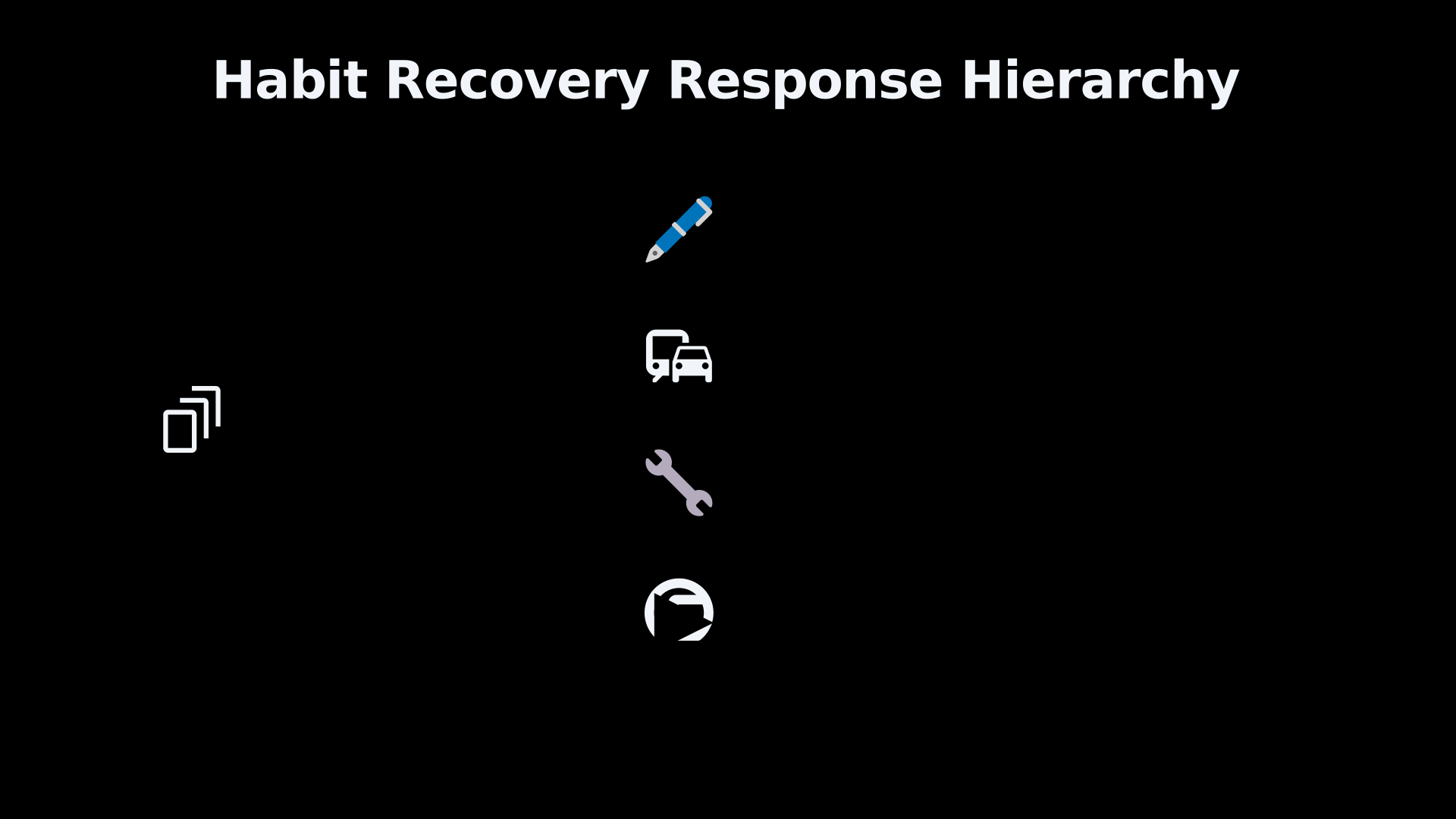
A useful hierarchy is therefore: full version when reasonably possible; smaller predefined version when circumstances genuinely constrain the full behaviour; next normal cue after a completely missed opportunity.
Make the recovery rule part of the habit
The most robust version of “restart at the next cue” is decided before it is needed. Implementation-intention research matters here because it converts a vague aspiration — “I must get back on track quickly” — into a response attached to an identifiable situation.[Cancer Control]cancercontrol.cancer.govOpen source on cancer.gov.
For example:
Normal rule: After breakfast, I walk for 15 minutes. Difficult-day rule: If breakfast finishes and I genuinely cannot fit in 15 minutes, I walk for five. Miss rule: If I miss the opportunity entirely, I do not owe myself extra walking; I resume after breakfast tomorrow.
The same structure can be adapted to studying, writing, tidying, practising a skill or other repeatable behaviours. What matters is that the recovery plan preserves the original architecture: recognisable cue, feasible response, repeat.
This is where consistency differs most clearly from perfection. Perfection tries to make lapses impossible. A workable long-term system assumes that some lapses will occur and makes their aftermath predictable. One missed cue becomes one missed repetition rather than a reason to renegotiate the entire project.
The next normal cue is valuable precisely because it is ordinary. No new motivation, special date or act of compensation is required. The routine simply gets another opportunity to run.
Amazon book picks
Further Reading
Books and field guides related to The Best Time to Restart Is the Next Cue. Use these as the next step if you want deeper reading beyond the article.
Atomic Habits
Rating: 3.5/5 from 7 Google Books ratings
The #1 New York Times bestseller. Over 25 million copies sold! Translated into 60+ languages! Tiny Changes, Remarkable Results No matter...
Tiny Habits
Improving your life is much easier than you think. Whether it’s losing weight, sleeping more, or restoring your work/life balance – the s...
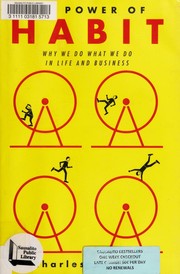
The Power of Habit
Rating: 4.0/5 from 145 Google Books ratings
Duhigg takes us to the edge of scientific discoveries that explain why habits exist and how they can be changed. Distilling information i...
Mini Habits
Discover the Life-Changing Strategy of This Worldwide Bestseller in 17 Languages! Lasting Change For Early Quitters, Burnouts, The Unmoti...
eBay marketplace picks
Marketplace Samples
Live-tested eBay searches with available results related to this page.
Selected fromhabit tracker board oneBay.co.uk.

Endnotes
1.
Source: onlinelibrary.wiley.com
Link:https://onlinelibrary.wiley.com/doi/10.1002/ejsp.674
Source snippet
Wiley Online LibraryHow are habits formed: Modelling habit formation in the real world - Lally - 2010 - European Journal of Social Psycho...
2.
Source: onlinelibrary.wiley.com
Link:https://onlinelibrary.wiley.com/doi/abs/10.1002/ejsp.674?msockid=17570258034862e732eb114c02616368
Source snippet
Wiley Online LibraryHow are habits formed: Modelling habit formation in the real world - Lally - 2010 - European Journal of Social Psycho...
3.
Source: cancercontrol.cancer.gov
Link:https://cancercontrol.cancer.gov/brp/research/constructs/implementation-intentions
4.
Source: compass.onlinelibrary.wiley.com
Link:https://compass.onlinelibrary.wiley.com/doi/10.1111/spc3.12975?af=R
5.
Source: bpspsychub.onlinelibrary.wiley.com
Link:https://bpspsychub.onlinelibrary.wiley.com/doi/10.1111/bjhp.12637
6.
Source: onlinelibrary.wiley.com
Link:https://onlinelibrary.wiley.com/doi/abs/10.1002/ejsp.674?MixPanelId=15e3fe314440-0468d8411-64220f54-100000-15e3fe314460
7.
Source: onlinelibrary.wiley.com
Link:https://onlinelibrary.wiley.com/doi/abs/10.1002/ejsp.674
8.
Source: onlinelibrary.wiley.com
Link:https://onlinelibrary.wiley.com/doi/abs/10.1002/ejsp.674?cf_chl_jschl_tk=pmd_EwcJDaCFBR9OVEL1O_0qjioww0Gc86ZzpBvCBFhrDcE-1635261061-0-gqNtZGzNAjujcnBszQi9
9.
Source: onlinelibrary.wiley.com
Title: j.1360 0443.1990.tb01606.x
Link:https://onlinelibrary.wiley.com/doi/10.1111/j.1360-0443.1990.tb01606.x
10.
Source: pmc.ncbi.nlm.nih.gov
Link:https://pmc.ncbi.nlm.nih.gov/articles/PMC3505409/
Source snippet
PubMed Central (PMC)Making health habitual: the psychology of ‘habit-formation’ and general practice - PMC...
11.
Source: pubmed.ncbi.nlm.nih.gov
Link:https://pubmed.ncbi.nlm.nih.gov/33405284/
Source snippet
Habit formation following routine-based versus time-based cue planning: A randomized controlled trial - PubMedJanuary 6, 2021...
Published: January 6, 2021
12.
Source: frontiersin.org
Link:https://www.frontiersin.org/journals/psychology/articles/10.3389/fpsyg.2022.883795/full
Source snippet
FrontiersFrontiers | Context Stability in Habit Building Increases Automaticity and Goal AttainmentJune 10, 2022...
Published: June 10, 2022
13.
Source: pmc.ncbi.nlm.nih.gov
Link:https://pmc.ncbi.nlm.nih.gov/articles/PMC9223740/
14.
Source: pubmed.ncbi.nlm.nih.gov
Link:https://pubmed.ncbi.nlm.nih.gov/35742582/
15.
Source: pmc.ncbi.nlm.nih.gov
Link:https://pmc.ncbi.nlm.nih.gov/articles/PMC6235272/
16.
Source: pubmed.ncbi.nlm.nih.gov
Link:https://pubmed.ncbi.nlm.nih.gov/39952422/
17.
Source: ncbi.nlm.nih.gov
Title: NCBI[Box], THE ABSTINENCE VIOLATION EFFECT
Link:https://www.ncbi.nlm.nih.gov/books/NBK601489/box/ch2.b9/?report=objectonly
18.
Source: pmc.ncbi.nlm.nih.gov
Link:https://pmc.ncbi.nlm.nih.gov/articles/PMC3296289/
19.
Source: pubmed.ncbi.nlm.nih.gov
Link:https://pubmed.ncbi.nlm.nih.gov/21787035/
20.
Source: pubmed.ncbi.nlm.nih.gov
Link:https://pubmed.ncbi.nlm.nih.gov/8916628/
21.
Source: tandfonline.com
Link:https://www.tandfonline.com/doi/full/10.1080/17437199.2026.2618195
22.
Source: pmc.ncbi.nlm.nih.gov
Link:https://pmc.ncbi.nlm.nih.gov/articles/PMC13092134/
23.
Source: dictionary.apa.org
Title: abstinence violation effect
Link:https://dictionary.apa.org/abstinence-violation-effect
24.
Source: tandfonline.com
Link:https://www.tandfonline.com/doi/abs/10.1080/17437199.2026.2618195
25.
Source: pmc.ncbi.nlm.nih.gov
Link:https://pmc.ncbi.nlm.nih.gov/articles/PMC12603517/
26.
Source: pmc.ncbi.nlm.nih.gov
Link:https://pmc.ncbi.nlm.nih.gov/articles/PMC12374139/
27.
Source: pmc.ncbi.nlm.nih.gov
Link:https://pmc.ncbi.nlm.nih.gov/articles/PMC12268216/
28.
Source: frontiersin.org
Link:https://www.frontiersin.org/journals/psychology/articles/10.3389/fpsyg.2025.1518834/full
29.
Source: pubmed.ncbi.nlm.nih.gov
Link:https://pubmed.ncbi.nlm.nih.gov/40081281/
30.
Source: doi.org
Title: The Society for Conservation Biology
Link:https://doi.org/10.1111/csp2.13272
31.
Source: pmc.ncbi.nlm.nih.gov
Link:https://pmc.ncbi.nlm.nih.gov/articles/PMC11586801/
32.
Source: pubmed.ncbi.nlm.nih.gov
Link:https://pubmed.ncbi.nlm.nih.gov/39424408/
33.
Source: pmc.ncbi.nlm.nih.gov
Link:https://pmc.ncbi.nlm.nih.gov/articles/PMC11733102/
34.
Source: pmc.ncbi.nlm.nih.gov
Link:https://pmc.ncbi.nlm.nih.gov/articles/PMC10944418/
35.
Source: pmc.ncbi.nlm.nih.gov
Link:https://pmc.ncbi.nlm.nih.gov/articles/PMC10543633/
36.
Source: pubmed.ncbi.nlm.nih.gov
Link:https://pubmed.ncbi.nlm.nih.gov/37619622/
37.
Source: frontiersin.org
Link:https://www.frontiersin.org/journals/psychology/articles/10.3389/fpsyg.2023.1254580/full
38.
Source: pmc.ncbi.nlm.nih.gov
Link:https://pmc.ncbi.nlm.nih.gov/articles/PMC10461502/
39.
Source: pmc.ncbi.nlm.nih.gov
Link:https://pmc.ncbi.nlm.nih.gov/articles/PMC10585941/
40.
Source: pmc.ncbi.nlm.nih.gov
Link:https://pmc.ncbi.nlm.nih.gov/articles/PMC9261070/
41.
Source: pubmed.ncbi.nlm.nih.gov
Link:https://pubmed.ncbi.nlm.nih.gov/35651860/
42.
Source: frontiersin.org
Link:https://www.frontiersin.org/journals/public-health/articles/10.3389/fpubh.2022.866992/full
43.
Source: pmc.ncbi.nlm.nih.gov
Link:https://pmc.ncbi.nlm.nih.gov/articles/PMC12318445/
44.
Source: tandfonline.com
Link:https://www.tandfonline.com/doi/full/10.1080/23311908.2022.2041277
45.
Source: tandfonline.com
Link:https://www.tandfonline.com/doi/full/10.1080/08870446.2021.2003362
46.
Source: pubmed.ncbi.nlm.nih.gov
Link:https://pubmed.ncbi.nlm.nih.gov/34702786/
47.
Source: ncbi.nlm.nih.gov
Link:https://ncbi.nlm.nih.gov/books/NBK567039/
48.
Source: pubmed.ncbi.nlm.nih.gov
Link:https://pubmed.ncbi.nlm.nih.gov/33368932/
49.
Source: pmc.ncbi.nlm.nih.gov
Link:https://pmc.ncbi.nlm.nih.gov/articles/PMC8451927/
50.
Source: pmc.ncbi.nlm.nih.gov
Link:https://pmc.ncbi.nlm.nih.gov/articles/PMC7429724/
51.
Source: pubmed.ncbi.nlm.nih.gov
Link:https://pubmed.ncbi.nlm.nih.gov/32799849/
52.
Source: pmc.ncbi.nlm.nih.gov
Link:https://pmc.ncbi.nlm.nih.gov/articles/PMC7005588/
53.
Source: pubmed.ncbi.nlm.nih.gov
Link:https://pubmed.ncbi.nlm.nih.gov/31269457/
54.
Source: pmc.ncbi.nlm.nih.gov
Link:https://pmc.ncbi.nlm.nih.gov/articles/PMC6717645/
55.
Source: pmc.ncbi.nlm.nih.gov
Link:https://pmc.ncbi.nlm.nih.gov/articles/PMC6697980/
56.
Source: pmc.ncbi.nlm.nih.gov
Link:https://pmc.ncbi.nlm.nih.gov/articles/PMC6667662/
57.
Source: frontiersin.org
Link:https://www.frontiersin.org/journals/psychology/articles/10.3389/fpsyg.2019.01556/full
58.
Source: pubmed.ncbi.nlm.nih.gov
Link:https://pubmed.ncbi.nlm.nih.gov/30012547/
59.
Source: pmc.ncbi.nlm.nih.gov
Link:https://pmc.ncbi.nlm.nih.gov/articles/PMC6066639/
60.
Source: pubmed.ncbi.nlm.nih.gov
Link:https://pubmed.ncbi.nlm.nih.gov/29580155/
61.
Source: pmc.ncbi.nlm.nih.gov
Link:https://pmc.ncbi.nlm.nih.gov/articles/PMC5583960/
62.
Source: pubmed.ncbi.nlm.nih.gov
Link:https://pubmed.ncbi.nlm.nih.gov/26855121/
63.
Source: pmc.ncbi.nlm.nih.gov
Link:https://pmc.ncbi.nlm.nih.gov/articles/PMC4371624/
64.
Source: pmc.ncbi.nlm.nih.gov
Link:https://pmc.ncbi.nlm.nih.gov/articles/PMC4492122/
65.
Source: pubmed.ncbi.nlm.nih.gov
Link:https://pubmed.ncbi.nlm.nih.gov/25633208/
66.
Source: pubmed.ncbi.nlm.nih.gov
Link:https://pubmed.ncbi.nlm.nih.gov/25099386/
67.
Source: tandfonline.com
Link:https://www.tandfonline.com/doi/abs/10.1080/08870446.2014.950658
68.
Source: pmc.ncbi.nlm.nih.gov
Link:https://pmc.ncbi.nlm.nih.gov/articles/PMC4566897/
69.
Source: pmc.ncbi.nlm.nih.gov
Link:https://pmc.ncbi.nlm.nih.gov/articles/PMC5644785/
70.
Source: doi.org
Title: A further look into compensatory health beliefs: A think aloud study
Link:https://doi.org/10.1111/j.2044-8287.2012.02097.x
71.
Source: tandfonline.com
Link:https://www.tandfonline.com/doi/full/10.1080/08870446.2012.662974
72.
Source: pubmed.ncbi.nlm.nih.gov
Link:https://pubmed.ncbi.nlm.nih.gov/18851764/
73.
Source: pubmed.ncbi.nlm.nih.gov
Link:https://pubmed.ncbi.nlm.nih.gov/17553212/
74.
Source: tandfonline.com
Link:https://www.tandfonline.com/doi/full/10.1080/0887044042000196737
75.
Source: tandfonline.com
Link:https://www.tandfonline.com/doi/abs/10.1080/0887044042000196737
76.
Source: sciencedirect.com
Title: Abstinence Violation
Link:https://www.sciencedirect.com/topics/psychology/abstinence-violation
77.
Source: sciencedirect.com
Title: Coping Planning
Link:https://www.sciencedirect.com/topics/psychology/coping-planning
78.
Source: pubmed.ncbi.nlm.nih.gov
Link:https://pubmed.ncbi.nlm.nih.gov/2265290/
79.
Source: pmc.ncbi.nlm.nih.gov
Link:https://pmc.ncbi.nlm.nih.gov/articles/PMC6760427/
80.
Source: pubmed.ncbi.nlm.nih.gov
Link:https://pubmed.ncbi.nlm.nih.gov/8197890/
81.
Source: pubmed.ncbi.nlm.nih.gov
Link:https://pubmed.ncbi.nlm.nih.gov/16480560/
82.
Source: pubmed.ncbi.nlm.nih.gov
Link:https://pubmed.ncbi.nlm.nih.gov/23006056/
Additional References
83.
Source: youtube.com
Title: How To Change with Prof. Katy Milkman
Link:https://www.youtube.com/watch?v=crdFZHA_z1U
Source snippet
Hack Your Habits for Lasting Change: Insights from Wendy Wood and Adam Grant is directly relevant because it features leading habit resea...
84.
Source: openresearch.surrey.ac.uk
Title: Open Research Surrey Habit Formation and Behavior Change
Link:https://openresearch.surrey.ac.uk/esploro/outputs/bookChapter/Habit-Formation-and-Behavior-Change/99648862902346
Source snippet
Open Research SurreyHabit Formation and Behavior Change - University of Surrey...
85.
Source: psychologicalscience.org
Link:https://www.psychologicalscience.org/conventions/archive/2022annual/paper/39997/
86.
Source: nature.com
Link:https://www.nature.com/articles/s41746-025-01785-x
87.
Source: youtube.com
Title: Atomic Habits: How to Get 1% Better Every Day
Link:https://www.youtube.com/watch?v=U_nzqnXWvSo
Source snippet
BJ Fogg: Behavior Scientist and Expert on Habit Formation...
88.
Source: youtube.com
Title: BJ Fogg: Behavior Scientist and Expert on Habit Formation
Link:https://www.youtube.com/watch?v=qn4N5DcxPIs
Source snippet
The Science of Good and Bad Habits with Dr. Wendy Wood...
89.
Source: researchgate.net
Link:https://www.researchgate.net/publication/375418215_A_randomised_controlled_trial_to_investigate_the_feasibility_and_acceptability_of_a_small_change_approach_to_prevent_weight_gain
90.
Source: researchgate.net
Link:https://www.researchgate.net/publication/285542964_Behaviour_change_techniques_The_development_and_evaluation_of_a_taxonomic_method_for_reporting_and_describing_behaviour_change_interventions_a_suite_of_five_studies_involving_consensus_methods_randomi
91.
Source: fitragamuffin.com
Link:https://www.fitragamuffin.com/blog/stop-beating-yourself-up-for-not-exercising
92.
Source: becisions.com
Link:https://becisions.com/dictionary/terms/abstinence-violation-effect