Within Scale Up
When Is a Habit Ready to Grow?
A habit is safer to expand when starting feels routine, cues still work, and ordinary disruptions no longer derail repetition.
On this page
- Reliability matters more than a day count
- Signs that starting has become more automatic
- Why recovery after missed days matters
Page outline Jump by section
Introduction
A habit is ready to grow when the existing version is becoming reliably cue-driven rather than repeatedly decision-driven. The strongest practical signs are not a particular streak length but a cluster of changes: the behaviour happens on most intended occasions, its usual cue reliably gets it started, initiation requires less conscious remembering or negotiation, and an ordinary interruption does not turn into prolonged abandonment.
That distinction matters because habit formation varies enormously. A 2024 systematic review found substantial differences between behaviours and individuals, with reported habit-formation times ranging from 4 to 335 days across the relevant studies. The classic real-world study by Phillippa Lally and colleagues likewise found estimates ranging from 18 to 254 days to approach peak automaticity.[nih.gov]pmc.ncbi.nlm.nih.govOpen source on nih.gov.
For scaling, therefore, the useful question is not “Have I done this for long enough?” It is: “Has the small version become dependable enough that adding demand is unlikely to dismantle the pattern that produces it?”
Reliability matters more than a day count
The familiar idea that a habit becomes established after a fixed number of days does not fit the research particularly well. In Lally and colleagues’ 12-week study, 96 participants chose an eating, drinking or activity behaviour to repeat daily in the same context. Automaticity generally rose with repetition towards a plateau, but people reached that plateau at markedly different rates. The often-repeated figure of 66 days was a median estimate, not a universal deadline.[Wiley Online Library]onlinelibrary.wiley.comWiley Online LibraryHow are habits formed: Modelling habit formation in the real world - Lally - 2010 - European Journal of Social Psycho…
The more recent systematic review reinforces the point. Across 20 studies involving 2,601 participants, researchers used different behaviours, measures and criteria for habit formation. Only four studies specifically reported time to automaticity, and their results varied substantially. The review also judged most included studies to have a high risk of bias, which makes a precise universal threshold even harder to defend.[PubMed]pubmed.ncbi.nlm.nih.govTime to Form a Habit: A Systematic Review and Meta-Analysis of Health Behaviour Habit Formation and Its Determinants - PubMed…
For deciding whether to scale, behavioural stability is therefore more informative than elapsed time. Someone who has read for ten minutes after breakfast for six weeks but still needs an alarm, repeated self-persuasion and frequent catch-up sessions may have accumulated plenty of repetitions without developing a particularly strong cue–behaviour link. Someone else may find that finishing breakfast now naturally leads to reaching for the book. The second pattern is closer to what habit researchers mean by automaticity.
This follows from the underlying mechanism. Habits develop as responses become associated with recurring contextual cues. Wendy Wood and Dennis Rünger describe habits as an efficient default form of responding that emerges through repeating responses in recurring contexts. Frequency alone is therefore not the whole story: what increasingly triggers the behaviour matters.[Annual Reviews]annualreviews.orgAnnual Reviews Psychology of Habit | Annual ReviewsAnnual ReviewsPsychology of Habit | Annual ReviewsJanuary 4, 2016…
A sensible scaling decision consequently looks for repeated evidence rather than a calendar milestone. One easy session proves little. Several weeks of effortless-looking repetition do not prove complete automaticity either, but they provide much better evidence when the same cue continues to initiate the behaviour and missed opportunities remain exceptions rather than the beginning of collapse.
Signs that starting has become more automatic
The most useful automaticity signal is often found at the start of the routine. Habit researchers distinguish between habitual instigation — automatically selecting and initiating an action — and habitual execution, in which the sequence of actions itself proceeds automatically. In a study covering breakfast consumption, snacking and flossing, Benjamin Gardner and colleagues found that measures of habitual instigation were consistently more predictive of subsequent behaviour frequency than measures of habitual execution.[BPS Psych Hub]bpspsychub.onlinelibrary.wiley.comBPS Psych HubHabitual instigation and habitual execution: Definition, measurement, and effects on behaviour frequency - Gardner - 2016…
That makes initiation especially relevant to scaling. A 10-minute walk need not become something performed in a trance before it can be expanded. What matters more is whether the usual situation increasingly produces the transition into walking: lunch ends, shoes go on, and the person leaves. The behaviour can still involve conscious choices once under way.
Several observable signs point in that direction:
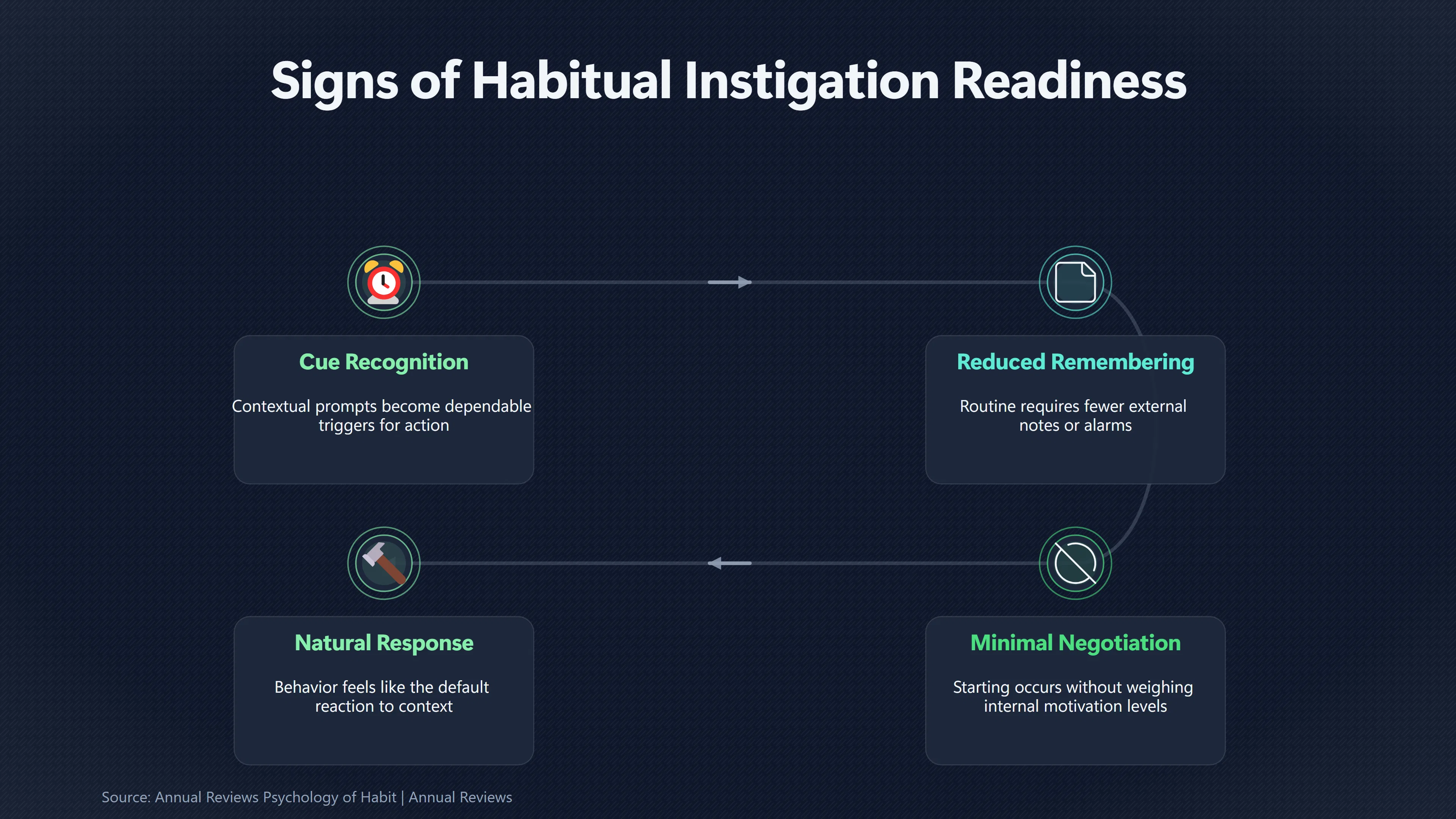
- The cue regularly produces a start. After breakfast, arriving home or shutting the work laptop has become a dependable prompt rather than merely a reminder of something you ought to do.
- Remembering requires less work. The routine is less dependent on alarms, notes or suddenly remembering late in the day.
- There is less negotiation before beginning. Starting no longer routinely requires weighing whether you feel motivated enough.
- The behaviour feels increasingly like the normal response in that situation. You may notice yourself beginning with comparatively little deliberation.
- This pattern is repeated, not occasional. A single unusually motivated week is weaker evidence than the same low-friction initiation across ordinary weeks.
These signs closely resemble the dimensions researchers actually use to measure automaticity. The validated four-item Self-Report Behavioural Automaticity Index focuses on whether a behaviour feels automatic, occurs without conscious remembering or thinking, and can begin before the person fully notices that they have started. Crucially, the scale deliberately separates automaticity from simple behavioural frequency.[PubMed Central (PMC)]pmc.ncbi.nlm.nih.govPubMed Central (PMC)Towards parsimony in habit measurement: Testing the convergent and predictive validity of an automaticity subscale of…
That does not mean a person needs to satisfy every item at its extreme before increasing a routine. There is no validated “scale your habit now” score. Rather, these dimensions provide better diagnostic questions than “How many days is my streak?”
Does the cue still work on ordinary days?
Automaticity is not simply an internal feeling of ease. It reflects a learned relationship between a context and a response, so the reliability of that context is another important readiness signal.
A 2022 study by Marco Stojanovic, Axel Grund and Stefan Fries examined this directly. In one experiment, 95 university students completed 2,482 repetitions of study habits over six weeks. Participants assigned to the stable-context condition were asked to use the same place and point in the day, while another group deliberately varied those conditions. A second dataset examined 308 habits from 218 users of a habit-building app. Across the datasets, greater context stability predicted stronger automaticity and better attainment of repetition goals; automaticity partially mediated the association between context stability and goal attainment.[Frontiers]frontiersin.orgOpen source on frontiersin.org.
For scaling, that suggests a useful test: does the established cue continue to do its job when life is merely ordinary rather than ideal?
Consider someone building a writing habit. During the first weeks, writing 100 words after making the first morning coffee may demand considerable attention. Later, coffee preparation itself may begin to lead naturally towards opening the document. At that point, moving from 100 to 150 words changes the amount of work while leaving the learned starting structure intact.
By contrast, if the writer still completes 100 words only by moving the session around the day, relying on repeated notifications and making up missed sessions at night, the total completion rate may conceal a fragile initiation mechanism. Increasing the target could add difficulty to a routine that is still largely being held together by conscious management.
Context dependence has an important qualification. A habit that works perfectly only under one exceptionally narrow set of circumstances is not necessarily robust. Research on “habit discontinuity” shows that major context changes, such as moving home, can weaken established cue–behaviour patterns.[PubMed]pubmed.ncbi.nlm.nih.govOpen source on nih.gov. The practical target is therefore not immunity to every disruption. It is a stable cue relationship that survives the normal variation of the life in which the habit actually has to operate.
Why easier initiation is stronger evidence than easier performance
It is tempting to scale a habit as soon as the activity itself feels easy. But “easy” can mean several different things.
Five push-ups may become physically easy because fitness has improved. Reading five pages may become cognitively easy because the book is engaging. A ten-minute practice session may feel easy because there is little time pressure that week. None of those changes necessarily shows that the habitual initiation mechanism has strengthened.
The more relevant change is reduced friction before the behaviour begins. Gardner and colleagues’ distinction between habitual instigation and execution helps explain why. Their evidence suggests that automatically getting started is particularly important for behaviour frequency.[BPS Psych Hub]bpspsychub.onlinelibrary.wiley.comBPS Psych HubHabitual instigation and habitual execution: Definition, measurement, and effects on behaviour frequency - Gardner - 2016…
There is related evidence that increasing automaticity can reduce motivational interference while a routine is being performed. In an event-sampling study of deliberate study-habit building, increasing automaticity was associated with reductions in motivational problems such as competing thoughts and task switching.[Frontiers]frontiersin.orgOpen source on frontiersin.org. This does not establish a universal threshold for scaling, but it helps explain why a mature routine can feel less psychologically expensive even when the activity itself still requires effort.
A useful distinction follows:
“This task is easy for me” is mainly evidence about the task.
“When the cue occurs, I reliably begin without much negotiation” is evidence about the habit.
For scaling decisions, the second observation deserves more weight.
Why recovery after missed days matters
A habit does not need a flawless streak before it can grow. In fact, treating every missed occasion as evidence that a habit has failed misunderstands what the formation research shows.
In Lally and colleagues’ study, missing a single opportunity did not materially impair the habit-formation process. Automaticity emerged from the broader pattern of repeated behaviour in a consistent context, not from preserving a mathematically perfect chain.[Wiley Online Library]onlinelibrary.wiley.comWiley Online LibraryHow are habits formed: Modelling habit formation in the real world - Lally - 2010 - European Journal of Social Psycho…
This makes recovery behaviour a useful practical stress test. Imagine two people who have each completed an evening reading habit on 27 of the past 30 intended nights. Their numerical consistency is identical. One missed three isolated evenings and simply resumed after dinner the following day. The other missed three consecutive evenings and needed a new reminder system and substantial effort to restart.
The completion count alone treats those histories as equivalent. For scaling purposes, they are not. The first pattern provides stronger evidence that the underlying routine can absorb ordinary disruption.
That should not be turned into another arbitrary rule such as “always restart within 24 hours”. Research on lapses and relapses shows that maintenance is influenced by multiple psychological, behavioural and environmental factors, and the evidence does not provide a universal recovery deadline.[PubMed]pubmed.ncbi.nlm.nih.govOpen source on nih.gov. The more defensible inference is comparative: easy resumption is better evidence of stability than a routine that repeatedly requires reconstruction after small interruptions.
This also explains why deliberately protecting a streak can sometimes give misleading information. If a person performs a token version at 11.55 pm purely to preserve a counter, the streak remains intact while the original cue–behaviour relationship may have contributed very little. Conversely, one missed occasion followed by an unremarkable return to the normal routine may reveal greater stability.

Ordinary disruption is the useful stress test
Automatic habits remain context-sensitive. Strong habit does not mean that behaviour will occur regardless of circumstances; contextual cues are part of what makes habitual responding possible in the first place. Large environmental changes can weaken established habits, as research following changes such as residential relocation illustrates.[PubMed Central (PMC)]pmc.ncbi.nlm.nih.govOpen source on nih.gov.
So the appropriate readiness test is not “Can this habit survive anything?” It is whether it survives ordinary noise: a tiring day, a slightly late meal, a busy morning, a missed session or a modest change in schedule.
That distinction prevents an unrealistic standard. A lunchtime walk that disappears during a week in hospital tells little about whether its normal version was ready to grow. A lunchtime walk that repeatedly disappears whenever a meeting runs ten minutes late is more informative. The second case suggests that the routine may still depend on unusually favourable conditions.
There is also a reason not to deliberately destabilise a developing habit simply to test it. Stojanovic and colleagues found that stable contexts supported automaticity better than deliberately variable ones.[Frontiers]frontiersin.orgOpen source on frontiersin.org. Readiness is better inferred from the disruptions life naturally supplies than from repeatedly changing the cue, time and place to see what happens.
A practical threshold for growing the habit
There is no research-backed automaticity score at which everyone should increase duration, difficulty or frequency. Habit measures were designed to study automaticity and predict behaviour, not to prescribe a universal moment for progression. The 2024 systematic review also highlights substantial methodological variation across studies and behaviours.[PubMed Central (PMC)]pmc.ncbi.nlm.nih.govOpen source on nih.gov.
A more defensible decision rule is to look for convergence across several signals. The existing version is a plausible candidate for scaling when it is reliably repeated in its intended context; the normal cue usually initiates it; remembering and deciding have become noticeably less effortful; ordinary fluctuations do not routinely prevent it; and an occasional miss is followed by a fairly natural return.
The key word is usually. Automaticity is gradual rather than all-or-nothing. Lally and colleagues observed a curve in which repetition produced progressively smaller gains as automaticity approached an individual plateau.[Wiley Online Library]onlinelibrary.wiley.comWiley Online LibraryHow are habits formed: Modelling habit formation in the real world - Lally - 2010 - European Journal of Social Psycho… Waiting for a subjective state of total effortlessness is therefore unnecessary, just as scaling solely because a calendar says “day 30” is poorly justified.
For example, suppose a person meditates for five minutes after brushing their teeth in the morning. After a period of repetition, brushing usually leads directly to sitting down; alarms are rarely needed; five minutes happens on most intended mornings; a late start may shorten the session but does not routinely eliminate it; and after a missed morning, the normal sequence resumes the next day. Those observations collectively provide considerably stronger evidence for increasing the session than the statement “I have a 50-day streak”.
Conversely, if the routine is still completed mainly through reminders, catch-up sessions, guilt about breaking a streak or repeated decisions about when to fit it in, the behaviour may be consistent without yet being strongly automatic. Scaling at that point risks increasing the burden on the very deliberate control that is currently keeping the routine alive.
The scaling sign to remember
The most useful marker is not that the habit has become completely effortless. Many worthwhile behaviours — exercising, studying, writing or practising a skill — can remain demanding even when their initiation becomes habitual.
What should become easier is the transition from cue to start.
Research consistently places automaticity in the learned relationship between recurring contexts and behaviour, while evidence on habitual instigation suggests that automatically initiating an action is especially relevant to continued behavioural frequency.[Annual Reviews]annualreviews.orgAnnual Reviews Psychology of Habit | Annual ReviewsAnnual ReviewsPsychology of Habit | Annual ReviewsJanuary 4, 2016… Combined with the wide variation in habit-formation times, this makes observable stability a better guide to scaling than an arbitrary day count.[PubMed]pubmed.ncbi.nlm.nih.govTime to Form a Habit: A Systematic Review and Meta-Analysis of Health Behaviour Habit Formation and Its Determinants - PubMed…
A habit is therefore most plausibly ready to grow when starting has become ordinary, the established cue is still doing useful work, and small disruptions produce resumption rather than reconstruction. That is not proof that the routine cannot fail after it is expanded. It is evidence that there is now a sufficiently stable behavioural foundation worth building on.
Amazon book picks
Further Reading
Books and field guides related to When Is a Habit Ready to Grow?. Use these as the next step if you want deeper reading beyond the article.
Atomic Habits
Rating: 3.5/5 from 7 Google Books ratings
The #1 New York Times bestseller. Over 25 million copies sold! Translated into 60+ languages! Tiny Changes, Remarkable Results No matter...
Tiny Habits
Improving your life is much easier than you think. Whether it’s losing weight, sleeping more, or restoring your work/life balance – the s...
Good Habits, Bad Habits
'The world's leading expert on habits' - Matthew Syed, bestselling author of Black Box Thinking and Rebel IdeasWhat if you could harness...

The Power of Habit
Rating: 4.0/5 from 145 Google Books ratings
Duhigg takes us to the edge of scientific discoveries that explain why habits exist and how they can be changed. Distilling information i...
eBay marketplace picks
Marketplace Samples
Live-tested eBay searches with available results related to this page.
Selected frominspirational sign oneBay.co.uk.



Endnotes
1.
Source: onlinelibrary.wiley.com
Link:https://onlinelibrary.wiley.com/doi/10.1002/ejsp.674
Source snippet
Wiley Online LibraryHow are habits formed: Modelling habit formation in the real world - Lally - 2010 - European Journal of Social Psycho...
2.
Source: onlinelibrary.wiley.com
Link:https://onlinelibrary.wiley.com/doi/pdf/10.1002/ejsp.674
Source snippet
Wiley Online LibraryHow are habits formed: Modelling habit formation in the real world - Lally - 2010 - European Journal of Social Psycho...
3.
Source: bpspsychub.onlinelibrary.wiley.com
Link:https://bpspsychub.onlinelibrary.wiley.com/doi/10.1111/bjhp.12189
Source snippet
BPS Psych HubHabitual instigation and habitual execution: Definition, measurement, and effects on behaviour frequency - Gardner - 2016...
4.
Source: onlinelibrary.wiley.com
Link:https://onlinelibrary.wiley.com/doi/full/10.1111/dme.70032
5.
Source: iaap-journals.onlinelibrary.wiley.com
Link:https://iaap-journals.onlinelibrary.wiley.com/doi/10.1111/aphw.70016
6.
Source: iaap-journals.onlinelibrary.wiley.com
Link:https://iaap-journals.onlinelibrary.wiley.com/doi/10.1111/aphw.12600
7.
Source: compass.onlinelibrary.wiley.com
Link:https://compass.onlinelibrary.wiley.com/doi/10.1111/spc3.12975
8.
Source: bpspsychub.onlinelibrary.wiley.com
Link:https://bpspsychub.onlinelibrary.wiley.com/doi/10.1111/bjhp.12637
9.
Source: bpspsychub.onlinelibrary.wiley.com
Link:https://bpspsychub.onlinelibrary.wiley.com/doi/abs/10.1111/bjhp.12189
10.
Source: onlinelibrary.wiley.com
Link:https://onlinelibrary.wiley.com/doi/abs/10.1002/ejsp.674?MixPanelId=15e3fe314440-0468d8411-64220f54-100000-15e3fe314460
11.
Source: onlinelibrary.wiley.com
Link:https://onlinelibrary.wiley.com/doi/10.1002/ejsp.674?538fcd4b_page=1&947f74f7page=3&=%2Fen-gt%2Four-commitment%23kI3HdLdDj7HLFW4BJlUYoy23RoHF9sl3JcIXrw%3D%3D
12.
Source: onlinelibrary.wiley.com
Link:https://onlinelibrary.wiley.com/doi/abs/10.1002/ejsp.674
13.
Source: onlinelibrary.wiley.com
Link:https://onlinelibrary.wiley.com/doi/full/10.1002/ejsp.674
14.
Source: onlinelibrary.wiley.com
Link:https://onlinelibrary.wiley.com/doi/abs/10.1002/ejsp.674?source=content_type%3Areact%7Cfirst_level_url%3Aarticle%7Csection%3Amain_content%7Cbutton%3Abody_link
15.
Source: onlinelibrary.wiley.com
Link:https://onlinelibrary.wiley.com/doi/abs/10.1002/ejsp.674?cf_chl_jschl_tk=pmd_EwcJDaCFBR9OVEL1O_0qjioww0Gc86ZzpBvCBFhrDcE-1635261061-0-gqNtZGzNAjujcnBszQi9
16.
Source: onlinelibrary.wiley.com
Link:https://onlinelibrary.wiley.com/doi/10.1002/ejsp.674?2d235898_page=2&538fcd4b_page=6&d2101103_page=8&d73ad837_page=2
17.
Source: iaap-journals.onlinelibrary.wiley.com
Link:https://iaap-journals.onlinelibrary.wiley.com/doi/10.1111/aphw.70064
18.
Source: iaap-journals.onlinelibrary.wiley.com
Link:https://iaap-journals.onlinelibrary.wiley.com/doi/10.1111/aphw.70017
19.
Source: pmc.ncbi.nlm.nih.gov
Link:https://pmc.ncbi.nlm.nih.gov/articles/PMC11641623/
20.
Source: pubmed.ncbi.nlm.nih.gov
Link:https://pubmed.ncbi.nlm.nih.gov/39685110/
Source snippet
Time to Form a Habit: A Systematic Review and Meta-Analysis of Health Behaviour Habit Formation and Its Determinants - PubMed...
21.
Source: doi.org
Link:https://doi.org/10.3390/healthcare12232488
Source snippet
Time to Form a Habit: A Systematic Review and Meta-Analysis of Health Behaviour Habit Formation and Its Determinants...
22.
Source: annualreviews.org
Title: Annual Reviews Psychology of Habit | Annual Reviews
Link:https://www.annualreviews.org/docserver/fulltext/psych/67/1/annurev-psych-122414-033417.pdf
Source snippet
Annual ReviewsPsychology of Habit | Annual ReviewsJanuary 4, 2016...
Published: January 4, 2016
23.
Source: pubmed.ncbi.nlm.nih.gov
Title: Pub Med Psychology of Habit
Link:https://pubmed.ncbi.nlm.nih.gov/26361052/
Source snippet
Psychology of Habit - PubMed...
24.
Source: pubmed.ncbi.nlm.nih.gov
Link:https://pubmed.ncbi.nlm.nih.gov/26991427/
Source snippet
Habitual instigation and habitual execution: Definition, measurement, and effects on behaviour frequency - PubMed...
25.
Source: pmc.ncbi.nlm.nih.gov
Link:https://pmc.ncbi.nlm.nih.gov/articles/PMC3552971/
Source snippet
PubMed Central (PMC)Towards parsimony in habit measurement: Testing the convergent and predictive validity of an automaticity subscale of...
26.
Source: pubmed.ncbi.nlm.nih.gov
Link:https://pubmed.ncbi.nlm.nih.gov/22935297/
27.
Source: frontiersin.org
Link:https://www.frontiersin.org/journals/psychology/articles/10.3389/fpsyg.2022.883795/full
28.
Source: pubmed.ncbi.nlm.nih.gov
Link:https://pubmed.ncbi.nlm.nih.gov/35756236/
29.
Source: pubmed.ncbi.nlm.nih.gov
Link:https://pubmed.ncbi.nlm.nih.gov/27120333/
30.
Source: frontiersin.org
Link:https://www.frontiersin.org/journals/psychology/articles/10.3389/fpsyg.2020.00167/full
31.
Source: pubmed.ncbi.nlm.nih.gov
Link:https://pubmed.ncbi.nlm.nih.gov/34851220/
32.
Source: pmc.ncbi.nlm.nih.gov
Link:https://pmc.ncbi.nlm.nih.gov/articles/PMC4847906/
33.
Source: pmc.ncbi.nlm.nih.gov
Link:https://pmc.ncbi.nlm.nih.gov/articles/PMC9226889/
34.
Source: pmc.ncbi.nlm.nih.gov
Link:https://pmc.ncbi.nlm.nih.gov/articles/PMC13295560/
35.
Source: pubmed.ncbi.nlm.nih.gov
Link:https://pubmed.ncbi.nlm.nih.gov/42053513/
36.
Source: pubmed.ncbi.nlm.nih.gov
Link:https://pubmed.ncbi.nlm.nih.gov/39702740/
37.
Source: pmc.ncbi.nlm.nih.gov
Link:https://pmc.ncbi.nlm.nih.gov/articles/PMC12672732/
38.
Source: pubmed.ncbi.nlm.nih.gov
Link:https://pubmed.ncbi.nlm.nih.gov/39225981/
39.
Source: pubmed.ncbi.nlm.nih.gov
Link:https://pubmed.ncbi.nlm.nih.gov/39324279/
40.
Source: pubmed.ncbi.nlm.nih.gov
Link:https://pubmed.ncbi.nlm.nih.gov/39321606/
41.
Source: pubmed.ncbi.nlm.nih.gov
Link:https://pubmed.ncbi.nlm.nih.gov/37700303/
42.
Source: pmc.ncbi.nlm.nih.gov
Link:https://pmc.ncbi.nlm.nih.gov/articles/PMC10498635/
43.
Source: pmc.ncbi.nlm.nih.gov
Link:https://pmc.ncbi.nlm.nih.gov/articles/PMC10357511/
44.
Source: pubmed.ncbi.nlm.nih.gov
Link:https://pubmed.ncbi.nlm.nih.gov/36749452/
45.
Source: pmc.ncbi.nlm.nih.gov
Link:https://pmc.ncbi.nlm.nih.gov/articles/PMC9372943/
46.
Source: frontiersin.org
Link:https://www.frontiersin.org/journals/psychology/articles/10.3389/fpsyg.2022.883795/full?infclid=98ed75048fad41069048c53e63b2394c
47.
Source: pubmed.ncbi.nlm.nih.gov
Link:https://pubmed.ncbi.nlm.nih.gov/34283681/
48.
Source: pmc.ncbi.nlm.nih.gov
Link:https://pmc.ncbi.nlm.nih.gov/articles/PMC8450373/
49.
Source: pubmed.ncbi.nlm.nih.gov
Link:https://pubmed.ncbi.nlm.nih.gov/34129276/
50.
Source: pmc.ncbi.nlm.nih.gov
Link:https://pmc.ncbi.nlm.nih.gov/articles/PMC8137900/
51.
Source: pubmed.ncbi.nlm.nih.gov
Link:https://pubmed.ncbi.nlm.nih.gov/34025512/
52.
Source: frontiersin.org
Link:https://www.frontiersin.org/journals/psychology/articles/10.3389/fpsyg.2021.643753/full
53.
Source: pubmed.ncbi.nlm.nih.gov
Link:https://pubmed.ncbi.nlm.nih.gov/33746848/
54.
Source: doi.org
Link:https://doi.org/10.1111/bjhp.12504
55.
Source: pmc.ncbi.nlm.nih.gov
Link:https://pmc.ncbi.nlm.nih.gov/articles/PMC7020232/
56.
Source: pubmed.ncbi.nlm.nih.gov
Link:https://pubmed.ncbi.nlm.nih.gov/32116961/
57.
Source: pmc.ncbi.nlm.nih.gov
Link:https://pmc.ncbi.nlm.nih.gov/articles/PMC7877301/
58.
Source: pubmed.ncbi.nlm.nih.gov
Link:https://pubmed.ncbi.nlm.nih.gov/29334317/
59.
Source: pubmed.ncbi.nlm.nih.gov
Link:https://pubmed.ncbi.nlm.nih.gov/28965003/
60.
Source: pmc.ncbi.nlm.nih.gov
Link:https://pmc.ncbi.nlm.nih.gov/articles/PMC4975085/
61.
Source: annualreviews.org
Title: Psychology of Habit | Annual Reviews
Link:https://www.annualreviews.org/docserver/fulltext/psych/67/1/annurev-psych-122414-033417.pdf?accname=guest&checksum=AF3B3EEFD1B16EB6822F73787ED682D5&expires=1767193310&id=id
62.
Source: annualreviews.org
Title: Psychology of Habit | Annual Reviews
Link:https://www.annualreviews.org/docserver/fulltext/psych/67/1/annurev-psych-122414-033417.pdf?accname=guest&checksum=073AC838243715A79C3D4DD2CDE4C47E&expires=1763333131&id=id
63.
Source: pubmed.ncbi.nlm.nih.gov
Link:https://pubmed.ncbi.nlm.nih.gov/26148187/
64.
Source: pubmed.ncbi.nlm.nih.gov
Link:https://pubmed.ncbi.nlm.nih.gov/26361052/?dopt=Abstract
65.
Source: pmc.ncbi.nlm.nih.gov
Link:https://pmc.ncbi.nlm.nih.gov/articles/PMC4566897/
66.
Source: doi.org
Link:https://doi.org/10.1111/BJHP.12060
67.
Source: pmc.ncbi.nlm.nih.gov
Link:https://pmc.ncbi.nlm.nih.gov/articles/PMC3505409/
68.
Source: doi.org
Link:https://doi.org/10.1080/17437199.2011.603640%C2%A0
69.
Source: pubmed.ncbi.nlm.nih.gov
Link:https://pubmed.ncbi.nlm.nih.gov/21749245/
70.
Source: pubmed.ncbi.nlm.nih.gov
Link:https://pubmed.ncbi.nlm.nih.gov/21299298/
71.
Source: pubmed.ncbi.nlm.nih.gov
Link:https://pubmed.ncbi.nlm.nih.gov/20658824/
72.
Source: annualreviews.org
Link:https://www.annualreviews.org/content/journals/psych/67/1
73.
Source: annualreviews.org
Link:https://www.annualreviews.org/content/journals/psych/67/1?page=1&pageSize=100
74.
Source: oxford-review.com
Title: Habit Formation
Link:https://oxford-review.com/habit-formation-what-the-neuroscience-is-saying/
Additional References
75.
Source: youtube.com
Title: How Does Habit Formation Impact UX Design Choices
Link:https://www.youtube.com/watch?v=CbtvMTlEfwM
Source snippet
For an in-depth breakdown of how neural circuits automate behaviors and how context stability governs habit strength, watch The Science o...
76.
Source: youtube.com
Title: Forget Big Change, Start with a Tiny Habit | BJ Fogg | TEDx Fremont
Link:https://www.youtube.com/watch?v=AdKUJxjn-R8
Source snippet
New Perspectives on Habit Formation from Machine Learning and Neuroscience...
77.
Source: youtube.com
Title: The Science of Making & Breaking Habits
Link:https://www.youtube.com/watch?v=Wcs2PFz5q6g
Source snippet
Forget Big Change, Start with a Tiny Habit | BJ Fogg | TEDxFremont...
78.
Source: researchgate.net
Link:https://www.researchgate.net/publication/339099388App-Based_Habit_Building_Reduces_Motivational_Impairments_During_Studying-_An_Event_Sampling_Study
79.
Source: researchgate.net
Link:https://www.researchgate.net/publication/301683128_Habit_Discontinuity_Self-Activation_and_the_Diminishing_Influence_of_Context_Change_Evidence_from_the_UK_Understanding_Society_Survey
80.
Source: researchgate.net
Link:https://www.researchgate.net/publication/230768091_Towards_parsimony_in_habit_measurement_Testing_the_convergent_and_predictive_validity_of_an_automaticity_subscale_of_the_Self-Report_Habit_Index
81.
Source: researchgate.net
Link:https://www.researchgate.net/publication/298790980_Habitual_instigation_and_habitual_execution_Definition_measurement_and_effects_on_behaviour_frequency
82.
Source: researchgate.net
Link:https://www.researchgate.net/publication/386593213_Time_to_Form_a_Habit_A_Systematic_Review_and_Meta-Analysis_of_Health_Behaviour_Habit_Formation_and_Its_Determinants
83.
Source: sciencedirect.com
Link:https://www.sciencedirect.com/science/article/pii/S0272494407000898
84.
Source: tandfonline.com
Link:https://www.tandfonline.com/doi/full/10.1080/08870446.2021.2003362