Within Meal Prep
How Ingredient Prep Makes Dinner Easier
Prepping vegetables, grains and proteins in advance can cut evening effort without locking the week into identical meals.
On this page
- Which ingredients save the most time when prepared ahead
- How to prep components without sacrificing variety
- Where ingredient prep stops saving effort
Page outline Jump by section
Introduction
Ingredient prep makes weeknight dinners faster by doing the slow, repetitive work before the hungry end-of-day moment. Instead of preparing complete meals in advance, the useful middle ground is to wash or cut sturdy vegetables, cook selected grains or pulses, portion proteins and keep a few flexible components ready to combine. Dinner still changes from night to night, but much of its friction has already disappeared.
This matters because time is a genuine constraint on home cooking. In a population study of 1,319 adults, people spending the least time on food preparation were more likely to prioritise convenience, eat fast food more frequently and consume vegetables and fruit less often. UK time-use research adds an important qualification: food preparation competes with sleep, leisure and other activities, so simply telling people to spend more time cooking can impose its own costs.
Ingredient prep offers a practical compromise. It does not make cooking effortless, and direct trials isolating this particular technique are limited. Its value is more straightforward: move washing, chopping, cooking and portioning to a convenient period so that a later meal requires fewer steps.
Which ingredients save the most time when prepared ahead?
The best candidates are not necessarily the ingredients thatcanbe prepared early. They are the ones that remove a meaningful bottleneck later without deteriorating badly in storage.
Sturdy vegetables are often high-value prep.Washing, trimming and cutting carrots, peppers, broccoli, cauliflower and similar vegetables can remove several small tasks from dinner. A container of ready-to-cook vegetables can go directly into a roasting tray, frying pan, curry or soup. But cutting is not neutral: research on fresh-cut produce shows that damaging plant tissue increases physiological stress and can accelerate moisture loss, softening, browning, flavour changes and microbial deterioration. The practical implication is to prepare only as far ahead as quality permits rather than automatically chopping every vegetable for the whole week.
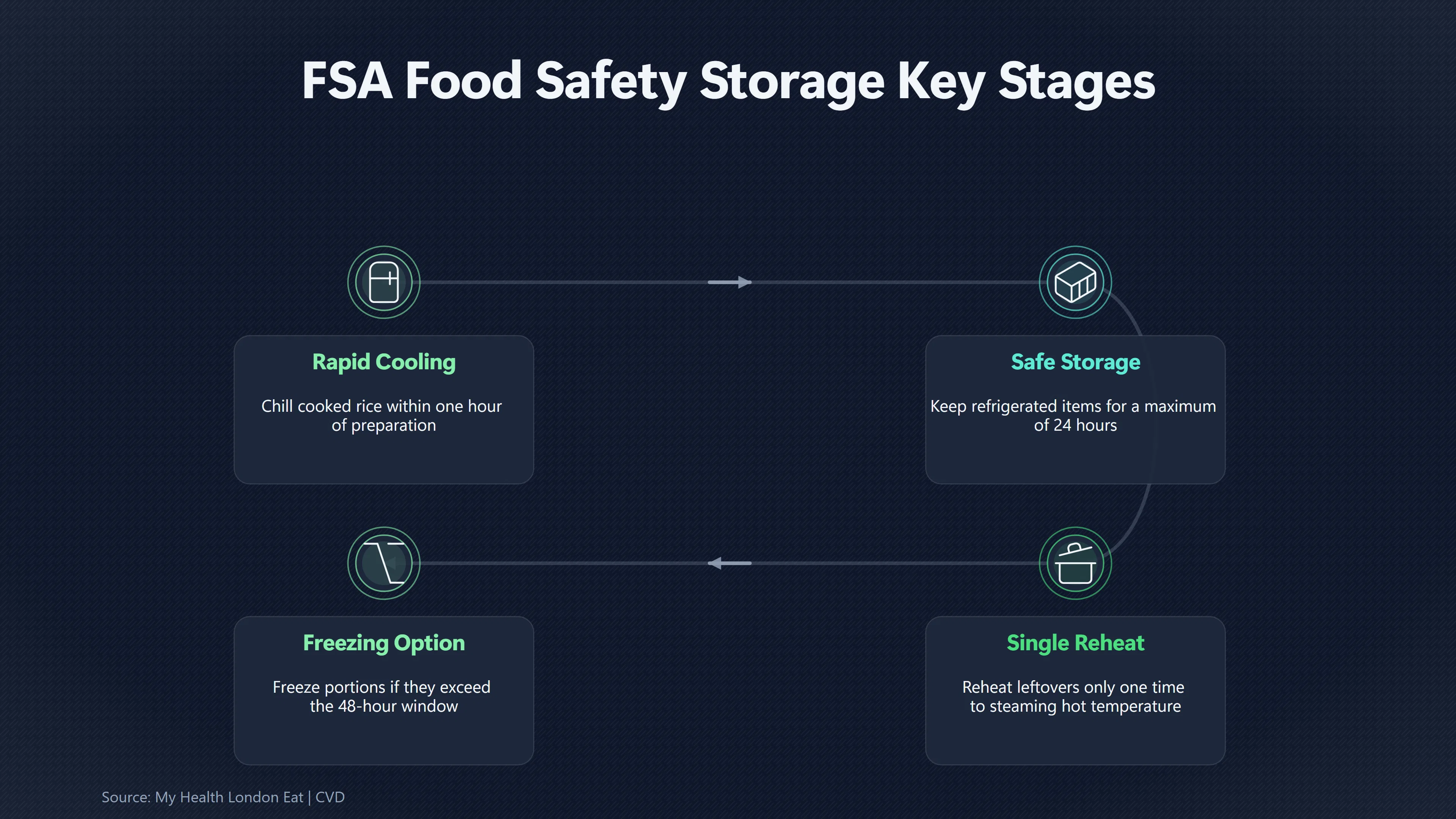
Cooked grains can remove a larger block of active waiting time.Preparing a grain in advance means a weekday bowl, stir-fry or side dish does not have to begin with measuring water and waiting for a pan to cook. Rice, however, needs particular care. The Food Standards Agency (FSA) advises that rice intended for later use should be chilled quickly — within one hour — kept refrigerated and used within 24 hours; reheated rice should be steaming hot throughout and should not be reheated more than once. A grain-prep habit is useful only if its storage routine is equally reliable.
Pulses offer an especially flexible component.A batch of lentils, chickpeas or beans can move between salads, soups, curries, wraps and grain bowls. There is no requirement to start with dried pulses, however. Tinned beans and lentils remove soaking and cooking entirely. NHS-linked guidance recognises dried and tinned pulses as relatively inexpensive protein options, while NHS guidance counts pulses towards fruit-and-vegetable intake. In a system designed to reduce effort, opening and draining a tin may sometimes be a better intervention than adding another Sunday cooking job.
Proteins are useful to portion when portioning removes genuine weekday work.A larger cooked batch can be divided for later meals, while raw ingredients can be organised according to their storage instructions and use-by dates. Food safety matters more than extracting the maximum number of refrigerator days: the FSA advises eating ordinary cooked leftovers within 48 hours or freezing them, and keeping a refrigerator at 0–5°C.
The common feature is leverage. Chopping one onion in advance saves little if the later recipe still demands 25 minutes of preparation. Having the vegetables, grain and main protein already usable can change the character of the task: dinner becomes assembly plus a short cooking step rather than a cooking project begun from zero.
How to prep components without sacrificing variety
Preparing ingredients rather than finished dishes separatesefficiency from repetition. The same neutral components can lead to meals that taste and feel different because the final combination, cooking method and seasoning remain undecided.
Suppose one preparation session produces roasted or chopped vegetables, cooked lentils and another ready-to-use protein. Those components do not have to become three identical boxes. Vegetables might go into a pasta dish one evening and a quick omelette another. Lentils could become a warm side, a soup addition or part of a salad. A protein can move between a wrap and a grain bowl. What has been predetermined is the labour, not necessarily the meal.
That flexibility matters because planning need not mean reduced dietary variety. In a large French observational study involving 40,554 adults, people who reported meal planning were more likely to fall into the highest quartile for overall food variety as well as the highest quartile for adherence to dietary guidance. The study cannot establish that planning caused those differences, but it undermines the assumption that advance preparation inevitably produces a monotonous diet.
A workable component system therefore tends to have three features:
- Prepare neutral bases more heavily than finished combinations.Cook the lentils; decide later whether they become a curry, salad or soup.
- Leave fast flavour decisions until dinner.Sauces, herbs, spices, dressings and garnishes can change the direction of ingredients whose labour-intensive preparation has already happened.
- Prep according to the difficult night, not an imaginary perfect week.If Tuesday and Thursday are consistently rushed, having components ready for those evenings may deliver more value than preparing seven days of food.
This resembles an implementation intention — converting a broad intention into a response that is easier to execute in a particular situation. A meta-analysis of 23 studies found that implementation intentions had a moderate effect on increasing healthier foods in the diet (Cohen’sd= 0.51) and a smaller effect on reducing unhealthy eating (d= 0.29). Ingredient prep was not itself the intervention studied, so those effect sizes should not be attributed to meal preparation. The useful connection is behavioural: arranging for a desired food to be readily available can be more actionable than relying on a general intention to make a good choice later.
Prep the bottleneck, not everything
A common failure mode is turning meal prep into another demanding self-improvement project. Two hours of Sunday chopping are not automatically a success because Tuesday’s dinner takes ten minutes. The relevant calculation includes the preparation session, containers, washing-up, refrigerator space and discarded food.
That constraint is visible in wider research on cooking. UK time-use data covering 6,143 people found that those doing more “foodwork” — work required to feed a household — allocated time differently across the rest of their day. Among women in particular, more foodwork was associated with less time for personal care, socialising and hobbies. The researchers explicitly warned that attempts to encourage more home food preparation should consider such unintended consequences.
The more efficient question is therefore:what repeatedly makes dinner slow?
If the answer is chopping, prepare vegetables. If it is waiting for grains or pulses, batch-cook those. If handling and portioning the main ingredient creates the obstacle, organise that. If the actual problem is having no food in the house, ingredient prep is downstream of the real problem and will not solve it.
Convenience foods can also be legitimate components of this system. Frozen vegetables, tinned pulses and other minimally demanding staples can eliminate preparation rather than merely moving it to another day. NHS guidance notes that fresh, frozen and tinned vegetables can all contribute towards fruit-and-vegetable intake. The goal is not to maximise the proportion of dinner personally chopped from raw ingredients.
That distinction is supported by UK dietary research. Although higher consumption of home-prepared food has been associated with better diet quality in observational data, a separate analysis of the UK National Diet and Nutrition Survey identified people with high-quality diets despite relatively low consumption of home-prepared food. Its authors concluded that extensive home preparation should not be treated as a prerequisite for eating well.
Where ingredient prep stops saving effort
Ingredient prep reaches diminishing returns when food is being prepared simply because it is prep day rather than because advance work will make a later meal easier.
The first warning sign isquality loss. Cutting removes some of a fruit or vegetable’s natural protection and can accelerate respiration, moisture loss, browning, softening and spoilage. Delicate leaves, ingredients prized for crispness and produce that deteriorates rapidly after cutting may therefore be better left intact until nearer the meal. Prepping a robust vegetable early can remove friction; turning good produce into limp leftovers merely transfers effort and creates waste.
The second limit isfood safety. The FSA advises cooling ordinary cooked leftovers promptly, refrigerating them within one to two hours and eating them within two days or freezing them. It also recommends reheating leftovers only once and heating them until steaming hot throughout. Those rules make a freezer useful when a preparation session produces more cooked food than can sensibly be eaten in the next couple of days.
The third limit isfalse efficiency. Preparing five different sauces, peeling every vegetable, cooking several grains and filling a refrigerator with labelled containers can look organised while consuming more total effort than the week requires. Ingredient prep works best when it targets repeated friction. A person who can cook couscous or open a tin of beans in minutes gains relatively little from doing those tasks days earlier; someone who repeatedly abandons dinner because vegetables still need washing and chopping may gain considerably more from solving that specific bottleneck.
There is also no strong evidence that a universal number of weekly preparation hours produces better outcomes. Much of the research connecting planning, home cooking and diet quality is observational, meaning people who prepare more food may differ in other important ways from those who prepare less. Ingredient prep is therefore better understood as an implementation tool than as a health intervention with a prescribed dose.

A low-friction weeknight system
A useful starting system is deliberately small. Choose two or three components that repeatedly delay dinner, prepare enough for the next few relevant meals, and leave enough flexibility that those ingredients can take more than one culinary direction.
For example, the useful advance work might be one container of sturdy prepared vegetables, one safely stored cooked component and one protein that is ready to use. Keep quick alternatives such as frozen vegetables or tinned pulses available rather than assuming everything must be prepared manually. Date cooked food where confusion is likely, freeze surplus portions early, and treat the FSA’s shorter rice-storage guidance separately from the general rule for leftovers.
Then judge the system by what happens on the difficult evening. If dinner can begin without a long chain of washing, chopping, measuring, defrosting and deciding, the preparation has done useful work. If Sunday has become an exhausting production session while food is still being thrown away on Friday, reduce the amount prepared.
That is the self-improvement value of ingredient prep: not becoming someone who spends more time organising food, but arranging the kitchen so that an acceptable dinner requires less effort at precisely the time when effort is hardest to supply.
Amazon book picks
Further Reading
Books and field guides related to How Ingredient Prep Makes Dinner Easier. Use these as the next step if you want deeper reading beyond the article.
Cook Once, Eat All Week
Cook Once, Eat All Week is a revolutionary way to get a delicious, healthy, and affordable dinner on the table FAST. Author Cassy Joy Gar...
An Everlasting Meal
Tamar weaves philosophy and instruction into approachable lessons on instinctive cooking. By wresting cooking from doctrine and doldrums,...
The Food Lab
A New York Times Bestseller Winner of the James Beard Award for General Cooking Winner of the IACP Cookbook of the Year Award "The one bo...

How to Cook Everything
Great Food Made Simple Here's the breakthrough one-stop cooking reference for today's generation of cooks! Nationally known cooking autho...
eBay marketplace picks
Marketplace Samples
Live-tested eBay searches with available results related to this page.
Selected fromself improvement wall art oneBay.co.uk.




Endnotes
1.
Source: myhealthlondon.nhs.uk
Title: My Health London Eat | CVD
Link:https://www.myhealthlondon.nhs.uk/be-healthier/healthy-lifestyle/eat/
2.
Source: nhs.uk
Title: 5 A Day portion sizes
Link:https://www.nhs.uk/live-well/eat-well/5-a-day/portion-sizes/
3.
Source: myhealthlondon.nhs.uk
Title: My Health London Fruit and vegetables | CVD
Link:https://www.myhealthlondon.nhs.uk/be-healthier/nutrition-hub/fruit-and-vegetables/
4.
Source: nhs.uk
Title: www.nhs.uk Eating a balanced diet
Link:https://www.nhs.uk/live-well/eat-well/how-to-eat-a-balanced-diet/eating-a-balanced-diet/
5.
Source: nhs.uk
Title: www.nhs.uk The vegetarian diet
Link:https://www.nhs.uk/live-well/eat-well/how-to-eat-a-balanced-diet/the-vegetarian-diet/
6.
Source: nhs.uk
Title: www.nhs.uk Children’s food: safety and hygiene
Link:https://www.nhs.uk/baby/weaning-and-feeding/childrens-food-safety-and-hygiene/
7.
Source: cntw.nhs.uk
Link:https://www.cntw.nhs.uk/resources/healthy-eating-on-a-budget
8.
Source: myhealthlondon.nhs.uk
Title: fruit and vegetables
Link:https://www.myhealthlondon.nhs.uk/resources/internal/fruit-and-vegetables/
9.
Source: nhs.uk
Title: www.nhs.uk The Eatwell Guide
Link:https://www.nhs.uk/live-well/eat-well/food-guidelines-and-food-labels/the-eatwell-guide/
10.
Source: nhs.uk
Title: www.nhs.uk8 tips for healthy eating
Link:https://www.nhs.uk/live-well/eat-well/how-to-eat-a-balanced-diet/eight-tips-for-healthy-eating/
11.
Source: nhs.uk
Title: www.nhs.uk5 A Day – Food Facts – Healthier Families
Link:https://www.nhs.uk/healthier-families/food-facts/5-a-day/
12.
Source: nhs.uk
Title: www.nhs.uk Healthy lunch ideas
Link:https://www.nhs.uk/healthier-families/recipes/lunch/
13.
Source: westlondon.nhs.uk
Link:https://www.westlondon.nhs.uk/ealing-talking-therapies/move-4-mood/eat-well-feel-well/food-preparation-and-portions
14.
Source: youtube.com
Link:https://www.youtube.com/watch?v=xgr0FqBdm6M
Source snippet
MEAL PREP | 10 healthy meals in 1 HOUR (+ PDF guide)...
15.
Source: youtube.com
Title: MEAL PREP | 10 healthy meals in 1 HOUR (+ PDF guide)
Link:https://www.youtube.com/watch?v=ERysyFbJH7w
Source snippet
Ingredient prep weeknight meals faster prep ahead components THIS Meal Planning Method WASTES So Much Food!! Try THIS HACK INSTEAD! #meal...
16.
Source: nutritionsource.hsph.harvard.edu
Title: meal prep
Link:https://nutritionsource.hsph.harvard.edu/meal-prep/
17.
Source: extension.umn.edu
Link:https://extension.umn.edu/preserve-your-own-food/freezing
Additional References
18.
Source: pmc.ncbi.nlm.nih.gov
Link:https://pmc.ncbi.nlm.nih.gov/articles/PMC7469020/
19.
Source: pubmed.ncbi.nlm.nih.gov
Link:https://pubmed.ncbi.nlm.nih.gov/27469103/
Source snippet
Recent advances in modified atmosphere packaging and edible coatings to maintain quality of fresh-cut fruits and vegetables - PubMed...
20.
Source: sciencedirect.com
Link:https://www.sciencedirect.com/science/article/pii/S0925521407003705
Source snippet
Quality of fresh-cut fruits and vegetables as affected by exposure to abiotic stress - ScienceDirectMay 1, 2008...
Published: May 1, 2008
21.
Source: sciencedirect.com
Title: ScienceDirect Factors affecting quality of fresh-cut horticultural products
Link:https://www.sciencedirect.com/science/article/abs/pii/S0925521496000415
Source snippet
Factors affecting quality of fresh-cut horticultural products - ScienceDirect...
22.
Source: pubmed.ncbi.nlm.nih.gov
Title: Pub Med Time spent on home food preparation and indicators of healthy eating
Link:https://pubmed.ncbi.nlm.nih.gov/25245799/
Source snippet
Time spent on home food preparation and indicators of healthy eating - PubMedSeptember 19, 2014...
Published: September 19, 2014
23.
Source: food.gov.uk
Title: UK Not reheating leftovers until steaming hot throughout | Food Standards Agency
Link:https://www.food.gov.uk/research/behaviour-and-perception/not-reheating-leftovers-until-steaming-hot-throughout
Source snippet
reheating leftovers until steaming hot throughout | Food Standards Agency...
24.
Source: youtube.com
Link:https://www.youtube.com/watch?v=ltnonDL_RkA
Source snippet
My Chef’s Guide To Week Night Meal Prepping...
25.
Source: pmc.ncbi.nlm.nih.gov
Link:https://pmc.ncbi.nlm.nih.gov/articles/PMC5288891/
26.
Source: pmc.ncbi.nlm.nih.gov
Link:https://pmc.ncbi.nlm.nih.gov/articles/PMC12385714/
27.
Source: pubmed.ncbi.nlm.nih.gov
Link:https://pubmed.ncbi.nlm.nih.gov/21056605/