Within Written Records
Paper or App: Which Habit Record Will Last?
Paper and digital systems can both preserve useful evidence, but engagement depends on which method people will keep using consistently.
On this page
- What comparative self monitoring studies found
- Convenience, visibility and recording friction
- Choosing the format you will actually maintain
Page outline Jump by section
Introduction
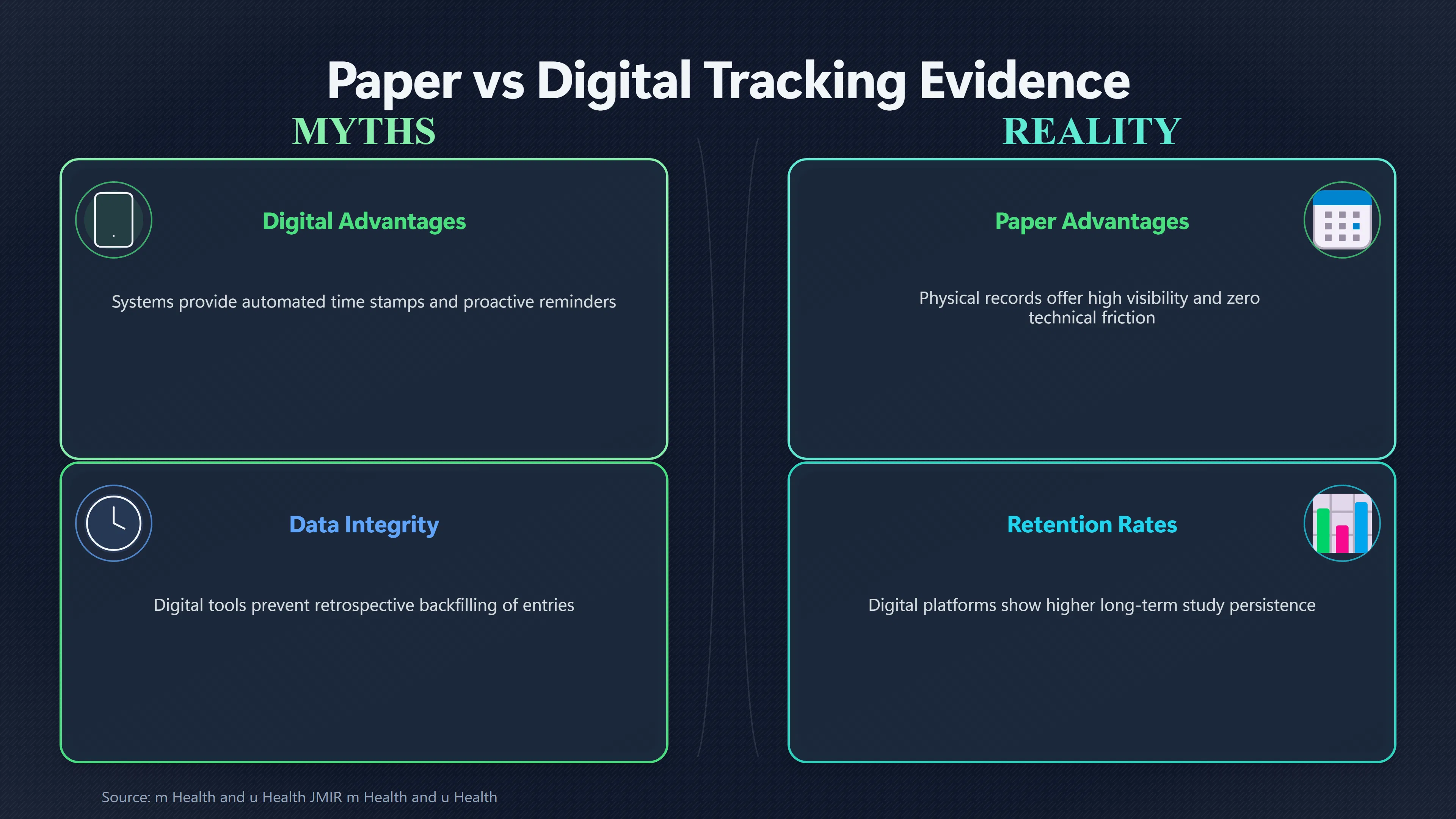
Paper and digital habit records can both do the essential job: leave evidence of what you actually did. The more important question is which format will still be receiving entries after the novelty has worn off. Comparative research does not support a simple rule that apps always beat notebooks. Digital systems often improve adherence because they are carried everywhere, can time-stamp entries, issue reminders and reduce some of the work of recording. Yet paper records can produce comparable data when people genuinely complete them, and some direct comparisons have found only modest differences between formats.[PubMed]pubmed.ncbi.nlm.nih.govSelf-Monitoring via Digital Health in Weight Loss Interventions: A Systematic Review Among Adults with Overweight or Obesity - PubM…
The practical criterion, therefore, is persistence rather than sophistication. A beautifully designed tracker that is abandoned after ten days preserves less useful evidence than a pencil mark on a calendar maintained for six months. For self-improvement, the best format is the one that makes recording sufficiently easy, visible and trustworthy that the record survives ordinary life.
What comparative self-monitoring studies found
Some of the most striking paper-versus-digital evidence comes from diary research conducted before smartphones became commonplace. In a 2003 study of 80 adults with chronic pain, participants were asked to record symptoms three times a day for 21 days. The paper binders secretly contained sensors that registered when they were opened, while electronic diaries automatically time-stamped entries. Paper participants reported completing 90% of entries within the required time window, but the instrumented binders indicated actual timely compliance of only 11%. On 32% of study days, the paper binder was never opened even though reported compliance for those days exceeded 90%. The electronic group achieved 94% verified compliance.[PubMed]pubmed.ncbi.nlm.nih.govPub Med Patient compliance with paper and electronic diariesPatient compliance with paper and electronic diaries - PubMed…
That experiment illustrates an important advantage of digital records: they can distinguish having a completed record from recording at the intended time. A paper diary can be filled in retrospectively and dated as though it were contemporary. A properly designed electronic system can preserve the actual time of entry and can prevent or expose backfilling. Where the purpose of tracking is to make progress harder to misremember, that difference matters: recreating last Tuesday’s record on Friday partly reintroduces the memory problem that tracking was supposed to solve.[PubMed Central (PMC)]pmc.ncbi.nlm.nih.govPub Med Central (PMC)Patient non-compliance with paper diariesPubMed Central (PMC)Patient non-compliance with paper diaries - PMCMay 18, 2002…
But that dramatic result should not be turned into a universal verdict against paper. A later series of three diary studies by Green and colleagues found much more reassuring results for paper-and-pencil methods. In one study, randomly signalled reports produced completion-time patterns that the researchers concluded could not plausibly have been fabricated; in two others, paper and electronic diary data were, with minor exceptions, psychometrically and statistically equivalent. Paper records can therefore work well when people actually use them as intended.[PubMed]pubmed.ncbi.nlm.nih.govPub Med Paper or plastic? Data equivalence in paper and electronic diariesPaper or plastic? Data equivalence in paper and electronic diaries - PubMed…
Other comparisons have similarly produced less decisive results. A study of people with Parkinson’s disease found median completion of 88% with electronic diaries and 98% with paper, although strict adherence to scheduled recording times for the paper group fell to 78%. A 2020 six-week randomised trial of 50 younger adults comparing a dietary app with a paper food diary found an average of 18.5 recording days in the app group versus 15.5 with paper, while changes in weight and other anthropometric measures did not differ significantly between groups.[PubMed]pubmed.ncbi.nlm.nih.govWireless real-time electronic data capture for self-assessment of motor function and quality of life in Parkinson's disease - PubMed…
The fairest reading is that the medium itself is not magic. Digital systems have useful capabilities, particularly time stamps and prompts, but people can maintain good paper records too. What becomes more interesting for self-improvement is what happens when tracking continues for months rather than days.
Digital tracking often wins on sustained use
Longer behavioural studies give digital recording a clearer advantage, although much of the strongest comparative evidence comes from weight-management research rather than generic habit trackers.
The six-month My Meal Mate trial in the UK randomly assigned 128 adults to a smartphone app, website or paper diary. Participants using the smartphone recorded their diet for an average of 92 days, compared with 35 days for website users and 29 days for paper-diary users. Six-month study retention was also substantially higher in the smartphone group: 93%, versus 55% for the website group and 53% for the diary group. Crucially, however, recording declined over time in all three groups. Digital delivery reduced the attrition problem; it did not abolish it.[JMIR]jmir.orgJournal of Medical Internet ResearchJournal of Medical Internet Research - Adherence to a Smartphone Application for Weight Loss Compared to Website and Paper Diary: Pil…
A larger 24-month trial offers a similarly useful qualification. The SMART trial assigned 210 adults to a paper record, a personal digital assistant (PDA), or a PDA that also supplied daily tailored feedback. Long-term weight change did not differ significantly between the three groups, although the electronic groups showed a different adherence trajectory from the paper group. Across formats, participants who maintained substantially greater adherence to self-monitoring lost more weight than those who rarely maintained it.[PubMed]pubmed.ncbi.nlm.nih.govOpen source on nih.gov.
Broader reviews point in the same direction. A 2020 meta-analysis of 20 studies concluded that mobile-health self-monitoring interventions had higher adherence than paper recording, including in comparisons extending to six and twelve months. A separate systematic review covering 39 studies found that digital self-monitoring engagement was higher than paper in 21 of 34 direct comparisons and lower in only two. Yet it also found that few digital interventions achieved engagement on at least 75% of days. Digital tracking, in other words, usually had the better persistence record without solving the underlying difficulty of sustained self-monitoring.[nih.gov]pubmed.ncbi.nlm.nih.govOpen source on nih.gov.
That distinction is central to choosing a personal system. “Apps have higher average adherence in these studies” is not the same proposition as “you personally should use an app”. Population averages identify useful tendencies. A personal tracking system succeeds only if its particular combination of effort, visibility and feedback fits the circumstances in which you have to make the entry.

Convenience, visibility and recording friction
Digital tracking has an obvious convenience advantage: for most smartphone users, the recording device is already present. There is no separate notebook to remember, entries can be made wherever the behaviour occurs, and software can perform work that paper cannot easily perform — calculating totals, storing histories, generating graphs, supplying feedback or prompting an overdue entry. Reviews of technology-supported self-monitoring have consequently suggested that electronic tools can reduce the burden of recording and support adherence.[PubMed Central (PMC)]pmc.ncbi.nlm.nih.govOpen source on nih.gov.
The historical comparisons are revealing here because early electronic diaries were far less capable than modern phones. Even PDAs could time-stamp entries and deliver tailored feedback; contemporary software can additionally automate parts of data collection. This means “paper versus digital” is partly a comparison of different amounts of recording friction, not simply handwriting versus tapping.
But digital convenience has another side. A habit tracker stored behind a phone screen is not necessarily visible between entries. A paper calendar attached to a wall, a notebook left beside a coffee machine or a card placed next to exercise equipment can make both the intended behaviour and its accumulated record conspicuous. That can be valuable when the main difficulty is remembering to act or noticing a developing pattern rather than entering complicated data.
Paper also has an unusually low technical burden. A tick, cross, number or short note requires no account, synchronisation, charging, menu navigation or software maintenance. For a binary habit such as “practised today”, an elaborate app may be solving a problem that does not exist. Conversely, recording every meal, expenditure or training variable can make manual entry laborious enough that searchable databases, automatic totals and reusable digital fields become worthwhile.
The relevant concept is therefore recording friction: everything that has to happen between finishing the behaviour and preserving usable evidence of it. The lowest-friction medium depends on the task. Ticking a wall calendar after practising guitar may be easier than unlocking a phone and opening an app. Logging the nutritional content of lunch may be dramatically easier in software than calculating and writing the same information manually.
The record must survive the drop in enthusiasm
One of the most consistent findings across self-monitoring research is less glamorous than the paper-versus-app debate: adherence tends to decline with time. Instrumented paper diaries used in an 18-month weight-loss programme documented a significant fall in self-monitoring as treatment progressed. Reviews of digital interventions likewise report decreasing use over the course of many programmes.[PubMed Central (PMC)]pmc.ncbi.nlm.nih.govOpen source on nih.gov.
This makes the first week’s enthusiasm a poor way to judge a tracking system. Almost any new notebook or app can feel manageable while attention is high. A better test is whether recording still feels proportionate on an inconvenient Tuesday six weeks later.
For a sustainable record, several questions matter more than the number of features:
- Can the entry be made immediately? A record made close to the behaviour is less dependent on later reconstruction.
- Is the smallest valid entry genuinely small? A tick, count or short number is easier to maintain than a mini-journal when all that is needed is evidence of occurrence.
- Will the record remain easy to inspect? Digital systems excel at searchable histories and summaries; visible paper can make patterns immediately apparent without opening anything.
- Does the format discourage backfilling? Automatic time stamps give digital systems a clear advantage where the timing of an entry matters.
- Does useful automation justify the extra interface? Reminders, calculations, sensor data and feedback can make an app worthwhile. If they add little, they may simply add steps.
- Can the system tolerate missed days? A tracker that psychologically turns one blank square into “the streak is ruined” may encourage abandonment rather than accurate recording.
The last point is especially important for records intended to correct memory. A blank should be allowed to remain evidence. Filling yesterday’s box from vague recollection merely to keep the tracker looking complete makes the record more attractive but less trustworthy.
Choosing the format you will actually maintain
For a simple habit, start by asking what evidence you will need later. If the question is merely “On how many days did I do this?”, paper can be remarkably efficient: date, mark, finished. Put the record where the behaviour happens and the physical object becomes both recorder and visible history.
Digital tracking becomes more compelling when the question requires richer information: When did I do it? How long? How much? What was the weekly average? Does the pattern change by day? It is also preferable when reminders are necessary, when automatic measurements are available, or when accurate entry times matter. Comparative studies suggest that these conveniences can translate into better sustained adherence on average.[PubMed Central (PMC)]pmc.ncbi.nlm.nih.govOpen source on nih.gov.
There is no need to treat the decision as permanent. A useful practical test is to choose the simplest plausible format and examine the record after several weeks. If blank days mainly reflect forgotten recording rather than missed behaviour, change the recording method: put paper somewhere unavoidable or use digital prompts. If entries are being postponed because they require too much detail, reduce the information collected. If the app is being ignored despite notifications, adding more notifications is unlikely to fix a system that has become burdensome.
Nor is a hybrid arrangement inherently inconsistent. Someone might use a visible paper calendar for the daily yes-or-no record and transfer a weekly total to a spreadsheet, or let a device automatically collect quantitative information while writing a brief weekly interpretation by hand. What matters is avoiding duplicate work that makes the system harder to sustain.
The evidence ultimately favours a pragmatic hierarchy. First, preserve an honest record. Second, make recording easy enough to continue. Third, add sophistication only when it improves the decisions that can be made from the record. Digital systems often have an adherence advantage and can provide stronger evidence about when an entry was made, but paper remains perfectly capable of preserving useful evidence when it fits naturally into the user’s routine. The durable habit record is not the one with the most features. It is the one that is still there, still being filled in, when memory later tries to rewrite how consistent the past month really was.[PubMed]pubmed.ncbi.nlm.nih.govPub Med Paper or plastic? Data equivalence in paper and electronic diariesPaper or plastic? Data equivalence in paper and electronic diaries - PubMed…
Amazon book picks
Further Reading
Books and field guides related to Paper or App Which Habit Record Will Last?. Use these as the next step if you want deeper reading beyond the article.
Atomic Habits
Rating: 3.5/5 from 7 Google Books ratings
The #1 New York Times bestseller. Over 25 million copies sold! Translated into 60+ languages! Tiny Changes, Remarkable Results No matter...
Getting Things Done
The personal productivity guru (Fast Company) delivers powerful methods that vastly increase your efficiency and creative results-at work...
Digital Minimalism
A New York Times, Wall Street Journal, Publishers Weekly, and USA Today bestseller "Newport is making a bid to be the Marie Kondo of tech...
eBay marketplace picks
Marketplace Samples
Live-tested eBay searches with available results related to this page.
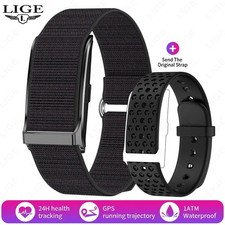
Selected fromfitness tracker band oneBay.co.uk.
Endnotes
1.
Source: mhealth.jmir.org
Title: m Health and u Health JMIR m Health and u Health
Link:https://mhealth.jmir.org/2020/7/e14013/
Source snippet
JMIR mHealth and uHealthJMIR mHealth and uHealth - Use of a Smartphone App for Weight Loss Versus a Paper-Based Dietary Diary in Overweig...
2.
Source: jmir.org
Title: Journal of Medical Internet Research
Link:https://www.jmir.org/2013/4/e32/
Source snippet
Journal of Medical Internet Research - Adherence to a Smartphone Application for Weight Loss Compared to Website and Paper Diary: Pil...
4.
Source: mhealth.jmir.org
Link:https://mhealth.jmir.org/2020/7/e14013/authors
5.
Source: mhealth.jmir.org
Link:https://mhealth.jmir.org/2020/7/e14013/metrics
6.
Source: jmir.org
Title: Journal of Medical Internet Research
Link:https://www.jmir.org/2020/6/e16480/
7.
Source: preprints.jmir.org
Link:https://preprints.jmir.org/preprint/14013/accepted
8.
Source: preprints.jmir.org
Link:https://preprints.jmir.org/preprint/14013
9.
Source: mhealth.jmir.org
Link:https://mhealth.jmir.org/2020/3/e17613/
10.
Source: jmir.org
Title: Journal of Medical Internet Research
Link:https://www.jmir.org/2019/1/e11683/
12.
Source: mhealth.jmir.org
Link:https://mhealth.jmir.org/2018/6/e10253/
13.
Source: mhealth.jmir.org
Link:https://mhealth.jmir.org/2018/4/e92
14.
Source: mhealth.jmir.org
Link:https://mhealth.jmir.org/2017/2/e8
15.
Source: publichealth.jmir.org
Title: 2020 instruments and questionnaires for nutrition and food intake
Link:https://publichealth.jmir.org/themes/457/2020-instruments-and-questionnaires-for-nutrition-and-food-intake
16.
Source: pubmed.ncbi.nlm.nih.gov
Link:https://pubmed.ncbi.nlm.nih.gov/33624440/
Source snippet
Self-Monitoring via Digital Health in Weight Loss Interventions: A Systematic Review Among Adults with Overweight or Obesity - PubM...
17.
Source: pubmed.ncbi.nlm.nih.gov
Title: Pub Med Paper or plastic? Data equivalence in paper and electronic diaries
Link:https://pubmed.ncbi.nlm.nih.gov/16594769/
Source snippet
Paper or plastic? Data equivalence in paper and electronic diaries - PubMed...
18.
Source: pubmed.ncbi.nlm.nih.gov
Title: Pub Med Patient compliance with paper and electronic diaries
Link:https://pubmed.ncbi.nlm.nih.gov/12689739/
Source snippet
Patient compliance with paper and electronic diaries - PubMed...
19.
Source: pmc.ncbi.nlm.nih.gov
Title: Pub Med Central (PMC)Patient non-compliance with paper diaries
Link:https://pmc.ncbi.nlm.nih.gov/articles/PMC111114/
Source snippet
PubMed Central (PMC)Patient non-compliance with paper diaries - PMCMay 18, 2002...
Published: May 18, 2002
20.
Source: pmc.ncbi.nlm.nih.gov
Title: Pub Med Central (PMC)Electronic Diaries: Appraisal and Current Status
Link:https://pmc.ncbi.nlm.nih.gov/articles/PMC2796846/
Source snippet
PubMed Central (PMC)Electronic Diaries: Appraisal and Current Status - PMC...
21.
Source: pubmed.ncbi.nlm.nih.gov
Link:https://pubmed.ncbi.nlm.nih.gov/15077243/
Source snippet
Wireless real-time electronic data capture for self-assessment of motor function and quality of life in Parkinson's disease - PubMed...
22.
Source: pubmed.ncbi.nlm.nih.gov
Link:https://pubmed.ncbi.nlm.nih.gov/32735225/
Source snippet
Use of a Smartphone App for Weight Loss Versus a Paper-Based Dietary Diary in Overweight Adults: Randomized Controlled Trial - PubMed...
23.
Source: pubmed.ncbi.nlm.nih.gov
Link:https://pubmed.ncbi.nlm.nih.gov/22704741/
24.
Source: pmc.ncbi.nlm.nih.gov
Link:https://pmc.ncbi.nlm.nih.gov/articles/PMC3563396/
25.
Source: pubmed.ncbi.nlm.nih.gov
Link:https://pubmed.ncbi.nlm.nih.gov/32635174/
26.
Source: pmc.ncbi.nlm.nih.gov
Link:https://pmc.ncbi.nlm.nih.gov/articles/PMC7400167/
27.
Source: pmc.ncbi.nlm.nih.gov
Link:https://pmc.ncbi.nlm.nih.gov/articles/PMC3268700/
28.
Source: pubmed.ncbi.nlm.nih.gov
Link:https://pubmed.ncbi.nlm.nih.gov/31003801/
29.
Source: pmc.ncbi.nlm.nih.gov
Link:https://pmc.ncbi.nlm.nih.gov/articles/PMC2435095/
30.
Source: pmc.ncbi.nlm.nih.gov
Link:https://pmc.ncbi.nlm.nih.gov/articles/PMC6926211/
31.
Source: pubmed.ncbi.nlm.nih.gov
Link:https://pubmed.ncbi.nlm.nih.gov/42474511/
32.
Source: pubmed.ncbi.nlm.nih.gov
Link:https://pubmed.ncbi.nlm.nih.gov/41368793/
33.
Source: pmc.ncbi.nlm.nih.gov
Link:https://pmc.ncbi.nlm.nih.gov/articles/PMC11814194/
34.
Source: pmc.ncbi.nlm.nih.gov
Link:https://pmc.ncbi.nlm.nih.gov/articles/PMC11372325/
35.
Source: pubmed.ncbi.nlm.nih.gov
Link:https://pubmed.ncbi.nlm.nih.gov/34412727/
36.
Source: pmc.ncbi.nlm.nih.gov
Link:https://pmc.ncbi.nlm.nih.gov/articles/PMC12838191/
37.
Source: pubmed.ncbi.nlm.nih.gov
Link:https://pubmed.ncbi.nlm.nih.gov/32857056/
38.
Source: pmc.ncbi.nlm.nih.gov
Link:https://pmc.ncbi.nlm.nih.gov/articles/PMC7486673/
39.
Source: pmc.ncbi.nlm.nih.gov
Link:https://pmc.ncbi.nlm.nih.gov/articles/PMC7428925/
40.
Source: pmc.ncbi.nlm.nih.gov
Link:https://pmc.ncbi.nlm.nih.gov/articles/PMC7351264/
41.
Source: pubmed.ncbi.nlm.nih.gov
Link:https://pubmed.ncbi.nlm.nih.gov/31890630/
42.
Source: pubmed.ncbi.nlm.nih.gov
Link:https://pubmed.ncbi.nlm.nih.gov/31155473/
43.
Source: pubmed.ncbi.nlm.nih.gov
Link:https://pubmed.ncbi.nlm.nih.gov/30003481/
44.
Source: pmc.ncbi.nlm.nih.gov
Link:https://pmc.ncbi.nlm.nih.gov/articles/PMC6153249/
45.
Source: pmc.ncbi.nlm.nih.gov
Link:https://pmc.ncbi.nlm.nih.gov/articles/PMC6035344/
46.
Source: pubmed.ncbi.nlm.nih.gov
Link:https://pubmed.ncbi.nlm.nih.gov/29636320/
47.
Source: pmc.ncbi.nlm.nih.gov
Link:https://pmc.ncbi.nlm.nih.gov/articles/PMC5789166/
48.
Source: pmc.ncbi.nlm.nih.gov
Link:https://pmc.ncbi.nlm.nih.gov/articles/PMC5314103/
49.
Source: pubmed.ncbi.nlm.nih.gov
Link:https://pubmed.ncbi.nlm.nih.gov/28153814/
50.
Source: pmc.ncbi.nlm.nih.gov
Link:https://pmc.ncbi.nlm.nih.gov/articles/PMC11740754/
51.
Source: pmc.ncbi.nlm.nih.gov
Link:https://pmc.ncbi.nlm.nih.gov/articles/PMC4266405/
52.
Source: pmc.ncbi.nlm.nih.gov
Link:https://pmc.ncbi.nlm.nih.gov/articles/PMC3529986/
53.
Source: pubmed.ncbi.nlm.nih.gov
Link:https://pubmed.ncbi.nlm.nih.gov/23429637/
54.
Source: pubmed.ncbi.nlm.nih.gov
Link:https://pubmed.ncbi.nlm.nih.gov/23429637/?dopt=Abstract
55.
Source: pmc.ncbi.nlm.nih.gov
Link:https://pmc.ncbi.nlm.nih.gov/articles/PMC3673932/
56.
Source: pmc.ncbi.nlm.nih.gov
Link:https://pmc.ncbi.nlm.nih.gov/articles/PMC3636323/
57.
Source: pubmed.ncbi.nlm.nih.gov
Link:https://pubmed.ncbi.nlm.nih.gov/23587561/
58.
Source: pmc.ncbi.nlm.nih.gov
Link:https://pmc.ncbi.nlm.nih.gov/articles/PMC3628067/
59.
Source: pubmed.ncbi.nlm.nih.gov
Link:https://pubmed.ncbi.nlm.nih.gov/23033885/
60.
Source: pmc.ncbi.nlm.nih.gov
Link:https://pmc.ncbi.nlm.nih.gov/articles/PMC3268702/
61.
Source: pubmed.ncbi.nlm.nih.gov
Link:https://pubmed.ncbi.nlm.nih.gov/21185970/
62.
Source: pmc.ncbi.nlm.nih.gov
Link:https://pmc.ncbi.nlm.nih.gov/articles/PMC2972290/
63.
Source: pmc.ncbi.nlm.nih.gov
Link:https://pmc.ncbi.nlm.nih.gov/articles/PMC2606655/
64.
Source: pubmed.ncbi.nlm.nih.gov
Link:https://pubmed.ncbi.nlm.nih.gov/22272807/
65.
Source: pubmed.ncbi.nlm.nih.gov
Link:https://pubmed.ncbi.nlm.nih.gov/11018366/
66.
Source: pubmed.ncbi.nlm.nih.gov
Link:https://pubmed.ncbi.nlm.nih.gov/14736583/
67.
Source: pubmed.ncbi.nlm.nih.gov
Link:https://pubmed.ncbi.nlm.nih.gov/41930416/
68.
Source: pmc.ncbi.nlm.nih.gov
Link:https://pmc.ncbi.nlm.nih.gov/articles/PMC5487285/
69.
Source: pubmed.ncbi.nlm.nih.gov
Link:https://pubmed.ncbi.nlm.nih.gov/16594771/
70.
Source: pubmed.ncbi.nlm.nih.gov
Link:https://pubmed.ncbi.nlm.nih.gov/30115555/
71.
Source: pubmed.ncbi.nlm.nih.gov
Link:https://pubmed.ncbi.nlm.nih.gov/7711686/
72.
Source: pubmed.ncbi.nlm.nih.gov
Link:https://pubmed.ncbi.nlm.nih.gov/20975577/
73.
Source: pubmed.ncbi.nlm.nih.gov
Link:https://pubmed.ncbi.nlm.nih.gov/20847736/
74.
Source: pubmed.ncbi.nlm.nih.gov
Link:https://pubmed.ncbi.nlm.nih.gov/25220777/
Additional References
75.
Source: youtube.com
Title: Turn Apple Reminders into the Perfect Habit Tracker (Daily Routine Hack)
Link:https://www.youtube.com/watch?v=Hor7QVIo-MU
Source snippet
Paper vs digital habit tracker Why Most Habit Trackers Make Things Worse...
76.
Source: nature.com
Link:https://www.nature.com/articles/s44401-025-00017-4
77.
Source: bmj.com
Title: Patient non-compliance with paper diaries | The BMJ
Link:https://www.bmj.com/content/324/7347/1193
Source snippet
Patient non-compliance with paper diaries | The BMJ...
78.
Source: youtube.com
Title: Paper Notebooks Are Still Better Than Phones, Tablets, & Laptops
Link:https://www.youtube.com/watch?v=QWhaSxZa5pU
Source snippet
Why I STILL Journal Better On iPads NOT Notebooks...
79.
Source: youtube.com
Title: Why Most Habit Trackers Make Things Worse
Link:https://www.youtube.com/watch?v=fSwpe8r50_o
Source snippet
Paper Notebooks Are Still Better Than Phones, Tablets, & Laptops...
80.
Source: youtube.com
Title: This Notebook Transformed My Habits
Link:https://www.youtube.com/watch?v=UMWPvYAKx7o
Source snippet
Turn Apple Reminders into the Perfect Habit Tracker (Daily Routine Hack)...
81.
Source: researchgate.net
Link:https://www.researchgate.net/publication/236184199_Adherence_to_a_Smartphone_Application_for_Weight_Loss_Compared_to_Website_and_Paper_Diary_Pilot_Randomized_Controlled_Trial
82.
Source: researchgate.net
Link:https://www.researchgate.net/publication/322516384_Comparing_Diet_and_Exercise_Monitoring_Using_Smartphone_App_and_Paper_Diary_A_Two-Phase_Intervention_Study
83.
Source: researchgate.net
Link:https://www.researchgate.net/publication/7184586_Paper_or_Plastic_Data_Equivalence_in_Paper_and_Electronic_Diaries
84.
Source: researchgate.net
Link:https://www.researchgate.net/publication/341899587_Use_of_a_Smartphone_Application_for_Weight_Loss_versus_a_Paper-Based_Dietary_Diary_in_Overweight_Adults_A_Randomized_Trial_Preprint