Within Behaviour Goals
Why If Then Plans Make Starting Easier
Linking a clear situation to a prepared response can make intended actions easier to start when the cue appears.
On this page
- How implementation intentions connect cues and actions
- What research says about goal attainment and memory
- How to write an if then plan for everyday goals
Page outline Jump by section
Introduction
An if-then plan turns a behaviour goal into a prepared response to a recognisable situation: “If X happens, then I will do Y.” In research this is called an implementation intention. Instead of relying on yourself to remember the goal, notice the opportunity and make a fresh decision at the crucial moment, you decide in advance what cue should trigger what action.
That apparently small change matters. A major 2024 review covering 642 independent tests found that implementation intentions improved behavioural, cognitive and emotional outcomes, with effects varying by outcome and study conditions. Plans worked better when they genuinely used a contingent if-then structure, when people were motivated to pursue the underlying goal and when the plans were rehearsed.[DOI]doi.orgThe when and how of planning: Meta-analysis of the scope and components of implementation intentions in 642 tests: European Review of SocDOIThe when and how of planning: Meta-analysis of the scope and components of implementation intentions in 642 tests: European Review of…
For self-improvement, the practical lesson is straightforward: once you know what behaviour you genuinely intend to perform, give it a clear moment at which to begin.
How cues become actions
A goal intention states what you want: “I intend to exercise regularly” or “I want to study more consistently”. An implementation intention adds a trigger and response: “If I finish work on Monday, Wednesday or Friday, then I will put on my trainers and go for a 30-minute walk.”
This is more than making the original goal more detailed. The distinctive feature is the contingent link between the situation and the response. The 2024 meta-analysis found larger effects for plans explicitly formulated contingently, while an earlier experiment on fruit and vegetable consumption found that an if-then format produced a larger behavioural increase than a more general plan that did not explicitly connect a situation with an action.[DOI]doi.orgThe when and how of planning: Meta-analysis of the scope and components of implementation intentions in 642 tests: European Review of SocDOIThe when and how of planning: Meta-analysis of the scope and components of implementation intentions in 642 tests: European Review of…
Research points to two complementary processes. Specifying the “if” can make the critical situation more mentally accessible, increasing the chance that it is noticed when it arrives. Linking that cue to the “then” response can in turn make initiation of the intended action more efficient. The original large-scale review of 94 independent tests found support for both greater accessibility of specified opportunities and more automatic initiation of the associated responses.[ScienceDirect]sciencedirect.comImplementation Intentions and Goal Achievement: A Meta‐analysis of Effects and Processes - ScienceDirect…
Consider the difference between these plans:
- Vague: “I will read more.”
- Scheduled but still deliberative: “I will try to read in the evening.”
- If-then: “If I put my mug in the dishwasher after dinner, then I will sit in the armchair and read for 20 minutes.”
- Obstacle plan: “If I feel tempted to check my phone while reading, then I will leave it on the kitchen counter until I finish.”
The third and fourth plans identify events that can actually be encountered. Once dinner ends or the temptation to check the phone appears, the person does not need to invent the next move from scratch.
That does not mean behaviour literally becomes an uncontrollable reflex. Experiments support faster or more efficient cue-linked responding, but the strongest version of the “automaticity” explanation remains debatable. In prospective-memory experiments, implementation intentions improved remembering but did not always protect performance when cognitive demands became high.[Guilford Journals]guilfordjournals.comOpen source on guilfordjournals.com. A useful everyday interpretation is therefore that an if-then plan reduces the amount of fresh deliberation needed at the decision point, rather than eliminating conscious control altogether.
What research says about attainment and memory
The evidence base is substantial, although the size of the benefit varies considerably between settings. Gollwitzer and Sheeran’s influential 2006 meta-analysis of 94 independent tests reported a medium-to-large overall effect on goal attainment, d = 0.65.[ScienceDirect]sciencedirect.comImplementation Intentions and Goal Achievement: A Meta‐analysis of Effects and Processes - ScienceDirect… The much larger review published online in 2024 examined 642 independent tests accumulated across roughly 25 years of research and reported beneficial effects across behavioural, cognitive and affective outcomes, with effect sizes ranging from d = 0.27 to 0.66.[DOI]doi.orgThe when and how of planning: Meta-analysis of the scope and components of implementation intentions in 642 tests: European Review of SocDOIThe when and how of planning: Meta-analysis of the scope and components of implementation intentions in 642 tests: European Review of…
Those broad averages should not be interpreted as a promise that every if-then plan will produce a large change. Domain-specific reviews often find smaller effects. A meta-analysis of physical-activity studies, for example, reported an overall standardised effect of 0.31 immediately after interventions and 0.24 at follow-up. Another review of randomised physical-activity trials found benefits particularly where planning was reinforced and included ways of dealing with barriers.[Taylor & Francis Online]tandfonline.comOpen source on tandfonline.com.
Diet research illustrates why the details matter. A review of 23 studies found a larger effect for increasing healthy eating (d = 0.51) than for reducing unhealthy eating (d = 0.29), while also warning that features of study design could inflate some estimates.[PubMed]pubmed.ncbi.nlm.nih.govDo implementation intentions help to eat a healthy diet? A systematic review and meta-analysis of the empirical evidence - PubMedFe… A newer meta-analysis restricted more tightly to genuine if-then interventions and active control groups found that participants reported eating about 0.29 additional portions of fruit and vegetables per day.[PubMed Central (PMC)]pmc.ncbi.nlm.nih.govOpen source on nih.gov. These findings are better read as evidence for a useful behavioural tool than as evidence for a universal transformation.
Remembering to act at the right moment
One especially relevant line of evidence concerns prospective memory: remembering to carry out an intended action later. That is precisely the problem behind everyday failures such as remembering an important task only after leaving the office or recalling the intention to take something with you once you are already on the train.
A meta-analysis of prospective-memory experiments found a medium improvement among healthy younger adults (d = 0.445), with larger effects when verbal if-then planning was combined with imagery.[ScienceDirect]sciencedirect.comOpen source on sciencedirect.com. Laboratory work that held the cue and intended response constant while changing the planning strategy also found that the if-then formulation strengthened the cue-response link and improved prospective-memory performance, whereas ordinary rehearsal did not produce the same benefit.[Taylor & Francis Online]tandfonline.comOpen source on tandfonline.com.
This helps explain why the technique can be valuable even when motivation is not the main problem. Sometimes you already want to perform the behaviour; you simply fail to retrieve that intention at the moment when it could be performed. An implementation intention gives the environment a more active role in reminding you.

A plan still needs a goal you actually want
If-then planning is mainly a tool for translating motivation into action, not manufacturing motivation that is absent. In two studies examining this distinction, implementation intentions improved goal attainment when the underlying goal intention was strong or activated, but not when it was weak or inactive.[PubMed]pubmed.ncbi.nlm.nih.govPub Med The interplay between goal intentions and implementation intentionsPub Med The interplay between goal intentions and implementation intentions The US National Cancer Institute’s behavioural-science summary similarly emphasises that implementation intentions are most useful when a strong positive goal intention already exists.[Cancer Control]cancercontrol.cancer.govOpen source on cancer.gov.
This gives if-then plans a specific place within behaviour goals. First decide that the behaviour is genuinely worth doing; then use the plan to solve an execution problem.
For example, someone who genuinely wants to practise a language but repeatedly forgets could use “If I sit down on the 08:10 train, then I will complete ten minutes of vocabulary practice.” Someone who does not actually want to study the language is unlikely to solve that motivational conflict merely by writing the same sentence.
The distinction also prevents a common misuse of implementation intentions: attaching a sophisticated plan to an ill-chosen behaviour. An if-then plan can help trigger the response you specify; it cannot establish that the response is useful, sustainable or aligned with the outcome you care about.
How to write an if-then plan that can actually fire
A useful plan needs an identifiable cue and an executable response. “If tomorrow comes, then I will exercise more” technically resembles an if-then sentence, but it still leaves the important decisions unresolved. Guidance synthesised by the US National Cancer Institute notes that imprecise opportunities and responses undermine the technique: both sides need enough specificity for the situation to be recognised and the behaviour to be initiated.[Cancer Control]cancercontrol.cancer.govOpen source on cancer.gov.
A practical construction process is:
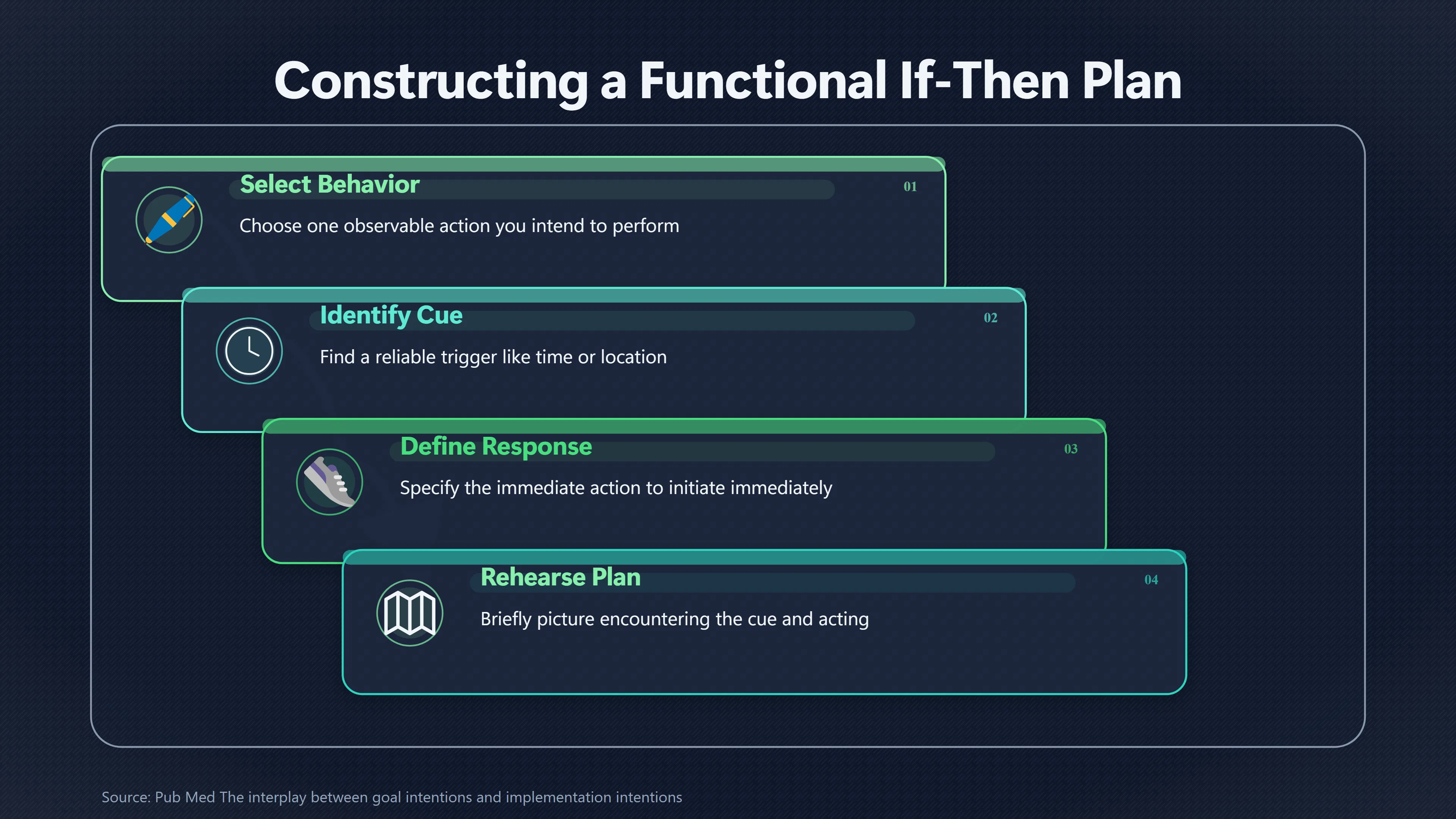
- Choose one behaviour you already intend to perform. Make it observable: “write for 20 minutes” rather than “be productive”.
- Find a cue that reliably occurs. A time and place can work, but so can completing another activity: finishing breakfast, closing a meeting, arriving home or putting the children to bed.
- Make the cue recognisable at the moment it happens. “When I have more time” is poor because there is no clear event to detect. “When I put my breakfast plate in the sink” is much harder to misinterpret.
- Specify the immediate response. Write what you will actually start doing, not another aspiration: “open the document and write for 20 minutes”, not “work on my career”.
- State the connection explicitly. “If cue, then I will response.”
- Rehearse the plan. Read it back and briefly picture encountering the cue and beginning the behaviour. The large 2024 review found larger effects when implementation intentions were rehearsed. DOI
Cue quality deserves particular attention. Research on self-generated plans suggests that people do not invariably select good triggers for themselves. A 2025 study of planning for children’s vocabulary learning, drawing on the wider implementation-intention literature, treated high-quality cues as those that were specific, salient and appropriate to the context. It also notes evidence that self-generated cues can yield smaller effects than more structured planning procedures. ScienceDirect
A useful test is therefore: Will I unmistakably know when the “if” has happened? If not, sharpen it.
Plan for obstacles as well as opportunities
Not every useful cue is an opportunity such as a time, place or completed routine. The cue can also be the obstacle that normally knocks behaviour off course.
Suppose the intended behaviour is a lunchtime walk. An opportunity plan might be:
If I finish eating lunch, then I will walk outside for 15 minutes.
But experience might reveal a predictable barrier: an invitation to continue chatting at the table. That permits a coping plan:
If I am tempted to stay at the table after lunch, then I will say I am going for my walk and leave immediately.
This approach is especially relevant where an existing routine competes with the new behaviour. Meta-analytic evidence on physical activity has found better results when implementation intentions incorporated barrier management, and later randomised-trial evidence similarly highlighted planning for perceived obstacles. Taylor & Francis Online
For unwanted habits, identifying the correct trigger can be the difficult part. A study of unhealthy snacking argued that effective plans require personally relevant cues and tested cue-monitoring as a way of discovering what actually prompted the unwanted behaviour. Taylor & Francis Online That suggests a useful correction when a plan repeatedly fails: do not automatically conclude that if-then planning “doesn’t work”. Check whether the plan was attached to the cue that really governs the situation.
Where if-then plans are most useful
Implementation intentions are particularly well suited to a familiar self-improvement problem: “I know what I want to do, but I keep failing to start it at the right time.” They can also help when a predictable distraction, feeling or competing behaviour repeatedly interferes with an intended action. The underlying cue does not have to be a clock time; the 2024 review classified cues including times and places, task junctures, events, thoughts and feelings. DOI
They are less convincing as a stand-alone answer when the real barrier is elsewhere. A plan cannot create hours that do not exist, make unaffordable resources affordable or make an unwanted goal personally meaningful. It can also misfire if the chosen cue rarely appears, is difficult to recognise, or triggers a response that is too ambitious to execute in that situation.
There is another reason not to over-engineer the technique. Research indicates that specifying a cue can focus attention on that planned opportunity, potentially making alternative opportunities less prominent. Guilford Journals The point is therefore not to script every minute of life. It is to pre-decide a small number of recurring decision points where hesitation, distraction or forgetting reliably separates intention from action.
For a behaviour goal that repeatedly stalls at the starting line, the most useful question may be surprisingly concrete: “What will I see, feel or finish immediately before I should act?” Turn that answer into the “if”, attach one clear behaviour to the “then”, and the goal has acquired something an intention alone does not provide: a trigger.
Amazon book picks
Further Reading
Books and field guides related to Why If Then Plans Make Starting Easier. Use these as the next step if you want deeper reading beyond the article.
Atomic Habits
Rating: 3.5/5 from 7 Google Books ratings
The #1 New York Times bestseller. Over 25 million copies sold! Translated into 60+ languages! Tiny Changes, Remarkable Results No matter...
Succeed: How We Can Reach Our Goals
Do you ever wonder why Asian students are able to achieve so much more than their American counterparts? Even very smart, very accomplish...
Rethinking Positive Thinking
“The solution isn’t to do away with dreaming and positive thinking. Rather, it’s making the most of our fantasies by brushing them up aga...
Tiny Habits
The world's leading expert on habit formation shows how you can have a happier, healthier life: by starting small. Myth: Change is hard....
eBay marketplace picks
Marketplace Samples
Live-tested eBay searches with available results related to this page.
Selected fromself improvement wall art oneBay.co.uk.
Current eBay listing
Self improvement Framed Wall Art Poster Canvas Print Picture


Current eBay listing
Self Improvement Quote Framed Wall Art Poster Canvas Print Picture

Endnotes
2.
Source: sciencedirect.com
Link:https://www.sciencedirect.com/science/article/abs/pii/S0065260106380021
Source snippet
Implementation Intentions and Goal Achievement: A Meta‐analysis of Effects and Processes - ScienceDirect...
3.
Source: doi.org
Link:https://doi.org/10.3758/MC.38.2.221
Source snippet
Implementation intention encoding does not automatize prospective memory responding | Memory & Cognition | Springer Nature Link...
4.
Source: sciencedirect.com
Link:https://www.sciencedirect.com/science/article/pii/S0165178115000360
5.
Source: cancercontrol.cancer.gov
Link:https://cancercontrol.cancer.gov/brp/research/constructs/implementation-intentions
6.
Source: sciencedirect.com
Link:https://www.sciencedirect.com/science/article/pii/S0361476X25000876
7.
Source: sciencedirect.com
Link:https://www.sciencedirect.com/science/article/abs/pii/S0885201420301520
8.
Source: sciencedirect.com
Link:https://www.sciencedirect.com/science/article/pii/S0376871620302854
9.
Source: sciencedirect.com
Link:https://www.sciencedirect.com/science/article/pii/S0195666318314363
10.
Source: sciencedirect.com
Link:https://www.sciencedirect.com/science/article/pii/S0001691816303626
11.
Source: sciencedirect.com
Link:https://www.sciencedirect.com/science/article/abs/pii/S0165178115000360
12.
Source: doi.org
Link:https://doi.org/10.1348/014466608x370591
13.
Source: sciencedirect.com
Link:https://www.sciencedirect.com/science/chapter/bookseries/abs/pii/S0065260106380021
14.
Source: sciencedirect.com
Link:https://www.sciencedirect.com/science/article/pii/S0195666310005325
15.
Source: sciencedirect.com
Link:https://www.sciencedirect.com/science/article/abs/pii/S002210310600028X
16.
Source: sciencedirect.com
Link:https://www.sciencedirect.com/science/article/pii/S0277953617304598
17.
Source: sciencedirect.com
Link:https://www.sciencedirect.com/science/article/pii/S1469029211000264
18.
Source: sciencedirect.com
Link:https://www.sciencedirect.com/science/article/abs/pii/S002210311630186X
19.
Source: doi.org
Link:https://doi.org/10.1007/978
20.
Source: doi.org
Link:https://doi.org/10.1521/SOCO.2007.25.2.248
21.
Source: tandfonline.com
Link:https://www.tandfonline.com/doi/abs/10.1080/10463283.2024.2334563
22.
Source: pubmed.ncbi.nlm.nih.gov
Link:https://pubmed.ncbi.nlm.nih.gov/20204996/
Source snippet
Comparing implementation intention interventions in relation to young adults' intake of fruit and vegetables - PubMed...
23.
Source: guilfordjournals.com
Link:https://guilfordjournals.com/doi/10.1521/soco.2007.25.2.248
24.
Source: guilfordjournals.com
Link:https://guilfordjournals.com/doi/full/10.1521/soco.2009.27.2.183
25.
Source: tandfonline.com
Link:https://www.tandfonline.com/doi/full/10.1080/17437199.2011.560095
26.
Source: pmc.ncbi.nlm.nih.gov
Link:https://pmc.ncbi.nlm.nih.gov/articles/PMC6235272/
Source snippet
PubMed Central (PMC)Impact of implementation intentions on physical activity practice in adults: A systematic review and meta-analysis of...
27.
Source: pubmed.ncbi.nlm.nih.gov
Link:https://pubmed.ncbi.nlm.nih.gov/21056605/
Source snippet
Do implementation intentions help to eat a healthy diet? A systematic review and meta-analysis of the empirical evidence - PubMedFe...
28.
Source: pmc.ncbi.nlm.nih.gov
Link:https://pmc.ncbi.nlm.nih.gov/articles/PMC13195971/
29.
Source: pubmed.ncbi.nlm.nih.gov
Link:https://pubmed.ncbi.nlm.nih.gov/41987207/
30.
Source: tandfonline.com
Link:https://www.tandfonline.com/doi/full/10.1080/20445911.2014.975816
31.
Source: pubmed.ncbi.nlm.nih.gov
Title: Pub Med The interplay between goal intentions and implementation intentions
Link:https://pubmed.ncbi.nlm.nih.gov/15574664/
32.
Source: tandfonline.com
Link:https://www.tandfonline.com/doi/full/10.1080/08870446.2014.950658
33.
Source: pubmed.ncbi.nlm.nih.gov
Link:https://pubmed.ncbi.nlm.nih.gov/25099386/
34.
Source: pubmed.ncbi.nlm.nih.gov
Link:https://pubmed.ncbi.nlm.nih.gov/41784001/
35.
Source: pubmed.ncbi.nlm.nih.gov
Link:https://pubmed.ncbi.nlm.nih.gov/41784001/%3Futm_source%3DFeedFetcher%26utm_medium%3Drss%26utm_campaign%3DNone%26utm_content%3D14UrQ4NgJAsHm8SXI5BaYp7FokEO6cTAmJLXI2aoiiNVJqzY1Q%26fc%3DNone%26ff%3D20260306143306%26v%3D2.19.0.post6%2B133c1fe
36.
Source: pmc.ncbi.nlm.nih.gov
Link:https://pmc.ncbi.nlm.nih.gov/articles/PMC10585941/
37.
Source: pubmed.ncbi.nlm.nih.gov
Link:https://pubmed.ncbi.nlm.nih.gov/36476147/
38.
Source: pmc.ncbi.nlm.nih.gov
Link:https://pmc.ncbi.nlm.nih.gov/articles/PMC10087331/
39.
Source: pubmed.ncbi.nlm.nih.gov
Link:https://pubmed.ncbi.nlm.nih.gov/36173203/
40.
Source: pmc.ncbi.nlm.nih.gov
Link:https://pmc.ncbi.nlm.nih.gov/articles/PMC10305802/
41.
Source: pmc.ncbi.nlm.nih.gov
Link:https://pmc.ncbi.nlm.nih.gov/articles/PMC9274250/
42.
Source: pubmed.ncbi.nlm.nih.gov
Link:https://pubmed.ncbi.nlm.nih.gov/35742582/
43.
Source: pubmed.ncbi.nlm.nih.gov
Link:https://pubmed.ncbi.nlm.nih.gov/35664117/
44.
Source: pmc.ncbi.nlm.nih.gov
Link:https://pmc.ncbi.nlm.nih.gov/articles/PMC9160833/
45.
Source: pmc.ncbi.nlm.nih.gov
Link:https://pmc.ncbi.nlm.nih.gov/articles/PMC8763258/
46.
Source: pubmed.ncbi.nlm.nih.gov
Link:https://pubmed.ncbi.nlm.nih.gov/34753411/
47.
Source: pubmed.ncbi.nlm.nih.gov
Link:https://pubmed.ncbi.nlm.nih.gov/33220048/
48.
Source: pmc.ncbi.nlm.nih.gov
Link:https://pmc.ncbi.nlm.nih.gov/articles/PMC8149892/
49.
Source: pubmed.ncbi.nlm.nih.gov
Link:https://pubmed.ncbi.nlm.nih.gov/34054628/
50.
Source: pmc.ncbi.nlm.nih.gov
Link:https://pmc.ncbi.nlm.nih.gov/articles/PMC7946166/
51.
Source: pubmed.ncbi.nlm.nih.gov
Link:https://pubmed.ncbi.nlm.nih.gov/32622228/
52.
Source: pubmed.ncbi.nlm.nih.gov
Link:https://pubmed.ncbi.nlm.nih.gov/32730052/
53.
Source: pmc.ncbi.nlm.nih.gov
Link:https://pmc.ncbi.nlm.nih.gov/articles/PMC7963295/
54.
Source: pubmed.ncbi.nlm.nih.gov
Link:https://pubmed.ncbi.nlm.nih.gov/31923898/
55.
Source: pubmed.ncbi.nlm.nih.gov
Link:https://pubmed.ncbi.nlm.nih.gov/31414843/
56.
Source: pubmed.ncbi.nlm.nih.gov
Link:https://pubmed.ncbi.nlm.nih.gov/30427874/
57.
Source: pubmed.ncbi.nlm.nih.gov
Link:https://pubmed.ncbi.nlm.nih.gov/28552168/
58.
Source: pubmed.ncbi.nlm.nih.gov
Link:https://pubmed.ncbi.nlm.nih.gov/27054302/
59.
Source: pubmed.ncbi.nlm.nih.gov
Link:https://pubmed.ncbi.nlm.nih.gov/25965276/
60.
Source: pmc.ncbi.nlm.nih.gov
Link:https://pmc.ncbi.nlm.nih.gov/articles/PMC4370584/
61.
Source: tandfonline.com
Link:https://www.tandfonline.com/doi/abs/10.1080/20445911.2014.975816
62.
Source: pmc.ncbi.nlm.nih.gov
Link:https://pmc.ncbi.nlm.nih.gov/articles/PMC4113409/
63.
Source: pubmed.ncbi.nlm.nih.gov
Link:https://pubmed.ncbi.nlm.nih.gov/22468716/
64.
Source: tandfonline.com
Link:https://www.tandfonline.com/doi/full/10.1080/13825585.2011.613449
65.
Source: tandfonline.com
Link:https://www.tandfonline.com/doi/abs/10.1080/17437199.2011.560095
66.
Source: pubmed.ncbi.nlm.nih.gov
Link:https://pubmed.ncbi.nlm.nih.gov/19130080/
67.
Source: pubmed.ncbi.nlm.nih.gov
Link:https://pubmed.ncbi.nlm.nih.gov/18851764/
68.
Source: pubmed.ncbi.nlm.nih.gov
Link:https://pubmed.ncbi.nlm.nih.gov/18604955/
69.
Source: pubmed.ncbi.nlm.nih.gov
Link:https://pubmed.ncbi.nlm.nih.gov/21177875/
70.
Source: ncbi.nlm.nih.gov
Link:https://www.ncbi.nlm.nih.gov/books/NBK81362/
71.
Source: tandfonline.com
Link:https://www.tandfonline.com/toc/pers20/36/1
72.
Source: tandfonline.com
Link:https://www.tandfonline.com/toc/pers20/36/1?nav=tocList
73.
Source: tandfonline.com
Link:https://www.tandfonline.com/doi/full/10.1080/10463283.2024.2334563
74.
Source: guilfordjournals.com
Link:https://guilfordjournals.com/doi/10.1521/soco.2009.27.2.183
75.
Source: openurl.ebsco.com
Link:https://openurl.ebsco.com/results?bquery=AU+Sheeran%2C+Paschal&limiters=RV%3AY&link_origin=&searchDescription=Sheeran%2C+Paschal&sid=ebsco%3Aocu%3Arecord
Additional References
76.
Source: youtube.com
Title: What is Implementation Intention | Explained in 2 min
Link:https://www.youtube.com/watch?v=6JqPF_8BWjw
Source snippet
For a clear breakdown of the empirical evidence and practical setup of implementation intentions, check out If-Then Planning: The Goal-Se...
77.
Source: youtube.com
Title: Why 99% Of People Will Never Achieve Their Goals (According To Psychology)
Link:https://www.youtube.com/watch?v=qgYDYJJlNHg
Source snippet
Psychology of People Who Plan Everything But Never Start...
78.
Source: youtube.com
Title: How to Automate Your Focus: The Science of If-Then Rules
Link:https://www.youtube.com/watch?v=MSPjnh5AEyE
Source snippet
Why 99% Of People Will Never Achieve Their Goals (According To Psychology)...
79.
Source: youtube.com
Title: Psychology of People Who Plan Everything But Never Start
Link:https://www.youtube.com/watch?v=M1PTdqtNy1c
Source snippet
What is Implementation Intention | Explained in 2 min...
80.
Source: youtube.com
Title: If-Then Planning: The Goal-Setting Myth vs. Truth
Link:https://www.youtube.com/watch?v=rg8-mZMERc4
Source snippet
How to Automate Your Focus: The Science of If-Then Rules...
81.
Source: psychologicalscience.org
Title: Implementation Intentions and Facilitation of Prospective Memory
Link:https://www.psychologicalscience.org/journals/psychological-science/1467-9280.00385/
82.
Source: researchgate.net
Link:https://www.researchgate.net/publication/233472164_A_meta-analytic_review_of_the_effect_of_implementation_intentions_on_physical_activity
83.
Source: researchgate.net
Link:https://www.researchgate.net/publication/335198508_Beyond_planning_A_meta-analysis_of_implementation_intentions_to_support_smoking_cessation
84.
Source: researchgate.net
Link:https://www.researchgate.net/publication/37367696_Implementation_Intentions_and_Goal_Achievement_A_Meta-Analysis_of_Effects_and_Processes
85.
Source: researchgate.net
Link:https://www.researchgate.net/publication/378870694_The_When_and_How_of_Planning_Meta-Analysis_of_the_Scope_and_Components_of_Implementation_Intentions_in_642_Tests