Within Reduce Friction
When Making a Habit Easier Stops Helping
Once the main access barrier is gone, further convenience may add little and can turn optimization into avoidance.
On this page
- Evidence that extra convenience can hit diminishing returns
- How to identify the real remaining barrier
- Avoiding friction reduction as productive procrastination
Page outline Jump by section
Introduction
Reducing friction is useful when friction is actually what is stopping a good habit. Once the behaviour is already easy to start, however, another shortcut, app, piece of equipment or round of preparation may produce little benefit. At that point the limiting factor may be something else: weak motivation, an unclear cue, lack of skill, competing priorities, an unstable routine or simply too little repetition.
This distinction matters because behavioural research strongly supports removing genuine effort barriers, but it does not establish that making an already accessible behaviour progressively easier will keep producing comparable gains. Habit formation depends on repeated behaviour in sufficiently stable contexts, and behaviour more broadly depends on capability, opportunity and motivation.[PubMed Central (PMC)]pmc.ncbi.nlm.nih.govPub Med Central (PMC)A meta-analytic cognitive framework of nudge and sludgePubMed Central (PMC)A meta-analytic cognitive framework of nudge and sludge - PMCNovember 29, 2023…
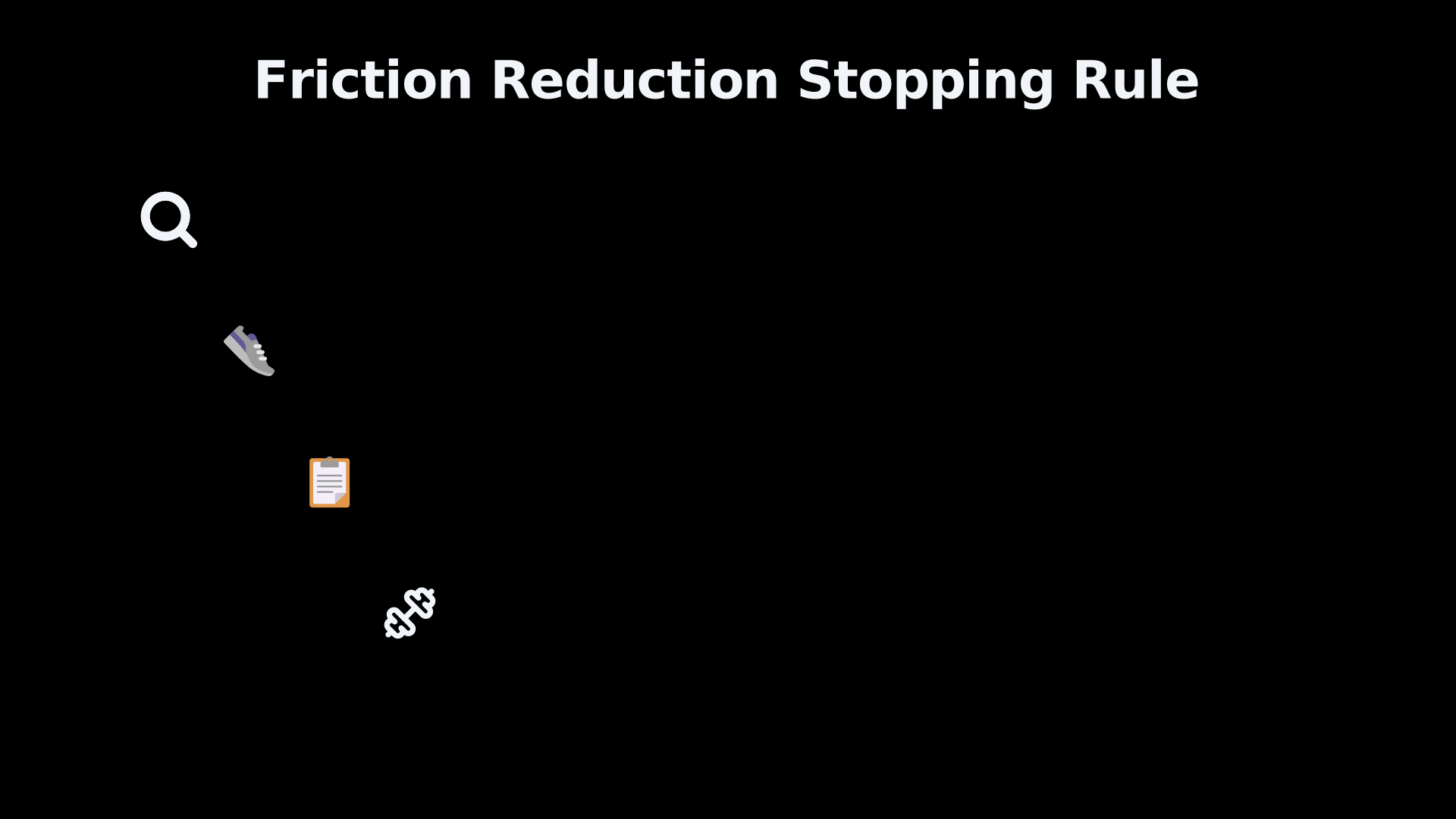
The practical stopping rule is therefore simple: remove friction until the main access barrier is no longer the problem, then diagnose what is actually preventing repetition. Otherwise, optimising the conditions for a habit can quietly replace doing the habit.
Extra convenience eventually solves the wrong problem
The evidence for reducing genuine friction is substantial. A meta-analysis covering 184 field experiments and more than 2.2 million participants found that interventions changing effort had stronger effects, on average, than interventions targeting intrinsic motivation. The authors also warned that publication bias may have inflated the estimated advantage.[PubMed Central (PMC)]pmc.ncbi.nlm.nih.govPub Med Central (PMC)A meta-analytic cognitive framework of nudge and sludgePubMed Central (PMC)A meta-analytic cognitive framework of nudge and sludge - PMCNovember 29, 2023… Governments use the same logic in “sludge audits”, which identify unnecessary time, procedural and psychological costs that prevent people from completing useful actions.[OECD]oecd.orgfixing frictions sludge audits around the world 5e9bb35c enFixing frictions: ‘sludge audits’ around the world | OECDJune 12, 2024…
Concrete cases show why. UK behavioural-insights work found that something as mundane as having to clear a loft could obstruct uptake of loft insulation, prompting a trial specifically designed to remove that hassle.[GOV.UK]GOV.UKOpen Policy Making toolkitSensitive policy tools - Guidance - GOV.UKFebruary 1, 2016… Another government report describes how removing a single unnecessary click from an online tax-payment journey increased timely payment by 20%.[GOV.UK Assets]assets.publishing.service.gov.ukAn exploration of potential behavioural biases in project delivery in the Department for TransportJuly 12, 2017… In cases like these, convenience changes behaviour because it removes an identifiable obstacle between intention and action.
But that evidence should not be stretched into a universal rule that less effort is always better. The relevant comparison in these interventions is usually a burdensome process versus a meaningfully easier one. It does not follow that reducing a four-step routine to three steps, then three to two, then buying specialised equipment to shave another ten seconds off it, will generate comparable improvements.
Research on habit formation points to a different source of diminishing returns. Habit automaticity typically develops through repetition in a consistent context, and its growth has often been modelled as an asymptotic process: gains are initially larger and then tend to become smaller as automaticity strengthens.[PubMed Central (PMC)]pmc.ncbi.nlm.nih.govPubMed Central (PMC)Context Stability in Habit Building Increases Automaticity and Goal Attainment - PMCJune 10, 2022… The crucial input is repeated performance, not an indefinitely optimised environment.
A recent preregistered reanalysis of a six-month longitudinal habit study reinforces that broader picture. Habit strength was associated with several factors, including behaviour frequency, context stability, autonomous motivation, positive feelings and perceived difficulty. In other words, difficulty matters, but it is one variable among several rather than a master lever that explains every stalled habit.[PubMed]pubmed.ncbi.nlm.nih.govOpen source on nih.gov.
That gives friction reduction a natural boundary. If putting running shoes beside the door changes “I cannot get myself organised in the morning” into regular runs, the intervention has done useful work. Once the shoes are already there and leaving takes a minute, rearranging them again is unlikely to fix a problem that is now about skipped sessions, poor scheduling or reluctance to run.
Find the barrier that remains
A useful way to decide whether more convenience will help is to stop asking, “How can I make this easier?” and ask, “At exactly what point does the behaviour fail?” Behaviour-change research provides a disciplined reason for doing this. The COM-B model treats behaviour as the product of interacting conditions involving capability, opportunity and motivation. Intervention design is supposed to begin with diagnosis rather than automatically applying the same solution to every failure.[PubMed Central (PMC)]pmc.ncbi.nlm.nih.govPubMed Central (PMC)The behaviour change wheel: A new method for characterising and designing behaviour change interventions - PMC…
That distinction can be applied to ordinary habits:
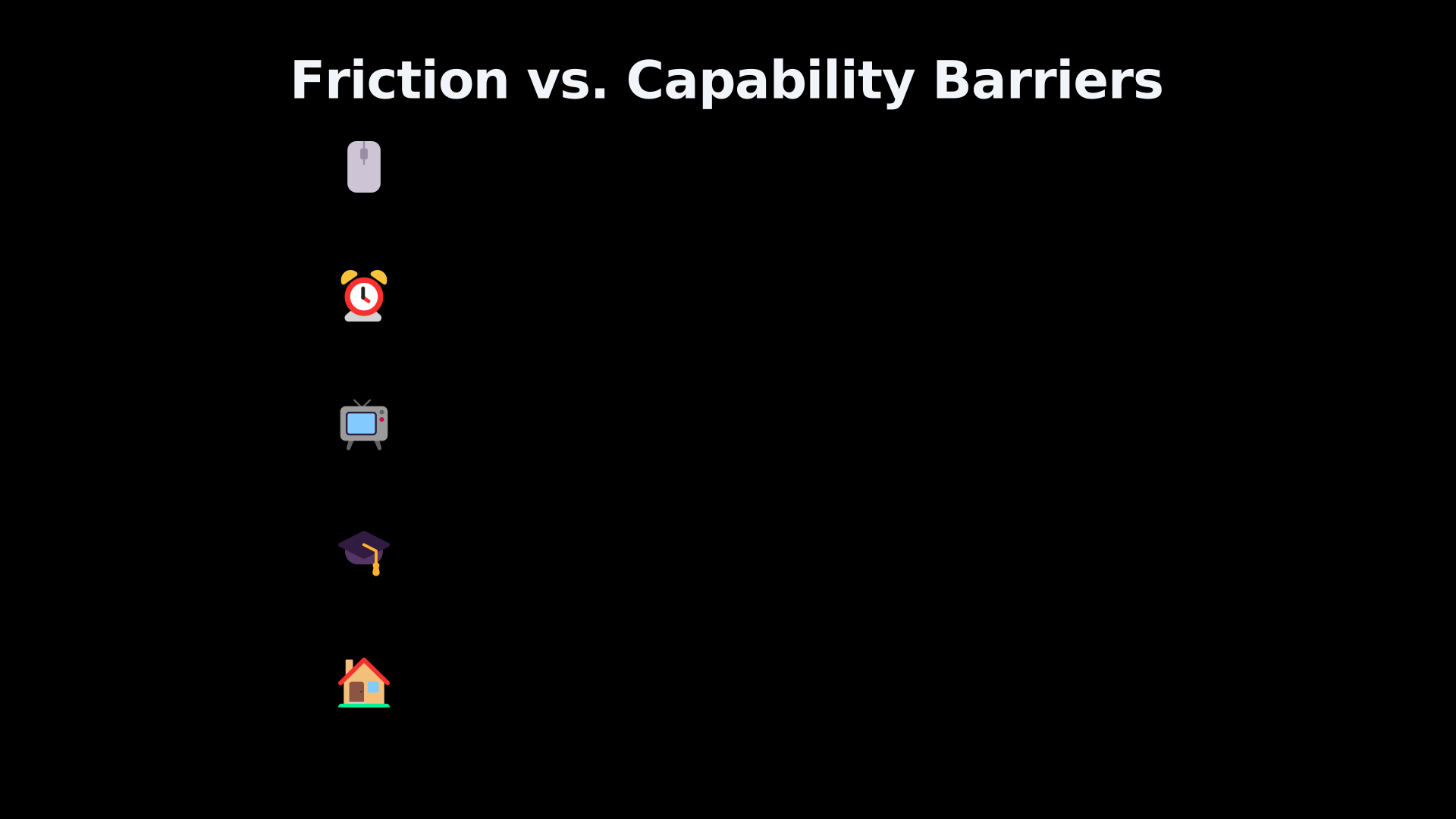
- The behaviour rarely starts because preparation is genuinely cumbersome. Friction is still a plausible target. Put the equipment where it is used, reduce unnecessary steps, pre-select the task or move the activity into an existing route or routine.
- Everything is ready, but you forget. The problem is more likely to be cueing or prospective memory than access. A stable trigger or an explicit if–then plan may be more useful than another convenience.
- You remember and have access, but repeatedly choose something else. Motivation, competing rewards or priorities deserve attention. Making the target behaviour another few seconds easier may not change that competition.
- You begin but cannot perform the behaviour effectively. The bottleneck may be capability: knowledge, physical ability or skill. Training and appropriately scaling the task address a different problem from environmental convenience.
- You perform it sometimes but not consistently. Look at context stability and scheduling. In two longitudinal datasets, more stable contexts predicted greater automaticity and better attainment of habit-repetition goals.[PubMed Central (PMC)]pmc.ncbi.nlm.nih.govPubMed Central (PMC)Context Stability in Habit Building Increases Automaticity and Goal Attainment - PMCJune 10, 2022…
- You know exactly what to do but repeatedly fail at the decisive moment. Pre-committing to a response can help. A classic meta-analysis of 94 tests found that implementation intentions — specific if–then plans connecting a situation to an action — improved goal attainment, while a much larger 2024 synthesis of 642 tests found positive effects across behavioural and other outcomes.[ScienceDirect]sciencedirect.comOpen source on sciencedirect.com.
This is why a stalled habit should not automatically trigger another environmental redesign. COM-B explicitly recognises that opportunity is only part of the behavioural system. Capability and motivation can be limiting conditions too, while habits themselves sit within motivation in the model.[PubMed Central (PMC)]pmc.ncbi.nlm.nih.govPubMed Central (PMC)The behaviour change wheel: A new method for characterising and designing behaviour change interventions - PMC…
Habit research also cautions against expecting any single mechanism to carry too much weight. A 2024 state-of-the-field review argues that habit is only one influence on behaviour and that habit formation may be neither necessary nor sufficient for sustaining real-world behaviour change.[Compass]compass.onlinelibrary.wiley.comOpen source on wiley.com. If habit itself should not be treated as a universal explanation, friction reduction — one way of supporting behaviour and repetition — deserves even less universal status.
Convenience should protect repetition, not replace it
The most useful test of a friction intervention is behavioural rather than aesthetic: does the change lead to more repetitions of the target behaviour?
Suppose someone wants to read every evening. Their book is buried in a cupboard, so putting it on the bedside table removes a genuine retrieval barrier and supplies a visible contextual cue. If reading becomes regular, further optimisation is unnecessary. Buying a different reading lamp might still be worthwhile for comfort, but it should not be confused with solving the behavioural problem.
If the person still does not read, the next question is what happens instead. If they automatically reach for their phone, the important intervention may concern the competing behaviour. If they are exhausted at bedtime, timing may be the problem. If the book is unappealing, motivation may be the problem. If evenings vary wildly, context stability may be weak. Each diagnosis points somewhere different.
That approach is consistent with the Behaviour Change Wheel, which was designed precisely to link interventions to diagnosed behavioural influences rather than treating one intervention function as universally appropriate.[behaviourchangewheel.com]behaviourchangewheel.comUnderstanding the WheelUnderstanding the Wheel It is also consistent with OECD behavioural guidance: reducing hassle can help bridge the intention–action gap, but sustained behaviour may additionally require concrete plans and feedback because the challenge is not merely initiating an action once but maintaining it over time.[OECD]oecd.orgcomponent 5component 5
For habit formation specifically, repetition remains central. Reviews describe habits as cue-linked responses acquired through repeated behaviour in sufficiently consistent contexts.[Taylor & Francis Online]tandfonline.comOpen source on tandfonline.com. A systematic review of health-behaviour habit formation similarly separates deciding to act, translating intention into behaviour, repeating the behaviour and eventually developing automaticity.[PubMed Central (PMC)]pmc.ncbi.nlm.nih.govOpen source on nih.gov. Friction reduction is especially valuable around the second stage because it can make enactment more likely. It cannot perform the third stage on your behalf.
The implication is an important reversal of emphasis: after the obvious obstacles are removed, the goal is no longer to create the easiest imaginable setup. It is to create a setup that is easy enough to support reliable repetition.
When optimisation becomes avoidance
There is a further risk once the practical barrier has largely disappeared: friction reduction itself can become an attractive substitute task. Reorganising a workspace, comparing habit-tracking apps, researching the ideal notebook, redesigning a morning routine or repeatedly refining a workout plan all resemble progress because they are connected to the desired behaviour. Yet none necessarily contains the behaviour that matters.
Research does not provide a validated threshold at which “habit optimisation” turns into procrastination, so claims about this boundary should remain modest. There is, however, strong evidence that procrastination involves delaying an intended action despite expecting the delay to leave one worse off, and research links certain perfectionistic concerns with greater procrastination. A meta-analysis covering 43 samples and 10,000 participants found a small-to-medium positive association between perfectionistic concerns and trait procrastination; a seven-day diary study of 317 students found evidence that perceived discrepancies between actual and ideal performance helped explain the relationship.[Sage Journals]journals.sagepub.comOpen source on sagepub.com.
That does not mean that anyone arranging their desk is a perfectionist or procrastinator. It supplies a more useful warning: preparation deserves scrutiny when the standard for being “ready” keeps moving.
A practical way to detect that shift is to compare preparation with execution. If you have changed the setup several times without increasing the number of actual repetitions, the setup is no longer the leading explanation. If the next optimisation is easier to describe than the obstacle it supposedly removes, its value is doubtful. And if you routinely spend the available habit window improving the system rather than using it, preparation has become behaviourally counterproductive regardless of how sensible each individual improvement sounds.
There is also a conceptual clue. Effective implementation intentions specify when, where and how a person will act, and research suggests they work partly by strengthening the connection between a recognised situation and a goal-directed response.[ScienceDirect]sciencedirect.comOpen source on sciencedirect.com. Once that connection is clear — for example, “after breakfast, I sit at the desk and practise Spanish for ten minutes” — repeatedly redesigning the plan can become less useful than allowing the same cue–response sequence to recur.

A stopping rule for friction reduction
There is no scientifically established number of clicks, minutes or preparation steps below which friction becomes irrelevant. The sensible threshold is functional rather than numerical.
Friction reduction has probably done enough when the target behaviour is readily available, clearly cued and realistically startable in the circumstances in which it is supposed to happen. From there, judge the system by repetitions. If repetitions rise, preserve the setup long enough for consistency to work. If they do not, investigate the next bottleneck instead of automatically making the setup easier.
This distinction also prevents “easy” from becoming synonymous with “effortless”. Some valuable behaviours contain unavoidable effort: exercise requires exertion, learning requires attention and practising a difficult skill requires tolerating mistakes. Behavioural science on sludge makes a comparable distinction at policy level between unnecessary friction and processes that serve a legitimate function; the aim is not simply to erase every possible cost.[OECD]oecd.orgfixing frictions sludge audits around the world 5e9bb35c enFixing frictions: ‘sludge audits’ around the world | OECDJune 12, 2024…
For personal habits, the useful target is therefore friction before the valuable work, not necessarily difficulty within the valuable work. Having exercise clothes ready can remove needless setup. It cannot — and need not — remove the physical challenge of training. Opening the study document automatically can eliminate searching and decision-making. It cannot replace the concentration required to understand the material.
The broader lesson for self-improvement is to treat convenience as an intervention rather than an ideology. Remove barriers that demonstrably prevent action. Keep the environment sufficiently stable to support repetition. Then stop polishing the runway and use it. The point of reducing friction is not to perfect the conditions for a habit; it is to make the habit happen often enough that the conditions cease to be the main story.
Amazon book picks
Further Reading
Books and field guides related to When Making a Habit Easier Stops Helping. Use these as the next step if you want deeper reading beyond the article.
Atomic Habits
Rating: 3.5/5 from 7 Google Books ratings
The #1 New York Times bestseller. Over 25 million copies sold! Translated into 60+ languages! Tiny Changes, Remarkable Results No matter...
Tiny Habits
Improving your life is much easier than you think. Whether it’s losing weight, sleeping more, or restoring your work/life balance – the s...
How to Change
Wall Street Journal bestseller “A welcome revelation.” --The Financial Times Award-winning Wharton Professor and Choiceology podcast host...
Nudge
Rating: 3.5/5 from 29 Google Books ratings
Thaler and Sunstein offer a groundbreaking discussion of how to apply the science of choice to nudge people toward decisions that can imp...
eBay marketplace picks
Marketplace Samples
Live-tested eBay searches with available results related to this page.
Selected fromhabit motivation sign oneBay.co.uk.
Endnotes
1.
Source: oecd.org
Title: fixing frictions sludge audits around the world 5e9bb35c en
Link:https://www.oecd.org/en/publications/fixing-frictions-sludge-audits-around-the-world_5e9bb35c-en.html
Source snippet
Fixing frictions: ‘sludge audits’ around the world | OECDJune 12, 2024...
Published: June 12, 2024
2.
Source: oecd.org
Link:https://www.oecd.org/en/publications/applying-behavioural-science-in-the-italian-public-administration_a7d9d7d9-en/full-report/bpa-for-administrative-processes_18845aae.html
Source snippet
BPA for administrative processes: Applying Behavioural Science in the Italian Public Administration | OECD...
3.
Source: GOV.UK
Title: Open Policy Making toolkit
Link:https://www.gov.uk/guidance/open-policy-making-toolkit/sensitive-policy-tools
Source snippet
Sensitive policy tools - Guidance - GOV.UKFebruary 1, 2016...
Published: February 1, 2016
4.
Source: GOV.UK
Title: Loft clearance: results of a behavioural trial
Link:https://www.gov.uk/government/publications/loft-clearance-results-of-a-behavioural-trial
5.
Source: assets.publishing.service.gov.uk
Link:https://assets.publishing.service.gov.uk/government/uploads/system/uploads/attachment_data/file/627788/exploration-of-behavioural-biases.pdf
Source snippet
An exploration of potential behavioural biases in project delivery in the Department for TransportJuly 12, 2017...
Published: July 12, 2017
6.
Source: sciencedirect.com
Link:https://www.sciencedirect.com/science/article/abs/pii/S0065260106380021
7.
Source: behaviourchangewheel.com
Title: Understanding the Wheel
Link:https://www.behaviourchangewheel.com/about-wheel
8.
Source: oecd.org
Title: component 5
Link:https://www.oecd.org/en/publications/tools-and-ethics-for-applied-behavioural-insights-the-basic-toolkit_9ea76a8f-en/full-report/component-5.html
9.
Source: sciencedirect.com
Link:https://www.sciencedirect.com/science/article/pii/S0191886917301484
10.
Source: sciencedirect.com
Link:https://www.sciencedirect.com/org/science/article/pii/S0048348626000798
11.
Source: oecd.org
Link:https://www.oecd.org/en/publications/applying-behavioural-science-in-the-italian-public-administration_a7d9d7d9-en/full-report/executive-summary_036e3f31.html
12.
Source: oecd.org
Title: applying behavioural science in the italian public administration a7d9d7d9 en
Link:https://www.oecd.org/en/publications/applying-behavioural-science-in-the-italian-public-administration_a7d9d7d9-en.html
13.
Source: oecd.org
Title: future directions for bpa 1a78f65c
Link:https://www.oecd.org/en/publications/applying-behavioural-science-in-the-italian-public-administration_a7d9d7d9-en/full-report/future-directions-for-bpa_1a78f65c.html
14.
Source: oecd.org
Title: keeping rules fit for purpose through evaluation and review b4cdc80b
Link:https://www.oecd.org/en/publications/better-regulation-practices-across-the-european-union-2025_6f007516-en/full-report/keeping-rules-fit-for-purpose-through-evaluation-and-review_b4cdc80b.html
15.
Source: oecd.org
Title: ai in public service design and delivery 09704c1a
Link:https://www.oecd.org/en/publications/2025/06/governing-with-artificial-intelligence_398fa287/full-report/ai-in-public-service-design-and-delivery_09704c1a.html
16.
Source: GOV.UK
Title: www.gov.uk Chapter 3: behaviour change
Link:https://www.gov.uk/government/publications/delivering-better-oral-health-an-evidence-based-toolkit-for-prevention/chapter-3-behaviour-change
17.
Source: oecd.org
Title: regulating for people 6d2fc8d4
Link:https://www.oecd.org/en/publications/oecd-regulatory-policy-outlook-2025_56b60e39-en/full-report/regulating-for-people_6d2fc8d4.html
18.
Source: oecd.org
Link:https://www.oecd.org/en/publications/innovative-capacity-and-participatory-policymaking-in-armenia_1efeba1a-en/full-report/component-7.html
19.
Source: GOV.UK
Title: www.gov.uk Fraud Prevention Standard for Counter Fraud Professionals (HTML)
Link:https://www.gov.uk/government/publications/government-counter-fraud-profession-standards-and-guidance/fraud-prevention-standard-for-counter-fraud-professionals-html
20.
Source: food.gov.uk
Link:https://www.food.gov.uk/research/food-hypersensitivity/consumer-responses-to-food-labelling-a-rapid-evidence-review?navref=quicklink&print=1
21.
Source: GOV.UK
Link:https://www.gov.uk/government/publications/online-choice-architecture-how-digital-design-can-harm-competition-and-consumers/evidence-review-of-online-choice-architecture-and-consumer-and-competition-harm
22.
Source: sciencedirect.com
Title: Maybe tomorrow: How burdens and biases impede energy-efficiency investments
Link:https://www.sciencedirect.com/science/article/pii/S2214629621002474
23.
Source: communications.gov.uk
Title: The principles of behaviour change
Link:https://www.communications.gov.uk/publication/the-principles-of-behaviour-change-communications/
24.
Source: oecd.org
Title: component 6
Link:https://www.oecd.org/en/publications/tools-and-ethics-for-applied-behavioural-insights-the-basic-toolkit_9ea76a8f-en/full-report/component-6.html
25.
Source: ukhsa.blog.gov.uk
Link:https://ukhsa.blog.gov.uk/2017/03/31/health-matters-using-behaviour-change-strategies-in-catering-outlets/
26.
Source: sciencedirect.com
Link:https://www.sciencedirect.com/science/chapter/bookseries/abs/pii/S0065260106380021
27.
Source: sciencedirect.com
Title: The Planning Fallacy: Cognitive, Motivational, and Social Origins
Link:https://www.sciencedirect.com/science/article/abs/pii/S0065260110430014%23%21
28.
Source: sciencedirect.com
Title: The social implications of planning: How public predictions bias future plans
Link:https://www.sciencedirect.com/science/article/abs/pii/S0022103105000375
29.
Source: coventry.gov.uk
Link:https://www.coventry.gov.uk/healthdeterminantsresearchcollaboration/research-projects/behaviour-change-insights-approach-recycling-contamination/print
30.
Source: coventry.gov.uk
Link:https://www.coventry.gov.uk/healthdeterminantsresearchcollaboration/research-projects/behaviour-change-insights-approach-recycling-contamination
31.
Source: local.gov.uk
Link:https://www.local.gov.uk/our-support/behavioural-insights/what-are-behavioural-insights
32.
Source: local.gov.uk
Link:https://www.local.gov.uk/our-support/communications-and-community-engagement/behavioural-insights/behavioural-insights
33.
Source: www2.local.gov.uk
Link:https://www2.local.gov.uk/our-support/communications-and-community-engagement/behavioural-insights/behavioural-insights
34.
Source: gcs.civilservice.gov.uk
Title: civilservice.gov.uk Strategic Communications: a behavioural approach
Link:https://gcs.civilservice.gov.uk/publications/strategic-communications-a-behavioural-approach/
35.
Source: com-b.org
Link:https://www.com-b.org/
36.
Source: hants.gov.uk
Link:https://www.hants.gov.uk/socialcareandhealth/publichealth/services-referrals-resources/behaviour-change
37.
Source: oecd.org
Link:https://www.oecd.org/en/topics/sub-issues/administrative-simplification.html
38.
Source: pmc.ncbi.nlm.nih.gov
Title: Pub Med Central (PMC)A meta-analytic cognitive framework of nudge and sludge
Link:https://pmc.ncbi.nlm.nih.gov/articles/PMC10685127/
Source snippet
PubMed Central (PMC)A meta-analytic cognitive framework of nudge and sludge - PMCNovember 29, 2023...
Published: November 29, 2023
39.
Source: pmc.ncbi.nlm.nih.gov
Link:https://pmc.ncbi.nlm.nih.gov/articles/PMC11641623/
40.
Source: pmc.ncbi.nlm.nih.gov
Link:https://pmc.ncbi.nlm.nih.gov/articles/PMC3096582/
Source snippet
PubMed Central (PMC)The behaviour change wheel: A new method for characterising and designing behaviour change interventions - PMC...
41.
Source: pmc.ncbi.nlm.nih.gov
Link:https://pmc.ncbi.nlm.nih.gov/articles/PMC9226889/
Source snippet
PubMed Central (PMC)Context Stability in Habit Building Increases Automaticity and Goal Attainment - PMCJune 10, 2022...
Published: June 10, 2022
42.
Source: pubmed.ncbi.nlm.nih.gov
Link:https://pubmed.ncbi.nlm.nih.gov/42053513/
43.
Source: pubmed.ncbi.nlm.nih.gov
Link:https://pubmed.ncbi.nlm.nih.gov/35756236/
44.
Source: doi.org
Link:https://doi.org/10.1080/10463283.2024.2334563
45.
Source: compass.onlinelibrary.wiley.com
Link:https://compass.onlinelibrary.wiley.com/doi/10.1111/spc3.12975
46.
Source: compass.onlinelibrary.wiley.com
Link:https://compass.onlinelibrary.wiley.com/doi/full/10.1111/spc3.12975
47.
Source: tandfonline.com
Link:https://www.tandfonline.com/doi/full/10.1080/17437199.2011.603640
48.
Source: pmc.ncbi.nlm.nih.gov
Link:https://pmc.ncbi.nlm.nih.gov/articles/PMC4566897/
49.
Source: journals.sagepub.com
Link:https://journals.sagepub.com/doi/10.1002/per.2098
50.
Source: pubmed.ncbi.nlm.nih.gov
Link:https://pubmed.ncbi.nlm.nih.gov/42384955/
51.
Source: tandfonline.com
Link:https://www.tandfonline.com/doi/full/10.1080/10864415.2026.2641905
52.
Source: pmc.ncbi.nlm.nih.gov
Link:https://pmc.ncbi.nlm.nih.gov/articles/PMC13059544/
53.
Source: pmc.ncbi.nlm.nih.gov
Link:https://pmc.ncbi.nlm.nih.gov/articles/PMC13114073/
54.
Source: pubmed.ncbi.nlm.nih.gov
Link:https://pubmed.ncbi.nlm.nih.gov/41784001/
55.
Source: onlinelibrary.wiley.com
Link:https://onlinelibrary.wiley.com/doi/10.1002/9781118410868.wbehibs1140
56.
Source: doi.org
Link:https://doi.org/10.1017/bpp.2024.44
57.
Source: pmc.ncbi.nlm.nih.gov
Link:https://pmc.ncbi.nlm.nih.gov/articles/PMC11574773/
58.
Source: pubmed.ncbi.nlm.nih.gov
Link:https://pubmed.ncbi.nlm.nih.gov/39225981/
59.
Source: compass.onlinelibrary.wiley.com
Link:https://compass.onlinelibrary.wiley.com/doi/epdf/10.1111/spc3.12975
60.
Source: pubmed.ncbi.nlm.nih.gov
Link:https://pubmed.ncbi.nlm.nih.gov/40909436/
61.
Source: pmc.ncbi.nlm.nih.gov
Link:https://pmc.ncbi.nlm.nih.gov/articles/PMC11046690/
62.
Source: pubmed.ncbi.nlm.nih.gov
Link:https://pubmed.ncbi.nlm.nih.gov/38047612/
63.
Source: pubmed.ncbi.nlm.nih.gov
Link:https://pubmed.ncbi.nlm.nih.gov/38034123/
64.
Source: pubmed.ncbi.nlm.nih.gov
Link:https://pubmed.ncbi.nlm.nih.gov/36724394/
65.
Source: pmc.ncbi.nlm.nih.gov
Link:https://pmc.ncbi.nlm.nih.gov/articles/PMC9854224/
66.
Source: pmc.ncbi.nlm.nih.gov
Link:https://pmc.ncbi.nlm.nih.gov/articles/PMC9372943/
67.
Source: pubmed.ncbi.nlm.nih.gov
Link:https://pubmed.ncbi.nlm.nih.gov/34283681/
68.
Source: pmc.ncbi.nlm.nih.gov
Link:https://pmc.ncbi.nlm.nih.gov/articles/PMC12318445/
69.
Source: doi.org
Link:https://doi.org/10.1073/pnas.2107346118
70.
Source: pmc.ncbi.nlm.nih.gov
Link:https://pmc.ncbi.nlm.nih.gov/articles/PMC8566331/
71.
Source: pubmed.ncbi.nlm.nih.gov
Link:https://pubmed.ncbi.nlm.nih.gov/34707522/
72.
Source: pmc.ncbi.nlm.nih.gov
Link:https://pmc.ncbi.nlm.nih.gov/articles/PMC8542725/
73.
Source: pmc.ncbi.nlm.nih.gov
Link:https://pmc.ncbi.nlm.nih.gov/articles/PMC8149892/
74.
Source: pubmed.ncbi.nlm.nih.gov
Link:https://pubmed.ncbi.nlm.nih.gov/34054628/
75.
Source: pubmed.ncbi.nlm.nih.gov
Link:https://pubmed.ncbi.nlm.nih.gov/33405284/
76.
Source: pmc.ncbi.nlm.nih.gov
Link:https://pmc.ncbi.nlm.nih.gov/articles/PMC7400384/
77.
Source: pmc.ncbi.nlm.nih.gov
Link:https://pmc.ncbi.nlm.nih.gov/articles/PMC6960169/
78.
Source: pubmed.ncbi.nlm.nih.gov
Link:https://pubmed.ncbi.nlm.nih.gov/31680711/
79.
Source: pmc.ncbi.nlm.nih.gov
Link:https://pmc.ncbi.nlm.nih.gov/articles/PMC6778105/
80.
Source: pmc.ncbi.nlm.nih.gov
Link:https://pmc.ncbi.nlm.nih.gov/articles/PMC6667662/
81.
Source: pubmed.ncbi.nlm.nih.gov
Link:https://pubmed.ncbi.nlm.nih.gov/31396122/
82.
Source: pmc.ncbi.nlm.nih.gov
Link:https://pmc.ncbi.nlm.nih.gov/articles/PMC6302524/
83.
Source: pubmed.ncbi.nlm.nih.gov
Link:https://pubmed.ncbi.nlm.nih.gov/28974825/
84.
Source: pubmed.ncbi.nlm.nih.gov
Link:https://pubmed.ncbi.nlm.nih.gov/28739920/
85.
Source: onlinelibrary.wiley.com
Link:https://onlinelibrary.wiley.com/doi/abs/10.1002/per.2098
86.
Source: onlinelibrary.wiley.com
Link:https://onlinelibrary.wiley.com/doi/full/10.1002/per.2098?frame=0&iOS=&nav=1%3Frefid%3Dorganic%3Frefid%3Dorganic%3Frefid%3Dorganic
87.
Source: journals.sagepub.com
Link:https://journals.sagepub.com/doi/pdf/10.1002/per.2098
88.
Source: journals.sagepub.com
Link:https://journals.sagepub.com/doi/10.1002/per.2098?icid=int.sj-full-text.similar-articles.2
89.
Source: pubmed.ncbi.nlm.nih.gov
Link:https://pubmed.ncbi.nlm.nih.gov/26361052/
90.
Source: pubmed.ncbi.nlm.nih.gov
Link:https://pubmed.ncbi.nlm.nih.gov/25965276/
91.
Source: bpspsychub.onlinelibrary.wiley.com
Link:https://bpspsychub.onlinelibrary.wiley.com/doi/10.1111/bjc.12086
92.
Source: doi.org
Link:https://doi.org/10.1080/17437199.2011.603640%C2%A0
93.
Source: tandfonline.com
Link:https://www.tandfonline.com/doi/abs/10.1080/17437199.2011.603640
94.
Source: pubmed.ncbi.nlm.nih.gov
Link:https://pubmed.ncbi.nlm.nih.gov/22989272/
95.
Source: pmc.ncbi.nlm.nih.gov
Link:https://pmc.ncbi.nlm.nih.gov/articles/PMC3505409/
96.
Source: pubmed.ncbi.nlm.nih.gov
Link:https://pubmed.ncbi.nlm.nih.gov/24815613/
Additional References
97.
Source: youtube.com
Title: The Silent Cost of Bad Habits | James Clear
Link:https://www.youtube.com/watch?v=zChiVdbSp5M
Source snippet
To better understand why optimizing environment and reducing friction reaches a ceiling without addressing capability and motivation, wat...
98.
Source: youtube.com
Link:https://www.youtube.com/watch?v=kwkGr62qHm8
Source snippet
The Science of Breaking Bad Habits with Wendy Wood, PhD...
99.
Source: nature.com
Link:https://www.nature.com/articles/s44159-024-00305-0
100.
Source: extranet.who.int
Link:https://extranet.who.int/fctcapps/fctcapps/fctc/kh/article12/e-library/behaviour-change-wheel-new-method-characterising-and-designing
101.
Source: youtube.com
Title: Dr. Susan Michie, The Behaviour Change Wheel
Link:https://www.youtube.com/watch?v=2-KvaIsb0fM
Source snippet
How to Break Unwanted Habits and How to Create New Desired Ones with Adam Grant and Wendy Wood...
102.
Source: nature.com
Title: Megastudies improve the impact of applied behavioural science | Nature
Link:https://www.nature.com/articles/s41586-021-04128-4
103.
Source: youtube.com
Title: What really changes behaviour? | Professor Susan Michie
Link:https://www.youtube.com/watch?v=4GzrNxPx1fg
Source snippet
Dr. Susan Michie, The Behaviour Change Wheel...
104.
Source: youtube.com
Title: The Science of Breaking Bad Habits with Wendy Wood, Ph D
Link:https://www.youtube.com/watch?v=OYDJigY89Ss
Source snippet
The Silent Cost of Bad Habits | James Clear...
105.
Source: researchgate.net
Link:https://www.researchgate.net/publication/376030390_A_meta-analytic_cognitive_framework_of_nudge_and_sludge
106.
Source: researchgate.net
Link:https://www.researchgate.net/publication/37367696_Implementation_Intentions_and_Goal_Achievement_A_Meta-Analysis_of_Effects_and_Processes