Within Evidence Limits
Does It Really Take 66 Days to Form a Habit?
Habit automaticity can take weeks or months, making 66 days a midpoint from one study rather than a universal deadline.
On this page
- Where the 66 day number came from
- Why individual habit times vary so widely
- What newer reviews say about fixed deadlines
Page outline Jump by section
Introduction
The “66-day rule” is best understood as a memorable summary of one influential study, not a countdown built into human psychology. Phillippa Lally and colleagues found that participants who successfully followed a model of increasing automaticity took a median of 66 days to reach 95% of their estimated maximum automaticity. But individual estimates ranged from 18 to 254 days, and the researchers never established 66 days as a universal deadline.[Wiley Online Library]onlinelibrary.wiley.comWiley Online LibraryHow are habits formed: Modelling habit formation in the real world - Lally - 2010 - European Journal of Social Psycho…
Later research makes the case against a fixed deadline even stronger. A 2024 systematic review found reported median formation times of 59–66 days, but means of 106–154 days and individual estimates spanning 4 to 335 days. A large field study likewise found that different behaviours acquired predictable, habit-like patterns on different timescales.[PubMed Central (PMC)]pmc.ncbi.nlm.nih.govOpen source on nih.gov.
So the useful lesson is not “repeat something for exactly 66 days”. It is that automaticity usually develops gradually through repetition, often over weeks or months, and its timing depends heavily on the behaviour, person and context.
Where the 66-day number came from
The number traces back to Lally and colleagues’ study, first published online in 2009 and subsequently appearing in the European Journal of Social Psychology in 2010. The researchers recruited 96 volunteers and asked them to choose a new eating, drinking or physical-activity behaviour — performed once each day in the same context, such as after breakfast — and follow it for 12 weeks. Participants recorded whether they performed the behaviour and completed daily measures of its automaticity.[Wiley Online Library]onlinelibrary.wiley.comWiley Online LibraryHow are habits formed: Modelling habit formation in the real world - Lally - 2010 - European Journal of Social Psycho…
That last detail matters. The researchers were not simply counting how many consecutive days somebody completed a task and declaring it a “habit”. They were interested in automaticity: the extent to which performing the behaviour came to require less conscious initiation. Habit researchers commonly distinguish this from mere behavioural frequency; habits are responses that become linked to recurring contexts through repetition.[PubMed]pubmed.ncbi.nlm.nih.govPub Med Psychology of HabitPub Med Psychology of Habit
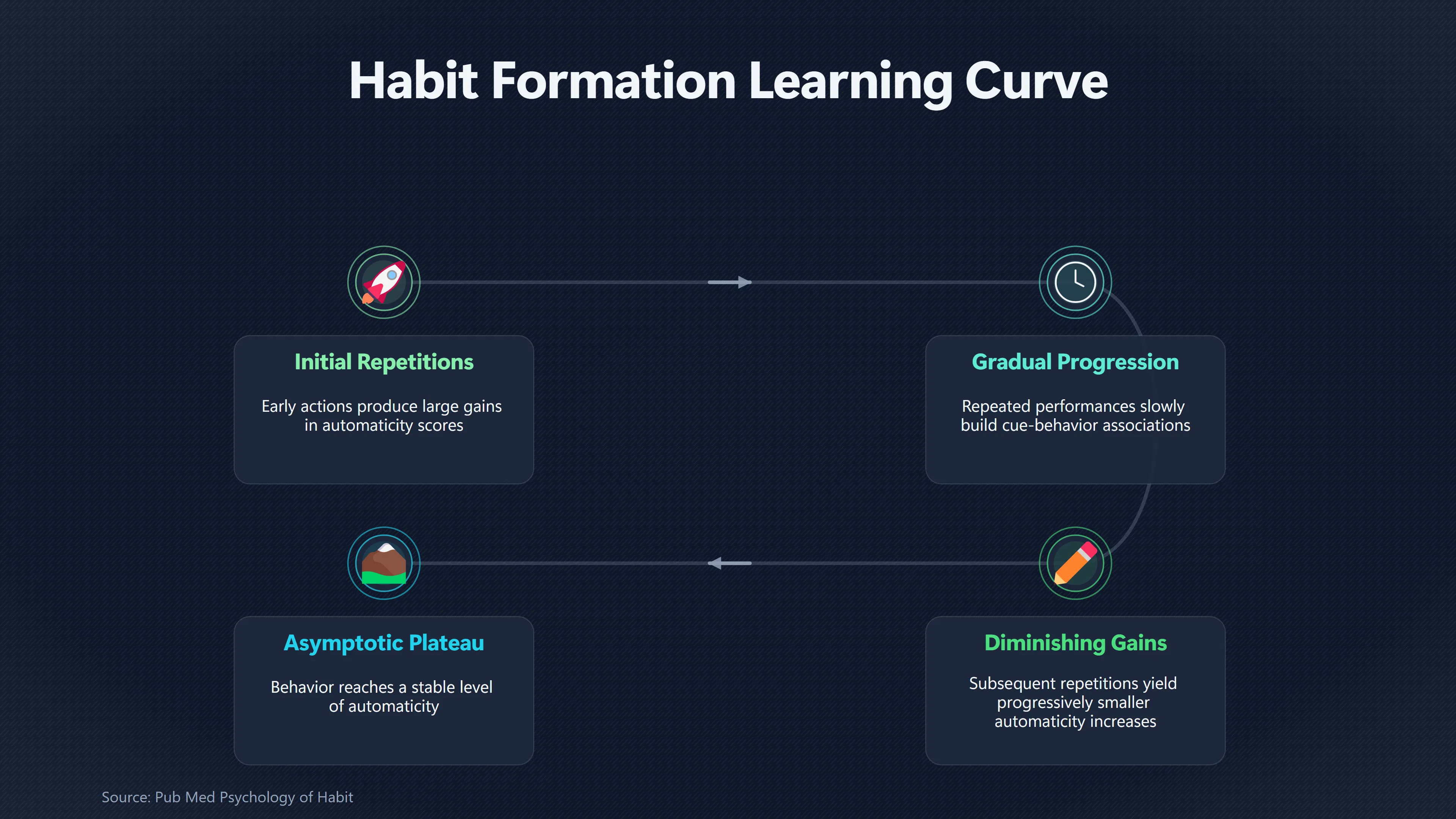
The researchers fitted a curved trajectory to each participant’s automaticity scores. The proposed pattern was asymptotic: early repetitions should produce relatively large gains in automaticity, with each subsequent gain becoming smaller as the person approaches a plateau. In other words, habit development was modelled as a gradual learning curve, not as a switch that flips on a particular day.[Wiley Online Library]onlinelibrary.wiley.comWiley Online LibraryHow are habits formed: Modelling habit formation in the real world - Lally - 2010 - European Journal of Social Psycho…
This is where “66 days” needs careful qualification. Of the 96 recruited volunteers, 82 supplied sufficient data for analysis. The mathematical model could be fitted to 62, and only 39 were classified as showing a good fit. For people whose trajectories could be modelled, the estimated time to reach 95% of their eventual automaticity varied from 18 to 254 days. The figure that became famous — 66 days — represented the middle of this highly dispersed distribution, not an experimentally demonstrated requirement.[Wiley Online Library]onlinelibrary.wiley.comWiley Online LibraryHow are habits formed: Modelling habit formation in the real world - Lally - 2010 - European Journal of Social Psycho…
Lally herself has since explicitly rejected the universal interpretation. In a 2026 University of Surrey interview, she said the important finding was the high variability in habit-formation time rather than the idea that everyone needs 66 days.[University of Surrey]surrey.ac.ukOpen source on surrey.ac.uk.
That distinction changes the claim considerably:
What the study supports: for certain daily eating, drinking and activity behaviours, automaticity often increased progressively over repeated performances, with 66 days being a useful description of the centre of one sample’s distribution.
What it does not support: every behaviour becomes a habit after 66 repetitions, everyone reaches automaticity on day 66, or failing to feel automatic by that date means habit formation has failed.
Why real habit times vary so widely
A fixed number of calendar days hides an important question: what actually happens during those days? Habit learning depends on repeated encounters between a context and a response. Two people can therefore spend the same 66 calendar days having very different learning experiences.
Research on context stability illustrates the point. In one study of university students building study habits and another using data from a habit-building app, greater stability in the circumstances surrounding repetition predicted stronger automaticity. The first study deliberately varied or stabilised participants’ contexts; across both datasets, context stability was associated with greater automaticity and better attainment of repetition goals.[PubMed]pubmed.ncbi.nlm.nih.govOpen source on nih.gov.
Repetition itself is similarly important. In a 2021 randomised trial, 192 adults linked a chosen nutrition behaviour either to a daily routine or to a particular time. Both approaches increased automaticity, and repeated enactment of the planned behaviour was a key predictor of habit development. Among participants who successfully formed habits, the median modelled time to peak automaticity was 59 days — close to Lally’s headline figure, but with individual estimates extending from 4 to 335 days in the later systematic review’s synthesis.[BPS Psych Hub]bpspsychub.onlinelibrary.wiley.comOpen source on wiley.com.
Even apparently small differences in a routine can be associated with very different timelines. In an experiment following 48 students performing a daily stretching exercise, participants assigned to stretch after waking were estimated to reach automaticity at about 106 days, compared with about 154 days for those assigned to stretch before bed. Those estimates were extrapolated from learning curves rather than direct observations of a precise “habit day”, which is another reason not to read them as exact deadlines.[PubMed]pubmed.ncbi.nlm.nih.govPub Med Effects of circadian cortisol on the development of a health habitPub Med Effects of circadian cortisol on the development of a health habit
The broader point is more robust than any particular number: elapsed time is an imperfect proxy for habit learning. A 2025 cognitive-neuroscience review emphasises that repetition and time need to be distinguished. Very simple laboratory behaviours can acquire habitual characteristics quickly when hundreds of repetitions are compressed into a short period, while complex real-world behaviours may accumulate relevant repetitions much more slowly.[ScienceDirect]sciencedirect.comOpen source on sciencedirect.com.
This also explains why “doing something for two months” is not a sufficiently precise prescription. Drinking water after breakfast provides one clearly defined response to a frequently recurring cue. “Exercise regularly” can involve travel, clothes, equipment, scheduling, different movements and changing environments. Calendar duration alone cannot make those learning situations equivalent.
The curve matters more than the deadline
The original study contains another finding that tends to disappear when 66 days becomes a rule: habit formation was modelled as a curve with diminishing gains.
The first repetitions in a stable context can produce comparatively large changes in automaticity. As the cue–behaviour relationship becomes better established, additional repetitions still contribute but yield progressively smaller increases, eventually approaching a plateau.[Wiley Online Library]onlinelibrary.wiley.comOpen source on wiley.com.
That has two practical consequences for interpreting progress.
First, there need not be a particular morning when a person wakes up and suddenly “has” the habit. Automaticity is a continuum. Day 65 and day 67 are not psychologically separated by a threshold simply because the median in one dataset happened to be 66.
Second, the eventual plateau is not necessarily perfect automaticity. The 95% calculation in the Lally study meant 95% of that person’s modelled asymptote — essentially, 95% of the automaticity level towards which their measurements appeared to be heading. It did not mean that the behaviour was 95% automatic according to some universal biological scale.[Wiley Online Library]onlinelibrary.wiley.comWiley Online LibraryHow are habits formed: Modelling habit formation in the real world - Lally - 2010 - European Journal of Social Psycho…
This is an important piece of statistical translation. “It took a median 66 days to reach 95% of the estimated automaticity plateau” is a reasonably faithful description of the analysis. “Scientists proved that habits take 66 days to form” converts a model-dependent group statistic into a universal causal rule.
The original results also challenge the idea that a streak must be flawless. Missing a single opportunity to perform the behaviour did not materially disrupt the habit-formation process in Lally’s analysis. That does not establish that repeated or prolonged interruptions are harmless, but it does mean the study itself offers little justification for treating one missed day as a reset to zero.[Wiley Online Library]onlinelibrary.wiley.comOpen source on wiley.com.

Large datasets make a universal deadline less plausible
One limitation of the original study is its modest sample and reliance on self-reported automaticity. More recent research has approached the timing question using much larger datasets and objective behavioural records.
A 2023 Proceedings of the National Academy of Sciences study analysed more than 12 million gym-attendance observations and more than 40 million hospital handwashing observations. Instead of asking participants how automatic an action felt, the researchers used machine learning to measure how predictably behaviour became associated with contextual variables over time.[PubMed]pubmed.ncbi.nlm.nih.govWhat can machine learning teach us about habit formation? Evidence from exercise and hygiene - PubMed…
The two behaviours developed on different timescales. Hospital handwashing acquired predictable patterns over weeks, whereas gym attendance took months. The authors therefore concluded that their evidence contradicted the idea of a single “magic number” of days for habit formation.[PubMed]pubmed.ncbi.nlm.nih.govWhat can machine learning teach us about habit formation? Evidence from exercise and hygiene - PubMed…
There is an instructive wrinkle in this study’s publication history. A correction changed the reported estimate for gym habit formation: the corrected analysis put the estimated time to 95% of the asymptote at roughly 68–78 days, or about two to three months, rather than the originally reported four to seven months.[PubMed Central (PMC)]pmc.ncbi.nlm.nih.govOpen source on nih.gov. That correction is worth noting precisely because this topic attracts overconfident numerical headlines. Even sophisticated estimates depend on the dataset, model and operational definition being used.
The large field study also does not simply “replicate 66 days”. Its definition of habit formation differs from Lally’s: it measures increasing context-sensitive predictability, whereas Lally measured self-reported automaticity. The PNAS authors themselves acknowledge that predictability could partly arise from mechanisms other than automaticity.[PubMed Central (PMC)]pmc.ncbi.nlm.nih.govOpen source on nih.gov.
The studies therefore complement rather than duplicate one another. One asks how automatically a deliberately repeated daily behaviour feels; another asks how predictable established real-world behaviour becomes from its context. Both undermine the strongest version of the 66-day claim because both show that the answer depends on what behaviour and what definition of “habit” are being measured.
What newer reviews say about fixed deadlines
The strongest recent synthesis is a 2024 systematic review and meta-analysis of health-related habit formation. It included 20 studies and 2,601 participants, covering behaviours including physical activity, water consumption, diet, dental flossing and reductions in sedentary behaviour.[PubMed]pubmed.ncbi.nlm.nih.govOpen source on nih.gov.
Its results make an appealing headline possible but also show why that headline requires caution. Among the four included studies that directly reported habit-formation times, medians ranged from 59 to 66 days, while reported means ranged from 106 to 154 days. Individual estimates across studies extended from 4 to 335 days.[PubMed Central (PMC)]pmc.ncbi.nlm.nih.govOpen source on nih.gov.
That difference between medians and means is revealing. A typical or middle observation can sit near two months while a substantial slower-forming tail pushes averages much higher. Saying “about two months” can therefore be a useful rough orientation for some health behaviours without establishing a two-month rule.
The evidence base is also thinner than the popularity of habit deadlines might suggest. Only four of the 20 studies in the review directly reported the time required to reach a habit-formation criterion. Eleven of the 20 studies were rated as having a high risk of bias, and the authors explicitly identified the small number of direct timing studies as a limitation.[PubMed Central (PMC)]pmc.ncbi.nlm.nih.govOpen source on nih.gov.
The review also had to accept differing operational definitions of when a habit had “formed”. Some studies used automaticity scales; others used thresholds or modelled plateaus. Habit formation itself is continuous, so choosing a threshold inevitably turns a gradual process into a convenient numerical endpoint.[PubMed Central (PMC)]pmc.ncbi.nlm.nih.govOpen source on nih.gov.
For evidence quality, that is the crucial caveat. The modern literature is strong enough to reject a rigid deadline more confidently than it can nominate a replacement one.
A better way to use the 66-day finding
For self-improvement, 66 days works better as an expectation-correcting benchmark than as a target. It tells a reader that three weeks of repetition may be far too early to decide a behaviour has failed to become habitual. It also suggests that continuing for several months can be entirely compatible with normal habit development. The 2024 review found evidence of habit strengthening beyond one month in multiple included studies.[PubMed Central (PMC)]pmc.ncbi.nlm.nih.govOpen source on nih.gov.
But the research points towards monitoring the process rather than the calendar. The relevant questions are whether the behaviour is actually being repeated, whether it is attached to a sufficiently stable cue or context, and whether initiating it is becoming less dependent on deliberate remembering and decision-making. Stable contexts have been associated experimentally and observationally with stronger automaticity, while repeated plan enactment predicts habit development.[PubMed]pubmed.ncbi.nlm.nih.govOpen source on nih.gov.
That produces a more evidence-faithful interpretation of the famous number:
- 66 days is not a deadline. It was the median estimate in a particular real-world study.
- Variation is part of the main result, not statistical noise to ignore. The original range was 18–254 days, while a later review found individual estimates extending from 4–335 days.[Wiley Online Library]onlinelibrary.wiley.comWiley Online LibraryHow are habits formed: Modelling habit formation in the real world - Lally - 2010 - European Journal of Social Psycho…
- Different behaviours need not share a timescale. Large observational datasets find meaningful differences between domains such as handwashing and gym attendance.[PubMed]pubmed.ncbi.nlm.nih.govWhat can machine learning teach us about habit formation? Evidence from exercise and hygiene - PubMed…
- One missed repetition is not evidence of starting over. The original study found no material disruption from a single missed opportunity.[Wiley Online Library]onlinelibrary.wiley.comOpen source on wiley.com.
- “Habit formed” is itself measurement-dependent. Automaticity, a modelled plateau and context-sensitive behavioural predictability capture related but not identical phenomena.[PubMed Central (PMC)]pmc.ncbi.nlm.nih.govOpen source on nih.gov.
The 66-day figure therefore survives scientific scrutiny only in its narrow form: it is a useful historical data point showing that meaningful automaticity can take considerably longer than popular short-term challenges imply. As a universal rule, it fails for the same reason many self-improvement slogans fail — it replaces a wide distribution, a gradual process and several measurement choices with one reassuringly precise number.
Amazon book picks
Further Reading
Books and field guides related to Does It Really Take 66 Days to Form a Habit?. Use these as the next step if you want deeper reading beyond the article.
Good Habits, Bad Habits
'The world's leading expert on habits' - Matthew Syed, bestselling author of Black Box Thinking and Rebel IdeasWhat if you could harness...
Atomic Habits
Rating: 3.5/5 from 7 Google Books ratings
The #1 New York Times bestseller. Over 25 million copies sold! Translated into 60+ languages! Tiny Changes, Remarkable Results No matter...

The Power of Habit
Rating: 4.0/5 from 145 Google Books ratings
Duhigg takes us to the edge of scientific discoveries that explain why habits exist and how they can be changed. Distilling information i...
Tiny Habits
Improving your life is much easier than you think. Whether it’s losing weight, sleeping more, or restoring your work/life balance – the s...
eBay marketplace picks
Marketplace Samples
Live-tested eBay searches with available results related to this page.
Selected fromhabit poster oneBay.co.uk.



Current eBay listing
Success is a Daily Habit Framed Wall Art Poster Print Picture

Current eBay listing
Success is a Habit Retro Design Framed Wall Art Poster Print Picture
Endnotes
1.
Source: onlinelibrary.wiley.com
Link:https://onlinelibrary.wiley.com/doi/10.1002/ejsp.674?947f74f7_page=5&b158b201_page=5
Source snippet
Wiley Online LibraryHow are habits formed: Modelling habit formation in the real world - Lally - 2010 - European Journal of Social Psycho...
2.
Source: onlinelibrary.wiley.com
Link:https://onlinelibrary.wiley.com/doi/abs/10.1002/ejsp.674?msockid=2489864bf52b6612230d95d6f48167ef
3.
Source: bpspsychub.onlinelibrary.wiley.com
Link:https://bpspsychub.onlinelibrary.wiley.com/doi/abs/10.1111/bjhp.12504
4.
Source: sciencedirect.com
Link:https://www.sciencedirect.com/science/article/pii/S1364661324002663
5.
Source: iaap-journals.onlinelibrary.wiley.com
Link:https://iaap-journals.onlinelibrary.wiley.com/doi/10.1111/aphw.12605
6.
Source: sciencedirect.com
Link:https://www.sciencedirect.com/science/article/pii/S2352289523000164
7.
Source: onlinelibrary.wiley.com
Link:https://onlinelibrary.wiley.com/doi/abs/10.1002/ejsp.674?msockid=038ed114f43667dd0790c4bef5146634
8.
Source: onlinelibrary.wiley.com
Link:https://onlinelibrary.wiley.com/doi/abs/10.1002/ejsp.674?538fcd4b_page=6&947f74f7_page=5
9.
Source: onlinelibrary.wiley.com
Link:https://onlinelibrary.wiley.com/doi/abs/10.1002/ejsp.674
10.
Source: onlinelibrary.wiley.com
Link:https://onlinelibrary.wiley.com/doi/abs/10.1002/ejsp.674?aff_id=24772
11.
Source: onlinelibrary.wiley.com
Link:https://onlinelibrary.wiley.com/doi/abs/10.1002/ejsp.674?cf_chl_jschl_tk=pmd_EwcJDaCFBR9OVEL1O_0qjioww0Gc86ZzpBvCBFhrDcE-1635261061-0-gqNtZGzNAjujcnBszQi9
12.
Source: onlinelibrary.wiley.com
Link:https://onlinelibrary.wiley.com/doi/10.1002/ejsp.674
13.
Source: bpspsychub.onlinelibrary.wiley.com
Link:https://bpspsychub.onlinelibrary.wiley.com/share/SFKV2IDZIZUZFJF4X9N2?target=10.1111%2Fbjhp.12504
14.
Source: pmc.ncbi.nlm.nih.gov
Link:https://pmc.ncbi.nlm.nih.gov/articles/PMC11641623/
15.
Source: pubmed.ncbi.nlm.nih.gov
Link:https://pubmed.ncbi.nlm.nih.gov/37068252/
Source snippet
What can machine learning teach us about habit formation? Evidence from exercise and hygiene - PubMed...
16.
Source: pubmed.ncbi.nlm.nih.gov
Title: Pub Med Psychology of Habit
Link:https://pubmed.ncbi.nlm.nih.gov/26361052/?dopt=Abstract
17.
Source: doi.org
Link:https://doi.org/10.1111/bjhp.12504
18.
Source: surrey.ac.uk
Link:https://www.surrey.ac.uk/news/does-it-really-take-66-days-form-habit-we-asked-expert-dr-pippa-lally
19.
Source: pubmed.ncbi.nlm.nih.gov
Link:https://pubmed.ncbi.nlm.nih.gov/35756236/
20.
Source: doi.org
Link:https://doi.org/10.3390/healthcare12232488
21.
Source: pubmed.ncbi.nlm.nih.gov
Title: Pub Med Effects of circadian cortisol on the development of a health habit
Link:https://pubmed.ncbi.nlm.nih.gov/28650196/
22.
Source: pmc.ncbi.nlm.nih.gov
Link:https://pmc.ncbi.nlm.nih.gov/articles/PMC10151500/
23.
Source: pmc.ncbi.nlm.nih.gov
Link:https://pmc.ncbi.nlm.nih.gov/articles/PMC10450439/
24.
Source: pubmed.ncbi.nlm.nih.gov
Link:https://pubmed.ncbi.nlm.nih.gov/39685110/
25.
Source: pubmed.ncbi.nlm.nih.gov
Link:https://pubmed.ncbi.nlm.nih.gov/33405284/
26.
Source: pubmed.ncbi.nlm.nih.gov
Link:https://pubmed.ncbi.nlm.nih.gov/42053513/
27.
Source: cordis.europa.eu
Link:https://cordis.europa.eu/project/id/947307/results
28.
Source: pubmed.ncbi.nlm.nih.gov
Link:https://pubmed.ncbi.nlm.nih.gov/38579249/
29.
Source: pubmed.ncbi.nlm.nih.gov
Link:https://pubmed.ncbi.nlm.nih.gov/39500685/
30.
Source: pubmed.ncbi.nlm.nih.gov
Link:https://pubmed.ncbi.nlm.nih.gov/39456116/
31.
Source: pubmed.ncbi.nlm.nih.gov
Link:https://pubmed.ncbi.nlm.nih.gov/39321606/
32.
Source: pubmed.ncbi.nlm.nih.gov
Link:https://pubmed.ncbi.nlm.nih.gov/38870547/
33.
Source: pubmed.ncbi.nlm.nih.gov
Link:https://pubmed.ncbi.nlm.nih.gov/38787601/
34.
Source: pubmed.ncbi.nlm.nih.gov
Link:https://pubmed.ncbi.nlm.nih.gov/38676835/
35.
Source: pubmed.ncbi.nlm.nih.gov
Link:https://pubmed.ncbi.nlm.nih.gov/38594324/
36.
Source: pubmed.ncbi.nlm.nih.gov
Link:https://pubmed.ncbi.nlm.nih.gov/38047612/
37.
Source: pubmed.ncbi.nlm.nih.gov
Link:https://pubmed.ncbi.nlm.nih.gov/38010353/
38.
Source: pubmed.ncbi.nlm.nih.gov
Link:https://pubmed.ncbi.nlm.nih.gov/36749452/
39.
Source: pmc.ncbi.nlm.nih.gov
Link:https://pmc.ncbi.nlm.nih.gov/articles/PMC12318445/
40.
Source: pubmed.ncbi.nlm.nih.gov
Link:https://pubmed.ncbi.nlm.nih.gov/26361052/
41.
Source: pmc.ncbi.nlm.nih.gov
Link:https://pmc.ncbi.nlm.nih.gov/articles/PMC3505409/
42.
Source: pmc.ncbi.nlm.nih.gov
Link:https://pmc.ncbi.nlm.nih.gov/articles/PMC6033090/
43.
Source: spring.org.uk
Link:https://www.spring.org.uk/habits
44.
Source: surrey.ac.uk
Link:https://www.surrey.ac.uk/people/phillippa-lally
45.
Source: surrey.ac.uk
Link:https://www.surrey.ac.uk/habitat-surrey-habit-application-and-theory-group/research/theory-and-methods
Additional References
46.
Source: ucl.ac.uk
Title: University College London How long does it take to form a habit? | UCL News
Link:https://www.ucl.ac.uk/news/2009/aug/how-long-does-it-take-form-habit
Source snippet
University College LondonHow long does it take to form a habit? | UCL News - UCL – University College London...
47.
Source: youtube.com
Title: The Real Science of Rewiring Your Mind
Link:https://www.youtube.com/watch?v=nwbGTfSQ0sU
Source snippet
Breaking & Building Habits: Timelines, Difficulties & Solutions | Charles Duhigg explores why rigid habit-formation rules are misleading...
48.
Source: youtube.com
Title: The Science of Making & Breaking Habits | Huberman Lab Essentials
Link:https://www.youtube.com/watch?v=HXuj7wAt7u8
Source snippet
Breaking & Building Habits: Timelines, Difficulties & Solutions | Charles Duhigg...
49.
Source: youtube.com
Title: Breaking & Building Habits: Timelines, Difficulties & Solutions | Charles Duhigg
Link:https://www.youtube.com/watch?v=raf1BdMWlPA
Source snippet
Achieve Your Goals Through the Power of Habits...
50.
Source: youtube.com
Title: The Reason You’re Not Disciplined Has Nothing To Do With Motivation
Link:https://www.youtube.com/watch?v=K0oW2sqO7Io
Source snippet
How to Form Habits That (Actually) Stick...
51.
Source: youtube.com
Title: Achieve Your Goals Through the Power of Habits
Link:https://www.youtube.com/watch?v=qopZaJsUhkc
Source snippet
The Reason You're Not Disciplined Has Nothing To Do With Motivation...
52.
Source: researchgate.net
Link:https://www.researchgate.net/publication/356209185_Developing_habit-based_health_behaviour_change_interventions_twenty-one_questions_to_guide_future_research
53.
Source: researchgate.net
Link:https://www.researchgate.net/publication/348328187_Habit_formation_following_routine-based_versus_time-based_cue_planning_A_randomized_controlled_trial
54.
Source: researchgate.net
Link:https://www.researchgate.net/publication/385535715_Leveraging_cognitive_neuroscience_for_making_and_breaking_real-world_habits
55.
Source: researchgate.net
Link:https://www.researchgate.net/publication/386593213_Time_to_Form_a_Habit_A_Systematic_Review_and_Meta-Analysis_of_Health_Behaviour_Habit_Formation_and_Its_Determinants