Within Sleep and Focus
What One Short Night Does to Attention
Even one night with only a few hours of sleep can make sustained attention slower and less reliable the next day.
On this page
- How reaction times change after one restricted night
- Why attentional lapses matter more than average speed
- Which mental abilities may remain relatively intact
Page outline Jump by section
Introduction
One short night can make attention measurably less reliable the next day, even when the person has slept rather than stayed awake all night. The clearest evidence comes from a 2024 systematic review and meta-analysis of 44 studies in which adults were restricted to roughly two to six hours of sleep opportunity for one night. The next day, sustained-attention reaction times were slower and attentional lapses were more frequent. Subjective sleepiness increased even more strongly.[ScienceDirect]sciencedirect.comImpact of one night of sleep restriction on sleepiness and cognitive function: A systematic review and meta-analysis - Scien…
The important word is sustained. A short night does not necessarily produce an obvious collapse across every mental ability. Instead, one of its most reproducible effects is difficulty maintaining consistently prompt attention over minutes of repetitive or monotonous activity. That makes the cost easy to underestimate: much of the time performance can still look competent, while occasional slow responses or missed signals become more common.[PubMed Central (PMC)]pmc.ncbi.nlm.nih.govPubMed Central (PMC)Sleep deprivation, vigilant attention, and brain function: a review - PMCJune 8, 2019…
How reaction times change after one restricted night
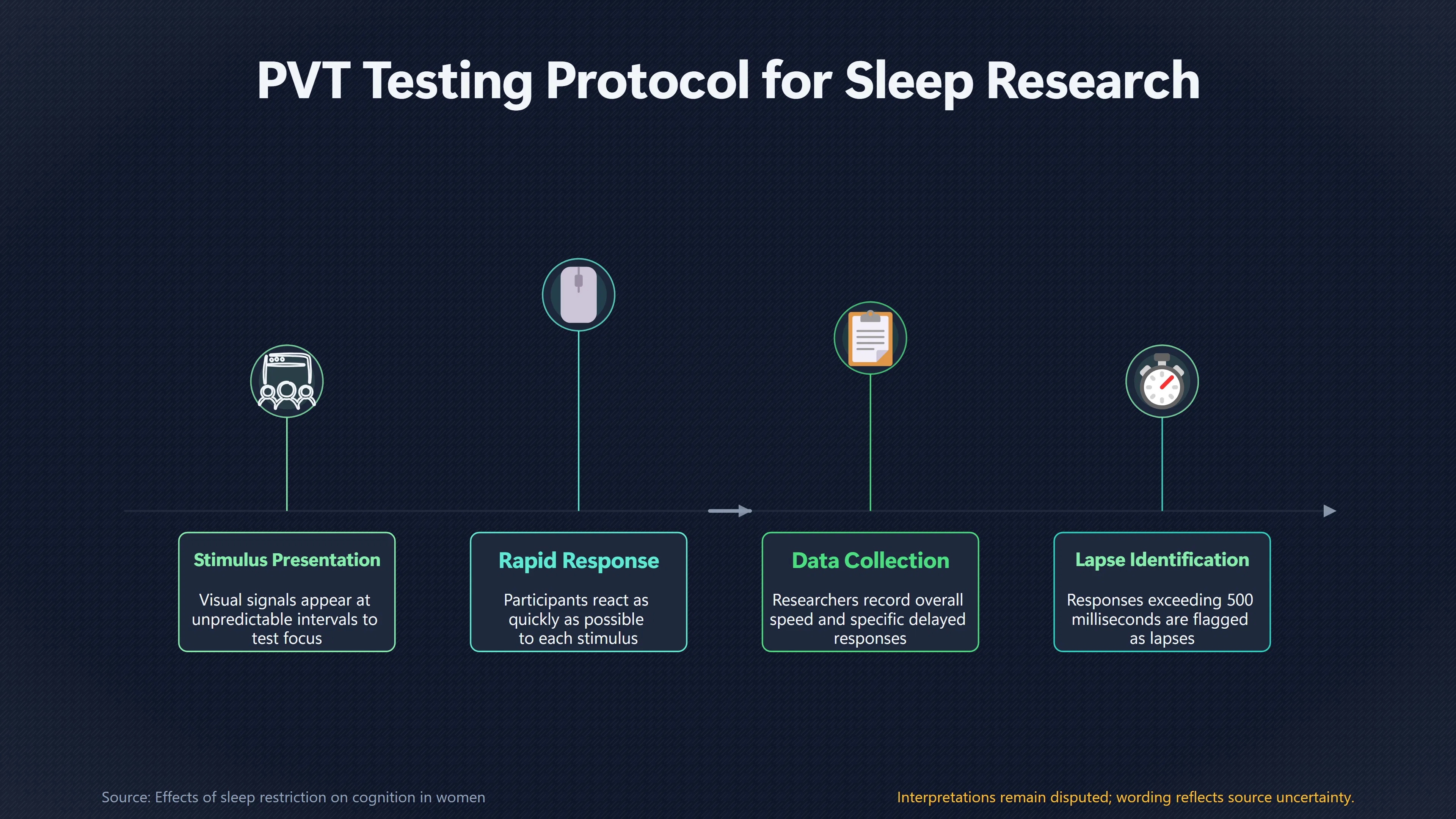
Researchers often measure this effect with the psychomotor vigilance test (PVT). It is deliberately simple: a stimulus appears at unpredictable intervals and the participant responds as quickly as possible. Because there is little reasoning to do, worsening performance is difficult to explain away as failure to understand a complicated task. Researchers can examine overall response speed, the slowest responses and conspicuously delayed responses — commonly those taking more than 500 milliseconds — classified as lapses.[PubMed Central (PMC)]pmc.ncbi.nlm.nih.govPubMed Central (PMC)Sleep deprivation, vigilant attention, and brain function: a review - PMCJune 8, 2019…
Across the 44 studies included in the 2024 meta-analysis, a single restricted night produced a standardised mean difference of 0.512 for slower reaction times on sustained-attention tasks and 0.489 for attentional lapses. Both effects were statistically significant. Subjective sleepiness increased more strongly, with a standardised mean difference of 0.986. These standardised effect sizes describe average differences across studies rather than a prediction that every person will slow by a particular number of milliseconds.[ScienceDirect]sciencedirect.comImpact of one night of sleep restriction on sleepiness and cognitive function: A systematic review and meta-analysis - Scien…
A controlled experiment provides a more concrete illustration. In one study, 24 participants averaged about 7.8 hours of sleep in the normal-sleep condition and 5.0 hours after sleep restriction. Following the shorter night, overall PVT performance slowed, the slowest 10% of responses deteriorated, and lapses increased significantly. Yet another measure of brief, transient attention in the same experiment — the “attentional blink” — showed no significant effect of sleep restriction.[PubMed Central (PMC)]pmc.ncbi.nlm.nih.govPubMed Central (PMC)The impact of sleep loss on sustained and transient attention: an EEG study - PMC…
A different experiment involving 61 healthy adults aged 20–29 compared normal sleep with either four hours in bed or a night containing four deliberately prolonged awakenings. Both disrupted conditions increased omission and commission errors on a sustained-attention task. The finding is useful because it shows that next-day attention can be vulnerable not only when the sleep window is drastically shortened, but also when a night’s sleep is substantially interrupted.[ScienceDirect]sciencedirect.comEffects of one night of induced night-wakings versus sleep restriction on sustained attention and mood: a pilot study - Scie…
The evidence nevertheless does not support a precise one-night dose formula. In the 2024 synthesis, sustained-attention impairment was not significantly associated with sleep duration across the two-to-six-hour restriction range. That does not mean that two hours and six hours of sleep are equivalent. It means these studies did not establish a sufficiently clean relationship to justify predicting next-day impairment from sleep duration alone. Differences in protocols, testing times and individuals make the response more complicated.[PubMed]pubmed.ncbi.nlm.nih.govImpact of one night of sleep restriction on sleepiness and cognitive function: A systematic review and meta-analysis - PubMed…
Why lapses matter more than average speed
An average reaction time can hide the characteristic problem created by insufficient sleep. Sleep-loss research has long described state instability: instead of every response becoming uniformly slower, normal-looking responses are increasingly mixed with unusually slow responses and failures to respond promptly. In other words, performance becomes less dependable from one moment to the next.[PubMed Central (PMC)]pmc.ncbi.nlm.nih.govPubMed Central (PMC)Sleep deprivation, vigilant attention, and brain function: a review - PMCJune 8, 2019…
That distinction changes how a short night’s consequences should be interpreted. Imagine that most responses during a monotonous task remain reasonably fast but a handful become dramatically delayed. The average may move only modestly, yet those rare failures could be the responses that matter most if the task involves spotting a road hazard, noticing an alarm, monitoring equipment or catching an error before acting.
This is one reason vigilance tests examine the tail of the reaction-time distribution rather than reporting only a mean. In the five-hour-sleep experiment, for example, researchers found deterioration not just in overall PVT speed but specifically in the slowest 10% of responses and in the number of lapses.[PubMed Central (PMC)]pmc.ncbi.nlm.nih.govPubMed Central (PMC)The impact of sleep loss on sustained and transient attention: an EEG study - PMC…
The broader sleep-loss literature reinforces this interpretation. Reviews describe vigilant-attention impairment as increased moment-to-moment variability, with exceptionally slow responses interspersed among faster ones. Experiments involving more severe sleep deprivation likewise find that both average reaction time and within-person variability rise as sleep pressure increases.[PubMed Central (PMC)]pmc.ncbi.nlm.nih.govPubMed Central (PMC)Sleep deprivation, vigilant attention, and brain function: a review - PMCJune 8, 2019…
For self-improvement, this makes a short night particularly relevant to tasks that demand consistency rather than occasional peak performance. Being capable of a fast response does not demonstrate that attention is fully restored; the problem is that the fast response may not arrive reliably on every occasion. A person may therefore have a productive-looking morning while still being more vulnerable to intermittent attention failures.
The same distinction helps explain why monotonous activities deserve particular caution. Driving research has used sustained-attention measures precisely because sleepiness and prolonged, repetitive performance can interact. In a counterbalanced study of 47 healthy adults, researchers compared normal sleep with a four-hour sleep opportunity and assessed participants using two sustained-attention tasks alongside a computer-based fitness-to-drive battery and subjective and physiological measures of sleepiness.[PubMed]pubmed.ncbi.nlm.nih.govThe effect of partial sleep deprivation on computer-based measures of fitness to drive - PubMed…
Not every driving-related measure necessarily deteriorates after one restricted night. Another simulator experiment found clear increases in subjective sleepiness after four hours of sleep but more limited effects attributable specifically to sleep restriction across the driving-performance measures examined. Such findings are a useful restraint on overstatement: laboratory evidence strongly supports reduced vigilance, but it should not be translated into the claim that every complex real-world performance measure deteriorates by the same amount.[PubMed]pubmed.ncbi.nlm.nih.govOpen source on nih.gov.
Which mental abilities may remain relatively intact
Perhaps the most useful finding from the one-night literature is its selectivity. The 2024 meta-analysis examined sustained attention alongside choice reaction time, cognitive throughput, working memory and inhibitory control. It detected significant impairment in sustained-attention speed and lapses but did not find statistically significant overall effects for those other cognitive domains.[ScienceDirect]sciencedirect.comImpact of one night of sleep restriction on sleepiness and cognitive function: A systematic review and meta-analysis - Scien…
This does not prove that working memory or inhibitory control are immune to one short night. Individual experiments can produce different results, tasks vary in sensitivity, and other meta-analyses covering broader or repeated sleep-restriction protocols have found effects extending beyond vigilance. A previous meta-analysis of 61 studies, for example, found adverse effects of short-term sleep restriction across several areas, with sustained attention among the domains showing a significant deficit.[ScienceDirect]sciencedirect.comOpen source on sciencedirect.com.
But for the specific question of one curtailed night, the newer synthesis gives a more tightly bounded answer. Vigilance is one of the clearest places to expect a detectable next-day cost. Someone can therefore perform adequately on a brief reasoning, memory or choice task and still have impaired ability to maintain attention reliably over time. The apparent contradiction — “I can still think, so the short night did not affect me” — disappears once different cognitive abilities are separated.
Individual studies also show why sweeping claims are inappropriate. A review of sleep restriction in highly trained or occupationally skilled populations found studies in which vigilance worsened after a restricted night alongside studies in which particular occupation-specific or cognitive measures did not show significant changes. Task demands, testing time and experimental design all influence whether an impairment becomes visible.[PubMed Central (PMC)]pmc.ncbi.nlm.nih.govOpen source on nih.gov.
What the next day actually looks like
The evidence supports a narrower and more useful expectation than “sleep deprivation makes you stupid”. After one substantially shortened night, the next day is better characterised as a period in which alertness is lower and sustained attention is more fragile. Responses tend to slow, unusually delayed responses become more frequent, and subjective sleepiness rises. Meanwhile, some other tested abilities may remain sufficiently intact that the person still feels capable of normal work.[PubMed]pubmed.ncbi.nlm.nih.govImpact of one night of sleep restriction on sleepiness and cognitive function: A systematic review and meta-analysis - PubMed…
That combination is precisely why a single short night can be deceptive. A person does not need to feel incapable of thinking in order to be less dependable at maintaining attention. Nor does one successful burst of concentrated work demonstrate that vigilance has returned to baseline. The laboratory signature is probabilistic: the risk of a slow or missed response has increased.
For self-improvement, the practical lesson is correspondingly specific. After an unusually short night, it is sensible to distinguish tasks where occasional attention failures have little consequence from those where one lapse matters disproportionately. Routine planning or a brief conversation is not cognitively equivalent to prolonged driving, safety monitoring or another repetitive task in which a single missed event can carry a high cost. The strongest one-night evidence concerns that ability to stay continuously responsive, not a universal loss of intelligence or competence.[PubMed Central (PMC)]pmc.ncbi.nlm.nih.govPubMed Central (PMC)Sleep deprivation, vigilant attention, and brain function: a review - PMCJune 8, 2019…
A short night, then, should not be judged solely by whether you can still perform well for a few minutes. The more revealing question is whether you can keep doing so reliably. Controlled studies indicate that after only one curtailed night, that reliability is already one of the first cognitive qualities to weaken.[ScienceDirect]sciencedirect.comImpact of one night of sleep restriction on sleepiness and cognitive function: A systematic review and meta-analysis - Scien…
Amazon book picks
Further Reading
Books and field guides related to What One Short Night Does to Attention. Use these as the next step if you want deeper reading beyond the article.
Why We Sleep
"Sleep is one of the most important but least understood aspects of our life, wellness, and longevity ... An explosion of scientific disc...
The Sleep Solution
With cutting-edge sleep science and time-tested techniques, The Sleep Solution will help anyone achieve healthy sleep and eliminate pills...
The Promise of Sleep
Sleep better, live longer with the groundbreaking information and step-by-step program in this revolutionary book. Healthful sleep has be...
The Sleep Fix
From Emmy Award-winning ABC News anchor/correspondent and former insomniac Diane Macedo comes a practical, user-friendly guide to getting...
eBay marketplace picks
Marketplace Samples
Live-tested eBay searches with available results related to this page.
Selected fromsleep accessories oneBay.co.uk.

Endnotes
1.
Source: sciencedirect.com
Link:https://www.sciencedirect.com/science/article/pii/S1087079224000443
Source snippet
Impact of one night of sleep restriction on sleepiness and cognitive function: A systematic review and meta-analysis - Scien...
2.
Source: sciencedirect.com
Link:https://www.sciencedirect.com/science/article/pii/S1389945714001579
Source snippet
Effects of one night of induced night-wakings versus sleep restriction on sustained attention and mood: a pilot study - Scie...
3.
Source: sciencedirect.com
Link:https://www.sciencedirect.com/science/article/pii/S0149763417301641
4.
Source: sciencedirect.com
Link:https://www.sciencedirect.com/science/article/pii/S0149763424003981
5.
Source: sciencedirect.com
Link:https://www.sciencedirect.com/science/article/pii/S0031938424002142
6.
Source: sciencedirect.com
Link:https://www.sciencedirect.com/science/article/pii/S0022399919307081
7.
Source: sciencedirect.com
Link:https://www.sciencedirect.com/science/article/pii/S0031938419311394
8.
Source: sciencedirect.com
Link:https://www.sciencedirect.com/science/article/abs/pii/S0005791617301635
9.
Source: sciencedirect.com
Title: Effects of sleep restriction on cognition in women
Link:https://www.sciencedirect.com/science/article/abs/pii/S0301051107001561
10.
Source: sciencedirect.com
Title: Effects of sleep reduction on spatial attention
Link:https://www.sciencedirect.com/science/article/pii/S0301051105000815
11.
Source: sciencedirect.com
Link:https://www.sciencedirect.com/science/article/pii/S0031938405000740
12.
Source: sciencedirect.com
Title: EE G and behavioural correlates of mild sleep deprivation and vigilance
Link:https://www.sciencedirect.com/science/article/pii/S1388245720305241
13.
Source: sciencedirect.com
Link:https://www.sciencedirect.com/science/article/pii/S0001457519316380
14.
Source: sciencedirect.com
Link:https://www.sciencedirect.com/science/article/abs/pii/S0897189721001609
15.
Source: pubmed.ncbi.nlm.nih.gov
Link:https://pubmed.ncbi.nlm.nih.gov/38759474/
Source snippet
Impact of one night of sleep restriction on sleepiness and cognitive function: A systematic review and meta-analysis - PubMed...
16.
Source: pmc.ncbi.nlm.nih.gov
Link:https://pmc.ncbi.nlm.nih.gov/articles/PMC6879580/
Source snippet
PubMed Central (PMC)Sleep deprivation, vigilant attention, and brain function: a review - PMCJune 8, 2019...
Published: June 8, 2019
17.
Source: pmc.ncbi.nlm.nih.gov
Link:https://pmc.ncbi.nlm.nih.gov/articles/PMC7204874/
Source snippet
PubMed Central (PMC)The impact of sleep loss on sustained and transient attention: an EEG study - PMC...
18.
Source: pubmed.ncbi.nlm.nih.gov
Link:https://pubmed.ncbi.nlm.nih.gov/24891081/
Source snippet
Effects of one night of induced night-wakings versus sleep restriction on sustained attention and mood: a pilot study - PubMed...
19.
Source: pubmed.ncbi.nlm.nih.gov
Link:https://pubmed.ncbi.nlm.nih.gov/11330205/
Source snippet
Sustained attention performance during sleep deprivation: evidence of state instability - PubMed...
20.
Source: pubmed.ncbi.nlm.nih.gov
Link:https://pubmed.ncbi.nlm.nih.gov/26115651/
Source snippet
The effect of partial sleep deprivation on computer-based measures of fitness to drive - PubMed...
21.
Source: pubmed.ncbi.nlm.nih.gov
Link:https://pubmed.ncbi.nlm.nih.gov/15885247/
22.
Source: pubmed.ncbi.nlm.nih.gov
Link:https://pubmed.ncbi.nlm.nih.gov/28757454/
23.
Source: pmc.ncbi.nlm.nih.gov
Link:https://pmc.ncbi.nlm.nih.gov/articles/PMC8271199/
24.
Source: pubmed.ncbi.nlm.nih.gov
Link:https://pubmed.ncbi.nlm.nih.gov/39427809/
25.
Source: pubmed.ncbi.nlm.nih.gov
Link:https://pubmed.ncbi.nlm.nih.gov/39216809/
26.
Source: pubmed.ncbi.nlm.nih.gov
Link:https://pubmed.ncbi.nlm.nih.gov/38759474/?format=pubmed
27.
Source: pmc.ncbi.nlm.nih.gov
Link:https://pmc.ncbi.nlm.nih.gov/articles/PMC10001806/
28.
Source: pubmed.ncbi.nlm.nih.gov
Link:https://pubmed.ncbi.nlm.nih.gov/35218665/
29.
Source: pmc.ncbi.nlm.nih.gov
Link:https://pmc.ncbi.nlm.nih.gov/articles/PMC8766996/
30.
Source: pubmed.ncbi.nlm.nih.gov
Link:https://pubmed.ncbi.nlm.nih.gov/34557048/
31.
Source: pmc.ncbi.nlm.nih.gov
Link:https://pmc.ncbi.nlm.nih.gov/articles/PMC8076531/
32.
Source: pubmed.ncbi.nlm.nih.gov
Link:https://pubmed.ncbi.nlm.nih.gov/33927603/
33.
Source: pubmed.ncbi.nlm.nih.gov
Link:https://pubmed.ncbi.nlm.nih.gov/32085985/
34.
Source: pubmed.ncbi.nlm.nih.gov
Link:https://pubmed.ncbi.nlm.nih.gov/31176308/
35.
Source: pubmed.ncbi.nlm.nih.gov
Link:https://pubmed.ncbi.nlm.nih.gov/29126328/
36.
Source: pubmed.ncbi.nlm.nih.gov
Link:https://pubmed.ncbi.nlm.nih.gov/27999367/
37.
Source: pmc.ncbi.nlm.nih.gov
Link:https://pmc.ncbi.nlm.nih.gov/articles/PMC4876616/
38.
Source: pmc.ncbi.nlm.nih.gov
Link:https://pmc.ncbi.nlm.nih.gov/articles/PMC4402669/
39.
Source: pubmed.ncbi.nlm.nih.gov
Link:https://pubmed.ncbi.nlm.nih.gov/25515101/
40.
Source: pubmed.ncbi.nlm.nih.gov
Link:https://pubmed.ncbi.nlm.nih.gov/23523374/
41.
Source: pmc.ncbi.nlm.nih.gov
Link:https://pmc.ncbi.nlm.nih.gov/articles/3454374/
42.
Source: pubmed.ncbi.nlm.nih.gov
Link:https://pubmed.ncbi.nlm.nih.gov/22754046/
43.
Source: pmc.ncbi.nlm.nih.gov
Link:https://pmc.ncbi.nlm.nih.gov/articles/PMC3369235/
44.
Source: pmc.ncbi.nlm.nih.gov
Link:https://pmc.ncbi.nlm.nih.gov/articles/PMC3197786/
45.
Source: pmc.ncbi.nlm.nih.gov
Link:https://pmc.ncbi.nlm.nih.gov/articles/PMC3079937/
46.
Source: pmc.ncbi.nlm.nih.gov
Link:https://pmc.ncbi.nlm.nih.gov/articles/3079937/
47.
Source: pmc.ncbi.nlm.nih.gov
Link:https://pmc.ncbi.nlm.nih.gov/articles/PMC3310176/
48.
Source: pmc.ncbi.nlm.nih.gov
Link:https://pmc.ncbi.nlm.nih.gov/articles/PMC2910531/
49.
Source: pubmed.ncbi.nlm.nih.gov
Link:https://pubmed.ncbi.nlm.nih.gov/20050992/
50.
Source: pubmed.ncbi.nlm.nih.gov
Link:https://pubmed.ncbi.nlm.nih.gov/19742409/
51.
Source: pubmed.ncbi.nlm.nih.gov
Link:https://pubmed.ncbi.nlm.nih.gov/17803017/
52.
Source: pmc.ncbi.nlm.nih.gov
Link:https://pmc.ncbi.nlm.nih.gov/articles/PMC1978335/
53.
Source: pubmed.ncbi.nlm.nih.gov
Link:https://pubmed.ncbi.nlm.nih.gov/9231952/
54.
Source: pubmed.ncbi.nlm.nih.gov
Link:https://pubmed.ncbi.nlm.nih.gov/10354808/
55.
Source: pubmed.ncbi.nlm.nih.gov
Link:https://pubmed.ncbi.nlm.nih.gov/9174413/
56.
Source: pmc.ncbi.nlm.nih.gov
Link:https://pmc.ncbi.nlm.nih.gov/articles/PMC3603691/
Additional References
57.
Source: youtube.com
Link:https://www.youtube.com/watch?v=tJL8aii3TLs
Source snippet
David Dinges, PhD: Wakefulness in the 24/7 Society...
58.
Source: youtube.com
Title: Thomas Andrillon
Link:https://www.youtube.com/watch?v=c7kcdE87_kA
Source snippet
Effects of Sleep Deprivation on Attention and Mood...
59.
Source: youtube.com
Title: Sleep and Human Performance
Link:https://www.youtube.com/watch?v=VV76Te1I78Q
Source snippet
Thomas Andrillon lapses of attention sleep Thomas Andrillon - Can sleep intrusions in waking explain lapses of attention?...
60.
Source: youtube.com
Title: Effects of Sleep Deprivation on Attention and Mood
Link:https://www.youtube.com/watch?v=U9SiyStcIU8
Source snippet
Wandering minds, sleepy brains: lapses of attention and local sleep in wakefulness...
61.
Source: cdc.gov
Link:https://www.cdc.gov/niosh/docs/2016-162/pilots/story_html5.html
62.
Source: researchgate.net
Link:https://www.researchgate.net/publication/380133638_Impact_of_one_night_of_sleep_restriction_on_sleepiness_and_cognitive_function_A_systematic_review_and_meta-analysis
63.
Source: researchgate.net
Link:https://www.researchgate.net/publication/46146545_Neurobehavioral_Dynamics_Following_Chronic_Sleep_Restriction_Dose-Response_Effects_of_One_Night_for_Recovery
64.
Source: researchgate.net
Link:https://www.researchgate.net/publication/45492707_Time_of_Day_Effects_on_Neurobehavioral_Performance_During_Chronic_Sleep_Restriction
65.
Source: frontiersin.org
Link:https://www.frontiersin.org/journals/psychology/articles/10.3389/fpsyg.2017.01607/full
66.
Source: em-consulte.com
Link:https://www.em-consulte.com/article/1677672/impact-of-one-night-of-sleep-restriction-on-sleepi