Within Better Habits
Add Friction Before an Impulse Purchase
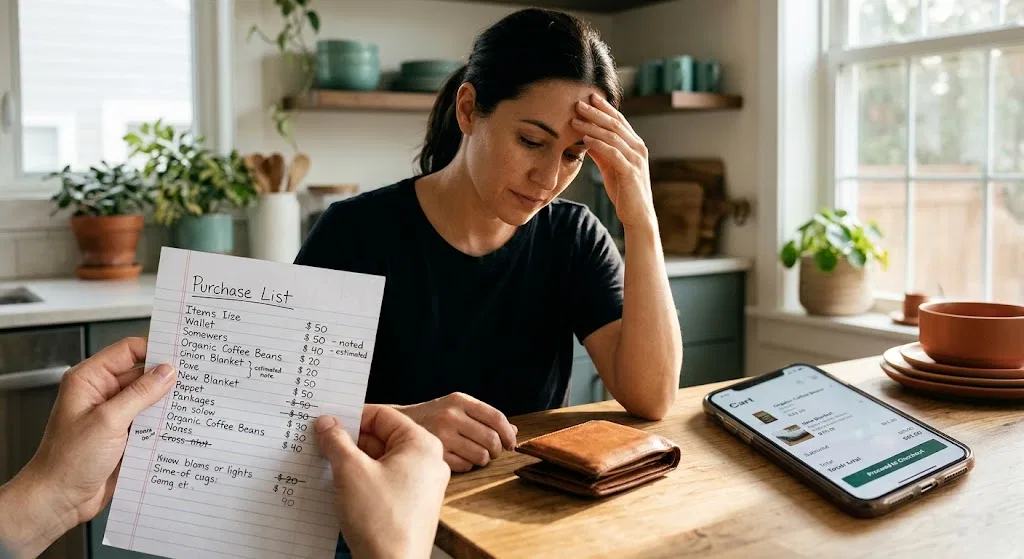
Adding friction before checkout can create time to reconsider unnecessary purchases instead of relying on restraint at the final click.
On this page
- Why instant checkout encourages impulsive action
- Creating a review step before buying
- Tracking one problem spending category
Page outline Jump by section
Introduction
Impulsive spending is difficult to control precisely because modern buying systems are designed to remove pauses. Saved card details, mobile wallets and one-click checkout compress the interval between wanting something and owning it. A useful spending system reverses that design: it deliberately adds a small amount of friction before payment, then makes the cost visible enough for the buyer to reconsider.
The principle is not that every purchase should become laborious. It is to identify the kinds of spending that repeatedly produce regret — clothes bought from social media adverts, takeaway orders, beauty products, hobby equipment or another personal trouble spot — and place a review step between desire and checkout. Research stretching from early studies of credit cards to newer experiments with digital shopping suggests that payment convenience can weaken spending restraint, while delays, reflection and timely spending feedback can sometimes restore it.[oup.com]academic.oup.comOxford AcademicEffects of Payment Mechanism on Spending Behavior: The Role of Rehearsal and Immediacy of Payments | Journal of Consumer R…
The strongest practical lesson is therefore modest: do not expect willpower to arrive at the checkout button. Change the checkout process before the temptation appears.
Why instant checkout encourages impulsive action
The problem predates smartphones. Researchers have long observed that payment mechanisms change how spending feels. In a 2001 study, Drazen Prelec and Duncan Simester found that participants instructed to pay by credit card were willing, in some situations, to pay substantially more than those using cash. Separate work by Dilip Soman found that previous spending influenced later purchase intentions more strongly when payments were immediate and when people had to record the amount, making the expenditure easier to remember.[CiNii]cir.nii.ac.jpCiNiiAlways Leave Home Without It: A Further Investigation of the Credit-Card Effect on Willingness to Pay | CiNii ResearchFebruary 1, 2001…
That distinction is often described in terms of payment transparency or payment coupling. Cash makes the loss conspicuous: money physically leaves the wallet at the same time as the purchase. Credit separates those events and makes the transaction less tangible. Experiments by Priya Raghubir and Joydeep Srivastava found greater willingness to spend with less cash-like forms of payment, including gift certificates, and showed that increasing the salience of what was being spent could reduce the difference.[PubMed]pubmed.ncbi.nlm.nih.govMonopoly money: the effect of payment coupling and form on spending behavior - PubMed…
Digital commerce pushes this historical trend further. Instead of finding cash, entering card numbers or even visiting another website, a shopper may move from advert to payment in seconds. A 2025 study of 1,162 digital-payment users reported an association between the reduced psychological visibility and ease of digital payments and greater impulse buying. It is useful contemporary evidence, although its observational survey design means it cannot prove that digital payments themselves caused each extra purchase.[PubMed Central (PMC)]pmc.ncbi.nlm.nih.govPubMed Central (PMC)Spendception: The Psychological Impact of Digital Payments on Consumer Purchase Behavior and Impulse Buying - PMCMarc…
Nor should the argument be exaggerated into “faster checkout always causes impulse buying”. An experimental study of social-commerce checkout found that keeping checkout inside Instagram did not, by itself, increase impulse buying as the researchers had predicted; brand familiarity and social cues mattered as well. The important point is narrower: removing transactional effort eliminates one opportunity to reconsider, but purchasing behaviour still depends on the product, shopper and surrounding cues.[ScienceDirect]sciencedirect.comCheckout button and online consumer impulse-buying behavior in social commerce: A trust transfer perspective - ScienceDirect…
For someone trying to change their own spending, that is actually helpful. The goal is not to reconstruct a cash-only economy. It is to identify where convenience is working against a prior intention — “I want to spend less on clothes this month” — and restore a deliberate decision point there.

Creating a review step before buying
The simplest countermeasure is postponement: convert “buy now” into “decide later”. That can mean putting an item on a wish list rather than purchasing it, leaving it in the basket, or requiring a set waiting period for non-essential purchases.
Research on e-commerce self-control gives this idea more support than the familiar “24-hour rule” might suggest, but it also shows that the details matter. Carol Moser and colleagues studied interventions designed to interrupt impulse purchases. In one experiment, an approximately 25-hour delay reduced both the reported urge to buy and purchase intention. Another experiment prompted people to spend a few minutes listing reasons for and against a purchase; reflection also reduced purchase urge and intention.[Deep Blue]deepblue.lib.umich.eduOpen source on umich.edu.
A much shorter interruption did not work nearly as well. In a laboratory experiment in the same research programme, delaying Amazon purchases for ten minutes did not produce a statistically significant reduction in impulse items bought or money spent. One likely reason was that participants simply kept shopping during the delay. Friction works poorly if the waiting period leaves the person immersed in the same stream of tempting products.[Deep Blue]deepblue.lib.umich.eduOpen source on umich.edu.
That suggests a better design than merely staring at a countdown clock. A useful review step changes both time and context:
- Capture rather than purchase. Put the item on a wish list, note or dedicated “later” basket. The desire is recorded, so postponement does not feel like forgetting it.
- Leave the shopping environment. Close the app or browser instead of continuing to browse while the timer runs.
- Review after the emotional peak has passed. For ordinary non-essential purchases, reviewing the following day is more defensible than pretending there is a scientifically established universal number of hours.
- Ask a concrete comparison question. “Would I choose this over the other things I intend to spend £60 on this month?” is more informative than “Do I really need it?”, which is easy to rationalise.
- Buy deliberately if it still passes review. Friction is a filter, not a prohibition.
Earlier qualitative work with online shoppers found that postponement was already one of the strategies people commonly described as successful: adding an item to a basket or wish list and returning later often allowed the initial urge to subside. In the same research, many participants expressed interest in tools that would impose a pause before checkout.[yardi.people.si.umich.edu]yardi.people.si.umich.eduImpulse Buying: Design Practices and Consumer NeedsImpulse Buying: Design Practices and Consumer Needs
Removing saved payment details applies the same idea in a cruder form. Instead of manufacturing a long waiting period, it inserts a small task — finding the card and entering its details — between desire and purchase. There appears to be much less direct experimental evidence for “delete your saved card” as a standalone intervention than popular advice sometimes implies, so it should be understood as an application of the wider friction principle rather than a proven treatment in its own right. The older payment research nevertheless supports the underlying logic that spending behaviour can change when payment becomes more salient and less automatic.[PubMed]pubmed.ncbi.nlm.nih.govMonopoly money: the effect of payment coupling and form on spending behavior - PubMed…
Tracking one problem spending category
Friction addresses the moment before a purchase. Monitoring addresses the repeated pattern behind it. The two work particularly well together when tracking is narrow enough to remain useful.
The Consumer Financial Protection Bureau found in its research on spending management that people often had budgets but did not consult them when making real-time decisions. Participants showed strong interest in tools that displayed how much money remained available at the point of purchase, because the information connected a current transaction with its effect on the rest of the budget. The research was exploratory rather than proof that every feedback tool reduces spending, but it identified an important weakness in conventional budgeting: information that arrives after the purchase is less useful for interrupting the purchase.[Consumer Financial Protection Bureau]consumerfinance.govOpen source on consumerfinance.gov.
Field evidence also suggests that increasing transaction salience can affect actual spending. A study using a smartphone application and real credit-card transaction data gave participants goals and feedback about their spending. The intervention produced a significant reduction in expenditure, but an important detail was that feedback needed to include both ordinary and exceptional purchases. Showing only routine purchases was not enough.[ScienceDirect]sciencedirect.comOpen source on sciencedirect.com.
Budgets themselves can help without producing perfect compliance. Research using data from a UK personal-finance app, a Canadian credit-union field experiment and a US financial-diary study found that people routinely set overly optimistic budgets and exceeded them. Even so, setting a budget was associated with lower spending, and some effects persisted for months. More impulsive consumers were particularly poor at staying within their stated budgets, reinforcing the case for combining a limit with a system that interrupts individual decisions.[Oxford Academic]academic.oup.comOpen source on oup.com.
For practical self-improvement, this argues against beginning with an elaborate accounting system covering every coffee, utility bill and supermarket purchase. If the behaviour to change is impulsive clothes shopping, track clothes first. If it is food delivery, track food delivery. Give the category a visible monthly amount and make every proposed purchase answer to that number.
A compact system might therefore look like this:
- Problem category: online clothes.[doi.org]doi.orgSource details in endnotes.
- Monthly allowance: £120.
- Checkout rule: no non-essential item is bought during the first browsing session.
- Capture rule: save the item and price to a “review tomorrow” list.
- Review information: show how much of the £120 has already been spent.
- Decision: buy, reject or leave on the list for another review.
This is deliberately different from tracking everything. The purpose is to make one recurrent choice legible enough to change.

When feedback can backfire
More information is not automatically better. Experiments with real-time grocery spending feedback have produced mixed effects. One study found that shoppers who were not operating under a strict budget reduced expenditure when shown real-time totals, partly by switching towards cheaper products. But shoppers who had already set budgets sometimes spent more when feedback showed that they still had room available.[Sage Journals]journals.sagepub.comSage Journals Smart Shopping Carts: How Real-Time Feedback Influences SpendingSage Journals Smart Shopping Carts: How Real-Time Feedback Influences Spending
A separate field experiment using mobile self-scanning likewise found no significant reduction in overall spending across all shoppers, although customers identified as having lower self-control did reduce spending and the number of items they bought when given real-time feedback.[Lund University]portal.research.lu.seOpen source on lu.se.
The lesson is that a spending limit can become either a ceiling or a target. Someone who sees “£42 remaining” may interpret it as “I can still spend £42”. For impulse control, a better display may therefore emphasise the cost of the proposed purchase and the remaining competing uses for the money, rather than treating unused budget as permission to consume.
Monitoring can also fail because it becomes burdensome. In a UK evaluation in which participants used budgeting apps or pen-and-paper tracking for three months, 797 people entered the project but only 278 both completed the evaluation and used their assigned budgeting method throughout. Among completers, many reported improvements in tracking, but the attrition illustrates a familiar weakness of comprehensive budgeting systems: a tool cannot influence spending if maintaining it becomes a chore people abandon.[Fincap]fincap.org.ukFincap Looking after the pennies | What Works | EvaluationFincap Looking after the pennies | What Works | Evaluation
That is another reason to begin with one troublesome category. A lightweight system that survives six months is more useful than a perfect financial dashboard that survives six days.
From credit-card restraint to deliberate digital friction
The history of payment technology has largely moved in one direction: less effort, less delay and less visible separation from money. Early behavioural studies showed that moving away from cash could alter willingness to spend; later work examined gift certificates and other less transparent forms of payment; current digital systems can compress discovery, decision and payment into a single continuous interaction.[nii.ac.jp]cir.nii.ac.jpCiNiiAlways Leave Home Without It: A Further Investigation of the Credit-Card Effect on Willingness to Pay | CiNii ResearchFebruary 1, 2001…
A spending system that interrupts impulsive purchases deliberately moves a few steps in the opposite direction. It does not require rejecting digital payments. It selectively restores three things that frictionless commerce tends to remove: time to reconsider, visibility of the financial trade-off, and separation between wanting and buying.
The evidence does not justify a magic formula such as “every purchase must wait exactly 24 hours”. Different delays and feedback systems produce different results, and some interventions fail. What is better supported is the broader design logic: longer postponement can reduce purchase urge, reflection can weaken immediate purchase intention, making transactions salient can help control credit-card spending, and budgets are more useful when they influence decisions before money has already been spent.[umich.edu]deepblue.lib.umich.eduDeep Blue Impulse Buying: Designing for Self-Control with E-commerceDeep Blue Impulse Buying: Designing for Self-Control with E-commerce
For self-improvement, that turns an abstract ambition — “be less impulsive with money” — into a repeatable system: choose the spending category that causes the most regret, remove the fastest route to payment, postpone questionable purchases outside the shopping session, and show the category total when the decision is reviewed. The improvement comes not from winning a battle of restraint at every checkout, but from arranging the checkout so that fewer decisions have to be fought in the first place.
Amazon book picks
Further Reading
Books and field guides related to Add Friction Before an Impulse Purchase. Use these as the next step if you want deeper reading beyond the article.

The Power of Habit
Rating: 4.0/5 from 145 Google Books ratings
In The Power of Habit, award-winning business reporter Charles Duhigg takes us to the thrilling edge of scientific discoveries that expla...
The Psychology of Money
Doing well with money isn't necessarily about what you know. It's about how you behave. And behavior is hard to teach, even to really sma...
I Will Teach You to Be Rich
As seen on the new NETFLIX series! The groundbreaking NEW YORK TIMES and WALL STREET JOURNAL BESTSELLER that taught a generation how to e...
Your Money or Your Life
A fully revised edition of one of the most influential books ever written on personal finance with more than a million copies sold “The b...
eBay marketplace picks
Marketplace Samples
Live-tested eBay searches with available results related to this page.
Selected fromself improvement wall art oneBay.co.uk.

Current eBay listing
Self improvement Framed Wall Art Poster Canvas Print Picture



Current eBay listing
Self Improvement Quote Framed Wall Art Poster Canvas Print Picture
Endnotes
1.
Source: deepblue.lib.umich.edu
Title: Deep Blue Impulse Buying: Designing for Self-Control with E-commerce
Link:https://deepblue.lib.umich.edu/items/b4da4889-a5bd-4fd5-a8c6-5b940df3b972
2.
Source: sciencedirect.com
Link:https://www.sciencedirect.com/science/article/pii/S0969698923001789
Source snippet
Checkout button and online consumer impulse-buying behavior in social commerce: A trust transfer perspective - ScienceDirect...
3.
Source: deepblue.lib.umich.edu
Link:https://deepblue.lib.umich.edu/data/concern/data_sets/m039k5047?locale=en
4.
Source: deepblue.lib.umich.edu
Title: Deep Blue Impulse Buying: Designing for Self-Control
Link:https://deepblue.lib.umich.edu/bitstream/handle/2027.42/155212/moserc_1.pdf
5.
Source: yardi.people.si.umich.edu
Title: Impulse Buying: Design Practices and Consumer Needs
Link:https://yardi.people.si.umich.edu/pubs/Schoenebeck_ImpulseBuying19.pdf
6.
Source: sciencedirect.com
Link:https://www.sciencedirect.com/science/article/pii/S0747563220302569
7.
Source: sciencedirect.com
Link:https://www.sciencedirect.com/science/article/pii/S0969698926001013
8.
Source: sciencedirect.com
Link:https://www.sciencedirect.com/science/article/pii/S0969698923001789?dgcid=rss_sd_all
9.
Source: sciencedirect.com
Title: Using mobile while shopping in-store: a new model of impulse-buying behaviour
Link:https://www.sciencedirect.com/org/science/article/pii/S0736376122000453
10.
Source: sciencedirect.com
Title: If-then plans help regulate automatic peer influence on impulse buying
Link:https://www.sciencedirect.com/org/science/article/pii/S0309056620000076
11.
Source: ir.lib.ncu.edu.tw
Title: ncu.edu.tw錯過對後續購買的影響; How consumers make buying decision after missing sales
Link:https://ir.lib.ncu.edu.tw/handle/987654321/44090?locale=en-US
12.
Source: ir.lib.ncu.edu.tw
Link:https://ir.lib.ncu.edu.tw/handle/987654321/44090
13.
Source: sciencedirect.com
Link:https://www.sciencedirect.com/science/article/abs/pii/S0969698923001789
14.
Source: sciencedirect.com
Title: The state of online impulse-buying research: A literature analysis
Link:https://www.sciencedirect.com/science/article/pii/S037872061630057X
15.
Source: sciencedirect.com
Title: How consumers budget
Link:https://www.sciencedirect.com/science/article/pii/S0167268122003493
16.
Source: sciencedirect.com
Link:https://www.sciencedirect.com/science/article/pii/S0167487017303173
17.
Source: sciencedirect.com
Link:https://www.sciencedirect.com/science/article/pii/S0148296312001816
18.
Source: sciencedirect.com
Title: Socio-economic status, delay of gratification, and impulse buying
Link:https://www.sciencedirect.com/science/article/abs/pii/S0167487098000099
19.
Source: sciencedirect.com
Link:https://www.sciencedirect.com/science/article/abs/pii/S1057740815000741
20.
Source: sciencedirect.com
Link:https://www.sciencedirect.com/science/article/pii/S0167268123002950
21.
Source: sciencedirect.com
Link:https://www.sciencedirect.com/science/article/pii/S2352728516300598
22.
Source: sciencedirect.com
Link:https://www.sciencedirect.com/science/article/pii/S2214804318301642
23.
Source: sciencedirect.com
Link:https://www.sciencedirect.com/science/article/pii/S0167268121003723
24.
Source: sciencedirect.com
Title: Model-based evaluation of cooling-off policies
Link:https://www.sciencedirect.com/science/article/pii/S0899825621000695
25.
Source: sciencedirect.com
Title: Online promotion effects under time limitation
Link:https://www.sciencedirect.com/science/article/abs/pii/S0167923623000386
26.
Source: sciencedirect.com
Link:https://www.sciencedirect.com/science/article/pii/S1057740809000151
27.
Source: etd.lib.ncu.edu.tw
Link:https://etd.lib.ncu.edu.tw/detail/9a5d7f5d2076c76dbfa15a270e2fb6e7/?seq=1
28.
Source: ndltd.ncl.edu.tw
Link:https://ndltd.ncl.edu.tw/cgi-bin/gs32/gsweb.cgi/login?o=dnclcdr&s=id%3D%22108NCYU5371001%22.&searchmode=basic
29.
Source: repository.hkust.edu.hk
Title: hkust.edu.hk Usage Metrics
Link:https://repository.hkust.edu.hk/ir/usage-metrics/download/1783.1-23614
30.
Source: academic.oup.com
Link:https://academic.oup.com/jcr/article-abstract/27/4/460/1810425
Source snippet
Oxford AcademicEffects of Payment Mechanism on Spending Behavior: The Role of Rehearsal and Immediacy of Payments | Journal of Consumer R...
31.
Source: pubmed.ncbi.nlm.nih.gov
Link:https://pubmed.ncbi.nlm.nih.gov/18808275/
Source snippet
Monopoly money: the effect of payment coupling and form on spending behavior - PubMed...
32.
Source: cir.nii.ac.jp
Link:https://cir.nii.ac.jp/crid/1360011146037792896
Source snippet
CiNiiAlways Leave Home Without It: A Further Investigation of the Credit-Card Effect on Willingness to Pay | CiNii ResearchFebruary 1, 2001...
Published: February 1, 2001
33.
Source: pmc.ncbi.nlm.nih.gov
Link:https://pmc.ncbi.nlm.nih.gov/articles/PMC11939284/
Source snippet
PubMed Central (PMC)Spendception: The Psychological Impact of Digital Payments on Consumer Purchase Behavior and Impulse Buying - PMCMarc...
34.
Source: consumerfinance.gov
Link:https://www.consumerfinance.gov/data-research/research-reports/consumer-insights-managing-spending/
35.
Source: academic.oup.com
Link:https://academic.oup.com/jcr/article/49/5/697/6603733?guestAccessKey=4c9f1a39-00ec-4796-88a5-e56d43d39b7a
36.
Source: journals.sagepub.com
Title: Sage Journals Smart Shopping Carts: How Real-Time Feedback Influences Spending
Link:https://journals.sagepub.com/doi/10.1509/jm.12.0060
37.
Source: portal.research.lu.se
Link:https://portal.research.lu.se/en/publications/self-scanning-and-self-control-a-field-experiment-on-real-time-fe/
38.
Source: fincap.org.uk
Title: Fincap Looking after the pennies | What Works | Evaluation
Link:https://www.fincap.org.uk/en/evaluations/looking-after-the-pennies
39.
Source: doi.org
Link:https://doi.org/10.1080/10447318.2026.2662520
40.
Source: consumerfinance.gov
Title: Your Money, Your Goals toolkit | Consumer Financial Protection Bureau
Link:https://www.consumerfinance.gov/consumer-tools/educator-tools/your-money-your-goals/toolkit/
41.
Source: consumerfinance.gov
Title: Data & Research | Consumer Financial Protection Bureau
Link:https://www.consumerfinance.gov/data-research/
42.
Source: consumerfinance.gov
Link:https://www.consumerfinance.gov/data-research/research-reports/data-spotlight-consumer-experiences-with-overdraft-programs/full-report/
43.
Source: doi.org
Title: Hit the Road, Cart: A Study on Affect and Online Shopping Cart Abandonment
Link:https://doi.org/10.1111/ijcs.70060
44.
Source: doi.org
Link:https://doi.org/10.3390/bs15030387
45.
Source: consumerfinance.gov
Title: Assess your spending | Consumer Financial Protection Bureau
Link:https://www.consumerfinance.gov/owning-a-home/prepare/assess-your-spending/
46.
Source: doi.org
Title: Buy Now, Pay Later: Impact of Installment Payments on Customer Purchases
Link:https://doi.org/10.1177/00222429241282414
47.
Source: pmc.ncbi.nlm.nih.gov
Link:https://pmc.ncbi.nlm.nih.gov/articles/PMC11326551/
48.
Source: doi.org
Title: Fewer Clicks, More Purchases | Management Science
Link:https://doi.org/10.1287%2Fmnsc.2023.4716
49.
Source: consumerfinance.gov
Link:https://www.consumerfinance.gov/data-research/research-reports/consumer-savings-app-strategies-and-savings-outcomes/
50.
Source: pmc.ncbi.nlm.nih.gov
Link:https://pmc.ncbi.nlm.nih.gov/articles/PMC9622920/
51.
Source: pubmed.ncbi.nlm.nih.gov
Link:https://pubmed.ncbi.nlm.nih.gov/36329755/
52.
Source: GOV.UK
Link:https://www.gov.uk/government/publications/online-choice-architecture-how-digital-design-can-harm-competition-and-consumers/evidence-review-of-online-choice-architecture-and-consumer-and-competition-harm
53.
Source: doi.org
Link:https://doi.org/10.1111/bjhp.12523
54.
Source: doi.org
Link:https://doi.org/10.1002/mar.21490
55.
Source: pmc.ncbi.nlm.nih.gov
Link:https://pmc.ncbi.nlm.nih.gov/articles/PMC7892835/
56.
Source: consumerfinance.gov
Link:https://www.consumerfinance.gov/data-research/research-reports/balancing-savings-and-debt-findings-from-an-online-experiment/
57.
Source: pmc.ncbi.nlm.nih.gov
Link:https://pmc.ncbi.nlm.nih.gov/articles/PMC7351522/
58.
Source: journals.sagepub.com
Link:https://journals.sagepub.com/doi/10.1177/0894439320914261
59.
Source: consumerfinance.gov
Link:https://www.consumerfinance.gov/archive/blog/budgeting-how-to-create-a-budget-and-stick-with-it/
60.
Source: academic.oup.com
Link:https://academic.oup.com/jcmc/article/10/1/JCMC10112/4614485
61.
Source: consumerfinance.gov
Link:https://www.consumerfinance.gov/archive/blog/managing-your-spending-achieve-your-goals/
62.
Source: consumerfinance.gov
Link:https://www.consumerfinance.gov/data-research/research-reports/power-light-touch-financial-education/
63.
Source: ofgem.gov.uk
Link:https://www.ofgem.gov.uk/publications/domestic-consumer-expectations-and-preferences-switching-energy-supplier-and-cooling-period
64.
Source: consumerfinance.gov
Link:https://www.consumerfinance.gov/archive/blog/technology-changing-how-people-access-their-financial-records-share-your-story/
65.
Source: journals.sagepub.com
Link:https://journals.sagepub.com/doi/pdf/10.1509/jm.12.0060?download=true
66.
Source: journals.sagepub.com
Link:https://journals.sagepub.com/doi/abs/10.1509/jm.12.0060
67.
Source: pmc.ncbi.nlm.nih.gov
Link:https://pmc.ncbi.nlm.nih.gov/articles/PMC2831204/
68.
Source: doi.org
Title: Discretionary unplanned buying in consumer society
Link:https://doi.org/10.1002/cb.14
69.
Source: academic.oup.com
Link:https://academic.oup.com/jcr/article-abstract/27/4/460/1810425?login=false
70.
Source: academic.oup.com
Link:https://academic.oup.com/jcr/article-abstract/23/1/40/1892763?login=false
71.
Source: cir.nii.ac.jp
Link:https://cir.nii.ac.jp/crid/1360292621137298816
72.
Source: cir.nii.ac.jp
Link:https://cir.nii.ac.jp/crid/1360011146037792896?lang=ja
73.
Source: doi.org
Link:https://doi.org/10.1016/j.jretconser.2022.103000
74.
Source: journals.sagepub.com
Link:https://journals.sagepub.com/doi/pdf/10.1509/jmkr.38.1.30.18828?download=true
75.
Source: pubmed.ncbi.nlm.nih.gov
Link:https://pubmed.ncbi.nlm.nih.gov/7964366/
76.
Source: fincap.org.uk
Title: The Shopper Stopper: an What Works | Evaluation
Link:https://www.fincap.org.uk/en/evaluations/the-shopper-stopper-an-evaluation
77.
Source: consumerfinance.gov
Link:https://www.consumerfinance.gov/consumer-tools/financial-well-being/
Additional References
78.
Source: youtube.com
Title: Why You Can’t Stop Spending Money (It’s Not What You Think)
Link:https://www.youtube.com/watch?v=fblCbV1ni6s
Source snippet
Friction Maxxing: The Psychological Trick to Stop Impulse Spending...
79.
Source: youtube.com
Title: Friction Maxxing: The Psychological Trick to Stop Impulse Spending
Link:https://www.youtube.com/watch?v=wAGf8x4KCoc
Source snippet
Why You're Still Stuck Financially (It's Not Willpower)...
80.
Source: youtube.com
Link:https://www.youtube.com/watch?v=2dTUbyI7LII
Source snippet
Why You Can't Stop Spending Money (It's Not What You Think)...
81.
Source: researchgate.net
Link:https://www.researchgate.net/publication/397674227_Fear_of_missing_out_FOMO_and_impulsive_buying_on_TikTok_shop_A_study_using_the_stimulus-organism-response_SOR_model
82.
Source: researchgate.net
Link:https://www.researchgate.net/publication/222623095_Socio-Economic_Status_Delay_of_Gratification_and_Impulse_Buying
83.
Source: researchgate.net
Link:https://www.researchgate.net/publication/395433519_The_Influence_of_Electronic_Word-of-Mouth_Communication_and_Delay_of_Gratification_on_Online_Impulsive_Buying_Behavior_among_Student_Users_of_Shopee_E-Commerce_Platform_in_Bandung_Raya
84.
Source: researchgate.net
Link:https://www.researchgate.net/publication/253236378_Written_Notice_of_Cooling-Off_Periods_A_Forty-Year_Natural_Experiment_in_Illusory_Consumer_Protection_and_the_Relative_Effectiveness_of_Oral_and_Written_Disclosures
85.
Source: visualize.jove.com
Link:https://visualize.jove.com/40150281-spendception-the-psychological-impact-of-digital-payments-on-consumer-purchase-behavior-and-impulse-buying
86.
Source: apa.org
Link:https://www.apa.org/news/press/releases/2008/09/credit-cash
87.
Source: iza.org
Link:https://www.iza.org/publications/dp/16304