Within Complex Habits
Why Twice a Week Habits May Take Much Longer
A routine done only a few times each week provides fewer cue-action repetitions, so automaticity may develop more slowly.
On this page
- Habit learning depends on repeated cue action pairings
- Calendar time versus number of repetitions
- What six month habit data suggest about frequency
Page outline Jump by section
Introduction
A routine performed only twice a week can take much longer to become automatic than one performed every day for a simple reason: habit learning happens through repetitions, not merely through the passage of calendar time. Each performance in a recurring context gives the brain another opportunity to strengthen the association between a cue and an action. A twice-weekly routine supplies roughly eight such opportunities in a month; a daily routine supplies about 30. Research consistently links greater behavioural frequency with stronger automaticity, although frequency is not the only factor that matters.[PubMed Central (PMC)]pmc.ncbi.nlm.nih.govPubMed Central (PMC)Habits, Quick and Easy: Perceived Complexity Moderates the Associations of Contextual Stability and Rewards With Beha…
That distinction is especially important for complex self-improvement routines such as gym sessions, meal preparation or structured study. The familiar habit-formation estimates measured in days mostly come from studies of behaviours attempted daily. They should not simply be transferred to routines performed two or three times a week. For low-frequency behaviours, counting meaningful cue-action repetitions is often more informative than counting days on the calendar.[Wiley Online Library]onlinelibrary.wiley.comWiley Online LibraryHow are habits formed: Modelling habit formation in the real world - Lally - 2010 - European Journal of Social Psycho…
Habit learning depends on repeated cue-action pairings
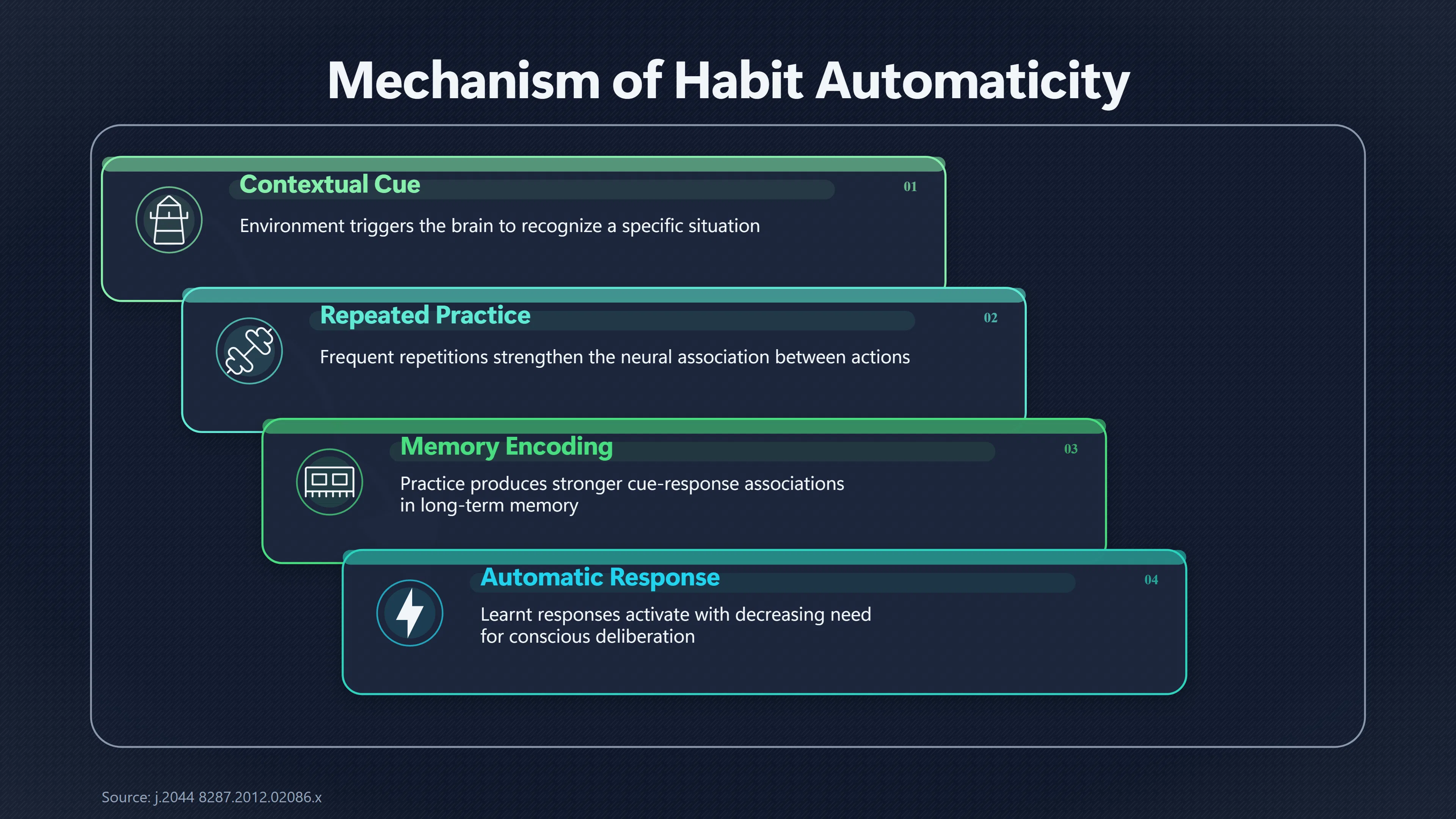
A habit is more than something a person does regularly. In contemporary habit research, the crucial feature is automaticity: encountering a familiar context begins to activate a learnt response with decreasing need for conscious deliberation. That relationship develops through repeated experience in which the relevant cue and behaviour occur together. Reviews of habit formation therefore describe the core process as repetition in a sufficiently consistent context.[Taylor & Francis Online]tandfonline.comTaylor & Francis OnlinePromoting habit formation: Health Psychology Review: Vol 7, No sup1 - Get AccessOctober 11, 2011…
Experimental evidence supports the underlying learning mechanism. In two experiments involving a sequential sushi-making task, researchers found that greater practice produced stronger cue-response associations in memory. Those associations, in turn, predicted better performance when participants later carried out the task without instructions while under cognitive load. The researchers concluded that repetition helps recurring contextual cues automatically activate the responses practised in their presence.[PubMed]pubmed.ncbi.nlm.nih.govPub Med Measuring context-response associations that drive habitsMeasuring context-response associations that drive habits - PubMedDecember 4, 2023…
This makes frequency important in a way that a calendar cannot capture. Suppose someone begins two new routines on 1 January. They take a vitamin after breakfast every day but go to the gym every Tuesday and Saturday. After six weeks, the vitamin behaviour has had as many as 42 opportunities to become associated with its cue; the gym routine has had about 12. Both routines are “six weeks old”, but their learning histories are radically different.
The comparison is simplified: repetitions are not interchangeable units, and habit strength does not rise by a fixed amount every time. Context stability, reward, behavioural difficulty and individual differences all matter. Even so, a study covering 25 behaviours in 459 participants found that frequency and contextual stability were each independently positively associated with automaticity, while perceived complexity was negatively associated with it.[PubMed Central (PMC)]pmc.ncbi.nlm.nih.govPubMed Central (PMC)Habits, Quick and Easy: Perceived Complexity Moderates the Associations of Contextual Stability and Rewards With Beha…
For complex low-frequency routines, the disadvantage can therefore be compounded. There are fewer occasions on which to learn the routine, and each occasion may involve more decisions or sub-actions than a simple behaviour does.
Calendar time can hide the real amount of practice
The best-known real-world habit study illustrates why “days to form a habit” can be misleading when applied to infrequent routines. Phillippa Lally and colleagues asked 96 participants to choose an eating, drinking or activity behaviour and perform it daily in the same context for 12 weeks. Among participants whose automaticity trajectories could be modelled, the estimated time to reach 95% of their eventual automaticity ranged from 18 to 254 days. Automaticity followed a curve: gains were initially larger and then diminished as participants approached a plateau.[Wiley Online Library]onlinelibrary.wiley.comWiley Online LibraryHow are habits formed: Modelling habit formation in the real world - Lally - 2010 - European Journal of Social Psycho…
Those numbers are frequently treated as general-purpose habit deadlines, but the study design matters. Participants had a daily opportunity for cue-behaviour learning. A routine scheduled twice weekly cannot accumulate comparable numbers of repetitions at the same speed.
The arithmetic shows the scale of the difference. At perfect adherence, 30 repetitions require about one month for a daily behaviour, around ten weeks for a three-times-weekly routine, and roughly fifteen weeks for a twice-weekly routine. Sixty repetitions would require about two months, twenty weeks and thirty weeks respectively. These are illustrations of exposure counts, not scientifically established thresholds at which habits suddenly form. Research does not support a universal number of repetitions that guarantees automaticity.
Indeed, researchers have specifically warned that habit-formation studies often analyse change against elapsed time even though repetition is the proposed learning mechanism. A 2022 methodological review noted that the real-world formation studies it examined analysed habit development over time rather than directly over repetitions. The authors also highlighted a case in which participants sometimes performed a behaviour more than once per day, demonstrating why days themselves can be an imperfect proxy for learning opportunities.[Taylor & Francis Online]tandfonline.comOpen source on tandfonline.com.
This distinction also explains why an occasional missed performance is different from a routinely sparse schedule. In Lally’s daily study, missing one opportunity did not materially derail the formation process; automaticity continued developing afterwards.[Wiley Online Library]onlinelibrary.wiley.comWiley Online LibraryHow are habits formed: Modelling habit formation in the real world - Lally - 2010 - European Journal of Social Psycho… A twice-weekly schedule, by contrast, is not a daily schedule with occasional lapses. Long gaps are built into it. Missing one Tuesday gym session could mean going a full week between two performances, sharply reducing the number of cue-action pairings accumulated that month.
What six-month habit data suggest about frequency
Newer longitudinal evidence gives frequency a particularly important role. A 2026 preregistered reanalysis by Sebastian Bürgler and colleagues followed 254 people for six months, measuring behavioural automaticity monthly alongside ten possible determinants of habit development. The researchers identified trajectories of habit formation and habit degradation, and membership of those trajectories differed according to behavioural complexity, frequency and context stability.[PubMed]pubmed.ncbi.nlm.nih.govWhat Makes a Habit? Investigating Potential Determinants of Habit Formation - PubMed…
In the multilevel analyses, behavioural frequency was positively associated with habit strength, as were context stability, autonomous motivation and positive feelings such as feeling pleased and energised; perceived difficulty was negatively associated with habit strength. Crucially for low-frequency routines, frequency was the determinant that showed a statistically significant interaction with time after correction for multiple testing. The finding strengthens the case that how often a behaviour is actually performed matters to how its automaticity changes across months.[Sage Journals]journals.sagepub.comSage JournalsWhat Makes a Habit? Investigating Potential Determinants of Habit Formation - Sebastian Bürgler, Marina Milyavskaya, Gail Mc…
It does not establish a formula such as “twice weekly takes three times as many months as six times weekly”. The study was observational and reanalysed data collected during the COVID-19 pandemic, when people’s environments and routines were unusually disrupted. Nor does frequency act independently of everything else. What the evidence supports is the more modest and useful conclusion that habit development reflects accumulated behavioural experience, and people who perform an intended routine infrequently accumulate that experience more slowly.
Exercise research makes the same issue concrete. A longitudinal study of 111 new gym members over 12 weeks reported that exercising at least four times per week for six weeks was the minimum pattern associated with establishing an exercise habit in that sample. Consistency, lower behavioural complexity, environmental factors and positive affective judgements also predicted changes in habit formation.[PubMed]pubmed.ncbi.nlm.nih.govPub Med Exercise habit formation in new gym members: a longitudinal studyPub Med Exercise habit formation in new gym members: a longitudinal study
That “four bouts” result should not be converted into a universal prescription. Another 13-week longitudinal study following 226 university sports and gym participants found a more complicated picture: cumulative prior class attendance did not significantly predict subsequent gains in automaticity after preceding automaticity was included in the model, although frequency was associated with subsequent automaticity in a simpler model. Positive average feelings about the exercise were also associated with greater automaticity.[PubMed]pubmed.ncbi.nlm.nih.govPub Med(How) Does Affect Influence the Formation of Habits in Exercise?Pub Med(How) Does Affect Influence the Formation of Habits in Exercise? The contrast is useful because it prevents an overly mechanical conclusion that repetition alone creates a habit.
Why twice-a-week habits may take much longer
For a low-frequency routine, three effects can converge. First, fewer scheduled performances mean fewer chances to reinforce the cue-action association. Second, missing a single scheduled performance removes a much larger proportion of the month’s practice than missing one performance of a daily behaviour. Third, complex routines may contain several decisions and actions, so repeated exposure may be needed not only to automate starting but also to make the sequence itself easier to execute.
Context can either soften or intensify this problem. Research manipulating the stability of where and when new behaviours were performed found greater automaticity when repetition occurred in more stable contexts. A separate study of vitamin-taking found that greater context stability was associated with more frequent repetition and with larger gains in habit strength per repetition.[PubMed Central (PMC)]pmc.ncbi.nlm.nih.govOpen source on nih.gov. In practical terms, “strength training every Tuesday and Saturday immediately after leaving work” supplies a more repeatable learning situation than “exercise twice sometime this week”, even though both plans have the same nominal weekly frequency.
There is therefore an important distinction between low frequency and inconsistent frequency. Some worthwhile behaviours genuinely should not be performed every day. A twice-weekly routine can still become habitual if its cue and setting recur reliably. The relevant lesson from habit science is not to inflate frequency merely to make the behaviour habitual, but to recognise that fewer repetitions normally imply a longer calendar runway for learning.
This also changes how progress should be judged. After eight weeks, someone completing a twice-weekly routine may have performed it only 16 times. If it still requires deliberate planning, that does not contradict research showing that some daily behaviours become substantially more automatic over a similar number of weeks: the two schedules have supplied very different amounts of practice. Daily nutrition interventions, for example, have found repeated enactment of the planned behaviour to be a key predictor of increasing automaticity.[PubMed]pubmed.ncbi.nlm.nih.govOpen source on nih.gov.
The better question is how many consistent repetitions have occurred
For self-improvement routines that happen only a few times each week, “How many days have I been doing this?” can give a false impression of how much habit learning has actually taken place. A more informative set of questions is whether the planned behaviour has been repeatedly completed, whether substantially the same cue precedes it, and whether initiating it is becoming less dependent on conscious reminders.
The evidence does not justify replacing the popular “66 days” claim with a new universal target such as 30, 50 or 100 repetitions. People, behaviours and contexts vary too much, and automaticity develops gradually rather than appearing at a fixed threshold. The classic daily study found enormous individual variation, while newer longitudinal work identifies frequency alongside context stability, complexity, difficulty, motivation and affect as relevant determinants.[Wiley Online Library]onlinelibrary.wiley.comWiley Online LibraryHow are habits formed: Modelling habit formation in the real world - Lally - 2010 - European Journal of Social Psycho…
What can be said with considerably greater confidence is that calendar time and learning opportunity are not the same thing. A twice-weekly complex routine may need many months to accumulate the cue-action repetitions that a daily behaviour receives in a few weeks. For low-frequency habits, a long formation period is therefore not surprising. It is a predictable consequence of learning from fewer repetitions—and a reason to measure progress by consistent practice and growing automaticity rather than by an arbitrary countdown of days.
Amazon book picks
Further Reading
Books and field guides related to Why Twice a Week Habits May Take Much Longer. Use these as the next step if you want deeper reading beyond the article.
Good Habits, Bad Habits
'The world's leading expert on habits' - Matthew Syed, bestselling author of Black Box Thinking and Rebel IdeasWhat if you could harness...
Atomic Habits
Rating: 3.5/5 from 7 Google Books ratings
The #1 New York Times bestseller. Over 25 million copies sold! Translated into 60+ languages! Tiny Changes, Remarkable Results No matter...

The Power of Habit
Rating: 4.0/5 from 145 Google Books ratings
Duhigg takes us to the edge of scientific discoveries that explain why habits exist and how they can be changed. Distilling information i...
Making Habits, Breaking Habits
"An accessible and informative guide for readers to take control of their lives" ( Publishers Weekly). Habits are more powerful than will...
eBay marketplace picks
Marketplace Samples
Live-tested eBay searches with available results related to this page.
Selected frommotivational poster oneBay.co.uk.




Endnotes
1.
Source: onlinelibrary.wiley.com
Link:https://onlinelibrary.wiley.com/doi/full/10.1002/ejsp.674
Source snippet
Wiley Online LibraryHow are habits formed: Modelling habit formation in the real world - Lally - 2010 - European Journal of Social Psycho...
2.
Source: iaap-journals.onlinelibrary.wiley.com
Link:https://iaap-journals.onlinelibrary.wiley.com/doi/10.1111/aphw.70016
3.
Source: bpspsychub.onlinelibrary.wiley.com
Link:https://bpspsychub.onlinelibrary.wiley.com/doi/10.1111/bjhp.12637
4.
Source: bpspsychub.onlinelibrary.wiley.com
Link:https://bpspsychub.onlinelibrary.wiley.com/doi/abs/10.1111/bjhp.12504
5.
Source: bpspsychub.onlinelibrary.wiley.com
Title: j.2044 8287.2012.02086.x
Link:https://bpspsychub.onlinelibrary.wiley.com/doi/10.1111/j.2044-8287.2012.02086.x
6.
Source: pmc.ncbi.nlm.nih.gov
Link:https://pmc.ncbi.nlm.nih.gov/articles/PMC6667662/
Source snippet
PubMed Central (PMC)Habits, Quick and Easy: Perceived Complexity Moderates the Associations of Contextual Stability and Rewards With Beha...
7.
Source: pubmed.ncbi.nlm.nih.gov
Link:https://pubmed.ncbi.nlm.nih.gov/42053513/
Source snippet
What Makes a Habit? Investigating Potential Determinants of Habit Formation - PubMed...
8.
Source: tandfonline.com
Link:https://www.tandfonline.com/doi/full/10.1080/23311908.2022.2041277
9.
Source: tandfonline.com
Link:https://www.tandfonline.com/doi/full/10.1080/17437199.2011.603640
Source snippet
Taylor & Francis OnlinePromoting habit formation: Health Psychology Review: Vol 7, No sup1 - Get AccessOctober 11, 2011...
Published: October 11, 2011
10.
Source: pubmed.ncbi.nlm.nih.gov
Title: Pub Med Measuring context-response associations that drive habits
Link:https://pubmed.ncbi.nlm.nih.gov/38047612/
Source snippet
Measuring context-response associations that drive habits - PubMedDecember 4, 2023...
Published: December 4, 2023
11.
Source: pubmed.ncbi.nlm.nih.gov
Link:https://pubmed.ncbi.nlm.nih.gov/31396122/
Source snippet
Habits, Quick and Easy: Perceived Complexity Moderates the Associations of Contextual Stability and Rewards With Behavioral Automat...
12.
Source: journals.sagepub.com
Link:https://journals.sagepub.com/doi/full/10.1177/01461672261440446
Source snippet
Sage JournalsWhat Makes a Habit? Investigating Potential Determinants of Habit Formation - Sebastian Bürgler, Marina Milyavskaya, Gail Mc...
13.
Source: pubmed.ncbi.nlm.nih.gov
Title: Pub Med Exercise habit formation in new gym members: a longitudinal study
Link:https://pubmed.ncbi.nlm.nih.gov/25851609/
14.
Source: pubmed.ncbi.nlm.nih.gov
Title: Pub Med(How) Does Affect Influence the Formation of Habits in Exercise?
Link:https://pubmed.ncbi.nlm.nih.gov/33192892/
15.
Source: pmc.ncbi.nlm.nih.gov
Link:https://pmc.ncbi.nlm.nih.gov/articles/PMC9226889/
16.
Source: pmc.ncbi.nlm.nih.gov
Link:https://pmc.ncbi.nlm.nih.gov/articles/PMC6302524/
17.
Source: pubmed.ncbi.nlm.nih.gov
Link:https://pubmed.ncbi.nlm.nih.gov/33405284/
18.
Source: journals.sagepub.com
Link:https://journals.sagepub.com/doi/10.1177/01461672261440446
19.
Source: journals.sagepub.com
Link:https://journals.sagepub.com/doi/pdf/10.1177/01461672261440446?download=true
20.
Source: journals.sagepub.com
Link:https://journals.sagepub.com/doi/abs/10.1177/01461672261440446?af=R
21.
Source: journals.sagepub.com
Link:https://journals.sagepub.com/doi/abs/10.1177/01461672261440446
22.
Source: pmc.ncbi.nlm.nih.gov
Link:https://pmc.ncbi.nlm.nih.gov/articles/PMC13114073/
23.
Source: pmc.ncbi.nlm.nih.gov
Link:https://pmc.ncbi.nlm.nih.gov/articles/PMC11641623/
24.
Source: pmc.ncbi.nlm.nih.gov
Link:https://pmc.ncbi.nlm.nih.gov/articles/PMC11891988/
25.
Source: pmc.ncbi.nlm.nih.gov
Link:https://pmc.ncbi.nlm.nih.gov/articles/PMC9919723/
26.
Source: doi.org
Link:https://doi.org/10.1186/S12889-022-13977-1
27.
Source: doi.org
Link:https://doi.org/10.1007/s11257-022-09326-x
28.
Source: pmc.ncbi.nlm.nih.gov
Link:https://pmc.ncbi.nlm.nih.gov/articles/PMC12318445/
29.
Source: pmc.ncbi.nlm.nih.gov
Link:https://pmc.ncbi.nlm.nih.gov/articles/PMC8137900/
30.
Source: doi.org
Link:https://doi.org/10.1111/bjhp.12504
31.
Source: pmc.ncbi.nlm.nih.gov
Link:https://pmc.ncbi.nlm.nih.gov/articles/PMC7645026/
32.
Source: pubmed.ncbi.nlm.nih.gov
Link:https://pubmed.ncbi.nlm.nih.gov/31680711/
33.
Source: pmc.ncbi.nlm.nih.gov
Link:https://pmc.ncbi.nlm.nih.gov/articles/PMC6703190/
34.
Source: doi.org
Link:https://doi.org/10.1016/j.paid.2017.04.024
35.
Source: frontiersin.org
Link:https://www.frontiersin.org/journals/psychology/articles/10.3389/fpsyg.2017.00190/full
36.
Source: pmc.ncbi.nlm.nih.gov
Link:https://pmc.ncbi.nlm.nih.gov/articles/PMC4566897/
37.
Source: pmc.ncbi.nlm.nih.gov
Link:https://pmc.ncbi.nlm.nih.gov/articles/PMC3505409/
38.
Source: doi.org
Link:https://doi.org/10.1111/j.2044-8287.2012.02086.x
39.
Source: pubmed.ncbi.nlm.nih.gov
Link:https://pubmed.ncbi.nlm.nih.gov/22935297/
40.
Source: doi.org
Link:https://doi.org/10.1080/17437199.2011.603640%C2%A0
41.
Source: pubmed.ncbi.nlm.nih.gov
Link:https://pubmed.ncbi.nlm.nih.gov/20658824/
42.
Source: pubmed.ncbi.nlm.nih.gov
Link:https://pubmed.ncbi.nlm.nih.gov/36437536/
43.
Source: sk.sagepub.com
Link:https://sk.sagepub.com/ency/edvol/embed/encyclopedia-of-sport-and-exercise-psychology/chpt/habit
44.
Source: journals.sagepub.com
Link:https://journals.sagepub.com/doi/abs/10.1111/j.0081-1750.2003.t01-1-00127.x
45.
Source: spring.org.uk
Link:https://www.spring.org.uk/habits
46.
Source: ouci.dntb.gov.ua
Link:https://ouci.dntb.gov.ua/en/works/7318gA86/
Additional References
47.
Source: openresearch.surrey.ac.uk
Link:https://openresearch.surrey.ac.uk/esploro/outputs/journalArticle/What-Makes-a-Habit-Investigating-Potential/991112195502346
Source snippet
Open Research SurreyWhat Makes a Habit? Investigating Potential Determinants of Habit Formation - University of Surrey...
48.
Source: youtube.com
Title: PAN Podcast #6 | Dr. Phillippa Lally | Habits and Health
Link:https://www.youtube.com/watch?v=7A5AgZLd5bY
Source snippet
The Psychology of Habits | Dr. Benjamin Gardner | 3...
49.
Source: researchgate.net
Link:https://www.researchgate.net/publication/274728787_Exercise_habit_formation_in_new_gym_members_A_longitudinal_study
50.
Source: researchgate.net
Link:https://www.researchgate.net/publication/387745365_From_Occasional_to_Steady_Habit_Formation_Insights_From_a_Comprehensive_Fitness_Study
51.
Source: frontiersin.org
Link:https://www.frontiersin.org/journals/psychology/articles/10.3389/fpsyg.2022.883795/full
52.
Source: frontiersin.org
Link:https://www.frontiersin.org/journals/psychology/articles/10.3389/fpsyg.2022.883795/full?infclid=98ed75048fad41069048c53e63b2394c
53.
Source: frontiersin.org
Link:https://www.frontiersin.org/journals/psychology/articles/10.3389/fpsyg.2019.01556/full
54.
Source: frontiersin.org
Link:https://www.frontiersin.org/journals/psychology/articles/10.3389/fpsyg.2022.994177/full
55.
Source: researchgate.net
Link:https://www.researchgate.net/figure/Group-level-analysis-of-quadratic-automaticity-curves-across-both-intervention-conditions_fig4_348328187
56.
Source: sciencedirect.com
Link:https://www.sciencedirect.com/science/article/pii/S0191886919304258