Within Track Progress
Does Reporting Your Progress Improve Follow Through?
Progress monitoring tends to work better when results are reported to another person rather than kept entirely private.
On this page
- What experiments found about reported versus private progress
- Why accountability may change effort and commitment
- Low pressure ways to build a useful progress check in
Page outline Jump by section
Introduction
Reporting progress to another person can make tracking more effective than keeping the same information entirely private. The best broad evidence comes from a meta-analysis of 138 randomised studies involving 19,951 people: progress-monitoring interventions improved goal attainment overall, but the effect was substantially larger when people reported their monitoring results to someone else or monitored them publicly. Privately monitored and reported progress had an average effect size of d = 0.47, compared with d = 0.19 when privately monitored information stayed private.[White Rose Research Online]eprints.whiterose.ac.ukOpen source on whiterose.ac.uk.

That does not mean that broadcasting a goal guarantees success, or that everyone needs a demanding “accountability partner”. Reporting appears useful because it changes what happens to the record: somebody else will see it, making missed actions harder to quietly reinterpret or forget. The most defensible practical approach is therefore modest: track a concrete behaviour, send a brief factual update to a supportive person at an agreed interval, and use the conversation to decide what happens next.
Reported progress performed better than private tracking
The 2016 Psychological Bulletin meta-analysis by Benjamin Harkin and colleagues provides the clearest evidence specific to this question. It distinguished three arrangements: monitoring in a genuinely public setting; monitoring privately and then reporting the information to at least one other person; and monitoring privately without reporting it. Examples included weighing in front of a weight-loss group, privately measuring something and telephoning the result to a researcher, and privately measuring it without telling anybody.[White Rose Research Online]eprints.whiterose.ac.ukOpen source on whiterose.ac.uk.
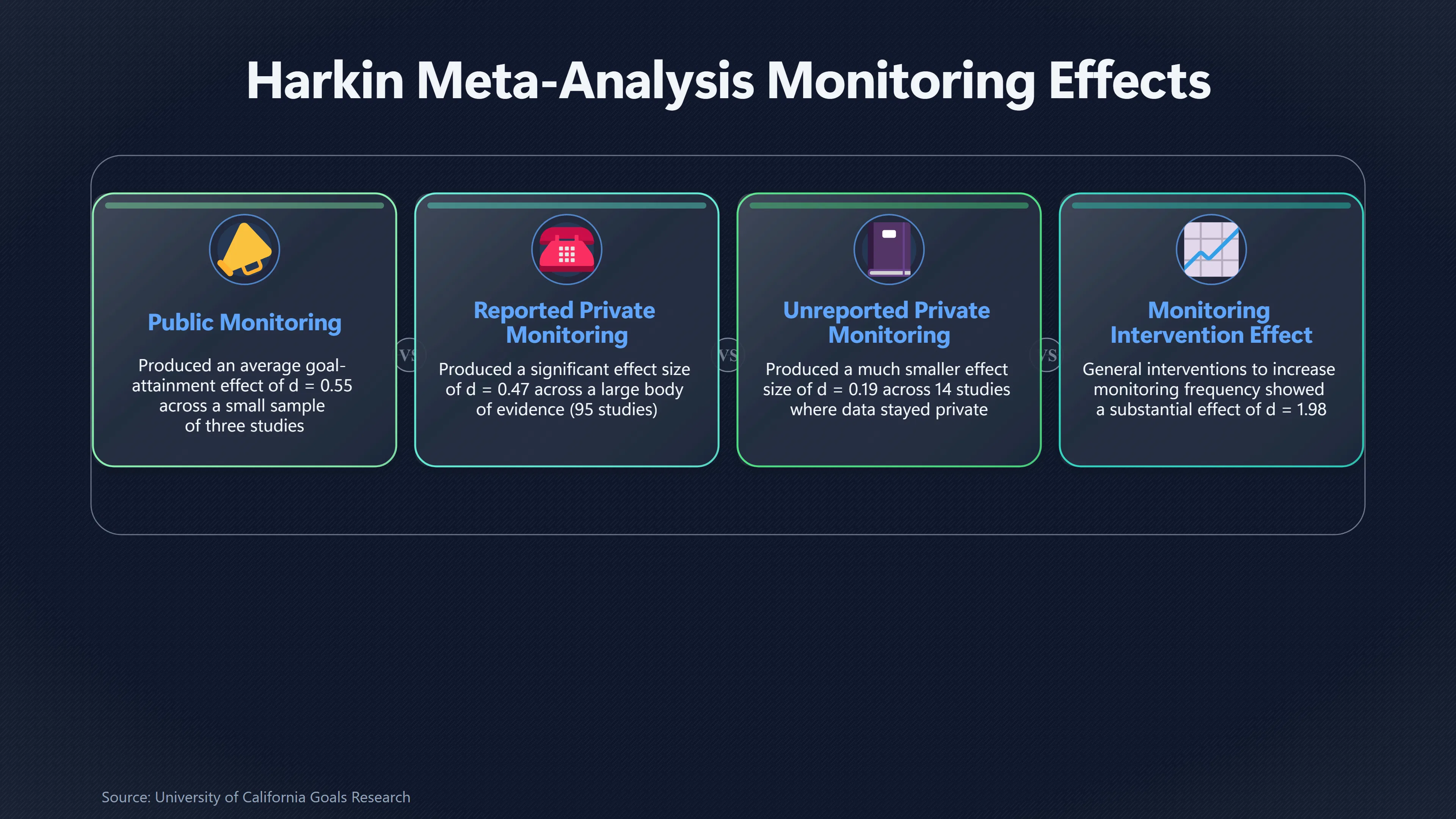
The differences were notable. Public monitoring produced an average goal-attainment effect of d = 0.55, although this estimate came from only three studies and therefore deserves caution. Private monitoring followed by reporting, represented by a much larger body of evidence, produced d = 0.47 across 95 studies. Private monitoring that was not reported produced d = 0.19 across 14 studies. The reported-versus-unreported difference was statistically significant.[White Rose Research Online]eprints.whiterose.ac.ukOpen source on whiterose.ac.uk.
This is more informative than simply observing that highly motivated people tend to find accountability partners. The meta-analysis included studies in which participants were randomly allocated to interventions intended to increase progress monitoring. Across the full evidence base, those interventions increased monitoring substantially (d = 1.98) and improved goal attainment (d = 0.40); increases in monitoring frequency statistically mediated improvements in attainment.[PubMed]pubmed.ncbi.nlm.nih.govDoes monitoring goal progress promote goal attainment? A meta-analysis of the experimental evidence - PubMed…
There is an important limitation, however. The reported-versus-private figures are moderator findings across different studies and intervention designs, not the result of one enormous experiment that randomly assigned thousands of otherwise identical people to “tell someone” or “keep it secret”. Harkin and colleagues explicitly called for direct comparisons that could identify whether accountability itself causes the extra benefit and which psychological mechanism explains it.[White Rose Research Online]eprints.whiterose.ac.ukOpen source on whiterose.ac.uk.
Smaller experiments reinforce the need for that caution. In a randomised pilot involving 69 patients using an app to conduct skin self-examinations, some participants had an accountability partner who received monthly progress reports. Self-examination increased across the study, from 58% at baseline to 83% after six months, but there was no significant difference between intervention groups: adding an accountability partner did not outperform the app alone in this small trial. Satisfaction was also lowest in the accountability-partner-only group.[PubMed]pubmed.ncbi.nlm.nih.govPiloting the Use of Smartphones, Reminders, and Accountability Partners to Promote Skin Self-Examinations in Patients with Total Bo…
So “accountability always works” is too strong. A better reading is that reported monitoring is a promising amplifier of tracking, with strong meta-analytic evidence of association between intervention design and larger effects, but individual accountability arrangements do not reliably add value in every setting.
Why another person can change the meaning of a tracker
A private tracker supplies information. A reported tracker supplies information plus a social consequence. If you planned three study sessions and completed one, a private record can be closed and forgotten. If you have agreed to send “1/3 completed” to somebody on Sunday, the discrepancy has an audience.
Harkin and colleagues proposed several possible explanations for the larger effects of reported and public monitoring: stronger public commitment, a feeling of personal accountability, concern about how one presents oneself to other people, and, in experiments, the possibility that participants respond to what they think researchers expect. The meta-analysis could not establish which mechanism was responsible.[White Rose Research Online]eprints.whiterose.ac.ukOpen source on whiterose.ac.uk.
More recent research helps fill in part of that picture. In four longitudinal studies involving 1,035 participants, Johanna Peetz, Roger Buehler and Tayler Wells examined what happened when people told others about personal goals. In one observational study, disclosure predicted receiving more support and putting in greater goal-pursuit effort. In two studies that instructed participants to share a goal, sharing led to greater support from other people, which was in turn associated with greater effort and progress. In a fourth study, telling a person who was physically present increased subsequent goal-pursuit effort, although it did not increase reported support in that particular experiment.[PubMed]pubmed.ncbi.nlm.nih.govGoals Out Loud: Telling Others About a Goal Increases Support Received and Facilitates Goal Pursuit - PubMedOctober 27, 2025…
That evidence concerns goal disclosure, rather than repeated progress reporting, so the two should not be treated as identical interventions. It nevertheless identifies a useful interpersonal pathway: once another person knows what you are trying to do, that person can potentially encourage you, remind you, discuss obstacles or otherwise make the goal more socially present.[DOI]doi.orgGoals Out Loud: Telling Others About a Goal Increases Support Received and Facilitates Goal Pursuit - Johanna Peetz, Roger Buehler, Ta…
Publicity can also increase commitment after things go wrong. Three experiments reported by Jinfeng Jiao and Catherine Cole found that people high in “self-monitoring” — here meaning sensitivity to social presentation, rather than simply recording progress — were more likely to persist following a public goal failure than a private one. The public/private distinction did not produce the same effect among low self-monitors.[Wiley Online Library]onlinelibrary.wiley.comWiley Online LibraryThe Effects of Goal Publicity and Self‐Monitoring on Escalation of Goal Commitment - Jiao - 2020 - Journal of Consume… This suggests an important boundary: social visibility does not exert the same motivational force on everybody.
Accountability is not the same as announcing a goal
The useful distinction is between telling somebody what you intend to do and showing somebody what actually happened.
A one-off announcement — “I am going to run three times a week” — creates visibility around the intention. A reporting system creates repeated contact with evidence: “I planned three runs; I completed two.” The latter preserves the feedback function of progress tracking while adding another person as an audience.
That distinction matters because research on public goals is not uniformly positive. The literature includes circumstances in which publicity changes commitment or persistence differently depending on the individual and the form of disclosure. The 2020 experiments on public failure, for example, found effects conditional on participants’ self-monitoring tendencies rather than a universal benefit from publicity.[Wiley Online Library]onlinelibrary.wiley.comWiley Online LibraryThe Effects of Goal Publicity and Self‐Monitoring on Escalation of Goal Commitment - Jiao - 2020 - Journal of Consume… The recent goal-disclosure research likewise stresses that the audience and manner of disclosure matter.[PubMed]pubmed.ncbi.nlm.nih.govGoals Out Loud: Telling Others About a Goal Increases Support Received and Facilitates Goal Pursuit - PubMedOctober 27, 2025…
There is also a practical difference between accountability and surveillance. The Harkin meta-analysis classified progress as “reported” when privately obtained monitoring information was given to at least one other person. It did not require a large audience, public social-media post or competitive group.[White Rose Research Online]eprints.whiterose.ac.ukOpen source on whiterose.ac.uk. That makes the evidence compatible with a much quieter arrangement: one trusted friend, colleague, coach or study partner can provide the relevant social visibility.
A widely circulated small study by Gail Matthews illustrates this format particularly clearly. Participants were assigned to five goal-setting conditions, ranging from merely thinking about goals to writing goals and sending weekly progress reports to a supportive friend. Among the 149 participants who completed the study, the group sending weekly progress reports reported greater goal accomplishment than the groups using less intensive arrangements.[Dominican University of California]dominican.eduUniversity of California Goals ResearchDominican University of CaliforniaGoals Research SummaryJuly 2, 2026… This is useful supporting evidence, but it should not carry the weight sometimes given to it online: it was a relatively small study with substantial non-completion, and the broader Harkin meta-analysis provides the stronger foundation.
A useful check-in should make progress visible, not punitive
For self-improvement, the evidence points towards a fairly lightweight design. The purpose is not to recruit someone to police your behaviour. It is to make the tracking record consequential enough that you continue to collect it, look at it and respond to what it says.
A practical accountability arrangement can therefore stay simple:
- Choose one observable measure. Report something close to the behaviour: “3 of 4 planned workouts completed”, “four 25-minute study sessions”, or “five days without missing the morning practice”. Concrete numbers reduce the temptation to turn a check-in into a vague assessment of whether the week “felt productive”.
- Agree on the reporting rhythm beforehand. A weekly update often makes more sense for recurring habits than constant messaging. The interval should be short enough that a miss can still influence the next attempt.
- Report misses as readily as successes. If accountability makes people hide disappointing results, it defeats the purpose of monitoring. “Planned 4, completed 2” is useful information; an elaborate justification is usually not.
- Ask for a small response rather than supervision. Acknowledgement, one question about an obstacle, or a brief discussion of the next action can keep the process social without turning the other person into an unpaid manager. Goal-sharing research suggests that support from others can be one route from disclosure to greater effort.[PubMed]pubmed.ncbi.nlm.nih.govGoals Out Loud: Telling Others About a Goal Increases Support Received and Facilitates Goal Pursuit - PubMedOctober 27, 2025…
- Keep the record as well as sending it. Reporting and recording need not be alternatives. Harkin and colleagues found larger goal-attainment effects both when progress was reported or public and when monitoring information was physically recorded.[White Rose Research Online]eprints.whiterose.ac.ukOpen source on whiterose.ac.uk.
The tone matters as much as the mechanics. The skin-examination trial is a useful warning against assuming that more accountability automatically produces a better experience: adding accountability partners did not significantly improve the behavioural result and the accountability-only condition had the lowest satisfaction.[PubMed]pubmed.ncbi.nlm.nih.govPiloting the Use of Smartphones, Reminders, and Accountability Partners to Promote Skin Self-Examinations in Patients with Total Bo… A check-in that creates disproportionate embarrassment, nagging or interpersonal friction may simply become something the person starts avoiding.

The best accountability preserves honest feedback
The strongest case for reporting progress is not that social pressure is magically motivating. It is that progress tracking already works by confronting intentions with evidence, and another person can make that evidence harder to disregard.
Across the large progress-monitoring meta-analysis, keeping monitoring information entirely private was associated with a considerably smaller goal-attainment effect than reporting privately collected information to somebody else.[White Rose Research Online]eprints.whiterose.ac.ukOpen source on whiterose.ac.uk. More recent research adds a complementary explanation: telling another person about a goal can elicit support and is associated with greater effort and progress, although effects vary by setting and by how disclosure occurs.[PubMed]pubmed.ncbi.nlm.nih.govGoals Out Loud: Telling Others About a Goal Increases Support Received and Facilitates Goal Pursuit - PubMedOctober 27, 2025…
For everyday self-improvement, that argues for specific, low-pressure accountability rather than maximum publicity. Record the behaviour you intended to perform, let one suitable person see the result on a predictable schedule, and treat a disappointing report as information for the next attempt rather than as a failure to defend. The added value is not the audience itself. It is the recurring expectation that the gap between the plan and reality will be seen, acknowledged and acted upon.
Amazon book picks
Further Reading
Books and field guides related to Does Reporting Your Progress Improve Follow Through?. Use these as the next step if you want deeper reading beyond the article.
Atomic Habits
Rating: 3.5/5 from 7 Google Books ratings
The #1 New York Times bestseller. Over 25 million copies sold! Translated into 60+ languages! Tiny Changes, Remarkable Results No matter...
The 12 Week Year
The guide to shortening your execution cycle down from one year to twelve weeks Most organizations and individuals work in the context of...

The Power of Habit
Rating: 4.0/5 from 145 Google Books ratings
Duhigg takes us to the edge of scientific discoveries that explain why habits exist and how they can be changed. Distilling information i...
eBay marketplace picks
Marketplace Samples
Live-tested eBay searches with available results related to this page.
Selected frommotivation poster oneBay.co.uk.


Current eBay listing
Motivation Art Quote Framed Wall Art Poster Canvas Print Picture


Current eBay listing
Gym Motivation Framed Wall Art Poster Canvas Print Picture
Endnotes
1.
Source: doi.org
Link:https://doi.org/10.1177/01461672251382271
Source snippet
Goals Out Loud: Telling Others About a Goal Increases Support Received and Facilitates Goal Pursuit - Johanna Peetz, Roger Buehler, Ta...
2.
Source: onlinelibrary.wiley.com
Link:https://onlinelibrary.wiley.com/doi/10.1002/cb.1806
Source snippet
Wiley Online LibraryThe Effects of Goal Publicity and Self‐Monitoring on Escalation of Goal Commitment - Jiao - 2020 - Journal of Consume...
3.
Source: dominican.edu
Title: University of California Goals Research
Link:https://www.dominican.edu/sites/default/files/2020-02/gailmatthews-harvard-goals-researchsummary.pdf?previewmode=true
Source snippet
Dominican University of CaliforniaGoals Research SummaryJuly 2, 2026...
Published: July 2, 2026
4.
Source: doi.org
Link:https://doi.org/10.1186/s12966-023-01555-6
5.
Source: doi.org
Link:https://doi.org/10.1017/s0047279422000915
6.
Source: onlinelibrary.wiley.com
Link:https://onlinelibrary.wiley.com/doi/10.1002/ejsp.2745
7.
Source: onlinelibrary.wiley.com
Link:https://onlinelibrary.wiley.com/doi/abs/10.1002/cb.1806
8.
Source: bpspsychub.onlinelibrary.wiley.com
Link:https://bpspsychub.onlinelibrary.wiley.com/doi/abs/10.1111/bjhp.12389
9.
Source: doi.org
Link:https://doi.org/10.1093/ajcn/nqx048
10.
Source: eprints.whiterose.ac.uk
Link:https://eprints.whiterose.ac.uk/id/eprint/87431/1/bul
11.
Source: pubmed.ncbi.nlm.nih.gov
Link:https://pubmed.ncbi.nlm.nih.gov/26479070/
Source snippet
Does monitoring goal progress promote goal attainment? A meta-analysis of the experimental evidence - PubMed...
12.
Source: pubmed.ncbi.nlm.nih.gov
Link:https://pubmed.ncbi.nlm.nih.gov/30062632/
Source snippet
Piloting the Use of Smartphones, Reminders, and Accountability Partners to Promote Skin Self-Examinations in Patients with Total Bo...
13.
Source: pmc.ncbi.nlm.nih.gov
Link:https://pmc.ncbi.nlm.nih.gov/articles/PMC6126944/
Source snippet
PubMed Central (PMC)Piloting the Use of Smartphones, Reminders, and Accountability Partners to Promote Skin Self-Exams in Patients with T...
14.
Source: pubmed.ncbi.nlm.nih.gov
Link:https://pubmed.ncbi.nlm.nih.gov/41143471/
Source snippet
Goals Out Loud: Telling Others About a Goal Increases Support Received and Facilitates Goal Pursuit - PubMedOctober 27, 2025...
Published: October 27, 2025
15.
Source: GOV.UK
Title: www.gov.uk Local Outcomes Framework: Principles for use
Link:https://www.gov.uk/government/publications/local-outcomes-framework/local-outcomes-framework-principles-for-use
16.
Source: pmc.ncbi.nlm.nih.gov
Link:https://pmc.ncbi.nlm.nih.gov/articles/PMC13211942/
17.
Source: pmc.ncbi.nlm.nih.gov
Link:https://pmc.ncbi.nlm.nih.gov/articles/PMC12417905/
18.
Source: GOV.UK
Title: evaluation and performance analysis strategy and playbook 2024 to 2028
Link:https://www.gov.uk/government/publications/dbts-digital-evaluation-and-performance-analysis-strategy/evaluation-and-performance-analysis-strategy-and-playbook-2024-to-2028
19.
Source: pmc.ncbi.nlm.nih.gov
Link:https://pmc.ncbi.nlm.nih.gov/articles/PMC12167674/
20.
Source: pmc.ncbi.nlm.nih.gov
Link:https://pmc.ncbi.nlm.nih.gov/articles/PMC11751940/
21.
Source: pubmed.ncbi.nlm.nih.gov
Link:https://pubmed.ncbi.nlm.nih.gov/38663855/
22.
Source: pubmed.ncbi.nlm.nih.gov
Link:https://pubmed.ncbi.nlm.nih.gov/38178230/
23.
Source: pmc.ncbi.nlm.nih.gov
Link:https://pmc.ncbi.nlm.nih.gov/articles/PMC10765525/
24.
Source: pmc.ncbi.nlm.nih.gov
Link:https://pmc.ncbi.nlm.nih.gov/articles/PMC10498378/
25.
Source: pmc.ncbi.nlm.nih.gov
Link:https://pmc.ncbi.nlm.nih.gov/articles/PMC10357317/
26.
Source: pmc.ncbi.nlm.nih.gov
Link:https://pmc.ncbi.nlm.nih.gov/articles/PMC10524347/
27.
Source: pmc.ncbi.nlm.nih.gov
Link:https://pmc.ncbi.nlm.nih.gov/articles/PMC9789500/
28.
Source: pubmed.ncbi.nlm.nih.gov
Link:https://pubmed.ncbi.nlm.nih.gov/36083606/
29.
Source: reporter.nih.gov
Title: project details
Link:https://reporter.nih.gov/project-details/10275800
30.
Source: pmc.ncbi.nlm.nih.gov
Link:https://pmc.ncbi.nlm.nih.gov/articles/PMC8628117/
31.
Source: pmc.ncbi.nlm.nih.gov
Link:https://pmc.ncbi.nlm.nih.gov/articles/PMC7654846/
32.
Source: pmc.ncbi.nlm.nih.gov
Link:https://pmc.ncbi.nlm.nih.gov/articles/PMC7796926/
33.
Source: pmc.ncbi.nlm.nih.gov
Link:https://pmc.ncbi.nlm.nih.gov/articles/PMC7334459/
34.
Source: pmc.ncbi.nlm.nih.gov
Link:https://pmc.ncbi.nlm.nih.gov/articles/PMC7016303/
35.
Source: pmc.ncbi.nlm.nih.gov
Link:https://pmc.ncbi.nlm.nih.gov/articles/PMC6923189/
36.
Source: eprints.whiterose.ac.uk
Link:https://eprints.whiterose.ac.uk/id/eprint/168325/
37.
Source: pubmed.ncbi.nlm.nih.gov
Link:https://pubmed.ncbi.nlm.nih.gov/31409357/
38.
Source: pmc.ncbi.nlm.nih.gov
Link:https://pmc.ncbi.nlm.nih.gov/articles/PMC6693254/
39.
Source: pmc.ncbi.nlm.nih.gov
Link:https://pmc.ncbi.nlm.nih.gov/articles/PMC6593854/
40.
Source: pmc.ncbi.nlm.nih.gov
Link:https://pmc.ncbi.nlm.nih.gov/articles/PMC5710273/
41.
Source: pmc.ncbi.nlm.nih.gov
Link:https://pmc.ncbi.nlm.nih.gov/articles/PMC5488352/
42.
Source: pmc.ncbi.nlm.nih.gov
Link:https://pmc.ncbi.nlm.nih.gov/articles/PMC5410783/
43.
Source: pmc.ncbi.nlm.nih.gov
Link:https://pmc.ncbi.nlm.nih.gov/articles/PMC4917920/
44.
Source: pmc.ncbi.nlm.nih.gov
Link:https://pmc.ncbi.nlm.nih.gov/articles/PMC5306147/
45.
Source: eprints.whiterose.ac.uk
Link:https://eprints.whiterose.ac.uk/id/eprint/87431/
46.
Source: pmc.ncbi.nlm.nih.gov
Link:https://pmc.ncbi.nlm.nih.gov/articles/PMC4004138/
47.
Source: pmc.ncbi.nlm.nih.gov
Link:https://pmc.ncbi.nlm.nih.gov/articles/PMC3878579/
48.
Source: pmc.ncbi.nlm.nih.gov
Link:https://pmc.ncbi.nlm.nih.gov/articles/PMC3189889/
49.
Source: pubmed.ncbi.nlm.nih.gov
Link:https://pubmed.ncbi.nlm.nih.gov/12219856/
50.
Source: pubmed.ncbi.nlm.nih.gov
Link:https://pubmed.ncbi.nlm.nih.gov/31662031/
51.
Source: pubmed.ncbi.nlm.nih.gov
Link:https://pubmed.ncbi.nlm.nih.gov/30003476/
52.
Source: pmc.ncbi.nlm.nih.gov
Link:https://pmc.ncbi.nlm.nih.gov/articles/PMC12133204/
53.
Source: pmc.ncbi.nlm.nih.gov
Link:https://pmc.ncbi.nlm.nih.gov/articles/PMC5487285/
54.
Source: pmc.ncbi.nlm.nih.gov
Link:https://pmc.ncbi.nlm.nih.gov/articles/PMC10834374/
55.
Source: pubmed.ncbi.nlm.nih.gov
Link:https://pubmed.ncbi.nlm.nih.gov/27356991/
56.
Source: pmc.ncbi.nlm.nih.gov
Link:https://pmc.ncbi.nlm.nih.gov/articles/PMC8849530/
57.
Source: eprints.whiterose.ac.uk
Link:https://eprints.whiterose.ac.uk/id/eprint/91437/
Additional References
58.
Source: journals.sagepub.com
Link:https://journals.sagepub.com/doi/10.1177/01461672251382271
Source snippet
Sage JournalsGoals Out Loud: Telling Others About a Goal Increases Support Received and Facilitates Goal Pursuit - Johanna Peetz, Roger B...
59.
Source: storage.ghost.io
Link:https://storage.ghost.io/c/f3/3f/f33f5c03-3086-4eb9-8cda-87a9349ebfb2/content/files/2024/08/The-Impact-of-Commitment-Accountability-and-Written-Goals-on-Go.pdf
Source snippet
Ghost StorageThe Impact of Commitment, Accountability, and Written Goals on Goal Achievement...
60.
Source: youtube.com
Title: Find An Accountability Partner Or Group Plus Ways To Track Your Progress
Link:https://www.youtube.com/watch?v=THRq3vl1d1E
Source snippet
To dive deeper into the behavioral science behind sharing progress and goal attainment, check out Does Telling Others Your Goals Actually...
61.
Source: youtube.com
Title: Achieve 77% More by Writing Down Your Goals, Action Steps, and Accountability
Link:https://www.youtube.com/watch?v=KrpqKQgsO6E
Source snippet
How to [Track Progress]({{ 'track-progress/' | relative_url }}) With Your Accountability Buddy...
62.
Source: oecd.org
Link:https://www.oecd.org/en/publications/practical-guidelines-for-supporting-locally-led-development_eaecf72b-en/full-report/using-global-partnership-for-effective-development-co-operation-monitoring-evidence-to-assess-progress-on-locally-led-development_eff866f7.html
63.
Source: youtube.com
Title: How to Track Progress With Your Accountability Buddy
Link:https://www.youtube.com/watch?v=5eWDLkudCXA
Source snippet
Find An Accountability Partner Or Group Plus Ways To Track Your Progress...
64.
Source: youtube.com
Title: How To Improve The Odds Of Reaching Your Goals
Link:https://www.youtube.com/watch?v=xeJopg1jrM0
Source snippet
Achieve 77% More by Writing Down Your Goals, Action Steps, and Accountability...
65.
Source: researchgate.net
Link:https://www.researchgate.net/publication/291335719_Does_Monitoring_Goal_Progress_Promote_Goal_Attainment_A_Meta-Analysis_of_the_Experimental_Evidence
66.
Source: researchgate.net
Link:https://www.researchgate.net/publication/306006294_Iterative_development_of_Vegethon_A_theory-based_mobile_app_intervention_to_increase_vegetable_consumption
67.
Source: researchgate.net
Link:https://www.researchgate.net/publication/333645178The_Dynamics_of_Self-Governance_Capacity_The_Dutch_Rural_Civic_Initiative%27Project_Ulrum_2034%27