Within Complex Habits
Why the Same Time and Place Can Matter
Repeating a demanding routine in the same time and place can strengthen the cue that prompts it and improve follow-through.
On this page
- What context stability means for complex routines
- Study habit evidence from stable versus varied settings
- Making cues consistent when schedules are messy
Page outline Jump by section
Introduction
Repeating a demanding routine in the same setting can make it easier for that routine to become automatic. The reason is not simply that a fixed time or place makes a behaviour easier to remember. Habit learning depends on repeatedly pairing contextual cues with a response, so that encountering those cues increasingly prompts the response with less deliberate decision-making. For complex routines, which contain several steps and more opportunities to hesitate or stop, that stable cue structure may be especially useful.[ScienceDirect]sciencedirect.comHow do habits guide behavior? Perceived and actual triggers of habits in daily life - ScienceDirect…

The clearest direct evidence comes from experiments in which people have been asked either to keep the context of a new routine stable or deliberately vary it. Students developing study habits showed greater automaticity when repetitions occurred in a consistent context, while a recent randomised walking study found that both consistent- and varied-context planning increased activity but only consistent-context planning produced sustained increases in habit automaticity.[PubMed Central (PMC)]pmc.ncbi.nlm.nih.govPubMed Central (PMC)Context Stability in Habit Building Increases Automaticity and Goal Attainment - PMCJune 10, 2022…
For self-improvement, the practical lesson is therefore more precise than “be consistent”. When a routine is complicated, make the circumstances that start and surround it as predictable as reasonably possible.
What context stability means for a complex routine
A stable context is a recurring configuration of cues around a behaviour. Location and time of day are obvious examples, but context can also include a preceding activity, social setting or another reliable part of a daily routine. Habit researchers describe habits as learned context–response associations: repeated performance in recurring circumstances makes those circumstances increasingly capable of activating the behaviour.[ScienceDirect]sciencedirect.comHow do habits guide behavior? Perceived and actual triggers of habits in daily life - ScienceDirect…
That distinction matters for complex habits. Consider “study for 25 minutes” rather than “drink a glass of water”. Studying requires getting materials ready, choosing what to work on, beginning, maintaining attention and progressing through the task. If the person studies at a different time and place every day, each attempt arrives with a somewhat different set of cues and practical decisions. If studying repeatedly begins at the same desk after breakfast, the desk, the preceding meal and that part of the day can repeatedly become associated with starting the same behavioural sequence.
Research involving 459 participants and 25 behaviours provides unusually relevant evidence here. Frequency, contextual stability and perceived rewards were all positively associated with automaticity, while perceived behavioural complexity was negatively associated with it. Crucially, the association between contextual stability and automaticity was stronger for behaviours perceived as more complex. The study was observational, so it cannot prove that stabilising context caused complex behaviours to become automatic. But it suggests that environmental consistency may become more, rather than less, important as a routine becomes complicated.[Frontiers]frontiersin.orgFrontiersFrontiers | Habits, Quick and Easy: Perceived Complexity Moderates the Associations of Contextual Stability and Rewards With Beh…
There is also a useful distinction between automating the decision to start a complex routine and automating every action inside it. A higher-order habit can use a stable cue to initiate behaviour while leaving the details flexible. Research on nutrition, for example, has examined “fill half the plate with vegetables at dinner” as a higher-order habit: dinner supplies a recurring context, while the particular vegetables and meal can change. This is a useful model for complex self-improvement routines because it avoids demanding that every repetition be identical.[PubMed Central (PMC)]pmc.ncbi.nlm.nih.govPubMed Central (PMC)Effects of behavioral performance, intrinsic reward value, and context stability on the formation of a higher-order n…
The target might therefore be “when I finish breakfast at home, I begin my study session”, not “every study session must contain exactly the same sequence of tasks”. The first preserves a dependable context–action relationship while allowing the content of a demanding routine to respond to real needs.
Stable versus varied settings in study-habit research
A particularly informative six-week study by Marco Stojanovic, Axel Grund and Stefan Fries followed 95 university students through 2,482 repetitions of newly chosen study habits. Participants selected activities lasting between three and 30 minutes, such as working through a textbook or summarising lecture notes.[PubMed Central (PMC)]pmc.ncbi.nlm.nih.govPubMed Central (PMC)Context Stability in Habit Building Increases Automaticity and Goal Attainment - PMCJune 10, 2022…
The manipulation was deliberately concrete. Students in the stable-context condition were instructed to perform their study habit in the same place and at the same point in the course of the day. Those in the variable-context condition were told to vary both, including changing locations so that their recent repetitions occurred in different places. The manipulation produced a large difference in perceived context stability between the groups.[PubMed Central (PMC)]pmc.ncbi.nlm.nih.govPubMed Central (PMC)Context Stability in Habit Building Increases Automaticity and Goal Attainment - PMCJune 10, 2022…
Across the analyses, greater context stability predicted greater automaticity. It also predicted better attainment of the goal set for each repetition: in other words, participants were more likely to complete what they had intended to accomplish during the session when the context was stable. Part of the association between context stability and goal attainment was statistically mediated by automaticity. A second dataset involving 218 users of a habit-building app, covering 308 habits and 2,368 repetitions, produced a similar general pattern.[PubMed]pubmed.ncbi.nlm.nih.govContext Stability in Habit Building Increases Automaticity and Goal Attainment - PubMedJune 10, 2022…
That completion finding is particularly relevant to complex habits. Context may do more than remind someone to begin. Stojanovic and colleagues argue that familiar circumstances can support smoother execution after the routine has started. Earlier experimental work on multi-step routines similarly found that disrupting context during a practised coffee-making task produced more action errors.[PubMed Central (PMC)]pmc.ncbi.nlm.nih.govPubMed Central (PMC)Context Stability in Habit Building Increases Automaticity and Goal Attainment - PMCJune 10, 2022…
The result should not be overstated. Participants assigned to varying times and places still developed some automaticity, so an identical setting is not a prerequisite for learning. The student experiment also involved a predominantly young sample, incentives and deliberately planned once-daily habits; the authors caution against assuming that the findings generalise unchanged to every kind of behaviour.[PubMed Central (PMC)]pmc.ncbi.nlm.nih.govPubMed Central (PMC)Context Stability in Habit Building Increases Automaticity and Goal Attainment - PMCJune 10, 2022…
Even so, the experiment addresses an important practical question that observational studies cannot: changing the stability of the circumstances changed how habit development unfolded. For a demanding study routine, repeatedly returning to a recognisable starting situation appears preferable to deliberately scattering repetitions across unrelated times and locations.
Consistency helps beyond studying
Evidence from other complex behaviours points in the same direction, although not every finding is equally strong.
In a 2024 randomised controlled trial, 127 insufficiently active working adults were assigned to plan daily walks in consistent contexts, varied contexts or a comparison condition without required planning. Both planning groups increased their walking during the four-week intervention. Yet only the consistent-context planners developed increased walking automaticity and maintained that automaticity at the four-week follow-up.[PubMed]pubmed.ncbi.nlm.nih.govConfirming the Causal Role of Consistent Contexts in Developing a Walking Habit: A Randomized Comparison With Varied Contexts - PubMed…
That separation between doing more and becoming more automatic is important. A plan can persuade someone to perform a behaviour repeatedly without necessarily creating a strong habitual cue. Consistently pairing the behaviour with the same circumstances appears to contribute something beyond repetition alone. At the same time, the walking study contained an important warning: the consistent-context group did not show the expected superior maintenance of walking itself after the intervention. Automaticity is therefore useful, but it does not guarantee lasting behaviour on its own.[PubMed]pubmed.ncbi.nlm.nih.govConfirming the Causal Role of Consistent Contexts in Developing a Walking Habit: A Randomized Comparison With Varied Contexts - PubMed…
A different 56-day study illustrates both the promise and the uncertainty surrounding more elaborate routines. Researchers followed people attempting to make “fill half my plate with vegetables at dinner” habitual. Across individuals, greater average context stability was associated with greater average habit strength, and context stability had a stronger association with habit strength than perceived tastiness in the study’s primary analysis. However, being in a more stable-than-usual context on one day did not predict stronger habit ratings the following day.[PubMed Central (PMC)]pmc.ncbi.nlm.nih.govPubMed Central (PMC)Effects of behavioral performance, intrinsic reward value, and context stability on the formation of a higher-order n…
That mixed result is useful rather than inconvenient. It suggests that context stability should be understood as a repeated learning condition, not a magic switch. One unusually well-structured Tuesday does not necessarily make Wednesday’s behaviour habitual. The likely value comes from repeatedly exposing the same response to sufficiently similar cues over time.
A 2024 systematic review of health-habit formation reached a compatible conclusion. Across the available intervention literature, habit development varied substantially, while behavioural repetition, routines, implementation plans and context stability were among the factors associated with habit strength. The review also noted that researchers still do not know precisely how consistent repetitions must be.[PubMed Central (PMC)]pmc.ncbi.nlm.nih.govOpen source on nih.gov.

Making cues consistent when schedules are messy
“Same time and place” is a useful experimental instruction, but real life often makes literal repetition impossible. Shift work, commuting, caring responsibilities, hybrid working and travel can all move a routine around. The solution is not necessarily to abandon context stability. It is to identify the most dependable cue that survives those changes.
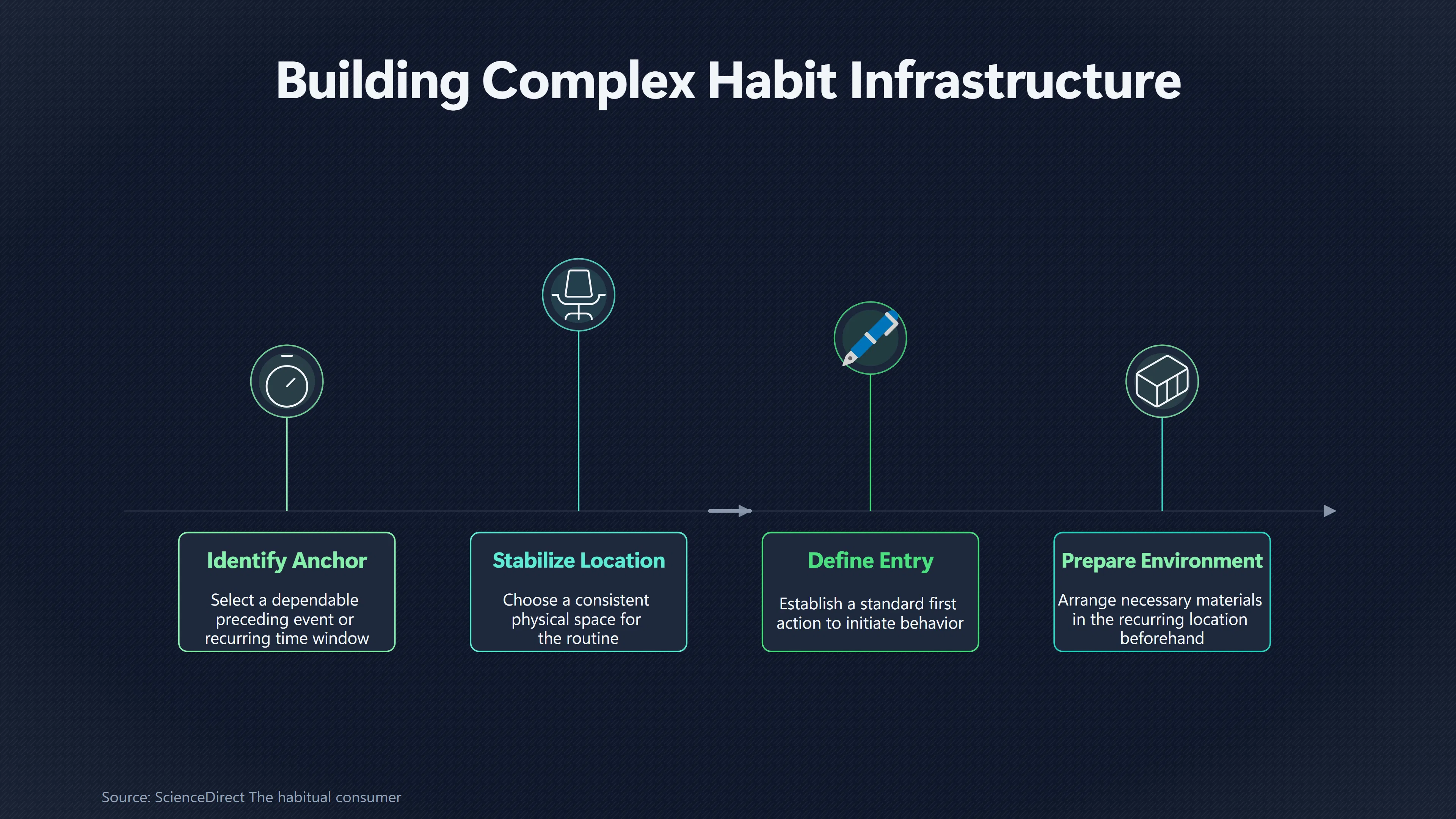
A practical hierarchy is:
- Use an existing event when clock time moves. “After I finish breakfast, I open my course notes” can remain recognisable even when breakfast occurs at 07:00 one day and 09:00 the next.
- Keep the location stable when possible. A particular desk, library area or exercise starting point can supply recurring environmental cues even if the exact start time varies.
- Keep the first action exceptionally stable. If the content of a routine must vary, preserve a standard opening move: sit at the desk, open the notebook and begin the first planned task, for example.
- Prepare the context in advance. Leaving the necessary materials in the recurring location reduces the number of decisions between encountering the cue and beginning the routine.
- Define a repeatable fallback context. Someone who normally studies after dinner at a desk might use “after breakfast at the hotel desk” when travelling. The fallback is less stable than the primary context, but more structured than deciding from scratch each day.
Implementation intentions — plans specifying when, where and how someone will act — are particularly relevant here. A large meta-analysis of 94 independent tests found that these if–then plans improved goal attainment overall, in part because they make the chosen situation more mentally accessible and connect it to the intended response. They should not be confused with habits: an implementation intention is deliberately created, whereas a habit association is gradually learned through repeated experience. But a good plan can repeatedly put behaviour in contact with the same cue, creating conditions in which habitual control can develop.[ScienceDirect]sciencedirect.comOpen source on sciencedirect.com.
Existing routines can perform a similar function without an exact clock time. In the walking trial, participants with more routine daily schedules sometimes developed stronger automaticity even without being explicitly told to plan consistent contexts; the analysis indicated that this operated through more consistent walking contexts.[PubMed]pubmed.ncbi.nlm.nih.govConfirming the Causal Role of Consistent Contexts in Developing a Walking Habit: A Randomized Comparison With Varied Contexts - PubMed…
This is why “after X” can sometimes be more robust than “at 7 pm”. A clock time is useful only if life reliably delivers the opportunity to act at that time. A recurring event — arriving home, finishing breakfast, putting the children to bed or closing the work laptop — may provide a more dependable anchor when the daily timetable shifts.

Stability should simplify the cue, not rigidify the whole routine
The strongest practical interpretation of this research is not that every feature of a complex habit must be frozen. Trying to reproduce an entire elaborate routine exactly can make the habit brittle: one late meeting or occupied room then appears to invalidate the plan.
Instead, stabilise the part of the context that tells you “this is when this routine begins”. The subsequent behaviour can retain enough flexibility to remain useful. A study habit might always start after breakfast at the same desk while alternating between reading, problem sets and revision. An exercise habit might start when work ends while the workout itself changes. A healthy-eating habit can attach vegetable preparation to dinner while allowing the meal to vary. The higher-order nutrition study explicitly illustrates how a stable initiation rule can coexist with variety in behavioural execution.[PubMed Central (PMC)]pmc.ncbi.nlm.nih.govPubMed Central (PMC)Effects of behavioral performance, intrinsic reward value, and context stability on the formation of a higher-order n…
This approach also fits the broader evidence on how established habits operate. Strong habits are particularly responsive to contextual cues associated with previous performance, and changes in those contexts can weaken the influence of an existing habit on behaviour.[ScienceDirect]sciencedirect.comHow do habits guide behavior? Perceived and actual triggers of habits in daily life - ScienceDirect…
For complex self-improvement routines, then, stable context is best treated as infrastructure for repetition. It removes one recurring question — when and where do I start? — from a behaviour that already contains plenty of other decisions. Repeating the routine under recognisable circumstances gives the environment repeated opportunities to become a cue. Over time, the beginning of the routine can require less conscious prompting, even when the work that follows remains genuinely demanding.
The practical takeaway
Stable contexts do not make difficult routines effortless, and the evidence does not support a rule that every repetition must occur at precisely the same minute in precisely the same chair. Nor does context stability replace frequency, motivation, feasibility or reward. Complex behaviours still require repeated performance, and the evidence about exactly which contextual cues matter most remains incomplete.[PubMed Central (PMC)]pmc.ncbi.nlm.nih.govPubMed Central (PMC)Effects of behavioral performance, intrinsic reward value, and context stability on the formation of a higher-order n…
What the research supports is a narrower and more useful policy: when trying to automate a complex routine, deliberately give it a recurring home in the day. Choose a recognisable place, time window or preceding event; pair that cue with a clearly defined first action; and preserve the pairing across as many repetitions as practical. When the full routine has to vary, stabilise its point of entry rather than insisting that every detail remain identical.
That strategy is especially well matched to complex habits because complexity creates more opportunities for deliberation and disruption. Observational evidence suggests contextual stability has a particularly strong relationship with automaticity for complex behaviours, while experimental evidence shows that consistent contexts can produce greater automaticity than deliberately varied ones.[frontiersin.org]frontiersin.orgFrontiersFrontiers | Habits, Quick and Easy: Perceived Complexity Moderates the Associations of Contextual Stability and Rewards With Beh…
The aim is not a perfectly rigid life. It is a sufficiently predictable cue that, eventually, beginning the difficult routine becomes the obvious next thing to do.
Amazon book picks
Further Reading
Books and field guides related to Why the Same Time and Place Can Matter. Use these as the next step if you want deeper reading beyond the article.
Good Habits, Bad Habits
'The world's leading expert on habits' - Matthew Syed, bestselling author of Black Box Thinking and Rebel IdeasWhat if you could harness...
Atomic Habits
Rating: 3.5/5 from 7 Google Books ratings
The #1 New York Times bestseller. Over 25 million copies sold! Translated into 60+ languages! Tiny Changes, Remarkable Results No matter...

The Power of Habit
Rating: 4.0/5 from 145 Google Books ratings
Duhigg takes us to the edge of scientific discoveries that explain why habits exist and how they can be changed. Distilling information i...
Tiny Habits
Improving your life is much easier than you think. Whether it’s losing weight, sleeping more, or restoring your work/life balance – the s...
eBay marketplace picks
Marketplace Samples
Live-tested eBay searches with available results related to this page.
Selected fromhabit tracker board oneBay.co.uk.


Endnotes
1.
Source: sciencedirect.com
Link:https://www.sciencedirect.com/science/article/pii/S002210311100254X
Source snippet
How do habits guide behavior? Perceived and actual triggers of habits in daily life - ScienceDirect...
2.
Source: sciencedirect.com
Link:https://www.sciencedirect.com/science/article/abs/pii/S0065260106380021
3.
Source: sciencedirect.com
Title: ScienceDirect The habitual consumer
Link:https://www.sciencedirect.com/science/article/abs/pii/S1057740809001065
4.
Source: sciencedirect.com
Title: Beyond deliberate self-control: Habits automatically achieve long-term goals
Link:https://www.sciencedirect.com/science/article/pii/S2352250X24000939
5.
Source: sciencedirect.com
Title: Neural autopilot and context-sensitivity of habits
Link:https://www.sciencedirect.com/science/article/pii/S2352154621001406
6.
Source: sciencedirect.com
Link:https://www.sciencedirect.com/science/article/pii/S0001691816303626
7.
Source: sciencedirect.com
Link:https://www.sciencedirect.com/science/article/pii/S0165178115000360
8.
Source: sciencedirect.com
Title: The habitual consumer
Link:https://www.sciencedirect.com/science/article/pii/S1057740809001065
9.
Source: sciencedirect.com
Link:https://www.sciencedirect.com/science/article/abs/pii/S002210310600028X
10.
Source: sciencedirect.com
Link:https://www.sciencedirect.com/science/article/pii/S002210311630186X
11.
Source: sciencedirect.com
Title: Beyond deliberate self-control: Habits automatically achieve long-term goals
Link:https://www.sciencedirect.com/science/article/abs/pii/S2352250X24000939
12.
Source: sciencedirect.com
Title: Situational Cue
Link:https://www.sciencedirect.com/topics/psychology/situational-cue
13.
Source: sciencedirect.com
Title: Habit-like attention
Link:https://www.sciencedirect.com/science/article/pii/S2352250X18301738
14.
Source: sciencedirect.com
Link:https://www.sciencedirect.com/science/article/abs/pii/S0191886926001820
15.
Source: sciencedirect.com
Link:https://www.sciencedirect.com/science/article/pii/S1369847812000794
16.
Source: sciencedirect.com
Title: Predicting habit: The case of physical exercise
Link:https://www.sciencedirect.com/science/article/pii/S1469029207000039
17.
Source: sciencedirect.com
Link:https://www.sciencedirect.com/science/article/abs/pii/S146902921630125X
18.
Source: sciencedirect.com
Link:https://www.sciencedirect.com/science/article/pii/S0022103105001356
19.
Source: sciencedirect.com
Link:https://www.sciencedirect.com/science/article/abs/pii/S0005796725000890
20.
Source: sciencedirect.com
Link:https://www.sciencedirect.com/science/article/pii/S0010027720301244
21.
Source: sciencedirect.com
Link:https://www.sciencedirect.com/science/article/abs/pii/S0022096516300285
22.
Source: sciencedirect.com
Link:https://www.sciencedirect.com/science/article/abs/pii/S0921344921001385
23.
Source: frontiersin.org
Link:https://www.frontiersin.org/journals/psychology/articles/10.3389/fpsyg.2019.01556/full
Source snippet
FrontiersFrontiers | Habits, Quick and Easy: Perceived Complexity Moderates the Associations of Contextual Stability and Rewards With Beh...
24.
Source: pmc.ncbi.nlm.nih.gov
Link:https://pmc.ncbi.nlm.nih.gov/articles/PMC9226889/
Source snippet
PubMed Central (PMC)Context Stability in Habit Building Increases Automaticity and Goal Attainment - PMCJune 10, 2022...
Published: June 10, 2022
25.
Source: pubmed.ncbi.nlm.nih.gov
Link:https://pubmed.ncbi.nlm.nih.gov/39225981/
Source snippet
Confirming the Causal Role of Consistent Contexts in Developing a Walking Habit: A Randomized Comparison With Varied Contexts - PubMed...
26.
Source: pmc.ncbi.nlm.nih.gov
Link:https://pmc.ncbi.nlm.nih.gov/articles/PMC4566897/
Source snippet
PubMed Central (PMC)A review and analysis of the use of ‘habit’ in understanding, predicting and influencing health-related behaviour - PMC...
27.
Source: pmc.ncbi.nlm.nih.gov
Link:https://pmc.ncbi.nlm.nih.gov/articles/PMC6667662/
Source snippet
PubMed Central (PMC)Habits, Quick and Easy: Perceived Complexity Moderates the Associations of Contextual Stability and Rewards With Beha...
28.
Source: pmc.ncbi.nlm.nih.gov
Link:https://pmc.ncbi.nlm.nih.gov/articles/PMC9372943/
Source snippet
PubMed Central (PMC)Effects of behavioral performance, intrinsic reward value, and context stability on the formation of a higher-order n...
29.
Source: frontiersin.org
Link:https://www.frontiersin.org/journals/psychology/articles/10.3389/fpsyg.2022.883795/full
30.
Source: pubmed.ncbi.nlm.nih.gov
Link:https://pubmed.ncbi.nlm.nih.gov/35756236/
Source snippet
Context Stability in Habit Building Increases Automaticity and Goal Attainment - PubMedJune 10, 2022...
Published: June 10, 2022
31.
Source: pmc.ncbi.nlm.nih.gov
Link:https://pmc.ncbi.nlm.nih.gov/articles/PMC11641623/
32.
Source: frontiersin.org
Link:https://www.frontiersin.org/journals/human-neuroscience/articles/10.3389/fnhum.2015.00395/full
33.
Source: pubmed.ncbi.nlm.nih.gov
Link:https://pubmed.ncbi.nlm.nih.gov/42053513/
34.
Source: pubmed.ncbi.nlm.nih.gov
Link:https://pubmed.ncbi.nlm.nih.gov/40080255/
35.
Source: pmc.ncbi.nlm.nih.gov
Link:https://pmc.ncbi.nlm.nih.gov/articles/PMC11920387/
36.
Source: pmc.ncbi.nlm.nih.gov
Link:https://pmc.ncbi.nlm.nih.gov/articles/PMC11782107/
37.
Source: pmc.ncbi.nlm.nih.gov
Link:https://pmc.ncbi.nlm.nih.gov/articles/PMC11574773/
38.
Source: pmc.ncbi.nlm.nih.gov
Link:https://pmc.ncbi.nlm.nih.gov/articles/PMC11297519/
39.
Source: pmc.ncbi.nlm.nih.gov
Link:https://pmc.ncbi.nlm.nih.gov/articles/PMC11161714/
40.
Source: pmc.ncbi.nlm.nih.gov
Link:https://pmc.ncbi.nlm.nih.gov/articles/PMC11201238/
41.
Source: pmc.ncbi.nlm.nih.gov
Link:https://pmc.ncbi.nlm.nih.gov/articles/PMC10585941/
42.
Source: pubmed.ncbi.nlm.nih.gov
Link:https://pubmed.ncbi.nlm.nih.gov/35962435/
43.
Source: frontiersin.org
Title: Frontiers | Development and Validation of a Daily Habit Scale
Link:https://www.frontiersin.org/journals/neuroscience/articles/10.3389/fnins.2022.880023/full
44.
Source: frontiersin.org
Link:https://www.frontiersin.org/journals/psychology/articles/10.3389/fpsyg.2022.883795/full?infclid=98ed75048fad41069048c53e63b2394c
45.
Source: pmc.ncbi.nlm.nih.gov
Link:https://pmc.ncbi.nlm.nih.gov/articles/PMC12318445/
46.
Source: pmc.ncbi.nlm.nih.gov
Link:https://pmc.ncbi.nlm.nih.gov/articles/PMC8800991/
47.
Source: pmc.ncbi.nlm.nih.gov
Link:https://pmc.ncbi.nlm.nih.gov/articles/PMC8734590/
48.
Source: pmc.ncbi.nlm.nih.gov
Link:https://pmc.ncbi.nlm.nih.gov/articles/PMC9207816/
49.
Source: pubmed.ncbi.nlm.nih.gov
Link:https://pubmed.ncbi.nlm.nih.gov/33502088/
50.
Source: pmc.ncbi.nlm.nih.gov
Link:https://pmc.ncbi.nlm.nih.gov/articles/PMC8774291/
51.
Source: pubmed.ncbi.nlm.nih.gov
Link:https://pubmed.ncbi.nlm.nih.gov/32497925/
52.
Source: frontiersin.org
Title: Frontiers | On How Definitions of Habits Can Complicate Habit Research
Link:https://www.frontiersin.org/journals/psychology/articles/10.3389/fpsyg.2019.02642/full
53.
Source: pmc.ncbi.nlm.nih.gov
Link:https://pmc.ncbi.nlm.nih.gov/articles/PMC6895142/
54.
Source: pubmed.ncbi.nlm.nih.gov
Link:https://pubmed.ncbi.nlm.nih.gov/31454674/
55.
Source: pubmed.ncbi.nlm.nih.gov
Link:https://pubmed.ncbi.nlm.nih.gov/31396122/
56.
Source: frontiersin.org
Link:https://www.frontiersin.org/journals/psychology/articles/10.3389/fpsyg.2019.00301/full
57.
Source: pmc.ncbi.nlm.nih.gov
Link:https://pmc.ncbi.nlm.nih.gov/articles/PMC4975085/
58.
Source: pmc.ncbi.nlm.nih.gov
Link:https://pmc.ncbi.nlm.nih.gov/articles/PMC4731333/
59.
Source: pmc.ncbi.nlm.nih.gov
Link:https://pmc.ncbi.nlm.nih.gov/articles/PMC4500900/
60.
Source: pmc.ncbi.nlm.nih.gov
Link:https://pmc.ncbi.nlm.nih.gov/articles/PMC4216661/
61.
Source: pmc.ncbi.nlm.nih.gov
Link:https://pmc.ncbi.nlm.nih.gov/articles/PMC3505409/
62.
Source: frontiersin.org
Link:https://www.frontiersin.org/subjects/automaticity?publication-date=01%2F01%2F2007-08%2F06%2F2026
63.
Source: scholarworks.brandeis.edu
Link:https://scholarworks.brandeis.edu/esploro/profile/jane_ebert/output/all?institution=01BRAND_INST
64.
Source: pubmed.ncbi.nlm.nih.gov
Link:https://pubmed.ncbi.nlm.nih.gov/15982113/
65.
Source: pmc.ncbi.nlm.nih.gov
Link:https://pmc.ncbi.nlm.nih.gov/articles/PMC13193246/
66.
Source: pubmed.ncbi.nlm.nih.gov
Link:https://pubmed.ncbi.nlm.nih.gov/17324087/
67.
Source: ouci.dntb.gov.ua
Link:https://ouci.dntb.gov.ua/en/works/7XJjALMl/
68.
Source: ouci.dntb.gov.ua
Link:https://ouci.dntb.gov.ua/en/works/4kpxeQml/
Additional References
69.
Source: academic.oup.com
Link:https://academic.oup.com/abm/article-abstract/58/11/741/7748316
Source snippet
OUP AcademicConfirming the Causal Role of Consistent Contexts in Developing a Walking Habit: A Randomized Comparison With Varied Contexts...
70.
Source: youtube.com
Title: How to change your habits: why they form and how to build or break them
Link:https://www.youtube.com/watch?v=yhLHfPZEKgU
Source snippet
"Routine vs. Habit: What's the REAL Difference?[https://www.youtube.com/watch?v=VCmO7P0E1Wc..."](https://www.youtube.com/watch?v=VCmO7P0E1Wc...")...
71.
Source: youtube.com
Title: The Neuroscience of Habits & How They Shape Us
Link:https://www.youtube.com/watch?v=ldOjn4YtdtE
Source snippet
How to Build Better Habits: The Ultimate Guide to Habit Formation...
72.
Source: youtube.com
Title: The Science of Making & Breaking Habits
Link:https://www.youtube.com/watch?v=Wcs2PFz5q6g
Source snippet
How to change your habits: why they form and how to build or break them...
73.
Source: researchgate.net
Link:https://www.researchgate.net/publication/362666582_Effects_of_behavioral_performance_intrinsic_reward_value_and_context_stability_on_the_formation_of_a_higher-order_nutrition_habit_an_intensive_longitudinal_diary_study
74.
Source: researchgate.net
Link:https://www.researchgate.net/publication/334653679_Habits_Quick_and_Easy_Perceived_Complexity_Moderates_the_Associations_of_Contextual_Stability_and_Rewards_With_Behavioral_Automaticity
75.
Source: researchgate.net
Link:https://www.researchgate.net/publication/380856470_Testing_the_Effect_of_Cue_Consistency_on_the_Past_Behavior-Habit-Physical_Activity_Relationship
76.
Source: researchgate.net
Link:https://www.researchgate.net/publication/386593213_Time_to_Form_a_Habit_A_Systematic_Review_and_Meta-Analysis_of_Health_Behaviour_Habit_Formation_and_Its_Determinants
77.
Source: researchgate.net
Link:https://www.researchgate.net/publication/381044449_What_is_habit_and_how_can_it_be_used_to_change_real-world_behaviour_Narrowing_the_theory-reality_gap
78.
Source: researchgate.net
Link:https://www.researchgate.net/publication/328619909_Physical_Activity_Habit_Complexities_and_Controversies_Theory_Mechanisms_Change_and_Contexts