Within Written Records
What Your Missed Sessions Can Reveal
Dates of missed sessions can expose recurring weak points such as Fridays, weekends, locations or other predictable circumstances.
On this page
- Turning omissions into usable evidence
- Spotting repeated day and context patterns
- Using patterns to revise the routine
Page outline Jump by section
Introduction
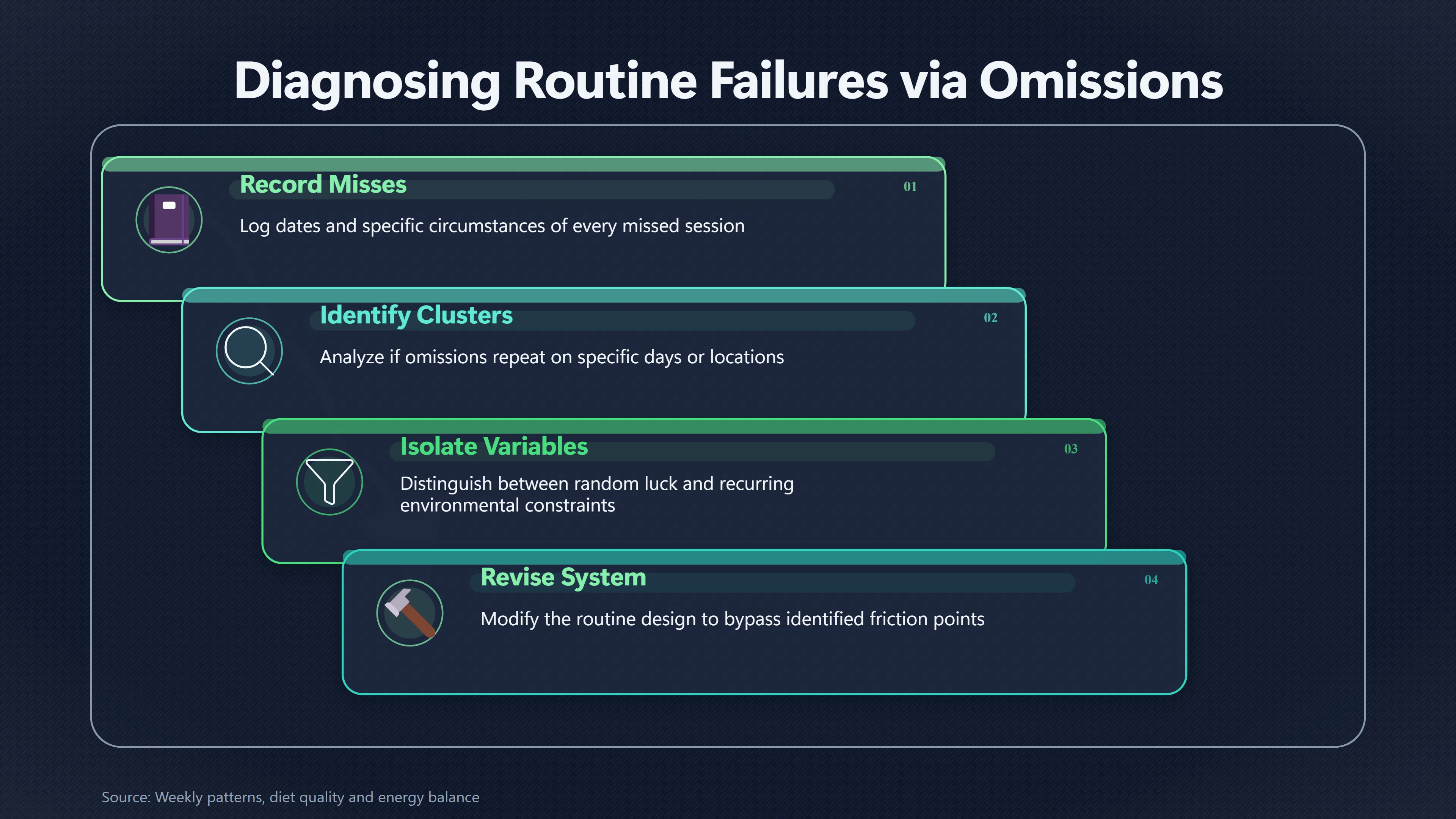
A missed session is more useful when it has a date attached to it. Three missed workouts can look like ordinary inconsistency; three consecutive missed Fridays suggest a specific weakness in the routine. The same principle applies to study sessions, writing practice, budgeting reviews or any repeated behaviour: omissions can reveal whether failure is scattered or concentrated around particular days, places, times and disruptions.
That distinction matters because routines are context-dependent. Research on habit formation finds that repeating behaviour in stable contexts supports automaticity and goal attainment, while changes in time, place and surrounding circumstances can make execution less reliable.[PubMed]pubmed.ncbi.nlm.nih.govContext Stability in Habit Building Increases Automaticity and Goal Attainment - PubMedJune 10, 2022… A written record therefore does more than establish how many sessions happened. By retaining the dates and circumstances of the sessions that did not happen, it can expose where the routine repeatedly loses its support.

Turning omissions into usable evidence
The simplest record — completed or missed, plus the date — already permits a useful question: are the omissions randomly distributed, or do they cluster? Adding one or two context fields can make the answer considerably more informative. A missed-session entry might record the planned time or place and a short reason such as “worked late”, “travelling” or “usual room unavailable”. The aim is not to create an elaborate diary. It is to retain enough information to distinguish an isolated miss from a recurring failure condition.
This approach fits the broader evidence for self-monitoring. Harkin and colleagues’ meta-analysis covered 138 experimental studies with 19,951 participants and found that interventions which increased monitoring of goal progress also improved goal attainment. Effects were larger when monitoring information was physically recorded.[White Rose Research Online]eprints.whiterose.ac.ukWhite Rose Research OnlineDoes Monitoring Goal Progress Promote Goal Attainment? A Meta-Analysis of the Experimental Evidence. - White Ro… For diagnosing routine failures, recording has an additional practical advantage: it leaves individual observations available for comparison rather than compressing them into a later judgement such as “I wasn’t very disciplined this month”.
But an omission log should not be treated as a causal experiment. If someone misses four Friday workouts, the record establishes a Friday pattern; it does not establish why Fridays are difficult. Workload, social plans, fatigue, transport or the chosen workout time could all be responsible. The record is best treated as a small personal dataset that identifies where to investigate.
Nor should one missed session be overinterpreted. Habit-formation research indicates that an occasional missed opportunity need not derail the development of automaticity.[PubMed Central (PMC)]pmc.ncbi.nlm.nih.govPubMed Central (PMC)Making health habitual: the psychology of ‘habit-formation’ and general practice - PMCDecember 1, 2012… The more consequential signal is repetition: the same omission appearing under similar circumstances often enough that “bad luck” becomes an increasingly poor description.
Spotting repeated day and context patterns
Day-of-week differences are real enough that researchers routinely account for them when studying repeated behaviour. In one seven-day accelerometer study of middle-aged Irish adults, Sunday differed from every other day for sedentary behaviour and light activity, leading the researchers to conclude that day of week should not be ignored when measuring habitual activity.[PubMed Central (PMC)]pmc.ncbi.nlm.nih.govPubMed Central (PMC)Number of Days Required to Estimate Habitual Activity Using Wrist-Worn GENEActiv Accelerometer: A Cross-Sectional Stu… UK Biobank accelerometer data from more than 96,000 participants likewise showed differences by time of day and smaller, but measurable, weekday-versus-weekend differences.[PubMed Central (PMC)]pmc.ncbi.nlm.nih.govPubMed Central (PMC)Large Scale Population Assessment of Physical Activity Using Wrist Worn Accelerometers: The UK Biobank Study - PMCFeb… These population findings do not tell an individual that their Friday or Sunday is troublesome; they demonstrate why collapsing seven different days into a weekly average can conceal meaningful temporal structure.
Similar clustering appears in adherence records. A 16-week behavioural weight-loss study found that dietary self-monitoring varied significantly across the week: participants were less likely to record their intake from Thursday through Sunday than on Tuesday, with the lowest odds on Saturday and Sunday.[PubMed Central (PMC)]pmc.ncbi.nlm.nih.govPubMed Central (PMC)Within-week and within-year patterns in self-monitoring of dietary intake in adults with obesity participating in a b… An outdoor exercise programme produced a different weekday pattern, with its highest attendance on Tuesday and lowest on Friday.[PubMed Central (PMC)]pmc.ncbi.nlm.nih.govPubMed Central (PMC)The Effect of Affective Exercise Experiences and Environmental Factors on Adherence to Outdoor Exercise Programs - PM… The specific “bad day”, in other words, is not universal. That is precisely why an individual’s own dated omissions matter more for routine diagnosis than a generic claim that weekends or Mondays are difficult.
Place and preceding events can be equally revealing. A qualitative study asked 39 participants to take vitamin C daily for three weeks and then examined how they tried to remember. Some remembering strategies depended heavily on a single cue: one participant, for example, associated the tablet with charging a laptop and missed it when that usual event did not occur. More broadly, loosely structured strategies became vulnerable when participants left home earlier, failed to visit their normal location or otherwise departed from the expected routine. Participants who reported no misses described using multiple cues, whereas those with frequent misses lacked a structured remembering strategy.[PubMed Central (PMC)]pmc.ncbi.nlm.nih.govOpen source on nih.gov.
That study is small and concerned a simple daily action, so it should not be generalised mechanically to every self-improvement routine. Its value is diagnostic: a miss can identify the cue on which a behaviour was unknowingly dependent. “Missed on Tuesday” becomes more informative when Tuesday was also “worked away from home”; several such observations can reveal that the apparent weekday effect is really a location effect.
Experimental and longitudinal habit research gives that interpretation stronger support. In a 2022 study, 95 university students built study habits for six weeks while researchers manipulated whether they performed them at stable or changing times and places; a second dataset examined 308 habits recorded by 218 app users. Across the two datasets, greater context stability predicted stronger automaticity and higher attainment of the goal for each repetition.[Frontiers]frontiersin.orgOpen source on frontiersin.org.
The practical implication is that missed-session analysis should look beyond raw totals. A compact review might ask:
- Day: Do misses disproportionately fall on Fridays, Sundays or another recurring day?
- Time: Does the routine work in the morning but repeatedly disappear when postponed until evening?
- Place: Do sessions happen at home but fail when travelling, working elsewhere or using a different room?
- Preceding cue: Does the behaviour depend on finishing breakfast, leaving work or another event that is sometimes absent?
- Competing demand: Do omissions repeatedly coincide with late meetings, childcare, social plans or another predictable commitment?
- Disruption: Does the routine survive ordinary days but collapse during holidays, travel or schedule changes?
The useful unit is not simply “missed”. It is missed under these circumstances.
Using patterns to revise the routine
Once a pattern appears, the appropriate response is usually to revise the vulnerable part of the system rather than issue a more forceful instruction to “be consistent”. If five weeks of records show that Monday-to-Thursday study sessions usually happen but Friday sessions repeatedly fail, abandoning the whole study routine would discard the part that already works. The evidence instead points towards Friday as the design problem.
A good revision should correspond to the observed failure. Repeated evening misses might justify moving the session earlier. Misses whenever the usual location is unavailable might justify defining a workable alternative location. If a routine disappears whenever one preceding cue is absent, adding a second reliable cue may make it less brittle. The vitamin-taking study found that people often had to discover useful cues through trial and error rather than predicting the best arrangement in advance.[PubMed Central (PMC)]pmc.ncbi.nlm.nih.govOpen source on nih.gov.
Another option is to convert the observed weak point into a specific contingency. Implementation intentions are plans that connect a recognisable situation to a predetermined response — essentially deciding in advance what to do when a relevant circumstance occurs. A major meta-analysis of 94 independent tests found a medium-to-large overall effect on goal attainment, and a more recent meta-analysis covering 642 tests found beneficial effects across cognitive, emotional and behavioural outcomes, with stronger effects when plans used a contingent if-then format.[ScienceDirect]sciencedirect.comOpen source on sciencedirect.com. A recurring omission supplies an especially concrete situation around which such a contingency can be designed.
Suppose a month’s record reads:
Friday 7th — missed — left work late
Friday 14th — missed — drinks after work
Friday 21st — missed — left work late
Friday 28th — missed — evening plans
The important finding is no longer “four failures”. It is that an evening routine has been scheduled inside a recurring Friday conflict. A sensible revision could be to move Friday’s session to lunchtime, replace it with a shorter version before work, or deliberately schedule the routine on four other days. Which solution is best depends on the goal; the record’s contribution is identifying the constraint that the redesign needs to solve.
This also guards against a common mistake in self-improvement: responding to every miss by increasing effort. Context-discontinuity research shows that habitual behaviour depends partly on stable environmental cues and can be disrupted when contexts change.[PubMed Central (PMC)]pmc.ncbi.nlm.nih.govPubMed Central (PMC)Habit Discontinuity, Self-Activation, and the Diminishing Influence of Context Change: Evidence from the UK Understan… If sessions repeatedly vanish when a particular cue or setting disappears, greater determination may not address the actual weak point. Building a routine that works in the circumstances that really occur is a different problem from repeatedly recommitting to one designed for ideal circumstances.
The governance value of a missed-session record is therefore quite narrow but powerful. It establishes a feedback rule: do not judge the routine only by its completion rate; inspect the distribution of its failures. A scattered handful of misses may call for no change at all. A cluster around the same day, place, time or disruption is evidence that the routine has a predictable weak point. Written omissions make that pattern difficult to explain away — and give the next revision somewhere specific to start.
Amazon book picks
Further Reading
Books and field guides related to What Your Missed Sessions Can Reveal. Use these as the next step if you want deeper reading beyond the article.
Atomic Habits
Rating: 3.5/5 from 7 Google Books ratings
The #1 New York Times bestseller. Over 25 million copies sold! Translated into 60+ languages! Tiny Changes, Remarkable Results No matter...
Tiny Habits
Improving your life is much easier than you think. Whether it’s losing weight, sleeping more, or restoring your work/life balance – the s...
How to Change
Wall Street Journal bestseller “A welcome revelation.” --The Financial Times Award-winning Wharton Professor and Choiceology podcast host...
eBay marketplace picks
Marketplace Samples
Live-tested eBay searches with available results related to this page.
Selected fromself improvement wall art oneBay.co.uk.
Current eBay listing
Self improvement Framed Wall Art Poster Canvas Print Picture

Current eBay listing
Self Improvement Quote Framed Wall Art Poster Canvas Print Picture

Endnotes
1.
Source: sciencedirect.com
Link:https://www.sciencedirect.com/science/article/abs/pii/S0065260106380021
2.
Source: sciencedirect.com
Link:https://www.sciencedirect.com/science/article/pii/S2368795920000013
3.
Source: sciencedirect.com
Link:https://www.sciencedirect.com/science/article/pii/S2468266718301634
4.
Source: sciencedirect.com
Title: Weekly patterns, diet quality and energy balance
Link:https://www.sciencedirect.com/science/article/pii/S0031938414001164
5.
Source: sciencedirect.com
Title: Promoting adherence to antibiotics: A test of implementation intentions
Link:https://www.sciencedirect.com/science/article/pii/S0738399105000972
6.
Source: sciencedirect.com
Link:https://www.sciencedirect.com/science/chapter/bookseries/abs/pii/S0065260106380021
7.
Source: sciencedirect.com
Link:https://www.sciencedirect.com/science/article/pii/S1574119213000989
8.
Source: pubmed.ncbi.nlm.nih.gov
Link:https://pubmed.ncbi.nlm.nih.gov/35756236/
Source snippet
Context Stability in Habit Building Increases Automaticity and Goal Attainment - PubMedJune 10, 2022...
Published: June 10, 2022
9.
Source: pmc.ncbi.nlm.nih.gov
Link:https://pmc.ncbi.nlm.nih.gov/articles/PMC4847906/
Source snippet
PubMed Central (PMC)Habit Discontinuity, Self-Activation, and the Diminishing Influence of Context Change: Evidence from the UK Understan...
10.
Source: eprints.whiterose.ac.uk
Link:https://eprints.whiterose.ac.uk/id/eprint/87431/
Source snippet
White Rose Research OnlineDoes Monitoring Goal Progress Promote Goal Attainment? A Meta-Analysis of the Experimental Evidence. - White Ro...
11.
Source: eprints.whiterose.ac.uk
Title: White Rose Research Onlineeprints@whiterose.ac.uk
Link:https://eprints.whiterose.ac.uk/id/eprint/87431/1/bul%20Harkin%20raw%20FINAL.pdf
12.
Source: pmc.ncbi.nlm.nih.gov
Link:https://pmc.ncbi.nlm.nih.gov/articles/PMC3505409/
Source snippet
PubMed Central (PMC)Making health habitual: the psychology of ‘habit-formation’ and general practice - PMCDecember 1, 2012...
Published: December 1, 2012
13.
Source: pmc.ncbi.nlm.nih.gov
Link:https://pmc.ncbi.nlm.nih.gov/articles/PMC4858250/
Source snippet
PubMed Central (PMC)Number of Days Required to Estimate Habitual Activity Using Wrist-Worn GENEActiv Accelerometer: A Cross-Sectional Stu...
14.
Source: pmc.ncbi.nlm.nih.gov
Link:https://pmc.ncbi.nlm.nih.gov/articles/PMC5287488/
Source snippet
PubMed Central (PMC)Large Scale Population Assessment of [Physical Activity]({{ 'physical-capacity/' | relative_url }}) Using Wrist Worn Accelerometers: The UK Biobank Study - PMCFeb...
15.
Source: pmc.ncbi.nlm.nih.gov
Link:https://pmc.ncbi.nlm.nih.gov/articles/PMC11966970/
Source snippet
PubMed Central (PMC)Within-week and within-year patterns in self-monitoring of dietary intake in adults with obesity participating in a b...
16.
Source: pmc.ncbi.nlm.nih.gov
Link:https://pmc.ncbi.nlm.nih.gov/articles/PMC11940904/
Source snippet
PubMed Central (PMC)The Effect of Affective Exercise Experiences and Environmental Factors on Adherence to Outdoor Exercise Programs - PM...
17.
Source: pmc.ncbi.nlm.nih.gov
Link:https://pmc.ncbi.nlm.nih.gov/articles/PMC7106637/
18.
Source: frontiersin.org
Link:https://www.frontiersin.org/journals/psychology/articles/10.3389/fpsyg.2022.883795/full
19.
Source: pmc.ncbi.nlm.nih.gov
Link:https://pmc.ncbi.nlm.nih.gov/articles/PMC9226889/
20.
Source: pmc.ncbi.nlm.nih.gov
Link:https://pmc.ncbi.nlm.nih.gov/articles/PMC8250330/
21.
Source: pubmed.ncbi.nlm.nih.gov
Link:https://pubmed.ncbi.nlm.nih.gov/41987207/
22.
Source: pubmed.ncbi.nlm.nih.gov
Link:https://pubmed.ncbi.nlm.nih.gov/42005527/
23.
Source: pmc.ncbi.nlm.nih.gov
Link:https://pmc.ncbi.nlm.nih.gov/articles/PMC13335809/
24.
Source: pubmed.ncbi.nlm.nih.gov
Link:https://pubmed.ncbi.nlm.nih.gov/41784001/
25.
Source: pubmed.ncbi.nlm.nih.gov
Link:https://pubmed.ncbi.nlm.nih.gov/41664447/
26.
Source: pubmed.ncbi.nlm.nih.gov
Link:https://pubmed.ncbi.nlm.nih.gov/41242697/
27.
Source: pmc.ncbi.nlm.nih.gov
Link:https://pmc.ncbi.nlm.nih.gov/articles/PMC11920387/
28.
Source: pmc.ncbi.nlm.nih.gov
Link:https://pmc.ncbi.nlm.nih.gov/articles/PMC11772751/
29.
Source: pmc.ncbi.nlm.nih.gov
Link:https://pmc.ncbi.nlm.nih.gov/articles/PMC11838730/
30.
Source: pmc.ncbi.nlm.nih.gov
Link:https://pmc.ncbi.nlm.nih.gov/articles/PMC11574773/
31.
Source: pmc.ncbi.nlm.nih.gov
Link:https://pmc.ncbi.nlm.nih.gov/articles/PMC11578820/
32.
Source: pubmed.ncbi.nlm.nih.gov
Link:https://pubmed.ncbi.nlm.nih.gov/39225981/
33.
Source: pubmed.ncbi.nlm.nih.gov
Link:https://pubmed.ncbi.nlm.nih.gov/37494828/
34.
Source: pubmed.ncbi.nlm.nih.gov
Link:https://pubmed.ncbi.nlm.nih.gov/37504049/
35.
Source: frontiersin.org
Link:https://www.frontiersin.org/journals/psychology/articles/10.3389/fpsyg.2023.1145969/full
36.
Source: pubmed.ncbi.nlm.nih.gov
Link:https://pubmed.ncbi.nlm.nih.gov/35832020/
37.
Source: pubmed.ncbi.nlm.nih.gov
Link:https://pubmed.ncbi.nlm.nih.gov/36173203/
38.
Source: pmc.ncbi.nlm.nih.gov
Link:https://pmc.ncbi.nlm.nih.gov/articles/PMC10305802/
39.
Source: pmc.ncbi.nlm.nih.gov
Link:https://pmc.ncbi.nlm.nih.gov/articles/PMC9274250/
40.
Source: frontiersin.org
Link:https://www.frontiersin.org/journals/psychology/articles/10.3389/fpsyg.2022.883795/full?infclid=98ed75048fad41069048c53e63b2394c
41.
Source: pmc.ncbi.nlm.nih.gov
Link:https://pmc.ncbi.nlm.nih.gov/articles/PMC9182754/
42.
Source: pmc.ncbi.nlm.nih.gov
Link:https://pmc.ncbi.nlm.nih.gov/articles/PMC12318445/
43.
Source: pubmed.ncbi.nlm.nih.gov
Link:https://pubmed.ncbi.nlm.nih.gov/35089159/
44.
Source: pubmed.ncbi.nlm.nih.gov
Link:https://pubmed.ncbi.nlm.nih.gov/34753411/
45.
Source: pubmed.ncbi.nlm.nih.gov
Link:https://pubmed.ncbi.nlm.nih.gov/34243167/
46.
Source: pubmed.ncbi.nlm.nih.gov
Link:https://pubmed.ncbi.nlm.nih.gov/34054628/
47.
Source: pmc.ncbi.nlm.nih.gov
Link:https://pmc.ncbi.nlm.nih.gov/articles/PMC8149892/
48.
Source: pubmed.ncbi.nlm.nih.gov
Link:https://pubmed.ncbi.nlm.nih.gov/35261565/
49.
Source: pubmed.ncbi.nlm.nih.gov
Link:https://pubmed.ncbi.nlm.nih.gov/32542355/
50.
Source: pmc.ncbi.nlm.nih.gov
Link:https://pmc.ncbi.nlm.nih.gov/articles/PMC7467308/
51.
Source: pmc.ncbi.nlm.nih.gov
Link:https://pmc.ncbi.nlm.nih.gov/articles/PMC7203619/
52.
Source: pmc.ncbi.nlm.nih.gov
Link:https://pmc.ncbi.nlm.nih.gov/articles/PMC7042030/
53.
Source: pmc.ncbi.nlm.nih.gov
Link:https://pmc.ncbi.nlm.nih.gov/articles/PMC6302524/
54.
Source: pubmed.ncbi.nlm.nih.gov
Link:https://pubmed.ncbi.nlm.nih.gov/30336306/
55.
Source: pmc.ncbi.nlm.nih.gov
Link:https://pmc.ncbi.nlm.nih.gov/articles/PMC6104748/
56.
Source: pmc.ncbi.nlm.nih.gov
Link:https://pmc.ncbi.nlm.nih.gov/articles/PMC6239140/
57.
Source: frontiersin.org
Link:https://www.frontiersin.org/journals/physiology/articles/10.3389/fphys.2018.00725/full
58.
Source: pmc.ncbi.nlm.nih.gov
Link:https://pmc.ncbi.nlm.nih.gov/articles/PMC6082338/
59.
Source: pubmed.ncbi.nlm.nih.gov
Link:https://pubmed.ncbi.nlm.nih.gov/29191800/
60.
Source: pmc.ncbi.nlm.nih.gov
Link:https://pmc.ncbi.nlm.nih.gov/articles/PMC5473478/
61.
Source: pmc.ncbi.nlm.nih.gov
Link:https://pmc.ncbi.nlm.nih.gov/articles/PMC4976780/
62.
Source: pmc.ncbi.nlm.nih.gov
Link:https://pmc.ncbi.nlm.nih.gov/articles/PMC5393947/
63.
Source: pubmed.ncbi.nlm.nih.gov
Link:https://pubmed.ncbi.nlm.nih.gov/28320422/
64.
Source: pubmed.ncbi.nlm.nih.gov
Link:https://pubmed.ncbi.nlm.nih.gov/28146576/
65.
Source: pubmed.ncbi.nlm.nih.gov
Link:https://pubmed.ncbi.nlm.nih.gov/28081249/
66.
Source: pmc.ncbi.nlm.nih.gov
Link:https://pmc.ncbi.nlm.nih.gov/articles/PMC5231361/
67.
Source: pubmed.ncbi.nlm.nih.gov
Link:https://pubmed.ncbi.nlm.nih.gov/29942574/
68.
Source: pubmed.ncbi.nlm.nih.gov
Link:https://pubmed.ncbi.nlm.nih.gov/27149674/
69.
Source: pubmed.ncbi.nlm.nih.gov
Link:https://pubmed.ncbi.nlm.nih.gov/25652568/
70.
Source: pmc.ncbi.nlm.nih.gov
Link:https://pmc.ncbi.nlm.nih.gov/articles/PMC4667949/
71.
Source: pmc.ncbi.nlm.nih.gov
Link:https://pmc.ncbi.nlm.nih.gov/articles/PMC4557227/
72.
Source: pmc.ncbi.nlm.nih.gov
Link:https://pmc.ncbi.nlm.nih.gov/articles/PMC4508000/
73.
Source: pmc.ncbi.nlm.nih.gov
Link:https://pmc.ncbi.nlm.nih.gov/articles/PMC4654698/
74.
Source: pubmed.ncbi.nlm.nih.gov
Link:https://pubmed.ncbi.nlm.nih.gov/25965276/
75.
Source: pmc.ncbi.nlm.nih.gov
Link:https://pmc.ncbi.nlm.nih.gov/articles/PMC4336769/
76.
Source: pmc.ncbi.nlm.nih.gov
Link:https://pmc.ncbi.nlm.nih.gov/articles/PMC10271587/
77.
Source: pubmed.ncbi.nlm.nih.gov
Link:https://pubmed.ncbi.nlm.nih.gov/25595219/
78.
Source: pubmed.ncbi.nlm.nih.gov
Link:https://pubmed.ncbi.nlm.nih.gov/24999905/
79.
Source: pubmed.ncbi.nlm.nih.gov
Link:https://pubmed.ncbi.nlm.nih.gov/23272102/
80.
Source: pmc.ncbi.nlm.nih.gov
Link:https://pmc.ncbi.nlm.nih.gov/articles/PMC3489688/
81.
Source: pubmed.ncbi.nlm.nih.gov
Link:https://pubmed.ncbi.nlm.nih.gov/23676713/
82.
Source: pubmed.ncbi.nlm.nih.gov
Link:https://pubmed.ncbi.nlm.nih.gov/21874552/
83.
Source: pubmed.ncbi.nlm.nih.gov
Link:https://pubmed.ncbi.nlm.nih.gov/18604955/
84.
Source: pubmed.ncbi.nlm.nih.gov
Link:https://pubmed.ncbi.nlm.nih.gov/12165695/
85.
Source: pubmed.ncbi.nlm.nih.gov
Link:https://pubmed.ncbi.nlm.nih.gov/30507230/
86.
Source: pubmed.ncbi.nlm.nih.gov
Link:https://pubmed.ncbi.nlm.nih.gov/31295226/
87.
Source: pubmed.ncbi.nlm.nih.gov
Link:https://pubmed.ncbi.nlm.nih.gov/19919502/
88.
Source: pubmed.ncbi.nlm.nih.gov
Link:https://pubmed.ncbi.nlm.nih.gov/23007484/
89.
Source: pubmed.ncbi.nlm.nih.gov
Link:https://pubmed.ncbi.nlm.nih.gov/20643390/
90.
Source: pubmed.ncbi.nlm.nih.gov
Link:https://pubmed.ncbi.nlm.nih.gov/12088128/
91.
Source: pubmed.ncbi.nlm.nih.gov
Link:https://pubmed.ncbi.nlm.nih.gov/23355044/
92.
Source: ncbi.nlm.nih.gov
Link:https://www.ncbi.nlm.nih.gov/books/NBK562025/
93.
Source: pubmed.ncbi.nlm.nih.gov
Link:https://pubmed.ncbi.nlm.nih.gov/22262706/
94.
Source: ouci.dntb.gov.ua
Link:https://ouci.dntb.gov.ua/en/works/7XJjALMl/
Additional References
95.
Source: youtube.com
Title: How to Stick to a Daily Schedule
Link:https://www.youtube.com/watch?v=Pp5svVuWuHE
Source snippet
For an in-depth breakdown of diagnosing friction points and maintaining [consistency]({{ 'consistency/' | relative_url }}) across disrupted schedules, check out How to Stick to...
96.
Source: youtube.com
Title: How to stop GIVING UP on your routines and ACTUALLY stay consistent
Link:https://www.youtube.com/watch?v=GQeGmoBLSkA
Source snippet
How to Get Back on Track After Falling Off Your Diet or Workout Plan...
97.
Source: nature.com
Link:https://www.nature.com/articles/s41598-025-87017-4
98.
Source: youtube.com
Title: How to Stick to Habits and Routines Without Falling Off!
Link:https://www.youtube.com/watch?v=nhtQs2M-7rs
Source snippet
How to stop GIVING UP on your routines and ACTUALLY stay consistent...
99.
Source: youtube.com
Title: How to Get Back on Track After Falling Off Your Diet or Workout Plan
Link:https://www.youtube.com/watch?v=-7n8b96ifiQ
Source snippet
Never Skip Twice: The Rule That Changed My Life...
100.
Source: psychologicalscience.org
Title: Implementation Intentions and Facilitation of Prospective Memory
Link:https://www.psychologicalscience.org/journals/psychological-science/1467-9280.00385/
101.
Source: researchgate.net
Link:https://www.researchgate.net/publication/335743512_Association_between_day_of_the_week_and_medication_adherence_among_adolescent_and_young_adult_kidney_transplant_recipients?_tp=eyJjb250ZXh0Ijp7InBhZ2UiOiJzY2llbnRpZmljQ29udHJpYnV0aW9ucyIsInByZXZpb3VzUGFnZSI6bnVsbCwic3ViUGFnZSI6bnVsbH19
102.
Source: researchgate.net
Link:https://www.researchgate.net/publication/291335719_Does_Monitoring_Goal_Progress_Promote_Goal_Attainment_A_Meta-Analysis_of_the_Experimental_Evidence
103.
Source: researchgate.net
Link:https://www.researchgate.net/publication/313227831_Large_Scale_Population_Assessment_of_Physical_Activity_Using_Wrist_Worn_Accelerometers_The_UK_Biobank_Study
104.
Source: bmj.com
Link:https://www.bmj.com/content/336/7653/1114