Within Precommitment
Can You Precommit Too Much or Too Little?
People can restrict themselves too much or too little, so effective precommitment depends on estimating temptation without sacrificing useful flexibility.
On this page
- Why people misjudge the future cost of temptation
- What undercommitment and overcommitment look like
- How to choose the smallest reliable restriction
Page outline Jump by section
Introduction
Precommitment can fail in two opposite ways. Undercommitment leaves enough room for a predictable temptation to win; overcommitment removes more freedom than the problem actually requires, making legitimate changes of plan unnecessarily costly. The practical target is therefore not maximum restriction. It is the smallest restriction that reliably changes what happens at the vulnerable moment.
This is difficult because choosing a commitment requires a forecast about your future self. You must estimate how strong the temptation will be, whether the restriction will actually stop the lapse, and how valuable flexibility might become if circumstances change. Research shows that people make errors in both directions. In an experiment built around distracting YouTube videos, participants sometimes paid for commitment they did not need, but undercommitment was more common and produced larger aggregate losses.[ScienceDirect]sciencedirect.comToo much commitment? An online experiment with tempting YouTube content - ScienceDirect… The lesson is not simply to “be stricter”. It is to calibrate the constraint to the failure you can actually predict.
Why we misjudge the future cost of temptation
A commitment decision contains an awkward forecasting problem. From a calm vantage point, you have to estimate what will happen later when an immediately attractive alternative is present. People who underestimate that future pull can choose a restriction too weak to work. People who overestimate it can buy protection against a failure that would never have occurred.
Claes Ek and Margaret Samahita tested this unusually directly. Participants completed a tedious online task while entertaining YouTube videos offered an opportunity to procrastinate. They could pay for a commitment device that probabilistically removed the videos. Because the researchers could compare willingness to pay for protection with participants’ realised losses when exposed to temptation, they could identify errors on both sides. A substantial group appeared to overcommit, being too pessimistic about how they would perform with temptation available. Yet more participants undercommitted, and the total losses associated with undercommitment were larger.[ScienceDirect]sciencedirect.comToo much commitment? An online experiment with tempting YouTube content - ScienceDirect…
That result matters because ordinary advice often assumes only one forecasting error: future me will be weaker than present me expects. That is important, but incomplete. Some people apparently make the opposite mistake and treat anticipated temptation as more dangerous than it turns out to be. Effective self-improvement therefore requires calibration rather than a blanket preference for harder constraints.
A related issue is awareness of one’s own self-control problem. Research distinguishing people who recognise their future self-control difficulties from those who do not finds that this awareness predicts commitment behaviour. People who are relatively sophisticated about their limitations are more likely to use commitment devices than people who fail to anticipate their own inconsistency.[IZA]iza.orgSophistication about Self-Control | IZA@LISER NetworkSophistication about Self-Control | IZA@LISER Network… But recognising that a problem exists is not the same as knowing exactly how much commitment it requires.
Classic research on self-imposed deadlines illustrates the distinction. Dan Ariely and Klaus Wertenbroch found that people were willing to impose costly deadlines on themselves and that those deadlines improved performance, suggesting genuine awareness of procrastination. Yet participants did not choose deadlines optimally: externally imposed, evenly spaced deadlines produced better performance in the relevant experiment. People could recognise the need for a constraint without accurately designing it.[Sage Journals]journals.sagepub.comSage JournalsProcrastination, Deadlines, and Performance: Self-Control by Precommitment - Dan Ariely, Klaus Wertenbroch, 2002…
What too little and too much commitment look like
Undercommitment is easy to mistake for commitment because some obstacle has technically been created. The relevant question, however, is whether that obstacle is large enough to change behaviour when temptation arrives.
A revealing field example comes from Anett John’s research on commitment savings in the Philippines. Participants could choose a savings plan and their own penalty for falling behind. The product increased savings on average, but 55% of clients defaulted and incurred monetary losses. The evidence was consistent with many participants choosing penalties too small to overcome their self-control problem: 80% selected the minimum permitted termination fee.[informs.org]pubsonline.informs.orgWhen Commitment Fails: Evidence from a Field Experiment | Management ScienceJune 12, 2019…
This is an important form of undercommitment disguised as prudence. A small penalty feels safer when chosen in advance, but if it is too small to affect the later decision, the person receives the disadvantages of commitment without its central benefit. In John’s study, many people were not merely failing to save; they were failing under a contract that could also impose a loss. The weakest commitment was not necessarily the safest commitment.
Everyday versions are less dramatic but structurally similar:
- A website blocker that can be dismissed instantly may add a click without stopping a predictable two-hour distraction.
- Putting spending money in a separate account may accomplish little if transferring it back takes seconds.
- Setting a self-imposed deadline with no consequence for moving it may simply create another date to renegotiate.
- Keeping a tempting option “just in case” can preserve exactly the choice that repeatedly defeats the original plan.
Overcommitment has the opposite structure. The restriction works against temptation, but it also blocks choices that the person would reasonably want to make. A rigid evening internet shutdown may prevent distraction, for example, while also preventing an unexpected piece of urgent work. Locking too much cash away may control discretionary spending but create difficulties when an unforeseen expense appears.
The general economic problem is that flexibility has value under uncertainty. David Laibson’s analysis of the relatively limited real-world demand for commitment emphasises that commitment itself has costs: variation in future opportunity costs, direct costs of restricting oneself and imperfect awareness of future behaviour can make a rigid constraint unattractive even for someone with present-biased preferences. In his calibrated model, the perceived benefits of commitment are often outweighed by its costs.[American Economic Association]aeaweb.orgAmerican Economic Association Why Don't Present-Biased Agents Make Commitments?American Economic AssociationWhy Don't Present-Biased Agents Make Commitments? - American Economic Association…
So declining a hard commitment is not necessarily evidence of weak motivation. Sometimes keeping an escape route is rational because the future contains genuine information that the present cannot know.

The real trade-off is temptation versus useful flexibility
This produces a more useful way to think about commitment strength. Imagine a spectrum running from unrestricted choice to complete lock-in. Moving towards lock-in provides more protection against predictable lapses, but it can also increase the cost of responding to legitimate surprises.
The best position depends on the predictability of the reason you will want to change course. If the future urge to abandon the plan is highly predictable and repeatedly turns out to be something you later regret, flexibility has relatively little value at that point. If future circumstances genuinely vary in ways that matter, flexibility becomes more valuable.
Consider two superficially similar plans to stop using distracting websites between 7 pm and 9 pm. One person has months of evidence that they repeatedly open entertainment sites during that window, lose an hour and regret it afterwards. Another sometimes needs the same sites for work, communication or research. A hard two-hour block addresses a highly predictable lapse for the first person. For the second, the identical restriction may solve one problem by creating another.
This is why “harder” cannot be treated as synonymous with “better”. Reviews of commitment-device research distinguish hard restrictions from softer commitments precisely because commitment can take different forms and impose different costs.[Annual Reviews]annualreviews.orgAnnual Reviews Commitment Devices | Annual ReviewsAnnual Reviews Commitment Devices | Annual Reviews Experimental work on savings also shows that people can deliberately value substantial illiquidity as protection against spending, even though illiquidity exposes them to the risk that money will be unavailable when circumstances change.[National Bureau of Economic Research]nber.orgOpen source on nber.org.
More recent experimental work provides another useful clue: allowing precommitment to be revocable can increase people’s willingness to choose it. That does not mean revocable commitment is always preferable—the ease of reversal can recreate the original temptation problem—but it shows why intermediate designs can matter when people value both protection and flexibility.[OUP Academic]academic.oup.comOpen source on oup.com.
How to choose the smallest reliable restriction
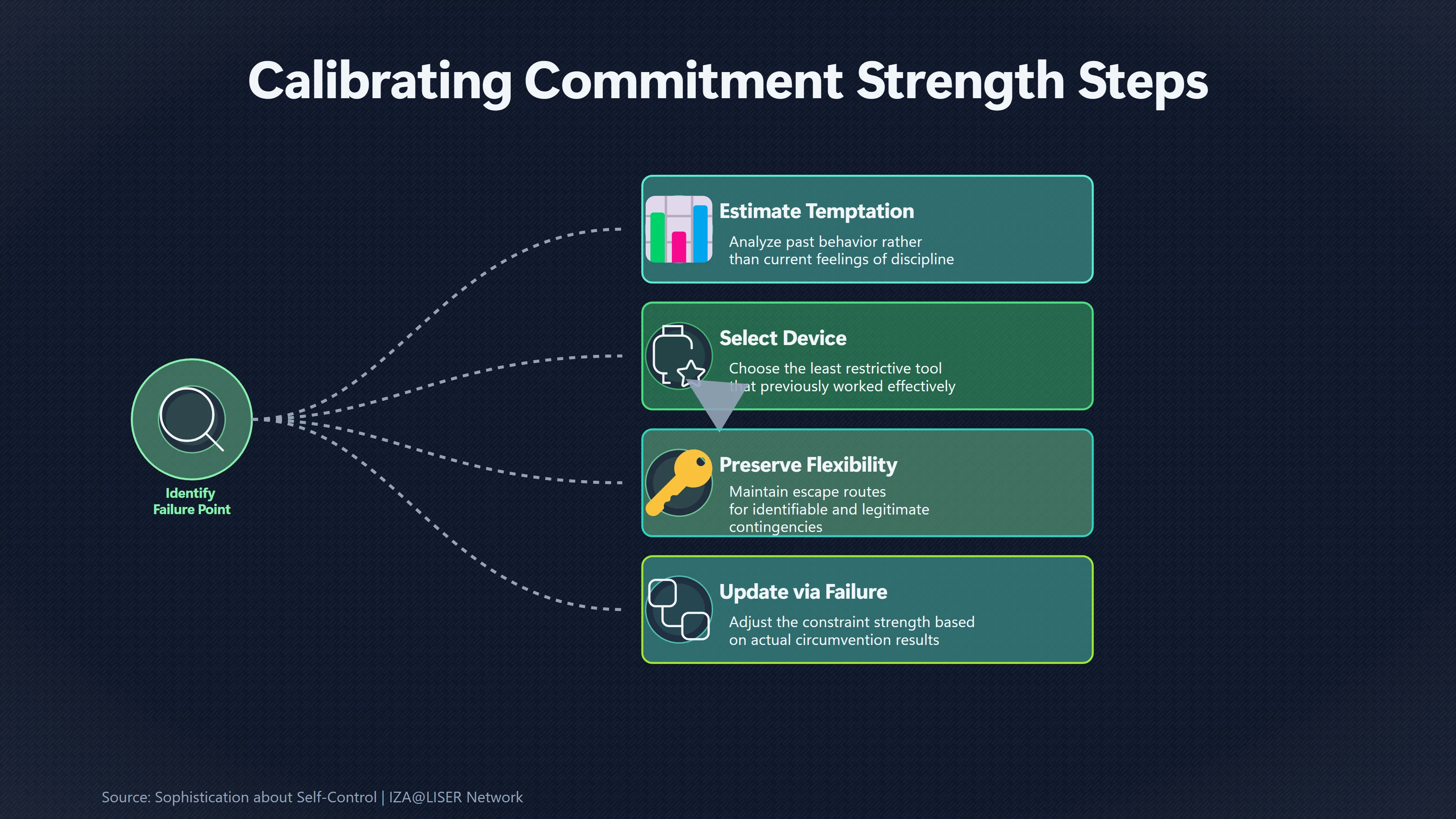
The most useful calibration rule is to begin with the specific failure mechanism, not with the most severe commitment available. Ask what your past behaviour suggests must become difficult, slow or unavailable for the predictable lapse not to happen.
A practical sequence is:
- Identify the repeatable failure point. “I procrastinate” is too broad. “When I sit down to work after dinner, I open short-form video within ten minutes” identifies a decision that can actually be constrained.
- Estimate temptation from behaviour, not intention. Look at comparable past situations. If you have repeatedly overridden reminders but rarely circumvented a blocker, that history is better evidence about required commitment strength than how disciplined you currently feel.
- Use the least restrictive device that has previously been sufficient. If moving the phone to another room reliably solves the problem, there is little reason to lock it away for an entire evening. If a one-click override repeatedly fails, however, continuing to use it is undercommitment rather than flexibility.
- Preserve flexibility for identifiable legitimate reasons. An escape route should correspond to a real contingency, not merely the future desire to abandon the plan. A scheduled review, limited exception or deliberately inconvenient override can preserve some adaptability without restoring effortless access to the temptation.
- Update from actual failures. Repeated circumvention is evidence that the commitment is too weak. Repeated occasions when the restriction prevents sensible behaviour are evidence that it is too broad or rigid.
This approach treats commitment strength as something to be learned, rather than as a test of character. That is consistent with evidence that experience can change people’s demand for commitment. In a field experiment involving food choices, both information about commitment and direct experience with a device restricting participants to healthy foods roughly doubled subsequent demand for commitment, suggesting that people can initially underestimate its usefulness and revise their beliefs after learning what it does for them.[ScienceDirect]sciencedirect.comOpen source on sciencedirect.com.
The same learning principle should operate in the other direction. If repeated experience shows that a restriction creates costs while the feared lapse rarely occurs, weakening it is not failure. It is evidence-based recalibration.
Right-sized commitment
The central mistake is to judge a precommitment by how strict it sounds. A restriction deserves to exist only because it improves the decisions that actually occur later.
Too little commitment leaves the crucial temptation effectively intact. Too much treats every future change of mind as a self-control failure, even when circumstances have genuinely changed. Research finds evidence for both errors, although direct experimental evidence suggests that undercommitment can be the more common and costly problem.[ScienceDirect]sciencedirect.comToo much commitment? An online experiment with tempting YouTube content - ScienceDirect… Field evidence adds a further warning: a commitment can be simultaneously costly and too weak, as when a penalty is large enough to hurt after failure but not large enough to prevent the failure itself.[PubsOnline]pubsonline.informs.orgWhen Commitment Fails: Evidence from a Field Experiment | Management ScienceJune 12, 2019…
The useful question, then, is not “How can I make this impossible to break?” It is: What is the smallest advance restriction that reliably blocks the lapse I can predict, while leaving room for changes of plan that I have good reason to make?
That is the difference between merely limiting your future choices and designing a precommitment that is actually worth keeping.
Amazon book picks
Further Reading
Books and field guides related to Can You Precommit Too Much or Too Little?. Use these as the next step if you want deeper reading beyond the article.
Nudge: Improving Decisions About Health, Wealth, and Happiness
Rating: 3.5/5 from 29 Google Books ratings
Thaler and Sunstein offer a groundbreaking discussion of how to apply the science of choice to nudge people toward decisions that can imp...
Nudge
Rating: 3.5/5 from 29 Google Books ratings
Thaler and Sunstein offer a groundbreaking discussion of how to apply the science of choice to nudge people toward decisions that can imp...
Thinking in Bets: Making Smarter Decisions When You Don't Hav...
Wall Street Journal bestseller! Poker champion turned business consultant Annie Duke teaches you how to get comfortable with uncertainty...
Decisive: How to Make Better Choices in Life and Work
The New York Times-bestselling authors of Switch and Made to Stick offer a fascinating tour through the workings of our minds to reveal h...
eBay marketplace picks
Marketplace Samples
Live-tested eBay searches with available results related to this page.
Selected frommotivational poster oneBay.co.uk.




Endnotes
1.
Source: sciencedirect.com
Link:https://www.sciencedirect.com/science/article/pii/S0167268123000197
Source snippet
Too much commitment? An online experiment with tempting YouTube content - ScienceDirect...
2.
Source: iza.org
Title: Sophistication about Self-Control | IZA@LISER Network
Link:https://www.iza.org/en/publications/dp/14609/sophistication-about-self-control
Source snippet
Sophistication about Self-Control | IZA@LISER Network...
3.
Source: academic.oup.com
Link:https://academic.oup.com/scan/article/doi/10.1093/scan/nsae093/7919776
4.
Source: sciencedirect.com
Link:https://www.sciencedirect.com/science/article/pii/S0167268118303123
5.
Source: academic.oup.com
Link:https://academic.oup.com/abm/article/60/1/kaag017/8658838
6.
Source: academic.oup.com
Link:https://academic.oup.com/scan/article/19/1/nsae093/7919776
7.
Source: academic.oup.com
Link:https://academic.oup.com/ej/article/134/664/3063/7692014
8.
Source: sciencedirect.com
Title: Overexertion of Effort under Working Time Autonomy and [Feedback]({{ ‘feedback/’ | relative_url }}) Provision
Link:https://www.sciencedirect.com/science/article/pii/S0167268123001968
9.
Source: sciencedirect.com
Link:https://www.sciencedirect.com/science/article/pii/S0167268121004984
10.
Source: academic.oup.com
Link:https://academic.oup.com/book/36713/chapter/321787221
11.
Source: academic.oup.com
Link:https://academic.oup.com/book/36713/chapter-abstract/321782919
12.
Source: academic.oup.com
Link:https://academic.oup.com/book/36713/chapter/321782919
13.
Source: sciencedirect.com
Title: Temptation and commitment in the laboratory
Link:https://www.sciencedirect.com/science/article/pii/S0899825617302002
14.
Source: academic.oup.com
Link:https://academic.oup.com/scan/article/12/4/635/2972862
15.
Source: sciencedirect.com
Title: Insurance, self-control, and contract flexibility
Link:https://www.sciencedirect.com/science/article/abs/pii/S0014292116300010
16.
Source: sciencedirect.com
Link:https://www.sciencedirect.com/science/article/pii/S0167268114002686
17.
Source: academic.oup.com
Link:https://academic.oup.com/jcr/article-abstract/42/2/340/1817421
18.
Source: academic.oup.com
Link:https://academic.oup.com/book/2828/chapter-abstract/143379805
19.
Source: sciencedirect.com
Title: Do sell-side stock analysts exhibit escalation of commitment?
Link:https://www.sciencedirect.com/science/article/abs/pii/S0167268110002209
20.
Source: sciencedirect.com
Link:https://www.sciencedirect.com/science/article/abs/pii/S0306453009002650
21.
Source: academic.oup.com
Link:https://academic.oup.com/book/32883/chapter-abstract/276400050
22.
Source: academic.oup.com
Link:https://academic.oup.com/book/37237/chapter-abstract/329689910
23.
Source: academic.oup.com
Link:https://academic.oup.com/book/51915/chapter-abstract/420793215
24.
Source: sciencedirect.com
Title: Commitment and self-control
Link:https://www.sciencedirect.com/science/article/pii/S0022053106001827
25.
Source: sciencedirect.com
Title: Loose knots: Strong versus weak commitments to save for education in Uganda
Link:https://www.sciencedirect.com/science/article/pii/S0304387824001937
26.
Source: sciencedirect.com
Link:https://www.sciencedirect.com/science/article/pii/S016726812500201X
27.
Source: sciencedirect.com
Title: Overexertion of Effort under Working Time Autonomy and Feedback Provision
Link:https://www.sciencedirect.com/science/article/abs/pii/S0167268123001968
28.
Source: sciencedirect.com
Link:https://www.sciencedirect.com/science/article/pii/S0167268118301768
29.
Source: sciencedirect.com
Link:https://www.sciencedirect.com/science/article/pii/S0001691826008711
30.
Source: sciencedirect.com
Link:https://www.sciencedirect.com/science/article/abs/pii/S0306453007002211
31.
Source: sciencedirect.com
Link:https://www.sciencedirect.com/science/article/abs/pii/S0167268199000268
32.
Source: sciencedirect.com
Link:https://www.sciencedirect.com/science/article/pii/S2093791123000045
33.
Source: sciencedirect.com
Title: Self-[consistency]({{ ‘consistency/’ | relative_url }}) and inequity dissonance as factors in undercompensation
Link:https://www.sciencedirect.com/science/article/pii/0030507372900633
34.
Source: youtube.com
Title: David Laibson
Link:https://www.youtube.com/watch?v=heO2RXvU8U4
Source snippet
Tying Your Own Hands: How Commitment Devices Outsmart Future You...
35.
Source: youtube.com
Title: Tying Your Own Hands: How Commitment Devices Outsmart Future You
Link:https://www.youtube.com/watch?v=3oKstOf247Q
Source snippet
Time Inconsistency / The Beta-Delta Model / Hyperbolic Discounting...
36.
Source: youtube.com
Title: Time Inconsistency / The Beta-Delta Model / Hyperbolic Discounting
Link:https://www.youtube.com/watch?v=6p0J6gFwQ1c
Source snippet
Present Bias: Why You'll Save "Starting Next Month" Forever...
37.
Source: youtube.com
Title: Present Bias: Why You’ll Save “Starting Next Month” Forever
Link:https://www.youtube.com/watch?v=IApu8OLKiuw
Source snippet
Behavioral Economics: Crash Course Economics #27...
38.
Source: youtube.com
Title: Behavioral Economics: Crash Course Economics #27
Link:https://www.youtube.com/watch?v=dqxQ3E1bubI
Source snippet
Commitment device behavioral economics self control Tying Your Own Hands: How Commitment Devices Outsmart Future You...
39.
Source: journals.sagepub.com
Link:https://journals.sagepub.com/doi/10.1111/1467-9280.00441
Source snippet
Sage JournalsProcrastination, Deadlines, and Performance: Self-Control by Precommitment - Dan Ariely, Klaus Wertenbroch, 2002...
40.
Source: pubsonline.informs.org
Link:https://pubsonline.informs.org/doi/10.1287/mnsc.2018.3236
Source snippet
When Commitment Fails: Evidence from a Field Experiment | Management ScienceJune 12, 2019...
Published: June 12, 2019
41.
Source: blogs.worldbank.org
Title: World Bank Blogs When Commitment Fails: Guest Post by Anett Hofmann
Link:https://blogs.worldbank.org/en/impactevaluations/when-commitment-fails-guest-post-anett-hofmann
42.
Source: aeaweb.org
Title: American Economic Association Why Don’t Present-Biased Agents Make Commitments?
Link:https://www.aeaweb.org/articles?id=10.1257%2Faer.p20151084
Source snippet
American Economic AssociationWhy Don't Present-Biased Agents Make Commitments? - American Economic Association...
43.
Source: pubs.aeaweb.org
Title: AEA Publications Why Don’t Present-Biased Agents Make Commitments?
Link:https://pubs.aeaweb.org/doi/10.1257/aer.p20151084
Source snippet
AEA PublicationsWhy Don't Present-Biased Agents Make Commitments? - American Economic Association...
44.
Source: annualreviews.org
Title: Annual Reviews Commitment Devices | Annual Reviews
Link:https://www.annualreviews.org/doi/10.1146/annurev.economics.102308.124324
45.
Source: nber.org
Link:https://www.nber.org/papers/w21474
46.
Source: aeaweb.org
Title: Dynamic Inconsistency in Risky Choice: Evidence from the Lab and Field
Link:https://www.aeaweb.org/articles?id=10.1257%2Faer.20210307
47.
Source: aeaweb.org
Title: American Economic Association
Link:https://www.aeaweb.org/conference/2023/program/1847?q=eNqrVipOLS7OzM8LqSxIVbKqhnGVrJQMlWp1lBKLi_OTgRwlHaWS1KJcXAgrJbESKpSZmwphlWWmloO0FxUUXDAFTA1AegsS00GyZkq1XDBurh4Z
48.
Source: doi.org
Link:https://doi.org/10.1073/pnas.2018726118
49.
Source: nber.org
Link:https://www.nber.org/papers/w26161
50.
Source: nber.org
Link:https://www.nber.org/papers/w25802
51.
Source: aeaweb.org
Title: Soft Commitments, Reminders, and Academic Performance
Link:https://www.aeaweb.org/articles?id=10.1257%2Fapp.20170288
52.
Source: aeaweb.org
Title: Alcohol and Self-Control: A Field Experiment in India
Link:https://www.aeaweb.org/articles?id=10.1257%2Faer.20170458
53.
Source: aeaweb.org
Link:https://www.aeaweb.org/articles?id=10.1257%2Fpol.20130351
54.
Source: aeaweb.org
Title: Risk, Delay, and Convex Self-Control Costs
Link:https://www.aeaweb.org/articles?id=10.1257%2Fmic.3.3.34
55.
Source: annualreviews.org
Title: Commitment Devices | Annual Reviews
Link:https://www.annualreviews.org/doi/pdf/10.1146/annurev.economics.102308.124324
56.
Source: annualreviews.org
Title: Commitment Devices | Annual Reviews
Link:https://www.annualreviews.org/content/journals/10.1146/annurev.economics.102308.124324
57.
Source: aeaweb.org
Title: A “Dual Self” Representation for Stochastic Temptation
Link:https://www.aeaweb.org/articles?id=10.1257%2Fmic.1.2.148
58.
Source: aeaweb.org
Title: Teamwork as a Self-Disciplining Device
Link:https://www.aeaweb.org/articles?id=10.1257%2Fmic.20160217
59.
Source: aeaweb.org
Title: A Dual-Self Model of Impulse Control
Link:https://www.aeaweb.org/articles?id=10.1257%2Faer.96.5.1449
60.
Source: aeaweb.org
Link:https://www.aeaweb.org/articles?id=10.1257%2Faer.20201333
61.
Source: aeaweb.org
Title: Doing It Now or Later
Link:https://www.aeaweb.org/articles?id=10.1257%2Faer.89.1.103
62.
Source: journals.sagepub.com
Title: 1467 9280.00441
Link:https://journals.sagepub.com/doi/abs/10.1111/1467-9280.00441
63.
Source: gu.se
Link:https://www.gu.se/en/about/find-staff/claesek
Additional References
64.
Source: pubmed.ncbi.nlm.nih.gov
Link:https://pubmed.ncbi.nlm.nih.gov/12009041/
Source snippet
Procrastination, deadlines, and performance: self-control by precommitment - PubMed...
65.
Source: researchrepository.ucd.ie
Link:https://researchrepository.ucd.ie/entities/publication/529b450d-e9dc-4d6e-be2d-0ef60e5b6a0b
Source snippet
UCD Research RepositoryToo much commitment? An online experiment with tempting YouTube content...
66.
Source: psychologicalscience.org
Title: Procrastination, Deadlines, and Performance: Self-Control by Precommitment
Link:https://www.psychologicalscience.org/journals/psychological-science/1467-9280.00441/
67.
Source: povertyactionlab.org
Link:https://www.povertyactionlab.org/evaluation/commitment-savings-products-philippines?lang=en
68.
Source: poverty-action.org
Link:https://poverty-action.org/publication/when-commitment-fails-%E2%80%93-evidence-field-experiment
69.
Source: hks.harvard.edu
Link:https://www.hks.harvard.edu/publications/self-control-and-commitment-can-decreasing-liquidity-savings-account-increase-deposits
70.
Source: bibbase.org
Link:https://bibbase.org/network/publication/ariely-wertenbroch-procrastinationdeadlinesandperformanceselfcontrolbyprecommitment-2002
71.
Source: researchgate.net
Link:https://www.researchgate.net/publication/11362417_Procrastination_Deadlines_and_Performance_Self-Control_by_Precommitment
72.
Source: stafforini.com
Link:https://stafforini.com/works/ariely-2002-procrastination-deadlines-performance/
73.
Source: nationalacademies.org
Link:https://www.nationalacademies.org/read/26874/chapter/7