Within Simple Metrics
Track the Behaviour Before Judging the Outcome
When a plan is not happening reliably, tracking whether the behaviour occurred is usually more useful than tracking its downstream results.
On this page
- Why weak adherence makes outcome data hard to interpret
- Choosing one behaviour measure that answers the immediate question
- When stable adherence justifies switching to an outcome metric
Page outline Jump by section
Introduction
When a self-improvement plan is not happening reliably, track the behaviour before judging the outcome. If the plan is to exercise three times a week but only one session usually happens, changes in fitness, weight or mood cannot yet tell you much about whether three weekly sessions would work. The immediate uncertainty is simpler: can you execute the plan consistently enough to test it?
Behaviour-change research formally distinguishes monitoring a behaviour from monitoring its downstream outcomes, while research on implementation fidelity makes the diagnostic point especially clear: weak implementation can make an effective intervention look ineffective.[NICE]nice.org.ukRecommendations | Behaviour change: individual approaches | Guidance | NICEJanuary 2, 2014…
This is a rule for choosing the next useful metric, not an argument that outcomes never matter. While adherence is unstable, use one simple measure of whether the intended action occurred. Once the behaviour is reliably happening for long enough to produce a meaningful result, promote the outcome metric.
Why weak adherence makes outcomes hard to interpret
Imagine that you plan four 30-minute study sessions each week because you want to improve your exam performance. After six weeks, your test scores have barely changed. There are at least two very different explanations:
- Execution failure: you rarely completed the four sessions, so the intended study routine was never properly tested.
- Strategy failure: you reliably completed the sessions, but that amount or method of studying did not improve learning.
The same disappointing outcome appears under both explanations, but the appropriate response is different. In the first case, changing study methods may be premature; you first need to make the routine executable. In the second, continuing to optimise reminders and scheduling may miss the point; the routine is happening, so its effectiveness deserves scrutiny.
This resembles the problem of implementation fidelity in intervention research. The Medical Research Council’s process-evaluation framework separates what was implemented and how from the outcomes subsequently observed. Its guidance notes that an intervention can have limited effects because its design is weak or because it was not properly implemented, which is why measures such as fidelity and dose help researchers interpret outcome results.[PubMed Central (PMC)]pmc.ncbi.nlm.nih.govPubMed Central (PMC)Process evaluation of complex interventions: Medical Research Council guidance - PMCMarch 19, 2015… Public Health England’s evaluation guidance makes the practical consequence explicit: understanding what was actually delivered is important because interpretation of outcomes depends on it.[GOV.UK]GOV.UKProcess evaluation: evaluation in health and wellbeingProcess evaluation: evaluation in health and wellbeing
A personal plan is not a clinical trial, but the diagnostic logic transfers well. If your intended “dose” is four study sessions and you complete one, you have mainly learnt that the present system produces about one session. You have not obtained a clean test of what four sessions would do.
Outcomes also have more competing causes
Downstream measures are often influenced by much more than the behaviour being changed. Body weight can move with fluid balance as well as eating and activity. Running performance can vary with sleep, illness, weather and accumulated fatigue. A weekly productivity rating may reflect workload as much as a new planning routine.
The further a measure sits downstream from your action, the more opportunities there are for other factors to affect it. Logic-model guidance therefore distinguishes implementation — what gets delivered in practice — from mechanisms and eventual outcomes.[GOV.UK]GOV.UKCreating a logic model for an intervention: evaluation in health and wellbeingCreating a logic model for an intervention: evaluation in health and wellbeing When adherence itself is uncertain, moving immediately to the end of that causal chain creates an avoidable interpretation problem.
This does not mean behavioural measures are inherently superior. It means they are closer to the decision you currently need to make.
Choose the behaviour measure that answers one question
The useful question during weak adherence is usually: Did the behaviour I intended to perform actually happen often enough?
Behaviour-change science treats this as a distinct measurement target. The Behaviour Change Technique Taxonomy separates “self-monitoring of behaviour” from “self-monitoring of outcomes of behaviour”. The former records the action itself; the latter records consequences produced by that action.[PubMed]pubmed.ncbi.nlm.nih.govThe behavior change technique taxonomy (v1) of 93 hierarchically clustered techniques: building an international consensus for the… NICE similarly distinguishes monitoring behaviours from outcomes and recommends goals, action plans, coping plans and review in light of progress.[NICE]nice.org.ukRecommendations | Behaviour change: individual approaches | Guidance | NICEJanuary 2, 2014…
For personal use, that distinction can produce deliberately boring metrics:
- Exercise: planned sessions completed out of planned sessions.
- Studying: planned study blocks started.
- Writing: planned writing sessions completed.
- Meditation: days the planned practice occurred.
- Bedtime routine: nights the routine began within the chosen window.
The aim is not to construct a comprehensive record. It is to make one decision legible.
Suppose you plan three gym visits a week. A weekly entry of 1/3, 2/3, 1/3, 2/3 is already highly actionable. Before worrying about strength gains or body-composition changes, you know that the planned frequency is not being achieved reliably. That directs attention towards the plan’s execution: its timing, difficulty, cues, competing commitments or minimum viable version.
Research supports monitoring as a useful self-regulation technique, although it does not support the stronger claim that more tracking is always better. A meta-analysis covering 138 experimental studies and 19,951 participants found that interventions designed to increase progress monitoring increased both monitoring and goal attainment; effects on attainment were larger when progress was physically recorded or reported publicly.[PubMed]pubmed.ncbi.nlm.nih.govDoes monitoring goal progress promote goal attainment? A meta-analysis of the experimental evidence - PubMedFebruary 1, 2016… A later meta-review of 66 meta-analyses found support for components including self-monitoring, goal setting and personalised feedback, but stressed that none worked consistently for every behaviour and population and that much of the evidence had methodological limitations.[PubMed]pubmed.ncbi.nlm.nih.govOpen source on nih.gov.
That uncertainty strengthens rather than weakens the case for minimalism: use monitoring to resolve a specific uncertainty instead of assuming that a larger dashboard must produce better self-regulation.
Measure occurrence before optimising quality
There is another useful hierarchy inside behaviour measurement itself. When initiation is the bottleneck, measuring fine details of performance can be premature.
Someone who repeatedly misses planned writing sessions probably does not first need a sophisticated “writing quality” score. Someone who cannot establish a walking routine may gain little from analysing pace zones. If meditation happens twice in a planned seven days, detailed ratings of depth or concentration can distract from the more basic failure mode.
A good first measure therefore often has a binary or countable form: happened/did not happen, or completed opportunities/planned opportunities. Once occurrence becomes dependable, duration, volume or quality can become relevant if they answer the next question.
This emphasis on enactment fits broader evidence on the gap between goals and action. Implementation intentions — plans specifying when, where or under what cue an action will occur — have repeatedly been studied as a way of helping people translate intentions into behaviour. A 2024 meta-analysis covering 642 independent tests found benefits across behavioural, cognitive and affective outcomes, with stronger effects when plans used a contingent if–then format and were rehearsed.[DOI]doi.orgOpen source on doi.org. The practical lesson is not that everyone needs an elaborate planning technique, but that “wanting the outcome” and “reliably initiating the behaviour” are separate problems.
Repeated behaviour also matters for habit formation. In a well-known 12-week field study, participants chose a daily eating, drinking or activity behaviour performed in a consistent context. Greater consistency was associated with clearer development of automaticity, while the time required varied considerably between individuals. Importantly, missing a single opportunity did not materially derail habit formation.[Wiley Online Library]onlinelibrary.wiley.comOpen source on wiley.com. That argues against treating an imperfect streak as failure: the useful signal is the pattern of repetition, not perfection.
Let misses trigger changes to the plan
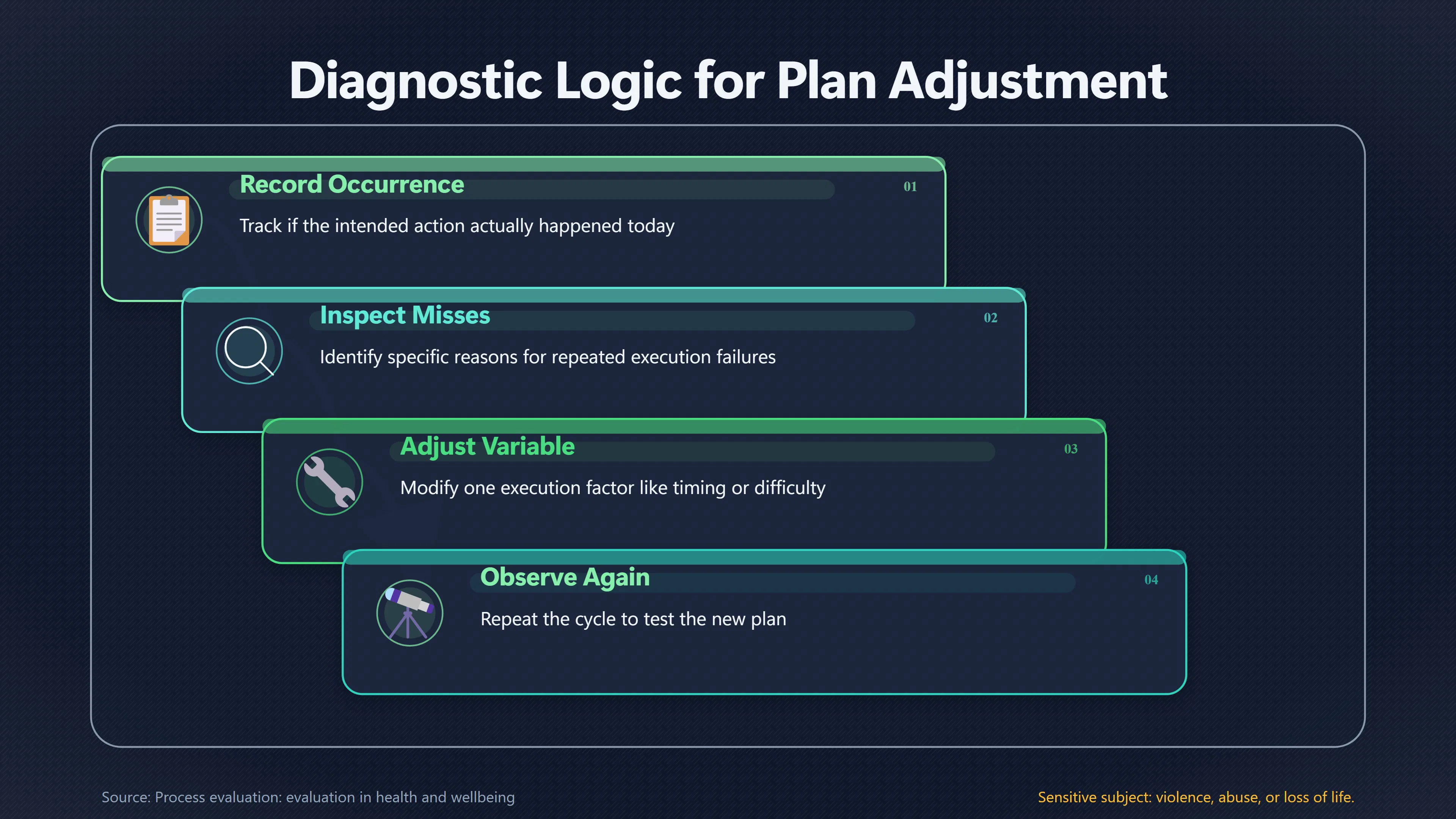
A behaviour metric becomes valuable when it governs a decision. Repeated misses should therefore prompt investigation of why the action is not occurring, rather than merely producing a disappointing score.
Consider a planned after-work exercise session. If the record shows that Monday and Wednesday sessions repeatedly disappear, the next intervention should target execution. Perhaps work regularly finishes late. Perhaps travelling to a gym adds too much friction. Perhaps the planned session is too demanding to start when tired. The useful adjustment might be moving the session, shortening its minimum version or attaching it to a more reliable cue.
The metric has done its job when it narrows the problem.
A simple governance rule is:
Planned behaviour → record occurrence → inspect repeated misses → change one execution variable → observe again.
This is different from chasing whichever number moved most recently. It also prevents an outcome metric from provoking the wrong response. If weight has not changed while intended dietary behaviours happened on only a minority of days, tightening the diet further may make adherence even worse. If a learning score has stalled while study sessions were rarely completed, increasing the sophistication of the study method may add complexity to a routine that already fails to start.
There is empirical reason to keep this distinction cautious rather than absolute. A meta-review examining self-regulatory techniques in diet, physical activity and weight-loss interventions found inconsistent results across reviews. Notably, its synthesis of the Harkin progress-monitoring evidence reported that monitoring behaviour had a sizeable association with behavioural change but no reliable effect on outcomes in that particular analysis. The authors also warned that evidence linking individual behaviour-change techniques to outcomes is methodologically difficult to interpret because interventions contain multiple interacting components.[PubMed Central (PMC)]pmc.ncbi.nlm.nih.govOpen source on nih.gov.
So the case for behaviour-first measurement is primarily diagnostic: it tells you whether the intended input is occurring. It should not be inflated into a promise that recording a behaviour automatically produces its desired outcome.
When stable adherence justifies an outcome metric
Behaviour-first tracking has an expiry condition. Once adherence becomes sufficiently stable, repeatedly confirming “yes, I did it” yields less new information. The important uncertainty moves downstream.
Suppose the planned study routine changes from erratic completion to 4/4 sessions most weeks. Now a flat learning outcome means something more interesting. The behaviour is being delivered with reasonable consistency, so questions about its effectiveness become legitimate: Are retrieval-practice scores improving? Is knowledge retained after a delay? Are exam-style questions becoming easier?
The same transition applies elsewhere:
Exercise: first establish that training sessions happen; then ask whether strength, endurance or another chosen performance outcome is improving.
Writing: first establish a repeatable writing practice; then assess whether it produces finished work of sufficient quality.
Sleep routine: first establish whether the chosen routine is actually followed; then judge whether it improves the outcome it was designed to influence.
There is no universal adherence percentage at which this switch should occur. The required period depends on the behaviour and on how quickly its outcome could reasonably change. A routine with an immediate result can be assessed sooner than one whose effects accumulate over months. Research on self-regulation also gives no defensible universal threshold: effects vary across behaviours, populations and intervention designs.[PubMed]pubmed.ncbi.nlm.nih.govOpen source on nih.gov.
The more useful criterion is informational: has adherence stopped being the main uncertainty? If you already know that the behaviour is happening reliably, continuing to make adherence the headline metric can become another form of measurement inertia.

The metric should move with the bottleneck
Behaviour metrics before outcome metrics is therefore a sequencing rule, not a permanent hierarchy.
Early on, the decisive uncertainty is often execution: “Can I get myself to do this reliably?” Measure the smallest observable behaviour that answers that question. If the answer is repeatedly no, alter the conditions under which the behaviour must occur rather than over-interpreting downstream results.
Later, the uncertainty can become effectiveness: “Now that I am actually doing this, is it producing the result I wanted?” At that point, an outcome metric earns its place.
The underlying governance principle is simple: do not judge a plan mainly by its downstream results until you know the plan has been implemented well enough to receive a fair test. That mirrors the logic used in formal intervention evaluation, where implementation, mechanisms and outcomes are distinguished precisely because an observed result is difficult to interpret without knowing what actually happened.[GOV.UK]GOV.UKProcess evaluation: evaluation in health and wellbeingProcess evaluation: evaluation in health and wellbeing
For self-improvement, this often leaves a remarkably small tracking system. When adherence is weak, one behaviour count may be enough. When adherence stabilises, retain it only as a light check and move attention to the outcome that can now answer the next decision.
Amazon book picks
Further Reading
Books and field guides related to Track the Behaviour Before Judging the Outcome. Use these as the next step if you want deeper reading beyond the article.
How to Measure Anything
Now updated with new research and even more intuitive explanations, a demystifying explanation of how managers can inform themselves to m...
Atomic Habits
Rating: 3.5/5 from 7 Google Books ratings
The #1 New York Times bestseller. Over 25 million copies sold! Translated into 60+ languages! Tiny Changes, Remarkable Results No matter...
Tiny Habits
Improving your life is much easier than you think. Whether it’s losing weight, sleeping more, or restoring your work/life balance – the s...
The Checklist Manifesto
THE GAME-CHANGING BOOK FROM THE BESTSELLING AUTHOR OF BEING MORTAL Today we find ourselves in possession of stupendous know-how, which we...
eBay marketplace picks
Marketplace Samples
Live-tested eBay searches with available results related to this page.
Selected fromhabit tracker calendar oneBay.co.uk.



Endnotes
1.
Source: nice.org.uk
Link:https://www.nice.org.uk/Guidance/PH49/chapter/recommendations
Source snippet
Recommendations | Behaviour change: individual approaches | Guidance | NICEJanuary 2, 2014...
Published: January 2, 2014
2.
Source: GOV.UK
Title: Process evaluation: evaluation in health and wellbeing
Link:https://www.gov.uk/guidance/evaluation-in-health-and-wellbeing-process
3.
Source: GOV.UK
Title: Creating a logic model for an intervention: evaluation in health and wellbeing
Link:https://www.gov.uk/guidance/evaluation-in-health-and-wellbeing-creating-a-logic-model
4.
Source: doi.org
Link:https://doi.org/10.1080/10463283.2024.2334563
5.
Source: onlinelibrary.wiley.com
Link:https://onlinelibrary.wiley.com/doi/10.1002/ejsp.674
6.
Source: doi.org
Link:https://doi.org/10.1186/s12913-026-14628-6
7.
Source: onlinelibrary.wiley.com
Link:https://onlinelibrary.wiley.com/doi/full/10.1111/obr.70066
8.
Source: doi.org
Link:https://doi.org/10.1111/obr.13306
9.
Source: onlinelibrary.wiley.com
Link:https://onlinelibrary.wiley.com/doi/full/10.1111/obr.13306
10.
Source: GOV.UK
Title: www.gov.uk Behaviour change techniques review: descriptive studies
Link:https://www.gov.uk/guidance/behaviour-change-techniques-review-descriptive-studies
11.
Source: health-ni.gov.uk
Title: Endorsed NICE Public Health Guidelines | Department of Health
Link:https://www.health-ni.gov.uk/publications/endorsed-nice-public-health-guidelines
12.
Source: bpspsychub.onlinelibrary.wiley.com
Link:https://bpspsychub.onlinelibrary.wiley.com/doi/10.1111/bjhp.12394
13.
Source: GOV.UK
Title: www.gov.uk[Withdrawn] Process evaluation
Link:https://www.gov.uk/government/publications/evaluation-in-health-and-well-being-overview/process-evaluation
14.
Source: compass.onlinelibrary.wiley.com
Link:https://compass.onlinelibrary.wiley.com/doi/pdf/10.1111/spc3.12265
15.
Source: compass.onlinelibrary.wiley.com
Link:https://compass.onlinelibrary.wiley.com/doi/abs/10.1111/spc3.12265
16.
Source: health-ni.gov.uk
Link:https://www.health-ni.gov.uk/articles/nice-public-health-guidance
17.
Source: bpspsychub.onlinelibrary.wiley.com
Link:https://bpspsychub.onlinelibrary.wiley.com/doi/10.1111/bjc.12086
18.
Source: doi.org
Link:https://doi.org/10.1080/17437199.2011.603640%C2%A0
19.
Source: onlinelibrary.wiley.com
Link:https://onlinelibrary.wiley.com/doi/abs/10.1002/ejsp.674
20.
Source: onlinelibrary.wiley.com
Link:https://onlinelibrary.wiley.com/doi/abs/10.1002/ejsp.674?MixPanelId=15e3fe314440-0468d8411-64220f54-100000-15e3fe314460
21.
Source: onlinelibrary.wiley.com
Link:https://onlinelibrary.wiley.com/doi/abs/10.1002/ejsp.674?msockid=17570258034862e732eb114c02616368
22.
Source: onlinelibrary.wiley.com
Link:https://onlinelibrary.wiley.com/doi/abs/10.1002/ejsp.674?msockid=038ed114f43667dd0790c4bef5146634
23.
Source: onlinelibrary.wiley.com
Link:https://onlinelibrary.wiley.com/doi/abs/10.1002/ejsp.674?cf_chl_jschl_tk=pmd_EwcJDaCFBR9OVEL1O_0qjioww0Gc86ZzpBvCBFhrDcE-1635261061-0-gqNtZGzNAjujcnBszQi9
24.
Source: doi.org
Link:https://doi.org/10.1186/1748-5908-2-40?uid=9fdd2257s16
25.
Source: doi.org
Link:https://doi.org/10.1093/ajcn/nqx048
26.
Source: pmc.ncbi.nlm.nih.gov
Title: Pub Med Central (PMC)A conceptual framework for implementation fidelity
Link:https://pmc.ncbi.nlm.nih.gov/articles/PMC2213686/
Source snippet
PubMed Central (PMC)A conceptual framework for implementation fidelity - PMC...
27.
Source: pmc.ncbi.nlm.nih.gov
Link:https://pmc.ncbi.nlm.nih.gov/articles/PMC4366184/
Source snippet
PubMed Central (PMC)Process evaluation of complex interventions: Medical Research Council guidance - PMCMarch 19, 2015...
Published: March 19, 2015
28.
Source: pubmed.ncbi.nlm.nih.gov
Link:https://pubmed.ncbi.nlm.nih.gov/23512568/
Source snippet
The behavior change technique taxonomy (v1) of 93 hierarchically clustered techniques: building an international consensus for the...
29.
Source: ncbi.nlm.nih.gov
Link:https://www.ncbi.nlm.nih.gov/books/NBK567039/
Source snippet
Developing an evidence-based online method of linking behaviour change techniques and theoretical mechanisms of action: a multiple method...
30.
Source: pubmed.ncbi.nlm.nih.gov
Link:https://pubmed.ncbi.nlm.nih.gov/26479070/
Source snippet
Does monitoring goal progress promote goal attainment? A meta-analysis of the experimental evidence - PubMedFebruary 1, 2016...
Published: February 1, 2016
31.
Source: pubmed.ncbi.nlm.nih.gov
Link:https://pubmed.ncbi.nlm.nih.gov/31662031/
32.
Source: pmc.ncbi.nlm.nih.gov
Link:https://pmc.ncbi.nlm.nih.gov/articles/PMC7571594/
33.
Source: pmc.ncbi.nlm.nih.gov
Link:https://pmc.ncbi.nlm.nih.gov/articles/PMC7429262/
34.
Source: pubmed.ncbi.nlm.nih.gov
Link:https://pubmed.ncbi.nlm.nih.gov/31973666/
35.
Source: pubmed.ncbi.nlm.nih.gov
Link:https://pubmed.ncbi.nlm.nih.gov/41784001/
36.
Source: pmc.ncbi.nlm.nih.gov
Link:https://pmc.ncbi.nlm.nih.gov/articles/PMC12750492/
37.
Source: pmc.ncbi.nlm.nih.gov
Link:https://pmc.ncbi.nlm.nih.gov/articles/PMC12133765/
38.
Source: pubmed.ncbi.nlm.nih.gov
Link:https://pubmed.ncbi.nlm.nih.gov/40470022/
39.
Source: pubmed.ncbi.nlm.nih.gov
Link:https://pubmed.ncbi.nlm.nih.gov/39952422/
40.
Source: pubmed.ncbi.nlm.nih.gov
Link:https://pubmed.ncbi.nlm.nih.gov/39528004/
41.
Source: pmc.ncbi.nlm.nih.gov
Link:https://pmc.ncbi.nlm.nih.gov/articles/PMC10427801/
42.
Source: pmc.ncbi.nlm.nih.gov
Link:https://pmc.ncbi.nlm.nih.gov/articles/PMC10765525/
43.
Source: pmc.ncbi.nlm.nih.gov
Link:https://pmc.ncbi.nlm.nih.gov/articles/PMC9685716/
44.
Source: pmc.ncbi.nlm.nih.gov
Link:https://pmc.ncbi.nlm.nih.gov/articles/PMC9328789/
45.
Source: pubmed.ncbi.nlm.nih.gov
Link:https://pubmed.ncbi.nlm.nih.gov/35264084/
46.
Source: pmc.ncbi.nlm.nih.gov
Link:https://pmc.ncbi.nlm.nih.gov/articles/PMC8791066/
47.
Source: pmc.ncbi.nlm.nih.gov
Link:https://pmc.ncbi.nlm.nih.gov/articles/8482308/
48.
Source: pmc.ncbi.nlm.nih.gov
Link:https://pmc.ncbi.nlm.nih.gov/articles/PMC8149892/
49.
Source: pubmed.ncbi.nlm.nih.gov
Link:https://pubmed.ncbi.nlm.nih.gov/34054628/
50.
Source: pmc.ncbi.nlm.nih.gov
Link:https://pmc.ncbi.nlm.nih.gov/articles/PMC7970161/
51.
Source: pmc.ncbi.nlm.nih.gov
Link:https://pmc.ncbi.nlm.nih.gov/articles/PMC8279202/
52.
Source: pmc.ncbi.nlm.nih.gov
Link:https://pmc.ncbi.nlm.nih.gov/articles/PMC7650157/
53.
Source: pmc.ncbi.nlm.nih.gov
Link:https://pmc.ncbi.nlm.nih.gov/articles/PMC8114368/
54.
Source: pubmed.ncbi.nlm.nih.gov
Link:https://pubmed.ncbi.nlm.nih.gov/31856664/
55.
Source: pubmed.ncbi.nlm.nih.gov
Link:https://pubmed.ncbi.nlm.nih.gov/31662031/?dopt=Abstract
56.
Source: pmc.ncbi.nlm.nih.gov
Link:https://pmc.ncbi.nlm.nih.gov/articles/PMC7018570/
57.
Source: pmc.ncbi.nlm.nih.gov
Link:https://pmc.ncbi.nlm.nih.gov/articles/PMC7004004/
58.
Source: pmc.ncbi.nlm.nih.gov
Link:https://pmc.ncbi.nlm.nih.gov/articles/PMC7254887/
59.
Source: pubmed.ncbi.nlm.nih.gov
Link:https://pubmed.ncbi.nlm.nih.gov/31707938/
60.
Source: pmc.ncbi.nlm.nih.gov
Link:https://pmc.ncbi.nlm.nih.gov/articles/PMC6693254/
61.
Source: pubmed.ncbi.nlm.nih.gov
Link:https://pubmed.ncbi.nlm.nih.gov/31409357/
62.
Source: pmc.ncbi.nlm.nih.gov
Link:https://pmc.ncbi.nlm.nih.gov/articles/PMC6634259/
63.
Source: pmc.ncbi.nlm.nih.gov
Link:https://pmc.ncbi.nlm.nih.gov/articles/PMC6419826/
64.
Source: pmc.ncbi.nlm.nih.gov
Link:https://pmc.ncbi.nlm.nih.gov/articles/PMC6069979/
65.
Source: ncbi.nlm.nih.gov
Link:https://www.ncbi.nlm.nih.gov/books/NBK501960/
66.
Source: pmc.ncbi.nlm.nih.gov
Link:https://pmc.ncbi.nlm.nih.gov/articles/PMC6041897/
67.
Source: pmc.ncbi.nlm.nih.gov
Link:https://pmc.ncbi.nlm.nih.gov/articles/PMC5645837/
68.
Source: pubmed.ncbi.nlm.nih.gov
Link:https://pubmed.ncbi.nlm.nih.gov/28762607/
69.
Source: pmc.ncbi.nlm.nih.gov
Link:https://pmc.ncbi.nlm.nih.gov/articles/PMC5655766/
70.
Source: pubmed.ncbi.nlm.nih.gov
Link:https://pubmed.ncbi.nlm.nih.gov/28392775/
71.
Source: pmc.ncbi.nlm.nih.gov
Link:https://pmc.ncbi.nlm.nih.gov/articles/PMC4957914/
72.
Source: pubmed.ncbi.nlm.nih.gov
Link:https://pubmed.ncbi.nlm.nih.gov/30202289/
73.
Source: pubmed.ncbi.nlm.nih.gov
Link:https://pubmed.ncbi.nlm.nih.gov/25965276/
74.
Source: nice.org.uk
Title: 1 Recom
Link:https://www.nice.org.uk/guidance/ph49/chapter/1-Recom-
75.
Source: nice.org.uk
Link:https://www.nice.org.uk/guidance/ph49/evidence
76.
Source: nice.org.uk
Link:https://www.nice.org.uk/Guidance/ph49?print=true
77.
Source: nice.org.uk
Title: ph49 behaviour change individual approaches baseline assessment tool2
Link:https://www.nice.org.uk/guidance/ph49/resources/ph49-behaviour-change-individual-approaches-baseline-assessment-tool2
78.
Source: pubmed.ncbi.nlm.nih.gov
Link:https://pubmed.ncbi.nlm.nih.gov/22340523/
79.
Source: pubmed.ncbi.nlm.nih.gov
Link:https://pubmed.ncbi.nlm.nih.gov/22390739/
80.
Source: pmc.ncbi.nlm.nih.gov
Link:https://pmc.ncbi.nlm.nih.gov/articles/PMC3171488/
81.
Source: pubmed.ncbi.nlm.nih.gov
Link:https://pubmed.ncbi.nlm.nih.gov/21749245/
82.
Source: pubmed.ncbi.nlm.nih.gov
Link:https://pubmed.ncbi.nlm.nih.gov/21215528/
83.
Source: pmc.ncbi.nlm.nih.gov
Link:https://pmc.ncbi.nlm.nih.gov/articles/PMC3409469/
84.
Source: pubmed.ncbi.nlm.nih.gov
Link:https://pubmed.ncbi.nlm.nih.gov/26616119/
85.
Source: pmc.ncbi.nlm.nih.gov
Link:https://pmc.ncbi.nlm.nih.gov/articles/PMC4781650/
86.
Source: pubmed.ncbi.nlm.nih.gov
Link:https://pubmed.ncbi.nlm.nih.gov/21922026/
87.
Source: pubmed.ncbi.nlm.nih.gov
Link:https://pubmed.ncbi.nlm.nih.gov/12088128/
Additional References
88.
Source: bmj.com
Link:https://www.bmj.com/content/350/bmj.h1258
Source snippet
Process evaluation of complex interventions: Medical Research Council guidance | The BMJ...
89.
Source: youtube.com
Title: Behavioral Scientist BJ Fogg on Building Lasting Habits
Link:https://www.youtube.com/watch?v=h35hy4LcVFw
Source snippet
For a practical breakdown of tracking actionable behaviors rather than lagging results, check out The Four Disciplines Of Execution: Lead...
90.
Source: youtube.com
Title: The Four Disciplines Of Execution: Lead vs. Lag Measures | Jim Huling
Link:https://www.youtube.com/watch?v=c2o0TiYDYJU
Source snippet
[Process Goals]({{ 'process-goals/' | relative_url }}) VS Outcome Goals: How to Set Goals You Can Actually Achieve...
91.
Source: youtube.com
Title: Process Goals VS Outcome Goals: How to Set Goals You Can Actually Achieve
Link:https://www.youtube.com/watch?v=tfQftLaQQ7Y
Source snippet
Best Ways to Build Better Habits & Break Bad Ones | James Clear...
92.
Source: youtube.com
Title: Best Ways to Build Better Habits & Break Bad Ones | James Clear
Link:https://www.youtube.com/watch?v=bdsc3Spm6Sw
Source snippet
2 Scorecards: One for the Lead + Another for the Lag...
93.
Source: youtube.com
Title: 2 Scorecards: One for the Lead + Another for the Lag
Link:https://www.youtube.com/watch?v=k5KgWIHfg28
Source snippet
Behavioral Scientist BJ Fogg on Building Lasting Habits...
94.
Source: researchgate.net
Link:https://www.researchgate.net/publication/375980696_Automated_tailored_adaptive_mobile_messaging_to_reduce_alcohol_consumption_in_help-seeking_adults_A_randomized_controlled_trial
95.
Source: researchgate.net
Link:https://www.researchgate.net/publication/315587721_Cognitive-behavioral_therapy_for_anger_in_children_and_adolescents_a_meta-analysis
96.
Source: researchgate.net
Link:https://www.researchgate.net/publication/303854625_Developing_and_evaluating_complex_interventions_the_new_Medical_Research_Council_guidance_Public_health_England_PHE
97.
Source: researchgate.net
Link:https://www.researchgate.net/publication/291335719_Does_Monitoring_Goal_Progress_Promote_Goal_Attainment_A_Meta-Analysis_of_the_Experimental_Evidence