Within Physical Capacity
What Should Your Workout Become on a Bad Day?
A shorter backup version of a normal workout can preserve continuity when weather, travel, overtime or low energy disrupts the plan.
On this page
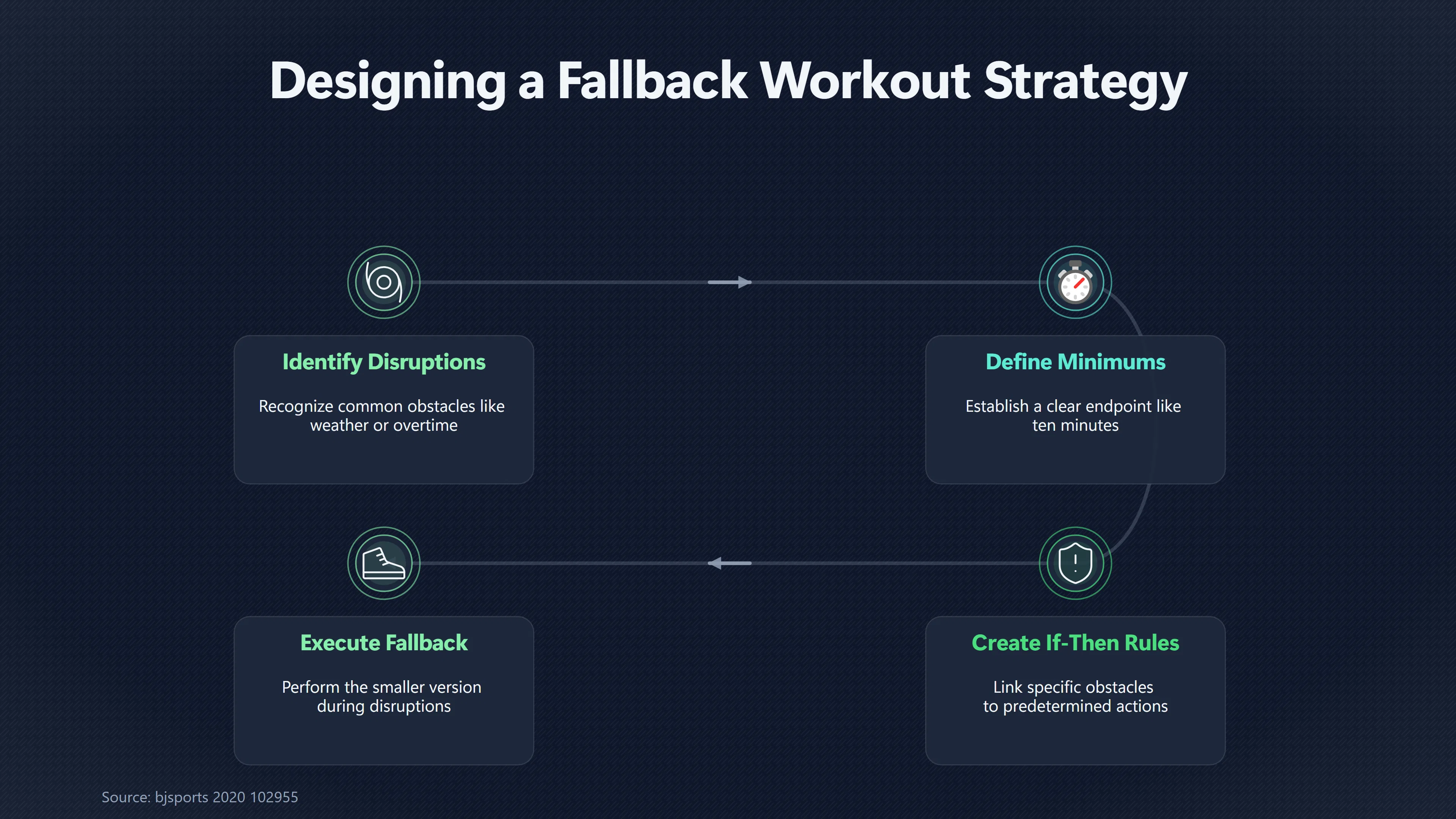
- Why rigid routines break under ordinary disruptions
- How to define a realistic minimum version
- When to use the fallback without letting it replace progression
Page outline Jump by section
Introduction
A fallback workout is a deliberately smaller version of the activity you normally planned to do, used when weather, travel, overtime, disrupted childcare or an unusually low-energy day makes the full session impractical. Its purpose is not to pretend that five or ten minutes equals a complete training session. It is to prevent an ordinary disruption from automatically becoming a day of no movement at all.
That distinction is supported by two useful strands of evidence. Modern physical-activity guidance no longer requires aerobic activity to occur in bouts of at least ten minutes: shorter bouts count, and some activity is better than none. At the same time, behavioural research suggests that planning specifically for obstacles can help translate an intention to exercise into action.[doi.org]doi.orgbjsports 2020 102955World Health Organization 2020 guidelines on physical activity and sedentary behaviourDecember 1, 2020…
For self-improvement, the practical lesson is simple: build the bad-day version before the bad day arrives. The normal workout remains the programme; the fallback is its continuity mechanism.
Why rigid routines break under ordinary disruptions
A routine can become easier to repeat when it is attached to stable circumstances. Research on physical-activity habits supports the importance of contextual cues, and a randomised walking study found that exercising in consistent contexts helped participants develop greater automaticity than planning walks in varied contexts.[PubMed]pubmed.ncbi.nlm.nih.govThe influence of context stability on physical activity and sedentary behaviour habit and behaviour: An ecological momentary assess… That is useful on normal days, but it exposes a weakness too: real life does not preserve those circumstances indefinitely.
Work runs late. A train is cancelled. Rain makes an outdoor route unpleasant. A hotel has no useful gym. A family responsibility consumes the evening. Research on physical-activity maintenance explicitly identifies changes in circumstances and disruptive work or personal responsibilities as events capable of breaking the contextual links on which habits depend.[PubMed]pubmed.ncbi.nlm.nih.govMaintaining habitual physical activity by overcoming disruptive competing actions: mechanisms and interventions - PubMedDecember 19…
The fragile response is to define success so narrowly that only the original plan qualifies. If the plan says “45 minutes at the gym after work”, an unexpected 30-minute delay can make the remaining 15 minutes seem pointless. Current guidance provides good reason not to treat it that way. The UK Chief Medical Officers state that small bouts, including those shorter than ten minutes, provide benefits, while WHO guidance says physical activity of any bout duration can contribute to health and that adults who are below recommendations should begin with small amounts and increase gradually.[gov.uk]GOV.UKU K Chief Medical Officers' physical activity guidelinesUK Chief Medical Officers' physical activity guidelines - GOV.UK…
There is also direct evidence that very short activity can have physiological value. A 2025 review and expert consensus covering 27 systematic reviews and 135 studies concluded that bouts of accumulated exercise lasting ten minutes or less can be a useful way of increasing activity and interrupting prolonged sitting.[PubMed]pubmed.ncbi.nlm.nih.govShort bouts of accumulated exercise: Review and consensus statement on definition, efficacy, feasibility, practical applications, a… Observational studies of vigorous intermittent lifestyle physical activity have likewise associated brief bursts embedded in everyday life with lower mortality and cardiovascular risk, although such findings cannot prove that the short bouts themselves caused the lower risk.[PubMed]pubmed.ncbi.nlm.nih.govOpen source on nih.gov. A newer US cohort found a similar association but warned that existing illness and reverse causation could partly explain it.[PubMed]pubmed.ncbi.nlm.nih.govOpen source on nih.gov.
None of this means that two minutes of stair climbing is physiologically equivalent to the planned run. It means that the choice on a disrupted day is not “proper workout or worthless activity”. There is meaningful territory in between.
How to define a realistic minimum version
The most useful fallback preserves the type of action while aggressively reducing whatever has become difficult: duration, volume, equipment, travel or complexity. Someone who normally walks or runs might use a brisk ten-minute walk. Someone who strength trains might do one compact round of familiar multi-joint movements. Someone stranded in a hotel might use stairs or a short equipment-free routine rather than searching for a replacement gym.
This is better designed in advance than improvised while tired. Planning interventions have a modest but meaningful evidence base in physical activity: a systematic review and meta-analysis of 41 randomised trials, including 5,439 participants, found greater physical activity in planning groups than controls, although effects varied considerably between studies.[PubMed]pubmed.ncbi.nlm.nih.govThe Effectiveness of Planning Interventions for Improving Physical Activity in the General Population: A Systematic Review and Meta… A separate review of implementation-intention interventions found that plans were particularly useful when they incorporated ways of managing expected obstacles and were reinforced over time.[PubMed Central (PMC)]pmc.ncbi.nlm.nih.govOpen source on nih.gov.
That makes a fallback well suited to an if–then rule. Instead of deciding from scratch at 8.30 pm whether exercise is still “worth it”, decide earlier: if overtime removes my normal gym session, I will walk briskly for ten minutes before going home. A large 2024 meta-analysis across 642 tests of implementation intentions found that contingent if–then formats were generally more effective than weaker forms of planning, particularly when people were already motivated to pursue the underlying goal.[DOI]doi.orgOpen source on doi.org.
A practical fallback can therefore be built around four constraints:
- Make starting almost frictionless. Remove the journey, complicated equipment, lengthy setup and unnecessary exercise choices. A fallback that still requires 30 minutes of preparation has not solved the disruption.
- Keep it recognisably connected to the normal routine. A runner might walk briskly, use stairs or run briefly; a strength trainee might retain a few familiar movement patterns with fewer sets.
- Set the minimum before motivation collapses. “Ten minutes”, “one round” or “one set of the main exercises” gives the decision a clear endpoint. “Do whatever I can” still requires negotiation.
- Allow completion to count. Once the predetermined fallback has been performed, the person has fulfilled the bad-day plan. Continuing is optional rather than required.
There is no universal scientifically established number of minutes that constitutes the ideal fallback. The correct minimum depends on fitness, normal training, goals and the nature of the disruption. Public-health recommendations provide targets for overall activity; they do not prescribe a special “consistency workout” for difficult days. The fallback is therefore best understood as a behavioural design built on evidence that smaller amounts of activity still matter, rather than as a distinct clinical exercise prescription.[DOI]doi.orgbjsports 2020 102955World Health Organization 2020 guidelines on physical activity and sedentary behaviourDecember 1, 2020…
What a fallback can preserve — and what it cannot
For someone whose main concern is general activity, a shorter session can contribute directly to the week’s total. The removal of the old ten-minute minimum is important here: five minutes of brisk walking does not become physiologically irrelevant simply because it falls short of an arbitrary session length.[PubMed Central (PMC)]pmc.ncbi.nlm.nih.govOpen source on nih.gov.
For strength or endurance training, the distinction between maintenance and progression becomes more important. Evidence on reduced-dose training suggests surprisingly large reductions in volume can sometimes preserve performance for a period. A review of training maintenance reported that endurance performance in general populations could be maintained for up to 15 weeks despite substantial reductions in training frequency or volume when intensity was maintained. It also found evidence that younger adults could maintain strength and muscle size for extended periods with as little as one strength session a week and one set per exercise, although requirements differ by population and outcome.[PubMed]pubmed.ncbi.nlm.nih.govOpen source on nih.gov.
Minimal-dose resistance-training research points in the same broad direction. Reviews conclude that low-volume strategies can improve strength, particularly in beginners and people who are otherwise doing little resistance exercise.[PubMed]pubmed.ncbi.nlm.nih.govOpen source on nih.gov. Even resistance-trained adults can respond to low-volume work: a 2025 randomised trial found appreciable improvements after eight weeks of single-set training performed twice weekly, although reducing training volume is not necessarily optimal for maximising every adaptation.[PubMed]pubmed.ncbi.nlm.nih.govOpen source on nih.gov.
That evidence should not be stretched into the claim that the shortest possible workout is the best programme. Multiple-set resistance programmes generally produce greater strength gains than single-set approaches, particularly when continued progression is the objective.[PubMed]pubmed.ncbi.nlm.nih.govOpen source on nih.gov. The useful conclusion is narrower: a large reduction in training is not the same thing as zero training, and temporary maintenance can be a sensible objective when circumstances make progression unrealistic.
When to use the fallback without letting it replace progression
A fallback works best when it has a trigger rather than becoming an easier option available whenever the normal workout feels mildly inconvenient. The distinction can be operational: use it when a genuine constraint has substantially reduced the available time, location, equipment or capacity for that day’s planned session.
Consider three ordinary disruptions. If heavy rain removes a planned outdoor run, the fallback might be ten minutes of brisk stair climbing or indoor walking. If a late meeting leaves only 15 minutes before other commitments, a strength trainee might perform a warm-up and one set of several familiar compound exercises rather than abandoning the session. If travel removes access to normal equipment, the fallback might be a short walk plus simple bodyweight movements. These are substitutions for a constrained day, not new definitions of adequate training every day.
Tracking the two separately can help preserve that distinction. Mark a normal session as full and the backup as fallback. Over several weeks, that record answers two different questions: “Did I keep moving through disruptions?” and “Am I still doing enough full training to progress?” A run of fallback sessions is therefore useful information rather than an excuse to declare the programme intact. It may indicate that the normal plan no longer fits the person’s actual schedule and needs redesigning.
There is another important boundary: “low energy” should not become a rule to exercise through illness or warning symptoms. A fallback is appropriate for ordinary tiredness or logistical disruption, not as a way of overriding reasons to rest or seek medical advice. NHS guidance advises stopping exercise with fever or acute illness and seeking medical advice for symptoms such as intense chest pain, severe unexplained breathlessness, faintness or unexplained dizziness.[Newcastle Hospitals NHS Foundation Trust]newcastle-hospitals.nhs.ukOpen source on nhs.uk.
The deeper consistency skill is therefore not maintaining identical workouts under every condition. It is maintaining an appropriate response when conditions change. On good days, train at the level required for progression. On genuinely disrupted days, execute the predetermined smaller version. When illness or concerning symptoms make exercise inappropriate, recover instead.
The minimum should protect the routine, not redefine it
Fallback workouts resolve a common tension in long-term physical activity. Stable routines are valuable because repetition in consistent contexts can support automaticity, yet a routine that works only when circumstances are ideal is inherently brittle.[PubMed]pubmed.ncbi.nlm.nih.govOpen source on nih.gov. Coping plans provide a second layer: the usual routine specifies what happens when life behaves normally; the fallback specifies what happens when a predictable obstacle appears.
This makes the strategy more useful than an abstract instruction to “be consistent”. The target is not a perfect attendance streak or an insistence that every workout be equally demanding. It is to prevent foreseeable disruptions from repeatedly forcing a fresh decision about whether physical activity happens at all.
For physical activity as capacity for other goals, that is the important payoff. A demanding week at work, a journey or a spell of bad weather does not require abandoning movement until life becomes orderly again. The workout can shrink temporarily while the broader pattern survives. Then, when the constraint passes, the full programme — and the progression it is designed to produce — resumes.
Amazon book picks
Further Reading
Books and field guides related to What Should Your Workout Become on a Bad Day?. Use these as the next step if you want deeper reading beyond the article.
No Sweat
Do you secretly hate exercising? Struggle to stick with a program? Millions of people try and fail to stay fit. But what if "exercising"...
Atomic Habits
Rating: 3.5/5 from 7 Google Books ratings
The #1 New York Times bestseller. Over 25 million copies sold! Translated into 60+ languages! Tiny Changes, Remarkable Results No matter...
Exercised
The book tells the story of how we never evolved to exercise - to do voluntary physical activity for the sake of health. Using his own re...
The Joy of Movement
The bestselling author of The Willpower Instinct introduces a surprising science-based book that doesn't tell us why we should exercise b...
eBay marketplace picks
Marketplace Samples
Live-tested eBay searches with available results related to this page.
Selected fromgym poster oneBay.co.uk.
Current eBay listing
Dumbbell Gym Workout Poster Fitness Training Exercise Chart A5–A1
Current eBay listing
Gym Motivational Posters Work Out Insperational Quotes Wall Art
Endnotes
1.
Source: doi.org
Title: bjsports 2020 102955
Link:https://doi.org/10.1136/bjsports-2020-102955
Source snippet
World Health Organization 2020 guidelines on physical activity and sedentary behaviourDecember 1, 2020...
Published: December 1, 2020
2.
Source: GOV.UK
Title: U K Chief Medical Officers’ physical activity guidelines
Link:https://www.gov.uk/government/publications/physical-activity-guidelines-uk-chief-medical-officers-report/uk-chief-medical-officers-physical-activity-guidelines
Source snippet
UK Chief Medical Officers' physical activity guidelines - GOV.UK...
3.
Source: nature.com
Link:https://www.nature.com/articles/s41591-022-02100-x
4.
Source: doi.org
Link:https://doi.org/10.1080/10463283.2024.2334563
5.
Source: newcastle-hospitals.nhs.uk
Link:https://www.newcastle-hospitals.nhs.uk/services/newcastle-occupational-health-service/information-for-staff/physiotherapy/self-help-leaflets/exercise-and-your-health-a-guide-to-getting-started/
6.
Source: doi.org
Link:https://doi.org/10.1249/MSS.0000000000003897
7.
Source: uhsussex.nhs.uk
Title: Cardiac rehabilitation
Link:https://www.uhsussex.nhs.uk/resources/cardiac-rehabilitation/
8.
Source: fhft.nhs.uk
Title: Exercise Bike Safety Information for G1:: Frimley Health NHS Foundation Trust
Link:https://www.fhft.nhs.uk/patients-and-visitors/patient-information-library/exercise-bike-safety-information-g1
9.
Source: cuh.nhs.uk
Title: cardiac rehabilitation cycling programme
Link:https://www.cuh.nhs.uk/patient-information/cardiac-rehabilitation-cycling-programme/
10.
Source: nhs.uk
Title: www.nhs.uk Getting a fit note
Link:https://www.nhs.uk/nhs-services/gps/getting-a-fit-note/
11.
Source: cuh.nhs.uk
Title: cardiac rehabilitation walking programme
Link:https://www.cuh.nhs.uk/patient-information/cardiac-rehabilitation-walking-programme/
12.
Source: cuh.nhs.uk
Title: cardiac rehabilitation home exercise guidelines
Link:https://www.cuh.nhs.uk/patient-information/cardiac-rehabilitation-home-exercise-guidelines/
13.
Source: guysandstthomas.nhs.uk
Title: Coronavirus (COVID-19) recovery
Link:https://www.guysandstthomas.nhs.uk/health-information/coronavirus-covid-19-recovery/managing-daily-activities
14.
Source: nhs.uk
Title: www.nhs.uk Glandular fever
Link:https://www.nhs.uk/conditions/glandular-fever/?roistat_visit=152812
15.
Source: myhealthlondon.nhs.uk
Link:https://www.myhealthlondon.nhs.uk/be-healthier/move-more/exercise-safely-with-cvd/
16.
Source: digitalpatientinformationhub.bradfordhospitals.nhs.uk
Title: bradfordhospitals.nhs.uk Physiotherapy
Link:https://digitalpatientinformationhub.bradfordhospitals.nhs.uk/ailments/physiotherapy/
17.
Source: berkshirehealthcare.nhs.uk
Link:https://www.berkshirehealthcare.nhs.uk/news/heat-exhaustion-and-heatstroke-unpacked
18.
Source: pubmed.ncbi.nlm.nih.gov
Link:https://pubmed.ncbi.nlm.nih.gov/35742582/
Source snippet
The Effectiveness of Planning Interventions for Improving Physical Activity in the General Population: A Systematic Review and Meta...
19.
Source: pubmed.ncbi.nlm.nih.gov
Link:https://pubmed.ncbi.nlm.nih.gov/33502088/
Source snippet
The influence of context stability on physical activity and sedentary behaviour habit and behaviour: An ecological momentary assess...
20.
Source: pubmed.ncbi.nlm.nih.gov
Link:https://pubmed.ncbi.nlm.nih.gov/39225981/
Source snippet
Confirming the Causal Role of Consistent Contexts in Developing a Walking Habit: A Randomized Comparison With Varied Contexts - PubMed...
21.
Source: pubmed.ncbi.nlm.nih.gov
Link:https://pubmed.ncbi.nlm.nih.gov/39702740/
Source snippet
Maintaining habitual physical activity by overcoming disruptive competing actions: mechanisms and interventions - PubMedDecember 19...
22.
Source: ncbi.nlm.nih.gov
Link:https://www.ncbi.nlm.nih.gov/books/NBK566046/?report=printable
Source snippet
WHO Guidelines on Physical Activity and Sedentary Behaviour - NCBI Bookshelf...
23.
Source: ncbi.nlm.nih.gov
Link:https://www.ncbi.nlm.nih.gov/books/NBK566046/
Source snippet
WHO Guidelines on Physical Activity and Sedentary Behaviour - NCBI Bookshelf...
24.
Source: pubmed.ncbi.nlm.nih.gov
Link:https://pubmed.ncbi.nlm.nih.gov/40972791/
Source snippet
Short bouts of accumulated exercise: Review and consensus statement on definition, efficacy, feasibility, practical applications, a...
25.
Source: pmc.ncbi.nlm.nih.gov
Link:https://pmc.ncbi.nlm.nih.gov/articles/PMC12860660/
26.
Source: pubmed.ncbi.nlm.nih.gov
Link:https://pubmed.ncbi.nlm.nih.gov/37777289/
27.
Source: pubmed.ncbi.nlm.nih.gov
Link:https://pubmed.ncbi.nlm.nih.gov/41612409/
28.
Source: pmc.ncbi.nlm.nih.gov
Link:https://pmc.ncbi.nlm.nih.gov/articles/PMC9223740/
29.
Source: pmc.ncbi.nlm.nih.gov
Link:https://pmc.ncbi.nlm.nih.gov/articles/PMC6235272/
30.
Source: pmc.ncbi.nlm.nih.gov
Link:https://pmc.ncbi.nlm.nih.gov/articles/PMC7085908/
31.
Source: pubmed.ncbi.nlm.nih.gov
Link:https://pubmed.ncbi.nlm.nih.gov/33629972/
32.
Source: pubmed.ncbi.nlm.nih.gov
Link:https://pubmed.ncbi.nlm.nih.gov/38509414/
33.
Source: pubmed.ncbi.nlm.nih.gov
Link:https://pubmed.ncbi.nlm.nih.gov/37924459/
34.
Source: pubmed.ncbi.nlm.nih.gov
Link:https://pubmed.ncbi.nlm.nih.gov/34822137/
35.
Source: pubmed.ncbi.nlm.nih.gov
Link:https://pubmed.ncbi.nlm.nih.gov/40249908/
36.
Source: pubmed.ncbi.nlm.nih.gov
Link:https://pubmed.ncbi.nlm.nih.gov/14971985/
37.
Source: pubmed.ncbi.nlm.nih.gov
Title: Pub Med Single versus multiple sets of resistance exercise: a meta-regression
Link:https://pubmed.ncbi.nlm.nih.gov/19661829/
38.
Source: pubmed.ncbi.nlm.nih.gov
Link:https://pubmed.ncbi.nlm.nih.gov/35756236/
39.
Source: pubmed.ncbi.nlm.nih.gov
Link:https://pubmed.ncbi.nlm.nih.gov/42352822/
40.
Source: pubmed.ncbi.nlm.nih.gov
Link:https://pubmed.ncbi.nlm.nih.gov/41995957/
41.
Source: pubmed.ncbi.nlm.nih.gov
Link:https://pubmed.ncbi.nlm.nih.gov/41987207/
42.
Source: pubmed.ncbi.nlm.nih.gov
Link:https://pubmed.ncbi.nlm.nih.gov/42073898/
43.
Source: pmc.ncbi.nlm.nih.gov
Link:https://pmc.ncbi.nlm.nih.gov/articles/PMC13014004/
44.
Source: pmc.ncbi.nlm.nih.gov
Link:https://pmc.ncbi.nlm.nih.gov/articles/PMC12965823/
45.
Source: pubmed.ncbi.nlm.nih.gov
Link:https://pubmed.ncbi.nlm.nih.gov/41736939/
46.
Source: pubmed.ncbi.nlm.nih.gov
Link:https://pubmed.ncbi.nlm.nih.gov/41664442/
47.
Source: cdc.gov
Link:https://www.cdc.gov/physical-activity-basics/benefits/
48.
Source: pubmed.ncbi.nlm.nih.gov
Link:https://pubmed.ncbi.nlm.nih.gov/40249908/?_bhlid=c68ba72647506912c5ed1541c136bd9b91113a25
49.
Source: pmc.ncbi.nlm.nih.gov
Link:https://pmc.ncbi.nlm.nih.gov/articles/PMC12861271/
50.
Source: pmc.ncbi.nlm.nih.gov
Link:https://pmc.ncbi.nlm.nih.gov/articles/PMC12949744/
51.
Source: pmc.ncbi.nlm.nih.gov
Link:https://pmc.ncbi.nlm.nih.gov/articles/PMC12314469/
52.
Source: pubmed.ncbi.nlm.nih.gov
Link:https://pubmed.ncbi.nlm.nih.gov/40415394/
53.
Source: pubmed.ncbi.nlm.nih.gov
Link:https://pubmed.ncbi.nlm.nih.gov/40470022/
54.
Source: pubmed.ncbi.nlm.nih.gov
Link:https://pubmed.ncbi.nlm.nih.gov/40275671/
55.
Source: cdc.gov
Title: physical activity
Link:https://www.cdc.gov/disability-and-health/conditions/physical-activity.html
56.
Source: pubmed.ncbi.nlm.nih.gov
Link:https://pubmed.ncbi.nlm.nih.gov/39467622/
57.
Source: pubmed.ncbi.nlm.nih.gov
Link:https://pubmed.ncbi.nlm.nih.gov/39952422/
58.
Source: pmc.ncbi.nlm.nih.gov
Link:https://pmc.ncbi.nlm.nih.gov/articles/PMC11350545/
59.
Source: pmc.ncbi.nlm.nih.gov
Link:https://pmc.ncbi.nlm.nih.gov/articles/PMC11488647/
60.
Source: pubmed.ncbi.nlm.nih.gov
Link:https://pubmed.ncbi.nlm.nih.gov/38823146/?dopt=Abstract
61.
Source: cdc.gov
Title: physical activity
Link:https://www.cdc.gov/diabetes/living-with/physical-activity.html
62.
Source: pmc.ncbi.nlm.nih.gov
Link:https://pmc.ncbi.nlm.nih.gov/articles/PMC11127831/
63.
Source: pmc.ncbi.nlm.nih.gov
Link:https://pmc.ncbi.nlm.nih.gov/articles/PMC10568913/
64.
Source: ncbi.nlm.nih.gov
Link:https://www.ncbi.nlm.nih.gov/books/NBK585062/
65.
Source: pmc.ncbi.nlm.nih.gov
Link:https://pmc.ncbi.nlm.nih.gov/articles/PMC10318642/
66.
Source: pmc.ncbi.nlm.nih.gov
Link:https://pmc.ncbi.nlm.nih.gov/articles/PMC9746174/
67.
Source: pmc.ncbi.nlm.nih.gov
Link:https://pmc.ncbi.nlm.nih.gov/articles/PMC9800274/
68.
Source: pubmed.ncbi.nlm.nih.gov
Link:https://pubmed.ncbi.nlm.nih.gov/36775533/
69.
Source: pubmed.ncbi.nlm.nih.gov
Link:https://pubmed.ncbi.nlm.nih.gov/35591809/
70.
Source: pubmed.ncbi.nlm.nih.gov
Link:https://pubmed.ncbi.nlm.nih.gov/35436232/
71.
Source: pmc.ncbi.nlm.nih.gov
Link:https://pmc.ncbi.nlm.nih.gov/articles/PMC8984013/
72.
Source: pmc.ncbi.nlm.nih.gov
Link:https://pmc.ncbi.nlm.nih.gov/articles/PMC8997544/
73.
Source: nhlbi.nih.gov
Link:https://www.nhlbi.nih.gov/health/heart/physical-activity/tips
74.
Source: pubmed.ncbi.nlm.nih.gov
Link:https://pubmed.ncbi.nlm.nih.gov/35669034/
75.
Source: pmc.ncbi.nlm.nih.gov
Link:https://pmc.ncbi.nlm.nih.gov/articles/PMC8725444/
76.
Source: pubmed.ncbi.nlm.nih.gov
Link:https://pubmed.ncbi.nlm.nih.gov/34702786/
77.
Source: pubmed.ncbi.nlm.nih.gov
Link:https://pubmed.ncbi.nlm.nih.gov/34656400/
78.
Source: pmc.ncbi.nlm.nih.gov
Link:https://pmc.ncbi.nlm.nih.gov/articles/PMC8918432/
79.
Source: pmc.ncbi.nlm.nih.gov
Link:https://pmc.ncbi.nlm.nih.gov/articles/PMC8450373/
80.
Source: pubmed.ncbi.nlm.nih.gov
Link:https://pubmed.ncbi.nlm.nih.gov/34527944/
81.
Source: pubmed.ncbi.nlm.nih.gov
Link:https://pubmed.ncbi.nlm.nih.gov/33415695/
82.
Source: pmc.ncbi.nlm.nih.gov
Link:https://pmc.ncbi.nlm.nih.gov/articles/PMC7769595/
83.
Source: pmc.ncbi.nlm.nih.gov
Link:https://pmc.ncbi.nlm.nih.gov/articles/PMC7806564/
84.
Source: pmc.ncbi.nlm.nih.gov
Link:https://pmc.ncbi.nlm.nih.gov/articles/PMC7539442/
85.
Source: pmc.ncbi.nlm.nih.gov
Link:https://pmc.ncbi.nlm.nih.gov/articles/PMC7782392/
86.
Source: pmc.ncbi.nlm.nih.gov
Link:https://pmc.ncbi.nlm.nih.gov/articles/PMC6527142/
87.
Source: pmc.ncbi.nlm.nih.gov
Link:https://pmc.ncbi.nlm.nih.gov/articles/PMC7308703/
88.
Source: pubmed.ncbi.nlm.nih.gov
Link:https://pubmed.ncbi.nlm.nih.gov/31923898/
89.
Source: pubmed.ncbi.nlm.nih.gov
Link:https://pubmed.ncbi.nlm.nih.gov/32105588/
90.
Source: pmc.ncbi.nlm.nih.gov
Link:https://pmc.ncbi.nlm.nih.gov/articles/PMC8009798/
91.
Source: pubmed.ncbi.nlm.nih.gov
Link:https://pubmed.ncbi.nlm.nih.gov/32059352/
92.
Source: pmc.ncbi.nlm.nih.gov
Link:https://pmc.ncbi.nlm.nih.gov/articles/PMC7734661/
93.
Source: pmc.ncbi.nlm.nih.gov
Link:https://pmc.ncbi.nlm.nih.gov/articles/PMC7685565/
94.
Source: pmc.ncbi.nlm.nih.gov
Link:https://pmc.ncbi.nlm.nih.gov/articles/PMC6558816/
95.
Source: pubmed.ncbi.nlm.nih.gov
Link:https://pubmed.ncbi.nlm.nih.gov/31095078/
96.
Source: pubmed.ncbi.nlm.nih.gov
Link:https://pubmed.ncbi.nlm.nih.gov/31033215/
97.
Source: pubmed.ncbi.nlm.nih.gov
Link:https://pubmed.ncbi.nlm.nih.gov/30973747
98.
Source: pmc.ncbi.nlm.nih.gov
Link:https://pmc.ncbi.nlm.nih.gov/articles/PMC6440859/
99.
Source: pubmed.ncbi.nlm.nih.gov
Link:https://pubmed.ncbi.nlm.nih.gov/30596272/
100.
Source: pubmed.ncbi.nlm.nih.gov
Link:https://pubmed.ncbi.nlm.nih.gov/30336306/
101.
Source: pmc.ncbi.nlm.nih.gov
Link:https://pmc.ncbi.nlm.nih.gov/articles/PMC6052630/
102.
Source: niddk.nih.gov
Title: tips starting physical activity
Link:https://www.niddk.nih.gov/health-information/weight-management/tips-get-active/tips-starting-physical-activity
103.
Source: pmc.ncbi.nlm.nih.gov
Link:https://pmc.ncbi.nlm.nih.gov/articles/PMC4971447/
104.
Source: pmc.ncbi.nlm.nih.gov
Link:https://pmc.ncbi.nlm.nih.gov/articles/4986030/
105.
Source: pubmed.ncbi.nlm.nih.gov
Link:https://pubmed.ncbi.nlm.nih.gov/26944952/
106.
Source: pubmed.ncbi.nlm.nih.gov
Link:https://pubmed.ncbi.nlm.nih.gov/25842384/
107.
Source: pubmed.ncbi.nlm.nih.gov
Link:https://pubmed.ncbi.nlm.nih.gov/26844069/
108.
Source: pubmed.ncbi.nlm.nih.gov
Link:https://pubmed.ncbi.nlm.nih.gov/24692183/
109.
Source: pubmed.ncbi.nlm.nih.gov
Link:https://pubmed.ncbi.nlm.nih.gov/24446685/
110.
Source: pmc.ncbi.nlm.nih.gov
Link:https://pmc.ncbi.nlm.nih.gov/articles/PMC3840618/
111.
Source: pubmed.ncbi.nlm.nih.gov
Link:https://pubmed.ncbi.nlm.nih.gov/23384089/
112.
Source: pmc.ncbi.nlm.nih.gov
Link:https://pmc.ncbi.nlm.nih.gov/articles/PMC3181282/
113.
Source: pmc.ncbi.nlm.nih.gov
Link:https://pmc.ncbi.nlm.nih.gov/articles/PMC2662780/
114.
Source: pubmed.ncbi.nlm.nih.gov
Link:https://pubmed.ncbi.nlm.nih.gov/?term=19204579
115.
Source: pubmed.ncbi.nlm.nih.gov
Link:https://pubmed.ncbi.nlm.nih.gov/19204579/?amp_device_id=d-EKM3lglpdBXjNk8WSblz
116.
Source: pubmed.ncbi.nlm.nih.gov
Link:https://pubmed.ncbi.nlm.nih.gov/18344230/
117.
Source: pubmed.ncbi.nlm.nih.gov
Link:https://pubmed.ncbi.nlm.nih.gov/18086723/
118.
Source: pubmed.ncbi.nlm.nih.gov
Link:https://pubmed.ncbi.nlm.nih.gov/17553212/
119.
Source: pubmed.ncbi.nlm.nih.gov
Link:https://pubmed.ncbi.nlm.nih.gov/16238853/
120.
Source: pubmed.ncbi.nlm.nih.gov
Link:https://pubmed.ncbi.nlm.nih.gov/16095786/
121.
Source: pubmed.ncbi.nlm.nih.gov
Link:https://pubmed.ncbi.nlm.nih.gov/10174219/
122.
Source: pmc.ncbi.nlm.nih.gov
Link:https://pmc.ncbi.nlm.nih.gov/articles/PMC7872013/
123.
Source: pubmed.ncbi.nlm.nih.gov
Link:https://pubmed.ncbi.nlm.nih.gov/21604068/
124.
Source: pubmed.ncbi.nlm.nih.gov
Link:https://pubmed.ncbi.nlm.nih.gov/20167953/
125.
Source: pubmed.ncbi.nlm.nih.gov
Link:https://pubmed.ncbi.nlm.nih.gov/28188586/
126.
Source: pubmed.ncbi.nlm.nih.gov
Link:https://pubmed.ncbi.nlm.nih.gov/41949147/
127.
Source: ncbi.nlm.nih.gov
Link:https://www.ncbi.nlm.nih.gov/books/NBK566048/?report=reader
128.
Source: ncbi.nlm.nih.gov
Link:https://www.ncbi.nlm.nih.gov/books/NBK566033/?report=printable
129.
Source: ncbi.nlm.nih.gov
Link:https://www.ncbi.nlm.nih.gov/books/NBK566048/?report=printable
130.
Source: pubmed.ncbi.nlm.nih.gov
Link:https://pubmed.ncbi.nlm.nih.gov/20401789/?dopt=Abstract
131.
Source: pubmed.ncbi.nlm.nih.gov
Link:https://pubmed.ncbi.nlm.nih.gov/?term=31797219
132.
Source: pubmed.ncbi.nlm.nih.gov
Link:https://pubmed.ncbi.nlm.nih.gov/16287373/
133.
Source: pubmed.ncbi.nlm.nih.gov
Link:https://pubmed.ncbi.nlm.nih.gov/11828249/
134.
Source: pubmed.ncbi.nlm.nih.gov
Link:https://pubmed.ncbi.nlm.nih.gov/17827449/
135.
Source: pubmed.ncbi.nlm.nih.gov
Link:https://pubmed.ncbi.nlm.nih.gov/27193530/
136.
Source: pubmed.ncbi.nlm.nih.gov
Link:https://pubmed.ncbi.nlm.nih.gov/21985115/
137.
Source: pubmed.ncbi.nlm.nih.gov
Link:https://pubmed.ncbi.nlm.nih.gov/34851220/
138.
Source: pubmed.ncbi.nlm.nih.gov
Link:https://pubmed.ncbi.nlm.nih.gov/12453168/
139.
Source: pubmed.ncbi.nlm.nih.gov
Link:https://pubmed.ncbi.nlm.nih.gov/17845881/
140.
Source: pubmed.ncbi.nlm.nih.gov
Link:https://pubmed.ncbi.nlm.nih.gov/8055862/
Additional References
141.
Source: youtube.com
Link:https://www.youtube.com/watch?v=F2ic64NJQPc
Source snippet
For a direct breakdown of how to salvage training sessions and adjust workout scope during disrupted or low-energy days, check out the Ma...
142.
Source: youtube.com
Title: The Psychology Of People Who Never Miss Workouts
Link:https://www.youtube.com/watch?v=DM9MxCLoTVg
Source snippet
5 MIN MOVE YOUR BODY DAILY WORKOUT (Full Body, Low Impact) - No Equipment, At Home...
143.
Source: cdc.gov
Link:https://www.cdc.gov/pcd/issues/2020/19_0321.htm
144.
Source: cdc.gov
Link:https://www.cdc.gov/nccdphp/dnpao/features/getting-more-active-minutes/index.html
145.
Source: youtube.com
Title: What to Do When a Workout Goes Bad | Masterclass
Link:https://www.youtube.com/watch?v=5rNsMzN9nAY
Source snippet
The Least Amount You Can Train and Still See Results | Mind Pump 2826...
146.
Source: youtube.com
Title: 5 MIN MOVE YOUR BODY DAILY WORKOUT (Full Body, Low Impact)
Link:https://www.youtube.com/watch?v=wrfUJhPk3ZM
Source snippet
What to Do When a Workout Goes Bad | Masterclass...
147.
Source: researchgate.net
Link:https://www.researchgate.net/publication/378870694_The_When_and_How_of_Planning_Meta-Analysis_of_the_Scope_and_Components_of_Implementation_Intentions_in_642_Tests
148.
Source: ijert.org
Link:https://www.ijert.org/a-mixed-method-study-using-survey-and-interview-analysis-to-examine-the-psychological-and-behavioral-effects-of-short-term-exercise-breaks-37-days-on-exercise-habits-and-dropout-ijertconv14is020122
149.
Source: ucl.ac.uk
Link:https://www.ucl.ac.uk/news/2022/dec/analysis-short-bursts-physical-activity-during-daily-life-may-lower-risk-premature-death
150.
Source: sciencedirect.com
Link:https://www.sciencedirect.com/science/article/pii/S1469029216300681