Within Automaticity
Does Missing One Day Reset a Habit?
An occasional missed repetition does not erase habit learning, but repeated missed cue-response pairings reduce opportunities for automaticity to strengthen.
On this page
- What a single missed opportunity does to habit growth
- Why repeated omissions matter more than isolated lapses
- Using missed repetitions to diagnose a weak setup
Page outline Jump by section
Introduction
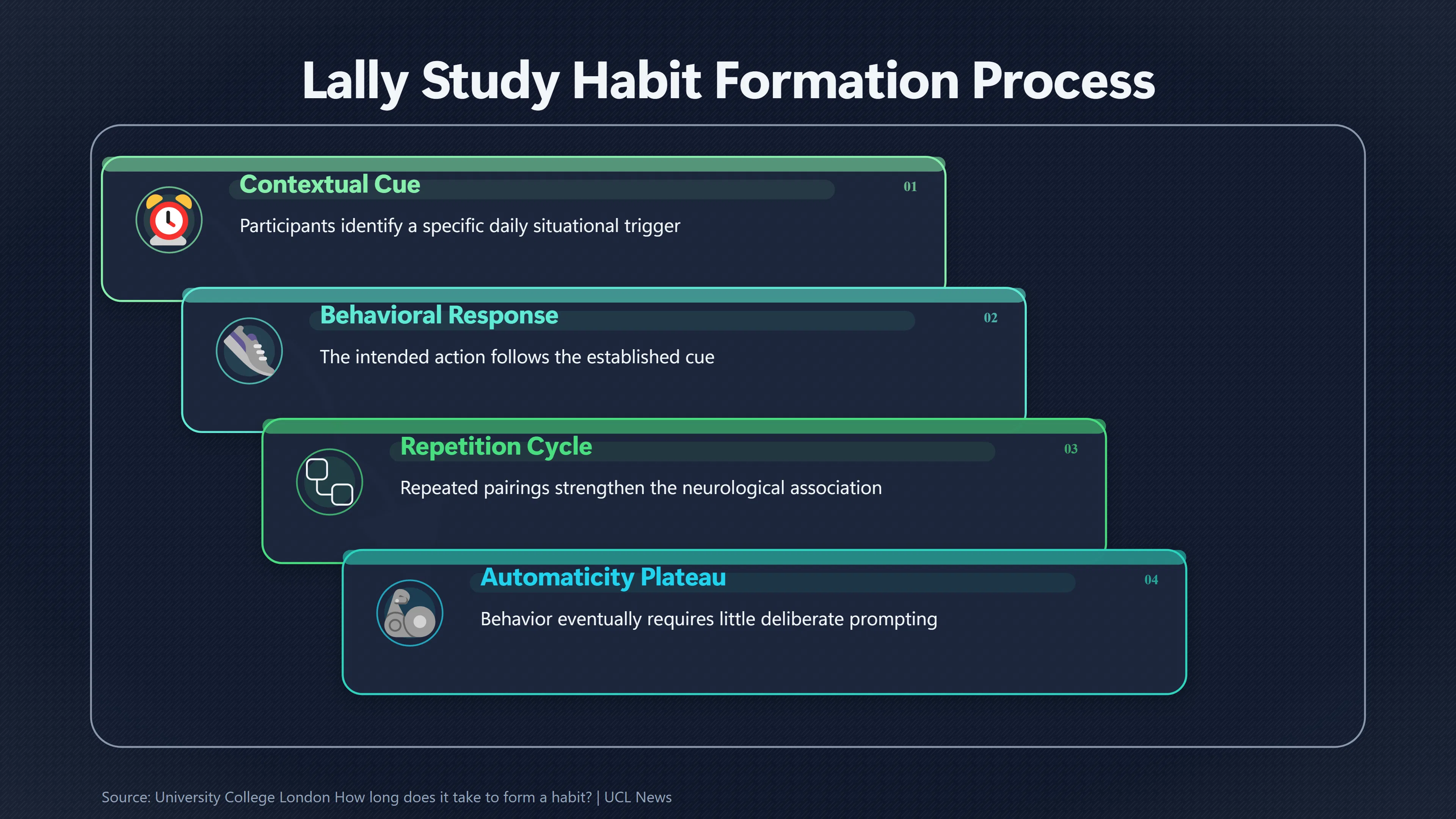
Missing one day does not appear to reset a developing habit. The best-known direct evidence comes from Phillippa Lally and colleagues’ 12-week study of 96 people building everyday eating, drinking or activity habits. Automaticity — the extent to which the behaviour felt as though it happened with little deliberate prompting — generally accumulated gradually, and missing a single opportunity did not materially alter that trajectory.[Wiley Online Library]onlinelibrary.wiley.comWiley Online LibraryHow are habits formed: Modelling habit formation in the real world - Lally - 2010 - European Journal of Social Psycho…
That finding is reassuring, but it is easy to overextend. The study did not establish that missed repetitions never matter, that any number of gaps is harmless, or that a habit survives indefinitely without practice. Cue–response learning depends on repeated opportunities in which a familiar situation is followed by the intended action. An isolated omission is therefore better understood as one lost learning opportunity than as a reset. A recurring pattern of omissions is more consequential because it reduces the very repetitions through which automaticity develops.
What a single missed opportunity does to habit growth
The most useful evidence comes from Lally and colleagues because participants were studied while attempting to form real habits in everyday life rather than simply reporting habits they already possessed. Each participant chose a health-related behaviour, such as drinking water, eating fruit or exercising, and specified a daily contextual cue such as “after breakfast”. They then reported their behaviour and automaticity over 84 days.[Wiley Online Library]onlinelibrary.wiley.comWiley Online LibraryHow are habits formed: Modelling habit formation in the real world - Lally - 2010 - European Journal of Social Psycho…
Automaticity did not behave like a streak counter. For participants whose data could be modelled successfully, it tended to follow an asymptotic learning curve: comparatively large gains occurred earlier, followed by progressively smaller gains as automaticity approached a plateau. The estimated time to reach 95% of that plateau varied enormously, from 18 to 254 days.[Wiley Online Library]onlinelibrary.wiley.comWiley Online LibraryHow are habits formed: Modelling habit formation in the real world - Lally - 2010 - European Journal of Social Psycho…
The researchers also examined missed opportunities. Their conclusion was unusually clear: missing one opportunity to perform the behaviour did not materially affect habit formation. UCL’s account of the research similarly reports that one missed opportunity had no significant effect, whereas people who were highly inconsistent generally did not succeed in forming habits.[University College London]ucl.ac.ukUniversity College London How long does it take to form a habit? | UCL NewsUniversity College LondonHow long does it take to form a habit? | UCL News - UCL – University College London…
That distinction matters. Suppose the intended pattern is:
Breakfast → take vitamin
and on Tuesday breakfast occurs but the vitamin is forgotten. The accumulated learning from Monday and all the preceding repetitions does not disappear on Tuesday. On Wednesday, breakfast can once again be followed by the vitamin, adding another cue–response pairing. A review translating the research into health practice notes that automaticity gains resumed after an occasional missed performance.[PubMed Central (PMC)]pmc.ncbi.nlm.nih.govPubMed Central (PMC)Making health habitual: the psychology of ‘habit-formation’ and general practice - PMCDecember 1, 2012…
A calendar streak and a learned habit are therefore different quantities. A streak can fall from 50 to zero overnight because that is how the counter is defined. There is no evidence from this dataset that habit automaticity behaves in the same all-or-nothing way.
Why repeated omissions matter more than isolated lapses
The comforting “one missed day is fine” result should not be converted into “consistency does not matter”. In fact, the broader result points in the opposite direction. Lally and colleagues found that greater consistency of performance was associated with a better-fitting habit-formation trajectory, while UCL’s summary explicitly distinguishes an occasional missed opportunity from being “very inconsistent”.[Wiley Online Library]onlinelibrary.wiley.comWiley Online LibraryHow are habits formed: Modelling habit formation in the real world - Lally - 2010 - European Journal of Social Psycho…
The reason follows from the mechanism being learned. A habit is not simply a record that an action has been performed many times. Habit research commonly defines it in terms of a response becoming automatically activated by recurring situational cues after repeated cue-specific behaviour.[PubMed Central (PMC)]pmc.ncbi.nlm.nih.govPubMed Central (PMC)A review and analysis of the use of ‘habit’ in understanding, predicting and influencing health-related behaviour - P… If the cue repeatedly occurs without the desired response, there are simply fewer successful cue–response pairings from which that association can strengthen.
Later longitudinal evidence reinforces the importance of the repetition context. In a 2022 study, researchers examined two datasets: 95 students completing 2,482 study-habit repetitions and 218 app users contributing data on 308 habits and 2,368 repetitions. More stable contexts were associated with greater automaticity and better attainment of repetition goals in both datasets; in the student study, context stability was experimentally manipulated by asking one group to keep place and time stable and another to vary them.[PubMed Central (PMC)]pmc.ncbi.nlm.nih.govPubMed Central (PMC)Context Stability in Habit Building Increases Automaticity and Goal Attainment - PMCJune 10, 2022…
This does not provide a numerical rule such as “two misses are safe but three are harmful”. The evidence is not precise enough to support such a threshold. Even the researchers behind the original missed-opportunity finding said they did not yet know what degree of consistency was necessary for habit formation.[University College London]ucl.ac.ukUniversity College London How long does it take to form a habit? | UCL NewsUniversity College LondonHow long does it take to form a habit? | UCL News - UCL – University College London…
That limitation is important because popular rules can sound more scientific than they are. Advice such as “never miss twice” may be a useful personal rule for preventing one lapse from turning into prolonged non-performance, but the Lally dataset does not establish a special biological or psychological boundary at the second missed day. What the evidence supports is a more modest distinction: isolated misses appear tolerable; persistent inconsistency reduces the opportunities through which the desired response becomes automatic.

A missed day is not necessarily a missed cue
There is another complication hidden by calendar-based tracking. A “missed day” and a “missed cue–response opportunity” are not always the same event.
Imagine someone intends to walk for ten minutes after lunch at work. On Saturday they do not go to work and their normal post-lunch situation never occurs. That is different, from a cue-learning perspective, from sitting in the usual workplace after lunch and repeatedly deciding not to walk. The original Lally study was explicitly organised around behaviour performed in response to a once-daily cue, rather than around accumulating an abstract number of consecutive calendar days.[Wiley Online Library]onlinelibrary.wiley.comWiley Online LibraryHow are habits formed: Modelling habit formation in the real world - Lally - 2010 - European Journal of Social Psycho…
This is one reason the evidence should not be translated too literally into streak rules. Habits are context-sensitive. Research characterises automatic habits as cue-contingent: relevant situations acquire the capacity to activate associated responses.[PubMed]pubmed.ncbi.nlm.nih.govThe automatic component of habit in health behavior: habit as cue-contingent automaticity - PubMed… A day on which the normal cue never appears provides different information about the setup from a day on which the cue appears clearly but repeatedly fails to produce action.
Nor should context stability itself be treated as universally proven to cause stronger habits in every setting. A 10-day ecological momentary assessment study of 104 older adults found relationships between some stable contexts and physical or sedentary behaviour, but its context-stability measures did not predict self-reported habit automaticity.[PubMed]pubmed.ncbi.nlm.nih.govOpen source on nih.gov. That result provides a useful check against making the simple “same cue every time” story more certain than the evidence warrants.
Using missed repetitions to diagnose a weak setup
For self-improvement, the most useful response to a miss is therefore not to declare the habit broken. It is to ask what the miss reveals.
If the omission is genuinely exceptional — illness, travel, an unusually late meeting, a disrupted morning — the evidence gives little reason to treat it as a return to day one. Resume the intended response when the relevant opportunity next occurs. The existing learning has not been shown to vanish because of one interruption.[Wiley Online Library]onlinelibrary.wiley.comWiley Online LibraryHow are habits formed: Modelling habit formation in the real world - Lally - 2010 - European Journal of Social Psycho…
Repeated misses deserve more attention because they may expose a problem in the cue–response arrangement itself. Three distinctions are especially useful:
- The cue is unreliable. “Exercise sometime after work” may produce highly variable opportunities, whereas a particular preceding event can be easier to recognise consistently.
- The cue occurs, but the response is regularly impractical. If the intended behaviour requires equipment, time, privacy or energy that is usually unavailable at that moment, repeated failure may reflect the setup rather than insufficient repetition.
- The response keeps occurring in changing circumstances. The behaviour may be frequent without repeatedly strengthening one clearly identifiable cue–response relationship. Experimental and longitudinal work suggests that stable performance contexts can facilitate automaticity, although the strength of this relationship varies between studies.[PubMed Central (PMC)]pmc.ncbi.nlm.nih.govPubMed Central (PMC)Context Stability in Habit Building Increases Automaticity and Goal Attainment - PMCJune 10, 2022…
This reframes a run of misses as information. If breakfast has occurred five times and the intended post-breakfast action has been forgotten four times, simply preserving a nominal goal of doing it “every day” does not repair the learning conditions. Making the cue more noticeable, reducing the response to something reliably executable, or moving it to a situation in which completion is more dependable can create more successful repetitions.
What the evidence does — and does not — justify
The claim that one miss does not reset a habit rests heavily on one influential naturalistic dataset, and that deserves emphasis. Lally’s study was small by modern standards, involved self-selected health behaviours, relied on self-reported automaticity and produced modelled habit curves for only a subset of participants. The enormous 18-to-254-day range also demonstrates how poorly a single universal habit timetable represents individual learning.[Wiley Online Library]onlinelibrary.wiley.comWiley Online LibraryHow are habits formed: Modelling habit formation in the real world - Lally - 2010 - European Journal of Social Psycho…
A 2024 systematic review and meta-analysis subsequently examined 20 intervention studies involving 2,601 participants and found substantial variation in health-habit formation across behaviours and individuals. The literature used differing interventions and measures, and only four included studies specifically measured automaticity while recording the time taken to reach it.[PubMed Central (PMC)]pmc.ncbi.nlm.nih.govOpen source on nih.gov. That broader evidence supports viewing habit formation as variable and gradual, but it does not supply a robust dose–response curve telling us exactly how much damage follows two, three or five consecutive omissions.
So the strongest conclusion is narrower than many habit slogans. There is no good basis for treating a single missed repetition as an automaticity reset. Equally, there is no good basis for concluding that omissions are cost-free indefinitely.
For cue–response learning, the more useful unit is not the perfect streak but the pattern of successful pairings over time. One missing link in that pattern leaves previous learning largely intact. Repeatedly encountering the intended situation without producing the intended response, or repeatedly failing to create usable opportunities at all, means fewer chances for the desired association to strengthen. That is when a missed repetition stops looking like an isolated lapse and starts looking like evidence that the habit setup itself needs attention.
Amazon book picks
Further Reading
Books and field guides related to Does Missing One Day Reset a Habit?. Use these as the next step if you want deeper reading beyond the article.
Atomic Habits
Rating: 3.5/5 from 7 Google Books ratings
The #1 New York Times bestseller. Over 25 million copies sold! Translated into 60+ languages! Tiny Changes, Remarkable Results No matter...
Good Habits, Bad Habits
'The world's leading expert on habits' - Matthew Syed, bestselling author of Black Box Thinking and Rebel IdeasWhat if you could harness...
The Power of Habit
Rating: 4.0/5 from 145 Google Books ratings
Duhigg takes us to the edge of scientific discoveries that explain why habits exist and how they can be changed. Distilling information i...
Tiny Habits
Improving your life is much easier than you think. Whether it’s losing weight, sleeping more, or restoring your work/life balance – the s...
eBay marketplace picks
Marketplace Samples
Live-tested eBay searches with available results related to this page.
Selected frommotivational wall art oneBay.co.uk.

Current eBay listing
Muhammad Ali Dream Motivational Quote Canvas Wall Art Picture Print

Current eBay listing
Gym Motivational Posters Work Out Insperational Quotes Wall Art
Endnotes
1.
Source: onlinelibrary.wiley.com
Link:https://onlinelibrary.wiley.com/doi/10.1002/ejsp.674
Source snippet
Wiley Online LibraryHow are habits formed: Modelling habit formation in the real world - Lally - 2010 - European Journal of Social Psycho...
2.
Source: onlinelibrary.wiley.com
Link:https://onlinelibrary.wiley.com/doi/pdf/10.1002/ejsp.674
Source snippet
Wiley Online LibraryHow are habits formed: Modelling habit formation in the real world - Lally - 2010 - European Journal of Social Psycho...
3.
Source: onlinelibrary.wiley.com
Link:https://onlinelibrary.wiley.com/doi/abs/10.1002/ejsp.674
Source snippet
Wiley Online LibraryHow are habits formed: Modelling habit formation in the real world - Lally - 2010 - European Journal of Social Psycho...
4.
Source: bpspsychub.onlinelibrary.wiley.com
Link:https://bpspsychub.onlinelibrary.wiley.com/doi/10.1111/bjhp.12509
5.
Source: onlinelibrary.wiley.com
Link:https://onlinelibrary.wiley.com/doi/10.1002/jeab.889
6.
Source: onlinelibrary.wiley.com
Link:https://onlinelibrary.wiley.com/doi/abs/10.1002/ejsp.674?MixPanelId=15e3fe314440-0468d8411-64220f54-100000-15e3fe314460
7.
Source: onlinelibrary.wiley.com
Link:https://onlinelibrary.wiley.com/doi/abs/10.1002/ejsp.674?source=content_type%3Areact%7Cfirst_level_url%3Aarticle%7Csection%3Amain_content%7Cbutton%3Abody_link
8.
Source: onlinelibrary.wiley.com
Link:https://onlinelibrary.wiley.com/doi/abs/10.1002/ejsp.674?cf_chl_jschl_tk=pmd_EwcJDaCFBR9OVEL1O_0qjioww0Gc86ZzpBvCBFhrDcE-1635261061-0-gqNtZGzNAjujcnBszQi9
9.
Source: onlinelibrary.wiley.com
Link:https://onlinelibrary.wiley.com/doi/abs/10.1002/ejsp.674?msockid=038ed114f43667dd0790c4bef5146634
10.
Source: onlinelibrary.wiley.com
Link:https://onlinelibrary.wiley.com/doi/abs/10.1002/ejsp.674?538fcd4b_page=6&947f74f7_page=5
11.
Source: onlinelibrary.wiley.com
Link:https://onlinelibrary.wiley.com/doi/10.1002/ejsp.674?538fcd4b_page=1&947f74f7page=3&=%2Fen-gt%2Four-commitment%23kI3HdLdDj7HLFW4BJlUYoy23RoHF9sl3JcIXrw%3D%3D
12.
Source: onlinelibrary.wiley.com
Link:https://onlinelibrary.wiley.com/doi/abs/10.1002/ejsp.674?aff_id=24772
13.
Source: ucl.ac.uk
Title: University College London How long does it take to form a habit? | UCL News
Link:https://www.ucl.ac.uk/news/2009/aug/how-long-does-it-take-form-habit%20
Source snippet
University College LondonHow long does it take to form a habit? | UCL News - UCL – University College London...
14.
Source: pmc.ncbi.nlm.nih.gov
Link:https://pmc.ncbi.nlm.nih.gov/articles/PMC3505409/
Source snippet
PubMed Central (PMC)Making health habitual: the psychology of ‘habit-formation’ and general practice - PMCDecember 1, 2012...
Published: December 1, 2012
15.
Source: pmc.ncbi.nlm.nih.gov
Link:https://pmc.ncbi.nlm.nih.gov/articles/PMC4566897/
Source snippet
PubMed Central (PMC)A review and analysis of the use of ‘habit’ in understanding, predicting and influencing health-related behaviour - P...
16.
Source: pmc.ncbi.nlm.nih.gov
Link:https://pmc.ncbi.nlm.nih.gov/articles/PMC9226889/
Source snippet
PubMed Central (PMC)Context Stability in Habit Building Increases Automaticity and Goal Attainment - PMCJune 10, 2022...
Published: June 10, 2022
17.
Source: pubmed.ncbi.nlm.nih.gov
Link:https://pubmed.ncbi.nlm.nih.gov/35756236/
Source snippet
Context Stability in Habit Building Increases Automaticity and Goal Attainment - PubMed...
18.
Source: pubmed.ncbi.nlm.nih.gov
Link:https://pubmed.ncbi.nlm.nih.gov/20658824/
Source snippet
The automatic component of habit in health behavior: habit as cue-contingent automaticity - PubMed...
19.
Source: pubmed.ncbi.nlm.nih.gov
Link:https://pubmed.ncbi.nlm.nih.gov/33502088/
20.
Source: pmc.ncbi.nlm.nih.gov
Link:https://pmc.ncbi.nlm.nih.gov/articles/PMC11641623/
21.
Source: doi.org
Link:https://doi.org/10.3390/healthcare12232488
22.
Source: pubmed.ncbi.nlm.nih.gov
Link:https://pubmed.ncbi.nlm.nih.gov/42053513/
23.
Source: pmc.ncbi.nlm.nih.gov
Link:https://pmc.ncbi.nlm.nih.gov/articles/PMC13114073/
24.
Source: pubmed.ncbi.nlm.nih.gov
Link:https://pubmed.ncbi.nlm.nih.gov/41664442/
25.
Source: pubmed.ncbi.nlm.nih.gov
Link:https://pubmed.ncbi.nlm.nih.gov/41664447/
26.
Source: pubmed.ncbi.nlm.nih.gov
Link:https://pubmed.ncbi.nlm.nih.gov/39685110/
27.
Source: pubmed.ncbi.nlm.nih.gov
Link:https://pubmed.ncbi.nlm.nih.gov/38787601/
28.
Source: pmc.ncbi.nlm.nih.gov
Link:https://pmc.ncbi.nlm.nih.gov/articles/PMC11161714/
29.
Source: pmc.ncbi.nlm.nih.gov
Link:https://pmc.ncbi.nlm.nih.gov/articles/PMC11081634/
30.
Source: doi.org
Link:https://doi.org/10.7554/elife.87346.4
31.
Source: pubmed.ncbi.nlm.nih.gov
Link:https://pubmed.ncbi.nlm.nih.gov/35086431/
32.
Source: pmc.ncbi.nlm.nih.gov
Link:https://pmc.ncbi.nlm.nih.gov/articles/PMC10842266/
33.
Source: pubmed.ncbi.nlm.nih.gov
Link:https://pubmed.ncbi.nlm.nih.gov/38047612/
34.
Source: pubmed.ncbi.nlm.nih.gov
Link:https://pubmed.ncbi.nlm.nih.gov/37261748/
35.
Source: pmc.ncbi.nlm.nih.gov
Link:https://pmc.ncbi.nlm.nih.gov/articles/PMC10524675/
36.
Source: pubmed.ncbi.nlm.nih.gov
Link:https://pubmed.ncbi.nlm.nih.gov/36749452/
37.
Source: pmc.ncbi.nlm.nih.gov
Link:https://pmc.ncbi.nlm.nih.gov/articles/PMC10495103/
38.
Source: pmc.ncbi.nlm.nih.gov
Link:https://pmc.ncbi.nlm.nih.gov/articles/PMC9540191/
39.
Source: pubmed.ncbi.nlm.nih.gov
Link:https://pubmed.ncbi.nlm.nih.gov/35962435/
40.
Source: pmc.ncbi.nlm.nih.gov
Link:https://pmc.ncbi.nlm.nih.gov/articles/PMC12318445/
41.
Source: pmc.ncbi.nlm.nih.gov
Link:https://pmc.ncbi.nlm.nih.gov/articles/PMC8602149/
42.
Source: pubmed.ncbi.nlm.nih.gov
Link:https://pubmed.ncbi.nlm.nih.gov/34713424/
43.
Source: pmc.ncbi.nlm.nih.gov
Link:https://pmc.ncbi.nlm.nih.gov/articles/PMC8137900/
44.
Source: pmc.ncbi.nlm.nih.gov
Link:https://pmc.ncbi.nlm.nih.gov/articles/PMC7969808/
45.
Source: pubmed.ncbi.nlm.nih.gov
Link:https://pubmed.ncbi.nlm.nih.gov/33405284/
46.
Source: pmc.ncbi.nlm.nih.gov
Link:https://pmc.ncbi.nlm.nih.gov/articles/PMC7645026/
47.
Source: pmc.ncbi.nlm.nih.gov
Link:https://pmc.ncbi.nlm.nih.gov/articles/PMC6667662/
48.
Source: pmc.ncbi.nlm.nih.gov
Link:https://pmc.ncbi.nlm.nih.gov/articles/PMC6374202/
49.
Source: pubmed.ncbi.nlm.nih.gov
Link:https://pubmed.ncbi.nlm.nih.gov/27120333/
50.
Source: pmc.ncbi.nlm.nih.gov
Link:https://pmc.ncbi.nlm.nih.gov/articles/PMC4847906/
51.
Source: pmc.ncbi.nlm.nih.gov
Link:https://pmc.ncbi.nlm.nih.gov/articles/PMC4012323/
52.
Source: pubmed.ncbi.nlm.nih.gov
Link:https://pubmed.ncbi.nlm.nih.gov/24714574/
53.
Source: pubmed.ncbi.nlm.nih.gov
Link:https://pubmed.ncbi.nlm.nih.gov/24576702/
54.
Source: pubmed.ncbi.nlm.nih.gov
Link:https://pubmed.ncbi.nlm.nih.gov/21749245/
55.
Source: pubmed.ncbi.nlm.nih.gov
Link:https://pubmed.ncbi.nlm.nih.gov/28188586/
Additional References
56.
Source: youtube.com
Title: Atomic Habits Is Not About Habits — It’s About Systems
Link:https://www.youtube.com/watch?v=sYATq3xv3aU
Source snippet
Understand how habit automaticity develops along an asymptotic curve rather than an all-or-nothing streak in How Long Does It Take to Bui...
57.
Source: youtube.com
Title: Healthy Habits Take Time: Systematic Review Debunks 21-Day Habit Myth
Link:https://www.youtube.com/watch?v=y4bft0nAGQs
Source snippet
Atomic Habits Is Not About Habits — It's About Systems...
58.
Source: youtube.com
Title: Best Ways to Build Better Habits & Break Bad Ones | James Clear
Link:https://www.youtube.com/watch?v=bdsc3Spm6Sw
Source snippet
How Long Does It Take to Build a Habit? HINT: It's NOT 21 Days...
59.
Source: youtube.com
Title: How to Hack Your Brain Into Getting Addicted to Discipline
Link:https://www.youtube.com/watch?v=untxeN7DWC0
Source snippet
Healthy Habits Take Time: Systematic Review Debunks 21-Day Habit Myth...
60.
Source: youtube.com
Title: How Long Does It Take to Build a Habit? HINT: It’s NOT 21 Days
Link:https://www.youtube.com/watch?v=cJ2gxIsScmk
Source snippet
How to Hack Your Brain Into Getting Addicted to Discipline...
61.
Source: researchgate.net
Link:https://www.researchgate.net/publication/386593213_Time_to_Form_a_Habit_A_Systematic_Review_and_Meta-Analysis_of_Health_Behaviour_Habit_Formation_and_Its_Determinants
62.
Source: dojowell.com
Link:https://dojowell.com/atlas/66-day-average-habit-formation
63.
Source: diabetesjournals.org
Link:https://diabetesjournals.org/diabetes/article/74/Supplement_1/698-P/159833
64.
Source: tandfonline.com
Link:https://www.tandfonline.com/doi/abs/10.1080/08870446.2025.2528925
65.
Source: frontiersin.org
Link:https://www.frontiersin.org/journals/psychology/articles/10.3389/fpsyg.2022.883795/full