Within Missed Days
Does One Missed Day Really Break a Habit?
A single missed opportunity does not erase the automaticity built through earlier repetitions, although it forgoes one chance to reinforce it.
On this page
- What the 12 week habit study actually found
- Why automaticity does not reset to zero
- What one missed repetition does and does not cost
Page outline Jump by section
Introduction
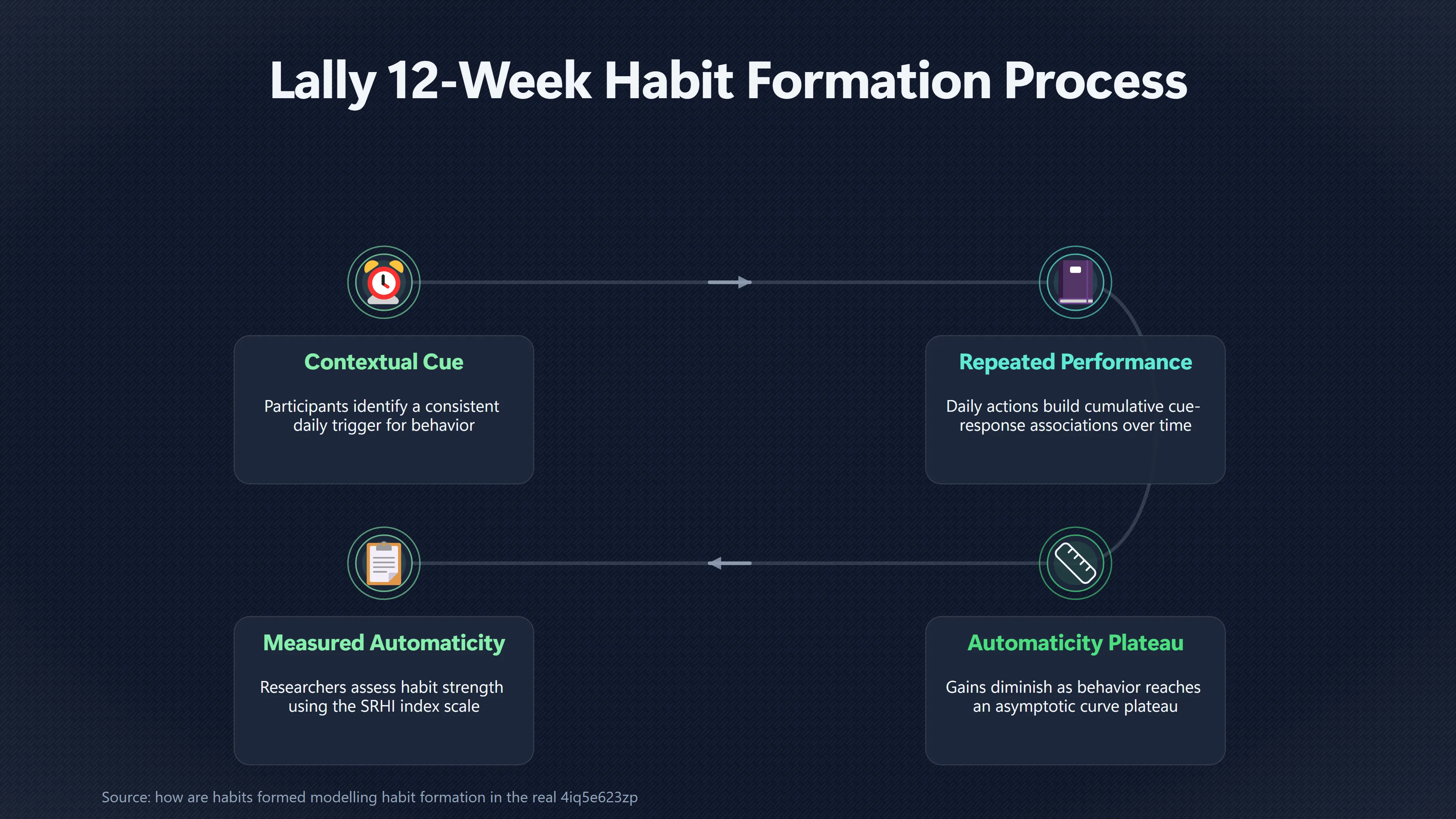
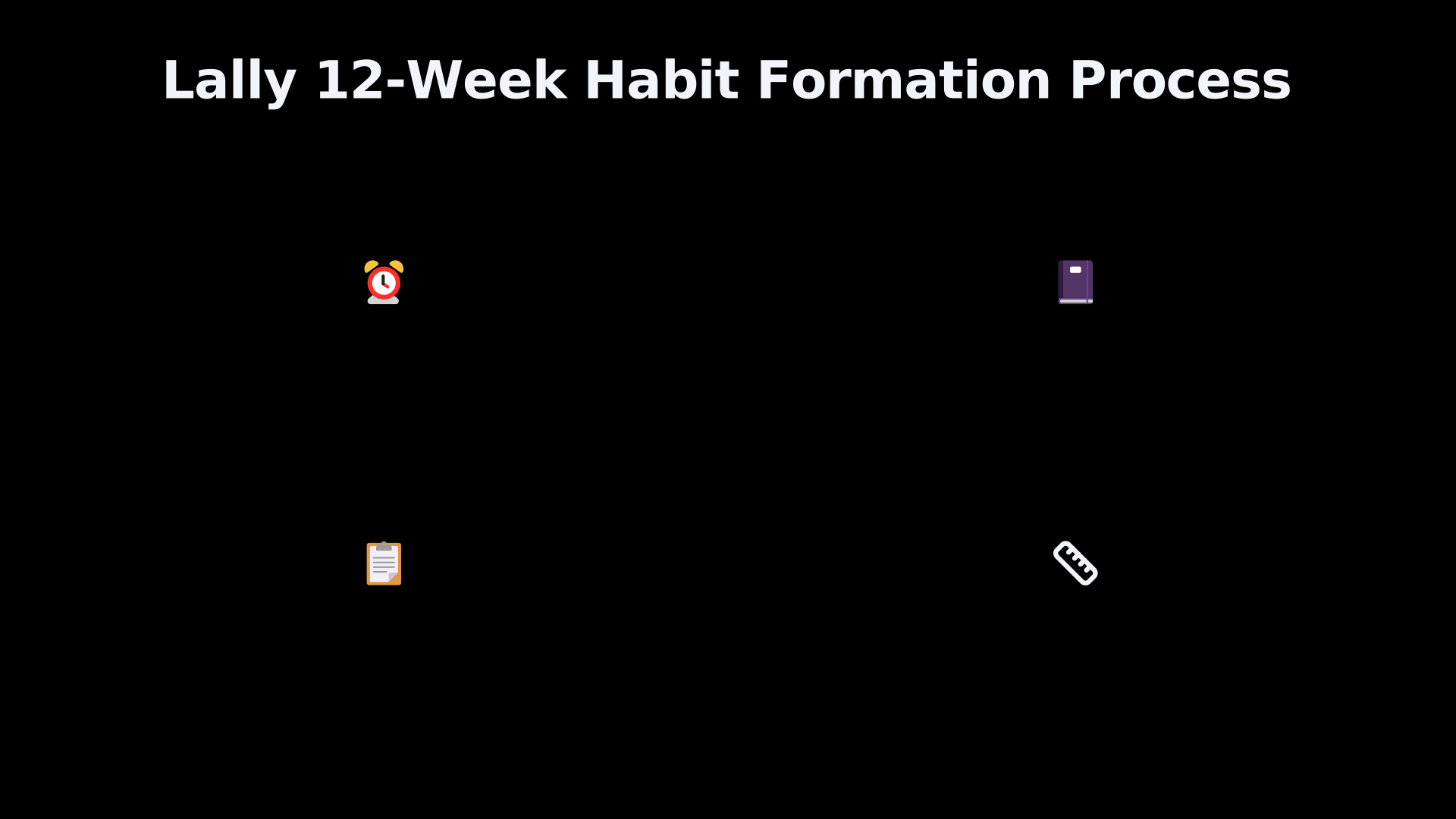
Missing one day does not reset a developing habit to zero. The best-known direct evidence comes from Phillippa Lally and colleagues’ 12-week real-world habit study: after people repeatedly performed a chosen behaviour in the same daily context, a single missed opportunity produced only a very small change in measured automaticity and did not materially disrupt the overall formation process.[Wiley Online Library]onlinelibrary.wiley.comWiley Online LibraryHow are habits formed: Modelling habit formation in the real world - Lally - 2010 - European Journal of Social Psycho…
That finding matters because habit strength is not a streak counter. It reflects learning: repeated encounters with a familiar context become associated with a particular response, making that response progressively easier to initiate without deliberate thought.[PubMed]pubmed.ncbi.nlm.nih.govPub Med Psychology of HabitPsychology of Habit - PubMedSeptember 10, 2015… One omission means one less opportunity to strengthen that association. It does not erase the learning produced by previous repetitions.
The useful distinction, then, is between losing one repetition and losing the habit itself. The first happens whenever a day is missed. The available evidence does not show that the second follows from a single miss.
What the 12-week habit study actually found
Lally and colleagues recruited 96 volunteers and asked each person to choose a new eating, drinking or activity behaviour. Participants were to perform it once a day in response to a consistent contextual cue — for example, doing the behaviour after breakfast — for 12 weeks. They recorded whether they had performed it and completed daily measures from the Self-Report Habit Index (SRHI), from which the researchers assessed automaticity. Eighty-two participants supplied enough data for the main analysis.[Wiley Online Library]onlinelibrary.wiley.comWiley Online LibraryHow are habits formed: Modelling habit formation in the real world - Lally - 2010 - European Journal of Social Psycho…
Habit strength did not rise in a simple straight line. Instead, automaticity generally followed an asymptotic curve: early repetitions could produce relatively large gains, after which further gains became progressively smaller as a person’s automaticity approached a plateau. Among participants for whom the researchers could model that trajectory, the estimated time to reach 95% of the eventual plateau ranged from 18 to 254 days.[Wiley Online Library]onlinelibrary.wiley.comWiley Online LibraryHow are habits formed: Modelling habit formation in the real world - Lally - 2010 - European Journal of Social Psycho…
The researchers also examined missed opportunities directly. They defined a miss as an occasion when the participant did not perform the behaviour after having performed it on the preceding three opportunities. They identified 140 such misses across 55 participants. Immediately after an omission, automaticity fell by an average of just 0.29 points on the automaticity scale — a very small change.[Transformation Weight Control]transformationweightcontrol.comTransformation Weight Control European Journal of Social PsychologyTransformation Weight ControlEuropean Journal of Social PsychologyApril 19, 2026…
For 67 of those missed opportunities, the researchers also had the necessary data after the participant resumed the behaviour. Across the interval containing the miss, automaticity was 0.55 points higher than before it. For comparison, when participants performed the behaviour consistently across the comparable period, the average increase was 0.79 points. The authors concluded that the difference was small enough that a single missed opportunity did not materially affect habit formation.[SciSpace]scispace.comhow are habits formed modelling habit formation in the real 4iq5e623zpSciSpace(PDF) How are habits formed: Modelling habit formation in the real world (2010) | Phillippa Lally | 1734 CitationsOctober 1, 2010…
This is more informative than simply observing that some successful habit-builders occasionally missed days. The researchers specifically looked at automaticity immediately around omissions and compared its movement with periods of uninterrupted performance.
There is an important limit to the result. It does not establish that any number of missed days is harmless. Lally later emphasised through University College London that although one missed opportunity did not significantly affect formation, people who were very inconsistent generally failed to develop habits successfully. The researchers could not specify a universal minimum level of consistency.[University College London]ucl.ac.ukUniversity College London How long does it take to form a habit? | UCL NewsUniversity College LondonHow long does it take to form a habit? | UCL News - UCL – University College London…
Why automaticity does not reset to zero
The result makes sense once habit strength is separated from the visible behaviour on a particular day. Contemporary habit research generally describes habits in terms of learned associations between recurring contexts and responses. Repeatedly carrying out a response in a stable context strengthens that association until encountering the context itself can help activate the response.[PubMed]pubmed.ncbi.nlm.nih.govPub Med Habit in Personality and Social PsychologyHabit in Personality and Social Psychology - PubMedJuly 24, 2017…
A missed performance is therefore not equivalent to deleting the association. Imagine that someone has repeatedly drunk a glass of water immediately after breakfast. Each successful pairing provides another experience of breakfast context → drink water. If they skip the water on Tuesday, Tuesday contributes no successful pairing. But the cue-response learning accumulated on Monday and the preceding days has not thereby vanished.
Experimental evidence published in 2024 strengthens the underlying learning account. Jennifer Labrecque, Kristen Lee and Wendy Wood had participants practise a sequential task and then objectively tested cue-response associations. More practice produced stronger associations, which in turn supported performance; the improvement could not be explained simply by stronger intentions or motivation.[PubMed]pubmed.ncbi.nlm.nih.govPub Med Measuring context-response associations that drive habitsMeasuring context-response associations that drive habits - PubMed… This does not directly test missed days in everyday habit formation, but it helps explain why accumulated practice should not behave like a streak that disappears after one omission.
The distinction between behaviour and habit strength is especially important here. A person can fail to perform a habitual response on a particular occasion even though the underlying cue-response association remains. Reviews of the habit literature explicitly distinguish the occurrence of behaviour from the learned association capable of prompting it.[PubMed Central (PMC)]pmc.ncbi.nlm.nih.govOpen source on nih.gov.
That is why “I did not do it today” and “I no longer have any habit strength” are not interchangeable statements. The first describes an event. The second makes a claim about learned automaticity — and one missed event is not evidence that all of that learning has disappeared.
What one missed repetition actually costs
Saying that one miss does not reset a habit should not be turned into the stronger claim that the miss has literally no cost. Habit formation depends on repetition. When the behaviour is omitted, there is no new successful cue-response pairing on that occasion, so the person has forgone one opportunity for further strengthening. A recent systematic review of health-behaviour habit formation likewise identifies repeated performance and stable contexts as central determinants of increasing automaticity.[PubMed Central (PMC)]pmc.ncbi.nlm.nih.govOpen source on nih.gov.
The shape of the Lally study’s learning curves adds an interesting qualification. Because gains tended to be larger earlier in formation and diminish towards a plateau, repetitions are not necessarily equivalent to identical points on a scoreboard.[PubMed Central (PMC)]pmc.ncbi.nlm.nih.govOpen source on nih.gov. Missing a day is better understood as interrupting an ongoing learning trajectory than as subtracting a fixed amount of “habit progress”.
A separate six-week study of app-supported study habits offers broadly compatible evidence. Among 2,483 repetitions after participants’ first performance, 530 — 21.3% — followed a pause of at least one day. The length of the pause did not significantly predict automaticity in the researchers’ model. However, pauses longer than one day were rare, so the study provides much better reassurance about short interruptions than about extended breaks.[PubMed Central (PMC)]pmc.ncbi.nlm.nih.govOpen source on nih.gov.
Taken together, the evidence supports three careful conclusions:
- What is lost: one opportunity to practise the response in its intended context.
- What is not shown to be lost: all automaticity accumulated through previous repetitions.
- What remains uncertain: exactly when repeated omissions become frequent or prolonged enough to meaningfully hinder a particular person’s habit development.
That final uncertainty matters. Researchers know that consistency helps habit formation, but a 2024 systematic review concluded that the precise degree of consistency required remains unclear. Habit-development rates also vary considerably across people and behaviours.[PubMed Central (PMC)]pmc.ncbi.nlm.nih.govOpen source on nih.gov. There is no scientifically established rule saying that two misses, three misses or any other simple number automatically destroys a habit.
One miss is different from a changed pattern
The reassuring finding is specifically about an isolated missed opportunity, not a licence to treat repetition as optional. In the original study, greater consistency was associated with trajectories that better fitted the expected automaticity-growth model, and Lally explicitly distinguished occasional misses from being highly inconsistent.[Wiley Online Library]onlinelibrary.wiley.comWiley Online LibraryHow are habits formed: Modelling habit formation in the real world - Lally - 2010 - European Journal of Social Psycho…
There is also a reason to distinguish missing the behaviour from losing the context in which it was learnt. Habits are context-dependent. Research on habit discontinuity shows that larger changes in familiar circumstances — such as changing location or routine — can disrupt habitual performance because the cues that normally activate the response have changed.[PubMed Central (PMC)]pmc.ncbi.nlm.nih.govOpen source on nih.gov. That is a substantially different event from encountering Monday’s usual cue, failing to respond once, and returning to the same routine on Tuesday.
This helps define exactly how far the “one missed day” evidence should travel. It supports the proposition that an isolated omission within an otherwise repeated, stable pattern does not wipe out habit strength. It does not demonstrate that lengthy interruptions, highly irregular performance or wholesale changes of context have the same negligible effect.
The practical meaning of a missed day
After one miss, the evidence gives little reason to behave as though previous repetitions no longer count. The most faithful response to the research is simply to resume the behaviour when its familiar cue next occurs.
Suppose someone is building the habit of taking a short walk after lunch. After weeks of doing so, an unusually busy Wednesday prevents the walk. Thursday’s post-lunch opportunity is not “day one” in any meaningful learning sense. The person returns to the same cue with the context-response learning produced by earlier repetitions still behind them. What Wednesday lacked was another reinforcing repetition, not the continued existence of every previous one.
This interpretation also avoids overstating the famous 12-week study. It does not prove that misses are beneficial, that consistency is unimportant or that habit strength can survive indefinitely without performance. Its narrower conclusion is both better supported and more useful: habit progress is cumulative learning, not an all-or-nothing streak.
A single missed day is therefore best understood as a small gap in practice. The important evidence from Lally’s dataset is not that nothing happened after the miss — automaticity showed a tiny short-term dip — but that the larger learning trajectory remained intact and gains resumed.[Transformation Weight Control]transformationweightcontrol.comTransformation Weight Control European Journal of Social PsychologyTransformation Weight ControlEuropean Journal of Social PsychologyApril 19, 2026… For someone concerned that one imperfect day has destroyed weeks of progress, that is the central finding: one missed repetition costs a repetition; it does not send habit strength back to zero.

Amazon book picks
Further Reading
Books and field guides related to Does One Missed Day Really Break a Habit?. Use these as the next step if you want deeper reading beyond the article.
Atomic Habits
Rating: 3.5/5 from 7 Google Books ratings
The #1 New York Times bestseller. Over 25 million copies sold! Translated into 60+ languages! Tiny Changes, Remarkable Results No matter...
Tiny Habits
Improving your life is much easier than you think. Whether it’s losing weight, sleeping more, or restoring your work/life balance – the s...
Good Habits, Bad Habits
'The world's leading expert on habits' - Matthew Syed, bestselling author of Black Box Thinking and Rebel IdeasWhat if you could harness...
The Power of Habit
Rating: 4.0/5 from 145 Google Books ratings
Duhigg takes us to the edge of scientific discoveries that explain why habits exist and how they can be changed. Distilling information i...
eBay marketplace picks
Marketplace Samples
Live-tested eBay searches with available results related to this page.
Selected frommotivational poster oneBay.co.uk.


Current eBay listing
Gym Motivational Posters Work Out Insperational Quotes Wall Art
Current eBay listing
Motivational Quotes Framed Wall Art Poster Canvas Print Picture

Endnotes
1.
Source: onlinelibrary.wiley.com
Link:https://onlinelibrary.wiley.com/doi/10.1002/ejsp.674
Source snippet
Wiley Online LibraryHow are habits formed: Modelling habit formation in the real world - Lally - 2010 - European Journal of Social Psycho...
2.
Source: onlinelibrary.wiley.com
Link:https://onlinelibrary.wiley.com/doi/abs/10.1002/ejsp.674?msockid=2489864bf52b6612230d95d6f48167ef
Source snippet
Wiley Online LibraryHow are habits formed: Modelling habit formation in the real world - Lally - 2010 - European Journal of Social Psycho...
3.
Source: scispace.com
Title: how are habits formed modelling habit formation in the real 4iq5e623zp
Link:https://scispace.com/papers/how-are-habits-formed-modelling-habit-formation-in-the-real-4iq5e623zp
Source snippet
SciSpace(PDF) How are habits formed: Modelling habit formation in the real world (2010) | Phillippa Lally | 1734 CitationsOctober 1, 2010...
Published: October 1, 2010
4.
Source: physoc.onlinelibrary.wiley.com
Link:https://physoc.onlinelibrary.wiley.com/doi/10.14814/phy2.15522
5.
Source: myscp.onlinelibrary.wiley.com
Link:https://myscp.onlinelibrary.wiley.com/doi/10.1016/j.jcps.2009.08.003
6.
Source: onlinelibrary.wiley.com
Link:https://onlinelibrary.wiley.com/doi/abs/10.1002/ejsp.674
7.
Source: onlinelibrary.wiley.com
Link:https://onlinelibrary.wiley.com/doi/abs/10.1002/ejsp.674?MixPanelId=15e3fe314440-0468d8411-64220f54-100000-15e3fe314460
8.
Source: onlinelibrary.wiley.com
Link:https://onlinelibrary.wiley.com/doi/abs/10.1002/ejsp.674?cf_chl_jschl_tk=pmd_EwcJDaCFBR9OVEL1O_0qjioww0Gc86ZzpBvCBFhrDcE-1635261061-0-gqNtZGzNAjujcnBszQi9
9.
Source: onlinelibrary.wiley.com
Link:https://onlinelibrary.wiley.com/doi/abs/10.1002/ejsp.674?source=content_type%3Areact%7Cfirst_level_url%3Aarticle%7Csection%3Amain_content%7Cbutton%3Abody_link
10.
Source: onlinelibrary.wiley.com
Link:https://onlinelibrary.wiley.com/doi/abs/10.1002/ejsp.674?aff_id=24772
11.
Source: onlinelibrary.wiley.com
Link:https://onlinelibrary.wiley.com/doi/abs/10.1002/ejsp.674?msockid=038ed114f43667dd0790c4bef5146634
12.
Source: onlinelibrary.wiley.com
Link:https://onlinelibrary.wiley.com/doi/abs/10.1002/ejsp.674?538fcd4b_page=6&947f74f7_page=5
13.
Source: ucl.ac.uk
Title: University College London How long does it take to form a habit? | UCL News
Link:https://www.ucl.ac.uk/news/2009/aug/how-long-does-it-take-form-habit%20
Source snippet
University College LondonHow long does it take to form a habit? | UCL News - UCL – University College London...
14.
Source: pubmed.ncbi.nlm.nih.gov
Title: Pub Med Psychology of Habit
Link:https://pubmed.ncbi.nlm.nih.gov/26361052/
Source snippet
Psychology of Habit - PubMedSeptember 10, 2015...
Published: September 10, 2015
15.
Source: pubmed.ncbi.nlm.nih.gov
Title: Pub Med Measuring context-response associations that drive habits
Link:https://pubmed.ncbi.nlm.nih.gov/38047612/
Source snippet
Measuring context-response associations that drive habits - PubMed...
16.
Source: transformationweightcontrol.com
Title: Transformation Weight Control European Journal of Social Psychology
Link:https://transformationweightcontrol.com/wp-content/uploads/2024/12/Lally-2010-How-Habits-are-Formed.pdf
Source snippet
Transformation Weight ControlEuropean Journal of Social PsychologyApril 19, 2026...
Published: April 19, 2026
17.
Source: pubmed.ncbi.nlm.nih.gov
Title: Pub Med Habit in Personality and Social Psychology
Link:https://pubmed.ncbi.nlm.nih.gov/28737111/
Source snippet
Habit in Personality and Social Psychology - PubMedJuly 24, 2017...
Published: July 24, 2017
18.
Source: pmc.ncbi.nlm.nih.gov
Link:https://pmc.ncbi.nlm.nih.gov/articles/PMC4566897/
19.
Source: pubmed.ncbi.nlm.nih.gov
Link:https://pubmed.ncbi.nlm.nih.gov/25207647/
20.
Source: pmc.ncbi.nlm.nih.gov
Link:https://pmc.ncbi.nlm.nih.gov/articles/PMC11641623/
21.
Source: pmc.ncbi.nlm.nih.gov
Link:https://pmc.ncbi.nlm.nih.gov/articles/PMC7020232/
22.
Source: pmc.ncbi.nlm.nih.gov
Link:https://pmc.ncbi.nlm.nih.gov/articles/PMC4847906/
23.
Source: pubmed.ncbi.nlm.nih.gov
Title: Pub Med Changing circumstances, disrupting habits
Link:https://pubmed.ncbi.nlm.nih.gov/15982113/
24.
Source: pmc.ncbi.nlm.nih.gov
Link:https://pmc.ncbi.nlm.nih.gov/articles/PMC3505409/
25.
Source: pmc.ncbi.nlm.nih.gov
Link:https://pmc.ncbi.nlm.nih.gov/articles/PMC13114073/
26.
Source: pubmed.ncbi.nlm.nih.gov
Link:https://pubmed.ncbi.nlm.nih.gov/40329023/
27.
Source: pubmed.ncbi.nlm.nih.gov
Link:https://pubmed.ncbi.nlm.nih.gov/39702740/
28.
Source: pmc.ncbi.nlm.nih.gov
Link:https://pmc.ncbi.nlm.nih.gov/articles/PMC11574773/
29.
Source: pmc.ncbi.nlm.nih.gov
Link:https://pmc.ncbi.nlm.nih.gov/articles/PMC11652125/
30.
Source: pmc.ncbi.nlm.nih.gov
Link:https://pmc.ncbi.nlm.nih.gov/articles/PMC11161714/
31.
Source: pmc.ncbi.nlm.nih.gov
Link:https://pmc.ncbi.nlm.nih.gov/articles/PMC11081634/
32.
Source: pmc.ncbi.nlm.nih.gov
Link:https://pmc.ncbi.nlm.nih.gov/articles/PMC10842266/
33.
Source: pmc.ncbi.nlm.nih.gov
Link:https://pmc.ncbi.nlm.nih.gov/articles/PMC10578412/
34.
Source: pmc.ncbi.nlm.nih.gov
Link:https://pmc.ncbi.nlm.nih.gov/articles/PMC10151500/
35.
Source: pmc.ncbi.nlm.nih.gov
Link:https://pmc.ncbi.nlm.nih.gov/articles/PMC9372943/
36.
Source: pmc.ncbi.nlm.nih.gov
Link:https://pmc.ncbi.nlm.nih.gov/articles/PMC9226889/
37.
Source: pubmed.ncbi.nlm.nih.gov
Link:https://pubmed.ncbi.nlm.nih.gov/35756236/
38.
Source: pmc.ncbi.nlm.nih.gov
Link:https://pmc.ncbi.nlm.nih.gov/articles/PMC12318445/
39.
Source: pubmed.ncbi.nlm.nih.gov
Link:https://pubmed.ncbi.nlm.nih.gov/34283681/
40.
Source: pmc.ncbi.nlm.nih.gov
Link:https://pmc.ncbi.nlm.nih.gov/articles/PMC8137900/
41.
Source: pubmed.ncbi.nlm.nih.gov
Link:https://pubmed.ncbi.nlm.nih.gov/32228721/
42.
Source: pubmed.ncbi.nlm.nih.gov
Link:https://pubmed.ncbi.nlm.nih.gov/32116961/
43.
Source: pmc.ncbi.nlm.nih.gov
Link:https://pmc.ncbi.nlm.nih.gov/articles/PMC6974578/
44.
Source: pmc.ncbi.nlm.nih.gov
Link:https://pmc.ncbi.nlm.nih.gov/articles/PMC5473478/
45.
Source: pubmed.ncbi.nlm.nih.gov
Link:https://pubmed.ncbi.nlm.nih.gov/27449709/
46.
Source: pubmed.ncbi.nlm.nih.gov
Link:https://pubmed.ncbi.nlm.nih.gov/27120333/
47.
Source: pubmed.ncbi.nlm.nih.gov
Link:https://pubmed.ncbi.nlm.nih.gov/26361052/?dopt=Abstract
48.
Source: pubmed.ncbi.nlm.nih.gov
Link:https://pubmed.ncbi.nlm.nih.gov/24614400/
49.
Source: pmc.ncbi.nlm.nih.gov
Link:https://pmc.ncbi.nlm.nih.gov/articles/PMC4296343/
50.
Source: pubmed.ncbi.nlm.nih.gov
Link:https://pubmed.ncbi.nlm.nih.gov/21859902/
51.
Source: pmc.ncbi.nlm.nih.gov
Link:https://pmc.ncbi.nlm.nih.gov/articles/PMC13193246/
52.
Source: pubmed.ncbi.nlm.nih.gov
Link:https://pubmed.ncbi.nlm.nih.gov/22989272/
Additional References
53.
Source: youtube.com
Link:https://www.youtube.com/watch?v=SuCqaQnVwn0
Source snippet
Never miss twice James Clear habit Never Miss Two Days: James Clear’s Best Habit Rule Revealed...
54.
Source: youtube.com
Link:https://www.youtube.com/watch?v=KXX5lZS2Akk
Source snippet
The Habit Blueprint: How to Make Changes That Stick with Dr. Wendy Wood and Charles Good...
55.
Source: youtube.com
Title: ATOMIC HABITS
Link:https://www.youtube.com/watch?v=1gdkBt9it84
Source snippet
How to Make Positive Changes that Stick with Wendy Wood || The Psychology Podcast...
56.
Source: youtube.com
Title: 1% Better Every Day
Link:https://www.youtube.com/watch?v=mNeXuCYiE0U
Source snippet
ATOMIC HABITS - Tiny Changes that Create Remarkable Results - James Clear...
57.
Source: youtube.com
Title: Atomic Habits: How to Get 1% Better Every Day
Link:https://www.youtube.com/watch?v=U_nzqnXWvSo
Source snippet
1% Better Every Day - James Clear at ConvertKit Craft + Commerce 2017...
58.
Source: ziprecruiter.com
Link:https://www.ziprecruiter.com/Jobs/Remote-Ai-Trainer/–in-Illinois
59.
Source: ziprecruiter.com
Link:https://www.ziprecruiter.com/Jobs/Gig-Work/-in-Montgomery%2CAL
60.
Source: researchgate.net
Link:https://www.researchgate.net/publication/339099388App-Based_Habit_Building_Reduces_Motivational_Impairments_During_Studying-_An_Event_Sampling_Study
61.
Source: researchgate.net
Link:https://www.researchgate.net/publication/301683128_Habit_Discontinuity_Self-Activation_and_the_Diminishing_Influence_of_Context_Change_Evidence_from_the_UK_Understanding_Society_Survey
62.
Source: sciencedirect.com
Link:https://www.sciencedirect.com/science/article/pii/S1877575618302131