Within Motivation Limits
Can a Stable Context Make Habits Easier?
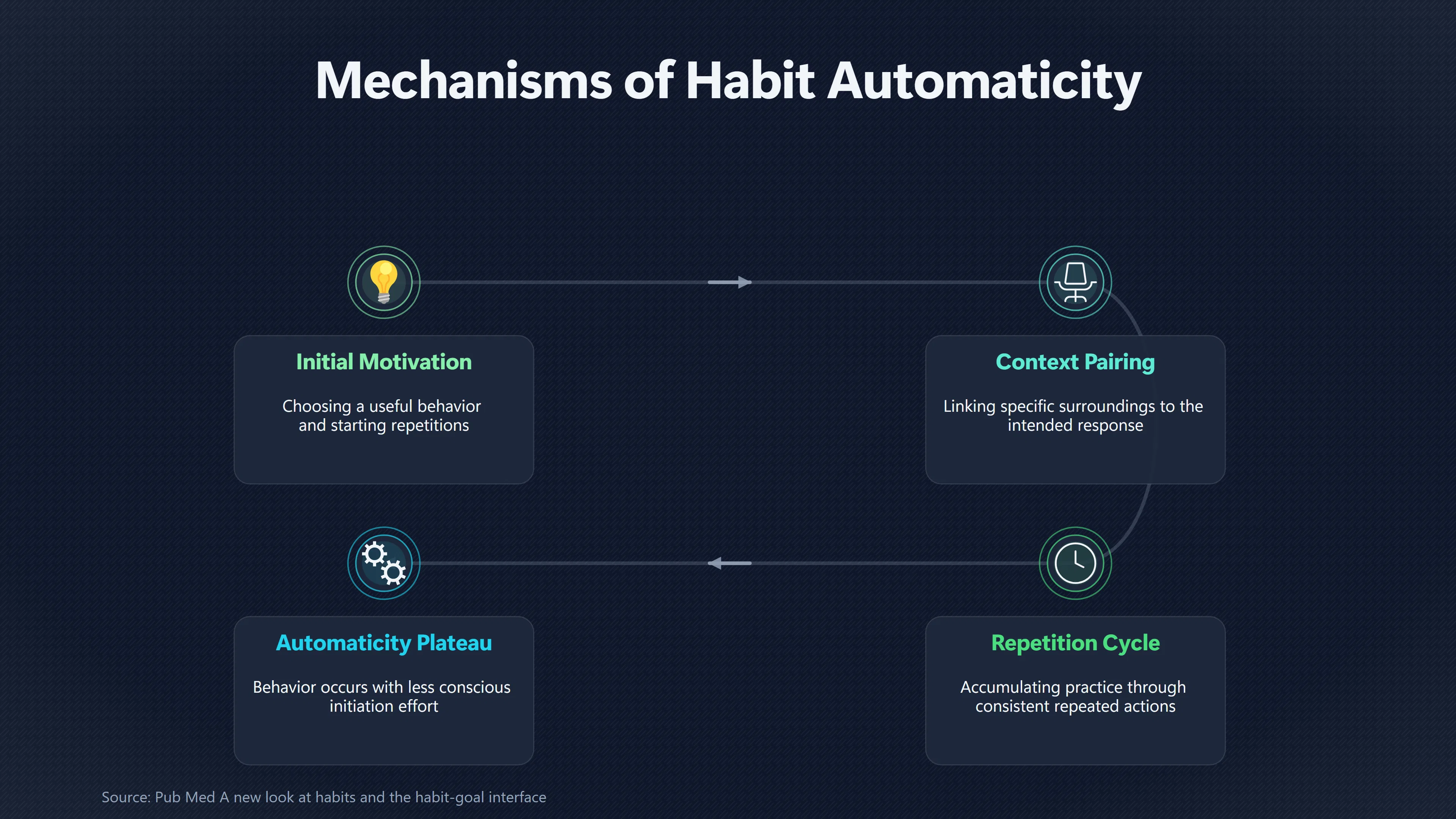
Repeating a behaviour in a stable context can strengthen automaticity, reducing how much fresh deliberation is needed each time.
On this page
- Why recurring contexts can become behavioural cues
- What study and walking experiments found
- How consistency can reduce repeated decision making
Page outline Jump by section
Introduction
A stable context can make a new behaviour easier to repeat because the surroundings, timing or preceding routine can gradually become cues for the action itself. Instead of repeatedly asking, “Will I do this now?”, a person who always studies after breakfast, walks after lunch or stretches after brushing their teeth gives the brain a recurring cue–response pattern to learn. Habit researchers call the resulting sense that an action happens with less conscious initiation automaticity.[PubMed]pubmed.ncbi.nlm.nih.govPub Med A new look at habits and the habit-goal interfaceA new look at habits and the habit-goal interface - PubMed…
The practical point is not that motivation becomes unnecessary. Motivation is still important for choosing a useful behaviour and getting enough repetitions underway. The advantage of context consistency is that those repetitions can gradually shift some control away from fresh deliberation. Experiments on study habits and walking now provide stronger evidence that keeping contexts relatively stable can accelerate this process, although automaticity does not guarantee that behaviour will persist under every circumstance.[PubMed]pubmed.ncbi.nlm.nih.govContext Stability in Habit Building Increases Automaticity and Goal Attainment - PubMedJune 10, 2022…
Why recurring contexts can become behavioural cues
Habit theory treats a context as more than a backdrop. When a behaviour repeatedly follows particular features of a situation, associations can develop between those features and the response. “Context” can include a physical place, a time of day, people who are present, an emotional state or — importantly — another action that reliably happens immediately beforehand.[Sage Journals]journals.sagepub.comSage Journals Habits—A Repeat PerformanceSage JournalsHabits—A Repeat Performance - David T. Neal, Wendy Wood, Jeffrey M. Quinn, 2006…
That last category explains why “after breakfast” can be a useful habit context even when breakfast does not occur at exactly 7:30 every morning. The preceding routine provides an event that can recur despite some clock-time variation. Likewise, arriving at a desk, putting the children to bed or finishing lunch can potentially provide a recognisable starting condition for the next behaviour. The essential ingredient is not a magical location or hour; it is repeated pairing between sufficiently recognisable circumstances and the intended response.
This distinction matters because repetition alone and repetition in a recurring context are not quite the same intervention. If someone reads for 20 minutes every day but does so at unpredictable times and places, they accumulate practice. If they repeatedly read immediately after breakfast in the same chair, they also repeatedly expose themselves to cues that can become associated with starting to read. The theoretical expectation is that the second pattern provides more opportunity for cue-dependent automaticity to develop.[PubMed]pubmed.ncbi.nlm.nih.govPub Med A new look at habits and the habit-goal interfaceA new look at habits and the habit-goal interface - PubMed…
A well-known real-world study by Phillippa Lally and colleagues illustrates the process. Ninety-six volunteers selected an eating, drinking or activity behaviour and attempted it daily in the same context — such as after breakfast — for 12 weeks. Automaticity generally rose rapidly at first and then more slowly towards a plateau. Among participants for whom the researchers could model the process, estimated time to reach 95% of their eventual automaticity ranged from 18 to 254 days. Missing a single opportunity did not materially derail habit formation.[Wiley Online Library]onlinelibrary.wiley.comWiley Online LibraryHow are habits formed: Modelling habit formation in the real world - Lally - 2010 - European Journal of Social Psycho…
Those results are useful partly because they undermine the popular idea that a habit appears after a fixed number of days. The more defensible target is consistent cue–behaviour repetition, not completing an arbitrary streak. A 2024 systematic review likewise concluded that habit formation times vary substantially between people and behaviours, while identifying repeated performance and stable contexts among the factors relevant to developing automaticity.[PubMed Central (PMC)]pmc.ncbi.nlm.nih.govOpen source on nih.gov.
What study and walking experiments found
The particularly useful evidence comes from studies that deliberately changed context consistency rather than merely observing people who already had strong routines.
In a 2022 investigation, Marco Stojanovic and colleagues followed 95 university students building study habits over six weeks. Participants generated 2,482 logged habit repetitions. One group was told to keep the time and place of the behaviour stable, while another was instructed to vary them. A second dataset examined 308 habits recorded by 218 users of a habit-building app. Across the datasets, greater context stability predicted greater automaticity and better attainment of the intended repetition goal; automaticity partially mediated the relationship between context stability and goal attainment.[PubMed Central (PMC)]pmc.ncbi.nlm.nih.govOpen source on nih.gov.
There is an important qualification inside that experiment. Simply belonging to the assigned stable-context group did not by itself produce a statistically significant difference in automaticity. Instead, the day-to-day degree of context stability predicted automaticity, particularly among participants operating in generally stable contexts. The authors therefore argued that context needs to be specified with enough precision: a vague plan such as doing something “at home after school” may still encompass considerable variation from one repetition to the next.[Frontiers]frontiersin.orgOpen source on frontiersin.org.
A newer randomised study provides more direct evidence from physical activity. Jane Ebert and Xin Yao Lin recruited 127 insufficiently active working adults and compared three conditions over four weeks: planning daily walking in consistent contexts, planning it in varying contexts, and a control condition without required planning. Both planning groups increased their walking during the intervention, but only the consistent-context group developed and subsequently maintained increased walking automaticity at the four-week follow-up.[PubMed]pubmed.ncbi.nlm.nih.govConfirming the Causal Role of Consistent Contexts in Developing a Walking Habit: A Randomized Comparison With Varied Contexts - PubMed…
That separation is revealing. Planning helped people walk more during the active intervention whether the contexts were stable or varied. Context consistency made the distinctive difference to whether walking came to feel more automatic. In other words, a strategy can successfully increase behaviour in the short term without necessarily producing the same degree of habit learning.
The walking experiment also identified an intriguing natural advantage: people whose everyday schedules were already more routine were better positioned to develop automaticity. Among control participants who received no planning requirement, those with more routine schedules developed greater automaticity, with the effect mediated by walking in more consistent contexts. A predictable daily structure may therefore supply useful cues even without an elaborate habit-building system.[PubMed]pubmed.ncbi.nlm.nih.govConfirming the Causal Role of Consistent Contexts in Developing a Walking Habit: A Randomized Comparison With Varied Contexts - PubMed…
Consistency helps, but the evidence is not absolute
Stable context should not be turned into another simplistic self-improvement rule. Some observational findings are less tidy than the experimental results.
For example, a 2021 study followed 104 older adults for ten days using repeated assessments and activity monitoring. Greater stability of some contexts was associated with behaviour — including more moderate-to-vigorous physical activity when physical contexts were more stable — but none of the measured context-stability dimensions predicted habit automaticity. The researchers concluded that context stability was related to some behaviours without evidence in their study that habit explained the relationship.[BPS PsycHub]bpspsychub.onlinelibrary.wiley.comOpen source on wiley.com.
Different cues may also matter for different people and behaviours. In an earlier study of 1,244 Australian adults, consistency of routine and mood was associated with physical-activity automaticity, whereas consistency of time and the people present was associated with the amount of physical activity. That makes “always do it at exactly the same time” too narrow as universal advice: the useful recurring cue might instead be a routine or another personally salient feature of the situation.[PubMed]pubmed.ncbi.nlm.nih.govCue Consistency Associated with Physical Activity Automaticity and Behavior - PubMed…
More recent longitudinal work reinforces that individual variation. A 2026 study examining physical activity and sedentary behaviour found that context stability was more consistently associated with changes in habit strength than with behavioural change, but the context that mattered differed between people. For physical-activity adopters, habit gains were associated with their most stable individual cue rather than one universally superior type of context.[Taylor & Francis Online]tandfonline.comOpen source on tandfonline.com.
The sensible interpretation is therefore stable enough to learn, not rigid for its own sake. Context consistency is a way of giving repetition a dependable structure. It is not evidence that every successful habit must occur in one exact room at one exact minute.
How consistency can reduce repeated decision-making
The connection to motivation becomes clearest at the moment a behaviour is supposed to start. A purely motivational approach repeatedly presents the person with a choice: exercise now or later, study here or somewhere else, read tonight or tomorrow. Even when the long-term goal remains attractive, each occasion requires another initiation decision.
A stable-context strategy changes that structure. The practical intervention is to choose a repeatable cue and response, then preserve their relationship for long enough that automaticity has an opportunity to develop. For example:
- “After I finish breakfast, I will review my notes at the kitchen table.”
- “When I finish lunch at work, I will take my usual walk.”
- “After I brush my teeth in the evening, I will stretch.”
- “When I sit at my desk at the start of the working day, I will spend ten minutes on the priority task before opening routine messages.”
These examples are useful because the cue is observable and recurring. They are more conducive to stable repetition than “I will study when I feel focused” or “I will exercise when I have time”, which make initiation depend on conditions that may shift from day to day.
The intervention should nevertheless accommodate ordinary disruption. Lally and colleagues found that one missed opportunity did not materially impair the habit-formation trajectory, so maintaining the cue–response relationship over time matters more than treating an uninterrupted streak as sacred.[Wiley Online Library]onlinelibrary.wiley.comWiley Online LibraryHow are habits formed: Modelling habit formation in the real world - Lally - 2010 - European Journal of Social Psycho… When schedules genuinely change, it may be more useful to establish a second dependable version — for example, a weekday cue and a weekend cue — than to preserve an impractical rule simply for consistency’s sake.
Nor should automaticity be confused with guaranteed long-term adherence. In the walking randomised trial, the consistent-context group acquired and maintained greater automaticity but did not show the expected maintenance of increased walking after the intervention. Across all participants, however, people who developed greater automaticity did maintain their walking better, showing less decline.[PubMed]pubmed.ncbi.nlm.nih.govConfirming the Causal Role of Consistent Contexts in Developing a Walking Habit: A Randomized Comparison With Varied Contexts - PubMed… This is an important boundary on the claim: habit strength can support persistence without making competing demands, changed circumstances or other barriers disappear.
The practical lesson for self-improvement
For a new behaviour that already seems worthwhile, the useful question is often not “How can I stay motivated every day?” but “What recurring situation can reliably become the cue for this action?” Research on intentional habit formation suggests that repeating an action under recognisably similar conditions can strengthen automaticity, and experimental work now supports a causal contribution from context consistency rather than merely a correlation between organised people and stronger habits.[PubMed Central (PMC)]pmc.ncbi.nlm.nih.govOpen source on nih.gov.
This shifts the role of motivation without pretending to eliminate it. Motivation can select the behaviour, justify the effort and get the learning process started. A stable context then helps turn repeated execution into a learned pattern. As automaticity develops, the cue itself can increasingly help initiate the response, reducing the amount of fresh deliberation required on each occasion.[PubMed]pubmed.ncbi.nlm.nih.govPub Med A new look at habits and the habit-goal interfaceA new look at habits and the habit-goal interface - PubMed…
The strongest implementation principle is consequently modest: make the desired action easy to encounter under similar circumstances repeatedly. Choose a context that genuinely recurs, define it clearly enough to recognise, keep the behaviour feasible, and judge progress over repeated opportunities rather than by a mythical fixed habit-formation deadline. Stable contexts do not make motivation irrelevant; they help ensure that long-term self-improvement does not have to win the motivational argument from scratch every single time.
Amazon book picks
Further Reading
Books and field guides related to Can a Stable Context Make Habits Easier?. Use these as the next step if you want deeper reading beyond the article.
Atomic Habits
Rating: 3.5/5 from 7 Google Books ratings
The #1 New York Times bestseller. Over 25 million copies sold! Translated into 60+ languages! Tiny Changes, Remarkable Results No matter...

The Power of Habit
Rating: 4.0/5 from 145 Google Books ratings
Duhigg takes us to the edge of scientific discoveries that explain why habits exist and how they can be changed. Distilling information i...
Tiny Habits
Improving your life is much easier than you think. Whether it’s losing weight, sleeping more, or restoring your work/life balance – the s...
Good Habits, Bad Habits
'The world's leading expert on habits' - Matthew Syed, bestselling author of Black Box Thinking and Rebel IdeasWhat if you could harness...
eBay marketplace picks
Marketplace Samples
Live-tested eBay searches with available results related to this page.
Selected fromstudy desk accessory oneBay.co.uk.



Endnotes
1.
Source: onlinelibrary.wiley.com
Link:https://onlinelibrary.wiley.com/doi/10.1002/ejsp.674
Source snippet
Wiley Online LibraryHow are habits formed: Modelling habit formation in the real world - Lally - 2010 - European Journal of Social Psycho...
2.
Source: onlinelibrary.wiley.com
Link:https://onlinelibrary.wiley.com/doi/pdf/10.1002/ejsp.674
Source snippet
Wiley Online LibraryHow are habits formed: Modelling habit formation in the real world - Lally - 2010 - European Journal of Social Psycho...
3.
Source: bpspsychub.onlinelibrary.wiley.com
Link:https://bpspsychub.onlinelibrary.wiley.com/doi/10.1111/bjhp.12509
4.
Source: bpspsychub.onlinelibrary.wiley.com
Link:https://bpspsychub.onlinelibrary.wiley.com/doi/pdfdirect/10.1111/bjhp.12509
5.
Source: bpspsychub.onlinelibrary.wiley.com
Link:https://bpspsychub.onlinelibrary.wiley.com/doi/abs/10.1111/bjhp.12509
6.
Source: myscp.onlinelibrary.wiley.com
Link:https://myscp.onlinelibrary.wiley.com/doi/10.1016/j.jcps.2009.08.003
7.
Source: onlinelibrary.wiley.com
Link:https://onlinelibrary.wiley.com/doi/abs/10.1002/ejsp.674
8.
Source: onlinelibrary.wiley.com
Link:https://onlinelibrary.wiley.com/doi/abs/10.1002/ejsp.674?msockid=038ed114f43667dd0790c4bef5146634
9.
Source: onlinelibrary.wiley.com
Link:https://onlinelibrary.wiley.com/doi/abs/10.1002/ejsp.674?msockid=17570258034862e732eb114c02616368
10.
Source: onlinelibrary.wiley.com
Link:https://onlinelibrary.wiley.com/doi/abs/10.1002/ejsp.674?538fcd4b_page=6&947f74f7_page=5
11.
Source: onlinelibrary.wiley.com
Link:https://onlinelibrary.wiley.com/doi/abs/10.1002/ejsp.674?MixPanelId=15e3fe314440-0468d8411-64220f54-100000-15e3fe314460
12.
Source: onlinelibrary.wiley.com
Link:https://onlinelibrary.wiley.com/doi/10.1002/ejsp.674?947f74f7_page=6&b158b201_page=5
13.
Source: onlinelibrary.wiley.com
Link:https://onlinelibrary.wiley.com/doi/abs/10.1002/ejsp.674?cf_chl_jschl_tk=pmd_EwcJDaCFBR9OVEL1O_0qjioww0Gc86ZzpBvCBFhrDcE-1635261061-0-gqNtZGzNAjujcnBszQi9
14.
Source: onlinelibrary.wiley.com
Link:https://onlinelibrary.wiley.com/doi/abs/10.1002/ejsp.674?aff_id=24772
15.
Source: onlinelibrary.wiley.com
Link:https://onlinelibrary.wiley.com/doi/abs/10.1002/ejsp.674?source=content_type%3Areact%7Cfirst_level_url%3Aarticle%7Csection%3Amain_content%7Cbutton%3Abody_link
16.
Source: onlinelibrary.wiley.com
Link:https://onlinelibrary.wiley.com/doi/abs/10.1111/1468-2508.t01-1-00124
17.
Source: onlinelibrary.wiley.com
Link:https://onlinelibrary.wiley.com/doi/10.1002/jclp.70204
18.
Source: pubmed.ncbi.nlm.nih.gov
Title: Pub Med A new look at habits and the habit-goal interface
Link:https://pubmed.ncbi.nlm.nih.gov/17907866/
Source snippet
A new look at habits and the habit-goal interface - PubMed...
19.
Source: pubmed.ncbi.nlm.nih.gov
Link:https://pubmed.ncbi.nlm.nih.gov/20658824/
Source snippet
The automatic component of habit in health behavior: habit as cue-contingent automaticity - PubMed...
20.
Source: pubmed.ncbi.nlm.nih.gov
Link:https://pubmed.ncbi.nlm.nih.gov/35756236/
Source snippet
Context Stability in Habit Building Increases Automaticity and Goal Attainment - PubMedJune 10, 2022...
Published: June 10, 2022
21.
Source: pubmed.ncbi.nlm.nih.gov
Link:https://pubmed.ncbi.nlm.nih.gov/39225981/
Source snippet
Confirming the Causal Role of Consistent Contexts in Developing a Walking Habit: A Randomized Comparison With Varied Contexts - PubMed...
22.
Source: journals.sagepub.com
Title: Sage Journals Habits—A Repeat Performance
Link:https://journals.sagepub.com/doi/10.1111/j.1467-8721.2006.00435.x
Source snippet
Sage JournalsHabits—A Repeat Performance - David T. Neal, Wendy Wood, Jeffrey M. Quinn, 2006...
23.
Source: pubmed.ncbi.nlm.nih.gov
Link:https://pubmed.ncbi.nlm.nih.gov/25864705/
Source snippet
Cue Consistency Associated with Physical Activity Automaticity and Behavior - PubMed...
24.
Source: pmc.ncbi.nlm.nih.gov
Link:https://pmc.ncbi.nlm.nih.gov/articles/PMC11641623/
25.
Source: pmc.ncbi.nlm.nih.gov
Link:https://pmc.ncbi.nlm.nih.gov/articles/PMC9226889/
26.
Source: frontiersin.org
Link:https://www.frontiersin.org/journals/psychology/articles/10.3389/fpsyg.2022.883795/full
27.
Source: doi.org
Link:https://doi.org/10.1093/abm/kaae045
28.
Source: tandfonline.com
Link:https://www.tandfonline.com/doi/abs/10.1080/08870446.2025.2528925
29.
Source: pubmed.ncbi.nlm.nih.gov
Link:https://pubmed.ncbi.nlm.nih.gov/41664442/
30.
Source: pubmed.ncbi.nlm.nih.gov
Link:https://pubmed.ncbi.nlm.nih.gov/42053513/
31.
Source: journals.sagepub.com
Link:https://journals.sagepub.com/doi/full/10.1177/01461672261440446
32.
Source: pubmed.ncbi.nlm.nih.gov
Link:https://pubmed.ncbi.nlm.nih.gov/41866955/
33.
Source: pubmed.ncbi.nlm.nih.gov
Link:https://pubmed.ncbi.nlm.nih.gov/40080255/
34.
Source: pmc.ncbi.nlm.nih.gov
Link:https://pmc.ncbi.nlm.nih.gov/articles/PMC11297519/
35.
Source: journals.sagepub.com
Link:https://journals.sagepub.com/doi/10.1177/20552076241265217
36.
Source: pmc.ncbi.nlm.nih.gov
Link:https://pmc.ncbi.nlm.nih.gov/articles/PMC11201238/
37.
Source: frontiersin.org
Link:https://www.frontiersin.org/journals/psychology/articles/10.3389/fpsyg.2022.883795/full?infclid=98ed75048fad41069048c53e63b2394c
38.
Source: pmc.ncbi.nlm.nih.gov
Link:https://pmc.ncbi.nlm.nih.gov/articles/PMC12318445/
39.
Source: pubmed.ncbi.nlm.nih.gov
Link:https://pubmed.ncbi.nlm.nih.gov/33502088/
40.
Source: pubmed.ncbi.nlm.nih.gov
Link:https://pubmed.ncbi.nlm.nih.gov/33405284/
41.
Source: pmc.ncbi.nlm.nih.gov
Link:https://pmc.ncbi.nlm.nih.gov/articles/PMC7218590/
42.
Source: pmc.ncbi.nlm.nih.gov
Link:https://pmc.ncbi.nlm.nih.gov/articles/PMC7020232/
43.
Source: frontiersin.org
Link:https://www.frontiersin.org/journals/psychology/articles/10.3389/fpsyg.2020.00167/full
44.
Source: pubmed.ncbi.nlm.nih.gov
Link:https://pubmed.ncbi.nlm.nih.gov/31396122/
45.
Source: pmc.ncbi.nlm.nih.gov
Link:https://pmc.ncbi.nlm.nih.gov/articles/PMC6667662/
46.
Source: tandfonline.com
Link:https://www.tandfonline.com/doi/full/10.1080/09658211.2018.1432662
47.
Source: pubmed.ncbi.nlm.nih.gov
Link:https://pubmed.ncbi.nlm.nih.gov/31148882/
48.
Source: journals.sagepub.com
Link:https://journals.sagepub.com/doi/10.1177/1545968317690832
49.
Source: tandfonline.com
Link:https://www.tandfonline.com/doi/full/10.1080/08964289.2015.1017549
50.
Source: pubmed.ncbi.nlm.nih.gov
Link:https://pubmed.ncbi.nlm.nih.gov/25999838/
51.
Source: pmc.ncbi.nlm.nih.gov
Link:https://pmc.ncbi.nlm.nih.gov/articles/PMC4398599/
52.
Source: pmc.ncbi.nlm.nih.gov
Link:https://pmc.ncbi.nlm.nih.gov/articles/PMC4566897/
53.
Source: pubmed.ncbi.nlm.nih.gov
Link:https://pubmed.ncbi.nlm.nih.gov/41949147/
54.
Source: researchgate.net
Link:https://www.researchgate.net/profile/Jane-Ebert
55.
Source: journals.sagepub.com
Title: j.1467 8721.2006.00435.x
Link:https://journals.sagepub.com/doi/abs/10.1111/j.1467-8721.2006.00435.x
56.
Source: journals.sagepub.com
Title: j.1467 8721.2006.00435.x
Link:https://journals.sagepub.com/doi/abs/10.1111/j.1467-8721.2006.00435.x?mod=article_inline
57.
Source: openurl.ebsco.com
Link:https://openurl.ebsco.com/results?bquery=AU+Ebert%2C+Jane&page=1&sid=ebsco%3Aocu_results%3Acache
58.
Source: openurl.ebsco.com
Link:https://openurl.ebsco.com/results?bquery=AU+Carson%2C+Valerie&limiters=RV%3AY%2CDT%3A202406-&link_origin=&searchDescription=Carson%2C+Valerie&sid=ebsco%3Aocu%3Arecord
59.
Source: openurl.ebsco.com
Link:https://openurl.ebsco.com/results?bquery=AU+Vanderloo%2C+Leigh%C2%A0M.&limiters=RV%3AY%2CDT%3A202406-&link_origin=&searchDescription=Vanderloo%2C+Leigh%C2%A0M.&sid=ebsco%3Aocu%3Arecord
60.
Source: openurl.ebsco.com
Link:https://openurl.ebsco.com/results?bquery=DE+%22HEALTH+of+refugees%22&limiters=RV%3AY%2CDT%3A202406-&link_origin=&searchDescription=HEALTH+of+refugees&sid=ebsco%3Aocu%3Arecord
Additional References
61.
Source: sciencedirect.com
Link:https://www.sciencedirect.com/science/article/pii/S1469029218305867
Source snippet
Habit and physical activity: Theoretical advances, practical implications, and agenda for future research - ScienceDirect...
62.
Source: youtube.com
Title: How Does Habit Formation Impact UX Design Choices
Link:https://www.youtube.com/watch?v=CbtvMTlEfwM
Source snippet
For a foundational breakdown of the behavioral neuroscience behind [context cues]({{ 'context-cues/' | relative_url }}) and automaticity, watch The Science of Making & Breaking...
63.
Source: researchgate.net
Link:https://www.researchgate.net/publication/373868754_Effects_of_habit_formation_interventions_on_physical_activity_habit_strength_meta-analysis_and_meta-regression
64.
Source: researchgate.net
Link:https://www.researchgate.net/publication/329729103_Habit_and_physical_activity_Theoretical_advances_practical_implications_and_agenda_for_future_research
65.
Source: researchgate.net
Link:https://www.researchgate.net/publication/328619909_Physical_Activity_Habit_Complexities_and_Controversies_Theory_Mechanisms_Change_and_Contexts
66.
Source: researchgate.net
Link:https://www.researchgate.net/publication/349767578_A_Systematic_Review_Examining_the_Relationship_Between_Habit_and_Physical_Activity_Behavior_in_Longitudinal_Studies
67.
Source: researchgate.net
Link:https://www.researchgate.net/publication/380856470_Testing_the_Effect_of_Cue_Consistency_on_the_Past_Behavior-Habit-Physical_Activity_Relationship
68.
Source: visualize.jove.com
Link:https://visualize.jove.com/39225981-confirming-the-causal-role-of-consistent-contexts-in-developing-a-walking-habit-a-randomized-comparison-with-varied-contexts
69.
Source: visualize.jove.com
Link:https://visualize.jove.com/42586550-Not-all-cues-are-equal-A-systematic-review-and-threelevel-metaanalysis-of-context-consistency-physical-activity-and-habit-strength
70.
Source: researchgate.net
Link:https://www.researchgate.net/publication/5936907_A_New_Look_at_Habits_and_the_Habit-Goal_Interface