Within Missed Days
After a Miss, Keep the Habit Cue
Returning when the familiar cue next appears preserves the context that has been linking a situation with the intended behaviour.
On this page
- Why stable contexts help habits become automatic
- Returning at the next normal cue
- When the usual cue no longer fits your life
Page outline Jump by section
Introduction
After a missed day, the most useful restart is usually the least dramatic one: when the familiar cue next appears, do the habit there again. If the behaviour has been paired with “after breakfast”, arriving at the office, finishing lunch or another recurring situation, returning at that same cue continues the learning process that was already under way. A lapse does not require a new start date, a compensatory session or a redesigned routine.
The reason is mechanical rather than motivational. Habits develop as repeated behaviour becomes associated with recurring features of its context. Eventually, encountering those features can help activate the response with less deliberate decision-making. Research finds stronger automaticity when behaviours are repeated in stable rather than continually changing contexts, while one missed opportunity need not materially derail habit formation.[wiley.com]onlinelibrary.wiley.comWiley Online LibraryHow are habits formed: Modelling habit formation in the real world - Lally - 2010 - European Journal of Social Psycho…
For restarting after an ordinary lapse, then, the valuable thing to preserve is not the streak. It is the cue–behaviour relationship.
Why stable contexts help habits become automatic
In habit research, a “cue” is broader than an alarm or reminder. It can be a location, time of day, preceding action, social situation or other recurring feature present around the behaviour. Washing your hands after using the toilet is a straightforward example: the preceding event provides a reliable context in which the response has repeatedly occurred. With enough consistent pairings, exposure to contextual cues can increasingly activate the behaviour without the same degree of conscious prompting.[tandfonline.com]tandfonline.comTaylor & Francis OnlineFull article: Developing habit-based health behaviour change interventions: twenty-one questions to guide future r…
This makes context stability especially relevant after a lapse. The useful unit of continuity is not simply “I exercised yesterday and today”; it can instead be “when this situation occurs, this is what I do”. Missing one occurrence leaves that learned relationship available for the next occurrence. Returning to the normal cue supplies another pairing of the same situation with the same response.
Evidence increasingly supports a causal role for that consistency. In a 2022 study, 95 university students formed study habits over six weeks. One group was instructed to vary places and times, while another kept its performance context stable. A second dataset examined 308 habits recorded by 218 users of a habit-building app. Across both datasets, greater context stability predicted greater automaticity and better attainment of repetition goals; in the experimental study, the stable-context group showed the expected context effects that were absent when place and time were deliberately varied.[PubMed]pubmed.ncbi.nlm.nih.govContext Stability in Habit Building Increases Automaticity and Goal Attainment - PubMed…
A later randomised study provides a useful real-world example. Researchers assigned 127 insufficiently active working adults to walking plans involving consistent contexts, varied contexts or no required planning change. Both consistent- and varied-context planners increased walking during the four-week intervention, but only the consistent-context planners developed and maintained greater habit automaticity. That distinction matters: doing the behaviour and making its initiation habitual are related but not identical outcomes.[PubMed]pubmed.ncbi.nlm.nih.govConfirming the Causal Role of Consistent Contexts in Developing a Walking Habit: A Randomized Comparison With Varied Contexts - Pub…
The same general pattern appears in a 2024 systematic review and meta-analysis of health-behaviour habit formation. Across the literature, repetition was central, but stable patterns of performing the target behaviour in a consistent context were associated with stronger habits. The authors also cautioned that research cannot yet specify a universal amount of consistency required.[PubMed Central (PMC)]pmc.ncbi.nlm.nih.govOpen source on nih.gov.
So “keep the cue” should not be interpreted as a magical formula in which precisely matching one time or place guarantees a habit. It is better understood as a way of giving associative learning a relatively consistent signal.
Return at the next normal cue
Suppose the intended habit is ten minutes of stretching after breakfast. Tuesday is missed because the morning goes badly. From a cue-based perspective, the cleanest restart is not an elaborate recovery plan on Tuesday night. It is to stretch after breakfast on Wednesday, when the situation that has been associated with stretching naturally returns.
That approach fits the original real-world habit-formation study by Phillippa Lally and colleagues. Ninety-six participants selected an eating, drinking or activity behaviour and attempted it daily in the same context for 12 weeks. Automaticity generally increased with repeated context-consistent performance, while missing a single opportunity did not materially affect the formation process. More consistent performance was nevertheless associated with a better-fitting habit-development trajectory, so the finding supports tolerating an isolated miss rather than treating repeated inconsistency as irrelevant.[Wiley Online Library]onlinelibrary.wiley.comWiley Online LibraryHow are habits formed: Modelling habit formation in the real world - Lally - 2010 - European Journal of Social Psycho…
The practical restart rule can therefore be kept deliberately simple:
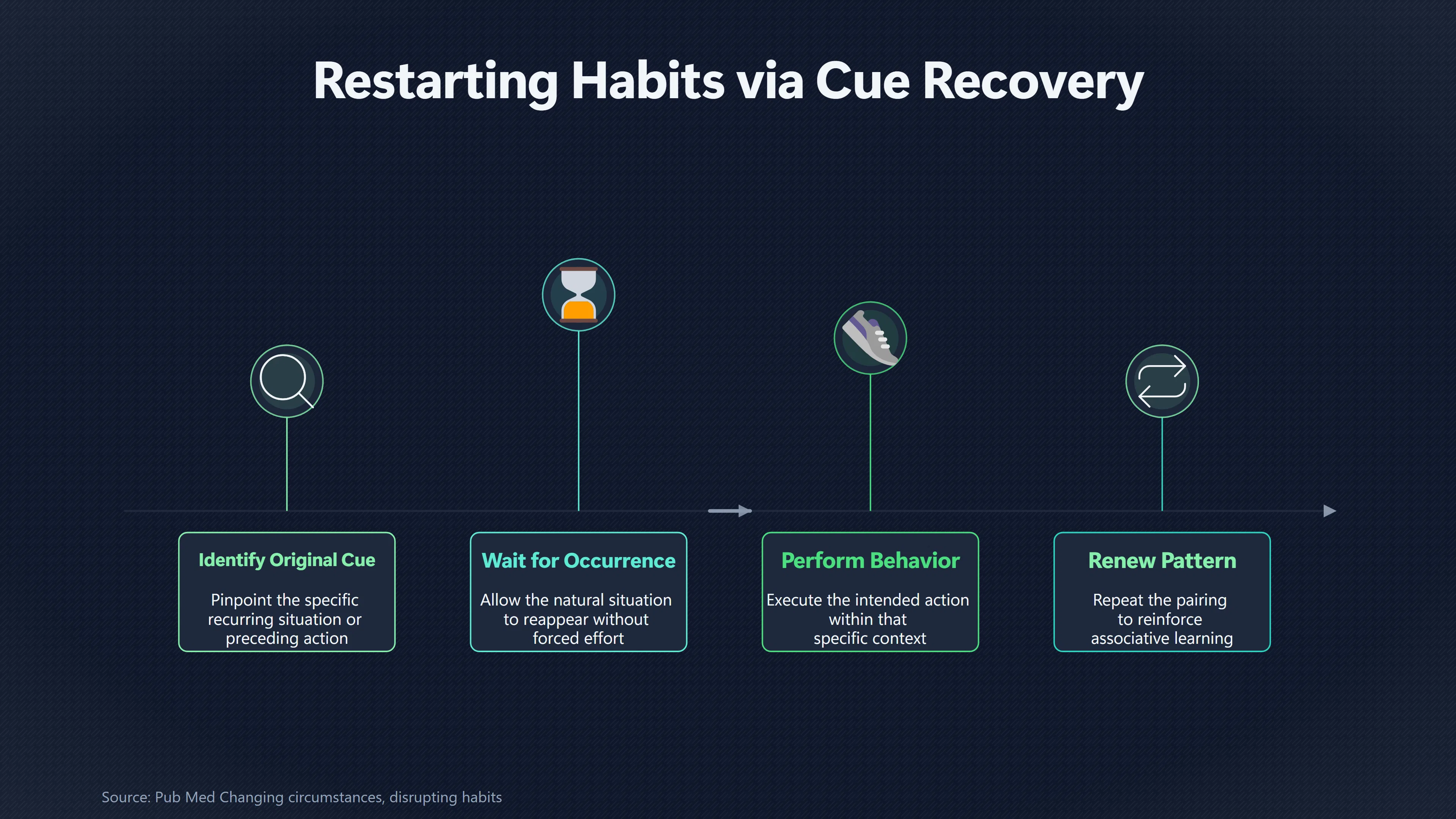
- Identify the cue you were already using. Think “after I make my morning coffee” or “when I finish lunch”, rather than merely “every day”.
- Wait for its next normal occurrence. An ordinary lapse does not create a need to manufacture an extra performance solely to repair the streak.
- Perform the intended behaviour when that cue occurs. This restores the same cue–response pairing instead of introducing an unnecessary new one.
- Repeat from there. The important pattern is renewed context-consistent repetition, not retrospective correction of the missed occasion.
A cue need not be an exact clock time. In a randomised trial of 192 adults building healthy-eating habits, participants linked their chosen behaviour either to a daily routine, such as after breakfast, or to a particular time. Automaticity increased in both conditions, with no significant advantage for either cue type; frequent enactment of the behaviour in response to the chosen cue predicted greater automaticity.[PubMed]pubmed.ncbi.nlm.nih.govHabit formation following routine-based versus time-based cue planning: A randomized controlled trial - PubMedJanuary 6, 2021…
That result makes the restart principle more flexible than “always do it at 7.30 am”. A person whose mornings vary might have a more dependable cue in a sequence of actions: after brushing their teeth, after putting the kettle on, when arriving home or immediately after closing their work laptop. Researchers note that habit cues can include preceding actions as well as times and locations, and existing routines can provide particularly convenient stable contexts.[PubMed Central (PMC)]pmc.ncbi.nlm.nih.govPubMed Central (PMC)Making health habitual: the psychology of ‘habit-formation’ and general practice - PMC…
The goal is therefore recognisable sameness, not perfect duplication. What needs to recur is enough of the meaningful context for the same behaviour to become predictably associated with it.

Why changing the cue after every miss can work against you
A lapse can provoke unnecessary troubleshooting: perhaps the workout should move from morning to evening, the reading habit needs a different chair, or the reminder needs another time. Sometimes those changes are justified. But continually relocating a workable habit after ordinary misses can remove the very regularity that helps automaticity develop.
Research on established habits illustrates why. In a classic study of students transferring universities, habitual exercising, newspaper reading and television watching were more likely to persist when relevant aspects of their performance contexts remained stable. When the usual circumstances changed, habitual behaviour was disrupted and behaviour could come under greater intentional control.[PubMed]pubmed.ncbi.nlm.nih.govPub Med Changing circumstances, disrupting habitsPub Med Changing circumstances, disrupting habits
Experimental and review work likewise describes habits as unusually context-dependent compared with goal-directed actions. Context change can weaken or interrupt habitual responding because the cues that previously evoked the response are absent or altered. Importantly, this does not mean the underlying learning has literally been deleted; habit expression can depend on whether the relevant context is present.[PubMed]pubmed.ncbi.nlm.nih.govOpen source on nih.gov.
That gives a missed day and a changed life different meanings. A miss is an omitted repetition; a context change can remove the trigger itself. If yesterday’s breakfast was unusually rushed but tomorrow’s normal breakfast returns, there may be little reason to redesign anything. If a new job eliminates breakfast at home altogether, preserving the old cue may no longer be practical.
When the usual cue no longer fits your life
Stable cues are useful only when they remain sufficiently available. Moving house, changing jobs, becoming a parent, retiring or undergoing a major schedule change can disrupt the contexts in which existing habits were learned. Research on “habit discontinuity” shows that such transitions can weaken contextual control over behaviour. A UK analysis involving 18,053 people, for example, found evidence consistent with context change after moving home temporarily weakening established travel patterns.[PubMed]pubmed.ncbi.nlm.nih.govOpen source on nih.gov.
In that situation, “keep the cue” should not become “cling to an obsolete routine”. If the old cue has disappeared, the practical task changes from resuming an existing cue–behaviour pairing to establishing a dependable replacement context.
A useful replacement is one that is likely to recur and is easy to recognise. If “go for a walk after leaving the office” disappeared when work became remote, “walk after shutting down the work computer” preserves the useful structure of a preceding-action cue even though the physical setting has changed. If a fixed 6 pm routine became unreliable because of changing shifts, a recurring event such as finishing the main meal may provide a more stable anchor. Habit researchers explicitly recognise that useful contexts can be functional or event-based rather than rigidly tied to one clock time or physical location.[Taylor & Francis Online]tandfonline.comTaylor & Francis OnlineFull article: Developing habit-based health behaviour change interventions: twenty-one questions to guide future r…
Once a replacement is necessary, consistency matters again. Repeatedly performing the behaviour in the new context gives that context the opportunity to acquire predictive value. The 2021 nutrition trial is reassuring here: both routine-based and time-based cue plans supported increases in automaticity when participants repeatedly enacted the behaviour in response to their planned cue.[PubMed]pubmed.ncbi.nlm.nih.govHabit formation following routine-based versus time-based cue planning: A randomized controlled trial - PubMedJanuary 6, 2021…

The useful measure of a restart
A streak asks, “How many consecutive days have I done this?” Cue-based habit formation asks a different question: “When the relevant situation occurs, how reliably does it lead to the behaviour?”
That second question better reflects the mechanism researchers are trying to build. Modern reviews describe habit as a learned cue–behaviour association through which situational cues can generate a response increasingly automatically. They also caution against oversimplifying this into a rigid claim that every habit requires an identical time and place; real-world cues are personal, can consist of several contextual features, and may include preceding routines as well as physical settings.[Wiley Online Library]compass.onlinelibrary.wiley.comOpen source on wiley.com.
After an isolated miss, this produces a restrained but evidence-based rule: do not reset the habit simply because the streak reset. Keep the cue, and answer it with the behaviour when it next appears. Lapses still matter if they become chronic because they remove opportunities for repetition. But an ordinary missed occasion need not erase the context–behaviour learning accumulated before it.[Wiley Online Library]onlinelibrary.wiley.comWiley Online LibraryHow are habits formed: Modelling habit formation in the real world - Lally - 2010 - European Journal of Social Psycho…
That is why the familiar cue can serve as a better restart point than guilt, compensation or a fresh Monday. It brings the behaviour back into the situation that has been learning to call it forth.
Amazon book picks
Further Reading
Books and field guides related to After a Miss, Keep the Habit Cue. Use these as the next step if you want deeper reading beyond the article.
Good Habits, Bad Habits
'The world's leading expert on habits' - Matthew Syed, bestselling author of Black Box Thinking and Rebel IdeasWhat if you could harness...
Atomic Habits
Rating: 3.5/5 from 7 Google Books ratings
The #1 New York Times bestseller. Over 25 million copies sold! Translated into 60+ languages! Tiny Changes, Remarkable Results No matter...
Tiny Habits
Improving your life is much easier than you think. Whether it’s losing weight, sleeping more, or restoring your work/life balance – the s...
The Power of Habit
Rating: 4.0/5 from 145 Google Books ratings
Duhigg takes us to the edge of scientific discoveries that explain why habits exist and how they can be changed. Distilling information i...
eBay marketplace picks
Marketplace Samples
Live-tested eBay searches with available results related to this page.
Selected fromhabit tracker board oneBay.co.uk.

Endnotes
1.
Source: onlinelibrary.wiley.com
Link:https://onlinelibrary.wiley.com/doi/abs/10.1002/ejsp.674?aff_id=24772
Source snippet
Wiley Online LibraryHow are habits formed: Modelling habit formation in the real world - Lally - 2010 - European Journal of Social Psycho...
2.
Source: onlinelibrary.wiley.com
Link:https://onlinelibrary.wiley.com/doi/abs/10.1002/ejsp.674
Source snippet
Wiley Online LibraryHow are habits formed: Modelling habit formation in the real world - Lally - 2010 - European Journal of Social Psycho...
3.
Source: compass.onlinelibrary.wiley.com
Link:https://compass.onlinelibrary.wiley.com/doi/full/10.1111/spc3.12975
4.
Source: compass.onlinelibrary.wiley.com
Link:https://compass.onlinelibrary.wiley.com/doi/10.1111/spc3.12975
5.
Source: compass.onlinelibrary.wiley.com
Link:https://compass.onlinelibrary.wiley.com/doi/epdf/10.1111/spc3.12975
6.
Source: bpspsychub.onlinelibrary.wiley.com
Link:https://bpspsychub.onlinelibrary.wiley.com/doi/abs/10.1111/bjhp.12504
7.
Source: onlinelibrary.wiley.com
Link:https://onlinelibrary.wiley.com/doi/10.1002/ejsp.674
8.
Source: onlinelibrary.wiley.com
Link:https://onlinelibrary.wiley.com/doi/abs/10.1002/ejsp.674?msockid=038ed114f43667dd0790c4bef5146634
9.
Source: onlinelibrary.wiley.com
Link:https://onlinelibrary.wiley.com/doi/10.1002/ejsp.674?947f74f7_page=5&b158b201_page=5
10.
Source: onlinelibrary.wiley.com
Link:https://onlinelibrary.wiley.com/doi/abs/10.1002/ejsp.674?msockid=17570258034862e732eb114c02616368
11.
Source: onlinelibrary.wiley.com
Link:https://onlinelibrary.wiley.com/doi/abs/10.1002/ejsp.674?MixPanelId=15e3fe314440-0468d8411-64220f54-100000-15e3fe314460
12.
Source: onlinelibrary.wiley.com
Link:https://onlinelibrary.wiley.com/doi/abs/10.1002/ejsp.674?cf_chl_jschl_tk=pmd_EwcJDaCFBR9OVEL1O_0qjioww0Gc86ZzpBvCBFhrDcE-1635261061-0-gqNtZGzNAjujcnBszQi9
13.
Source: onlinelibrary.wiley.com
Link:https://onlinelibrary.wiley.com/doi/abs/10.1002/ejsp.674?538fcd4b_page=6&947f74f7_page=5
14.
Source: onlinelibrary.wiley.com
Link:https://onlinelibrary.wiley.com/doi/10.1002/ejsp.205
15.
Source: bpspsychub.onlinelibrary.wiley.com
Link:https://bpspsychub.onlinelibrary.wiley.com/share/SFKV2IDZIZUZFJF4X9N2?target=10.1111%2Fbjhp.12504
16.
Source: pubmed.ncbi.nlm.nih.gov
Link:https://pubmed.ncbi.nlm.nih.gov/35756236/
Source snippet
Context Stability in Habit Building Increases Automaticity and Goal Attainment - PubMed...
17.
Source: pmc.ncbi.nlm.nih.gov
Link:https://pmc.ncbi.nlm.nih.gov/articles/PMC11641623/
18.
Source: tandfonline.com
Link:https://www.tandfonline.com/doi/full/10.1080/08870446.2021.2003362
Source snippet
Taylor & Francis OnlineFull article: Developing habit-based health behaviour change interventions: twenty-one questions to guide future r...
19.
Source: pmc.ncbi.nlm.nih.gov
Link:https://pmc.ncbi.nlm.nih.gov/articles/PMC3505409/
Source snippet
PubMed Central (PMC)Making health habitual: the psychology of ‘habit-formation’ and general practice - PMC...
20.
Source: pmc.ncbi.nlm.nih.gov
Link:https://pmc.ncbi.nlm.nih.gov/articles/PMC4566897/
Source snippet
PubMed Central (PMC)A review and analysis of the use of ‘habit’ in understanding, predicting and influencing health-related behaviour - PMC...
21.
Source: pmc.ncbi.nlm.nih.gov
Link:https://pmc.ncbi.nlm.nih.gov/articles/PMC9226889/
Source snippet
PubMed Central (PMC)Context Stability in Habit Building Increases Automaticity and Goal Attainment - PMC...
22.
Source: pubmed.ncbi.nlm.nih.gov
Link:https://pubmed.ncbi.nlm.nih.gov/39225981/
Source snippet
Confirming the Causal Role of Consistent Contexts in Developing a Walking Habit: A Randomized Comparison With Varied Contexts - Pub...
23.
Source: pubmed.ncbi.nlm.nih.gov
Link:https://pubmed.ncbi.nlm.nih.gov/33405284/
Source snippet
Habit formation following routine-based versus time-based cue planning: A randomized controlled trial - PubMedJanuary 6, 2021...
Published: January 6, 2021
24.
Source: doi.org
Link:https://doi.org/10.1111/bjhp.12504
25.
Source: pubmed.ncbi.nlm.nih.gov
Title: Pub Med Changing circumstances, disrupting habits
Link:https://pubmed.ncbi.nlm.nih.gov/15982113/
26.
Source: pubmed.ncbi.nlm.nih.gov
Link:https://pubmed.ncbi.nlm.nih.gov/34713424/
27.
Source: doi.org
Link:https://doi.org/10.3758%2Fs13420-021-00488-z
28.
Source: pubmed.ncbi.nlm.nih.gov
Link:https://pubmed.ncbi.nlm.nih.gov/27120333/
29.
Source: pmc.ncbi.nlm.nih.gov
Link:https://pmc.ncbi.nlm.nih.gov/articles/PMC4847906/
30.
Source: tandfonline.com
Link:https://www.tandfonline.com/doi/full/10.1080/23311908.2026.2673224
31.
Source: pubmed.ncbi.nlm.nih.gov
Link:https://pubmed.ncbi.nlm.nih.gov/42053513/
32.
Source: pubmed.ncbi.nlm.nih.gov
Link:https://pubmed.ncbi.nlm.nih.gov/41664442/
33.
Source: pubmed.ncbi.nlm.nih.gov
Link:https://pubmed.ncbi.nlm.nih.gov/39685110/
34.
Source: pubmed.ncbi.nlm.nih.gov
Link:https://pubmed.ncbi.nlm.nih.gov/39321606/
35.
Source: doi.org
Link:https://doi.org/10.1093/abm/kaae045
36.
Source: pubmed.ncbi.nlm.nih.gov
Link:https://pubmed.ncbi.nlm.nih.gov/35962435/
37.
Source: doi.org
Link:https://doi.org/10.1186/s12966-022-01343-8
38.
Source: tandfonline.com
Link:https://www.tandfonline.com/doi/full/10.1080/17437199.2021.1876572
39.
Source: pmc.ncbi.nlm.nih.gov
Link:https://pmc.ncbi.nlm.nih.gov/articles/PMC7106637/
40.
Source: pubmed.ncbi.nlm.nih.gov
Link:https://pubmed.ncbi.nlm.nih.gov/32228721/
41.
Source: pubmed.ncbi.nlm.nih.gov
Link:https://pubmed.ncbi.nlm.nih.gov/31396122/
42.
Source: pmc.ncbi.nlm.nih.gov
Link:https://pmc.ncbi.nlm.nih.gov/articles/3505409/
43.
Source: pmc.ncbi.nlm.nih.gov
Link:https://pmc.ncbi.nlm.nih.gov/articles/PMC3464791/
44.
Source: doi.org
Link:https://doi.org/10.1080/17437199.2011.603640%C2%A0
45.
Source: tandfonline.com
Link:https://www.tandfonline.com/doi/abs/10.1080/17437199.2011.603640
46.
Source: tandfonline.com
Title: Promoting habit formation: Health Psychology Review: Vol 7, No sup1
Link:https://www.tandfonline.com/doi/full/10.1080/17437199.2011.603640
47.
Source: pubmed.ncbi.nlm.nih.gov
Link:https://pubmed.ncbi.nlm.nih.gov/21749245/
48.
Source: pubmed.ncbi.nlm.nih.gov
Link:https://pubmed.ncbi.nlm.nih.gov/20658824/
49.
Source: pubmed.ncbi.nlm.nih.gov
Link:https://pubmed.ncbi.nlm.nih.gov/23211256/
50.
Source: pubmed.ncbi.nlm.nih.gov
Link:https://pubmed.ncbi.nlm.nih.gov/15647140/
51.
Source: doi.org
Link:https://doi.org/10.1521/SOCO.2007.25.2.248
Additional References
52.
Source: youtube.com
Title: Taster lecture: What are habits? | University of Surrey
Link:https://www.youtube.com/watch?v=1WfnQJ8aRMQ
Source snippet
This discussion on The Psychology of Habits with Dr. Benjamin Gardner directly explains how cue-behavior associations drive automaticity...
53.
Source: youtu.be
Link:https://youtu.be/0PSsPED3Qm0
Source snippet
Bad habits can be challenging to change due to friction — that is, the time and effort it takes to overcome them...
54.
Source: nature.com
Link:https://www.nature.com/articles/s41598-024-65753-3
55.
Source: youtube.com
Title: The secret habits that control your life | Wendy Wood
Link:https://www.youtube.com/watch?v=FoAODalKhv8
Source snippet
Secrets to Making Change Stick with Dr. Wendy Wood & Charles Good...
56.
Source: youtube.com
Title: The Psychology of Habits | Dr. Benjamin Gardner
Link:https://www.youtube.com/watch?v=83cKQylK7zo
Source snippet
The secret habits that control your life | Wendy Wood...
57.
Source: researchgate.net
Link:https://www.researchgate.net/publication/348328187_Habit_formation_following_routine-based_versus_time-based_cue_planning_A_randomized_controlled_trial
58.
Source: surrey.ac.uk
Link:https://www.surrey.ac.uk/people/phillippa-lally
59.
Source: frontiersin.org
Link:https://www.frontiersin.org/journals/psychology/articles/10.3389/fpsyg.2022.883795/full
60.
Source: frontiersin.org
Link:https://www.frontiersin.org/journals/psychology/articles/10.3389/fpsyg.2022.883795/full?infclid=98ed75048fad41069048c53e63b2394c
61.
Source: researchgate.net
Link:https://www.researchgate.net/publication/32898894_How_are_habits_formed_Modeling_habit_formation_in_the_real_world