Within Precommitment
When Blocking Distractions Beats Resisting Them
Scheduled access blocks can protect planned work by making distracting content unavailable during the hours when temptation usually wins.
On this page
- How advance blocking changes the future choice set
- What the 2023 You Tube experiment found about commitment
- Choosing the smallest block that still protects focused work
Page outline Jump by section
Introduction
Blocking digital temptations works by changing the choice you will face during focused work. Instead of opening a document and repeatedly deciding not to check social media, news or video, you decide beforehand that those options will be unavailable for a defined period. That distinction matters: the intervention is not a reminder to exercise self-control but a form of digital precommitment that reduces the opportunities to abandon the task.
The evidence is promising but more qualified than the marketing around productivity blockers often suggests. Workplace research has found longer periods of focus when distracting sites were blocked, while other experiments show that restrictions can fail, become burdensome or remove content people genuinely need. A particularly revealing 2023 experiment using tempting YouTube videos found both overcommitment and undercommitment — but, after adjustment, undercommitment was the larger problem.[DOI]doi.org3123024.3124558DOIHow blocking distractions affects workplace focus and productivity | Proceedings of the 2017 ACM International Joint Conference on Per…
How advance blocking changes the future choice set
The important implementation detail is when the decision is made. Suppose someone intends to write from 09:00 to 10:30 but routinely drifts into social media at about 09:20. Simply deciding to “stay off social media” leaves the tempting option available at exactly the moment when the earlier plan is vulnerable. Scheduling a block at 08:55 changes the later situation: at 09:20 there is no ordinary choice between continuing the paragraph and opening the feed.
This is why scheduled blocking is meaningfully different from noticing distraction and activating a blocker after it has already begun. Automatic scheduling moves the intervention upstream. Current blocking software can implement recurring periods in which selected sites or apps become unavailable without requiring the user to start a focus session at the vulnerable moment.[Focus Bear]support.focusbear.ioFocus Bear Blocking Schedule: Automatically Block Apps and Websites by TimeFocus Bear Blocking Schedule: Automatically Block Apps and Websites by Time The behavioural principle does not depend on a particular product: the useful feature is that access changes before the temptation-driven decision would otherwise occur.
There are at least two reasons this can help. First, digital interruptions can directly compete for attention. In an experimental study, receiving mobile-phone notifications disrupted performance on an attention-demanding task even when participants did not interact with the phone. Another experiment in which people could switch between a cognitive task and their own smartphones found naturally arriving notifications were the strongest predictor of switches from work to phone use.[PubMed]pubmed.ncbi.nlm.nih.govPub Med The attentional cost of receiving a cell phone notificationThe attentional cost of receiving a cell phone notification - PubMedJune 29, 2015… Blocking or silencing a known source of interruption can therefore prevent some attention shifts rather than requiring recovery afterwards.
Second, blocking removes repeated opportunities for voluntary diversion. A small workplace field study illustrates the distinction. Thirty-two information workers completed five baseline working days followed by five days with non-work online distractions blocked. During the blocking period, participants reported significantly higher productivity and were able to focus for significantly longer; those most susceptible to social-media distraction showed the greatest gains in focus.[DOI]doi.org3123024.3124558DOIHow blocking distractions affects workplace focus and productivity | Proceedings of the 2017 ACM International Joint Conference on Per…
That study was exploratory rather than a large randomised trial, so it should not be read as proof that blockers reliably increase objective output. It also uncovered a useful warning: some participants worked for longer stretches without taking physical breaks, with higher stress. Removing digital diversion can eliminate an unhelpful interruption without automatically creating a healthy working rhythm.[DOI]doi.orgEffects of Individual Differences in Blocking Workplace Distractions | Proceedings of the 2018 CHI Conference on Human Factors in Comp… A good block therefore protects work from predictable temptations; it need not prohibit breaks.
What the 2023 YouTube experiment found about commitment
Claes Ek and Margaret Samahita’s 2023 experiment provides an unusually direct test of digital precommitment because participants faced an actual tempting alternative while doing tedious work. During a 15-minute transcription task, YouTube videos appeared in pop-ups. Participants could state how much they were willing to pay for a commitment device that could remove the videos for the whole task. The design kept the pop-ups themselves present even when videos were removed, helping the researchers separate the temptation of the videos from the mechanical interruption of closing a window.[UCD Research Repository]researchrepository.ucd.ieResearch RepositoryUCD Research Repository…
The temptation was not merely hypothetical. Among exposed participants, some clicked through to YouTube or watched videos in the pop-ups; five spent more than half of the 15-minute task period on YouTube. Yet many resisted successfully.[UCD Research Repository]researchrepository.ucd.ieResearch RepositoryUCD Research Repository… This variation allowed the researchers to ask a more interesting question than whether distracting video can hurt work: did people correctly judge how much protection they needed?
Not always. After the researchers adjusted for learning between the two work tasks, 19.3% of exposed participants were classified as overestimating the commitment justified by their realised material losses, while 47.8% underestimated it. The estimated aggregate welfare loss associated with underestimation was also substantially larger than that associated with overestimation under the study’s assumptions.[UCD Research Repository]researchrepository.ucd.ieResearch RepositoryUCD Research Repository… Using a measure that also incorporated expectations about the psychological difficulty of resisting temptation produced a more conservative but similar direction: 17.5% were classified as overcommitters and 24.3% as undercommitters after the learning adjustment.[UCD Research Repository]researchrepository.ucd.ieResearch RepositoryUCD Research Repository…
The practical lesson is not that stronger blocking is always better. Some people really did seek more commitment than their subsequent behaviour appeared to justify. Rather, the experiment challenges the comforting assumption that people reliably know they will cope when distraction arrives. In this setting, insufficient commitment was at least as important a problem as excessive commitment.[ScienceDirect]sciencedirect.comToo much commitment? An online experiment with tempting YouTube content - ScienceDirect…
There is also an important limit to what this experiment establishes. It involved a short, artificial transcription task and deliberately presented tempting YouTube content; everyday focused work can last hours and may require occasional access to the same platforms that also distract. The experiment is therefore stronger evidence for the mechanism of advance restriction than for any particular all-day blocking regimen.
Blocking is not automatically better than a lighter intervention
Other evidence makes that qualification important. In a randomised experiment involving students in a Stanford massive open online course, Richard Patterson tested several behavioural tools. A commitment device that let students precommit to how much distracting time they would allow themselves increased time spent working on the course by 24%, raised grades by 0.29 standard deviations and increased course completion by 40% relative to the control group. Yet a separate distraction-blocking treatment did not produce statistically distinguishable outcomes from the control.[ScienceDirect]sciencedirect.comCan behavioral tools improve online student outcomes? Experimental evidence from a massive open online course - ScienceDirect…
That result is a useful antidote to treating the word blocker as the active ingredient. Design matters. A restriction has to target a behaviour that is actually interfering with the goal, operate when that behaviour is most likely to occur, and be difficult enough to bypass that the advance decision survives the later impulse. A block that is poorly matched to the problem can add inconvenience without improving work.
Restrictions can also displace rather than eliminate distraction. If one feed is inaccessible but five substitutes remain one click away, the user may simply switch destinations. Conversely, blocking too much can interfere with legitimate work. Research on SwitchTube, an experimental alternative YouTube interface, highlights this tension particularly clearly: people may visit the same platform either to pursue a specific goal or to browse recommendations. Its researchers developed a focus-oriented interface rather than indiscriminately removing YouTube, and a three-week field deployment with 46 participants found that allowing people to switch between focused and exploratory interfaces was associated with greater perceived agency, satisfaction and goal alignment.[Ora]ox.ac.ukOra Switch Tube: a proof-of-concept system introducing “adaptable commitment interfaces” as a tool for digital wellbeingOra Switch Tube: a proof-of-concept system introducing “adaptable commitment interfaces” as a tool for digital wellbeing
The implication for precommitment is precision. “YouTube is bad during work” is often too crude a rule. “Recommendations and Shorts are unavailable while I am coding, but a tutorial reached through search remains accessible” may protect the actual goal with much less collateral cost.
Choosing the smallest block that still protects focused work
The most defensible starting point is not maximum restriction but the smallest reliable intervention that removes the recurring failure point. The block should correspond to observed behaviour rather than to an abstract desire to use technology less.
A practical sequence is:
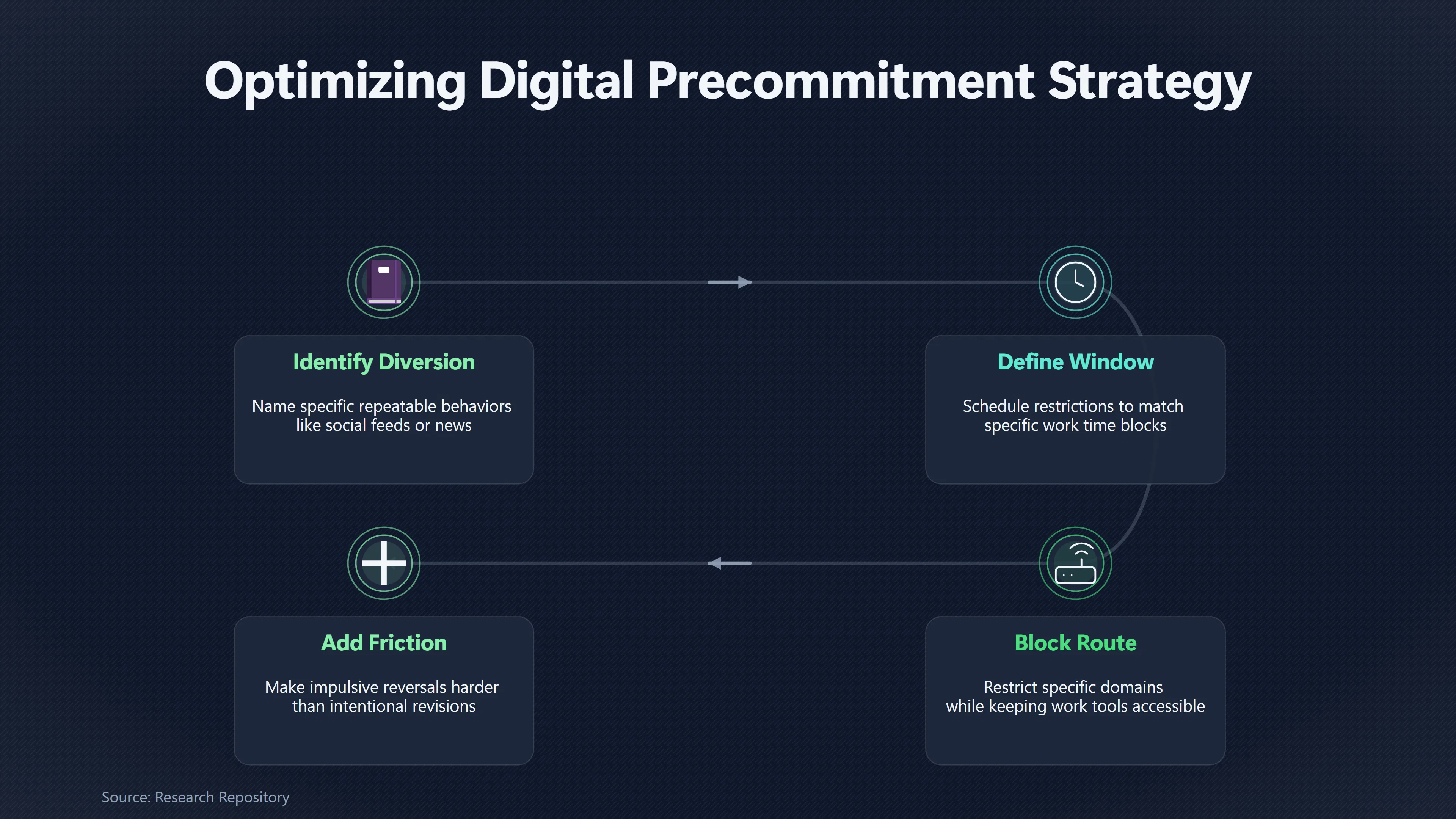
- Name the repeatable diversion. Identify what actually breaks focused sessions: for example, opening a social feed, reading news, watching recommended videos or responding to non-urgent notifications. A vague rule against “the internet” makes it harder to distinguish temptation from necessary tools.
- Protect a specific work window. If distraction repeatedly appears during a planned 90-minute writing period, schedule the restriction to begin just before that period and end with it. This preserves the defining advantage of precommitment: the access decision has already been made when temptation arrives.
-
Block the route, not more of your life than necessary. Start with the domains, apps, feeds or notifications that reliably cause switching. Keep work-critical services available. The SwitchTube research is a reminder that the same service can contain both goal-directed and distracting pathways. Ora
- Make impulsive reversal harder than intentional revision. A blocker that can be disabled instantly may become little more than a reminder. But an irreversible all-day restriction can create needless costs when circumstances change. The useful middle ground is enough friction to prevent an automatic escape while retaining a deliberate way to revise future sessions.
-
Preserve real breaks. Blocking distraction should not mean sitting continuously at the desk. In the workplace blocking study, some participants replaced online diversion with physical breaks, while others worked longer and experienced greater stress. DOI Scheduling an actual break separately avoids making social media the only available signal that it is time to stop.
- Judge the block by protected work, not screen-time purity. Lower screen time is not itself proof of better performance. A preregistered field experiment involving 112 people found that interventions could reduce objectively measured smartphone use without producing an immediate causal improvement in academic performance or subjective wellbeing. PubMed The relevant question here is narrower: did the block prevent the predictable diversion and make the intended focused session easier to complete?
The last point prevents digital blocking from becoming an exercise in unnecessary austerity. If a 60-minute social-media block reliably protects an hour of writing, there is little behavioural reason to turn it into a six-hour ban merely because stronger restriction feels more disciplined.
When blocking beats resisting
Advance blocking is most useful when three conditions coincide: the distraction is predictable, access to it is unnecessary during the intended work period, and previous intentions to resist it have repeatedly failed. Under those circumstances, continuing to practise the same in-the-moment choice leaves the weakest part of the system unchanged.
The research does not justify blocking every enjoyable digital activity, nor does it show that website blockers universally raise productivity. It supports a narrower and more useful proposition. Digital temptations can disrupt attention and draw people away from productive tasks; restricting them can improve focus in some settings; and people do not always accurately anticipate how much protection they will need. PubMed+2DOI
For self-improvement, that makes scheduled digital blocking valuable less as a test of discipline than as an exercise in environmental design. Decide while the goal is salient which predictable temptation does not need to be available. Remove it only for the vulnerable period. Then, when focused work begins, there is one less decision to win.
Amazon book picks
Further Reading
Books and field guides related to When Blocking Distractions Beats Resisting Them. Use these as the next step if you want deeper reading beyond the article.
Digital Minimalism: Choosing a Focused Life in a Noisy World
A New York Times, Wall Street Journal, Publishers Weekly, and USA Today bestseller "Newport is making a bid to be the Marie Kondo of tech...
Nudge
Rating: 3.5/5 from 29 Google Books ratings
Thaler and Sunstein offer a groundbreaking discussion of how to apply the science of choice to nudge people toward decisions that can imp...
Indistractable: How to Control Your Attention and Choose Your...
*As heard on Steven Bartlett's Diary of a CEO* 'A must-read' Mark Manson We are living through a crisis of distraction. Plans get sidetra...
Deep Work: Rules for Focused Success in a Distracted World
Trade paperback. Professor and popular blogger Cal Newport reveals the new key to achieving success and true meaning in professional life...
eBay marketplace picks
Marketplace Samples
Live-tested eBay searches with available results related to this page.
Selected frommotivational poster oneBay.co.uk.

Current eBay listing
Gym Motivational Posters Work Out Insperational Quotes Wall Art

Current eBay listing
Motivational Quotes Framed Wall Art Poster Canvas Print Picture
Endnotes
2.
Source: sciencedirect.com
Link:https://www.sciencedirect.com/science/article/pii/S0167268123000197
Source snippet
Too much commitment? An online experiment with tempting YouTube content - ScienceDirect...
3.
Source: doi.org
Link:https://doi.org/10.1145/3173574.3173666
Source snippet
Effects of Individual Differences in Blocking Workplace Distractions | Proceedings of the 2018 CHI Conference on Human Factors in Comp...
4.
Source: researchrepository.ucd.ie
Title: Research Repository
Link:https://researchrepository.ucd.ie/bitstreams/5a84f945-e2a5-429e-846b-8132821e8aee/download
Source snippet
UCD Research Repository...
5.
Source: sciencedirect.com
Link:https://www.sciencedirect.com/science/article/pii/S0167268118301768
Source snippet
Can behavioral tools improve online student outcomes? Experimental evidence from a massive open online course - ScienceDirect...
6.
Source: sciencedirect.com
Title: “I don’t care about cookies!” data disclosure and time-inconsistent users
Link:https://www.sciencedirect.com/science/article/pii/S0167624524000349
7.
Source: bsp.ucd.ie
Title: ie Academic Publications (selection) – UCD Behavioural Science Centre
Link:https://bsp.ucd.ie/publications/
8.
Source: researchrepository.ucd.ie
Title: ie Too much commitment? An online experiment with tempting You Tube content
Link:https://researchrepository.ucd.ie/entities/publication/529b450d-e9dc-4d6e-be2d-0ef60e5b6a0b
9.
Source: researchrepository.ucd.ie
Link:https://researchrepository.ucd.ie/entities/publication/6c57026c-d131-40b6-8d5c-640e8b950778
10.
Source: sciencedirect.com
Link:https://www.sciencedirect.com/science/article/pii/S0167268121004984
11.
Source: sciencedirect.com
Link:https://www.sciencedirect.com/science/article/abs/pii/S0014292121002269
12.
Source: sciencedirect.com
Title: Who’ll stop lying under oath? Empirical evidence from tax evasion games
Link:https://www.sciencedirect.com/science/article/pii/S0014292120300015
13.
Source: researchrepository.ucd.ie
Title: ie Pessimism and Overcommitment
Link:https://researchrepository.ucd.ie/entities/publication/af276b0a-2d9f-4da4-94ec-48eaa15254c9
14.
Source: sciencedirect.com
Link:https://www.sciencedirect.com/science/article/abs/pii/S0167268114002686
15.
Source: sciencedirect.com
Title: A field test of the quiet hour as a time management technique
Link:https://www.sciencedirect.com/science/article/abs/pii/S1162908812001016
16.
Source: ucd.ie
Title: Research Groups
Link:https://www.ucd.ie/economics/research/researchgroups/
17.
Source: sciencedirect.com
Title: Human-capital investments as a commitment device
Link:https://www.sciencedirect.com/science/article/pii/S0264999323002110
18.
Source: sciencedirect.com
Title: Can commitment contracts boost participation in public health programmes?
Link:https://www.sciencedirect.com/science/article/pii/S2214804319300734
19.
Source: sciencedirect.com
Link:https://www.sciencedirect.com/science/article/pii/S2214804322001021
20.
Source: sciencedirect.com
Title: Can interventions affect commitment demand? A field experiment on food choice
Link:https://www.sciencedirect.com/science/article/pii/S0167268118303123
21.
Source: sciencedirect.com
Title: Time inconsistency, sophistication, and commitment: An experimental study
Link:https://www.sciencedirect.com/science/article/abs/pii/S0165176521002597
22.
Source: sciencedirect.com
Title: Is only one of my selves authentic? An empirical approach
Link:https://www.sciencedirect.com/science/article/pii/S2214804322001410
23.
Source: sciencedirect.com
Title: A field test of the quiet hour as a time management technique
Link:https://www.sciencedirect.com/science/article/pii/S1162908812001016
24.
Source: youtube.com
Title: Tame Daily Distractions With a ‘Precommitment Pact’
Link:https://www.youtube.com/watch?v=9-P3r0r96RA
Source snippet
Avoiding Distractions & Doing Deep Work | Dr. Cal Newport & Dr. Andrew Huberman...
25.
Source: youtube.com
Title: Avoiding Distractions & Doing Deep Work | Dr. Cal Newport & Dr. Andrew Huberman
Link:https://www.youtube.com/watch?v=f7V76Ky-_v8
Source snippet
Block EVERY distraction with 5 Apps...
26.
Source: youtube.com
Title: Block EVERY distraction with 5 Apps!
Link:https://www.youtube.com/watch?v=kSWgRC8nws4
Source snippet
how to eliminate distractions on your computer (full guide)...
27.
Source: youtube.com
Title: how to eliminate distractions on your computer (full guide)
Link:https://www.youtube.com/watch?v=2qDE048ovsI
Source snippet
What is Precommitment | Explained in 2 min...
28.
Source: youtube.com
Title: What is Precommitment | Explained in 2 min
Link:https://www.youtube.com/watch?v=WuS8yRywzdo
Source snippet
Digital precommitment focus block distractions The Focus Barrier Rule Eliminate Distractions Before They Start...
29.
Source: support.focusbear.io
Title: Focus Bear Blocking Schedule: Automatically Block Apps and Websites by Time
Link:https://support.focusbear.io/portal/en/kb/articles/blocking-schedule
30.
Source: pubmed.ncbi.nlm.nih.gov
Title: Pub Med The attentional cost of receiving a cell phone notification
Link:https://pubmed.ncbi.nlm.nih.gov/26121498/
Source snippet
The attentional cost of receiving a cell phone notification - PubMedJune 29, 2015...
Published: June 29, 2015
31.
Source: pubmed.ncbi.nlm.nih.gov
Link:https://pubmed.ncbi.nlm.nih.gov/33219457/
Source snippet
Labor/leisure decisions in their natural context: The case of the smartphone - PubMed...
34.
Source: pubmed.ncbi.nlm.nih.gov
Link:https://pubmed.ncbi.nlm.nih.gov/42456006/
35.
Source: GOV.UK
Link:https://www.gov.uk/government/publications/social-media-restriction-pilots-qualitative-research-with-13-to-17-year-olds-in-the-uk/social-media-intervention-research-2026-social-media-restriction-pilots-qualitative-research-with-13-to-17-year-olds-in-the-uk
36.
Source: pubmed.ncbi.nlm.nih.gov
Link:https://pubmed.ncbi.nlm.nih.gov/42414339/
37.
Source: pmc.ncbi.nlm.nih.gov
Link:https://pmc.ncbi.nlm.nih.gov/articles/PMC11834938/
38.
Source: pubmed.ncbi.nlm.nih.gov
Link:https://pubmed.ncbi.nlm.nih.gov/39552411/
39.
Source: pubmed.ncbi.nlm.nih.gov
Link:https://pubmed.ncbi.nlm.nih.gov/37993083/
40.
Source: pubmed.ncbi.nlm.nih.gov
Link:https://pubmed.ncbi.nlm.nih.gov/36395335/
41.
Source: pubmed.ncbi.nlm.nih.gov
Link:https://pubmed.ncbi.nlm.nih.gov/36089897/
42.
Source: pubmed.ncbi.nlm.nih.gov
Link:https://pubmed.ncbi.nlm.nih.gov/35670738/
43.
Source: pubmed.ncbi.nlm.nih.gov
Link:https://pubmed.ncbi.nlm.nih.gov/35124666/
44.
Source: pubmed.ncbi.nlm.nih.gov
Link:https://pubmed.ncbi.nlm.nih.gov/32635650/
45.
Source: pubmed.ncbi.nlm.nih.gov
Link:https://pubmed.ncbi.nlm.nih.gov/29541040/
46.
Source: pubmed.ncbi.nlm.nih.gov
Link:https://pubmed.ncbi.nlm.nih.gov/27366147/
47.
Source: pubmed.ncbi.nlm.nih.gov
Link:https://pubmed.ncbi.nlm.nih.gov/37280752/
48.
Source: pubmed.ncbi.nlm.nih.gov
Link:https://pubmed.ncbi.nlm.nih.gov/12009041/
49.
Source: pubmed.ncbi.nlm.nih.gov
Link:https://pubmed.ncbi.nlm.nih.gov/30507600/
50.
Source: gu.se
Link:https://www.gu.se/en/about/find-staff/claesek
51.
Source: ouci.dntb.gov.ua
Link:https://ouci.dntb.gov.ua/en/works/lRmG5AW4/
Additional References
52.
Source: microsoft.com
Title: How Blocking Distractions Affects Workplace Focus and Productivity
Link:https://www.microsoft.com/en-us/research/publication/how-blocking-distractions-affects-workplace-focus-and-productivity/
Source snippet
How Blocking Distractions Affects Workplace Focus and Productivity - Microsoft Research...
53.
Source: psychologicalscience.org
Link:https://www.psychologicalscience.org/journals/psychological-science/09567976261460772/
54.
Source: researchgate.net
Link:https://www.researchgate.net/publication/368570403_SwitchTube_A_Proof-of-Concept_System_Introducing_Adaptable_Commitment_Interfaces_as_a_Tool_for_Digital_Wellbeing
55.
Source: focusmo.app
Link:https://focusmo.app/features/workspaces
56.
Source: freedom.to
Link:https://freedom.to/
57.
Source: freedom.to
Link:https://freedom.to/?rfsn=5337675.36effb
58.
Source: freedom.to
Link:https://freedom.to/splash
59.
Source: github.com
Link:https://github.com/Cold-Turkey-Website-Blocker
60.
Source: postmake.io
Link:https://postmake.io/tools/cold-turkey
61.
Source: coldworkapp.com
Link:https://www.coldworkapp.com/