Within Track Progress
Why We Avoid Checking Progress When Behind
People sometimes avoid uncomfortable progress information, removing the feedback that could prompt corrective action.
On this page
- The ostrich problem in goal monitoring
- Why uncomfortable feedback is easy to avoid
- Keeping missed targets visible enough to act on
Page outline Jump by section
Introduction
Progress tracking has an awkward weakness: the moment feedback becomes most useful can also be the moment people least want to see it. When spending is running over budget, workouts have been missed or a project is slipping, checking the numbers can turn a suspected shortfall into an undeniable one. Avoiding the tracker offers immediate emotional relief, but it also removes information that could trigger corrective action.
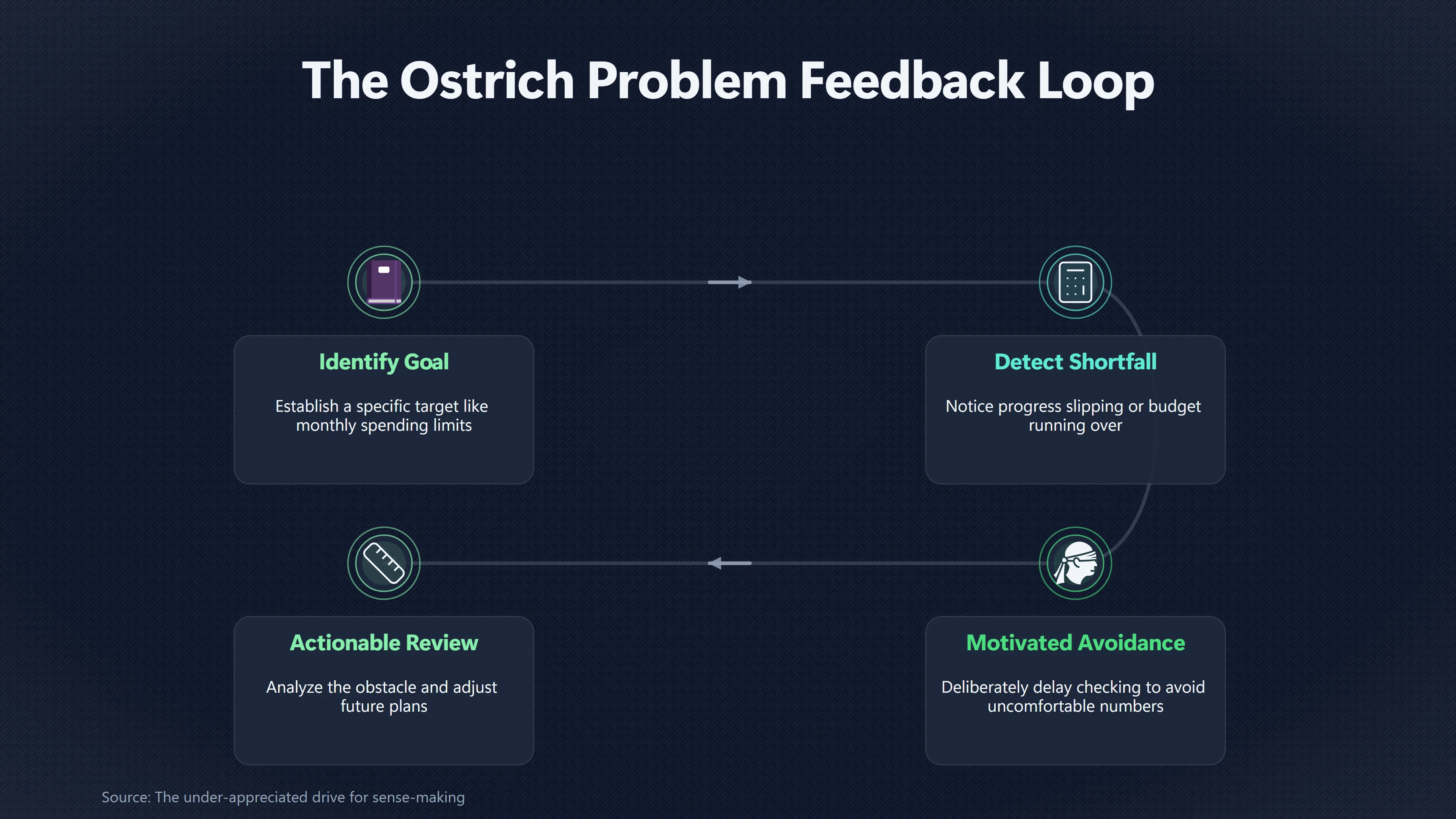
Researchers call this the “ostrich problem”: deliberately avoiding, delaying or discounting available information about progress towards a goal. It is not simply forgetting to track. The distinctive problem is motivated avoidance — not looking because the answer may be uncomfortable, inconvenient or demanding.[DOI]doi.orgDOI‘The Ostrich Problem’: Motivated Avoidance or Rejection of Information About Goal Progress - Webb - 2013 - Social and Personality Psyc…
This creates an important qualification to the advice to “track your progress”. Tracking only improves self-regulation when the feedback loop remains open during bad weeks as well as good ones. The practical challenge is therefore not merely making progress measurable, but making disappointing measurements tolerable and useful enough that people continue to look.
The ostrich problem in goal monitoring
Imagine someone who has set a monthly spending limit. Halfway through the month, they suspect they have overspent. Opening the banking app could clarify the situation while there is still time to cancel purchases or reduce discretionary spending. Yet precisely because the balance might confirm a problem, postponing the check can feel attractive.
Thomas Webb, Betty Chang and Yael Benn used the “ostrich problem” to describe this broader failure of goal monitoring. Their review distinguishes active monitoring — deliberately seeking information such as checking an account — from information that becomes apparent without deliberate effort. Avoidance can occur at either stage: a person can decline to obtain the information or receive it and then discount, ignore or reinterpret what it means.[DOI]doi.orgDOI‘The Ostrich Problem’: Motivated Avoidance or Rejection of Information About Goal Progress - Webb - 2013 - Social and Personality Psyc…
That distinction separates progress avoidance from ordinary measurement problems. Someone who cannot obtain reliable information is not necessarily avoiding it. Nor is every imperfect metric evidence of avoidance. But if a student counts pages read because testing their actual understanding would expose weak progress, an apparently respectable measure can become a substitute that protects them from the more diagnostic one. Webb and colleagues explicitly identify this sort of motivated substitution as a possible form of the ostrich problem.[compass.onlinelibrary.wiley.com]compass.onlinelibrary.wiley.comWebb - 2013 - Social and Personality Psychology Compass - Wiley Online Library…
The risk matters because progress monitoring is not just record-keeping. A large meta-analysis covering 138 randomised studies and 19,951 participants found that interventions designed to increase monitoring substantially increased monitoring frequency and produced a smaller but meaningful improvement in goal attainment; increases in monitoring statistically mediated improvements in attainment.[PubMed]pubmed.ncbi.nlm.nih.govDoes monitoring goal progress promote goal attainment? A meta-analysis of the experimental evidence - PubMedFebruary 1, 2016… Avoiding feedback therefore interrupts a mechanism that can otherwise help translate intentions into action.
Why uncomfortable feedback is easy to avoid
The simplest explanation is also an important one: not knowing can feel better right now. Information avoidance has been defined more broadly as behaviour intended to prevent or delay acquiring available but potentially unwanted information.[Sage Journals]journals.sagepub.comSage Journals Information Avoidance: Who, What, When, and WhySage JournalsInformation Avoidance: Who, What, When, and Why - Kate Sweeny, Darya Melnyk, Wendi Miller, James A. Shepperd, 2010… Goal tracking creates a particularly clear version of that conflict because the information often carries an evaluation: actual behaviour is being compared with something the person wanted, promised or expected themselves to do.
The ostrich-problem framework describes competing motives. Accurate feedback serves self-assessment and self-improvement: knowing that you are behind can help you change course. But the same information may threaten self-enhancement or conflict with an existing view of yourself. Someone can therefore simultaneously want an accurate answer for tomorrow’s benefit and want to avoid that answer for today’s comfort.[compass.onlinelibrary.wiley.com]compass.onlinelibrary.wiley.comWebb - 2013 - Social and Personality Psychology Compass - Wiley Online Library…
Later empirical work made those motives more concrete. In one study, participants recalled occasions when they had avoided monitoring personal goals. The most strongly endorsed explanations included believing that the information would require an unwanted action or change of beliefs, knowing that progress was poor, and experiencing negative emotions when thinking about the goal or working towards it.[Frontiers]frontiersin.orgFrontiersFrontiers | Why Do People Act Like the Proverbial Ostrich? Investigating the Reasons That People Provide for Not Monitoring Thei…
This helps explain why avoidance can intensify when a goal is going badly. A progress check does not merely say, “you are behind”. It can imply, “your current approach is not working”, “you need to do something difficult”, or “your earlier assumptions were wrong”. Ignorance temporarily postpones all three conclusions.
There is another wrinkle. People can rationalise avoidance in apparently practical terms. In the prospective second study by Webb and colleagues, declining an opportunity to monitor progress was associated with doubts about the accuracy and usefulness of the available information; perceived control over goal attainment also predicted avoidance. The reasons people retrospectively said were important were therefore not identical to the factors that best predicted subsequent monitoring behaviour.[Frontiers]frontiersin.orgFrontiersFrontiers | Why Do People Act Like the Proverbial Ostrich? Investigating the Reasons That People Provide for Not Monitoring Thei…
That makes the ostrich problem difficult to recognise in oneself. “I don’t want to know because I’m behind” may instead become “that number doesn’t tell me much anyway”. Sometimes that criticism will be legitimate. The useful question is whether the metric really has stopped informing decisions or whether its apparent uselessness increases precisely when it begins delivering unwelcome news.
Avoidance protects mood by sacrificing feedback
Progress avoidance is not irrational in the narrow sense that it has no benefit. Its benefit is simply concentrated in the present. Not checking can postpone disappointment, embarrassment, anxiety or the obligation to make a difficult decision. The cost arrives later.
This is why information avoidance is best understood as a trade-off rather than as simple laziness. Research on the ostrich problem proposes that people can face a self-control conflict between proximal concerns — avoiding the unpleasant implications of negative feedback — and the more distant objective of improving performance.[compass.onlinelibrary.wiley.com]compass.onlinelibrary.wiley.comWebb - 2013 - Social and Personality Psychology Compass - Wiley Online Library… Recent research in health-information avoidance also supports a broader defensive interpretation: across two studies involving five samples and 1,850 participants, avoidance and derogation of unwanted information behaved as related self-protective strategies. If uncomfortable information was not avoided, people could instead defend themselves by discounting it.[PubMed]pubmed.ncbi.nlm.nih.govPub Med Information avoidance: An interchangeable strategy of self-protectionInformation avoidance: An interchangeable strategy of self-protection - PubMedJune 28, 2024…
For goal tracking, that suggests two ways the feedback loop can fail. The obvious one is not checking. The less obvious one is checking without accepting: repeatedly finding reasons why every disappointing result should not count. A useful monitoring system has to survive both.
There is nevertheless an important caution against treating all discomfort as something to push through. Monitoring itself can sometimes have psychological costs. Research on self-weighing illustrates the point particularly well. A meta-analysis of 29 independent tests involving 10,775 participants found little overall association between self-weighing and affect, body-related attitudes or disordered eating, but a small negative association with psychological functioning; effects also differed between people and circumstances.[PubMed]pubmed.ncbi.nlm.nih.govPub Med What is the psychological impact of self-weighing? A meta-analysisPub Med What is the psychological impact of self-weighing? A meta-analysis
The lesson is not that unpleasant feedback should always be confronted more aggressively. It is that a tracking system should produce decision-relevant information without turning every measurement into a verdict on the person. When a metric is genuinely harmful, misleading or inappropriate, changing it can be sensible. When the metric is useful but merely unwelcome because performance has slipped, abandoning it removes the very signal needed for recovery.
Keeping missed targets visible enough to act on
The central design problem is therefore to reduce the opportunity for a bad result to end the monitoring habit. A tracker that works beautifully during successful weeks but disappears during unsuccessful ones gives a distorted picture of progress.
One useful principle is to make the checking rule independent of the result. Rather than deciding whether to review progress according to how things feel, decide in advance: check spending every Friday; review completed study sessions each Sunday; record planned versus completed workouts at the end of each week. The point is not constant surveillance. It is to prevent anticipated bad news from determining whether the measurement happens at all.
A second principle is to track information that leads naturally to a response. The ostrich-problem research suggests that people avoid information partly when it seems inaccurate or useless.[Frontiers]frontiersin.orgFrontiersFrontiers | Why Do People Act Like the Proverbial Ostrich? Investigating the Reasons That People Provide for Not Monitoring Thei… A metric should therefore make the next decision easier. “I am failing at fitness” is an emotionally loaded judgement. “One of three planned runs happened this week” is narrower, observable and capable of prompting a specific adjustment.
A practical review can consequently separate three things that are easily collapsed into one:
- What happened? Record the result without explanation: two planned sessions were missed.
- What made the plan fail? Identify the obstacle rather than converting the shortfall into a judgement of character.
- What changes next? Reduce the target, alter the timing, remove friction or make another concrete adjustment.
This structure matters because negative feedback is valuable principally for what it enables next. Webb and colleagues argue that avoiding progress information makes it harder both to recognise the need for action and to identify an appropriate response.[compass.onlinelibrary.wiley.com]compass.onlinelibrary.wiley.comWebb - 2013 - Social and Personality Psychology Compass - Wiley Online Library… A tracker that displays failure but offers no route towards adaptation preserves the unpleasant part of feedback while weakening its practical benefit.
Keeping a physical or persistent record can also make selective memory harder. The broader experimental evidence on progress monitoring found larger effects on goal attainment when information was physically recorded and when outcomes were reported or made public.[PubMed]pubmed.ncbi.nlm.nih.govDoes monitoring goal progress promote goal attainment? A meta-analysis of the experimental evidence - PubMedFebruary 1, 2016… That does not mean every private goal needs public accountability. It does suggest that a durable record has advantages over repeatedly asking oneself, “How do I think I’m doing?”
The tracker must work on bad weeks
The most revealing test of a progress system is not whether someone enjoys using it while ahead. It is whether the system still produces usable information after several missed targets.
That changes what “good tracking” means. A sophisticated dashboard that someone stops opening when results deteriorate is less useful than a simple record they continue to review. Likewise, increasing the number of metrics can backfire if it creates more opportunities for judgement, rationalisation or avoidance. The aim is not maximum measurement; it is a sufficiently reliable feedback channel between behaviour and the next decision.
Research on monitoring across different kinds of personal goals reinforces the importance of making progress legible. Studies involving interviews and two online samples found that people reported monitoring more readily when goals were represented in quantifiable terms and when they felt confident about attaining them.[PubMed]pubmed.ncbi.nlm.nih.govPub Med Which Factors Are Associated with Monitoring Goal Progress?Pub Med Which Factors Are Associated with Monitoring Goal Progress? The second finding is particularly revealing: monitoring is easier when the expected news is good, which is exactly why a useful system needs protection against disappearing when confidence falls.
There is also a limit to what the evidence currently establishes. The ostrich-problem literature provides a persuasive framework, observational patterns and experimental work on reasons for avoidance, but it does not establish one universally effective anti-avoidance technique for every kind of personal goal. Even the European Commission’s summary of the research programme describes the work as identifying why monitoring fails and potential directions for interventions rather than supplying a single settled solution.[CORDIS]cordis.europa.eunge interventions | FP7 | CORDIS | European Commission…
The safest practical inference is narrower: do not let anticipated performance determine whether you obtain performance information. Make checks regular rather than mood-dependent, keep the metric closely connected to controllable behaviour, distinguish the result from self-judgement, and make every shortfall point towards a decision. Progress tracking earns its place in self-improvement not by making failure pleasant, but by keeping failure visible early enough to do something about it.
Amazon book picks
Further Reading
Books and field guides related to Why We Avoid Checking Progress When Behind. Use these as the next step if you want deeper reading beyond the article.
Thinking, Fast and Slow
Why is there more chance we'll believe something if it's in a bold type face? Why are judges more likely to deny parole before lunch? Why...
The Ostrich Paradox
"The Ostrich Paradox boldly addresses a key question of our time: Why are we humans so poor at dealing with disastrous risks, and what ca...
Atomic Habits
Rating: 3.5/5 from 7 Google Books ratings
The #1 New York Times bestseller. Over 25 million copies sold! Translated into 60+ languages! Tiny Changes, Remarkable Results No matter...

The Power of Habit
Rating: 4.0/5 from 145 Google Books ratings
Duhigg takes us to the edge of scientific discoveries that explain why habits exist and how they can be changed. Distilling information i...
eBay marketplace picks
Marketplace Samples
Live-tested eBay searches with available results related to this page.
Selected frommotivation poster oneBay.co.uk.
Current eBay listing
Gym Motivation Quote Framed Wall Art Poster Canvas Print Picture


Current eBay listing
Motivation Quotes Framed Wall Art Poster Canvas Print Picture
Current eBay listing
Gym Motivation Framed Wall Art Poster Canvas Print Picture
Endnotes
1.
Source: doi.org
Link:https://doi.org/10.1111/spc3.12071
Source snippet
DOI‘The Ostrich Problem’: Motivated Avoidance or Rejection of Information About Goal Progress - Webb - 2013 - Social and Personality Psyc...
2.
Source: compass.onlinelibrary.wiley.com
Link:https://compass.onlinelibrary.wiley.com/doi/10.1111/spc3.12071
Source snippet
Webb - 2013 - Social and Personality Psychology Compass - Wiley Online Library...
3.
Source: doi.org
Title: The under-appreciated drive for sense-making
Link:https://doi.org/10.1016/j.jebo.2015.10.016
4.
Source: compass.onlinelibrary.wiley.com
Link:https://compass.onlinelibrary.wiley.com/doi/abs/10.1111/spc3.12071
5.
Source: compass.onlinelibrary.wiley.com
Link:https://compass.onlinelibrary.wiley.com/doi/full/10.1111/spc3.12071?scrollTo=references
6.
Source: onlinelibrary.wiley.com
Link:https://onlinelibrary.wiley.com/page/journal/17519004/homepage/emotionmotivation.htm
7.
Source: journals.sagepub.com
Title: Sage Journals Information Avoidance: Who, What, When, and Why
Link:https://journals.sagepub.com/doi/pdf/10.1037/a0021288
Source snippet
Sage JournalsInformation Avoidance: Who, What, When, and Why - Kate Sweeny, Darya Melnyk, Wendi Miller, James A. Shepperd, 2010...
8.
Source: pubmed.ncbi.nlm.nih.gov
Link:https://pubmed.ncbi.nlm.nih.gov/26479070/
Source snippet
Does monitoring goal progress promote goal attainment? A meta-analysis of the experimental evidence - PubMedFebruary 1, 2016...
Published: February 1, 2016
9.
Source: journals.sagepub.com
Title: Sage Journals Information Avoidance: Who, What, When, and Why
Link:https://journals.sagepub.com/doi/abs/10.1037/a0021288
Source snippet
Sage JournalsInformation Avoidance: Who, What, When, and Why - Kate Sweeny, Darya Melnyk, Wendi Miller, James A. Shepperd, 2010...
10.
Source: frontiersin.org
Link:https://www.frontiersin.org/journals/psychology/articles/10.3389/fpsyg.2017.00152/full
Source snippet
FrontiersFrontiers | Why Do People Act Like the Proverbial Ostrich? Investigating the Reasons That People Provide for Not Monitoring Thei...
11.
Source: pmc.ncbi.nlm.nih.gov
Link:https://pmc.ncbi.nlm.nih.gov/articles/PMC5297323/
Source snippet
PubMed Central (PMC)Why Do People Act Like the Proverbial Ostrich? Investigating the Reasons That People Provide for Not Monitoring Their...
12.
Source: cordis.europa.eu
Link:https://cordis.europa.eu/project/id/280515/reporting
Source snippet
nge interventions | FP7 | CORDIS | European Commission...
13.
Source: pubmed.ncbi.nlm.nih.gov
Title: Pub Med Information avoidance: An interchangeable strategy of self-protection
Link:https://pubmed.ncbi.nlm.nih.gov/39013284/
Source snippet
Information avoidance: An interchangeable strategy of self-protection - PubMedJune 28, 2024...
Published: June 28, 2024
14.
Source: pubmed.ncbi.nlm.nih.gov
Title: Pub Med What is the psychological impact of self-weighing? A meta-analysis
Link:https://pubmed.ncbi.nlm.nih.gov/26742706/
15.
Source: pmc.ncbi.nlm.nih.gov
Link:https://pmc.ncbi.nlm.nih.gov/articles/PMC4917920/
16.
Source: pubmed.ncbi.nlm.nih.gov
Title: Pub Med Which Factors Are Associated with Monitoring Goal Progress?
Link:https://pubmed.ncbi.nlm.nih.gov/28392775/
17.
Source: frontiersin.org
Link:https://www.frontiersin.org/journals/communication/articles/10.3389/fcomm.2024.1468968/full
18.
Source: pmc.ncbi.nlm.nih.gov
Link:https://pmc.ncbi.nlm.nih.gov/articles/PMC11499518/
19.
Source: pmc.ncbi.nlm.nih.gov
Link:https://pmc.ncbi.nlm.nih.gov/articles/PMC11232995/
20.
Source: dictionary.apa.org
Title: negative feedback
Link:https://dictionary.apa.org/negative-feedback
21.
Source: pmc.ncbi.nlm.nih.gov
Link:https://pmc.ncbi.nlm.nih.gov/articles/PMC10575496/
22.
Source: frontiersin.org
Link:https://www.frontiersin.org/journals/psychology/articles/10.3389/fpsyg.2021.769591/full
23.
Source: pmc.ncbi.nlm.nih.gov
Link:https://pmc.ncbi.nlm.nih.gov/articles/PMC8500063/
24.
Source: pmc.ncbi.nlm.nih.gov
Link:https://pmc.ncbi.nlm.nih.gov/articles/PMC7962887/
25.
Source: pubmed.ncbi.nlm.nih.gov
Link:https://pubmed.ncbi.nlm.nih.gov/30798156/
26.
Source: dictionary.apa.org
Link:https://dictionary.apa.org/feedback
27.
Source: cordis.europa.eu
Link:https://cordis.europa.eu/project/id/280515
28.
Source: pmc.ncbi.nlm.nih.gov
Link:https://pmc.ncbi.nlm.nih.gov/articles/PMC5364185/
29.
Source: frontiersin.org
Title: Frontiers | Which Factors Are Associated with Monitoring Goal Progress?
Link:https://www.frontiersin.org/journals/psychology/articles/10.3389/fpsyg.2017.00434/full
30.
Source: pubmed.ncbi.nlm.nih.gov
Link:https://pubmed.ncbi.nlm.nih.gov/28228740/
31.
Source: pmc.ncbi.nlm.nih.gov
Link:https://pmc.ncbi.nlm.nih.gov/articles/PMC5456254/
32.
Source: pmc.ncbi.nlm.nih.gov
Link:https://pmc.ncbi.nlm.nih.gov/articles/PMC5173426/
33.
Source: pubmed.ncbi.nlm.nih.gov
Link:https://pubmed.ncbi.nlm.nih.gov/26896865/
34.
Source: pmc.ncbi.nlm.nih.gov
Link:https://pmc.ncbi.nlm.nih.gov/articles/PMC4626624/
35.
Source: pmc.ncbi.nlm.nih.gov
Link:https://pmc.ncbi.nlm.nih.gov/articles/PMC4508580/
36.
Source: pmc.ncbi.nlm.nih.gov
Link:https://pmc.ncbi.nlm.nih.gov/articles/PMC4489331/
37.
Source: pmc.ncbi.nlm.nih.gov
Link:https://pmc.ncbi.nlm.nih.gov/articles/PMC4729441/
38.
Source: pubmed.ncbi.nlm.nih.gov
Link:https://pubmed.ncbi.nlm.nih.gov/26627092/
39.
Source: pubmed.ncbi.nlm.nih.gov
Link:https://pubmed.ncbi.nlm.nih.gov/25521523/
40.
Source: pmc.ncbi.nlm.nih.gov
Link:https://pmc.ncbi.nlm.nih.gov/articles/PMC4196471/
41.
Source: pmc.ncbi.nlm.nih.gov
Link:https://pmc.ncbi.nlm.nih.gov/articles/PMC4104823/
42.
Source: pmc.ncbi.nlm.nih.gov
Link:https://pmc.ncbi.nlm.nih.gov/articles/PMC4023076/
43.
Source: pubmed.ncbi.nlm.nih.gov
Link:https://pubmed.ncbi.nlm.nih.gov/22241812/
44.
Source: pmc.ncbi.nlm.nih.gov
Link:https://pmc.ncbi.nlm.nih.gov/articles/PMC3246364/
45.
Source: journals.sagepub.com
Link:https://journals.sagepub.com/doi/10.1037/a0021288
46.
Source: journals.sagepub.com
Link:https://journals.sagepub.com/doi/full/10.1037/a0021288
47.
Source: pubmed.ncbi.nlm.nih.gov
Link:https://pubmed.ncbi.nlm.nih.gov/18983667/
48.
Source: pubmed.ncbi.nlm.nih.gov
Link:https://pubmed.ncbi.nlm.nih.gov/10654636/
49.
Source: pubmed.ncbi.nlm.nih.gov
Link:https://pubmed.ncbi.nlm.nih.gov/9216083/
50.
Source: pmc.ncbi.nlm.nih.gov
Link:https://pmc.ncbi.nlm.nih.gov/articles/PMC12645271/
51.
Source: pmc.ncbi.nlm.nih.gov
Link:https://pmc.ncbi.nlm.nih.gov/articles/PMC1175801/
52.
Source: pubmed.ncbi.nlm.nih.gov
Link:https://pubmed.ncbi.nlm.nih.gov/23084168/
53.
Source: pubmed.ncbi.nlm.nih.gov
Link:https://pubmed.ncbi.nlm.nih.gov/26566095/
Additional References
54.
Source: youtube.com
Title: The Ostrich Effect
Link:https://www.youtube.com/watch?v=YC8NXc7IseA
Source snippet
Why You Avoid Bad News (Ostrich Effect) explores the psychological drive behind the ostrich effect and explains why individuals actively...
55.
Source: youtube.com
Title: The Ostrich Effect: Understanding Avoidance in Negative Situations
Link:https://www.youtube.com/watch?v=fHYjhGQRblI
Source snippet
The Ostrich Effect: Our Failure to Face Failure...
56.
Source: youtube.com
Title: Why You Avoid Bad News (Ostrich Effect)
Link:https://www.youtube.com/watch?v=WIefcNekd8c
Source snippet
The Ostrich Effect: Understanding Avoidance in Negative Situations...
57.
Source: mendeley.com
Link:https://www.mendeley.com/catalogue/607353f2-5168-3848-a4b3-2a108a0acdb0/
58.
Source: researchgate.net
Link:https://www.researchgate.net/publication/291335719_Does_Monitoring_Goal_Progress_Promote_Goal_Attainment_A_Meta-Analysis_of_the_Experimental_Evidence
59.
Source: 1library.net
Link:https://1library.net/document/rz3x7o7z-does-monitoring-progress-promote-attainment-analysis-experimental-evidence.html
60.
Source: sciencedirect.com
Link:https://www.sciencedirect.com/science/article/abs/pii/S009265661400021X
61.
Source: sciencedirect.com
Link:https://www.sciencedirect.com/science/article/pii/S009265661400021X
62.
Source: eurekamag.com
Link:https://eurekamag.com/research/057/653/057653112.php
63.
Source: tandfonline.com
Link:https://www.tandfonline.com/doi/abs/10.1080/10503307.2021.1959079