Within Scale Up
What to Do When a Bigger Habit Stops Sticking
If a scaled habit starts collapsing on normal days, the added demand may be too large and the previous reliable version remains a useful floor.
On this page
- Warning signs that the expansion is too demanding
- Separating a bad day from a broken repetition pattern
- Using the reliable floor behaviour to recover
Page outline Jump by section
Introduction
When a habit becomes less consistent soon after you make it harder, the most useful interpretation is usually not that the original habit has failed. It is that the new dose of the behaviour may exceed what your existing routine can reliably carry. A ten-minute walk that happened almost every day and a newly prescribed 40-minute walk are not behaviourally identical simply because both are called “walking”.
Habit research does not provide a precise rule for how large an increase is “too large”. It does, however, point in a consistent direction: repetition, stable contexts and manageable behaviour support automaticity, while greater perceived difficulty and behavioural complexity can work against it. A 2026 longitudinal study, for example, found perceived difficulty negatively associated with habit strength, while behaviour frequency and context stability were positively associated with it.[PubMed]pubmed.ncbi.nlm.nih.govWhat Makes a Habit? Investigating Potential Determinants of Habit Formation - PubMedApril 29, 2026…
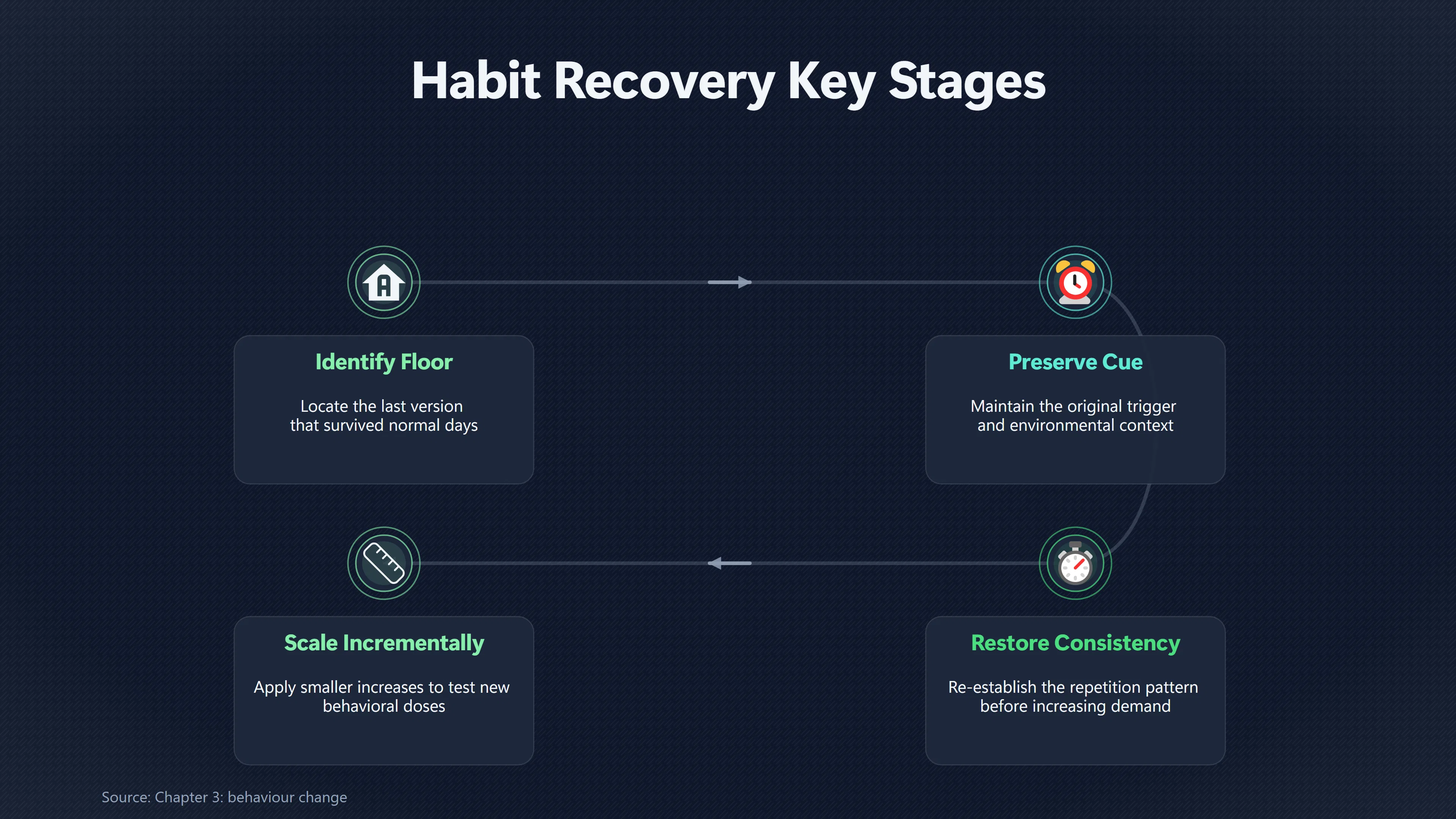
The practical response is therefore diagnostic rather than punitive. Distinguish an isolated bad day from a new pattern of missed repetitions. If the bigger version repeatedly disappears under ordinary conditions, return to the smaller version that was already reliable, preserve its cue and rebuild upwards in smaller increments.
Warning Signs the Expansion Is Too Demanding
A scaled habit has to work on normal days, not merely demonstrate what you can do when time, energy and motivation all cooperate. This distinction matters because increasing a habit can quietly change more than its apparent size.
Consider someone who reliably reads for ten minutes after making evening tea. Moving to 15 minutes mostly changes duration. Moving to an hour may also require an earlier start, fewer interruptions, more sustained attention and a different bedtime. The cue may be unchanged, but the behaviour now makes substantially greater demands on the rest of the evening.
Research supports treating that added difficulty as consequential. A 2026 preregistered reanalysis followed 254 participants over six months and identified trajectories of both habit formation and habit degradation. Behavioural complexity, frequency and context stability differed between those trajectories, and greater perceived difficulty was associated with weaker habit strength. The authors emphasised that habits are dynamic rather than something that simply becomes permanent once established.[PubMed]pubmed.ncbi.nlm.nih.govWhat Makes a Habit? Investigating Potential Determinants of Habit Formation - PubMedApril 29, 2026…
This fits broader evidence that behavioural complexity matters for habitual control. Reviews of health behaviour research report stronger habit effects for behaviours lower in complexity, while a 2024 systematic review of health-related habit formation found that frequency, behavioural regulation, type of behaviour and other practical characteristics can influence habit strength.[Springer Nature]link.springer.comSpringer NatureProgress on theory of planned behavior research: advances in research synthesis and agenda for future research | Journal o…
The clearest warning signs after an increase are therefore behavioural:
- The habit starts requiring favourable days. The expanded version works at weekends or when work is quiet, but repeatedly disappears on ordinary busy days.
- Starting requires renewed negotiation. A previously near-automatic “I do this now” becomes “Do I have enough time or energy for this?”
- Completion frequency falls noticeably. More behaviour per successful session is being bought at the price of fewer sessions.
- The increase creates secondary requirements. A longer workout now requires changing clothes, travelling somewhere, showering or finding an uninterrupted hour.
- The old cue stops producing a practical response. “After breakfast” may still trigger the thought of exercising, for example, but a 45-minute session no longer fits between breakfast and leaving home.
That last distinction is especially important. Stable contexts help both habit development and performance. In a six-week study of university students and a separate real-world dataset from a habit-building app, greater context stability predicted stronger automaticity and better attainment of repetition goals.[PubMed]pubmed.ncbi.nlm.nih.govContext Stability in Habit Building Increases Automaticity and Goal Attainment - PubMedJune 10, 2022… If scaling forces the behaviour into different times, places or circumstances, the change may inadvertently weaken part of the structure that made the smaller habit dependable.
So “make the habit harder” should not mean “make each successful repetition as impressive as possible”. A useful increase is one that raises the behavioural dose without causing the repetition pattern to collapse.
Is It a Bad Day or a Broken Pattern?
One missed repetition is weak evidence that an expansion has failed. A sequence of misses tied to the increased demand is much more informative.
This distinction prevents two opposite mistakes. The first is overreacting to every lapse by immediately reducing the habit. The second is protecting an unrealistic target for weeks because each failure can individually be explained away.
The classic real-world habit-formation study by Phillippa Lally and colleagues followed people performing a chosen behaviour in the same daily context for 12 weeks. Missing a single opportunity did not materially disrupt the habit-formation process. What mattered more was the broader pattern of repetition in a consistent context.[Wiley Online Library]onlinelibrary.wiley.comWiley Online LibraryHow are habits formed: Modelling habit formation in the real world - Lally - 2010 - European Journal of Social Psycho… Although that study examined formation rather than the specific problem of scaling an established habit, it provides a useful caution against treating one missed day as catastrophic.
Maintenance research makes a similar conceptual distinction between a lapse, meaning a single deviation, and relapse, in which lapses accumulate into a return towards an earlier behavioural pattern.[PubMed Central (PMC)]pmc.ncbi.nlm.nih.govOpen source on nih.gov. Applied to habit scaling, the question is not “Did I miss Tuesday?” but “What happened to the probability that I perform this behaviour after increasing its demands?”
A practical test is to compare the enlarged habit with its former baseline. Suppose 15 minutes of language practice happened on six evenings out of seven. You raise it to 45 minutes and, over the next few weeks, manage three or four sessions in a typical week. The new target produces impressive sessions, but it has also damaged the repetition pattern. That is useful evidence about the design of the expansion.
By contrast, if the 45-minute version usually happens and disappears only during an unusually difficult week, there is less reason to conclude that the increase itself is wrong. The problem may be temporary conditions rather than the normal behavioural demand.
The relevant test is therefore ordinary-condition survivability. Ask whether the bigger version can repeatedly coexist with the workload, tiredness, interruptions and imperfect motivation that make up normal life. This is stricter than asking whether the target is physically possible, but more useful for a habit intended to last.
Why “Push Through It” Can Misdiagnose the Problem
When consistency falls, it is tempting to assume that maintaining the harder target will eventually force adaptation. Sometimes persistence is appropriate. But this argument confuses two different challenges: gradually increasing capacity and repeatedly failing to initiate an oversized routine.
Behaviour-change guidance generally favours progression through manageable steps rather than simply prescribing a large end-state. NICE recommends planning change through easy steps over time, using coping plans for relapse and developing routines around small, manageable changes.[Nice]nice.org.ukOpen source on nice.org.uk. Current UK public-health guidance similarly recommends goals that are challenging but achievable, warning that unreachable goals can be demotivating.[GOV.UK]GOV.UKChapter 3: behaviour changeChapter 3: behaviour change
More specific evidence comes from physical activity. A 2026 systematic review and meta-analysis examined “graded tasks”: beginning with achievable tasks and progressively increasing their difficulty. Across 53 identified studies involving 10,060 adults, 39 studies entered the meta-analysis, which found a medium positive effect on physical activity. Importantly, graded tasks were used alongside goal-setting and action planning rather than as uncontrolled increases in difficulty. The authors rated the overall certainty of evidence as low because of factors including substantial heterogeneity and potential publication bias, so the result should not be turned into a universal law of habit scaling.[PubMed]pubmed.ncbi.nlm.nih.govOpen source on nih.gov.
The lesson is narrower but useful: progression and manageability are compatible. Making a habit easier again after an unsuccessful increase is not the opposite of progression. It can be the mechanism that restores enough repetition to make further progression possible.

Use the Reliable Floor to Recover
When the expanded habit repeatedly fails, the previous dependable version becomes valuable information. It identifies a behavioural dose that already fitted your life.
Call this the reliable floor: the smallest established version you have good evidence you can perform under ordinary conditions. It is not necessarily the smallest imaginable action. If you previously walked for 20 minutes almost every lunchtime, your floor might be that 20-minute walk rather than merely putting on your shoes.
Returning to that floor serves three purposes. First, it restores repetitions. Second, it can preserve the established cue and context instead of forcing you to design the habit again from scratch. Third, it separates maintaining the routine from pursuing the larger target.
That separation is consistent with what habit research says about contextual cues. Habits develop through repeated cue–behaviour associations in relatively stable circumstances, and disruption to context can weaken habitual responding.[Compass]compass.onlinelibrary.wiley.comOpen source on wiley.com. A recovery strategy that keeps “after lunch, walk” intact while temporarily reducing how long you walk changes less of the behavioural architecture than abandoning lunchtime walks until you feel ready to resume the ambitious version.
A simple recovery sequence is:
- Return to the last version that was genuinely reliable. Do not choose a smaller target merely to make the numbers look good; use the most recent dose that regularly survived normal days.
- Keep its established cue where possible. If the habit reliably began after breakfast, after arriving home or when opening your laptop, preserve that trigger rather than simultaneously redesigning the schedule.
- Restore consistency before testing another increase. The immediate goal is to re-establish the repetition pattern, not compensate for missed work.
- Make the next increase smaller. If moving from 20 to 60 minutes broke the pattern, the next experiment might be 25 or 30 minutes rather than another attempt at 60.
- Judge the increase by both dose and repetition. A harder habit is an improvement only when the extra work does not produce an unacceptable loss of consistency.
This approach also avoids making perfect streaks the objective. A reliable floor is a recovery tool, not a demand never to miss. NICE behaviour-change guidance explicitly includes monitoring for signs of relapse, rehearsed action plans and adjustment of goals in light of experience.[Nice]nice.org.ukNice Recommendations | Behaviour change: individual approaches | Guidance | NICENice Recommendations | Behaviour change: individual approaches | Guidance | NICE The useful skill is not flawless adherence but recognising deterioration early enough to respond.
A Bigger Habit Should Earn Its Place
Scaling is successful when the enlarged behaviour becomes compatible with ordinary life, not when it produces occasional exceptional performances. That makes consistency after an increase a form of feedback.
There is no research-backed percentage at which you should automatically retreat, nor evidence that every temporary consistency drop proves an increase was too ambitious. Individual habits differ considerably in how quickly and strongly they become automatic, and the habit literature remains heterogeneous. A 2024 systematic review found substantial individual variation in habit-formation times and noted that most of its 20 included studies had a high risk of bias.[PubMed Central (PMC)]pmc.ncbi.nlm.nih.govOpen source on nih.gov.
The useful principle is consequently adaptive rather than numerical. One missed day can be noise. Repeatedly losing a formerly reliable behaviour after increasing its duration, intensity, frequency or complexity is a signal worth acting on.
If five minutes reliably became 15, the habit has grown. If 15 reliably became 25, it has grown again. If 25 becomes an hour but the routine now happens only when circumstances are unusually favourable, the larger number can disguise a weaker behavioural system. Evidence on context stability, difficulty, graded progression and relapse management all points towards the same practical conclusion: when scaling damages reliability, protect the established repetition pattern first and increase the demand more gradually afterwards.[PubMed]pubmed.ncbi.nlm.nih.govWhat Makes a Habit? Investigating Potential Determinants of Habit Formation - PubMedApril 29, 2026…
Amazon book picks
Further Reading
Books and field guides related to What to Do When a Bigger Habit Stops Sticking. Use these as the next step if you want deeper reading beyond the article.
Tiny Habits
Improving your life is much easier than you think. Whether it’s losing weight, sleeping more, or restoring your work/life balance – the s...
Atomic Habits
Rating: 3.5/5 from 7 Google Books ratings
The #1 New York Times bestseller. Over 25 million copies sold! Translated into 60+ languages! Tiny Changes, Remarkable Results No matter...
Mini Habits
Discover the Life-Changing Strategy of This Worldwide Bestseller in 17 Languages! Lasting Change For Early Quitters, Burnouts, The Unmoti...

Elastic Habits
Elastic habits are easier to form, more impactful, more fun, and more resilient than habits formed with any other strategy.These flexible...
eBay marketplace picks
Marketplace Samples
Live-tested eBay searches with available results related to this page.
Selected frommotivational wall art oneBay.co.uk.

Current eBay listing
Muhammad Ali Dream Motivational Quote Canvas Wall Art Picture Print


Current eBay listing
Gym Motivational Posters Work Out Insperational Quotes Wall Art
Endnotes
1.
Source: link.springer.com
Link:https://link.springer.com/article/10.1007/s10865-024-00545-8
Source snippet
Springer NatureProgress on theory of planned behavior research: advances in research synthesis and agenda for future research | Journal o...
2.
Source: onlinelibrary.wiley.com
Link:https://onlinelibrary.wiley.com/doi/10.1002/ejsp.674
Source snippet
Wiley Online LibraryHow are habits formed: Modelling habit formation in the real world - Lally - 2010 - European Journal of Social Psycho...
3.
Source: onlinelibrary.wiley.com
Link:https://onlinelibrary.wiley.com/doi/pdf/10.1002/ejsp.674
Source snippet
Wiley Online LibraryHow are habits formed: Modelling habit formation in the real world - Lally - 2010 - European Journal of Social Psycho...
4.
Source: GOV.UK
Title: Chapter 3: behaviour change
Link:https://www.gov.uk/government/publications/delivering-better-oral-health-an-evidence-based-toolkit-for-prevention/chapter-3-behaviour-change
5.
Source: compass.onlinelibrary.wiley.com
Link:https://compass.onlinelibrary.wiley.com/doi/full/10.1111/spc3.12975
6.
Source: GOV.UK
Title: www.gov.uk U K Chief Medical Officers’ physical activity guidelines
Link:https://www.gov.uk/government/publications/physical-activity-guidelines-uk-chief-medical-officers-report/uk-chief-medical-officers-physical-activity-guidelines
7.
Source: peterborough.gov.uk
Title: Tiny habits that make movement stick | Peterborough City Council
Link:https://www.peterborough.gov.uk/engagement-hub/tiny-habits-that-make-movement-stick
8.
Source: communications.gov.uk
Title: Evaluate and learn: The Evaluation Cycle
Link:https://www.communications.gov.uk/publication/gcs-evaluation-cycle/
9.
Source: link.springer.com
Link:https://link.springer.com/article/10.1186/s12966-023-01493-3
10.
Source: link.springer.com
Link:https://link.springer.com/article/10.1007/s10389-022-01766-4
11.
Source: communications.gov.uk
Title: The principles of behaviour change
Link:https://www.communications.gov.uk/publication/the-principles-of-behaviour-change-communications/
12.
Source: gcs.civilservice.gov.uk
Title: civilservice.gov.uk Behaviour change
Link:https://gcs.civilservice.gov.uk/guidance/marketing/behaviour-change/
13.
Source: GOV.UK
Link:https://www.gov.uk/government/publications/behaviour-change-guide-for-local-government-and-partners
14.
Source: onlinelibrary.wiley.com
Link:https://onlinelibrary.wiley.com/doi/10.1155/2019/3068748
15.
Source: quarterly.blog.gov.uk
Link:https://quarterly.blog.gov.uk/2016/01/25/new-year-new-motivation-for-health-changes/
16.
Source: onlinelibrary.wiley.com
Link:https://onlinelibrary.wiley.com/doi/abs/10.1002/ejsp.674?MixPanelId=15e3fe314440-0468d8411-64220f54-100000-15e3fe314460
17.
Source: onlinelibrary.wiley.com
Link:https://onlinelibrary.wiley.com/doi/abs/10.1002/ejsp.674?source=content_type%3Areact%7Cfirst_level_url%3Aarticle%7Csection%3Amain_content%7Cbutton%3Abody_link
18.
Source: onlinelibrary.wiley.com
Link:https://onlinelibrary.wiley.com/doi/abs/10.1002/ejsp.674
19.
Source: onlinelibrary.wiley.com
Link:https://onlinelibrary.wiley.com/doi/abs/10.1002/ejsp.674?msockid=038ed114f43667dd0790c4bef5146634
20.
Source: onlinelibrary.wiley.com
Link:https://onlinelibrary.wiley.com/doi/abs/10.1002/ejsp.674?cf_chl_jschl_tk=pmd_EwcJDaCFBR9OVEL1O_0qjioww0Gc86ZzpBvCBFhrDcE-1635261061-0-gqNtZGzNAjujcnBszQi9
21.
Source: coventry.gov.uk
Link:https://www.coventry.gov.uk/healthdeterminantsresearchcollaboration/research-projects/behaviour-change-physical-activity
22.
Source: local.gov.uk
Link:https://www.local.gov.uk/our-support/climate-change-hub/behaviour-change-and-environment/how-can-we-sustain-behaviour-change
23.
Source: new.calderdale.gov.uk
Link:https://new.calderdale.gov.uk/health-and-social-care/better-living-service/tips
24.
Source: win.wolverhampton.gov.uk
Link:https://win.wolverhampton.gov.uk/kb5/wolverhampton/directory/advice.page?id=vcDFYTnjTgc
25.
Source: ouci.dntb.gov.ua
Link:https://ouci.dntb.gov.ua/en/works/4bV6Rb14/
26.
Source: ouci.dntb.gov.ua
Link:https://ouci.dntb.gov.ua/en/works/7318gA86/
27.
Source: pubmed.ncbi.nlm.nih.gov
Link:https://pubmed.ncbi.nlm.nih.gov/42053513/
Source snippet
What Makes a Habit? Investigating Potential Determinants of Habit Formation - PubMedApril 29, 2026...
Published: April 29, 2026
28.
Source: pmc.ncbi.nlm.nih.gov
Link:https://pmc.ncbi.nlm.nih.gov/articles/PMC11641623/
29.
Source: pubmed.ncbi.nlm.nih.gov
Link:https://pubmed.ncbi.nlm.nih.gov/35756236/
Source snippet
Context Stability in Habit Building Increases Automaticity and Goal Attainment - PubMedJune 10, 2022...
Published: June 10, 2022
30.
Source: pmc.ncbi.nlm.nih.gov
Link:https://pmc.ncbi.nlm.nih.gov/articles/PMC9226889/
Source snippet
PubMed Central (PMC)Context Stability in Habit Building Increases Automaticity and Goal Attainment - PMC...
31.
Source: pmc.ncbi.nlm.nih.gov
Link:https://pmc.ncbi.nlm.nih.gov/articles/PMC8450373/
32.
Source: nice.org.uk
Link:https://www.nice.org.uk/guidance/ph6/chapter/recommendations
33.
Source: nice.org.uk
Title: Nice Recommendations | Behaviour change: individual approaches | Guidance | NICE
Link:https://www.nice.org.uk/Guidance/PH49/chapter/recommendations
34.
Source: pubmed.ncbi.nlm.nih.gov
Link:https://pubmed.ncbi.nlm.nih.gov/41644516/
35.
Source: pubmed.ncbi.nlm.nih.gov
Link:https://pubmed.ncbi.nlm.nih.gov/27120333/
36.
Source: pubmed.ncbi.nlm.nih.gov
Link:https://pubmed.ncbi.nlm.nih.gov/39685110/
37.
Source: pubmed.ncbi.nlm.nih.gov
Link:https://pubmed.ncbi.nlm.nih.gov/41664447/
38.
Source: pmc.ncbi.nlm.nih.gov
Link:https://pmc.ncbi.nlm.nih.gov/articles/PMC12649445/
39.
Source: nice.org.uk
Link:https://www.nice.org.uk/guidance/qs212/chapter/Quality-statement-7-Advice-and-support-after-stopping-medicines-for-weight-management-or-completing-behavioural-interventions
40.
Source: pmc.ncbi.nlm.nih.gov
Link:https://pmc.ncbi.nlm.nih.gov/articles/PMC12285069/
41.
Source: nice.org.uk
Title: Behavioural overweight and obesity management interventions
Link:https://www.nice.org.uk/guidance/ng246/chapter/Behavioural-overweight-and-obesity-management-interventions
42.
Source: pmc.ncbi.nlm.nih.gov
Link:https://pmc.ncbi.nlm.nih.gov/articles/PMC12672732/
43.
Source: pubmed.ncbi.nlm.nih.gov
Link:https://pubmed.ncbi.nlm.nih.gov/39225981/
44.
Source: pmc.ncbi.nlm.nih.gov
Link:https://pmc.ncbi.nlm.nih.gov/articles/PMC11178247/
45.
Source: pubmed.ncbi.nlm.nih.gov
Link:https://pubmed.ncbi.nlm.nih.gov/38787601/
46.
Source: pmc.ncbi.nlm.nih.gov
Link:https://pmc.ncbi.nlm.nih.gov/articles/PMC11161714/
47.
Source: nice.org.uk
Link:https://www.nice.org.uk/guidance/ng222/chapter/recommendations
48.
Source: pubmed.ncbi.nlm.nih.gov
Link:https://pubmed.ncbi.nlm.nih.gov/35382707/
49.
Source: pmc.ncbi.nlm.nih.gov
Link:https://pmc.ncbi.nlm.nih.gov/articles/PMC8997544/
50.
Source: pmc.ncbi.nlm.nih.gov
Link:https://pmc.ncbi.nlm.nih.gov/articles/PMC12318445/
51.
Source: pubmed.ncbi.nlm.nih.gov
Link:https://pubmed.ncbi.nlm.nih.gov/34338165/
52.
Source: pubmed.ncbi.nlm.nih.gov
Link:https://pubmed.ncbi.nlm.nih.gov/31396122/
53.
Source: pmc.ncbi.nlm.nih.gov
Link:https://pmc.ncbi.nlm.nih.gov/articles/PMC6667662/
54.
Source: pmc.ncbi.nlm.nih.gov
Link:https://pmc.ncbi.nlm.nih.gov/articles/PMC6504043/
55.
Source: pmc.ncbi.nlm.nih.gov
Link:https://pmc.ncbi.nlm.nih.gov/articles/PMC7524543/
56.
Source: pubmed.ncbi.nlm.nih.gov
Link:https://pubmed.ncbi.nlm.nih.gov/29665889/
57.
Source: pmc.ncbi.nlm.nih.gov
Link:https://pmc.ncbi.nlm.nih.gov/articles/PMC6305562/
58.
Source: pmc.ncbi.nlm.nih.gov
Link:https://pmc.ncbi.nlm.nih.gov/articles/PMC5350064/
59.
Source: pmc.ncbi.nlm.nih.gov
Link:https://pmc.ncbi.nlm.nih.gov/articles/PMC4847906/
60.
Source: pmc.ncbi.nlm.nih.gov
Link:https://pmc.ncbi.nlm.nih.gov/articles/PMC4975085/
61.
Source: pmc.ncbi.nlm.nih.gov
Link:https://pmc.ncbi.nlm.nih.gov/articles/PMC4721385/
62.
Source: pmc.ncbi.nlm.nih.gov
Link:https://pmc.ncbi.nlm.nih.gov/articles/PMC4287360/
63.
Source: pubmed.ncbi.nlm.nih.gov
Link:https://pubmed.ncbi.nlm.nih.gov/24937649/
64.
Source: nice.org.uk
Link:https://www.nice.org.uk/guidance/ph49/chapter/context
65.
Source: pmc.ncbi.nlm.nih.gov
Link:https://pmc.ncbi.nlm.nih.gov/articles/PMC3505409/
66.
Source: nice.org.uk
Link:https://www.nice.org.uk/guidance/PH38/chapter/glossary
67.
Source: nice.org.uk
Link:https://www.nice.org.uk/guidance/ph38/chapter/recommendations
68.
Source: pubmed.ncbi.nlm.nih.gov
Link:https://pubmed.ncbi.nlm.nih.gov/21749245/
69.
Source: nice.org.uk
Title: Quality statement 3 Preventing relapse
Link:https://www.nice.org.uk/guidance/qs8/chapter/Quality-statement-3-Preventing-relapse
70.
Source: pmc.ncbi.nlm.nih.gov
Link:https://pmc.ncbi.nlm.nih.gov/articles/PMC4533928/
71.
Source: doi.org
Link:https://doi.org/10.1348/014466608x370591
72.
Source: pubmed.ncbi.nlm.nih.gov
Link:https://pubmed.ncbi.nlm.nih.gov/18851764/
73.
Source: nice.org.uk
Link:https://www.nice.org.uk/guidance/ph6/chapter/Considerations
74.
Source: pubmed.ncbi.nlm.nih.gov
Link:https://pubmed.ncbi.nlm.nih.gov/17553212/
75.
Source: pmc.ncbi.nlm.nih.gov
Link:https://pmc.ncbi.nlm.nih.gov/articles/PMC1592392/
76.
Source: pubmed.ncbi.nlm.nih.gov
Link:https://pubmed.ncbi.nlm.nih.gov/10709948/
77.
Source: pubmed.ncbi.nlm.nih.gov
Link:https://pubmed.ncbi.nlm.nih.gov/34851220/
78.
Source: pubmed.ncbi.nlm.nih.gov
Link:https://pubmed.ncbi.nlm.nih.gov/15982113/
79.
Source: niddk.nih.gov
Title: changing habits better health
Link:https://www.niddk.nih.gov/health-information/diet-nutrition/changing-habits-better-health
80.
Source: pubmed.ncbi.nlm.nih.gov
Link:https://pubmed.ncbi.nlm.nih.gov/21985115/
81.
Source: ncbi.nlm.nih.gov
Link:https://www.ncbi.nlm.nih.gov/books/NBK571075/
Additional References
82.
Source: journals.sagepub.com
Link:https://journals.sagepub.com/doi/full/10.1177/01461672261440446
Source snippet
Sage JournalsWhat Makes a Habit? Investigating Potential Determinants of Habit Formation - Sebastian Bürgler, Marina Milyavskaya, Gail Mc...
83.
Source: openresearch.surrey.ac.uk
Link:https://openresearch.surrey.ac.uk/esploro/outputs/journalArticle/What-Makes-a-Habit-Investigating-Potential/991112195502346
Source snippet
Open Research SurreyWhat Makes a Habit? Investigating Potential Determinants of Habit Formation - University of Surrey...
84.
Source: youtube.com
Title: How to Break Bad Habits | James Clear & Dr. Andrew Huberman
Link:https://www.youtube.com/watch?v=BKPR5n3hWWQ
Source snippet
"BJ Fogg" Tiny Habits friction difficulty Why Your Habits Fail: The Science of Friction, Defaults and Better Systems...
85.
Source: youtube.com
Title: Wharton Great Question: Prof. Katy Milkman – How to Foster Healthy Habits
Link:https://www.youtube.com/watch?v=Cz_BP1yanLI
Source snippet
How to Break Bad Habits | James Clear & Dr. Andrew Huberman...
86.
Source: youtube.com
Title: Best Ways to Build Better Habits & Break Bad Ones | James Clear
Link:https://www.youtube.com/watch?v=bdsc3Spm6Sw
Source snippet
Habit Expert, Wendy Wood, Breaks Down the Three Bases of Habit Formation...
87.
Source: youtube.com
Title: Habit Expert, Wendy Wood, Breaks Down the Three Bases of Habit Formation
Link:https://www.youtube.com/watch?v=SihwUFcKAwk
Source snippet
Why You Keep Failing At Habit Changes | BJ Fogg Ep. 306...
88.
Source: youtube.com
Title: Why You Keep Failing At Habit Changes | BJ Fogg Ep. 306
Link:https://www.youtube.com/watch?v=4ctWBMhNrrU
Source snippet
Wharton Great Question: Prof. Katy Milkman – How to Foster Healthy Habits...
89.
Source: sciencedirect.com
Link:https://www.sciencedirect.com/science/article/pii/S0001691816303626
90.
Source: frontiersin.org
Link:https://www.frontiersin.org/journals/psychology/articles/10.3389/fpsyg.2022.883795/full
91.
Source: frontiersin.org
Link:https://www.frontiersin.org/journals/psychology/articles/10.3389/fpsyg.2022.883795/full?infclid=98ed75048fad41069048c53e63b2394c