Within Written Records
When a Simple Tick Box Is Enough
A binary record can answer the most important adherence question without turning self-monitoring into a burdensome data project.
On this page
- What binary tracking captures well
- When extra metrics add little value
- When a richer record is justified
Page outline Jump by section
Introduction
For a recurring habit, the most useful record is often the smallest one that can answer the question you will actually ask later: did I do the planned behaviour on this occasion, or not? A tick beside Monday’s walk, a yes/no entry after language practice, or a marked square for taking a daily medication creates evidence without requiring a miniature research project.
That simplicity is not a claim that more data are always useless. It is a rule about matching the record to the decision. If the goal is “practise guitar after dinner on Monday, Wednesday and Friday”, duration, mood and difficulty may add little to the first adherence question. Three planned occasions require three answers. Research on progress monitoring broadly supports recording behaviour, while habit-formation studies routinely use simple daily occurrence measures because repetition in a stable context is itself important information.[PubMed]pubmed.ncbi.nlm.nih.govDoes monitoring goal progress promote goal attainment? A meta-analysis of the experimental evidence - PubMedFebruary 1, 2016…
The important qualification is that the evidence specifically comparing binary habit trackers with richer tracking systems is limited. The stronger evidence supports self-monitoring in general; studies using tick sheets and yes/no diaries show that binary recording is a workable implementation of that principle, not that a tick box is universally superior.[PubMed Central (PMC)]pmc.ncbi.nlm.nih.govPubMed Central (PMC)Self-regulatory behavior change techniques in interventions to promote healthy eating, physical activity, or weight l…
What binary tracking captures well
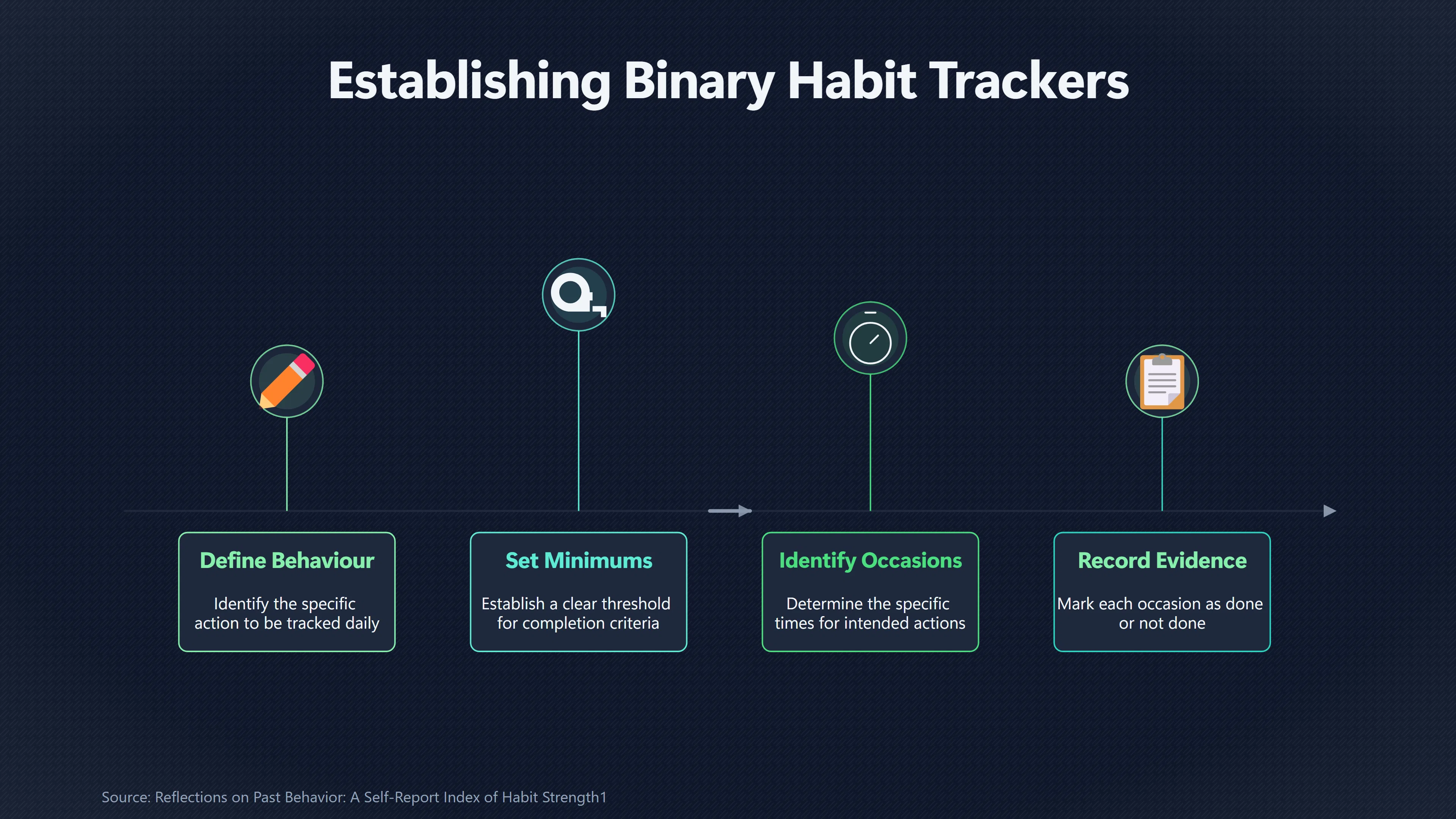
Binary tracking works best when the intended behaviour has a clear definition and a clear opportunity. “Read for ten minutes before bed” can become a yes/no question. “Be more intellectual” cannot. The tracker therefore needs a behavioural threshold established in advance: what counts as done, and on which occasions is it supposed to happen?
That produces a particularly legible measure of adherence. If the plan called for four sessions this week and three happened, the record says 3/4. If the behaviour was planned every weekday and the ticks repeatedly disappear on Fridays, the pattern is visible without reconstructing the week from memory. This is the distinctive value of a binary record: it preserves the occurrence pattern while discarding details that may not be needed.
There is good reason to treat recording as more than clerical work. Harkin and colleagues’ meta-analysis covered 138 experimental studies and 19,951 participants. Interventions designed to increase monitoring increased goal attainment overall, and effects were larger when monitoring information was physically recorded. The review concerns progress monitoring broadly rather than tick-box habit trackers specifically, so it cannot establish that binary tracking is the optimal format. It does support the underlying policy of turning progress into an external record instead of relying entirely on recollection.[PubMed]pubmed.ncbi.nlm.nih.govDoes monitoring goal progress promote goal attainment? A meta-analysis of the experimental evidence - PubMedFebruary 1, 2016…
Habit research provides a more concrete example. In Phillippa Lally and colleagues’ well-known 12-week field study, 96 volunteers selected an eating, drinking or activity behaviour to repeat daily in a consistent context and recorded whether they had performed it. Repetition was associated with increasing automaticity, although the rate varied greatly between individuals. Crucially, missing one opportunity did not materially derail the habit-formation process. That finding is useful when reading a tick-box record: an empty square is information about one missed repetition, not evidence that the entire effort has failed.[Wiley Online Library]onlinelibrary.wiley.comWiley Online LibraryHow are habits formed: Modelling habit formation in the real world - Lally - 2010 - European Journal of Social Psycho…
Later habit studies have continued to use binary behaviour measures. A longitudinal field study published in Frontiers in Psychology, for example, asked participants each day whether they had performed their chosen behaviour and whether they had done so in their chosen context. A 2023 study of fruit-consumption habits similarly used yes/no diary entries to record whether participants ate fruit after a designated meal. These designs illustrate exactly what binary measurement can preserve: whether the behaviour occurred and, when relevant, whether it occurred in the intended cueing context.[Frontiers]frontiersin.orgFrontiersFrontiers | How to Form Good Habits? A Longitudinal Field Study on the Role of Self-Control in Habit FormationMarch 27, 2020…
For ordinary self-improvement, that suggests a compact rule: track the smallest unit that corresponds to the commitment. “Floss after brushing at night” needs one daily box. “Strength train three times each week” needs a record of the three intended sessions. “Study Spanish for 20 minutes after breakfast” can be recorded as done only when the predefined minimum is reached. The simplicity comes from deciding what counts beforehand, not from making the standard vague.
When extra metrics add little value
Tracking systems easily accumulate fields: duration, intensity, quality, difficulty, mood, location, streak length, notes and numerical scores. Each can be useful for a particular question. But collecting information merely because it might become interesting later changes the tracker from an adherence record into a data-collection project.
For a stable recurring behaviour, extra metrics add little when they would not change the next decision. Imagine a person whose immediate objective is simply to establish three weekly gym visits. If a 25-minute session and a 50-minute session both satisfy the current commitment, exact duration may be secondary. The first useful question is whether the planned visits are actually happening. Once that becomes reliable, training volume or progression may deserve separate measurement.
This “minimum sufficient record” approach has indirect empirical support, although the evidence should not be overstated. In a small randomised pilot involving 72 adults, researchers compared standard calorie logging with a simplified system that monitored high-calorie foods. After six months, the groups did not differ significantly in dietary tracking days, dietary intake or weight loss; 43.2% of the standard-monitoring group and 42.9% of the simplified group achieved at least 5% weight loss. The intervention was about weight management rather than habit tick boxes, but it demonstrates an important principle: more detailed recording does not automatically produce a better outcome, and lower-information monitoring can sometimes remain useful.[PubMed Central (PMC)]pmc.ncbi.nlm.nih.govPubMed Central (PMC)A pilot randomized trial of simplified versus standard calorie dietary self-monitoring in a mobile weight loss interv…
The broader evidence is appropriately cautious. A meta-review covering 30 previous meta-analyses and 409,185 participants found inconsistent evidence about individual self-regulation techniques, including self-monitoring, across diet, physical activity and weight interventions. The authors also stressed methodological problems with trying to isolate individual techniques from complex, multi-component interventions. Binary tracking should therefore be treated as a practical implementation choice, not as a scientifically proven shortcut that guarantees behaviour change.[PubMed]pubmed.ncbi.nlm.nih.govOpen source on nih.gov.
Nor is it safe to assume that every additional question necessarily destroys adherence. Reviews of ecological momentary assessment — repeated questionnaires completed during daily life — find high average compliance despite substantial variation in assessment schedules. One meta-analysis of 477 articles reported average compliance of about 79%, while another systematic review found insufficient consistent evidence to identify a simple relationship between overall assessment burden and compliance. The case for a tick box is therefore primarily one of information economy: do not collect variables that have no present use, rather than assuming that every extra tap is demonstrably harmful.[PubMed]pubmed.ncbi.nlm.nih.govOpen source on nih.gov.
Make “done” unambiguous
The chief weakness of binary tracking is also obvious: two states cannot preserve distinctions that matter. A tick can make a two-minute token effort look identical to a substantial session unless the rule defining completion prevents that problem.
A useful binary tracker therefore needs three things settled before the week begins:
- The behaviour: what action is being tracked — for example, “practise vocabulary”.
- The minimum: what qualifies as completion — for example, “complete the planned 15-minute session”.
- The occasion: when it is expected — for example, “after breakfast on weekdays”.
That formulation makes the record interpretable. A blank square means the specified action did not happen on that intended occasion; a tick means it met the agreed threshold. It avoids negotiating retrospectively with the tracker — counting a vaguely related action because the day is ending and an unbroken run of ticks looks appealing.
Context can matter particularly during habit formation. Habit theory treats repeated performance in a consistent context as important because environmental or situational cues can become associated with the response. Lally and Gardner’s review describes habits as automatic behavioural responses to cues that develop through repetition in consistent contexts. A binary tracker can accommodate that without becoming complicated: instead of recording “meditated today”, the criterion can be “meditated after morning coffee”.[Taylor & Francis Online]tandfonline.comOpen source on tandfonline.com.
There is also no strong scientific reason to make an uninterrupted streak the primary score. Lally’s field study found that a single missed opportunity did not materially affect the habit-formation process. A tracker that turns one blank square into “back to zero” can therefore impose a psychological interpretation that the underlying repetition evidence does not require. Counting completed opportunities over a meaningful period — 16 of 20 planned occasions, for example — preserves more information than treating 15 consecutive successes followed by one miss as zero progress.[Wiley Online Library]onlinelibrary.wiley.comWiley Online LibraryHow are habits formed: Modelling habit formation in the real world - Lally - 2010 - European Journal of Social Psycho…
When a richer record is justified
A tick box stops being sufficient when the next useful question cannot be answered from occurrence alone. The right response is not necessarily to abandon binary tracking; it may be to add the one variable that resolves the new uncertainty.
Suppose someone reliably completes every scheduled run but wants to improve endurance. “Ran: yes” no longer distinguishes 2 km from 10 km, so distance or duration becomes decision-relevant. If a student consistently ticks “revision completed” but examination performance is stagnant, time spent, material covered or retrieval-test accuracy may reveal what the adherence record cannot. If sleep is the target, “went to bed on time” measures one behaviour but cannot establish sleep duration or quality.
The distinction is between measuring whether the process occurred and measuring its dose, quality or outcome. Those are different questions. Binary records are strongest for the first.
A richer record is particularly justified when:
- there is meaningful variation among completed sessions that affects the goal;
- safety, symptoms, dosage or other consequential details need accurate records;
- the behaviour occurs many times per day, making “done today” misleading;
- the aim is optimisation rather than basic consistency;
- repeated misses need diagnosis, so circumstances or barriers must be recorded;
- an outcome must be tracked separately from the behaviour intended to influence it.
Research on physical-activity interventions illustrates why this distinction matters. One trial analysis separately classified whether participants self-monitored and whether they actually met step- or activity-minute goals. Someone could therefore be monitoring faithfully without attaining the behavioural target. A simple tick is useful only when its meaning is clear: “I recorded my exercise”, “I exercised”, and “I met my exercise target” are three different binary variables.[PubMed]pubmed.ncbi.nlm.nih.govOpen source on nih.gov.
Similarly, a recent systematic review of feedback within diet, physical-activity and weight self-monitoring interventions found evidence that feedback could improve physical-activity outcomes, although effects varied by outcome and intervention. Once a record is being used to generate tailored feedback or adjust a programme, richer measurements may become useful precisely because someone intends to act on the additional information.[DOI]doi.orgOpen source on doi.org.

The useful record is the one that settles the question
Binary tracking is not a stripped-down version of “proper” tracking. For a clearly defined recurring habit, it can be the measurement that fits the question exactly. If the commitment was to perform a specified action on specified occasions, a sequence of yes/no observations reveals adherence directly.
Its limits should remain equally clear. A tick cannot reveal how hard somebody worked, how well they performed, what caused a miss or whether the behaviour ultimately produced the desired outcome. Those questions require other measurements. The mistake is collecting those measurements automatically rather than because a decision requires them.
For basic recurring habits, the practical policy is therefore economical: define the behaviour precisely, mark each intended occasion as done or not done, and review the resulting pattern rather than reconstructing it from memory. Add another metric only when the tick boxes leave an important, actionable question unanswered. That keeps the written record serving the behaviour, rather than allowing the work of maintaining the record to become a second habit project of its own.
Amazon book picks
Further Reading
Books and field guides related to When a Simple Tick Box Is Enough. Use these as the next step if you want deeper reading beyond the article.
Atomic Habits
Rating: 3.5/5 from 7 Google Books ratings
The #1 New York Times bestseller. Over 25 million copies sold! Translated into 60+ languages! Tiny Changes, Remarkable Results No matter...
Tiny Habits
Improving your life is much easier than you think. Whether it’s losing weight, sleeping more, or restoring your work/life balance – the s...
Mini Habits
Discover the Life-Changing Strategy of This Worldwide Bestseller in 17 Languages! Lasting Change For Early Quitters, Burnouts, The Unmoti...
eBay marketplace picks
Marketplace Samples
Example marketplace items related to this page. Use the search link to explore similar finds on eBay.
Selected fromphone lock box oneBay.co.uk.




Endnotes
1.
Source: onlinelibrary.wiley.com
Link:https://onlinelibrary.wiley.com/doi/10.1002/ejsp.674
Source snippet
Wiley Online LibraryHow are habits formed: Modelling habit formation in the real world - Lally - 2010 - European Journal of Social Psycho...
2.
Source: doi.org
Link:https://doi.org/10.1111/bjhp.12637
Source snippet
Habit formation in context: Context‐specific and context‐free measures for tracking fruit consumption habit formation and behaviour...
3.
Source: onlinelibrary.wiley.com
Link:https://onlinelibrary.wiley.com/doi/abs/10.1002/ejsp.674?MixPanelId=15e3fe314440-0468d8411-64220f54-100000-15e3fe314460
Source snippet
Wiley Online LibraryHow are habits formed: Modelling habit formation in the real world - Lally - 2010 - European Journal of Social Psycho...
4.
Source: doi.org
Link:https://doi.org/10.1186/s12966-023-01555-6
5.
Source: onlinelibrary.wiley.com
Link:https://onlinelibrary.wiley.com/doi/full/10.1002/oby.24234
6.
Source: onlinelibrary.wiley.com
Link:https://onlinelibrary.wiley.com/doi/full/10.1002/oby.23377
7.
Source: doi.org
Link:https://doi.org/10.1111/obr.13306
8.
Source: onlinelibrary.wiley.com
Link:https://onlinelibrary.wiley.com/doi/full/10.1111/obr.13306
9.
Source: onlinelibrary.wiley.com
Link:https://onlinelibrary.wiley.com/doi/10.1111/obr.13306
10.
Source: onlinelibrary.wiley.com
Link:https://onlinelibrary.wiley.com/doi/10.1038/oby.2010.208
11.
Source: doi.org
Link:https://doi.org/10.1080/17437199.2011.603640%C2%A0
12.
Source: onlinelibrary.wiley.com
Link:https://onlinelibrary.wiley.com/doi/abs/10.1002/ejsp.674
13.
Source: onlinelibrary.wiley.com
Link:https://onlinelibrary.wiley.com/doi/abs/10.1002/ejsp.674?source=content_type%3Areact%7Cfirst_level_url%3Aarticle%7Csection%3Amain_content%7Cbutton%3Abody_link
14.
Source: onlinelibrary.wiley.com
Link:https://onlinelibrary.wiley.com/doi/abs/10.1002/ejsp.674?msockid=038ed114f43667dd0790c4bef5146634
15.
Source: onlinelibrary.wiley.com
Link:https://onlinelibrary.wiley.com/doi/abs/10.1002/ejsp.674?cf_chl_jschl_tk=pmd_EwcJDaCFBR9OVEL1O_0qjioww0Gc86ZzpBvCBFhrDcE-1635261061-0-gqNtZGzNAjujcnBszQi9
16.
Source: doi.org
Title: Reflections on Past Behavior: A Self‐Report Index of Habit Strength1
Link:https://doi.org/10.1111%2Fj.1559-1816.2003.tb01951.x
17.
Source: onlinelibrary.wiley.com
Title: j.1559 1816.2003.tb01951.x
Link:https://onlinelibrary.wiley.com/doi/abs/10.1111/j.1559-1816.2003.tb01951.x
18.
Source: pubmed.ncbi.nlm.nih.gov
Link:https://pubmed.ncbi.nlm.nih.gov/26479070/
Source snippet
Does monitoring goal progress promote goal attainment? A meta-analysis of the experimental evidence - PubMedFebruary 1, 2016...
Published: February 1, 2016
19.
Source: pmc.ncbi.nlm.nih.gov
Link:https://pmc.ncbi.nlm.nih.gov/articles/PMC7429262/
Source snippet
PubMed Central (PMC)Self-regulatory behavior change techniques in interventions to promote healthy eating, physical activity, or weight l...
20.
Source: frontiersin.org
Link:https://www.frontiersin.org/journals/psychology/articles/10.3389/fpsyg.2020.00560/full
Source snippet
FrontiersFrontiers | How to Form Good Habits? A Longitudinal Field Study on the Role of [Self-Control]({{ 'self-control/' | relative_url }}) in Habit FormationMarch 27, 2020...
Published: March 27, 2020
21.
Source: pmc.ncbi.nlm.nih.gov
Link:https://pmc.ncbi.nlm.nih.gov/articles/PMC9469733/
Source snippet
PubMed Central (PMC)A pilot randomized trial of simplified versus standard calorie dietary self-monitoring in a mobile weight loss interv...
22.
Source: pubmed.ncbi.nlm.nih.gov
Link:https://pubmed.ncbi.nlm.nih.gov/35146942/
Source snippet
A pilot randomized trial of simplified versus standard calorie dietary self-monitoring in a mobile weight loss intervention - PubMed...
23.
Source: pubmed.ncbi.nlm.nih.gov
Link:https://pubmed.ncbi.nlm.nih.gov/31973666/
24.
Source: pubmed.ncbi.nlm.nih.gov
Link:https://pubmed.ncbi.nlm.nih.gov/33656451/
25.
Source: pmc.ncbi.nlm.nih.gov
Link:https://pmc.ncbi.nlm.nih.gov/articles/PMC9999286/
26.
Source: tandfonline.com
Link:https://www.tandfonline.com/doi/full/10.1080/17437199.2011.603640
27.
Source: pubmed.ncbi.nlm.nih.gov
Link:https://pubmed.ncbi.nlm.nih.gov/35089159/
28.
Source: pubmed.ncbi.nlm.nih.gov
Link:https://pubmed.ncbi.nlm.nih.gov/38178230/
29.
Source: pubmed.ncbi.nlm.nih.gov
Link:https://pubmed.ncbi.nlm.nih.gov/42425416/
30.
Source: pubmed.ncbi.nlm.nih.gov
Link:https://pubmed.ncbi.nlm.nih.gov/42326773/
31.
Source: pmc.ncbi.nlm.nih.gov
Link:https://pmc.ncbi.nlm.nih.gov/articles/PMC13070897/
32.
Source: pmc.ncbi.nlm.nih.gov
Link:https://pmc.ncbi.nlm.nih.gov/articles/PMC11876489/
33.
Source: pmc.ncbi.nlm.nih.gov
Link:https://pmc.ncbi.nlm.nih.gov/articles/PMC11897847/
34.
Source: pubmed.ncbi.nlm.nih.gov
Link:https://pubmed.ncbi.nlm.nih.gov/39933165/
35.
Source: pmc.ncbi.nlm.nih.gov
Link:https://pmc.ncbi.nlm.nih.gov/articles/PMC11862778/
36.
Source: frontiersin.org
Link:https://www.frontiersin.org/journals/digital-health/articles/10.3389/fdgth.2025.1467772/full
37.
Source: pmc.ncbi.nlm.nih.gov
Link:https://pmc.ncbi.nlm.nih.gov/articles/PMC11635918/
38.
Source: pmc.ncbi.nlm.nih.gov
Link:https://pmc.ncbi.nlm.nih.gov/articles/PMC11883899/
39.
Source: pmc.ncbi.nlm.nih.gov
Link:https://pmc.ncbi.nlm.nih.gov/articles/PMC10765525/
40.
Source: pmc.ncbi.nlm.nih.gov
Link:https://pmc.ncbi.nlm.nih.gov/articles/PMC10683993/
41.
Source: pubmed.ncbi.nlm.nih.gov
Link:https://pubmed.ncbi.nlm.nih.gov/38053827/
42.
Source: pmc.ncbi.nlm.nih.gov
Link:https://pmc.ncbi.nlm.nih.gov/articles/PMC10436173/
43.
Source: pmc.ncbi.nlm.nih.gov
Link:https://pmc.ncbi.nlm.nih.gov/articles/PMC10394603/
44.
Source: pubmed.ncbi.nlm.nih.gov
Link:https://pubmed.ncbi.nlm.nih.gov/37463017/
45.
Source: pubmed.ncbi.nlm.nih.gov
Link:https://pubmed.ncbi.nlm.nih.gov/37195477/
46.
Source: pubmed.ncbi.nlm.nih.gov
Link:https://pubmed.ncbi.nlm.nih.gov/36512404/
47.
Source: pmc.ncbi.nlm.nih.gov
Link:https://pmc.ncbi.nlm.nih.gov/articles/PMC9795401/
48.
Source: pubmed.ncbi.nlm.nih.gov
Link:https://pubmed.ncbi.nlm.nih.gov/35179513/
49.
Source: pmc.ncbi.nlm.nih.gov
Link:https://pmc.ncbi.nlm.nih.gov/articles/PMC8900900/
50.
Source: pmc.ncbi.nlm.nih.gov
Link:https://pmc.ncbi.nlm.nih.gov/articles/PMC9358747/
51.
Source: pmc.ncbi.nlm.nih.gov
Link:https://pmc.ncbi.nlm.nih.gov/articles/PMC9159560/
52.
Source: pmc.ncbi.nlm.nih.gov
Link:https://pmc.ncbi.nlm.nih.gov/articles/PMC8928602/
53.
Source: pmc.ncbi.nlm.nih.gov
Link:https://pmc.ncbi.nlm.nih.gov/articles/PMC8391728/
54.
Source: pubmed.ncbi.nlm.nih.gov
Link:https://pubmed.ncbi.nlm.nih.gov/34192411/
55.
Source: pubmed.ncbi.nlm.nih.gov
Link:https://pubmed.ncbi.nlm.nih.gov/34192411/?dopt=Abstract
56.
Source: pmc.ncbi.nlm.nih.gov
Link:https://pmc.ncbi.nlm.nih.gov/articles/PMC7970161/
57.
Source: pmc.ncbi.nlm.nih.gov
Link:https://pmc.ncbi.nlm.nih.gov/articles/PMC7556417/
58.
Source: pmc.ncbi.nlm.nih.gov
Link:https://pmc.ncbi.nlm.nih.gov/articles/PMC7269678/
59.
Source: pmc.ncbi.nlm.nih.gov
Link:https://pmc.ncbi.nlm.nih.gov/articles/PMC7571594/
60.
Source: frontiersin.org
Link:https://www.frontiersin.org/journals/psychology/articles/10.3389/fpsyg.2020.00167/full
61.
Source: pmc.ncbi.nlm.nih.gov
Link:https://pmc.ncbi.nlm.nih.gov/articles/PMC7156825/
62.
Source: tandfonline.com
Link:https://www.tandfonline.com/doi/full/10.1080/13854046.2019.1672792
63.
Source: pubmed.ncbi.nlm.nih.gov
Link:https://pubmed.ncbi.nlm.nih.gov/31155473/
64.
Source: pmc.ncbi.nlm.nih.gov
Link:https://pmc.ncbi.nlm.nih.gov/articles/PMC6856872/
65.
Source: pmc.ncbi.nlm.nih.gov
Link:https://pmc.ncbi.nlm.nih.gov/articles/PMC6393778/
66.
Source: pubmed.ncbi.nlm.nih.gov
Link:https://pubmed.ncbi.nlm.nih.gov/30235221/
67.
Source: pmc.ncbi.nlm.nih.gov
Link:https://pmc.ncbi.nlm.nih.gov/articles/PMC5942415/
68.
Source: pmc.ncbi.nlm.nih.gov
Link:https://pmc.ncbi.nlm.nih.gov/articles/PMC5977566/
69.
Source: pmc.ncbi.nlm.nih.gov
Link:https://pmc.ncbi.nlm.nih.gov/articles/PMC5583960/
70.
Source: pmc.ncbi.nlm.nih.gov
Link:https://pmc.ncbi.nlm.nih.gov/articles/PMC5618052/
71.
Source: pmc.ncbi.nlm.nih.gov
Link:https://pmc.ncbi.nlm.nih.gov/articles/PMC5057493/
72.
Source: pubmed.ncbi.nlm.nih.gov
Link:https://pubmed.ncbi.nlm.nih.gov/27367614/
73.
Source: pubmed.ncbi.nlm.nih.gov
Link:https://pubmed.ncbi.nlm.nih.gov/27307134/
74.
Source: pubmed.ncbi.nlm.nih.gov
Link:https://pubmed.ncbi.nlm.nih.gov/25262244/
75.
Source: pubmed.ncbi.nlm.nih.gov
Link:https://pubmed.ncbi.nlm.nih.gov/24735567/
76.
Source: pmc.ncbi.nlm.nih.gov
Link:https://pmc.ncbi.nlm.nih.gov/articles/PMC4566897/
77.
Source: pmc.ncbi.nlm.nih.gov
Link:https://pmc.ncbi.nlm.nih.gov/articles/PMC3538103/
78.
Source: pubmed.ncbi.nlm.nih.gov
Link:https://pubmed.ncbi.nlm.nih.gov/23587561/
79.
Source: pmc.ncbi.nlm.nih.gov
Link:https://pmc.ncbi.nlm.nih.gov/articles/PMC3728167/
80.
Source: pmc.ncbi.nlm.nih.gov
Link:https://pmc.ncbi.nlm.nih.gov/articles/PMC3505409/
81.
Source: pmc.ncbi.nlm.nih.gov
Link:https://pmc.ncbi.nlm.nih.gov/articles/PMC3563396/
82.
Source: tandfonline.com
Link:https://www.tandfonline.com/doi/abs/10.1080/17437199.2011.603640
83.
Source: pubmed.ncbi.nlm.nih.gov
Link:https://pubmed.ncbi.nlm.nih.gov/21749245/
84.
Source: pmc.ncbi.nlm.nih.gov
Link:https://pmc.ncbi.nlm.nih.gov/articles/PMC3268702/
85.
Source: pmc.ncbi.nlm.nih.gov
Link:https://pmc.ncbi.nlm.nih.gov/articles/PMC2860431/
86.
Source: pmc.ncbi.nlm.nih.gov
Link:https://pmc.ncbi.nlm.nih.gov/articles/PMC2435095/
87.
Source: pubmed.ncbi.nlm.nih.gov
Link:https://pubmed.ncbi.nlm.nih.gov/39962997/
88.
Source: pubmed.ncbi.nlm.nih.gov
Link:https://pubmed.ncbi.nlm.nih.gov/31662031/
89.
Source: pubmed.ncbi.nlm.nih.gov
Link:https://pubmed.ncbi.nlm.nih.gov/12921007/
90.
Source: pmc.ncbi.nlm.nih.gov
Link:https://pmc.ncbi.nlm.nih.gov/articles/PMC5487285/
91.
Source: pubmed.ncbi.nlm.nih.gov
Link:https://pubmed.ncbi.nlm.nih.gov/35016567/
92.
Source: pubmed.ncbi.nlm.nih.gov
Link:https://pubmed.ncbi.nlm.nih.gov/20847736/
93.
Source: pubmed.ncbi.nlm.nih.gov
Link:https://pubmed.ncbi.nlm.nih.gov/17904942/
94.
Source: pubmed.ncbi.nlm.nih.gov
Link:https://pubmed.ncbi.nlm.nih.gov/18689560/
95.
Source: pubmed.ncbi.nlm.nih.gov
Link:https://pubmed.ncbi.nlm.nih.gov/21397775/
96.
Source: pubmed.ncbi.nlm.nih.gov
Link:https://pubmed.ncbi.nlm.nih.gov/20363904/
97.
Source: pubmed.ncbi.nlm.nih.gov
Link:https://pubmed.ncbi.nlm.nih.gov/18643004/
98.
Source: pubmed.ncbi.nlm.nih.gov
Link:https://pubmed.ncbi.nlm.nih.gov/15576253/
99.
Source: pubmed.ncbi.nlm.nih.gov
Link:https://pubmed.ncbi.nlm.nih.gov/36862471/
100.
Source: pubmed.ncbi.nlm.nih.gov
Link:https://pubmed.ncbi.nlm.nih.gov/25331266/
Additional References
101.
Source: eprints.whiterose.ac.uk
Link:https://eprints.whiterose.ac.uk/id/eprint/91437/
Source snippet
White Rose Research OnlineDoes Monitoring Goal Progress Promote Goal Attainment? A Meta-Analysis of the Experimental Evidence - White Ros...
102.
Source: youtube.com
Link:https://www.youtube.com/watch?v=NIkRHWvSjAs
Source snippet
The Problem with Habit Trackers (And What to Do Instead)...
103.
Source: researchgate.net
Link:https://www.researchgate.net/publication/291335719_Does_Monitoring_Goal_Progress_Promote_Goal_Attainment_A_Meta-Analysis_of_the_Experimental_Evidence
104.
Source: researchgate.net
Link:https://www.researchgate.net/publication/400354503_Testing_the_Integration_of_Habit_Science_and_Learning_Theory_to_Promote_Behavior_Change_A_Habit-Based_Sleep_Health_Intervention_HABITs_for_Young_Adults_with_an_Evening_Circadian_Tendency?_tp=eyJjb250ZXh0Ijp7InBhZ2UiOiJzY2llbnRpZmljQ29udHJpYnV0aW9ucyIsInByZXZpb3VzUGFnZSI6bnVsbCwic3ViUGFnZSI6bnVsbH19
105.
Source: sciencedirect.com
Link:https://www.sciencedirect.com/org/science/article/pii/S2291522218001456
106.
Source: sciencedirect.com
Link:https://www.sciencedirect.com/science/article/pii/S2451865419300092
107.
Source: sciencedirect.com
Link:https://www.sciencedirect.com/science/article/abs/pii/S0002822307014800
108.
Source: sciencedirect.com
Link:https://www.sciencedirect.com/science/article/pii/S019188691730274X
109.
Source: medrxiv.org
Link:https://www.medrxiv.org/content/10.64898/2026.06.08.26355180v1.full
110.
Source: sciencedirect.com
Link:https://www.sciencedirect.com/science/article/pii/S2212267219302655